

The DOI matches its Crossref record; 124 of the 124 references it cites were found in a registry or an index.
Integrase-associated niche differentiation of endogenous large DNA viruses in crustaceans
Open accessPublished version of a preprint
Abstract
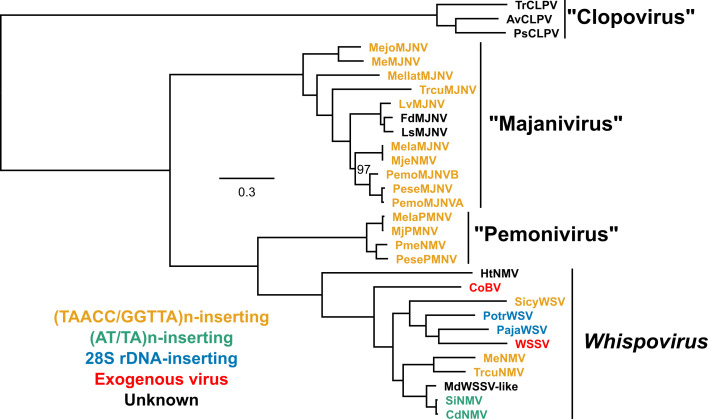
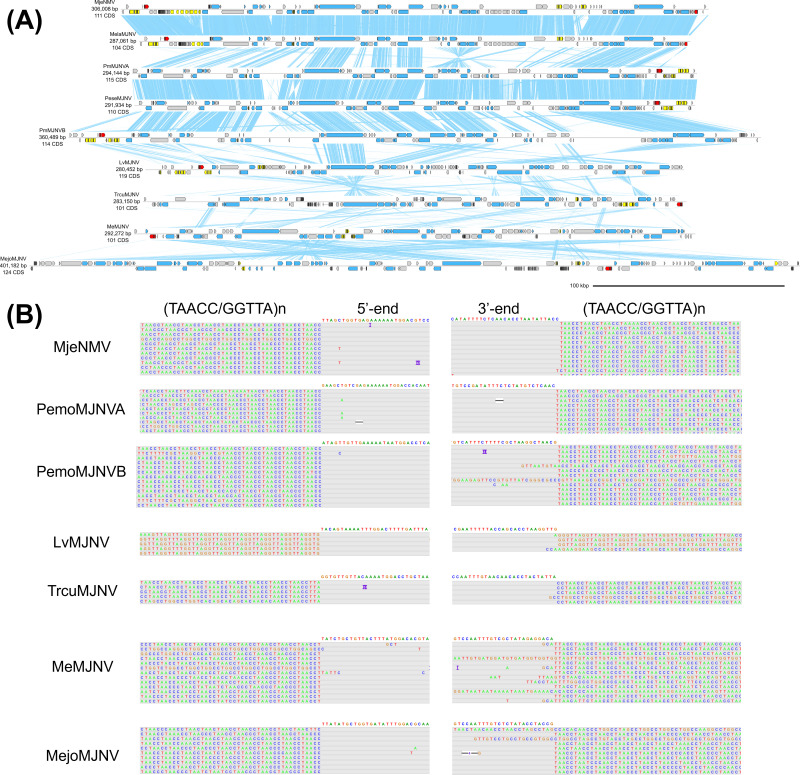
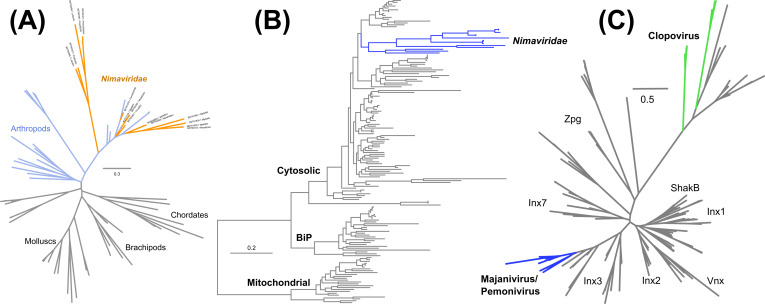
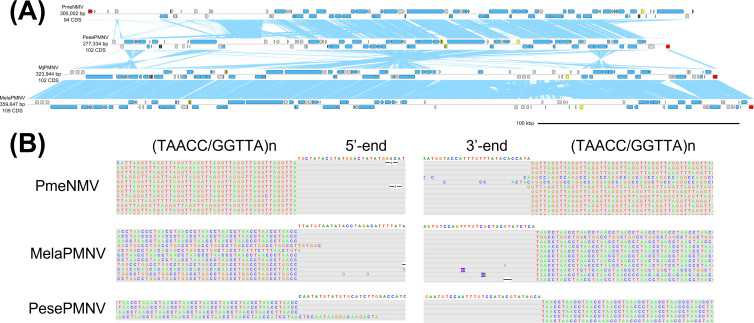
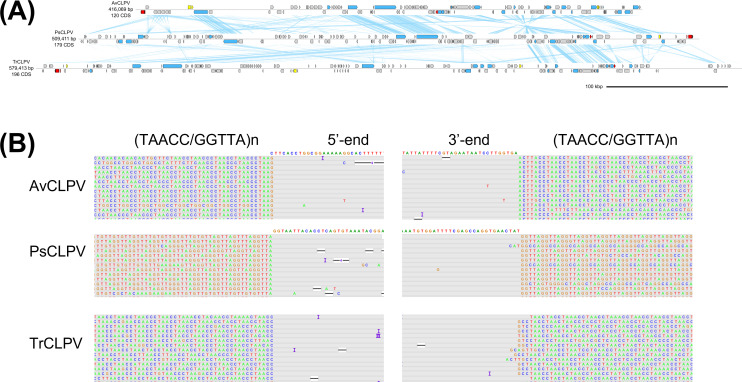
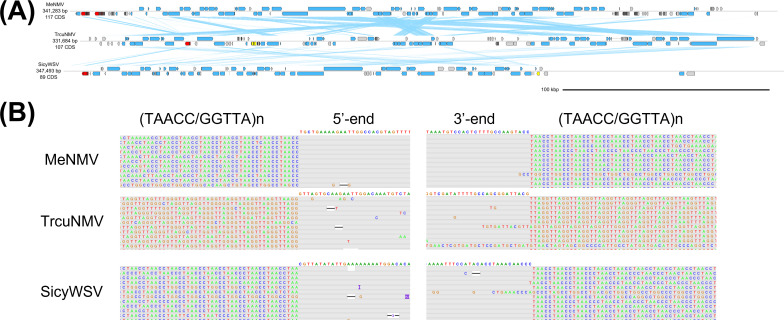
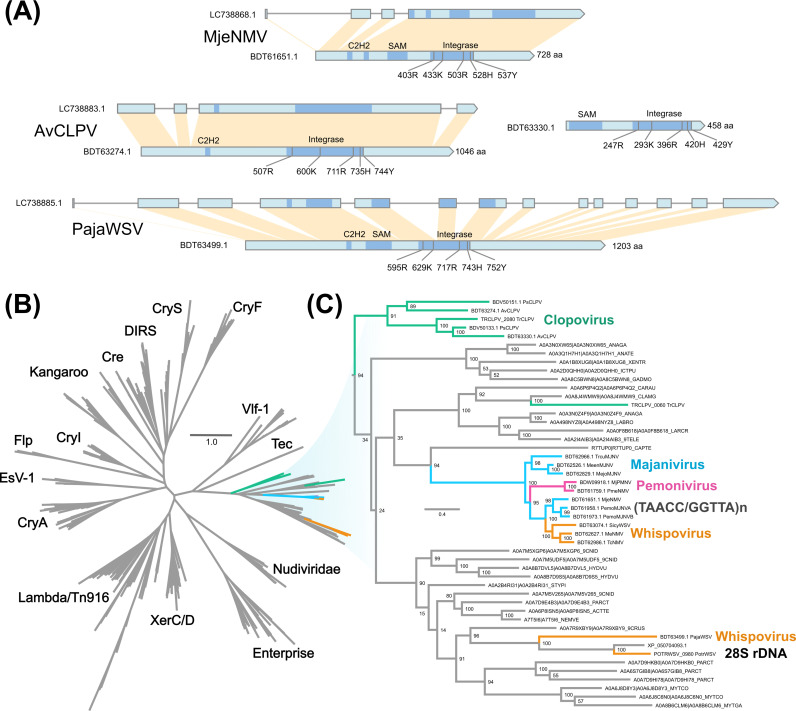
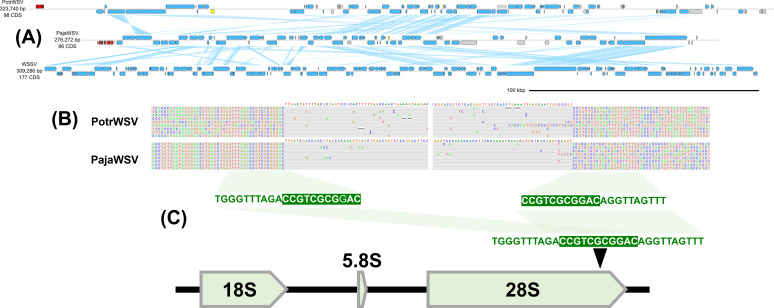
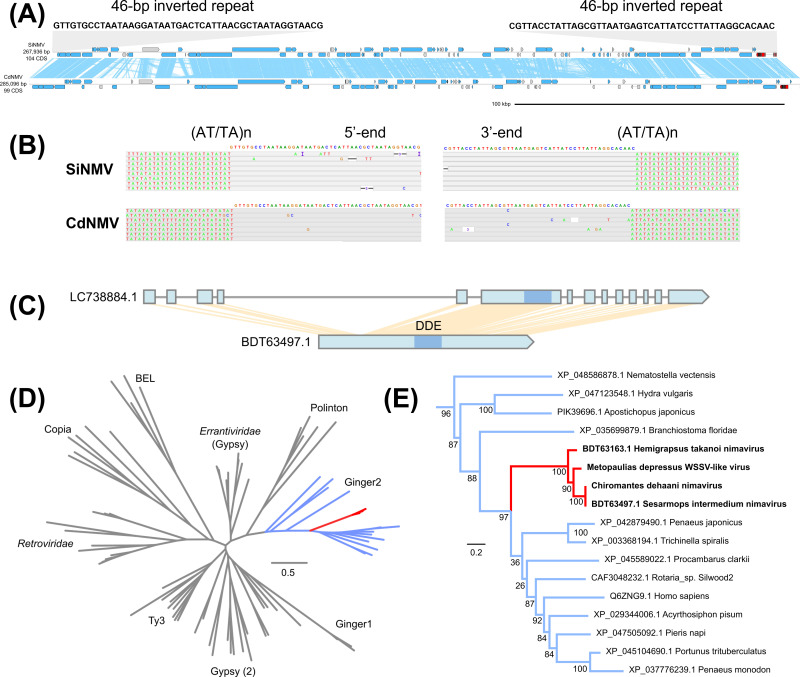
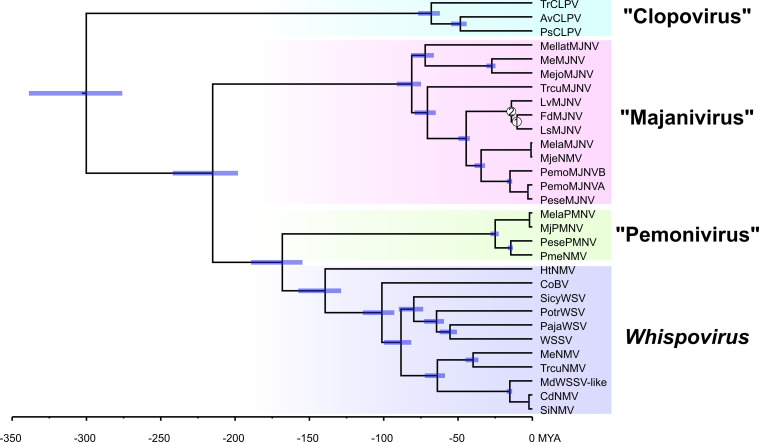
Crustacean genomes harbor sequences originating from nimaviruses, a family of large double-stranded DNA viruses infecting crustaceans. In this study, we recovered metagenome-assembled genomes of 27 endogenous nimaviruses from crustacean genome data. Phylogenetic analysis revealed four major lineages within Nimaviridae , and for three of these lineages, we propose novel genera of endogenous nimaviruses: “Majanivirus” and “Pemonivirus” identified from penaeid shrimp genomes, and “Clopovirus” identified from terrestrial isopods. Majanivirus genomes contain multiple eukaryotic-like genes such as baculoviral inhibitor of apoptosis repeat-containing genes, innexins, and heat shock protein 70-like genes, some of which contain introns. An alignment of long reads revealed that each endogenous nimavirus species specifically inserts into host microsatellites or within 28S rDNA. This insertion preference was associated with the type of virus-encoded DNA recombination enzymes, the integrases. Majaniviruses, pemoniviruses, some whispoviruses, and possibly clopoviruses specifically insert into the arthropod telomere repeat motif (TAACC/GGTTA)n and all possessed a specific tyrosine recombinase family. Pasiphaea japonica whispovirus and Portunus trituberculatus whispovirus, the closest relatives of white spot syndrome virus, integrate into the host 28S rDNA and are equipped with members of another family of tyrosine recombinases that are distantly related to telomere-specific tyrosine recombinases. Endogenous nimavirus genomes identified from sesarmid crabs, which lack tyrosine recombinases and are flanked by a 46-bp inverted terminal repeat, integrate into (AT/TA)n microsatellites through the acquisition of a Ginger2-like cut-and-paste DDE transposase. These results suggest that endogenous nimaviruses are giant transposable elements that occupy different sequence niches through the acquisition of different integrase families. IMPORTANCE: Crustacean genomes harbor sequences originating from a family of large DNA viruses called nimaviruses, but it is unclear why they are present. We show that endogenous nimaviruses selectively insert into repetitive sequences within the host genome, and this insertion specificity was correlated with different types of integrases, which are DNA recombination enzymes encoded by the nimaviruses themselves. This suggests that endogenous nimaviruses have colonized various genomic niches through the acquisition of integrases with different insertion specificities. Our results point to a novel survival strategy of endogenous large DNA viruses colonizing the host genomes. These findings may clarify the evolution and spread of nimaviruses in crustaceans and lead to measures to control and prevent the spread of pathogenic nimaviruses in aquaculture settings.
Overview
The claims and statistics of this paper haven’t been checked yet.
Run the check — free, no account needed. It reads the open-access text and checks the sources it cites.
Integrity signals
Registry
Cites
Statistics
Figures
Verification
Claims the paper makes
The claims and statistics of this paper haven’t been checked yet.
Run the check — free, no account needed. It reads the open-access text and checks the sources it cites.
Self-check
Percentages, sums and reported differences re-computed from the paper’s own numbers.
The self-check needs the paper’s full text.
Citations
Cites
The Sequence Alignment/Map format and SAMtools
Li, H., Handsaker, B., Wysoker, A., Fennell, T., Ruan, J., Homer, N., Marth, G., Abecasis, G., Durbin, R., & 1000 Genome Project Data Processing Subgroup (2009) · Bioinformatics · doi:10.1093/bioinformatics/btp352 · Cited by 62,041
Highly accurate protein structure prediction with AlphaFold
Jumper, J., Evans, R., Pritzel, A., Green, T., Figurnov, M., Ronneberger, O., Tunyasuvunakool, K., Bates, R., Žídek, A., Potapenko, A., et al. (2021) · Nature · doi:10.1038/s41586-021-03819-2 · Cited by 43,764
fastp: an ultra-fast all-in-one FASTQ preprocessor
Chen, S., Zhou, Y., Chen, Y., & Gu, J. (2018) · Bioinformatics · doi:10.1093/bioinformatics/bty560 · Cited by 29,721
BEDTools: a flexible suite of utilities for comparing genomic features
Quinlan, A. R., & Hall, I. M. (2010) · Bioinformatics · doi:10.1093/bioinformatics/btq033 · Cited by 27,437
IQ-TREE 2: New Models and Efficient Methods for Phylogenetic Inference in the Genomic Era
Minh, B. Q., Schmidt, H. A., Chernomor, O., Schrempf, D., Woodhams, M. D., von Haeseler, A., & Lanfear, R. (2020) · Molecular Biology and Evolution · doi:10.1093/molbev/msaa015 · Cited by 16,873
Robinson, J. T., Thorvaldsdóttir, H., Winckler, W., Guttman, M., Lander, E. S., Getz, G., & Mesirov, J. P. (2011) · Nature Biotechnology · doi:10.1038/nbt.1754 · Cited by 15,390
Graph-based genome alignment and genotyping with HISAT2 and HISAT-genotype
Kim, D., Paggi, J. M., Park, C., Bennett, C., & Salzberg, S. L. (2019) · Nature Biotechnology · doi:10.1038/s41587-019-0201-4 · Cited by 15,022
Minimap2: Pairwise alignment for nucleotide sequences
Li, H. (2018) · Bioinformatics · doi:10.1093/bioinformatics/bty191 · Cited by 14,807
trimAl: a tool for automated alignment trimming in large-scale phylogenetic analyses
Capella-Gutiérrez, S., Silla-Martínez, J. M., & Gabaldón, T. (2009) · Bioinformatics · doi:10.1093/bioinformatics/btp348 · Cited by 12,751
Prodigal: prokaryotic gene recognition and translation initiation site identification
Hyatt, D., Chen, G.-L., LoCascio, P. F., Land, M. L., Larimer, F. W., & Hauser, L. J. (2010) · BMC Bioinformatics · doi:10.1186/1471-2105-11-119 · Cited by 12,587
Research works printed but not linked: 1
- 10.1038/s41592-022-01488-1 · DOI · Paper page
Metadata
- Authors
- Kawato, S., Nozaki, R., Kondo, H., & Hirono, I.
- Affiliations
- Tokyo University of Marine Science and Technology (JP)
- Laboratory of Genome Science, Tokyo University of Marine Science and Technology , Tokyo, Japan
- Venue
- Microbiology Spectrum
- Publisher
- American Society for Microbiology
- Published
- 2024-01-11
- Volume
- 12
- Issue
- 1
- Pages
- e0055923-e0055923
- ISSN
- 2165-0497 (ISSN-L)
- PMC
- PMC10871703
- OpenAlex
- W4389488615
- Cited by
- 9
- References
- 124
- Citations by year
- 2026: 3 · 2025: 3 · 2024: 3
- FWCI
- 0.98
- Type
- journal article
- Language
- en
- Open access
- gold
- doi.org
- Licence
- cc-by
- creativecommons.org/licenses/by/4.0/ (vor)
- journals.asm.org/non-commercial-tdm-license (tdm)
- Locations
- Microbiology Spectrum (publishedVersion, cc-by)
- bioRxiv (Cold Spring Harbor Laboratory) (acceptedVersion)
- PubMed Central (publishedVersion, cc-by)
- PubMed (publishedVersion)
- DOAJ (DOAJ: Directory of Open Access Journals) (submittedVersion, cc-by-sa)
- Funders
- MEXT | Japan Science and Technology Agency (JPMJSA1806)
- MEXT | Japan Society for the Promotion of Science (19J21518, JP22H00379)
- Topics
- Life Sciences › Immunology and Microbiology › Immunology › Aquaculture disease management and microbiota
- Life Sciences › Immunology and Microbiology › Virology › Bacteriophages and microbial interactions
- Life Sciences › Biochemistry, Genetics and Molecular Biology › Genetics › Chromosomal and Genetic Variations
- Keywords
- usage, crustacean viruses, integrase, tyrosine recombinases, metagenome-assembled genomes, white spot syndrome virus, transposable elements, host-virus coevolution, terrestrial isopods, swimming crab, inverted terminal repeats
- MeSH terms
- DNA Viruses, Repetitive Sequences, Nucleic Acid, Genome, Integrases
About these checks
Registry, retraction, Cites and statistics results are computed, not judged, with one exception: a printed reference that no index lists is read once by a model before it counts as a citation error. Claims are extracted by a model and kept only when their quote appears verbatim in the text; each cited source is then checked, with a model’s help, for whether it says what the claim relies on. Those verdicts can be wrong — read the claim’s quote and the cited source before relying on one.
Statistics and arithmetic are recomputed, not judged.
Confidence bands are shown only for fields calibrated on our annotated test set. None is calibrated yet, so no band is shown.
What counts as a claim ›How we measure confidence ›How we check this ›
Are you an author, or do you see a problem with this page? Request a review
How to cite
Cite CoChat for the checks on this page, and the paper for its own findings.
- This page
- CoChat. (2026). Citation check: Integrase-associated niche differentiation of endogenous large DNA viruses in crustaceans. https://app.cochat.ai/papers/10.1128/spectrum.00559-23
- The paper
- Kawato, S., Nozaki, R., Kondo, H., & Hirono, I. (2024). Integrase-associated niche differentiation of endogenous large DNA viruses in crustaceans. Microbiology Spectrum. https://doi.org/10.1128/spectrum.00559-23
Data sources
Bibliographic data: Semantic Scholar, OpenAlex, Crossref.
Contains information from the Semantic Scholar Academic Graph Datasets, made available under the ODC Attribution License (ODC-BY 1.0).
Semantic Scholar’s data is described in: Kinney, R., et al. (2023). The Semantic Scholar Open Data Platform. arXiv:2301.10140.
