

Risk factors for intellectual disability in children with spastic cerebral palsy
Open accessThe DOI matches its Crossref record; 37 of the 39 references it cites were found in a registry or an index.
Abstract
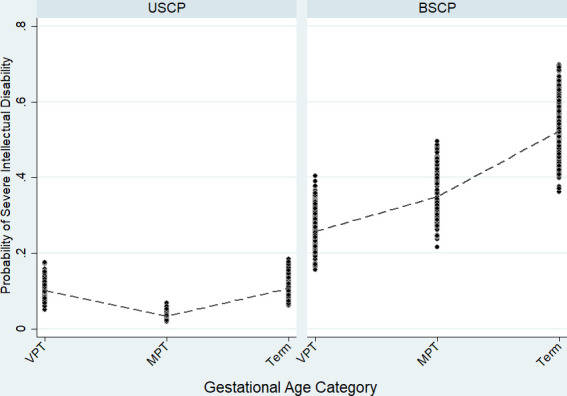
Background: Cerebral palsy (CP) is a non-progressive disorder of posture and movement caused by prenatal or perinatal lesions of the brain. Children with CP are also at increased risk of other disabilities, for example, intellectual disability. Previous studies suggest the risk of intellectual disability varies in complex ways according to the type of motor impairment and perinatal factors such as gestational age. Objective: To determine the patterns of risk of intellectual disability in children with spastic CP. Design: Cross-sectional, population-based study using the Northern Ireland Cerebral Palsy Register. Participants: Persons born in 1981–2008 with congenital bilateral or unilateral spastic CP (N=1452). Outcome measure: The outcome measure was severe intellectual disability (IQ <50), as reported by clinicians known to the child. Data pertaining to CP subtype, sex, gestational age, birth weight and functional level were included in analyses. Results: Severe intellectual disability was significantly more prevalent in children with bilateral spastic CP (BSCP) compared with children with unilateral spastic CP (χ² (2)=162.60, p<0.001). Compared with very preterm infants with BSCP, the risk of intellectual disability increased in moderately preterm (OR=3.97, 95% CI 1.04 to 15.23) and at-term (OR=2.51, 95% CI 1.16 to 5.44) children with BSCP. Conclusions: Children with BSCP are at increased risk of intellectual disability, with those born at term at the highest risk. The findings highlight the importance of early screening, particularly for children with BSCP born at term.
Overview
The claims and statistics of this paper haven’t been checked yet.
Free: it reads the open-access text and checks the first 5 claims that cite a source we can check. Create a free account to check every claim.
Integrity signals
Registry
Cites
Statistics
Figures
Verification
Claims the paper makes
The claims and statistics of this paper haven’t been checked yet.
Free: it reads the open-access text and checks the first 5 claims that cite a source we can check. Create a free account to check every claim.
Claims other papers make about this one
Each is checked against this paper’s own text: does it say what the citing paper says it does?
The source backs part of the claim, not all of it — or backs it for a different population, condition or comparison.
In the citing paper
“Cummins et al. [27] also pointed out potential underestimation issues related to assessment practices for severe ID.”
From The Mental Health of Children with Cerebral Palsy: A Review of the Last Five Years of Research (2025) · cites this paper as [27]
Experimental — accuracy not yet measuredThe source backs part of the claim, not all of it — or backs it for a different population, condition or comparison.
In the citing paper
“the research conclusions over the past five years suggest a high prevalence of ID in patients diagnosed with CP [13,16,17,18,19,20,21,27,28]”
From The Mental Health of Children with Cerebral Palsy: A Review of the Last Five Years of Research (2025) · cites this paper as [27]
Experimental — accuracy not yet measuredThe source backs part of the claim, not all of it — or backs it for a different population, condition or comparison.
In the citing paper
“Pahlman et al. [18] and Cummins et al. [27] suggested that ID is more strongly associated with severe GMFCS levels.”
From The Mental Health of Children with Cerebral Palsy: A Review of the Last Five Years of Research (2025) · cites this paper as [27]
Experimental — accuracy not yet measuredThe cited source says what the claim attributes to it.
In the citing paper
“The prevalence rate of ID reported in Cummins and colleagues [27] was 40.4% in their sample of individuals with spastic-type CP”
From The Mental Health of Children with Cerebral Palsy: A Review of the Last Five Years of Research (2025) · cites this paper as [27]
The cited source says what the claim attributes to it.
In the citing paper
“Perinatal factors were explored by Cummins et al. [27], who examined a sample of individuals with spastic CP and discovered that severe ID was more prevalent in infants born at term compared to preterm births.”
From The Mental Health of Children with Cerebral Palsy: A Review of the Last Five Years of Research (2025) · cites this paper as [27]
5 more claims about this paper
Create a free account to see every claim other papers make about this one.
Self-check
Percentages, sums and reported differences re-computed from the paper’s own numbers.
The self-check needs the paper’s full text.
Citations
Cites
Multiple Imputation for Nonresponse in Surveys
Rubin, D. B. (1987) · Wiley Series in Probability and Statistics · doi:10.1002/9780470316696 · Cited by 20,701
Sterne, J. A. C., White, I. R., Carlin, J. B., Spratt, M., Royston, P., Kenward, M. G., Wood, A. M., & Carpenter, J. R. (2009) · BMJ · doi:10.1136/bmj.b2393 · Cited by 7,299
Palisano, R., Rosenbaum, P., Walter, S., Russell, D., Wood, E., & Galuppi, B. (1997) · Developmental Medicine & Child Neurology · doi:10.1111/j.1469-8749.1997.tb07414.x · Cited by 6,721
A report: the definition and classification of cerebral palsy April 2006
(2007) · Developmental Medicine & Child Neurology · doi:10.1111/j.1469-8749.2007.tb12610.x · Cited by 4,793
Surveillance of cerebral palsy in Europe: a collaboration of cerebral palsy surveys and registers
Cans, C. (2000) · Developmental Medicine & Child Neurology · doi:10.1111/j.1469-8749.2000.tb00695.x · Cited by 1,635
Imaging the developing brain: what have we learned about cognitive development?
CASEY, B., TOTTENHAM, N., LISTON, C., & DURSTON, S. (2005) · Trends in Cognitive Sciences · doi:10.1016/j.tics.2005.01.011 · Cited by 1,556
A report: the definition and classification of cerebral palsy April 2006
Rosenbaum (2007) · Cited by 1,101
Motor development: A new synthesis.
Thelen, E. (1995) · American Psychologist · doi:10.1037/0003-066x.50.2.79 · Cited by 983
Multiple Imputation and its Application
Carpenter, J. R., & Kenward, M. G. (2013) · doi:10.1002/9781119942283 · Cited by 913
Surveillance of cerebral palsy in Europe: a collaboration of cerebral palsy surveys and registers
(SCPE), S. O. C. P. I. E. (2001) · Developmental Medicine and Child Neurology · doi:10.1017/s0012162200001511 · Cited by 908
Decreasing prevalence in cerebral palsy: a multi‐site European population‐based study, 1980 to 2003
Sellier, E., Platt, M. J., Andersen, G. L., Krägeloh‐Mann, I., De La Cruz, J., Cans, C., & Surveillance of Cerebral Palsy Network (2016) · Developmental Medicine & Child Neurology · doi:10.1111/dmcn.12865 · Cited by 483
Gross and fine motor function and accompanying impairments in cerebral palsy
Himmelmann, K., Beckung, E., Hagberg, G., & Uvebrant, P. (2006) · Developmental Medicine & Child Neurology · doi:10.1017/s0012162206000922 · Cited by 327 · cited 1×
“…each other, particularly in early developmental stages, 10 11 it is perhaps unsurprising that more severe motor difficulties have been shown to be related to intellectual disability 7–9 12 and that intellectual disability is more common in children with BSCP compared with children with USCP.”
Ananth, C. V., & Schisterman, E. F. (2017) · American Journal of Obstetrics and Gynecology · doi:10.1016/j.ajog.2017.04.016 · Cited by 322 · cited 1×
“36 Strengths of this study include the large sample size from a long-running national CP register that adheres to the SCPE standards and definitions.”
Gutbrod, T. (2000) · Archives of Disease in Childhood - Fetal and Neonatal Edition · doi:10.1136/fn.82.3.f208 · Cited by 270
Diagnosis, Treatment, and Prevention of Cerebral Palsy
O'SHEA, T. M. (2008) · Clinical Obstetrics & Gynecology · doi:10.1097/grf.0b013e3181870ba7 · Cited by 233
Sung, I.-K., Vohr, B., & Oh, W. (1993) · The Journal of Pediatrics · doi:10.1016/s0022-3476(05)80965-5 · Cited by 213 · cited 1×
“studies 18 19 have suggested that preterm birth confers higher risk of intellectual delay than very low birth weight, but the issue has not been sufficiently investigated in children with CP.”
Population impact of preterm birth and low birth weight on developmental disabilities in US children
Schieve, L. A., Tian, L. H., Rankin, K., Kogan, M. D., Yeargin-Allsopp, M., Visser, S., & Rosenberg, D. (2016) · Annals of Epidemiology · doi:10.1016/j.annepidem.2016.02.012 · Cited by 211 · cited 1×
“15 Studies 16 17 have suggested that, for children with CP, the risk of intellectual disability associated with prematurity may differ depending on the type of CP.”
Maenner, M. J., Blumberg, S. J., Kogan, M. D., Christensen, D., Yeargin-Allsopp, M., & Schieve, L. A. (2016) · Annals of Epidemiology · doi:10.1016/j.annepidem.2016.01.001 · Cited by 209
Intellectual Disability in Cerebral Palsy: A Population-Based Retrospective Study
Reid, S. M., Meehan, E. M., Arnup, S. J., & Reddihough, D. S. (2018) · Developmental Medicine & Child Neurology · doi:10.1111/dmcn.13773 · Cited by 190 · cited 3×
“Other authors have also described increased risk of intellectual disability in children with CP born at term, compared with those born VPT, 13 yet a large European study of CP reported little variation in ‘impairment index’ (a combination of motor, and/or intellectual, and/or associated…”
InfluentialThird Trimester Brain Growth in Preterm Infants Compared With In Utero Healthy Fetuses
Bouyssi-Kobar, M., du Plessis, A. J., McCarter, R., Brossard-Racine, M., Murnick, J., Tinkleman, L., Robertson, R. L., & Limperopoulos, C. (2016) · Pediatrics · doi:10.1542/peds.2016-1640 · Cited by 175
Cognitive Functioning in Children with Cerebral Palsy
Stadskleiv, K. (2020) · Developmental Medicine & Child Neurology · doi:10.1111/dmcn.14463 · Cited by 168 · cited 1×
“33 34 To our knowledge, only one total population study 7 has employed standardised scales to assess intellectual function in a total population of children with CP of all motor types.”
Cognitive profile in young Icelandic children with cerebral palsy
Sigurdardottir, S., Eiriksdottir, A., Gunnarsdottir, E., Meintema, M., Arnadottir, U., & Vik, T. (2008) · Developmental Medicine & Child Neurology · doi:10.1111/j.1469-8749.2008.02046.x · Cited by 161
Normative fetal brain growth by quantitative in vivo magnetic resonance imaging
Clouchoux, C., Guizard, N., Evans, A. C., du Plessis, A. J., & Limperopoulos, C. (2012) · American Journal of Obstetrics and Gynecology · doi:10.1016/j.ajog.2011.10.002 · Cited by 160 · cited 2×
“28 A fourfold increase in brain growth during the third trimester has been demonstrated.”
Palisano, R. J., Avery, L. M., Gorter, J. W., Galuppi, B. E., & McCoy, S. W. (2018) · Developmental Medicine & Child Neurology · doi:10.1111/dmcn.13903 · Cited by 143
Neuropsychological profiles of children with cerebral palsy
Stadskleiv, K., Jahnsen, R., Andersen, G. L., & von Tetzchner, S. (2018) · Developmental Neurorehabilitation · doi:10.1080/17518423.2017.1282054 · Cited by 126 · cited 1×
“A limitation of this study, although common practice in population-based registry research, 32 lies in our indicator of intellectual disability being typically based on a clinician’s ‘impression’ of the child rather than a standardised test, as limitations in motor, sensory and communication…”
Severity of Cerebral Palsy—The Impact of Associated Impairments
Horber, V., Fares, A., Platt, M. J., Arnaud, C., Krägeloh‐Mann, I., & Sellier, É. (2020) · Neuropediatrics · doi:10.1055/s-0040-1701669 · Cited by 70 · cited 1×
“27 Findings from our study however prompt consideration as to why term infants with BSCP are more at risk of severe intellectual disability than those born VPT.”
Trends in the prevalence of cerebral palsy in Northern Ireland, 1981–1997
Dolk, H., Parkes, J., & Hill, N. (2006) · Developmental Medicine & Child Neurology · doi:10.1017/s0012162206000909 · Cited by 63
Dalvand, H., Dehghan, L., Hadian, M. R., Feizy, A., & Hosseini, S. A. (2012) · Archives of Physical Medicine and Rehabilitation · doi:10.1016/j.apmr.2011.10.019 · Cited by 59
The Origin of the Cerebral Palsies: Contribution of Population-Based Neuroimaging Data
Horber, V., Sellier, É., Horridge, K., Rackauskaite, G., Andersen, G. L., Virella, D., Ortibus, E., Đaković, I., Hensey, O. J., Radšel, A., et al. (2020) · Neuropediatrics · doi:10.1055/s-0039-3402007 · Cited by 54 · cited 1×
“30 Conversely, among children with CP born at term, less than a third (30”
van Bakel, M. M. E., Einarsson, I., Arnaud, C., Craig, S., Michelsen, S. I., Pildava, S., Uldall, P. V., & Cans, C. (2013) · Developmental Medicine & Child Neurology · doi:10.1111/dmcn.12281 · Cited by 39
Agnieszka, K.-O., Monica, L., Delobel‐Ayoub, M., Ehlinger, V., Arnaud, C., & Simona, M. (2017) · Joint Research Centre (European Commission) · doi:10.2760/342293 · Cited by 39
Chen, R., Tedroff, K., Villamor, E., Lu, D., & Cnattingius, S. (2019) · European Journal of Epidemiology · doi:10.1007/s10654-019-00590-7 · Cited by 36 · cited 1×
“31 Our analyses did not indicate the risk associated with SGA varied across BSCP and USCP.”
Ballester‐Plané, J., Laporta‐Hoyos, O., Macaya, A., Póo, P., Meléndez-Plumed, M., Méndez, E. V., Delgado, I., Zubiaurre‐Elorza, L., Narberhaus, A., Tamargo, E. T., et al. (2016) · Research in Developmental Disabilities · doi:10.1016/j.ridd.2016.04.009 · Cited by 35 · cited 1×
“33 34 To our knowledge, only one total population study 7 has employed standardised scales to assess intellectual function in a total population of children with CP of all motor types.”
The Influence of Gestational Age on Severity of Impairment in Spastic Cerebral Palsy
Hemming, K., Colver, A. F., Hutton, J. L., Kurinczuk, J. J., & Pharoah, P. O. D. (2008) · The Journal of Pediatrics · doi:10.1016/j.jpeds.2008.02.041 · Cited by 30 · cited 3×
“15 Studies 16 17 have suggested that, for children with CP, the risk of intellectual disability associated with prematurity may differ depending on the type of CP.”
Intrauterine Growth and Cerebral Palsy in Twins: A European Multicenter Study
Glinianaia, S. V., Jarvis, S. N., Topp, M. W., Guillem, P., Platt, M. J., Pearce, M. S., & Parker, L. (2006) · Twin Research and Human Genetics · doi:10.1375/183242706777591209 · Cited by 30 · cited 1×
“Standardised birth-weight scores ( z BW) were calculated using Gardosi norms for single births 20 or adjusted norms for multiple births 21 ; these scores indicate deviations from the normative birth weight for sex and GA, according to birth type.”
Intelligence, Functioning, and Related Factors in Children with Cerebral Palsy
Turkoglu, G., Turkoglu, S., Celik, C., & Ucan, H. (2017) · Noro Psikiyatri Arsivi · doi:10.5152/npa.2015.12676 · Cited by 28
Population versus Customized Fetal Growth Norms and Adverse Outcomes in an Intrapartum Cohort
Lai, Y., Bloom, S., Spong, C. Y., Varner, M. W., Rouse, D. J., Ramin, S. M., Caritis, S. N., Peaceman, A. M., Sorokin, Y., SCISCIONE, A. C., et al. (2012) · American Journal of Perinatology · doi:10.1055/s-0032-1324708 · Cited by 19
Intelligence Functioning and Associated Factors in Children with Cerebral Palsy
Türkoğlu, S., Türkoğlu, G., Çelik, C., & Uçan, H. (2017) · European Psychiatry · doi:10.1016/j.eurpsy.2017.02.202 · Cited by 1
Intrauterine Growth and Cerebral Palsy in Twins: A European Multicenter Study
Glinianaia, S. V., Jarvis, S., Topp, M., Guillem, P., Platt, M. J., Pearce, M. S., & Parker, L. (2006) · Twin Research and Human Genetics · doi:10.1375/twin.9.3.460
Cited by
The Mental Health of Children with Cerebral Palsy: A Review of the Last Five Years of Research
Rausch, R., Chahin, S., Miller, C., Dopheide, L., Bovio, N., Harris, A., & Patel, D. (2025) · Journal of Clinical Medicine · doi:10.3390/jcm14124364 · Cited by 8
“[27].”
InfluentialO’Regan, E., Stadskleiv, K., Czuba, T., & Alriksson‐Schmidt, A. I. (2022) · Disability and Rehabilitation · doi:10.1080/09638288.2022.2138571 · Cited by 8
“Awareness of learning difficulties or ID permit families and children with disabilities to receive services, assistance, and financial support, as well as help adjust expectations for the child accordingly [4,5].”
BackgroundAsghar, M., Aabroo, S., Salik, S., Manzoor, S., Rani, S., Maqbool, S., & Address, M. (2022) · Pakistan Journal of Medical and Health Sciences · doi:10.53350/pjmhs22168125 · Cited by 6
Estrada, J. A. G., Cesare, N., Barger, K., Sisson, E., Cole, M. B., Holmes, L. G., Parker, S. E., Higgins, A., Ncube, C. N., Rosenberg, S. B., et al. (2026) · Paediatric and Perinatal Epidemiology · doi:10.1111/ppe.70121 · Cited by 4
“We did not include cerebral palsy in our cohort derivation because it does not always affect cognitive functioning and is rare in comparison to autism and intellectual disability [31]; however, we examined outcomes for those with cerebral palsy and co-occurring intellectual disability or autism.”
Yuan, J., Wang, G., Li, M., Zhang, L., He, L., Xu, Y., Zhu, D., YANG, Z. K., Xin, W., Sun, E., et al. (2024) · International Journal of Clinical and Health Psychology · doi:10.1016/j.ijchp.2024.100493 · Cited by 3
“This finding aligns with other studies (Cummins et al., 2021; Dolk et al., 2006; Hemming et al., 2008; Reid et al., 2018) suggesting that term births might have underlying genetic or metabolic factors leading to CP, while preterm CP is often due to hypoxia which predominantly affects motor…”
Influential
Metadata
- Authors
- Cummins, D., Kerr, C., McConnell, K., & Perra, O.
- Affiliations
- Royal Jubilee Maternity Services (GB)
- Queen's University Belfast (GB)
- Corresponding author
- Kerr, Claire
- Venue
- Archives of Disease in Childhood
- Publisher
- BMJ
- Published
- 2021-03-16
- Volume
- 106
- Issue
- 10
- Pages
- 975-980
- ISSN
- 0003-9888 (ISSN-L)
- 1468-2044
- PMC
- PMC8461399
- OpenAlex
- W3135209637
- Cited by
- 15
- References
- 37
- Citations by year
- 2026: 4 · 2025: 3 · 2024: 4 · 2023: 1 · 2022: 3
- FWCI
- 1.44
- Type
- journal article
- Language
- en
- Open access
- hybrid
- doi.org
- Licence
- Locations
- Archives of Disease in Childhood (publishedVersion, cc-by-nc)
- Europe PMC (PubMed Central) (publishedVersion, other-oa)
- PubMed Central (publishedVersion, cc-by-nc)
- PubMed (publishedVersion)
- Ulster University Research Portal (Ulster University) (acceptedVersion, other-oa)
- Research Portal (Queen's University Belfast) (submittedVersion, cc-by-nc)
- Funders
- Public Health Agency (Northern Ireland Cerebral Palsy Register)
- Topics
- Health Sciences › Medicine › Rehabilitation › Cerebral Palsy and Movement Disorders
- Health Sciences › Medicine › Pediatrics, Perinatology and Child Health › Neonatal and fetal brain pathology
- Social Sciences › Psychology › Clinical Psychology › Family and Disability Support Research
- Keywords
- spastic cerebral palsy, intellectual disability, bilateral spastic cerebral palsy, unilateral spastic cerebral palsy, preterm birth, gestational age, birth weight, risk factors, severe intellectual disability, early screening
- MeSH terms
- Birth Weight, Cerebral Palsy, Child, Preschool, Cross-Sectional Studies, Female, Gestational Age, Humans, Infant, Infant, Newborn, Infant, Small for Gestational Age, Male, Intellectual Disability, Northern Ireland, Registries, Risk Factors, Premature Birth, Term Birth
About these checks
Registry, retraction, Cites and statistics results are computed, not judged, with one exception: a printed reference that no index lists is read once by a model before it counts as a citation error. Claims are extracted by a model and kept only when their quote appears verbatim in the text; each cited source is then checked, with a model’s help, for whether it says what the claim relies on. Those verdicts can be wrong — read the claim’s quote and the cited source before relying on one.
Statistics and arithmetic are recomputed, not judged.
Confidence bands are shown only for fields calibrated on our annotated test set. None is calibrated yet, so no band is shown.
What counts as a claim ›How we measure confidence ›How we check this ›
Are you an author, or do you see a problem with this page? Request a review
Data sources
Bibliographic data: Semantic Scholar, OpenAlex, Crossref.
Contains information from the Semantic Scholar Academic Graph Datasets, made available under the ODC Attribution License (ODC-BY 1.0).
Semantic Scholar’s data is described in: Kinney, R., et al. (2023). The Semantic Scholar Open Data Platform. arXiv:2301.10140.
