

The DOI matches its Crossref record; 75 of the 77 references it cites were found in a registry or an index.
Exercise and other non-pharmaceutical interventions for cancer-related fatigue in patients during or after cancer treatment: a systematic review incorporating an indirect-comparisons meta-analysis
Open accessAbstract
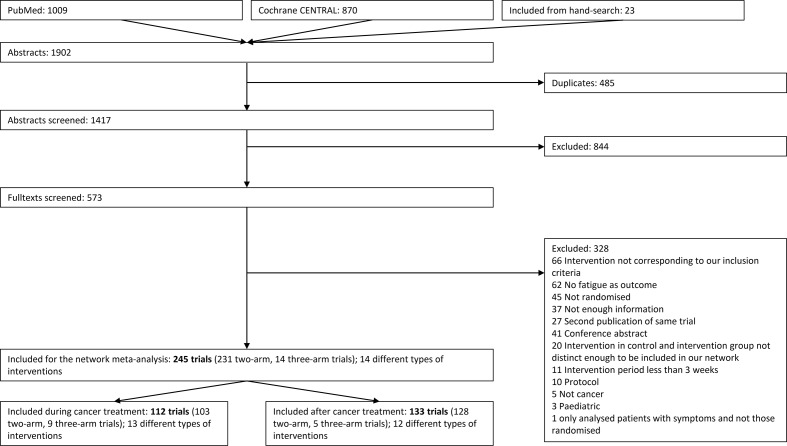
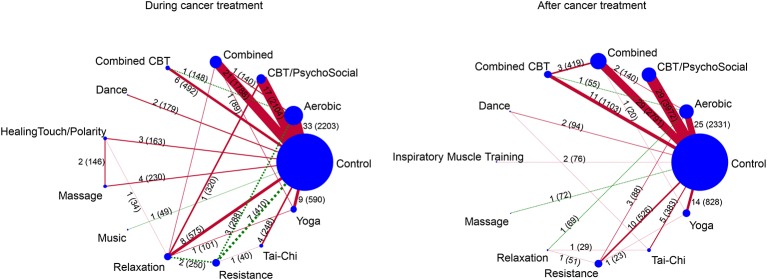
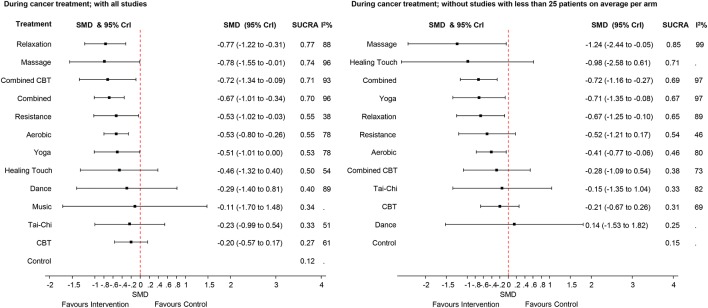
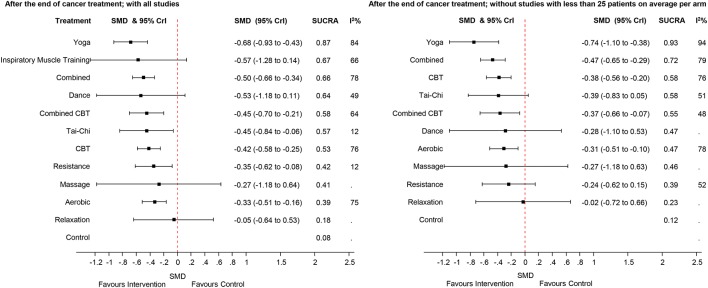
AIM: To assess the relative effects of different types of exercise and other non-pharmaceutical interventions on cancer-related fatigue (CRF) in patients during and after cancer treatment. DESIGN: Systematic review and indirect-comparisons meta-analysis. DATA SOURCES: Articles were searched in PubMed, Cochrane CENTRAL and published meta-analyses. ELIGIBILITY CRITERIA FOR SELECTING STUDIES: Randomised studies published up to January 2017 evaluating different types of exercise or other non-pharmaceutical interventions to reduce CRF in any cancer type during or after treatment. STUDY APPRAISAL AND SYNTHESIS: Risk of bias assessment with PEDro criteria and random effects Bayesian network meta-analysis. RESULTS: We included 245 studies. Comparing the treatments with usual care during cancer treatment, relaxation exercise was the highest ranked intervention with a standardisedmean difference (SMD) of -0.77 (95% Credible Interval (CrI) -1.22 to -0.31), while massage (-0.78; -1.55 to -0.01), cognitive-behavioural therapy combined with physical activity (combined CBT, -0.72; -1.34 to -0.09), combined aerobic and resistance training (-0.67; -1.01 to -0.34), resistance training (-0.53; -1.02 to -0.03), aerobic (-0.53; -0.80 to -0.26) and yoga (-0.51; -1.01 to 0.00) all had moderate-to-large SMDs. After cancer treatment, yoga showed the highest effect (-0.68; -0.93 to -0.43). Combined aerobic and resistance training (-0.50; -0.66 to -0.34), combined CBT (-0.45; -0.70 to -0.21), Tai-Chi (-0.45; -0.84 to -0.06), CBT (-0.42; -0.58 to -0.25), resistance training (-0.35; -0.62 to -0.08) and aerobic (-0.33; -0.51 to -0.16) showed all small-to-moderate SMDs. CONCLUSIONS: Patients can choose among different effective types of exercise and non-pharmaceutical interventions to reduce CRF.
Overview
The claims and statistics of this paper haven’t been checked yet.
Run the check — free, no account needed. It reads the open-access text and checks the sources it cites.
Integrity signals
Registry
Cites
Statistics
Figures
Verification
Claims the paper makes
The claims and statistics of this paper haven’t been checked yet.
Run the check — free, no account needed. It reads the open-access text and checks the sources it cites.
Claims other papers make about this one
Each is checked against this paper’s own text: does it say what the citing paper says it does?
The cited source says what the claim attributes to it.
In the citing paper
“Patients are also recommended various forms of psychotherapy [10,11,12], such as relaxation and guided imagery [13,14], mindfulness meditation (mindfulness-based stress reduction) [14], music therapy [15,16], occupational therapy [17,18,19], and breathing exercises [20,21,22].”
From The Effect of Vinyasa Yoga Practice on the Well-Being of Breast-Cancer Patients during COVID-19 Pandemic (2023) · cites this paper as [13]
Self-check
Percentages, sums and reported differences re-computed from the paper’s own numbers.
The self-check needs the paper’s full text.
Citations
Cites
Bias in meta-analysis detected by a simple, graphical test
Egger, M., Smith, G. D., Schneider, M., & Minder, C. (1997) · BMJ · doi:10.1136/bmj.315.7109.629 · Cited by 56,722
Cochrane Handbook for Systematic Reviews of Interventions: Cochrane Book Series
(2008) · doi:10.1002/9780470712184 · Cited by 25,048
Borenstein, M., Hedges, L. V., Higgins, J. P. T., & Rothstein, H. R. (2009) · doi:10.1002/9780470743386 · Cited by 14,225
Borenstein, M., Hedges, L. V., Higgins, J. P. T., & Rothstein, H. R. (2021) · doi:10.1002/9781119558378 · Cited by 9,799
Cohen, J. (1992) · Psychological Bulletin · doi:10.1037//0033-2909.112.1.155 · Cited by 8,771
Hutton, B., Salanti, G., Caldwell, D. M., Chaimani, A., Schmid, C. H., Cameron, C., Ioannidis, J. P. A., Straus, S., Thorlund, K., Jansen, J. P., et al. (2015) · Annals of Internal Medicine · doi:10.7326/m14-2385 · Cited by 8,269
Salanti, G., Ades, A. E., & Ioannidis, J. P. A. (2011) · Journal of Clinical Epidemiology · doi:10.1016/j.jclinepi.2010.03.016 · Cited by 3,766
Cancer-related fatigue—mechanisms, risk factors, and treatments
Bower, J. E. (2014) · Nature Reviews Clinical Oncology · doi:10.1038/nrclinonc.2014.127 · Cited by 1,666
Soft Tissue Sarcoma, Version 2.2022, NCCN Clinical Practice Guidelines in Oncology
von Mehren, M., Kane, J. M., Agulnik, M., Bui, M. M., Carr, J. R., Choy, E., Connelly, M., Dry, S., Ganjoo, K. N., González, R., et al. (2022) · Journal of the National Comprehensive Cancer Network · doi:10.6004/jnccn.2022.0035 · Cited by 1,203
Fatigue in breast cancer survivors: occurrence, correlates, and impact on quality of life.
Bower, J. E., Ganz, P. A., Desmond, K. A., Rowland, J. H., Meyerowitz, B. E., & Belin, T. R. (2000) · Journal of Clinical Oncology · doi:10.1200/jco.2000.18.4.743 · Cited by 1,134
Research works printed but not linked: 1
- 10.1037/0033-2909.112.1.155 · DOI · Paper page
Cited by
Sorted by citations
Items 301–393 of 393
Otra Historia centenaria: la de la Doctrina Social de la Iglesia.
de Diego, R. M. S. (1991) · Dialnet (Universidad de la Rioja)
Luo, X., Xie, Q., Shi, Q., Miao, Y., Yu, Q., Yu, H., Yin, H. X., Leng, X., Han, Y., & Zhou, H. (2021) · Research Square · doi:10.21203/rs.3.rs-593275/v1
Ng, D.-L.-C., Gan, G. G., Anuar, N. A., Tung, Y.-Z., Lai, N.-Z., Tan, Y.-W., Said, S. N. M., Madihie, A., Chai, C.-S., & Tan, S.-B. (2021) · doi:10.21203/rs.3.rs-123887/v1
Komplementärmedizin in der Uroonkologie
Thederan, I., & Rostock, M. (2022) · Springer Reference Medizin · doi:10.1007/978-3-642-41168-7_117-2
Yennurajalingam, S., & Bruera, E. D. (2021) · Oxford University Press eBooks · doi:10.1093/med/9780198821328.003.0066
Muraoka, K. (2018) · リハビリテーション医学 : 日本リハビリテーション医学会誌 · doi:10.2490/jjrmc.55.215
Mücke, M., & Kravchenko, D. (2018) · Springer eBooks · doi:10.1007/978-3-319-31738-0_12-1
Energy System Assessment in Metastatic Breast Cancer: A Cross-Sectional StudyPreprint
Cuesta‐Vargas, A., Buchan, J., Pajares, B., Ruiz-Medina, S., Alba, E., Trinidad‐Fernández, M., Díaz-Balboa, E., & Roldán‐Jiménez, C. (2020) · Research Square · doi:10.21203/rs.3.rs-68510/v1
Li, P., Wang, Q., Liu, L., Zhou, R., Liu, T., Wang, Y., & Li, F. (2022) · PLoS ONE · doi:10.1371/journal.pone.0270203
Ali, D. (2022) · Queensland University of Technology · doi:10.5204/thesis.eprints.233465
Cancer and Exercising - What Should be Considered?
Renni, M. J. P., Rego, M. V. M., & de Andrade, L. F. (2022) · Acta Scientific Women s Health · doi:10.31080/aswh.2022.04.421
Körperliche Aktivität bei Krebs – Wirksamkeit bewegungstherapeutischer Ansätze
Siebert, S., Kersten, J., Theurich, S., & Baumann, F. T. (2022) · TumorDiagnostik & Therapie · doi:10.1055/a-1892-3886
Sommeil, fatigue, troubles du sommeil et troubles cognitifs
Ouellet, M., Beaulieu‐Bonneau, S., Savard, J., & Morin, C. M. (2021) · De Boeck Supérieur eBooks · doi:10.3917/dbu.azouv.2021.01.0153
Grossman, M. (2022) · Springer eBooks · doi:10.1007/978-3-031-06101-1_16
The Transition to Survivorship
Grossman, M. (2022) · Springer eBooks · doi:10.1007/978-3-031-06101-1_17
Grossman, M. (2022) · Springer eBooks · doi:10.1007/978-3-031-06101-1_15
Komariah, A., & Rochmawati, E. (2022) · Jurnal Aisyah Jurnal Ilmu Kesehatan · doi:10.30604/jika.v7is2.1385
Hays, M., Santisi, H. L., & Mahon, M. M. (2022) · Oxford University Press eBooks · doi:10.1093/med/9780197583838.003.0031
O papel da fisioterapia em pacientes oncológicos
Ferreira, J. V. R., Miranda, P. H. D. S., Carneiro, R. M. D. S., Chaves, S. M. P., Costa, L. D. P. P. D., Oliveira, W. M. D., Santos, V. P. D., dos Santos, N. Í. M., Xavier, L. C. F., & Furtado, M. V. D. C. (2023) · Brazilian Journal of Development · doi:10.34117/bjdv9n1-384
Sport- und Bewegungstherapie in der Onkologie
Wefelnberg, M. M., Baumann, F. T., & Schmidt, T. (2023) · Springer Reference Medizin · doi:10.1007/978-3-662-46764-0_346-1
Xiao, M., Qian, X., Chen, X., Ji, L., Xiu, M., Li, Z., Cao, H., Chen, S., Li, Q., Li, Q., et al. (2023) · Research Square · doi:10.21203/rs.3.rs-2884298/v1
Pandey, S. (2021) · Oxford University Press eBooks · doi:10.1093/med/9780197559321.003.0041
Komplementärmedizin in der Uroonkologie
Thederan, I., & Rostock, M. (2023) · Springer Reference Medizin · doi:10.1007/978-3-662-63400-4_117
Roomaney, R., Coetzee, B., Smith, P., & Daniels, J. (2023) · Social and Health Sciences · doi:10.25159/2957-3645/11102
Yoga als komplementärmedizinisches Verfahren in der Onkologie
Kammler, G. (2023) · Im Focus Onkologie · doi:10.1007/s15015-023-3224-0
Tzschaschel, M. L. J., Janni, W., & Mergel, F. (2023) · Die Gynäkologie · doi:10.1007/s00129-023-05156-z
QUALIDADE DE VIDA DE MULHERES TRATADAS DE CÂNCER DE MAMA RELACIONADO AO NÍVEL DE ATIVIDADE FÍSICA
Mitidieri, I. M. M. G., Souza, B. L. D., Ismerim, M. S., Magalhães, L. M., Bezerra, J. C. P., & Dantas, E. H. M. (2023) · doi:10.29327/1296267.1-3
Ji, Y., Zhang, Y., Shi, Z., Wang, P., Chen, T., Fan, Z., & Jiang, E. (2023) · Research Square · doi:10.21203/rs.3.rs-3711048/v1
Traditionelle Chinesische Medizin in der Onkologie: wissenschaftliche Evidenz und Leitlinien
Schröder, S., & Böhme, G. (2023) · Zeitschrift für Komplementärmedizin · doi:10.1055/a-2188-3718
Chao, M., Xiang, C., Ding, M., Yang, X., & Kamalden, T. F. T. (2023) · Annals of Applied Sport Science · doi:10.61186/aassjournal.1183
Otto, S., Horneber, M., & Weis, J. (2023) · Springer eBooks · doi:10.1007/978-3-662-64615-1_4
Löwe, A., Hasenburg, A., Seeger, A., & Almstedt, K. (2024) · Die Onkologie · doi:10.1007/s00761-023-01452-4
Yoga als komplementärmedizinisches Verfahren in der Onkologie
Kammler, G. (2024) · Uro-News · doi:10.1007/s00092-024-6252-y
Millet, N., McDermott, H. J., Munir, F., Edwardson, C. L., Plekhanova, T., & Moss, E. L. (2024) · Research Square · doi:10.21203/rs.3.rs-3833041/v1
The Role of Physical Activity on Some Biochemical Parameters in Cancer Treatment
Dere, E. (2024) · Doğu Karadeniz Sağlık Bilimleri Dergisi · doi:10.59312/ebshealth.1363593
The role of physical activity in cancer prevention and symptom management
Leary, F. O. (2024) · InnovAiT Education and inspiration for general practice · doi:10.1177/17557380241239557
Tzschaschel, M. L. J., Janni, W., & Mergel, F. (2024) · Deutsche Zeitschrift für Akupunktur · doi:10.1007/s42212-024-00659-9
Ayurveda bei onkologischen Erkrankungen
Keßler, C. S., & Schiele, J. K. (2024) · Zeitschrift für Komplementärmedizin · doi:10.1055/a-2294-6947
Mind-Body-Medizin bei Patienten mit Prostatakarzinom
Saha, F. (2024) · Zeitschrift für Komplementärmedizin · doi:10.1055/a-2297-6685
Common symptoms and management in oncopalliative care
Saleem, A. N., Hassan, A. A., & Allam, A. A. K. (2024) · Elsevier eBooks · doi:10.1016/b978-0-443-13451-7.00003-4
Sporttherapie im digitalen Zeitalter: Vielversprechende Ansätze bei Krebs und Depression?
Enders, K., & Haller, N. (2024) · Springer eBooks · doi:10.1007/978-3-662-68241-8_35-1
Wang, Q., Xia, G., Liu, F., & Yang, X. (2024) · Research Square · doi:10.21203/rs.3.rs-5322961/v1
Mücke, M., & Kravchenko, D. (2024) · Springer eBooks · doi:10.1007/978-3-031-48991-4_12
Qu, Y., Yang, Y., Yan, H., He, Y., Gao, J., Deng, C., & Gu, L. (2025) · Research Square · doi:10.21203/rs.3.rs-6215616/v1
Micro-Wellness Interventions and Well-Being of Medical Doctors in Lagos State, Nigeria
Azeez, R. O., & JAYEOBA, F. I. (2025) · IGI Global eBooks · doi:10.4018/979-8-3693-8819-8.ch020
Kaple, G. S., Qureshi, M. I., Raghuveer, R., & Hullumani, S. (2025) · JMIR Research Protocols · doi:10.2196/66011
Ghosh, S., Siddique, M., Chatterjee, K., Pal, R. K., Alam, S. M., Halder, I., Chandra, S., Midya, A., & Saha, S. (2025) · Homeopathy · doi:10.1055/a-2547-9741
Singer, S., Amdal, C. D., Bjordal, K., Herlofson, B. B., Astrup, G. L., Boehm, A., Wöhner, U., Hammerlid, E. B., Gama, R. R., Jacinto, A. A., et al. (2025) · Head & Neck · doi:10.1002/hed.28263
Comorbid symptoms in cancer patients and caring for the caregiver
Strander, S. M., Chiu, D., Temel, J. S., Jacobs, J. M., & Forst, D. A. (2025) · Journal of Clinical and Experimental Neuropsychology · doi:10.1080/13803395.2025.2542245 · Cited by 1
Huang, C.-C., Liu, Y.-H., & Horng, Y.-S. (2025) · European Journal of Cancer Care · doi:10.1155/ecc/6615635 · Cited by 1
Incidence and Factors Influencing Locomotive Syndrome in Cancer Patients Living in the Community
Akezaki, Y., Nakata, E., Kikuuchi, M., Katayama, Y., & Sugihara, S. (2025) · Cureus · doi:10.7759/cureus.91856
Toftdahl, A. K. S., Hjørnholm, L. H., Virgilsen, L. F., Stuiver, M. M., Thomsen, J. L., & Riis, A. (2025) · BMJ Open · doi:10.1136/bmjopen-2025-102834
Faraj, S. F. (2025) · A and V Pub International Journal of Nursing and Medical Research · doi:10.52711/ijnmr.2025.23
Resistance training: features and use in treating fatigue in cancer survivors
Ribeiro, I. L., Lorca, L. A., & Berríos-Contreras, L. (2025) · Elsevier eBooks · doi:10.1016/b978-0-443-24080-5.00041-2
Psychological benefits of exercise for cancer survivors
Ni, X., Zhu, X., & Li, J. (2025) · Psycho-Oncologie · doi:10.18282/po4630
Investigating fatigue in adults with neuroendocrine neoplasms using a biopsychosocial model
Peters, S. W., Wolters, P. L., Rivero, J. D., Wedekind, M. F., Reilly, K. M., Flowers, C., Widemann, B. C., & Lockridge, R. (2025) · Supportive Care in Cancer · doi:10.1007/s00520-025-09970-0
Hiensch, A. E., Müller, J., Zopf, E. M., Schmidt, M. E., Monninkhof, E. M., Trevaskis, M., Belloso, J., Clauss, D., Gunasekara, N., Joaquim, A. V., et al. (2025) · Trials · doi:10.1186/s13063-025-09263-1
Physical Activity Interventions for Patients With Poststroke Fatigue: Protocol for a Scoping Review
Dong-ling, C., Liang, L., Ji, L., & Guo, X. (2025) · JMIR Research Protocols · doi:10.2196/80703
Appiah, E. O., Menlah, A., Xu, J., Susana, A. A., Agyekum, B. S., Garti, I., Kob, P., & Kumah, J. (2023) · Figshare · doi:10.6084/m9.figshare.24040648
Agbejule, O. A., Hart, N. H., Ekberg, S., Koczwara, B., Ladwa, R., Simonsen, C., Pinkham, E. P., & Chan, R. J. (2021) · Figshare · doi:10.6084/m9.figshare.14984883
Agbejule, O. A., Hart, N. H., Ekberg, S., Koczwara, B., Ladwa, R., Simonsen, C., Pinkham, E. P., & Chan, R. J. (2021) · Figshare · doi:10.6084/m9.figshare.14984880
Agbejule, O. A., Hart, N. H., Ekberg, S., Koczwara, B., Ladwa, R., Simonsen, C., Pinkham, E. P., & Chan, R. J. (2021) · Figshare · doi:10.6084/m9.figshare.14984874
Agbejule, O. A., Hart, N. H., Ekberg, S., Koczwara, B., Ladwa, R., Simonsen, C., Pinkham, E. P., & Chan, R. J. (2021) · Figshare · doi:10.6084/m9.figshare.14984877
Roed, K., Bjerre, E. D., & Midtgaard, J. (2022) · Figshare · doi:10.6084/m9.figshare.19305213
Roed, K., Bjerre, E. D., & Midtgaard, J. (2022) · Figshare · doi:10.6084/m9.figshare.19305210
Chen, X., Li, J., Chen, C., Zhang, Y., Zhang, S., Zhang, Y., Zhou, L., & Hu, X. (2024) · Figshare · doi:10.6084/m9.figshare.26596877
Sporttherapie im digitalen Zeitalter: Vielversprechende Ansätze bei Krebs und Depression?
Enders, K., & Haller, N. (2025) · Springer eBooks · doi:10.1007/978-3-662-70475-2_35
Zittema, D., Schouten, R. W., Nadort, E., Boeschoten, R. E., Smets, Y. F. C., Shaw, P. C., Vleming, L. J., Dekker, M. J. E., Westerman, M., Hoogeveen, E. K., et al. (2025) · General Hospital Psychiatry · doi:10.1016/j.genhosppsych.2025.12.022
Molecular Biology: Navigating the Landscape
Bhatia, M. (2026) · Current Issues in Molecular Biology · doi:10.3390/cimb48020133
Physiotherapy in the primary care oncology team
Prinsloo, L. (2026) · South African Family Practice · doi:10.4102/safp.v68i1.6231
Zhao, J., Liu, Y., Xiao, B., Tan, T., Yin, Y., Hu, Y., & Li, L. (2026) · Frontiers in Oncology · doi:10.3389/fonc.2026.1702233
Integrative approaches to head and neck cancer
McCurdy, M. R. (2026) · Elsevier eBooks · doi:10.1016/b978-0-443-30194-0.00020-5
MORANTE-SAINZ, I., Ruiz‐Pérez, I., & Maldonado‐Martín, S. (2026) · The Journal of Sports Medicine and Physical Fitness · doi:10.23736/s0022-4707.25.17121-1
Zheng, T., Jing, B., & Li, H. (2026) · Discover Oncology · doi:10.1007/s12672-026-04821-8
Cao, Y., Xin, R., Wang, M., Song, D., & Dong, X. (2026) · Acta Psychologica · doi:10.1016/j.actpsy.2026.106649
A Scoping Review on Exercise Interventions During Adjuvant Chemotherapy or Radiotherapy for Cancer
Nair, T., Mehta, C., & Kumar, P. G. (2026) · Cureus · doi:10.7759/cureus.106295
Zhang, Q., Chen, X., Duan, Y., Xie, J., Chen, Y., Hu, Y., & Cheng, Q. (2026) · JMIR Research Protocols · doi:10.2196/84925
Harrington, S., Lee, J. Q., Fleischer, A. B., Wood, K. C., Cohn, J. C., Malone, D. J., & Fisher, M. I. (2026) · Supportive Care in Cancer · doi:10.1007/s00520-026-10717-8
Dai, Z., Zhang, Y., Wang, Z., Chen, X., & Gao, P. (2026) · Frontiers in Public Health · doi:10.3389/fpubh.2026.1795975 · Cited by 1
Xie, J., Liang, Z., Li, M., & Wang, B. (2026) · Complementary Therapies in Medicine · doi:10.1016/j.ctim.2026.103392
Research Trends in Physical Activity and Breast Cancer: A 25-Year Bibliometric Analysis (2000–2025)
Navarro-Martínez, C., Villarejo-García, D. H., Becerra-Patiño, B. A., & Pino‐Ortega, J. (2026) · Clinical Oncology · doi:10.1016/j.clon.2026.104208
Wu, C., Nishi, A., Sun, Z., Zhao, J., & Chen, G. (2026) · Brain Behavior and Immunity Integrative · doi:10.1016/j.bbii.2026.100175 · Cited by 1
Intervention bei krankheitsspezifischen Aspekten
(2022) · Elsevier eBooks · doi:10.1016/b978-3-437-24041-6.00005-2
GÜR, G., Ardıç, A., Gümüşay, Ö., & Can, G. (2026) · Supportive Care in Cancer · doi:10.1007/s00520-026-11063-5
Digital Sports Therapy: Promising Approaches for Cancer and Depression?
Enders, K., & Haller, N. (2026) · Springer eBooks · doi:10.1007/978-3-662-73013-3_16
Luke, W. (2026) · Elsevier eBooks · doi:10.1016/b978-0-443-23516-0.00119-7
Gibson, J., Wang, D., & Huang, M. (2026) · Rehabilitation Oncology · doi:10.1097/01.reo.0000000000000430
Chen, Y., Wang, X., Liu, Q., Wei, Z., Xiuqin, M., Jinlian, S., & Rong, W. (2026) · Research Square · doi:10.21203/rs.3.rs-10837343/v1
Vanrusselt, D., Sleurs, C., Leenaerts, N., Kirsch, S., Ermengem, N. V., Lemiere, J., Myin‐Germeys, I., Uyttebroeck, A., & Verschueren, S. (2026) · Digital Health · doi:10.1177/20552076261494729
Amen, M. R. (2026) · Journal of Patient Experience · doi:10.1177/23743735261502331
Metadata
- Authors
- Hilfiker, R., Meichtry, A., Eicher, M., Nilsson Balfe, L., Knols, R. H., Verra, M. L., & Taeymans, J.
- Affiliations
- HES-SO Valais-Wallis (CH)
- Institute of Physiotherapy, Zurich University of Applied Sciences, Winterthur, Switzerland
- HES-SO University of Applied Sciences and Arts Western Switzerland (CH)
- School of Health Sciences, HES-SO Valais-Wallis, University of Applied Sciences and Arts Western Switzerland Valais, Leukerbad, Switzerland
- University Hospital Zurich (CH)
- University Hospital of Bern (CH)
- Bern University of Applied Sciences (CH)
- Corresponding author
- Hilfiker, Roger
- Venue
- British Journal of Sports Medicine
- Publisher
- BMJ
- Published
- 2017-05-13
- Volume
- 52
- Issue
- 10
- Pages
- 651-658
- ISSN
- 0306-3674 (ISSN-L)
- 1473-0480
- PMC
- PMC5931245
- OpenAlex
- W2612715342
- Cited by
- 396
- References
- 77
- Citations by year
- 2026: 26 · 2025: 46 · 2024: 50 · 2023: 69 · 2022: 63 · 2021: 56 · 2020: 41 · 2019: 28 · 2018: 11 · 2017: 4
- FWCI
- 2.41
- Type
- journal article
- Language
- en
- Open access
- hybrid
- doi.org
- Licence
- cc-by-nc
- Locations
- British Journal of Sports Medicine (publishedVersion, cc-by-nc)
- Europe PMC (PubMed Central) (publishedVersion, other-oa)
- PubMed Central (publishedVersion, cc-by-nc)
- PubMed (publishedVersion)
- SERVAL (Université de Lausanne) (publishedVersion, other-oa)
- ARBOR - Bern University of Applied Sciences Repository (submittedVersion, other-oa)
- Zürcher Hochschule für Angewandte Wissenschaften digital collection (Zurich University of Applied Sciences) (submittedVersion, cc-by-nc-nd)
- ArODES (HES-SO (https://www.hes-so.ch/)) (submittedVersion)
- IRIS (submittedVersion)
- HighWire Press Open Archive (submittedVersion)
- ZHAW Digital Collection (cc-by-nc)
- BFH: ARBOR
- Funders
- physioswiss
- HES-SO
- Topics
- Health Sciences › Medicine › Oncology › Cancer survivorship and care
- Health Sciences › Medicine › Oncology › Cancer-related cognitive impairment studies
- Health Sciences › Medicine › Pediatrics, Perinatology and Child Health › Childhood Cancer Survivors' Quality of Life
- Keywords
- cancer-related fatigue, exercise intervention, non-pharmaceutical interventions, relaxation techniques, massage, cognitive behavioral therapy, aerobic exercise, resistance training, yoga, Tai Chi, post-treatment fatigue, cancer survivors, indirect comparison, credible intervals, heterogeneous effects, treatment effect heterogeneity
- MeSH terms
- Exercise Therapy, Fatigue, Massage, Neoplasms, Relaxation Therapy, Yoga, Cognitive Behavioral Therapy, Randomized Controlled Trials as Topic, Tai Ji, Resistance Training
About these checks
Registry, retraction, Cites and statistics results are computed, not judged, with one exception: a printed reference that no index lists is read once by a model before it counts as a citation error. Claims are extracted by a model and kept only when their quote appears verbatim in the text; each cited source is then checked, with a model’s help, for whether it says what the claim relies on. Those verdicts can be wrong — read the claim’s quote and the cited source before relying on one.
Statistics and arithmetic are recomputed, not judged.
Confidence bands are shown only for fields calibrated on our annotated test set. None is calibrated yet, so no band is shown.
What counts as a claim ›How we measure confidence ›How we check this ›
Are you an author, or do you see a problem with this page? Request a review
