

The DOI matches its Crossref record; 75 of the 77 references it cites were found in a registry or an index.
Exercise and other non-pharmaceutical interventions for cancer-related fatigue in patients during or after cancer treatment: a systematic review incorporating an indirect-comparisons meta-analysis
Open accessAbstract
AIM: To assess the relative effects of different types of exercise and other non-pharmaceutical interventions on cancer-related fatigue (CRF) in patients during and after cancer treatment. DESIGN: Systematic review and indirect-comparisons meta-analysis. DATA SOURCES: Articles were searched in PubMed, Cochrane CENTRAL and published meta-analyses. ELIGIBILITY CRITERIA FOR SELECTING STUDIES: Randomised studies published up to January 2017 evaluating different types of exercise or other non-pharmaceutical interventions to reduce CRF in any cancer type during or after treatment. STUDY APPRAISAL AND SYNTHESIS: Risk of bias assessment with PEDro criteria and random effects Bayesian network meta-analysis. RESULTS: We included 245 studies. Comparing the treatments with usual care during cancer treatment, relaxation exercise was the highest ranked intervention with a standardisedmean difference (SMD) of -0.77 (95% Credible Interval (CrI) -1.22 to -0.31), while massage (-0.78; -1.55 to -0.01), cognitive-behavioural therapy combined with physical activity (combined CBT, -0.72; -1.34 to -0.09), combined aerobic and resistance training (-0.67; -1.01 to -0.34), resistance training (-0.53; -1.02 to -0.03), aerobic (-0.53; -0.80 to -0.26) and yoga (-0.51; -1.01 to 0.00) all had moderate-to-large SMDs. After cancer treatment, yoga showed the highest effect (-0.68; -0.93 to -0.43). Combined aerobic and resistance training (-0.50; -0.66 to -0.34), combined CBT (-0.45; -0.70 to -0.21), Tai-Chi (-0.45; -0.84 to -0.06), CBT (-0.42; -0.58 to -0.25), resistance training (-0.35; -0.62 to -0.08) and aerobic (-0.33; -0.51 to -0.16) showed all small-to-moderate SMDs. CONCLUSIONS: Patients can choose among different effective types of exercise and non-pharmaceutical interventions to reduce CRF.
Overview
The claims and statistics of this paper haven’t been checked yet.
Run the check — free, no account needed. It reads the open-access text and checks the sources it cites.
Integrity signals
Registry
Cites
Statistics
Figures
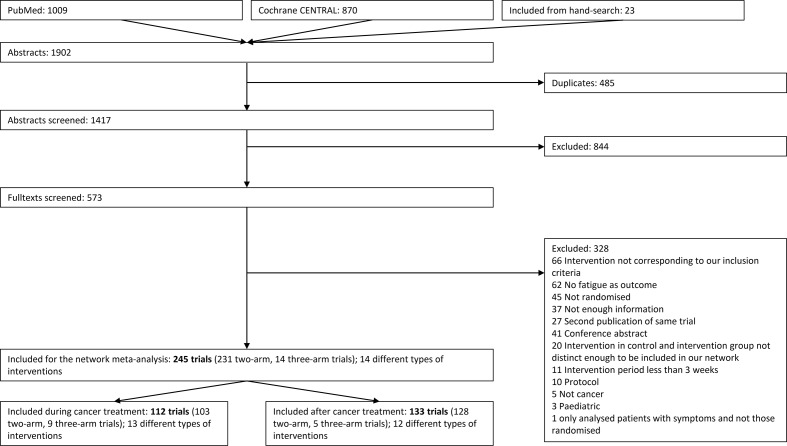
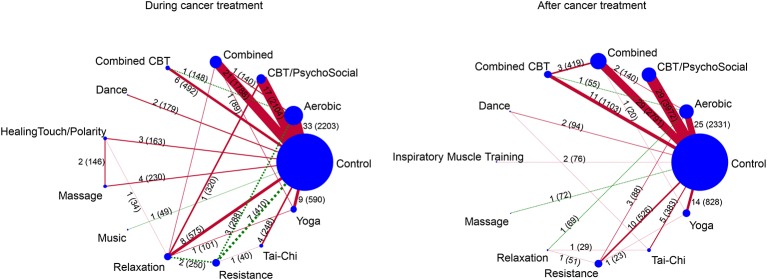
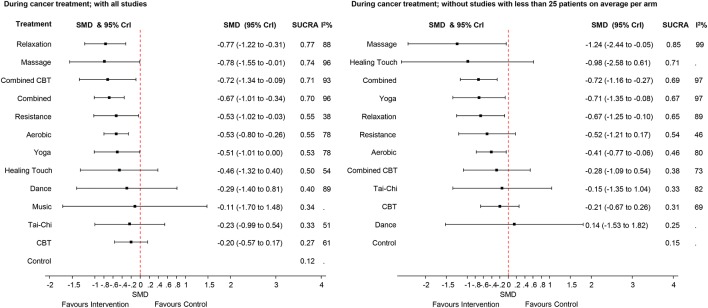
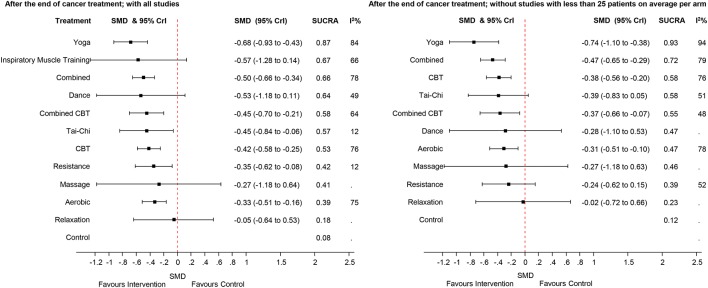
Verification
Claims the paper makes
The claims and statistics of this paper haven’t been checked yet.
Run the check — free, no account needed. It reads the open-access text and checks the sources it cites.
Claims other papers make about this one
Each is checked against this paper’s own text: does it say what the citing paper says it does?
The cited source says what the claim attributes to it.
In the citing paper
“Patients are also recommended various forms of psychotherapy [10,11,12], such as relaxation and guided imagery [13,14], mindfulness meditation (mindfulness-based stress reduction) [14], music therapy [15,16], occupational therapy [17,18,19], and breathing exercises [20,21,22].”
From The Effect of Vinyasa Yoga Practice on the Well-Being of Breast-Cancer Patients during COVID-19 Pandemic (2023) · cites this paper as [13]
Self-check
Percentages, sums and reported differences re-computed from the paper’s own numbers.
The self-check needs the paper’s full text.
Citations
Cites
Bias in meta-analysis detected by a simple, graphical test
Egger, M., Smith, G. D., Schneider, M., & Minder, C. (1997) · BMJ · doi:10.1136/bmj.315.7109.629 · Cited by 56,722
Cochrane Handbook for Systematic Reviews of Interventions: Cochrane Book Series
(2008) · doi:10.1002/9780470712184 · Cited by 25,048
Borenstein, M., Hedges, L. V., Higgins, J. P. T., & Rothstein, H. R. (2009) · doi:10.1002/9780470743386 · Cited by 14,225
Borenstein, M., Hedges, L. V., Higgins, J. P. T., & Rothstein, H. R. (2021) · doi:10.1002/9781119558378 · Cited by 9,799
Cohen, J. (1992) · Psychological Bulletin · doi:10.1037//0033-2909.112.1.155 · Cited by 8,771
Hutton, B., Salanti, G., Caldwell, D. M., Chaimani, A., Schmid, C. H., Cameron, C., Ioannidis, J. P. A., Straus, S., Thorlund, K., Jansen, J. P., et al. (2015) · Annals of Internal Medicine · doi:10.7326/m14-2385 · Cited by 8,269
Salanti, G., Ades, A. E., & Ioannidis, J. P. A. (2011) · Journal of Clinical Epidemiology · doi:10.1016/j.jclinepi.2010.03.016 · Cited by 3,766
Cancer-related fatigue—mechanisms, risk factors, and treatments
Bower, J. E. (2014) · Nature Reviews Clinical Oncology · doi:10.1038/nrclinonc.2014.127 · Cited by 1,666
Soft Tissue Sarcoma, Version 2.2022, NCCN Clinical Practice Guidelines in Oncology
von Mehren, M., Kane, J. M., Agulnik, M., Bui, M. M., Carr, J. R., Choy, E., Connelly, M., Dry, S., Ganjoo, K. N., González, R., et al. (2022) · Journal of the National Comprehensive Cancer Network · doi:10.6004/jnccn.2022.0035 · Cited by 1,203
Fatigue in breast cancer survivors: occurrence, correlates, and impact on quality of life.
Bower, J. E., Ganz, P. A., Desmond, K. A., Rowland, J. H., Meyerowitz, B. E., & Belin, T. R. (2000) · Journal of Clinical Oncology · doi:10.1200/jco.2000.18.4.743 · Cited by 1,134
Research works printed but not linked: 1
- 10.1037/0033-2909.112.1.155 · DOI · Paper page
Cited by
Sorted by citations
Exercise, Diet, and Weight Management During Cancer Treatment: ASCO Guideline
Ligibel, J. A., Bohlke, K., May, A. M., Clinton, S. K., Demark-Wahnefried, W., Gilchrist, S. C., Irwin, M. L., Late, M., Mansfield, S., Marshall, T. F., et al. (2022) · Journal of Clinical Oncology · doi:10.1200/jco.22.00687 · Cited by 700
Cancer-Related Fatigue: Causes and Current Treatment Options
Thong, M. S. Y., van Noorden, C. J. F., Steindorf, K., & Arndt, V. (2020) · Current Treatment Options in Oncology · doi:10.1007/s11864-020-0707-5 · Cited by 438
Wayne, P. M., Lee, M. S., Novakowski, J., Osypiuk, K., Ligibel, J., Carlson, L. E., & Song, R. (2018) · Journal of Cancer Survivorship · doi:10.1007/s11764-017-0665-5 · Cited by 251
Fuller, J. T., Hartland, M. C., Maloney, L. T., & Davison, K. (2018) · British Journal of Sports Medicine · doi:10.1136/bjsports-2017-098285 · Cited by 199
Physical Activity and Exercise in Lung Cancer Care: Will Promises Be Fulfilled?
Avancini, A., Sartori, G., Gkountakos, A., Casali, M., Trestini, I., Tregnago, D., Bria, E., Jones, L. W., Milella, M., Lanza, M., et al. (2020) · The Oncologist · doi:10.1634/theoncologist.2019-0463 · Cited by 207
Metadata
- Authors
- Hilfiker, R., Meichtry, A., Eicher, M., Nilsson Balfe, L., Knols, R. H., Verra, M. L., & Taeymans, J.
- Affiliations
- HES-SO Valais-Wallis (CH)
- Institute of Physiotherapy, Zurich University of Applied Sciences, Winterthur, Switzerland
- HES-SO University of Applied Sciences and Arts Western Switzerland (CH)
- School of Health Sciences, HES-SO Valais-Wallis, University of Applied Sciences and Arts Western Switzerland Valais, Leukerbad, Switzerland
- University Hospital Zurich (CH)
- University Hospital of Bern (CH)
- Bern University of Applied Sciences (CH)
- Corresponding author
- Hilfiker, Roger
- Venue
- British Journal of Sports Medicine
- Publisher
- BMJ
- Published
- 2017-05-13
- Volume
- 52
- Issue
- 10
- Pages
- 651-658
- ISSN
- 0306-3674 (ISSN-L)
- 1473-0480
- PMC
- PMC5931245
- OpenAlex
- W2612715342
- Cited by
- 396
- References
- 77
- Citations by year
- 2026: 26 · 2025: 46 · 2024: 50 · 2023: 69 · 2022: 63 · 2021: 56 · 2020: 41 · 2019: 28 · 2018: 11 · 2017: 4
- FWCI
- 2.41
- Type
- journal article
- Language
- en
- Open access
- hybrid
- doi.org
- Licence
- cc-by-nc
- Locations
- British Journal of Sports Medicine (publishedVersion, cc-by-nc)
- Europe PMC (PubMed Central) (publishedVersion, other-oa)
- PubMed Central (publishedVersion, cc-by-nc)
- PubMed (publishedVersion)
- SERVAL (Université de Lausanne) (publishedVersion, other-oa)
- ARBOR - Bern University of Applied Sciences Repository (submittedVersion, other-oa)
- Zürcher Hochschule für Angewandte Wissenschaften digital collection (Zurich University of Applied Sciences) (submittedVersion, cc-by-nc-nd)
- ArODES (HES-SO (https://www.hes-so.ch/)) (submittedVersion)
- IRIS (submittedVersion)
- HighWire Press Open Archive (submittedVersion)
- ZHAW Digital Collection (cc-by-nc)
- BFH: ARBOR
- Funders
- physioswiss
- HES-SO
- Topics
- Health Sciences › Medicine › Oncology › Cancer survivorship and care
- Health Sciences › Medicine › Oncology › Cancer-related cognitive impairment studies
- Health Sciences › Medicine › Pediatrics, Perinatology and Child Health › Childhood Cancer Survivors' Quality of Life
- Keywords
- cancer-related fatigue, exercise intervention, non-pharmaceutical interventions, relaxation techniques, massage, cognitive behavioral therapy, aerobic exercise, resistance training, yoga, Tai Chi, post-treatment fatigue, cancer survivors, indirect comparison, credible intervals, heterogeneous effects, treatment effect heterogeneity
- MeSH terms
- Exercise Therapy, Fatigue, Massage, Neoplasms, Relaxation Therapy, Yoga, Cognitive Behavioral Therapy, Randomized Controlled Trials as Topic, Tai Ji, Resistance Training
About these checks
Registry, retraction, Cites and statistics results are computed, not judged, with one exception: a printed reference that no index lists is read once by a model before it counts as a citation error. Claims are extracted by a model and kept only when their quote appears verbatim in the text; each cited source is then checked, with a model’s help, for whether it says what the claim relies on. Those verdicts can be wrong — read the claim’s quote and the cited source before relying on one.
Statistics and arithmetic are recomputed, not judged.
Confidence bands are shown only for fields calibrated on our annotated test set. None is calibrated yet, so no band is shown.
What counts as a claim ›How we measure confidence ›How we check this ›
Are you an author, or do you see a problem with this page? Request a review
