

Reallocation of time between device-measured movement behaviours and risk of incident cardiovascular disease
Open accessThe DOI matches its Crossref record; 48 of the 48 references it cites were found in a registry or an index.
Abstract
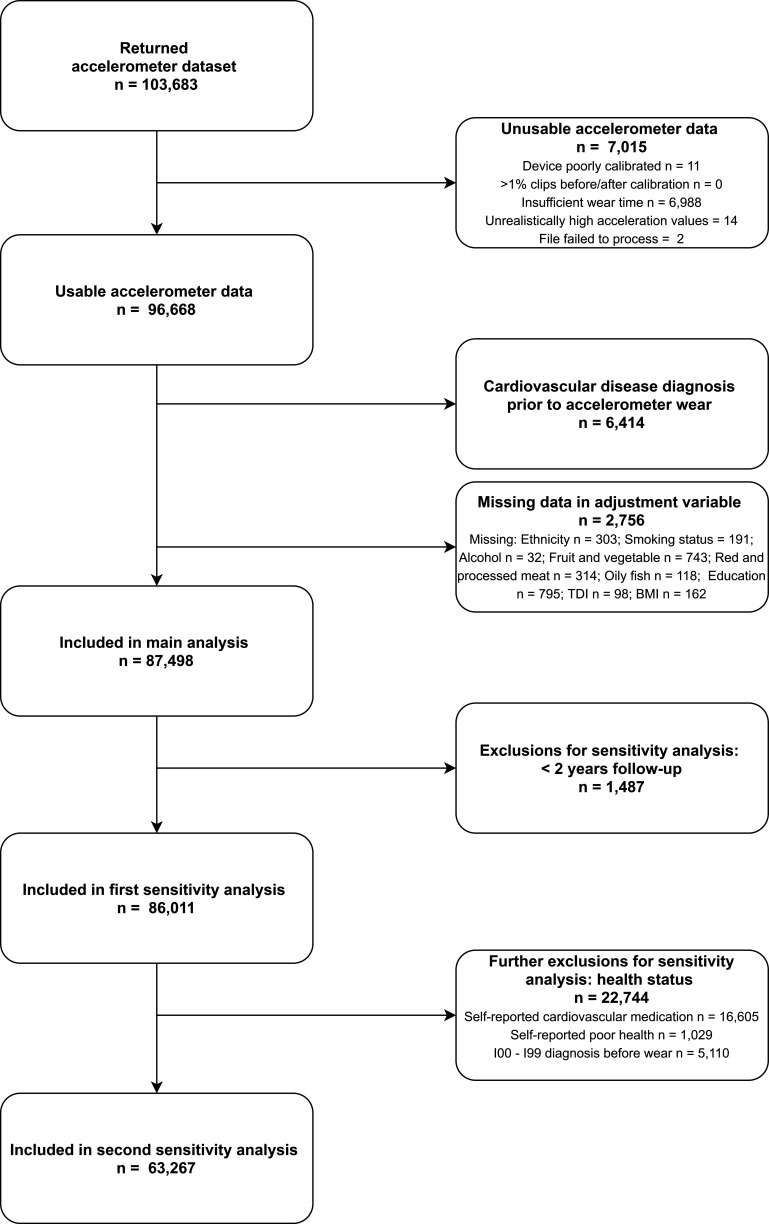
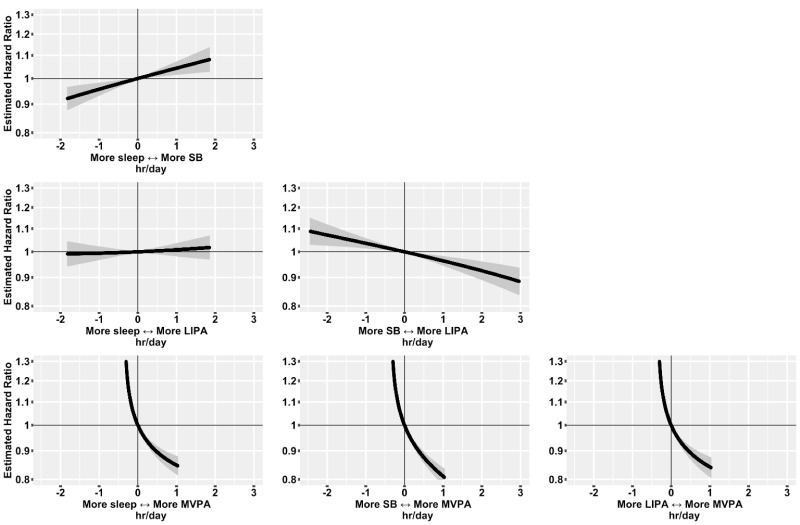
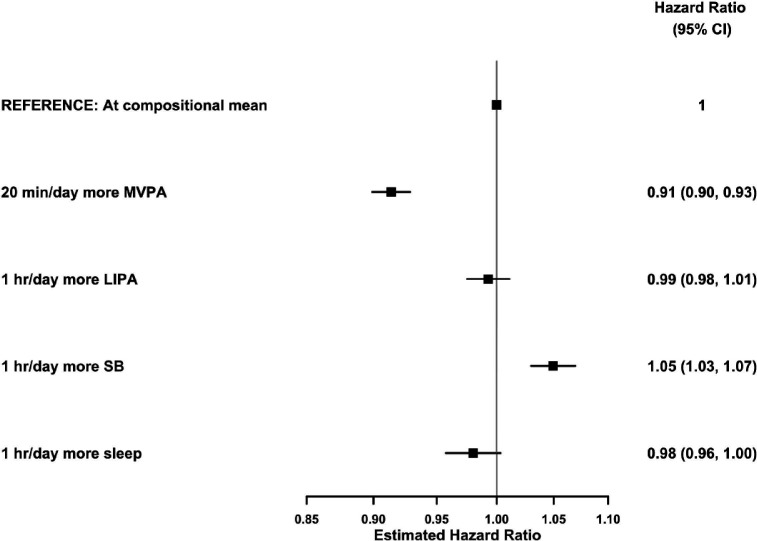
Objective: To improve classification of movement behaviours in free-living accelerometer data using machine-learning methods, and to investigate the association between machine-learned movement behaviours and risk of incident cardiovascular disease (CVD) in adults. Methods: Using free-living data from 152 participants, we developed a machine-learning model to classify movement behaviours (moderate-to-vigorous physical activity behaviours (MVPA), light physical activity behaviours, sedentary behaviour, sleep) in wrist-worn accelerometer data. Participants in UK Biobank, a prospective cohort, were asked to wear an accelerometer for 7 days, and we applied our machine-learning model to classify their movement behaviours. Using compositional data analysis Cox regression, we investigated how reallocating time between movement behaviours was associated with CVD incidence. Results: In leave-one-participant-out analysis, our machine-learning method classified free-living movement behaviours with mean accuracy 88% (95% CI 87% to 89%) and Cohen’s kappa 0.80 (95% CI 0.79 to 0.82). Among 87 498 UK Biobank participants, there were 4105 incident CVD events. Reallocating time from any behaviour to MVPA, or reallocating time from sedentary behaviour to any behaviour, was associated with lower CVD risk. For an average individual, reallocating 20 min/day to MVPA from all other behaviours proportionally was associated with 9% (95% CI 7% to 10%) lower risk, while reallocating 1 hour/day to sedentary behaviour from all other behaviours proportionally was associated with 5% (95% CI 3% to 7%) higher risk. Conclusion: Machine-learning methods classified movement behaviours accurately in free-living accelerometer data. Reallocating time from other behaviours to MVPA, and from sedentary behaviour to other behaviours, was associated with lower risk of incident CVD, and should be promoted by interventions and guidelines.
Overview
The claims and statistics of this paper haven’t been checked yet.
Free: it reads the open-access text and checks the first 5 claims that cite a source we can check. Create a free account to check every claim.
Integrity signals
Registry
Cites
Statistics
Figures
Verification
Claims the paper makes
The claims and statistics of this paper haven’t been checked yet.
Free: it reads the open-access text and checks the first 5 claims that cite a source we can check. Create a free account to check every claim.
Claims other papers make about this one
Each is checked against this paper’s own text: does it say what the citing paper says it does?
In the citing paper
“The random forest model achieved 90%+ precision and recall for detecting sleep windows in 152 free-living participants with sleep diaries that asked two questions: ‘What time did you first fall asleep last night?’ and ‘What time did you wake up (eyes open, ready to get up)?’30.”
From Self-supervised learning of accelerometer data provides new insights for sleep and its association with mortality (2024) · cites this paper as [30]
Self-check
Percentages, sums and reported differences re-computed from the paper’s own numbers.
The self-check needs the paper’s full text.
Citations
Cites
von Elm, E., Altman, D. G., Egger, M., Pocock, S. J., Gøtzsche, P. C., Vandenbroucke, J. P., & Initiative, F. T. S. (2007) · PLoS Medicine · doi:10.1371/journal.pmed.0040296 · Cited by 23,020
von Elm, E., Altman, D. G., Egger, M., Pocock, S. J., Gøtzsche, P. C., & Vandenbroucke, J. P. (2007) · The Lancet · doi:10.1016/s0140-6736(07)61602-x · Cited by 21,320
The Physical Activity Guidelines for Americans
Piercy, K. L., Troiano, R. P., Ballard, R. M., Carlson, S. A., Fulton, J. E., Galuska, D. A., George, S. M., & Olson, R. D. (2018) · JAMA · doi:10.1001/jama.2018.14854 · Cited by 9,755
Lee, I.-M., Shiroma, E. J., Lobelo, F., Puska, P., Blair, S. N., & Katzmarzyk, P. T. (2012) · The Lancet · doi:10.1016/s0140-6736(12)61031-9 · Cited by 8,215
Sensitivity analysis in observational research: Introducing the E-value
VanderWeele, T. J., & Ding, P. (2017) · Annals of Internal Medicine · doi:10.7326/m16-2607 · Cited by 6,350
2011 Compendium of Physical Activities: A Second Update of Codes and MET Values
AINSWORTH, B. E., HASKELL, W. L., HERRMANN, S. D., MECKES, N., BASSETT, D. R., TUDOR-LOCKE, C., GREER, J. L., VEZINA, J., WHITT-GLOVER, M. C., & LEON, A. S. (2011) · Medicine & Science in Sports & Exercise · doi:10.1249/mss.0b013e31821ece12 · Cited by 6,317
Forney, G. D. (1973) · Proceedings of the IEEE · doi:10.1109/proc.1973.9030 · Cited by 5,647
Fry, A., Littlejohns, T. J., Sudlow, C., Doherty, N., Adamska, L., Sprosen, T., Collins, R., & Allen, N. E. (2017) · American Journal of Epidemiology · doi:10.1093/aje/kwx246 · Cited by 3,979 · cited 1×
“…Biobank is not representative of the UK population 23 (eg, low socioeconomic status individuals are under-represented compared with the national population 42 ), though a previous study showed exposure–outcome associations found in UK Biobank were similar to results in more representative samples.”
Sedentary Behavior Research Network (SBRN)—Terminology Consensus Project process and outcome
on behalf of SBRN Terminology Consensus Project Participants, Tremblay, M. S., Aubert, S., Barnes, J. D., Saunders, T. J., Carson, V., Latimer-Cheung, A. E., Chastin, S. F. M., Altenburg, T. M., & Chinapaw, M. J. M. (2017) · International Journal of Behavioral Nutrition and Physical Activity · doi:10.1186/s12966-017-0525-8 · Cited by 3,793
Fit Yourself and Take Your Lungs to Heart
Palange, P., & Bonini, M. (2013) · Respiration · doi:10.1159/000350831 · Cited by 2,779
Research works printed but not linked: 2
- 10.1186/S12966-020-01042-2/TABLES/2 · doi:10.1186/s12966-020-01042-2/tables/2
- World Health Organization. Who guidelines on physical activity and sedentary behaviour. Geneva, 2020. 33369898
Cited by
Items 201–242 of 242
Syversen, A., Dosis, A., Zhang, Z., Jayne, D. G., & Wong, D. (2026) · BMC Digital Health · doi:10.1186/s44247-026-00239-y
“…Biobank Accelerometer Analysis Tool to classify accelerometer data into movement categories: Sleep, Sedentary, Light Physical Activity (LPA), and Moderate to Vigorous Physical Activity (MVPA) [31]. recommends near-complete recordings to capture both daytime and night-time autonomic activity [16].”
Schwendinger, F., Iaquinto, S., Waibl, V. J., Nittas, V., Gruebner, O., & von Wyl, V. (2026) · International Journal of Public Health · doi:10.3389/ijph.2026.1609200
“Research-grade devices, by contrast, commonly allow more independent data handling but typically demand greater data science expertise when working with publicly available algorithms like GGIR [14], biobankAccelerometerAnalysis [4, 15, 16], or FLIRT [17].”
Mellow, M. L., Stanford, T., Olds, T., Miatke, A., Smith, A. E., & Dumuid, D. (2026) · npj Digital Medicine · doi:10.1038/s41746-026-02542-4
“Average daily times spent in sleep, SB, light intensity PA (LPA) and moderate-vigorous intensity PA (MVPA) were obtained from the derived accelerometry data 35 within the UK Biobank ( fi eld codes are presented in SupplementaryTable2).”
Martinez, J., Cho, C. C., Kate, R. J., Swartz, A. M., Doherty, A., & Strath, S. J. (2026) · Journal for the Measurement of Physical Behaviour · doi:10.1123/jmpb.2025-0046
Self-citationGao, D., Zhang, W., Zhang, Y., Ji, M., Han, X., Liang, J., Pan, Y., Zheng, F., Xie, L., & Xie, W. (2026) · Pulmonology · doi:10.1080/25310429.2026.2649099 · Cited by 1
Ajufo, E. C., Kany, S., Rämö, J. T., Churchill, T. W., Guseh, J. S., Aragam, K. G., Ellinor, P. T., & Khurshid, S. S. (2026) · JACC Advances · doi:10.1016/j.jacadv.2026.102718
Zhou, L., Cao, Z., Lv, Y., Yang, H., Li, D., Lin, J., Xu, C., & Wang, Y. (2026) · Health Data Science · doi:10.34133/hds.0470
“…studies on the association of PA with health outcomes using the UK Biobank revealed that covariates mentioned above had steady influence [ 9 , 19 , 27 , 38 , 39 , 42 , 47 ] Second, the cohort within the UK Biobank exhibits a more favorable health profile compared to the broader public, which…”
InfluentialChen, H., Huang, E., Kuang, L., Zhang, B., Liao, D., Lai, S., Huang, H.-X., Xiong, Z., Wang, Y., Chen, S., et al. (2026) · Diabetes Obesity and Metabolism · doi:10.1111/dom.70828
“Detailed data collection and processing procedures have been described previously [25, 26].”
Yang, Q., Jia, H., Dou, L., & Zeng, B. (2026) · European Review of Aging and Physical Activity · doi:10.1186/s11556-026-00416-y
“A machine learning method previously developed and verified for use of the accelerometer data in UK Biobank [15].”
Sun, Z., Jia, T., Li, M., Yu, J., Zhang, X., Su, C., Wang, Y., Chen, J., You, P., Kou, C., et al. (2026) · BMC Public Health · doi:10.1186/s12889-026-27719-0
“MVPA was classified and quantified using a machine learning algorithm that achieved an average accuracy of 0.88 and a Cohen’s kappa of 0.80 in a UK-based sample [17].”
InfluentialKahl, F., Schalkamp, A., Gunter, K. M., Ophey, A., Röttgen, S., Razzaque, J., Kufer, K., Sandor, C., Fink, G. R., Kalbe, E., et al. (2026) · Movement Disorders · doi:10.1002/mds.70329
Yang, X., Geng, Z., Wang, Y., Luo, S., BinBin, L. I. U., Li, D., Zhang, G., Zhang, S., & Zhang, L. (2026) · Research Square · doi:10.21203/rs.3.rs-9793134/v1
Ibirogba, D. A., Andalco, L. S., Crotti, M. A. T. T. E. O., Charman, S. J., Fuller, A. S., Ajepe, T. O., Duncan, M. J., Blain, A. P., Niyi-Odumosu, F., Mwangi, P. E. T. E. R., et al. (2026) · Health Science Reports · doi:10.1002/hsr2.72618
“Several studies have highlighted the relative cardiometabolic effects of re-allocating time from one behaviour to another [6–8].”
Laurent, C. W. S., Balbim, G. M., Brown, D. M. Y., Kracht, C. L., Pfledderer, C. D., Groves, C. I., Holesovsky, C. D., Randolph, G. A. T., Rodheim, K., & Burkart, S. A. (2026) · International Journal of Behavioral Nutrition and Physical Activity · doi:10.1186/s12966-026-01935-8
Zhang, R., Jin, A., Fan, X., Li, F., Feng, Y., Zeng, L., Wang, J., Fan, N., Niu, L., & Liu, D. (2026) · Translational Vision Science & Technology · doi:10.1167/tvst.15.6.24
Dai, Y., Liu, Y., Pan, Y., Ma, J., Diao, X., Zhu, M., Yang, X., Gao, D., Zhang, Y., Ji, M., et al. (2026) · Nutrition Metabolism and Cardiovascular Diseases · doi:10.1016/j.numecd.2026.104849
He, Q., Sun, M., Yao, J., & Han, Q. (2026) · Journal of the American Heart Association · doi:10.1161/jaha.126.050774
Liu, T., Pu, J., Zhou, W., Luo, W., Li, D., Li, B., & Shang, S. (2026) · Interdisciplinary Nursing Research · doi:10.1097/nr9.0000000000000124
Maldonado‐Martín, S., Zeberio, I., de Rituerto-Zeberio, M. M., Madinabeitia-Murillo, J., Tous‐Espelosin, M., de Viñaspre, A. V. G., & González, E. G. (2026) · Cancer Control · doi:10.1177/10732748261463777
Shaw, J. S., Bray, M. J. C., Sair, H. I., Luna, L., Hunzinger, K. J., Oh, E. S., Rosenberg, P. B., & Peters, M. E. (2026) · Journal of Alzheimer s Disease · doi:10.1177/13872877261462930
“For more detail on the classi fi cation of activity levels into categories of sedentary time (UKB Field ID: 40047), light activity (UKB Field ID: 40048), moderate-vigorous activity (UKB Field ID: 40049), and sleep time (UKB Field ID: 40046), see Walmsley et al. (2021).”
Tu, C., Yang, X., Wang, Y., Hu, J. B., Hou, X., Bai, T., & Liu, L. (2026) · Frontiers in Public Health · doi:10.3389/fpubh.2026.1865206
Mura, M., Portugal, B., Mouton, C., Seil, R., & Malisoux, L. (2026) · BMJ Open Sport & Exercise Medicine · doi:10.1136/bmjsem-2025-003144
Yang, J.-Q., Liu, Y.-Y., Li, Q.-M., Liu, L., Wen, T.-J., Gong, T.-T., Wu, Q.-J., & Gao, S.-Y. (2026) · Journal of the American Heart Association : Cardiovascular and Cerebrovascular Disease · doi:10.1161/jaha.125.045185
Zhang, C., Huang, M. W., Tang, J., Zhang, S., Shen, Q., Wang, S., Liu, P., Liu, H., Zhang, C., Wang, Q., et al. (2026) · Medicine & Science in Sports & Exercise · doi:10.1249/mss.0000000000004069
Huang, Y., Cai, Y., Zhang, F., Wang, Z., Zhang, T., Mo, Q., Zhong, Q., Shen, J., Chen, G., Li, L., et al. (2026) · Journal of Sports Sciences · doi:10.1080/02640414.2026.2703384
“We used a machine-learning model developed by Rosemary et al. (Walmsley et al., 2022) to classify movement behaviors in wrist-worn accelerometer data, including MVPA, LPA, SB, and sleep.”
A neural signature of sleep deprivation in the human brain
Wen, Z., Pace-Schott, E. F., Franzen, P. L., Cui, L., Zhang, K., Gao, S., Hong, L. E., Kochunov, P., Germain, A., & Milad, M. R. (2026) · Nature Communications · doi:10.1038/s41467-026-75661-x
“Ina subset of participants with their accelerometer-based TST estimation available (n =17,209; age: 64.0 ±7.7 years; 7,700 male, 9,509 female) 47 , we further examined the association between PoSD and objectively measured sleep duration.”
InfluentialSleep enters the cardiovascular equation
Sanchis‐Gomar, F., Krittanawong, C., & Lavie, C. J. (2026) · Trends in Cardiovascular Medicine · doi:10.1016/j.tcm.2026.07.007 · Cited by 1
Tsanas, A., Steffan, B., Dixon, B., Hay, K., Pschetz, L., Jandrić, J., & Loretto, W. (2026) · Scientific Reports · doi:10.1038/s41598-026-58229-z
“…have been used in large scale studies such as the UK BioBank (100,000 participants, 40–69 year-old), where the collected actigraphy data has provided novel insights into PA patterns and their association with chronic healthcare conditions 26,27 , and even linking sleep patterns with mortality 28 .”
Niu, T., Fan, L., Lian, R., Wang, F., Zhao, J., & Lin, T. (2026) · Acta Diabetologica · doi:10.1007/s00592-026-02768-4 · Cited by 1
Advanced Data Analysis Methods for Wearable Device Data
Xu, W., Zhang, W., Chen, T., Sakal, C., Yao, X., & Li, X. (2026) · Springer eBooks · doi:10.1007/978-3-032-19984-3_1
Clinical Validity of Wrist‐ and Trunk‐Worn Sensor‐Derived Data Models in Parkinson’s Disease
Sun, Y., Day, S. E., Walters, K. R., & Schrag, A. E. (2026) · Parkinson s Disease · doi:10.1155/padi/8598501
“They allow prediction of activities from accelerometer data, generating time series and summary metrics of diferent activities [16, 17].”
Feng, Q., Noordam, R., Hu, D., Albalak, G., van Dijk, K. W., & van Heemst, D. (2026) · Diabetes Obesity and Metabolism · doi:10.1111/dom.71214
“…that categorized 30-s epochs into four activity types (sedentary, standing utilitarian movements, walking and running/high-energy activities), which were then mapped to corresponding intensity levels (sedentary, light, moderate (100–400 milligravity), vigorous (> 400 mil-ligravity)) [27].”
Gao, J., Chalitsios, C. V., Bennett, D., Aiden, D., Turner, M. R., & Thompson, A. G. (2026) · Journal of Neurology Neurosurgery & Psychiatry · doi:10.1136/jnnp-2026-339165 · Cited by 1
Self-citationMeng, Y., Yang, X., Sun, X., & Jia, Y. (2026) · Frontiers in Nutrition · doi:10.3389/fnut.2026.1892920
“MVPA was identified using a machine-learning algorithm developed and internally validated by Walmsley et al. using free-living data collected in the CAPTURE-24 study (24, 25).”
Kim, M. S., Yang, P., Chung, H.-G., Kim, J., Kim, D., Bae, H., Kim, M.-H., & Joung, B. (2026) · JACC Advances · doi:10.1016/j.jacadv.2026.102999
Sun, C., Liu, M.-T., Zhou, Q.-Y., Su, R., Dong, X., Chen, J. W., & Zhang, Q. (2026) · Frontiers in Nutrition · doi:10.3389/fnut.2026.1902990
Luo, J., Liu, R., Yin, J., Cao, W., Sun, S., & Chen, R. (2026) · PLoS Medicine · doi:10.1371/journal.pmed.1005213
“Between June 1, 2013 and December 23, 2015, a subset of 236,519 participants was invited to wear a wrist-worn accelerometer for seven consecutive days, of whom 103,611 returned usable data [24].”
InfluentialLi, Z., Ke, H., Feng, H., Lin, Q., & Chen, Y. (2026) · Frontiers in Public Health · doi:10.3389/fpubh.2026.1955306
“PA intensities were categorized using machine learning models (16) trained on free-living data from time-use diaries and wearable cameras.”
A wearable accelerometry landscape of human health and disease
Liang, Y., Zhao, Y., Deng, Y., Li, Y., Xu, Y., Chen, Y., Cui, X., Li, Z., Wu, Y., Sahakian, B. J., et al. (2026) · 中国科学通报:英文版 · doi:10.1016/j.scib.2026.09.066
Rohl, A. L., Fang, U., Rasmussen, C. L., Hendry, D., Doherty, A., Straker, L. M., & Campbell, A. (2026) · Journal for the Measurement of Physical Behaviour · doi:10.1123/jmpb.2026-0009
Self-citationGlynou, S. P., Musbahi, O., Sousi, S., & Cobb, J. P. (2026) · Bone and Joint Research · doi:10.1302/2046-3758.1510.bjr-2025-0603.r1
“22 This model was developed by Walmsley et al 23 and provides enhanced classifcation accuracy for the time spent in each activity level.”
Zheng, Z.-H., Liu, H.-D., Ge, X.-X., Zhang, S., Wang, Y.-C., Wei, Y.-T., Dong, P., Gao, M.-F., Gao, S.-Y., & Wei, Y.-L. (2026) · Frontiers in Public Health · doi:10.3389/fpubh.2026.1966467
Metadata
- Authors
- Walmsley, R., Chan, S., Smith-Byrne, K., Ramakrishnan, R., Woodward, M., Rahimi, K., Dwyer, T., Bennett, D., & Doherty, A.
- Affiliations
- University of Oxford (GB)
- Centre international de recherche sur le cancer (FR)
- Johns Hopkins University (US)
- Corresponding author
- Bennett, Derrick
- ORCID
- Venue
- British Journal of Sports Medicine
- Publisher
- BMJ
- Published
- 2021-09-06
- Volume
- 56
- Issue
- 18
- Pages
- 1008-1017
- ISSN
- 0306-3674 (ISSN-L)
- 1473-0480
- PMC
- PMC9484395
- OpenAlex
- W3196953909
- Semantic Scholar
- 06d7fbd400521a6bdfb6f2c52690e9943ada74f5
- Cited by
- 238
- References
- 48
- Citations by year
- 2026: 75 · 2025: 78 · 2024: 42 · 2023: 32 · 2022: 10 · 2021: 1
- FWCI
- 13.49
- Type
- journal article
- Language
- en
- Open access
- hybrid
- doi.org
- Locations
- British Journal of Sports Medicine (publishedVersion, cc-by)
- PubMed Central (publishedVersion, cc-by)
- PubMed (publishedVersion)
- UNSWorks (University of New South Wales, Sydney, Australia) (submittedVersion, cc-by-nc-nd)
- Minerva Access (University of Melbourne) (submittedVersion, cc-by)
- Funders
- Alan Turing Institute (SP/18/4/33803)
- National Health and Medical Research Foundation of Australia (1080206, 1149987)
- British Heart Foundation (PG/18/65/33872, SP/18/4/33803)
- Oxford Martin School, University of Oxford
- UK Research and Innovation (ES/L011662/1, ES/P011055/, MR/S502509/1)
- National Institute for Health Research Oxford Biomedical Research Centre
- Health Data Research UK
- Topics
- Health Sciences › Medicine › Public Health, Environmental and Occupational Health › Physical Activity and Health
- Physical Sciences › Computer Science › Computer Vision and Pattern Recognition › Context-Aware Activity Recognition Systems
- Health Sciences › Medicine › Cardiology and Cardiovascular Medicine › Cardiovascular Health and Risk Factors
- Keywords
- cardiovascular risk, moderate-to-vigorous physical activity, sedentary behavior, light physical activity, sleep, compositional data analysis, time reallocation, accelerometer data, machine learning classification, UK Biobank
About these checks
Registry, retraction, Cites and statistics results are computed, not judged, with one exception: a printed reference that no index lists is read once by a model before it counts as a citation error. Claims are extracted by a model and kept only when their quote appears verbatim in the text; each cited source is then checked, with a model’s help, for whether it says what the claim relies on. Those verdicts can be wrong — read the claim’s quote and the cited source before relying on one.
Statistics and arithmetic are recomputed, not judged.
Confidence bands are shown only for fields calibrated on our annotated test set. None is calibrated yet, so no band is shown.
What counts as a claim ›How we measure confidence ›How we check this ›
Are you an author, or do you see a problem with this page? Request a review
Data sources
Bibliographic data: Semantic Scholar, OpenAlex, Crossref.
Contains information from the Semantic Scholar Academic Graph Datasets, made available under the ODC Attribution License (ODC-BY 1.0).
Semantic Scholar’s data is described in: Kinney, R., et al. (2023). The Semantic Scholar Open Data Platform. arXiv:2301.10140.
