

How much running is too much? Identifying high-risk running sessions in a 5200-person cohort study
Open accessThe DOI matches its Crossref record; 49 of the 49 references it cites were found in a registry or an index; none of the 37 sources its claims cite is checked for support yet.
Abstract
Objectives: We explored whether a spike in running distance during a single session or over 1 week, compared with the preceding period, was associated with increased risk of running-related overuse injury. Methods: Adult runners were recruited for an 18-month cohort study. Three training-related exposures were defined based on a relative change in running distance, using data collected via Garmin devices: (1) session-specific running distance relative to the longest distance run in the past 30 days; (2) 1-week period relative to the preceding 3 weeks using the acute:chronic workload ratio (ACWR); (3) 1-week period using a week-to-week ratio. Runners were categorised into one of four time-varying states: (1) regression, or up to 10% increase (reference); (2) ‘small spike’ between >10% and 30% increase; (3) ‘moderate spike’ between >30% and 100% increase; and (4) ‘large spike’ >100% increase. Outcome was self-reported overuse running-related injury. A multistate Cox regression model was used to estimate adjusted hazard rate ratios (HRR). Results: Among 5205 runners (mean age 45.8 years, SD=10.4; 22% female), a total of 1820 (35%) sustained a running-related injury during 588 071 sessions. Significantly increased rates were identified for small spikes (HRR=1.64 (95% CI: 1.31 to 2.05, p=0.01)), moderate spikes (HRR=1.52 (95% CI: 1.16 to 2.00, p<0.01)) and large spikes (HRR=2.28 (95% CI: 1.50 to 3.48, p<0.01)) in single-session running distance. A negative dose-response relationship was observed for the ACWR. No relationship was identified for the week-to-week ratio. Conclusion: A significant increase in the rate of running-related overuse injury was found when the distance of a single running session exceeded 10% of the longest run undertaken in the last 30 days.
Overview
CoChat Summary
TL;DR
In a 5205-runner 18-month cohort, spikes in single-session running distance above 10% of the longest run in the prior 30 days were associated with higher rates of overuse running-related injury, with the largest increase when distance more than doubled. Traditional weekly load metrics (ACWR and week-to-week ratio) did not show increased injury rates; ACWR spikes were associated with lower rates.
Key findings
- Among 5205 runners (mean age 45.8 years, SD=10.4; 22% female), 1820 (35.0%) reported a running-related injury over 588,071 sessions; 1311 (72.0%) were overuse (main outcome) and 509 (28.0%) traumatic (competing risk).
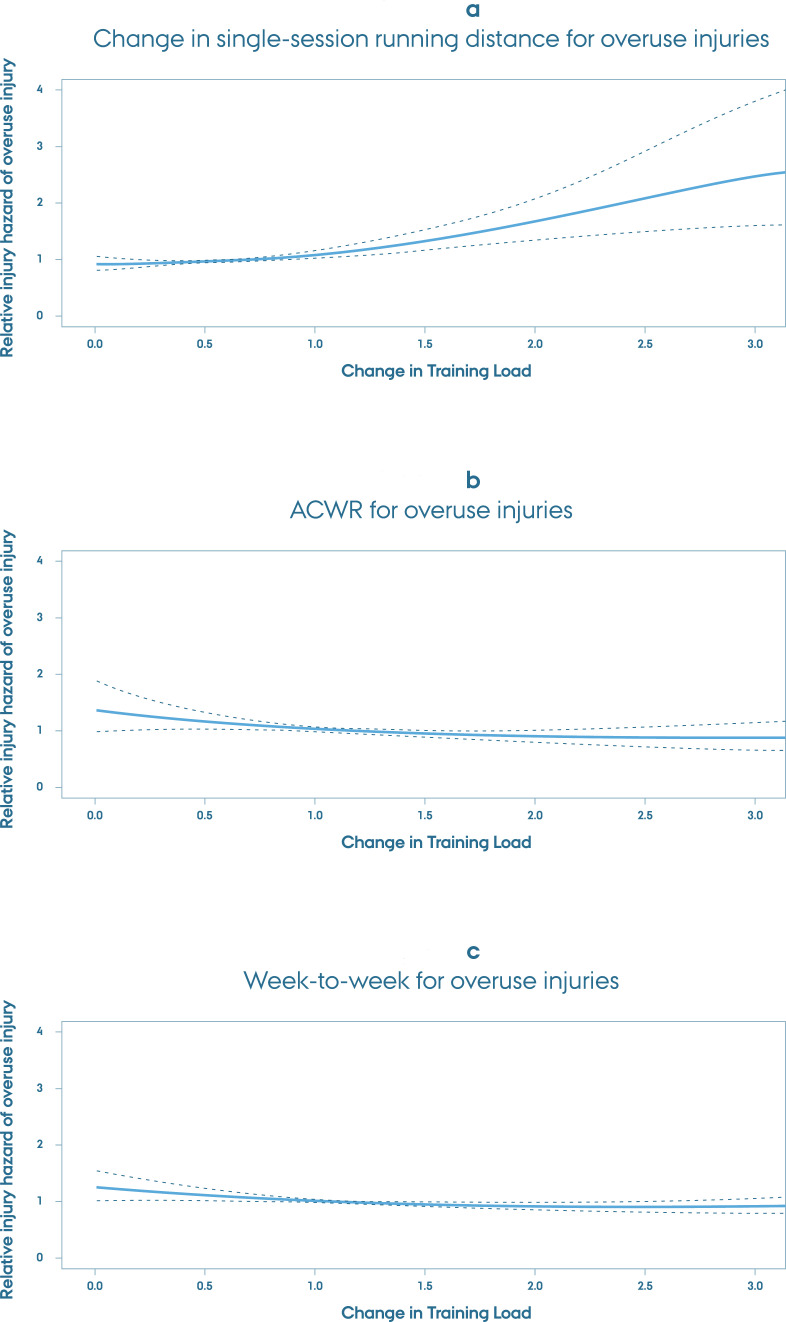
- Compared with regression or ≤10% progression, single-session distance spikes were associated with increased overuse injury rates: >10–30% HRR=1.64 (95% CI 1.31 to 2.05, p=0.01); >30–100% HRR=1.52 (1.16 to 2.00, p<0.01); >100% HRR=2.28 (1.50 to 3.48, p<0.01).
- For ACWR, a negative dose-response was observed: large spikes >100% had adjusted HRR=0.75 (95% CI 0.59 to 0.96, p=0.02) for overuse injuries; no significant relationship was identified for the week-to-week ratio.
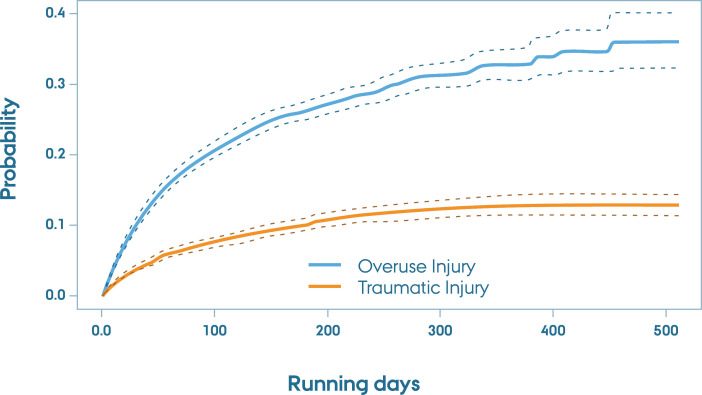
- At 200 sessions, 30.5% (95% CI 29.0% to 32.0%) had reported an overuse injury and 12.0% (11.0% to 13.1%) a traumatic injury. Sensitivity analyses with cut-offs from 10% to 1% suggested increases from 1% to 10% were associated with increased injury rate.
Methods
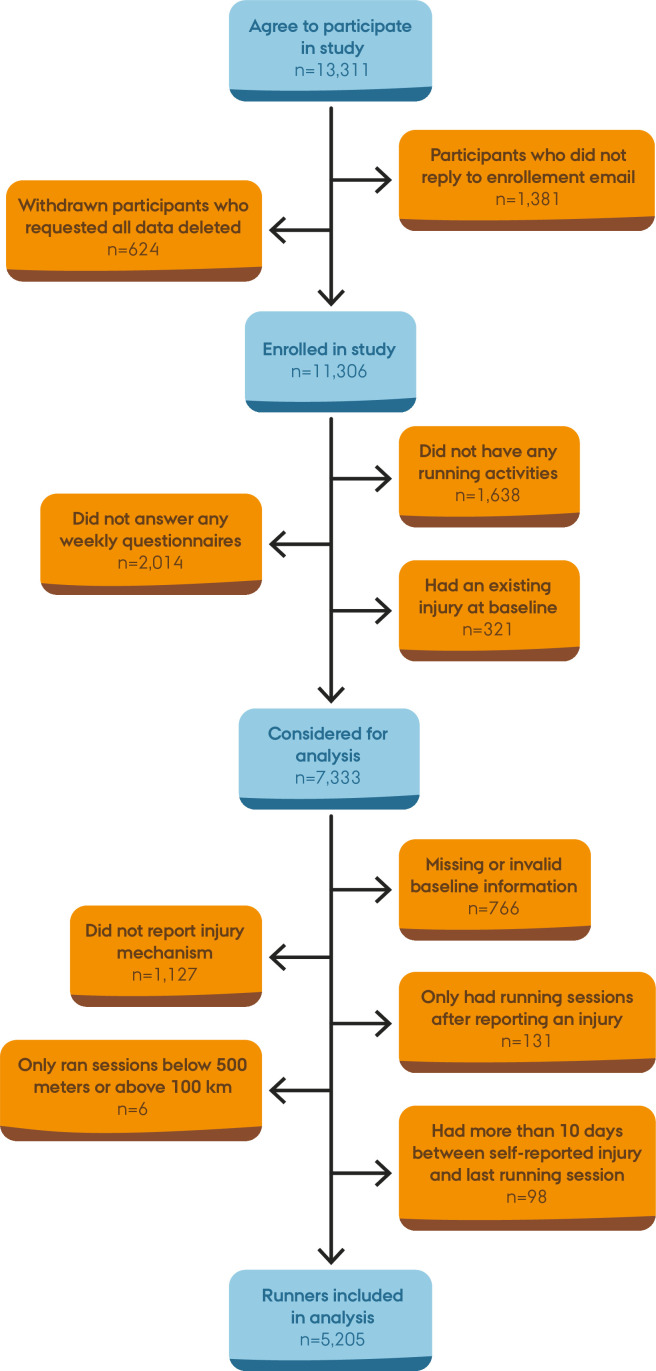
- Longitudinal data from the Garmin-RUNSAFE Running Health study; 18-month follow-up, enrolment 4 July–1 December 2019, follow-up until January 2021; 5205 adult runners who wore Garmin GPS devices, uploaded running data via Garmin Connect, and answered weekly questionnaires; exclusions included existing musculoskeletal problem at baseline, no running activity, and other criteria.
- Exposures were time-varying relative changes in running distance: (1) single-session distance relative to the longest session in the preceding 30 days; (2) uncoupled ACWR (1-week acute vs prior 3-week chronic); (3) week-to-week ratio. Runners were categorised as regression/≤10% (reference), small spike >10–30%, moderate >30–100%, large >100%, or not possible.
- Outcome was first self-reported overuse running-related injury; traumatic injuries were competing risks. Multistate Cox regression estimated adjusted hazard rate ratios, adjusted for age, BMI, sex, previous problems, and running experience. The study was exploratory; no a priori sample size or power calculation was made.
Limitations
- Stated: self-reported injury outcomes (information bias; injury definition did not require complete stoppage; runners may misclassify overuse vs traumatic, possibly inflating traumatic injuries); running distance as exposure and binned exposure states; analytical approach and generalisability; causal assumptions.
- Stated: other risk factors beyond training load (previous injury, absolute running distance, age, diseases/musculoskeletal conditions, BMI) were not included as effect measure modifiers due to low injury numbers, raising risk of spare data bias, so subgroup-specific advice was not possible.
- Stated/evident: observational design limits causal claims; authors call for randomised trials or target trial emulation. Evident from text: sample was predominantly male (77.9%) and from Europe/North America, recruited via Garmin newsletters/clubs/magazines, and required Garmin watch use, which may limit generalisability and inclusivity.
Model-written summary. Check it against the paper before relying on it.
Integrity signals
Registry
Cites
Statistics
Figures
Verification
Claims the paper makes
0 Valid · 0 Not valid · 26 Not checked · 40 Own results and interpretations
A result the paper reports from its own data — it cites no other source for it, so there is none to check. The quote shows it is in the paper.
In the paper
“significantly increased rates were identified for small spikes (hazard rate ratio (HRR)=1.64 (95% CI: 1.31 to 2.05, p=0.01))”
§ How much running is too much? Identifying high-risk running sessions in a 5200-person cohort study > Results
plainstates an association- Asserted: passes — The authors put it forward as true.
- Checkable: passes — It can be checked against evidence.
- Load-bearing: passes — The paper’s conclusions depend on it.
- Based: passes — The paper gives a reason why it holds.
- Rests on an assumption not shown here.
A result the paper reports from its own data — it cites no other source for it, so there is none to check. The quote shows it is in the paper.
In the paper
“Most of these injuries were reported on the same day as the running session or the following 1–2 days after the running session (online supplemental S3).”
§ How much running is too much? Identifying high-risk running sessions in a 5200-person cohort study > Results
plainstates an association- Asserted: passes — The authors put it forward as true.
- Checkable: passes — It can be checked against evidence.
- Load-bearing: unclear — It is unclear whether the paper’s conclusions depend on it.
- Based: passes — The paper gives a reason why it holds.
A result the paper reports from its own data — it cites no other source for it, so there is none to check. The quote shows it is in the paper.
In the paper
“In addition, changing cut-offs from 10% to 1% revealed an increase in distance from 1% to 10% to be associated with an increased injury rate (online supplemental S7).”
§ How much running is too much? Identifying high-risk running sessions in a 5200-person cohort study > Results
plainstates an association- Asserted: passes — The authors put it forward as true.
- Checkable: passes — It can be checked against evidence.
- Load-bearing: unclear — It is unclear whether the paper’s conclusions depend on it.
- Based: passes — The paper gives a reason why it holds.
A result the paper reports from its own data — it cites no other source for it, so there is none to check. The quote shows it is in the paper.
In the paper
“Among 5205 runners (mean age 45.8 years, SD=10.4; 22% female), a total of 1820 (35%) sustained a running-related injury during 588 071 sessions.”
- Also stated in: § Results · plain
“Of the 5205 runners, a total of 1820 (35.0%) reported a running-related injury”
§ How much running is too much? Identifying high-risk running sessions in a 5200-person cohort study > Abstract > Results
plain- Asserted: passes — The authors put it forward as true.
- Checkable: passes — It can be checked against evidence.
- Load-bearing: passes — The paper’s conclusions depend on it.
- Based: passes — The paper gives a reason why it holds.
- Also stated in: § Results · plain
A result the paper reports from its own data — it cites no other source for it, so there is none to check. The quote shows it is in the paper.
In the paper
“The present study identified a dose-response relationship between a spike in the number of kilometres run during a single running session and running injury development (table 1).”
- Also stated in: § Conclusion · boosted
“This study has revealed that a significant dose-response relationship exists between changes in single-session distance and running-related injuries in a cohort of 5205 adult runners, predominantly males from Europe and North America.”
§ How much running is too much? Identifying high-risk running sessions in a 5200-person cohort study > Discussion
boostedstates an associationn = 5,205- Asserted: passes — The authors put it forward as true.
- Checkable: passes — It can be checked against evidence.
- Load-bearing: passes — The paper’s conclusions depend on it.
- Based: passes — The paper gives a reason why it holds.
- Also stated in: § Conclusion · boosted
32 more claims
Create a free account to see all 66 claims and to verify the 30 references still open.
- It may state two separate claims as one. 14
- Probably not a substantial claim. 21
Self-check
Percentages, sums and reported differences re-computed from the paper’s own numbers.
Each contradiction between two passages listed here was confirmed by an independent check.
Rated major: it would touch a result — a value a result rests on, reported and recomputed p-values on opposite sides of the significance level, two passages that conflict with no sign which is right, or a cited work retracted before this paper was published.
In the paper
§ How much running is too much? Identifying high-risk running sessions in a 5200-person cohort study > Results
“small, moderate and large spikes in weekly running dose were associated with a significantly decreased rate of injury if the calculation of change in running distance was based on the ACWR.”
§ How much running is too much? Identifying high-risk running sessions in a 5200-person cohort study > Results
“| Change from>1.1 to 1.3 | 174 | Minor spike from>10% to 30% | 0.94 | (0.79 to 1.12) | 0.47 | 0.94 | (0.79 to 1.12) | 0.47 | | Change from>1.3 to 2.0 | 275 | Medium spike from>30% to 100% | 0.87 | (0.75 to 1.02) | 0.08 | 0.87 | (0.75 to 1.02) | 0.08 |”
Rated minor: it would not touch a result — a value no result rests on, a p-value that stays on the same side of the significance level, or a conflict that is clerical, resolved elsewhere in the paper, or outside its own findings.
In the paper
§ How much running is too much? Identifying high-risk running sessions in a 5200-person cohort study > Results
“At 200 km, 30.5% (95% CI: 29.0% to 32.0%) reported an overuse injury and 12.0% (95% CI: 11.0% to 13.1%) had reported a traumatic injury.”
§ How much running is too much? Identifying high-risk running sessions in a 5200-person cohort study > Results
“At 200 sessions, 30.5% (95% CI: 29.0% to 32.0%) had reported an overuse injury and 12.0% (95% CI: 11.0% to 13.1%) had reported a traumatic injury.”
Rated minor: it would not touch a result — a value no result rests on, a p-value that stays on the same side of the significance level, or a conflict that is clerical, resolved elsewhere in the paper, or outside its own findings.
In the paper
§ How much running is too much? Identifying high-risk running sessions in a 5200-person cohort study > Abstract > Conclusion
“A significant increase in the rate of running-related overuse injury was found when the distance of a single running session exceeded 10% of the longest run undertaken in the last 30 days.”
§ How much running is too much? Identifying high-risk running sessions in a 5200-person cohort study > Methods > Exposure
“(1) regression (running less than the longest run), or up to 10% progression (reference); (2) small spike corresponding to a progression between >10% and 30%”
Citations
Cites
Relaxing the Rule of Ten Events per Variable in Logistic and Cox Regression
Vittinghoff, E., & McCulloch, C. E. (2007) · American Journal of Epidemiology · doi:10.1093/aje/kwk052 · Cited by 4,359
The training—injury prevention paradox: should athletes be training smarter and harder?
Gabbett, T. J. (2016) · British Journal of Sports Medicine · doi:10.1136/bjsports-2015-095788 · Cited by 1,621
Monitoring Athlete Training Loads: Consensus Statement
Bourdon, P. C., Cardinale, M., Murray, A., Gastin, P., Kellmann, M., Varley, M. C., Gabbett, T. J., Coutts, A. J., Burgess, D. J., Gregson, W., et al. (2017) · International Journal of Sports Physiology and Performance · doi:10.1123/ijspp.2017-0208 · Cited by 1,206
Soligard, T., Schwellnus, M., Alonso, J.-M., Bahr, R., Clarsen, B., Dijkstra, H. P., Gabbett, T., Gleeson, M., Hägglund, M., Hutchinson, M. R., et al. (2016) · British Journal of Sports Medicine · doi:10.1136/bjsports-2016-096581 · Cited by 1,041
Target Trial Emulation: A Framework for Causal Inference From Observational Data
Hernán, M. A., Wang, W., & Leaf, D. E. (2022) · JAMA · doi:10.1001/jama.2022.21383 · Cited by 994
Clarsen, B., Myklebust, G., & Bahr, R. (2013) · British Journal of Sports Medicine · doi:10.1136/bjsports-2012-091524 · Cited by 755
Videbæk, S., Bueno, A. M., Nielsen, R. O., & Rasmussen, S. (2015) · Sports Medicine · doi:10.1007/s40279-015-0333-8 · Cited by 531
Self-citationInjuries in Runners; A Systematic Review on Risk Factors and Sex Differences
van der Worp, M. P., ten Haaf, D. S. M., van Cingel, R., de Wijer, A., Nijhuis-van der Sanden, M. W. G., & Staal, J. B. (2015) · PLOS ONE · doi:10.1371/journal.pone.0114937 · Cited by 361
A Consensus Definition of Running-Related Injury in Recreational Runners: A Modified Delphi Approach
Yamato, T. P., Saragiotto, B. T., & Lópes, A. D. (2015) · Journal of Orthopaedic and Sports Physical Therapy · doi:10.2519/jospt.2015.5741 · Cited by 317
A framework for the etiology of running‐related injuries
Bertelsen, M. L., Hulme, A., Petersen, J., Brund, R. K., Sørensen, H., Finch, C. F., Parner, E. T., & Nielsen, R. O. (2017) · Scandinavian Journal of Medicine & Science in Sports · doi:10.1111/sms.12883 · Cited by 276
Self-citationRunning across Europe: The Rise and Size of One of the Largest Sport Markets
Scheerder, J., Breedveld, K., & Borgers, J. (2015) · Palgrave Macmillan UK eBooks · doi:10.1057/9781137446374 · Cited by 267
Meta-Analyses of the Effects of Habitual Running on Indices of Health in Physically Inactive Adults
Hespanhol Junior, L. C., Pillay, J. D., van Mechelen, W., & Verhagen, E. (2015) · Sports Medicine · doi:10.1007/s40279-015-0359-y · Cited by 265
Nielsen, R. Ø., Parner, E. T., Nohr, E. A., Sørensen, H., Lind, M., & Rasmussen, S. (2014) · Journal of Orthopaedic & Sports Physical Therapy · doi:10.2519/jospt.2014.5164 · Cited by 207
Self-citationRisk factors for overuse injuries in short- and long-distance running: A systematic review
van Poppel, D., van der Worp, M. P., Slabbekoorn, A., van den Heuvel, S. P., van Middelkoop, M., Koes, B. W., Verhagen, A. P., & Scholten-Peeters, G. G. M. (2020) · Journal of sport and health science/Journal of Sport and Health Science · doi:10.1016/j.jshs.2020.06.006 · Cited by 181
Buist, I., Bredeweg, S. W., van Mechelen, W., Lemmink, K. A. P. M., Pepping, G.-J., & Diercks, R. L. (2008) · The American Journal of Sports Medicine · doi:10.1177/0363546507307505 · Cited by 167
A step towards understanding the mechanisms of running-related injuries
Malisoux, L., Nielsen, R. O., Urhausen, A. J. P., & Theisen, D. (2014) · Journal of science and medicine in sport · doi:10.1016/j.jsams.2014.07.014 · Cited by 146
Self-citationHollander, K., Rahlf, A. L., Wilke, J., Edler, C., Steib, S., Junge, A., & Zech, A. (2021) · Sports Medicine · doi:10.1007/s40279-020-01412-7 · Cited by 128
Risk and Protective Factors for Middle- and Long-Distance Running-Related Injury
Hulme, A., Nielsen, R. O., Timpka, T., Verhagen, E., & Finch, C. (2017) · Sports Medicine · doi:10.1007/s40279-016-0636-4 · Cited by 120
Self-citationJanssen, M., Scheerder, J., Thibaut, E., Brombacher, A., & Vos, S. (2017) · PLOS ONE · doi:10.1371/journal.pone.0181167 · Cited by 110
Reasons and predictors of discontinuation of running after a running program for novice runners
Fokkema, T., Hartgens, F., Kluitenberg, B., Verhagen, E., Backx, F. J. G., van der Worp, H., Bierma-Zeinstra, S. M. A., Koes, B. W., & van Middelkoop, M. (2019) · Journal of Science and Medicine in Sport · doi:10.1016/j.jsams.2018.06.003 · Cited by 87
Saragiotto, B. T., Yamato, T. P., & Lopes, A. D. (2014) · Journal of Orthopaedic & Sports Physical Therapy · doi:10.2519/jospt.2014.5710 · Cited by 86
Health and the running body: Notes from an ethnography
Shipway, R., & Holloway, I. (2013) · International Review for the Sociology of Sport · doi:10.1177/1012690213509807 · Cited by 84
Damsted, C., Glad, S., Nielsen, R. O., Sørensen, H., & Malisoux, L. (2018) · International Journal of Sports Physical Therapy · doi:10.26603/ijspt20180931 · Cited by 83
Self-citationMaupin, D., Schram, B., Canetti, E., & Orr, R. (2020) · Open Access Journal of Sports Medicine · doi:10.2147/oajsm.s231405 · Cited by 78
Nielsen, R. O., Malisoux, L., Møller, M., Theisen, D., & Parner, E. T. (2016) · Journal of Orthopaedic and Sports Physical Therapy · doi:10.2519/jospt.2016.6510 · Cited by 74
Self-citationCHecklist for statistical Assessment of Medical Papers: the CHAMP statement
Mansournia, M. A., Collins, G. S., Nielsen, R. O., Nazemipour, M., Jewell, N. P., Altman, D. G., & Campbell, M. J. (2021) · British Journal of Sports Medicine · doi:10.1136/bjsports-2020-103651 · Cited by 73
Self-citationTime-to-event analysis for sports injury research part 2: time-varying outcomes
Nielsen, R. O., Bertelsen, M. L., Ramskov, D., Møller, M., Hulme, A., Theisen, D., Finch, C. F., Fortington, L. V., Mansournia, M. A., & Parner, E. T. (2018) · British Journal of Sports Medicine · doi:10.1136/bjsports-2018-100000 · Cited by 70
Self-citationGabbett, T. J., Hulin, B. T., BLANCH, P. D., Chapman, P. P., & Bailey, D. (2019) · International Journal of Sports Medicine · doi:10.1055/a-0955-5589 · Cited by 64
Fokkema, T., van Damme, A. A. D. N., Fornerod, M. W. J., de Vos, R., Bierma‐Zeinstra, S. M. A., & van Middelkoop, M. (2020) · Scandinavian Journal of Medicine & Science in Sports · doi:10.1111/sms.13725 · Cited by 62
Can GPS Be Used to Detect Deleterious Progression in Training Volume Among Runners?
Nielsen, R. O., Cederholm, P., Buist, I., Sørensen, H., Lind, M., & Rasmussen, S. (2013) · Journal of Strength and Conditioning Research · doi:10.1519/jsc.0b013e3182711e3c · Cited by 57
Self-citationTime-to-event analysis for sports injury research part 1: time-varying exposures
Nielsen, R. O., Bertelsen, M. L., Ramskov, D., Møller, M., Hulme, A., Theisen, D., Finch, C. F., Fortington, L. V., Mansournia, M. A., & Parner, E. T. (2018) · British Journal of Sports Medicine · doi:10.1136/bjsports-2018-099408 · Cited by 56
Self-citationMenheere, D., Janssen, M., Funk, M., van der Spek, E. D., Lallemand, C., & Vos, S. B. (2020) · International Journal of Environmental Research and Public Health · doi:10.3390/ijerph17176046 · Cited by 46
Fokkema, T., Burggraaff, R., Hartgens, F., Kluitenberg, B., Verhagen, E. A. L. M., BACKX, F. J. G., van der Worp, H., Bierma‐Zeinstra, S., Koes, B. W., & van Middelkoop, M. (2018) · Journal of science and medicine in sport · doi:10.1016/j.jsams.2018.09.001 · Cited by 32
Validity of Self-Reported Running Distance
Dideriksen, M., Soegaard, C., & Nielsen, R. O. (2016) · Journal of Strength and Conditioning Research · doi:10.1519/jsc.0000000000001244 · Cited by 30
Self-citationNielsen, R. Ø., Bertelsen, M. L., Ramskov, D., Damsted, C., Brund, R. K., Parner, E. T., Sørensen, H., Rasmussen, S., & Kjærgaard, S. (2019) · BMJ Open · doi:10.1136/bmjopen-2019-032627 · Cited by 25
Self-citationTraining patterns associated with injury in New York City Marathon runners
Toresdahl, B. G., Metzl, J. D., Kinderknecht, J. J., Mcelheny, K., de Mille, P., Quijano, B., & Fontana, M. A. (2022) · British Journal of Sports Medicine · doi:10.1136/bjsports-2022-105670 · Cited by 25
Ramskov, D., Rasmussen, S., Sørensen, H., Parner, E. T., Lind, M., & Nielsen, R. O. (2018) · BMJ Open Sport & Exercise Medicine · doi:10.1136/bmjsem-2017-000333 · Cited by 24
Self-citationSmits, D.-W., Backx, F., Van Der Worp, H., Van Middelkoop, M., Hartgens, F., Verhagen, E., Kluitenberg, B., & Huisstede, B. (2019) · Research in Sports Medicine · doi:10.1080/15438627.2018.1492399 · Cited by 21
Nielsen, R. O., Bertelsen, M. L., Møller, M., Hulme, A., Mansournia, M. A., Casals, M., & Parner, E. T. (2020) · British Journal of Sports Medicine · doi:10.1136/bjsports-2018-100245 · Cited by 19
Self-citationNakaoka, G., Barboza, S. D., Verhagen, E., van Mechelen, W., & Hespanhol, L. (2021) · Sports Medicine · doi:10.1007/s40279-021-01483-0 · Cited by 16
Injured Runners Do Not Replace Lost Running Time with Other Physical Activity
Davis, J. J., & Gruber, A. H. (2019) · Medicine & Science in Sports & Exercise · doi:10.1249/mss.0000000000002227 · Cited by 15
Peterson, B. J., Searle, A., Spink, M. J., Hawke, F., Callister, R., & Chuter, V. (2022) · PLoS ONE · doi:10.1371/journal.pone.0273401 · Cited by 13
Linton, L., Barr, M., & Valentin, S. (2022) · Journal of Sport Rehabilitation · doi:10.1123/jsr.2021-0364 · Cited by 11
Definitions and surveillance methods of running‐related injuries: A scoping review
Lacey, A., Whyte, E., Dillon, S., O’Connor, S., Burke, A., & Moran, K. (2024) · European Journal of Sport Science · doi:10.1002/ejsc.12123 · Cited by 10
Cloosterman, K. L. A., Fokkema, T., de Vos, R.-J., van Oeveren, B., Bierma-Zeinstra, S. M. A., & van Middelkoop, M. (2022) · BMC Sports Science, Medicine and Rehabilitation · doi:10.1186/s13102-022-00472-8 · Cited by 9
Frandsen, J. S. B., Simonsen, N. S., Hulme, A., Jacobsen, J. S., & Nielsen, R. Ø. (2025) · JOSPT Open · doi:10.2519/josptopen.2024.0075 · Cited by 4
Self-citationRunning: How to Safely Increase Your Mileage
(2014) · Journal of Orthopaedic & Sports Physical Therapy · doi:10.2519/jospt.2014.0506 · Cited by 2
Joachim, M. R., Heiderscheit, B. C., & Kliethermes, S. A. (2024) · Injury Prevention · doi:10.1136/ip-2024-045233 · Cited by 2
(2003) · PubMed Central
Cited by
Cipryan, L., Skýpala, J., Litschmannová, M., Jandačka, D., Dostal, T., Sindler, D., Zahradník, D., & Hofmann, P. (2026) · Scandinavian Journal of Medicine and Science in Sports · doi:10.1111/sms.70225 · Cited by 2
Salama, Y., & Gadbois, W. J. (2026) · Journal of Orthopaedic Reports · doi:10.1016/j.jorep.2026.101002 · Cited by 2
Mind to Move: A Narrative Review of Individualized Running Biomechanics Beyond the Spring-Mass Model
Gindre, C., Lussiana, T., Breine, B., & Patoz, A. (2026) · Sports Medicine · doi:10.1007/s40279-026-02449-w · Cited by 2
Franks, C., Yockey, A., Bosley, N., Myers, T., Armstrong, K., Valliant, M. W., & Wade, C. (2025) · Sports · doi:10.3390/sports13110411 · Cited by 1
Running with an exotendon reduces compressive knee contact force
Stingel, J. P., Haralabidis, N., Hicks, J. L., Uhlrich, S. D., & Delp, S. L. (2026) · Journal of Biomechanics · doi:10.1016/j.jbiomech.2026.113217 · Cited by 1
Metadata
- Authors
- Schuster Brandt Frandsen, J., Hulme, A., Parner, E. T., Møller, M., Lindman, I., Abrahamson, J., Sjørup Simonsen, N., Sandell Jacobsen, J., Ramskov, D., Skejø, S., Malisoux, L., Bertelsen, M. L., & Nielsen, R. O.
- Affiliations
- Big Data Centre for Environment and Health, Aarhus University, Aarhus, Denmark
- The University of Queensland (AU)
- Aarhus University (DK)
- University of Southern Denmark (DK)
- Region Västra Götaland (SE)
- Sahlgrenska University Hospital (SE)
- Department of Public Health, Aarhus University, Aarhus, Denmark
- University College of Northern Denmark (DK)
- Luxembourg Institute of Health (LU)
- Corresponding author
- Nielsen, Rasmus Oestergaard
- ORCID
- Venue
- British Journal of Sports Medicine
- Publisher
- BMJ
- Published
- 2025-07-07
- Volume
- 59
- Issue
- 17
- Pages
- 1203-1210
- ISSN
- 0306-3674 (ISSN-L)
- 1473-0480
- PMC
- PMC12421110
- OpenAlex
- W4412089571
- Cited by
- 25
- References
- 49
- Citations by year
- 2026: 21 · 2025: 4
- FWCI
- 15.40
- Type
- journal article
- Language
- en
- Open access
- hybrid
- doi.org
- Licence
- Locations
- British Journal of Sports Medicine (publishedVersion, cc-by-nc)
- PubMed Central (publishedVersion, cc-by-nc)
- Europe PMC (PubMed Central) (publishedVersion, cc-by-nc)
- PubMed (publishedVersion)
- University of Southern Denmark Research Portal (University of Southern Denmark) (publishedVersion, cc-by-nc)
- Funders
- Danish Rheumatism Association (R160-A5157)
- Aarhus University Research Foundation (AUFF-E-2015-FLS-9-9)
- Topics
- Health Sciences › Medicine › Orthopedics and Sports Medicine › Sports injuries and prevention
- Physical Sciences › Engineering › Biomedical Engineering › Lower Extremity Biomechanics and Pathologies
- Health Sciences › Medicine › Orthopedics and Sports Medicine › Sports Performance and Training
- Keywords
- acute:chronic workload ratio, training load, running injury risk, dose-response relationship
- MeSH terms
- Adult, Athletic Injuries, Female, Humans, Male, Middle Aged, Cumulative Trauma Disorders, Risk Factors, Running, Time Factors, Cohort Studies, Proportional Hazards Models, Physical Conditioning, Human
About these checks
Registry, retraction, Cites and statistics results are computed, not judged, with one exception: a printed reference that no index lists is read once by a model before it counts as a citation error. Claims are extracted by a model and kept only when their quote appears verbatim in the text; each cited source is then checked, with a model’s help, for whether it says what the claim relies on. Those verdicts can be wrong — read the claim’s quote and the cited source before relying on one.
A language model drew the claims from the paper on 2026-11-19, under version 3 of the claim definition (model deepseek-v4.1-flash, prompt extract-v3).
A second model labelled each claim on 2026-11-19 (model jev-1.13-20260917, definition revision gold-guideline-v0.2).
Statistics and arithmetic are recomputed, not judged.
Confidence bands are shown only for fields calibrated on our annotated test set. None is calibrated yet, so no band is shown.
What counts as a claim ›How we measure confidence ›How we check this ›
Are you an author, or do you see a problem with this page? Request a review
Data sources
Bibliographic data: Semantic Scholar, OpenAlex, Crossref.
Contains information from the Semantic Scholar Academic Graph Datasets, made available under the ODC Attribution License (ODC-BY 1.0).
Semantic Scholar’s data is described in: Kinney, R., et al. (2023). The Semantic Scholar Open Data Platform. arXiv:2301.10140.
