

Ketamine for the acute treatment of severe suicidal ideation: double blind, randomised placebo controlled trial
Open accessThe DOI matches its Crossref record; 37 of the 37 references it cites were found in a registry or an index; 12 of the 44 sources its claims cite were checked for support.
Abstract
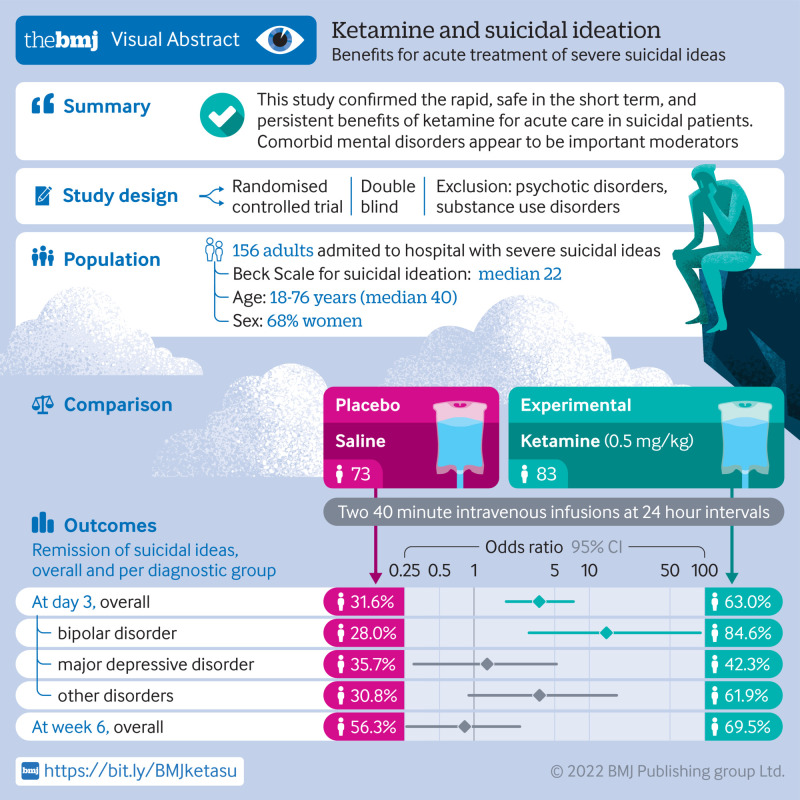
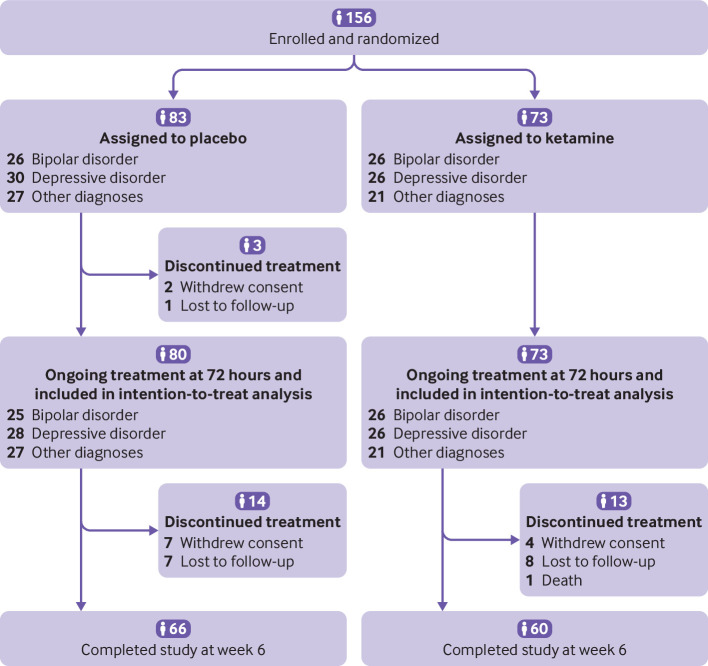
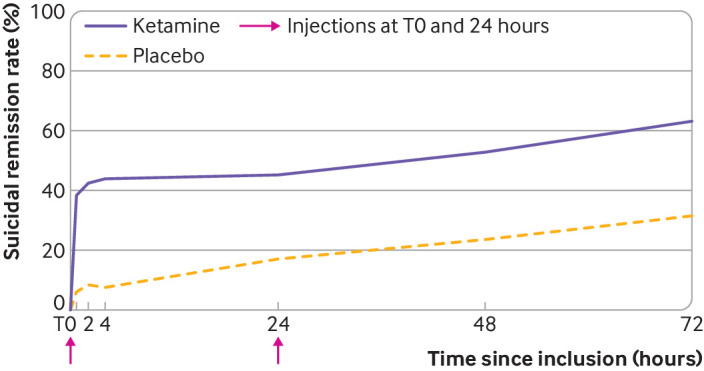
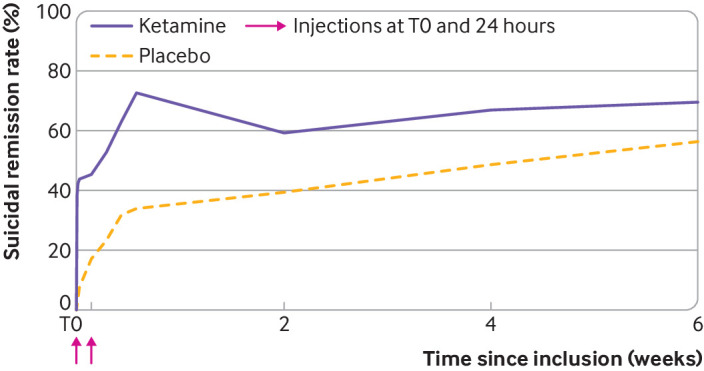
Objective: To confirm the rapid onset anti-suicidal benefits of ketamine in the short term and at six weeks, overall and according to diagnostic group. Design: Prospective, double blind, superiority, randomised placebo controlled trial. Setting: Seven French teaching hospitals between 13 April 2015 and 12 March 2019. Eligibility criteria for participants: Aged 18 or older with current suicidal ideation, admitted to hospital voluntarily. Exclusion criteria included a history of schizophrenia or other psychotic disorders, substance dependence, and contraindications for ketamine. Participants: 156 participants were recruited and randomised to placebo (n=83) or ketamine (n=73), stratified by centre and diagnosis: bipolar, depressive, or other disorders. Intervention: Two 40 minute intravenous infusions of ketamine (0.5 mg/kg) or placebo (saline) were administered at baseline and 24 hours, in addition to usual treatment. Main outcome measures: The primary outcome was the rate of patients in full suicidal remission at day 3, according to the scale for suicidal ideation total score ≤3. Analyses were conducted on an intention-to-treat basis. Results: More participants receiving ketamine reached full remission of suicidal ideas at day 3 than those receiving placebo: 46 (63.0%) of 83 participants in the ketamine arm and 25 (31.6%) of 73 in the placebo arm (odds ratio 3.7 (95% confidence interval 1.9 to 7.3), P<0.001). This effect differed according to the diagnosis (treatment: P<0.001; interaction: P=0.02): bipolar (odds ratio 14.1 (95% confidence interval 3.0 to 92.2), P<0.001), depressive (1.3 (0.3 to 5.2), P=0.6), or other disorders (3.7 (0.9 to 17.3, P=0.07)). Side effects were limited. No manic or psychotic symptom was seen. Moreover, a mediating effect of mental pain was found. At week 6, remission in the ketamine arm remained high, although non-significantly versus placebo (69.5% v 56.3%; odds ratio 0.8 (95% confidence interval 0.3 to 2.5), P=0.7). Conclusions: The findings indicate that ketamine is rapid, safe in the short term, and has persistent benefits for acute care in suicidal patients. Comorbid mental disorders appear to be important moderators. An analgesic effect on mental pain might explain the anti-suicidal effects of ketamine. Trial registration: ClinicalTrials.gov NCT02299440 .
Overview
CoChat Summary
TL;DR
In this double-blind randomised placebo-controlled trial, two intravenous ketamine infusions (0.5 mg/kg) rapidly increased full remission of severe suicidal ideation at day 3 compared with saline in voluntarily hospitalised adults. The effect differed by diagnostic group, was strongest in bipolar disorder, and was not statistically significant versus placebo at week 6.
Key findings
- At day 3, full suicidal remission (clinician-rated SSI total score ≤3) occurred in 46 (63.0%) of 73 patients in the ketamine arm versus 25 (31.6%) of 79 patients with data in the placebo arm (odds ratio 3.7, 95% confidence interval 1.9 to 7.3, P<0.001).
- The treatment effect differed by diagnosis (interaction P=0.02 or P=0.03 in adjusted analysis): bipolar disorder odds ratio 14.1 (3.0 to 92.2), P<0.001; depressive disorder 1.3 (0.3 to 5.2), P=0.6; other diagnoses 3.7 (0.9 to 17.3), P=0.07.
- At week 6, remission remained higher in the ketamine arm but was non-significant versus placebo: 69.5% v 56.3%; odds ratio 0.8 (0.3 to 2.5), P=0.7.
- Side effects were limited: 17 (23.3%) ketamine patients versus 7 (8.4%) placebo patients experienced at least one side effect; common ketamine side effects were sedation (11.0%), depersonalisation (9.6%), and nausea (6.8%). No manic or psychotic symptoms were seen. A mediation analysis suggested the anti-suicidal effect was mediated by reduced psychological pain.
Methods
- Prospective, double-blind, superiority, randomised placebo-controlled trial conducted in seven French teaching hospitals between 13 April 2015 and 12 March 2019; 156 adults aged ≥18 with current suicidal ideation, voluntarily admitted, were randomised 1:1 to ketamine (n=73) or placebo (n=83), stratified by centre and diagnosis (bipolar, depressive, or other).
- Intervention: two 40-minute intravenous infusions of ketamine (0.5 mg/kg) or placebo (0.9% saline) at baseline and 24 hours, in addition to usual treatment.
- Primary outcome: rate of full suicidal remission at day 3, defined as clinician-rated SSI total score ≤3; intention-to-treat analysis used logistic regression with arm-by-diagnostic-group interaction, Holm correction, linear mixed models for secondary outcomes, and a mediation model for psychological pain.
Limitations
- The paper states that diagnostic-group analyses used smaller samples, which may explain the large effect size in bipolar disorder and the lack of significant difference in depressive disorders; masking may have been compromised because ketamine can induce recognisable effects such as depersonalisation and dizziness, though this was not formally measured; and rapid resolution of suicidal ideas does not equate to reduced risk of suicidal acts, with similar suicide attempt rates during follow-up and potential for ketamine abuse requiring longer follow-up.
- Evident from the text: one centre included 75.0% of all patients, which may limit generalisability.
- Evident from the text: the abstract reports ketamine n=83 and placebo n=73, whereas the Methods and Results report ketamine n=73 and placebo n=83; the day 3 placebo denominator is also reported as 79 in the Results.
Model-written summary. Check it against the paper before relying on it.
Integrity signals
Registry
Cites
Statistics
Figures
Verification
Claims the paper makes
8 Valid · 2 Not valid · 22 Not checked · 80 Own results and interpretations
The cited sources support only part of this claim — read each source’s verdict below.
In the paper
“Firstly, the suicidal risk was often poorly measured (eg, with one single item of a depression scale).”
§ Ketamine for the acute treatment of severe suicidal ideation: double blind, randomised placebo controlled trial > Introduction
What the sources say
- Partly supportedcites [8] Diazgranados N Ibrahim L Brutsche NE. A randomized add-on trial of an N-methyl-D-aspartate antagonist in treatment-resistant bipolar depression. Arch Gen Psychiatry 2010; 67: 793- 802. 10.1001/archgenpsychiatry.2010.90 20679587 PMC3000408 sourceExperimental — accuracy not yet measured
Methods > Main Outcome Measures identifies the MADRS as this trial’s primary depression measure, and Results > Efficacy reports suicidal thoughts in an analysis of individual MADRS items. This supports the single-item example, but the paper does not say that previous ketamine studies often measured suicidal risk poorly. (LLM, conf=0.83)
- Not checked yetcites [9] Xiong J Lipsitz O Chen-Li D. The acute antisuicidal effects of single-dose intravenous ketamine and intranasal esketamine in individuals with major depression and bipolar disorders: A systematic review and meta-analysis. J Psychiatr Res 2021; 134: 57- 68. 10.1016/j.jpsychires.2020.12.038 33360864 source
- Supportedcites [10] Grunebaum MF Galfalvy HC Choo TH. Ketamine for Rapid Reduction of Suicidal Thoughts in Major Depression: A Midazolam-Controlled Randomized Clinical Trial. Am J Psychiatry 2018; 175: 327- 35. 10.1176/appi.ajp.2017.17060647 29202655 PMC5880701 source
The Abstract says that earlier reports of reduced suicidal ideation after ketamine were limited by measuring suicidal ideation with a single item from a depression inventory. This directly supports the citing sentence; the supplied passage does not specify a page. (LLM, conf=0.94)
plain- Asserted: passes — The authors put it forward as true.
- Checkable: passes — It can be checked against evidence.
- Load-bearing: passes — The paper’s conclusions depend on it.
- Based: passes — The paper gives a reason why it holds.
- Partly supported
The cited sources support only part of this claim — read each source’s verdict below.
In the paper
“Secondly, response (usually defined as a 50% score reduction on a scale) was the most common outcome rather than remission (that is, complete absence of suicidal ideas).”
§ Ketamine for the acute treatment of severe suicidal ideation: double blind, randomised placebo controlled trial > Introduction
What the sources say
- Partly supportedcites [8] Diazgranados N Ibrahim L Brutsche NE. A randomized add-on trial of an N-methyl-D-aspartate antagonist in treatment-resistant bipolar depression. Arch Gen Psychiatry 2010; 67: 793- 802. 10.1001/archgenpsychiatry.2010.90 20679587 PMC3000408 sourceExperimental — accuracy not yet measured
Our copy supports only the definitional parenthetical: the Statistical Analysis section defines 'Response (50% improvement from baseline on MADRS) and remission (MADRS scores <10)'. The attributed generalization — that previous ketamine studies of suicidal ideation usually took response rather than remission as the outcome — is nowhere stated; this trial measured depressive-symptom outcomes (MADRS primary), and the suicidal-thoughts item is explicitly reported as not significantly changed (Results, Efficacy). If anything, the Comment compares this trial with the 2006 ketamine trial in treatment-resistant MDD on both response AND remission rates ('similar remission rates at day 1 (31% for both studies)'), so the prior literature it cites did report remission. The claim's outcome-convention point about suicidal ideation is not supported by this source. (LLM, conf=0.65)
- Not checked yetcites [9] Xiong J Lipsitz O Chen-Li D. The acute antisuicidal effects of single-dose intravenous ketamine and intranasal esketamine in individuals with major depression and bipolar disorders: A systematic review and meta-analysis. J Psychiatr Res 2021; 134: 57- 68. 10.1016/j.jpsychires.2020.12.038 33360864 source
- Partly supportedcites [10] Grunebaum MF Galfalvy HC Choo TH. Ketamine for Rapid Reduction of Suicidal Thoughts in Major Depression: A Midazolam-Controlled Randomized Clinical Trial. Am J Psychiatry 2018; 175: 327- 35. 10.1176/appi.ajp.2017.17060647 29202655 PMC5880701 sourceExperimental — accuracy not yet measured
Our copy supports the definitional half of the sentence: in Randomization and Blinding it states 'Treatment response was defined as a day 1 SSI score ≥50% below baseline. We defined remission more stringently as a day 1 SSI score ≥50% below baseline and less than the eligibility threshold of 4,' and its Discussion describes earlier ketamine trials in response terms (Murrough et al.: 'odds ratio for response=2.2'; Hu et al.: 'faster response'). However, the paper nowhere characterizes previous ketamine suicidal-ideation studies as having 'usually' used response rather than remission; the limitations it credits to prior work (Abstract introduction) are measurement of ideation with a single depression-inventory item, lack of a control group, saline control, low baseline suicidal ideation, and mixed diagnoses. Note also that this source's 'remission' is a ≥50% drop plus SSI <4, not the complete absence of suicidal ideas the citing sentence glosses. (LLM, conf=0.65)
plain- Asserted: passes — The authors put it forward as true.
- Checkable: passes — It can be checked against evidence.
- Load-bearing: passes — The paper’s conclusions depend on it.
- Based: passes — The paper gives a reason why it holds.
- Partly supported
The cited sources support only part of this claim — read each source’s verdict below.
In the paper
“This placebo effect is also higher than that found in a meta-analysis of 10 trials analysing 157 suicidal patients with overall remission rates (clinician rated measures) of around 30% in the control group.29”
§ Ketamine for the acute treatment of severe suicidal ideation: double blind, randomised placebo controlled trial > Discussion > Principal findings
What the sources say
- Partly supportedcites [29] Wilkinson ST Ballard ED Bloch MH. The Effect of a Single Dose of Intravenous Ketamine on Suicidal Ideation: A Systematic Review and Individual Participant Data Meta-Analysis. Am J Psychiatry 2018; 175: 150- 8. 10.1176/appi.ajp.2017.17040472 28969441 PMC5794524 sourceExperimental — accuracy not yet measured
The Results (Characteristics of the Included Sample; page unavailable) report 10 included trials, but 167 participants with baseline suicidal ideation, not 157. The Results (The Effects of Ketamine on Clinician-Administered Suicidal Ideation Item Scores; page unavailable) compare the proportion free of suicidal ideation with a control group, but the available text does not give an overall control-group remission rate of around 30%. The Methods (Study Identification and Selection; page unavailable) also specify that controls received either saline placebo or midazolam, so the control outcome cannot simply be called a placebo effect. (LLM, conf=0.88)
plainn = 157- Asserted: passes — The authors put it forward as true.
- Checkable: passes — It can be checked against evidence.
- Load-bearing: unclear — It is unclear whether the paper’s conclusions depend on it.
- Based: passes — The paper gives a reason why it holds.
- Partly supported
Every source the paper cites for this claim was checked and supports it.
In the paper
“Additionally, one study of treatment resistant depression suggests that repeated doses of ketamine might be necessary for some patients to achieve remission of severe suicidal ideas.30”
§ Ketamine for the acute treatment of severe suicidal ideation: double blind, randomised placebo controlled trial > Discussion > Principal findings
What the sources say
- Supportedcites [30] Phillips JL Norris S Talbot J. Single and repeated ketamine infusions for reduction of suicidal ideation in treatment-resistant depression. Neuropsychopharmacology 2020; 45: 606- 12. 10.1038/s41386-019-0570-x 31759333 PMC7021716 source
The Discussion states that in the TRD sample, SI decreased after three Phase 2 infusions on clinician-rated MADRS-SI while 'the full course of six infusions was required to result in a significant SI decrease' on self-reported QIDS-SI, and that 'patients may gain additional benefits from repeated infusions beyond those obtained from single infusions.' The Abstract reports that 'Overall, 69% of participants had a complete alleviation of SI following repeated infusions,' and the Discussion opening and the marked-SI subgroup results (18 participants with baseline MADRS-SI ≥ 4) confirm cumulative reductions 'even for those with high pretreatment SI severity.' The hedged phrasing of the claim ('might be necessary for some patients') matches the source's own cautious framing of remission/alleviation of severe suicidal ideation requiring repeated dosing. (LLM, conf=0.85)
hedgedstates a possible cause- Asserted: passes — The authors put it forward as true.
- Checkable: passes — It can be checked against evidence.
- Load-bearing: unclear — It is unclear whether the paper’s conclusions depend on it.
- Based: passes — The paper gives a reason why it holds.
- Supported
The cited sources support only part of this claim — read each source’s verdict below.
In the paper
“Results in bipolar disorder—a disorder associated with a high suicidal risk and limited options to treat depression27—are highly encouraging and support two previous small studies.8 28”
§ Ketamine for the acute treatment of severe suicidal ideation: double blind, randomised placebo controlled trial > Discussion > Principal findings
What the sources say
- Partly supportedcites [8] Diazgranados N Ibrahim L Brutsche NE. A randomized add-on trial of an N-methyl-D-aspartate antagonist in treatment-resistant bipolar depression. Arch Gen Psychiatry 2010; 67: 793- 802. 10.1001/archgenpsychiatry.2010.90 20679587 PMC3000408 sourceExperimental — accuracy not yet measured
Our copy does report the bipolar-disorder results the sentence rests on: the Abstract (Results) and Results > Efficacy sections document significant rapid antidepressant effects of IV ketamine (0.5 mg/kg) added to lithium or valproate in 18 inpatients with treatment-resistant bipolar depression (71% responded to ketamine vs 6% to placebo; effect maintained through day 3), which is the 'highly encouraging' part. What our copy nowhere states is that these results 'support two previous small studies': the Comment relates the findings instead to the authors' single prior trial in treatment-resistant major depressive disorder (ref 34), listing both similarities and differences (faster onset, higher response at 40 min but lower at day 1, shorter duration), and the only 'consistent with all published studies using ketamine' statement (refs 30, 33, 34, 49) concerns dissociative adverse effects, not antidepressant efficacy. The same Comment also hedges the strength of the result ('these preliminary results require cautious interpretation. First, the group size was small'), so the citing sentence's unqualified framing overstates the source. (LLM, conf=0.70)
- Supportedcites [28] Zarate CA Jr Brutsche NE Ibrahim L. Replication of ketamine’s antidepressant efficacy in bipolar depression: a randomized controlled add-on trial. Biol Psychiatry 2012; 71: 939- 46. 10.1016/j.biopsych.2011.12.010 22297150 PMC3343177 source
The superscript 27 is attached to the parenthetical clause, i.e. that bipolar disorder carries high suicidal risk and has limited options for treating depression. Our copy's Introduction states exactly that framing: BPD is 'one of the most severe and lethal of all psychiatric disorders', the delay in treating suicidal behavior 'is an issue of particular concern in this already vulnerable population', and although several treatments are prescribed for bipolar depression 'none rapidly improve depressive symptoms—including suicidal ideation'; the Abstract Background adds that 'currently, no pharmacological treatments for bipolar depression exist' with rapid antidepressant/antisuicidal effects. The 'two previous small studies' portion of the sentence carries the separate citations 8 and 28 and is not attributed to this source (this paper itself replicates only its own earlier small bipolar trial, ref. 4). (LLM, conf=0.85)
plainstates an associationn = 26- Asserted: passes — The authors put it forward as true.
- Checkable: passes — It can be checked against evidence.
- Load-bearing: unclear — It is unclear whether the paper’s conclusions depend on it.
- Based: passes — The paper gives a reason why it holds.
- Partly supported
52 more claims
Create a free account to see all 112 claims and to verify the 32 references still open.
- It may state two separate claims as one. 29
- Probably not a substantial claim. 34
- The quote only partly states this claim. 1
Claims other papers make about this one
Each is checked against this paper’s own text: does it say what the citing paper says it does?
The cited source says what the claim attributes to it.
In the citing paper
“recent research demonstrating that ketamine significantly improved full remission rates for those presenting with severe acute suicidal ideation, though this effect differed based on primary diagnosis [76].”
From Ketamine in neuropsychiatric disorders: an update (2024) · cites this paper as [76]
The cited source says what the claim attributes to it.
In the citing paper
“Pharmacological approaches, particularly rapid-acting agents (i.e., ketamine), have attracted growing attention due to their capacity to produce short-term reductions in depressive symptoms, suicidal ideation, and affective distress [75,76,77].”
From Targeting Psychological Pain After a Suicide Attempt: Scoping Review and Intervention Protocol (2026) · cites this paper as [76]
Self-check
Percentages, sums and reported differences re-computed from the paper’s own numbers.
Each contradiction between two passages listed here was confirmed by an independent check.
Rated major: it would touch a result — a value a result rests on, reported and recomputed p-values on opposite sides of the significance level, two passages that conflict with no sign which is right, or a cited work retracted before this paper was published.
In the paper
“46 (63.0%) of 83 participants in the ketamine arm”
§ Ketamine for the acute treatment of severe suicidal ideation: double blind, randomised placebo controlled trial > Abstract > Results
Reported 63 · recomputed 55.421687
Rated major: it would touch a result — a value a result rests on, reported and recomputed p-values on opposite sides of the significance level, two passages that conflict with no sign which is right, or a cited work retracted before this paper was published.
In the paper
“25 (31.6%) of 73 in the placebo arm”
§ Ketamine for the acute treatment of severe suicidal ideation: double blind, randomised placebo controlled trial > Abstract > Results
Reported 31.6 · recomputed 34.246575
Rated major: it would touch a result — a value a result rests on, reported and recomputed p-values on opposite sides of the significance level, two passages that conflict with no sign which is right, or a cited work retracted before this paper was published.
In the paper
§ Ketamine for the acute treatment of severe suicidal ideation: double blind, randomised placebo controlled trial > Abstract > Results
“odds ratio 0.8 (95% confidence interval 0.3 to 2.5), P=0.7”
§ Ketamine for the acute treatment of severe suicidal ideation: double blind, randomised placebo controlled trial > Results > Outcomes at week 6
“the ketamine arm continued to have better full suicidal remission than the placebo arm (69.5 v 56.3% at week 6)”
Rated minor: it would not touch a result — a value no result rests on, a p-value that stays on the same side of the significance level, or a conflict that is clerical, resolved elsewhere in the paper, or outside its own findings.
In the paper
§ Ketamine for the acute treatment of severe suicidal ideation: double blind, randomised placebo controlled trial > Methods > Randomisation and masking
“based on the Mini-International Neuropsychiatric Interview (MINI) 5.0,17”
§ Ketamine for the acute treatment of severe suicidal ideation: double blind, randomised placebo controlled trial > Results > Patient characteristics
“MINI=Mini-International Neuropsychiatric Interview, seventh version (7.0.2)”
Rated minor: it would not touch a result — a value no result rests on, a p-value that stays on the same side of the significance level, or a conflict that is clerical, resolved elsewhere in the paper, or outside its own findings.
In the paper
§ Ketamine for the acute treatment of severe suicidal ideation: double blind, randomised placebo controlled trial > Results > Main outcomes at day 3
“Here, suicidal remission corresponds to a score < 3 on the Beck scale for suicidal ideation, clinician rated version”
§ Ketamine for the acute treatment of severe suicidal ideation: double blind, randomised placebo controlled trial > Methods > Outcomes
“The primary outcome was the rate of patients with a clinician rated SSI total score ≤3 (that is, in current full suicidal remission) at day 3”
Citations
Cites
The Brief Psychiatric Rating Scale.
Overall, J. E., & Gorham, D. R. (1962) · Psychological Reports · doi:10.2466/pr0.1962.10.3.799 · Cited by 11,090
(1998) · PubMed · Cited by 10,216
A Rating Scale for Mania: Reliability, Validity and Sensitivity
Young, R. C., Biggs, J. T., Ziegler, V. E., & Meyer, D. A. (1978) · British Journal of Psychiatry · doi:10.1192/bjp.133.5.429 · Cited by 8,744
Molecular Mechanisms of Depression: Perspectives on New Treatment Strategies
Lang, U. E., & Borgwardt, S. (2013) · Cellular Physiology and Biochemistry · doi:10.1159/000350094 · Cited by 8,475
The mini international neuropsychiatric interview
Lecrubier, Y., Sheehan, D., Hergueta, T., & Weiller, E. (1998) · European Psychiatry · doi:10.1016/s0924-9338(99)80239-9 · Cited by 5,872
The measurement of pessimism: the hopelessness scale
Beck, A. T., Weissman, A., Lester, D., & Trexler, L. (1974) · Journal of Consulting and Clinical Psychology · doi:10.1037/h0037562 · Cited by 5,494
Posner, K., Brown, G. K., Stanley, B., Brent, D. A., Yershova, K. V., Oquendo, M. A., Currier, G. W., Melvin, G. A., Greenhill, L., Shen, S., et al. (2011) · American Journal of Psychiatry · doi:10.1176/appi.ajp.2011.10111704 · Cited by 5,157
A randomized trial of an N-methyl-D-aspartate antagonist in treatment-resistant major depression.
Zarate, C. A., Singh, J. B., Carlson, P. J., Brutsche, N. E., Ameli, R., Luckenbaugh, D. A., Charney, D. S., & Manji, H. K. (2006) · Archives of General Psychiatry · doi:10.1001/archpsyc.63.8.856 · Cited by 3,766
Assessment of suicidal intention: The Scale for Suicide Ideation.
Beck, A. T., Kovacs, M., & Weissman, A. (1979) · Journal of Consulting and Clinical Psychology · doi:10.1037//0022-006x.47.2.343 · Cited by 3,419
The Inventory of Depressive Symptomatology (IDS): Psychometric properties
Rush, A. J., Gullion, C. M., Basco, M. R., Jarrett, R. B., & Trivedi, M. H. (1996) · Psychological Medicine · doi:10.1017/s0033291700035558 · Cited by 2,177
Research works printed but not linked: 1
- 10.1002/1097-4679(198807)44:4 · doi:10.1002/1097-4679(198807)44:4
Cited by
Items 101–187 of 187
Psychedelics: Safety and Efficacy
Miller, N. (2025) · International Journal of Environmental Research and Public Health · doi:10.3390/ijerph22020134 · Cited by 3
Targeting Psychological Pain After a Suicide Attempt: Scoping Review and Intervention Protocol
Comendador, L., Palao, D. J., Sanz, A., Andreo-Jover, J., Baca-García, E., Barrigón, M. L., Bobes-Bascarán, M. T., Botí, M. Á., Diaz-Marsá, M., Elices, M., et al. (2026) · Journal of Clinical Medicine · doi:10.3390/jcm15083124 · Cited by 2
Assessing suicide risk in chronic pain management: a narrative review across drug classes
Brezić, N., Gligorevic, S., Candido, K. D., & Knežević, N. N. (2024) · Expert Opinion on Drug Safety · doi:10.1080/14740338.2024.2391999 · Cited by 2
Yadav, E., Tekkalaki, B. V., Gadadavar, K. P., Yadawad, V. S., Chate, S. S., Patil, S., & Koparde, V. (2025) · Indian Journal of Psychological Medicine · doi:10.1177/02537176251334446 · Cited by 2
Expanding Ketamine Application for Treatment of Acute Suicidality in Long-Duration Spaceflight
Kutz, C. J., Mistry, A. M., & Dukes, C. H. (2025) · Aerospace Medicine and Human Performance · doi:10.3357/amhp.6619.2025 · Cited by 3
Shah, A. A., Sawaira, F., Misbahuddin, Mohmand, M. S., Khan, S., Bacha, Z. A. R. Y. A. B., Iftikhar, H., Jamal, A., Khattak, F., Khalid, A. A., et al. (2026) · Brain and Behavior · doi:10.1002/brb3.71255 · Cited by 2
Nobile, B., Peyre, H., Hoertel, N., Olié, É., & Courtet, P. (2026) · Journal of Affective Disorders · doi:10.1016/j.jad.2026.121408 · Cited by 2
Self-citationRoncete, G. P., Farhat, L. C., Beiram, L., Damiano, B. B. F., Bryan, C. J., Ramírez, K. L., Miguel, E. C., & Damiano, R. F. (2026) · Acta Psychiatrica Scandinavica · doi:10.1111/acps.70085 · Cited by 3
“…such as ketamine and intranasal esketamine appear to rapidly suppress suicidal ideation within 4–24 h in a handful of placebo-controlled trials, yet these studies are typically underpowered for behavioral endpoints, employ heterogeneous dosing schedules, and provide limited follow-up [11, 96, 97].”
Identification of suicide brain transcriptomic signatures using meta-analysis of multiple cohorts
Sokolov, A. V., Lafta, M. S., Jokinen, J., & Schiöth, H. B. (2026) · Translational Psychiatry · doi:10.1038/s41398-026-03978-8 · Cited by 2
An Update on Somatic Treatments for Suicide Risk
Rizk, M., & Mann, J. J. (2026) · American Journal of Psychiatry · doi:10.1176/appi.ajp.20260287 · Cited by 4
Chan, L. F., Woon, L. S., Shukor, N. A. M., Eu, C. L., Ismail, N., Chin, S. J., Jaafar, N. R. N., & Baharudin, A. (2022) · Frontiers in Psychiatry · doi:10.3389/fpsyt.2022.890099 · Cited by 3
The role of ketamine as an antidepressant agent
Senapathi, T. G. A., Widnyana, M. G., Aryani, L. N. A., & Ryalino, C. (2023) · Bali Journal of Anesthesiology · doi:10.4103/bjoa.bjoa_81_23 · Cited by 3
Schlegelmilch, M., Plint, A. C., Barrowman, N. J., Gray, C., & Bhatt, M. (2024) · BMJ Open · doi:10.1136/bmjopen-2024-085681 · Cited by 3
Almeida, T. M., Generoso, I. P., Rosa, D. A. A., Pinheiro, T. B., Foletto, L. D., Jorge, G. M. T., Grilo, L. B., da Silva, U. R. L., Cordeiro, Q., & Uchida, R. R. (2024) · Journal of Affective Disorders Reports · doi:10.1016/j.jadr.2024.100829 · Cited by 4
Ryan, W. C., & Heifets, B. D. (2024) · Journal of Psychoactive Drugs · doi:10.1080/02791072.2024.2421895 · Cited by 7
“Evidence instead points to robust anti-suicidal effects of ketamine (Abbar et al. 2022).”
You, Z., Lan, X., Wang, C., Liu, H., Li, W., Mai, S., Liu, H., Zhang, F., Liu, G., Chen, X., et al. (2025) · CNS Neuroscience & Therapeutics · doi:10.1111/cns.70324 · Cited by 3
“Ketamine has been used as a rapid-acting antidepressant for depression patients, while simultaneously diminishing the intensity of suicidal ideation [2–5].”
Zheng, F., Hu, Z., Chen, H., Cheng, J., Hou, Q., Zheng, J., Gong, X., Ji, J., Zayniddin, N., Abduahadi, S., et al. (2025) · European Journal of Medicinal Chemistry · doi:10.1016/j.ejmech.2025.117538 · Cited by 2
She, Y., Pan, J., Peng, L., Ma, L., Guo, X., Lei, D.-X., & Wang, H.-Z. (2022) · NeuroToxicology · doi:10.1016/j.neuro.2022.10.018 · Cited by 2
The Narrative-Crisis Model of Suicide as a Framework for Suicide Prevention
Goncearenco, I., Chennapragada, L., & Rogers, M. L. (2023) · Oxford University Press eBooks · doi:10.1093/med/9780197582718.003.0010 · Cited by 3
Pain, Substance Use Disorder and Suicide: on the Edge
Cheatle, M. D. (2024) · Current Addiction Reports · doi:10.1007/s40429-024-00585-9 · Cited by 2
“Results indicated that a higher proportion of patients who received ketamine reached full remission of their suicidal ideation at day 3 vs. those receiving placebo (63.0% vs. 31.6%), and this reduction was maintained at 6-week follow-up [38].”
InfluentialIlango, A., & Chazan, L. (2024) · Springer eBooks · doi:10.1007/978-3-319-31738-0_84-3 · Cited by 2
Mystical Experience Induced by Esketamine Treatment: A Real-World Observational StudyPreprint
Mallevays, M., Fuet, L., Danon, M., Lodovico, L. D., Jaffré, C., Bouzeghoub, L., Mrad, S. M., Rousselet, A.-V., Allary, L., Müh, C., et al. (2026) · medRxiv · doi:10.64898/2026.03.31.26349757 · Cited by 2
Self-citationBarzkar, M., Alavi, K., Malakouti, K., Khajeh-Azad, M.-A., Barzkar, F., Jalali Nadoushan, A. H., & Lahiji, M. N. (2025) · BMC Research Notes · doi:10.1186/s13104-024-07029-7 · Cited by 1
“…randomized clinical trial in 2017 with 80 adult participants with major depressive disorder and severe suicidal ideation reported that patients receiving ketamine experienced a larger reduction in Suicidal Ideation Scores (4.96 points) after 24 h (95% CI = 2.33, 7.59; Cohen’s d = 0.75) [20].”
InfluentialRadiation therapy patients’ interest in psychedelic-assisted therapy: results of a survey
Park, J., Banks, R., Munjal, A., Hanubal, K. S., Peterson, N., Harada, G., Hoyt, M. A., Healy, E. H., & Harris, J. P. (2025) · Radiation Oncology · doi:10.1186/s13014-025-02686-9 · Cited by 3
“…reduction in suicidal ideations in the short-term, while long-term follow up of patients who underwent single-dose psilocy-bin-assisted psychotherapy showed sustained reductions in depression, hopelessness, demoralization, and death anxiety in cancer patients up to 4.5 years later [8, 14].”
InfluentialVieira, F., Caliman‐Fontes, A. T., Souza‐Marques, B., Faria-Guimarães, D., Lins-Silva, D. H., Santos‐Lima, C., Jesus‐Nunes, A. P., & Quarantini, L. C. (2025) · Psychiatry Research · doi:10.1016/j.psychres.2025.116443 · Cited by 1
Beyond surgery: Repurposing anesthetics for treatment of central nervous system disorders
Mielko, J., Pakulska, J., Oszczyk, A., Lustyk, K., Pytka, K., & Sałaciak, K. (2025) · Progress in Neuro-Psychopharmacology and Biological Psychiatry · doi:10.1016/j.pnpbp.2025.111386 · Cited by 1
Smith, G., Piatkowski, T. M., Ferris, J., Bonenti, B., Davies, E., Barratt, M. J., Morgan, C. J. A., WINSTOCK, A. R., & Puljević, C. (2025) · Journal of Psychopharmacology · doi:10.1177/02698811251378509 · Cited by 1
Strous, J. F. M., Roelandt, G. H. J., van Dalfsen, J. H., Kamphuis, J., Marijnissen, R. M., & Schoevers, R. A. (2025) · International Journal of Methods in Psychiatric Research · doi:10.1002/mpr.70044 · Cited by 1
Efficacy of Oral Ketamine in Patients with Depression and Suicidality: A Retrospective Study
Wani, Z. A., Raj, R., Dar, S. A., & Haq, I. (2026) · Indian Journal of Psychological Medicine · doi:10.1177/02537176251415001 · Cited by 2
“7 For patients who are actively suicidal, there is an urgent need for the immediate administration of a medication or therapy that can provide rapid relief, even before hospitalization or comprehensive evaluation takes place.”
Brief report: Ketamine‐assisted “bridge therapy” for opioid tapering in complex cases
Oliveira, M., Palmeira, C. C. D. A., Negrão, A. B., Hadi, Z. A., Arana, J., Duarte, R. D. C. F., da Silva, J. L. P., Matsui, G. K., Rapozero, J. F. D., Crispim, D. H., et al. (2026) · American Journal on Addictions · doi:10.1111/ajad.70131 · Cited by 1
Syed, O. A., Sobolenko, V., Nestor, S. M., Husain, M. I., Lipsman, N., Alam, F., & Giacobbe, P. (2026) · CNS Drugs · doi:10.1007/s40263-026-01296-7 · Cited by 2
Bonnet, U., Scherbaum, N., Juckel, G., & Bschor, T. (2026) · Fortschritte der Neurologie · Psychiatrie · doi:10.1055/a-2846-4275 · Cited by 1
Kynurenine pathway profiles as markers of ketamine response in treatment-resistant depression
Pedraz-Petrozzi, B., Marszałek‐Grabska, M., Fornal, E., Wielgosz, A., Stachniuk, A., Marzec, P., Neumann, E., Riedinger, E., Gilles, M., Gründer, G., et al. (2026) · Brain Behavior and Immunity · doi:10.1016/j.bbi.2026.106889 · Cited by 1
Precision stratification of risk for suicidal behavior in people with bipolar depression
de Lacy, N., Lam, W.-Y., Baker, M., Virtosu, M., Deshmukh, V., Wilson, F., Pescosolido, B. A., & Smith, K. (2026) · Scientific Reports · doi:10.1038/s41598-026-72870-8 · Cited by 1
Freydier, M., Baude, C., Barmaki, M., Plantevin, F., & Arcagni, P. (2023) · Douleurs Évaluation - Diagnostic - Traitement · doi:10.1016/j.douler.2023.02.002 · Cited by 4
Guidelines for the prevention of suicide and high-risk behaviors
Hadei, N., Yaghoubi, F., Basirat, Z. B., Basirat, A. M. B., & Momeni, J. (2024) · The Neuroscience Journal of Shefaye Khatam · doi:10.61186/shefa.12.4.111 · Cited by 1
Medical research needs a Sue Gray
Abbasi, K. A. (2022) · BMJ · doi:10.1136/bmj.o274 · Cited by 1
Ketamin kan dempe selvmordstanker
Loftsgaard, L. S. (2022) · Tidsskrift for Den norske legeforening · doi:10.4045/tidsskr.22.0229 · Cited by 1
Ketamine for suicidal ideation: heed lessons from opiate epidemic
Breen, E. G. (2022) · BMJ · doi:10.1136/bmj.o597 · Cited by 1
Plöderl, M., Cooper, R. E., Walker, T., Shah, V., Horowitz, M. A., Volkmann, C., & Moncrieff, J. (2025) · medRxiv · doi:10.1101/2025.08.19.25333796 · Cited by 2
“This was also reported in other reviews with depression symptoms as an outcome [17,23,44,45] and may reflect greater amplified placebo effects of ketamine, which is usually administered intravenously.”
Ketamine for suicidal ideation
Giorgi, R. D. (2022) · BMJ · doi:10.1136/bmj.o74 · Cited by 2
La crise suicidaire : description, évaluation et prise en charge
Jollant, F. (2022) · La Presse Médicale Formation · doi:10.1016/j.lpmfor.2022.07.013 · Cited by 1
Self-citationPrendre en charge une crise suicidaire : faits pratiques
Olié, É., & Courtet, P. (2022) · La Presse Médicale Formation · doi:10.1016/j.lpmfor.2022.07.009
Self-citationChen, C., & Wang, X. (2023) · Neuropsychiatric Disease and Treatment · doi:10.2147/ndt.s429062
Rosenhagen, M. C., Elowe, J., Forte, A. M., & Schaad, N. (2023) · American Journal of Psychiatry and Neuroscience · doi:10.11648/j.ajpn.20231103.12 · Cited by 2
Bridging the gap: An interdisciplinary perspective on ketamine in psychiatric disorders
(2023) · Frontiers research topics · doi:10.3389/978-2-8325-3361-1
Ketamine and Psychedelics in PTSD and Depression: The New Frontier or the New Pandemic?
Belmaker, R. H., & Lichtenberg, P. (2023) · Springer eBooks · doi:10.1007/978-3-031-40371-2_16
Ketamin har god effekt mot depresjon
Åman, C. M. H., Kvam, T.-M., Andreassen, O. A., & Rønsen, A. C. (2023) · Sykepleien Forskning · doi:10.4220/sykepleiens.2023.93592
Improvement of Mental Health Symptoms in Response to Ketamine Therapy in Medicaid-Eligible Patients
Bonnett, C. J., Bonder, J. H., Jain, R., Stabbert, A., & Sayre, C. (2024) · Journal of Psychiatry and Mental Health · doi:10.16966/2474-7769.151
Lau, T., Russell, S., Kozyra, E., & Benjamin, S. (2024) · Springer eBooks · doi:10.1007/978-3-031-47802-4_28
Pham, G. S., & Mathew, S. J. (2024) · Elsevier eBooks · doi:10.1016/b978-0-443-18496-3.00014-8
Myo-inositol’s Role in Understanding the Pain Perception in Patients with Schizophrenia
Krzyściak, W., Szwajca, M., Karcz, P., Turek, A., Śmierciak, N., Bryll, A., Mazur, P., Chrzan, R. M., Furman, K., Pilecki, M. W., et al. (2024) · IntechOpen eBooks · doi:10.5772/intechopen.1005244
Programmed Cell Death Vs Death by Suicide; A Functional Comparison
de Silva, P. N. (2024) · Applied Cell Biology · doi:10.53043/2320-1991.acb12003
Rapid anti-suicidal effect of intravenous ketamine in resistant schizophrenia: a case report
Ahsan, M. S., Siddique, A. B. M., Kar, A., & Mubassara, L. (2024) · Bangladesh Journal of Psychiatry · doi:10.3329/bjpsy.v37i2.72779 · Cited by 1
The Effectiveness of Transcranial Magnetic Stimulation in Suicidality: An Updated Systematic ReviewPreprint
Manuele, S., Cerins, A., Jenkins, L. M., Thomas, E. H. X., Sabetfakhri, N. P., Cholakians, E., Aaronson, A. L., & Chen, L. (2025) · medRxiv · doi:10.1101/2025.05.05.25327034
“However, while Ketamine studies have shown promise in rapidly alleviating STB, side effects varied (e.g., sedation, depersonalization, agitation, nausea) and benefits were reported to last up to two weeks (Abbar et al., 2022; Bruton et al., 2025; Wilkinson et al., 2018).”
The Ethics of TMS in the Treatment of Suicidal Ideation
Bernanke, A., Roldan, C., & Hamm, B. (2025) · Advances in neuroethics · doi:10.1007/978-3-031-92401-9_13
Street ketamine use and differential risk of suicidality among adults in Taiwan
Kuo, Y.-C., Wang, S., & Chen, C. (2025) · Harm Reduction Journal · doi:10.1186/s12954-025-01308-7
Ketamine in Prehospital Emergency Medicine
Schober, P. R., & Schwarte, L. A. (2025) · Neuromethods · doi:10.1007/978-1-0716-4603-8_22
Almadani, A. H., Alghamdi, A. H., Alfahad, F., Alibrahim, A. S., Binbakhit, A. I., Alenazi, Z. B., Alruwaili, L. M., Alshahwan, A. A., Muhnna, A. K., & Aljaffer, M. A. (2025) · Frontiers in Psychiatry · doi:10.3389/fpsyt.2025.1678119
“Subsequent studies have corroborated ketamine ’ s bene fi ts (11, 12).”
Sanspara, M. M., Shah, D., Shah, S. H., Desai, N. D., Shah, S., & Patel, P. S. (2025) · Indian Journal of Psychological Medicine · doi:10.1177/02537176251389117
Ivory, R. A., Pate, K. M., Jones, B. M., Lindberg, S. C., Graber, J. S., & Frueh, B. C. (2025) · Nursing · doi:10.1097/nsg.0000000000000306 · Cited by 1
Nierenberg, A. A., Lavin, P. T., Javitt, D. C., Shelton, R., Sapko, M. T., Mathew, S. J., Besthof, R. E., & Javitt, J. C. (2023) · Figshare · doi:10.6084/m9.figshare.23938555
Tu, L., Liu, Y., Zhu, H., Zhang, Q., & Ji, X. (2024) · Figshare · doi:10.6084/m9.figshare.26734089
Chattopadhyay, D., Kale, A., Menon, V., & Andrade, C. (2026) · Indian Journal of Psychological Medicine · doi:10.1177/02537176251409363
Kayser, S., Bewernick, B. H., & Schläpfer, T. E. (2026) · Journal of Affective Disorders Reports · doi:10.1016/j.jadr.2026.101043
Wu, P.-C., Lin, W.-C., Su, T., Li, C., Hh, W., Tsai, S., Bai, Y., Tu, P., Mao, W., & Chen, M. (2026) · Pharmacopsychiatry · doi:10.1055/a-2807-8161
Advances in Psychopharmacology: What Clinicians Need to Know
(2026) · FOCUS The Journal of Lifelong Learning in Psychiatry · doi:10.1176/appi.focus.26024109
Roelandt, G. H. J., Strous, J. F. M., Kamphuis, J., Schoevers, R. A., & Marijnissen, R. M. (2026) · BJPsych Open · doi:10.1192/bjo.2026.11012
Distinct therapeutic profiles of ketamine in treatment-resistant depression: an exploratory analysis
Liu, K.-W., Lin, W., Li, C., Bai, Y., Su, T., & Chen, M. (2026) · The International Journal of Neuropsychopharmacology · doi:10.1093/ijnp/pyag021
“…acknowledging that the anti-suicidal effect is not entirely independent of antidepressant response 28,29 and may vary across diagnostic subgroups, 30 our data suggest that ketamine’s impact on suicidality is relatively resilient tothelevelofrefractorinesscomparedtoitseffectonapparentsadness and…”
How ketamine works: An actionable hypothesis
Malinow, R. (2026) · Proceedings of the National Academy of Sciences · doi:10.1073/pnas.2533728123
Xia, X., Feng, X., Huang, C., Chen, Z., Lei, W., & Yue, Y. (2026) · Psychiatry Research · doi:10.1016/j.psychres.2026.117229
Baharuddin, B., Setyaningrum, R. H., Handayani, L., Wiyono, N., & Sukarno, D. A. (2026) · Asian Journal of Psychiatry · doi:10.1016/j.ajp.2026.105044
Hardy, M. S., Li, S. W., & Wilkinson, S. T. (2026) · FOCUS The Journal of Lifelong Learning in Psychiatry · doi:10.1176/appi.focus.20260001
Last resort: the ethical obligation to offer ketamine in psychiatric euthanasia and assisted suicide
Zhang, J., & Sisti, D. A. (2026) · Journal of Medical Ethics · doi:10.1136/jme-2025-111672
Olié, É. (2025) · Elsevier eBooks · doi:10.1016/b978-2-294-78794-2.00030-0
Baryshnikov, I., Dematteï, C., Abbar, M., Isometsä, E. T., & Jollant, F. (2026) · Journal of Affective Disorders · doi:10.1016/j.jad.2026.122366
Self-citationChoi, W.-S., & Min, K. J. (2026) · Springer eBooks · doi:10.1007/978-981-92-1323-8_12
Serial Ketamine Infusions for Treatment-Resistant Bipolar Depression: A Randomized Clinical Trial
Orsini, D. K., Luch, S. D. D., Tomlinson, G., Lovell, G. F. M., Vasudeva, S., Rodrigues, N. B., Johnson, D. E., Flint, A. J., Llach, C.-D., McIntyre, R. S., et al. (2026) · JAMA Psychiatry · doi:10.1001/jamapsychiatry.2026.2658
Xiao, W., Zhang, H., Chen, X., Cai, J., 駱旭琛, & Deng, J. (2026) · Frontiers in Psychiatry · doi:10.3389/fpsyt.2026.1956736
Borkowska, M., Witaszczyk, M., Sołtan, A., Wiktorzak, N., Lipska, J., Prządka, J., Kochan-Olszewska, D., Rudnicki, L., Pawlicki, J., Laskus, J., et al. (2026) · International Journal of Innovative Technologies in Social Science · doi:10.31435/ijitss.3(51).2026.6636
“(18) An additional interpretative issue is whether the reduction in suicidal ideation represents an effect specific to suicidal ideation or is largely associated with broader improvement in depressive and anxiety-3 related symptoms.”
Psychedelics and suicidality: A double-edged sword - risks, mechanisms, and moving forward
Mallevays, M., & Berkovitch, L. (2026) · European Neuropsychopharmacology · doi:10.1016/j.euroneuro.2026.113878
Wolfson, P., & Carroll, C. (2026) · Frontiers in Psychiatry · doi:10.3389/fpsyt.2026.1886833
“A vital outcome of KAP is the successful reduction in suicidal ideation (19, 20).”
Current drug treatment of mental disorders
Bidan, N., Datkhayev, U., Serikbayeva, E., ZHAKIPBEKOV, K., Umurzakhova, G., Omirbayeva, A., & Shimirova, Z. (2026) · Pharmacia · doi:10.3897/pharmacia.73.e194894
Murao, M., Setoyama, D., Matsumoto, Y., Kato, T. A., Tachimori, H., Tada, T., Seki, H., 坪井, 貴., Watanabe, K., & Sakurai, H. (2026) · Pharmacopsychiatry · doi:10.1055/a-2959-4626
Trivedi, M. H., Fatt, C. C., Ayvaci, E. R., Mayes, T. L., Jha, M. K., Pak, T. K., Rebstock, S. E., Spain, T., Walsh, D., Kimatian, S. J., et al. (2026) · Contemporary Clinical Trials · doi:10.1016/j.cct.2026.108498
Alves, G. S., Santos, H. M. M. D., Damasceno, S. D., MACIEL, L. M. S., da Silva, O. A. F. S., Fe, C. S. D. M., de Santana, J. G., de Freitas, M. B. L., Carvalho, A. F., & Monteiro, D. (2026) · Frontiers in Psychiatry · doi:10.3389/fpsyt.2026.1963841
“TRD is associated with functional impairment, chronicity, and suicide risk (1, 4 – 6).”
InfluentialUso de cetamina na depressão grave e risco suicida: Desfechos clínicos e segurança
Gasparotto, N. D., Teixeira, N. A. P., Bandeira, H. L., Rosolen, I. C., & Silva, J. R. J. (2026) · Fisioterapia Brasil · doi:10.62827/fb.v27i9.1357
Metadata
- Authors
- Abbar, M., Demattei, C., El-Hage, W., Llorca, P.-M., Samalin, L., Demaricourt, P., Gaillard, R., Courtet, P., Vaiva, G., Gorwood, P., Fabbro, P., & Jollant, F.
- Affiliations
- Université de Montpellier (FR)
- Department of Biostatistics, Epidemiology, Public Health and Innovation in Methodology, CHU Nîmes, University of Montpellier, Nîmes, France
- CHRU Tours, Research Unit (UMR) 1253, iBrain, University of Tours, National Institute for Health and Medical Research (INSERM), Tours, France
- Institut Pascal (FR)
- School of Medicine, University of Paris and Sainte-Anne Hospital, Paris, France
- Inserm (FR)
- Department of Psychiatry, CHU Lille, Lille, France
- Université Paris Cité (FR)
- Corresponding author
- Jollant, Fabrice
- ORCID
- Venue
- BMJ
- Publisher
- BMJ
- Published
- 2022-02-02
- Volume
- 376
- Pages
- e067194
- ISSN
- 1756-1833 (ISSN-L)
- PMC
- PMC8808464
- OpenAlex
- W4210782512
- Cited by
- 181
- References
- 37
- Citations by year
- 2026: 37 · 2025: 37 · 2024: 46 · 2023: 38 · 2022: 23
- FWCI
- 21.54
- Type
- journal article
- Language
- en
- Open access
- hybrid
- doi.org
- Licence
- Locations
- BMJ (publishedVersion, cc-by-nc)
- PubMed Central (publishedVersion, cc-by-nc)
- PubMed (publishedVersion)
- HAL (submittedVersion, cc-by)
- Topics
- Health Sciences › Medicine › Pharmacology (medical) › Treatment of Major Depression
- Social Sciences › Psychology › Clinical Psychology › Suicide and Self-Harm Studies
- Health Sciences › Medicine › Psychiatry and Mental health › Electroconvulsive Therapy Studies
- Keywords
- ketamine, suicidal ideation, suicide prevention, rapid-acting antidepressants, bipolar disorder, depression, psychological suffering, mediating effect, intravenous infusion, hospitalized patients, treatment-resistant depression, mood stabilizers
- MeSH terms
- Adolescent, Adult, Aged, Analgesics, Depression, Double-Blind Method, Female, Humans, Ketamine, Male, Middle Aged, Prospective Studies, Remission Induction, Young Adult, Suicidal Ideation, Patient Acuity
About these checks
Registry, retraction, Cites and statistics results are computed, not judged, with one exception: a printed reference that no index lists is read once by a model before it counts as a citation error. Claims are extracted by a model and kept only when their quote appears verbatim in the text; each cited source is then checked, with a model’s help, for whether it says what the claim relies on. Those verdicts can be wrong — read the claim’s quote and the cited source before relying on one.
The claim verdicts this report counts are experimental: their accuracy is not yet measured.
A language model drew the claims from the paper on 2026-10-05, under version 3 of the claim definition (model deepseek-v4.1-flash, prompt extract-v3).
A second model labelled each claim on 2026-10-05 (model jev-1.13-20260917, definition revision gold-guideline-v0.2).
Cited sources are checked with a language model’s help (gpt-6-sol and qwen3.8-omni-flash).
Statistics and arithmetic are recomputed, not judged.
Confidence bands are shown only for fields calibrated on our annotated test set. None is calibrated yet, so no band is shown.
What counts as a claim ›How we measure confidence ›How we check this ›
Are you an author, or do you see a problem with this page? Request a review
Data sources
Bibliographic data: Semantic Scholar, OpenAlex, Crossref.
Contains information from the Semantic Scholar Academic Graph Datasets, made available under the ODC Attribution License (ODC-BY 1.0).
Semantic Scholar’s data is described in: Kinney, R., et al. (2023). The Semantic Scholar Open Data Platform. arXiv:2301.10140.
