

Association between changes in carbohydrate intake and long term weight changes: prospective cohort study
Open accessThe DOI matches its Crossref record; 49 of the 49 references it cites were found in a registry or an index.
Abstract
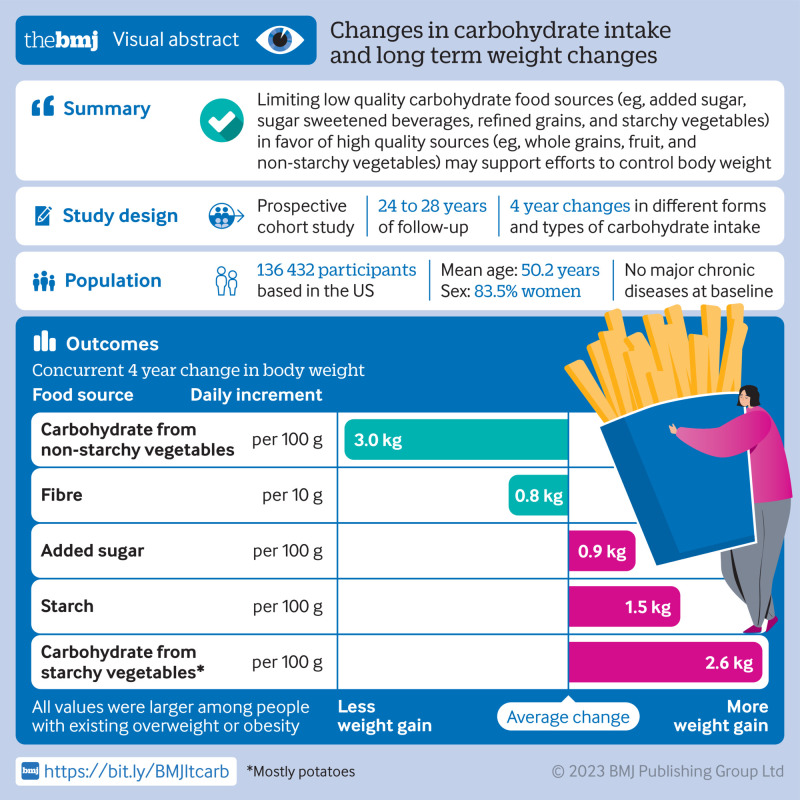
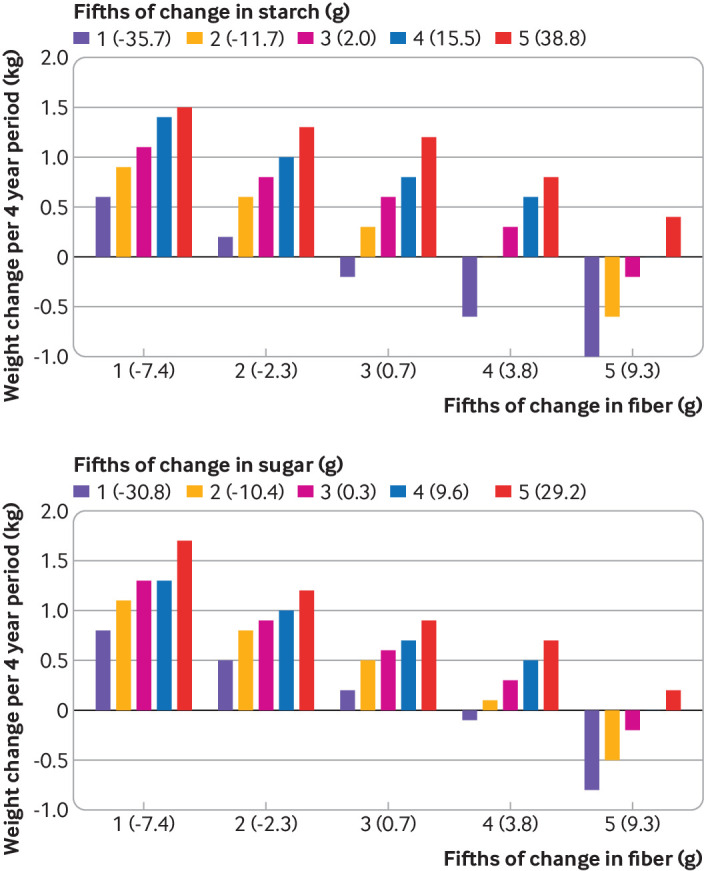
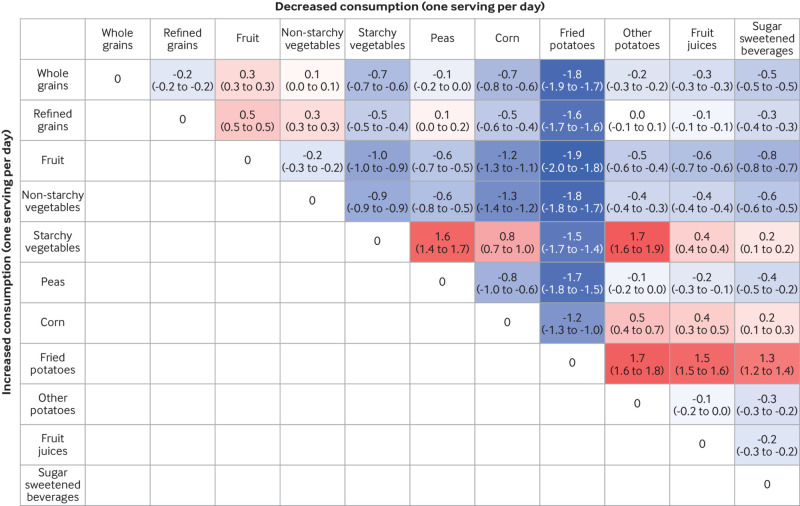
Objective: To comprehensively examine the associations between changes in carbohydrate intake and weight change at four year intervals. Design: Prospective cohort study. Setting: Nurses’ Health Study (1986-2010), Nurses’ Health Study II (1991-2015), and Health Professionals Follow-Up Study (1986-2014). Participants: 136 432 men and women aged 65 years or younger and free of diabetes, cancer, cardiovascular disease, respiratory disease, neurodegenerative disorders, gastric conditions, chronic kidney disease, and systemic lupus erythematosus before baseline. Main outcome measure: Weight change within a four year period. Results: The final analyses included 46 722 women in the Nurses’ Health Study, 67 186 women in the Nurses’ Health Study II, and 22 524 men in the Health Professionals Follow-up Study. On average, participants gained 1.5 kg (5th to 95th centile −6.8 to 10.0) every four years, amounting to 8.8 kg on average over 24 years. Among men and women, increases in glycemic index and glycemic load were positively associated with weight gain. For example, a 100 g/day increase in starch or added sugar was associated with 1.5 kg and 0.9 kg greater weight gain over four years, respectively, whereas a 10 g/day increase in fiber was associated with 0.8 kg less weight gain. Increased carbohydrate intake from whole grains (0.4 kg less weight gain per 100 g/day increase), fruit (1.6 kg less weight gain per 100 g/day increase), and non-starchy vegetables (3.0 kg less weight gain per 100 g/day increase) was inversely associated with weight gain, whereas increased intake from refined grains (0.8 kg more weight gain per 100 g/day increase) and starchy vegetables (peas, corn, and potatoes) (2.6 kg more weight gain per 100 g/day increase) was positively associated with weight gain. In substitution analyses, replacing refined grains, starchy vegetables, and sugar sweetened beverages with equal servings of whole grains, fruit, and non-starchy vegetables was associated with less weight gain. The magnitude of these associations was stronger among participants with overweight or obesity compared with those with normal weight (P<0.001 for interaction). Most of these associations were also stronger among women. Conclusions: The findings of this study highlight the potential importance of carbohydrate quality and source for long term weight management, especially for people with excessive body weight. Limiting added sugar, sugar sweetened beverages, refined grains, and starchy vegetables in favor of whole grains, fruit, and non-starchy vegetables may support efforts to control weight.
Overview
The claims and statistics of this paper haven’t been checked yet.
Free: it reads the open-access text and checks the first 5 claims that cite a source we can check. Create a free account to check every claim.
Integrity signals
Registry
Cites
Statistics
Figures
Verification
Claims the paper makes
The claims and statistics of this paper haven’t been checked yet.
Free: it reads the open-access text and checks the first 5 claims that cite a source we can check. Create a free account to check every claim.
Claims other papers make about this one
Each is checked against this paper’s own text: does it say what the citing paper says it does?
The check wasn’t confident either way, so it gives no verdict — never disputed.
In the citing paper
“DNL is an efficient biochemical pathway and plays a key role in explaining the metabolic benefits of low-carbohydrate diets, including improved insulin sensitivity, lipid profiles, and reduced hepatic steatosis in individuals with obesity, diabetes, or MASLD [76,115-117].”
From Hepatic Insulin Resistance and Steatosis in Metabolic Dysfunction-Associated Steatotic Liver Disease: New Insights into Mechanisms and Clinical Implications (2025) · cites this paper as [116]
Experimental — accuracy not yet measured
Self-check
Percentages, sums and reported differences re-computed from the paper’s own numbers.
The self-check needs the paper’s full text.
Citations
Cites
Health effects of overweight and obesity in 195 countries over 25 years
Collaborators, T. G. 2. O. (2017) · New England Journal of Medicine · doi:10.1056/nejmoa1614362 · Cited by 7,918
Redefine statistical significance
Benjamin, D. J., Berger, J. O., Johannesson, M., Nosek, B. A., Wagenmakers, E.-J., Berk, R., Bollen, K. A., Brembs, B., Brown, L., Camerer, C., et al. (2017) · Nature Human Behaviour · doi:10.1038/s41562-017-0189-z · Cited by 2,772
Changes in diet and lifestyle and long-term weight gain in women and men
Mozaffarian, D., Hao, T., Rimm, E. B., Willett, W. C., & Hu, F. B. (2011) · New England Journal of Medicine · doi:10.1056/nejmoa1014296 · Cited by 2,527 · cited 1×
“45 Consistent with our previous reports, 14 15 we also observed that women and men who increased their intakes of whole grains, fruit, and non-starchy vegetables concurrently gained less weight over time, and those who increased their intakes of refined grains and starchy vegetables (including…”
Self-citationDietary Fiber, Glycemic Load, and Risk of Non—insulin-dependent Diabetes Mellitus in Women
Salmerón, J. (1997) · JAMA: The Journal of the American Medical Association · doi:10.1001/jama.1997.03540300040031 · Cited by 1,804
Carbohydrate quality and human health: a series of systematic reviews and meta-analyses
Reynolds, A., Mann, J., Cummings, J., Winter, N., Mete, E., & Te Morenga, L. (2019) · The Lancet · doi:10.1016/s0140-6736(18)31809-9 · Cited by 1,630 · cited 1×
“Findings for all carbohydrate variables were generally similar in analyses stratified by smoking status and race or ethnicity (see supplementary tables 12 and 13).”
The glycemic index: methodology and clinical implications
Wolever, T., Jenkins, D., Jenkins, A., & Josse, R. (1991) · The American Journal of Clinical Nutrition · doi:10.1093/ajcn/54.5.846 · Cited by 1,168
The role of sugar-sweetened beverages in the global epidemics of obesity and chronic diseases
Malik, V. S., & Hu, F. B. (2022) · Nature Reviews Endocrinology · doi:10.1038/s41574-021-00627-6 · Cited by 854
Self-citationDiets with high or low protein content and glycemic index for weight-loss maintenance
Larsen, T. M., Dalskov, S.-M., van Baak, M., Jebb, S. A., Papadaki, A., Pfeiffer, A. F. H., Martinez, J. A., Handjieva-Darlenska, T., Kunešová, M., Pihlsgård, M., et al. (2010) · New England Journal of Medicine · doi:10.1056/nejmoa1007137 · Cited by 843 · cited 1×
“…increment), and carbohydrates (per 100 g increment) and weight changes (kg) according to body mass index at beginning of each four year period* 33 However, dietary glycemic index and glycemic load were not clearly related to BMI in studies that were cross sectional or had single dietary…”
Liu, S., Willett, W. C., Manson, J. E., Hu, F. B., Rosner, B., & Colditz, G. (2003) · The American Journal of Clinical Nutrition · doi:10.1093/ajcn/78.5.920 · Cited by 787
Self-citationDietary Fiber, Weight Gain, and Cardiovascular Disease Risk Factors in Young Adults
Ludwig, D. S. (1999) · JAMA · doi:10.1001/jama.282.16.1539 · Cited by 722
Self-citation
Research works printed but not linked: 2
- World Health Organization. Use of non-sugar sweeteners: WHO guideline. WHO, 2023. https://www.who.int/publications/i/item/9789240073616 37256996
- World Health Organization. Guideline: sugars intake for adults and children. Geneva: WHO; 2015 [cited 2023 Jun 6]. https://apps.who.int/iris/handle/10665/149782 25905159
Cited by
The EAT–Lancet Commission on healthy, sustainable, and just food systems
Rockström, J., Thilsted, S. H., Willett, W. C., Gordon, L. J., Herrero, M., Hicks, C. C., Mason-D'Croz, D., Rao, N., Springmann, M., Wright, E. C., et al. (2025) · The Lancet · doi:10.1016/s0140-6736(25)01201-2 · Cited by 475
Self-citationDiet strategies for promoting healthy aging and longevity: An epidemiological perspective
Hu, F. B. (2024) · Journal of Internal Medicine · doi:10.1111/joim.13728 · Cited by 216
Self-citationTruong, X. T., & Lee, D. H. (2025) · Diabetes & Metabolism Journal · doi:10.4093/dmj.2025.0644 · Cited by 84
Gilden, A. H., Catenacci, V. A., & Taormina, J. M. (2024) · Annals of Internal Medicine · doi:10.7326/aitc202405210 · Cited by 60
Volek, J. S., Yancy, W. S., Gower, B. A., Phinney, S. D., Slavin, J. L., Koutnik, A. P., Hurn, M., Spinner, J. R., Cucuzzella, M. T., & Hecht, F. M. (2024) · Frontiers in Nutrition · doi:10.3389/fnut.2024.1376098 · Cited by 46
Casas, R. M., Ruiz-León, A. M., Argente, J., Alasalvar, C., Bajoub, A., Bertomeu, I., Caroli, M., Castro‐Barquero, S., Crispi, F., Delarue, J., et al. (2025) · Advances in Nutrition · doi:10.1016/j.advnut.2025.100381 · Cited by 42
“Moreover, glycemic index was positively associated with weight change in a detailed analysis of 3 large cohorts [42].”
Self-citationRabbani, N., & Thornalley, P. J. (2025) · Clinical Science · doi:10.1042/cs20257727 · Cited by 17
Liu, Y., Mei, H., Li, X., Cheng, C., Wu, Y., Zou, C., Yu, Y., Gao, L., Zhang, H., Gao, X., et al. (2025) · Cell Metabolism · doi:10.1016/j.cmet.2025.01.015 · Cited by 17
Yuan, X., Wei, Y., Jiang, H., Wang, H., Wang, Z., Dong, M., Dong, X., & Zhang, J. (2024) · Nutrients · doi:10.3390/nu16050666 · Cited by 15
“Based on the glycemic index and dietary fiber, we classified carbohydrates into high-quality carbohydrates and low-quality carbohydrates [13,14] (see Appendix A).”
BackgroundMachine learning-assisted optimization of dietary intervention against dementia risk
Chen, S., Chen, H., You, J., Chen, S.-D., Fu, Y., Zhang, W., Huang, L., Feng, J., Gao, X., Cheng, W., et al. (2025) · Nature Human Behaviour · doi:10.1038/s41562-025-02255-w · Cited by 17
“In this study, potato, a starchy vegetable 23 rich in potassium, water-soluble vitamins and dietary fibre 24,25 , is associated with lower dementia risk at a moderate intake level compared with zero intake.”
Ludwig, D. S., Hu, F. B., Lichtenstein, A. H., & Willett, W. C. (2023) · American Journal of Clinical Nutrition · doi:10.1016/j.ajcnut.2023.09.006 · Cited by 14
Self-citationSantos, H. O., & Penha-Silva, N. (2025) · Nutrition · doi:10.1016/j.nut.2024.112617 · Cited by 11
Maternal dietary patterns during pregnancy and birth weight: a prospective cohort study
Li, T., He, Y., Wang, N., Feng, C., Zhou, P., Qi, Y., Wang, Z., Lin, X., Mao, D., Sun, Z., et al. (2024) · Nutrition Journal · doi:10.1186/s12937-024-01001-8 · Cited by 14
“Potato consumption has been associated with certain risk factors of macroso-mia, including gestational diabetes and long-term weight gain [44–46], which has been explained by hyperglycemia, insulin resistance, oxidative stress, and epigenetic modifications.”
BackgroundPractical strategies to manage obesity in type 2 diabetes
Rodbard, H. W., Barnard-Kelly, K. D., Pfeiffer, A. F. H., Mauersberger, C., Schnell, O., & Giorgino, F. (2024) · Diabetes Obesity and Metabolism · doi:10.1111/dom.15556 · Cited by 10
“158,161 There is increasing research interest in the field of precision nutrition because of the impact of individual genetic factors on the development of obesity and T2D.”
BackgroundJiménez, M. D. C. F.-F. (2024) · Journal of the American Nutrition Association · doi:10.1080/27697061.2024.2406887 · Cited by 12
Dietary carbohydrate intake and risk of type 2 diabetes: a 16-year prospective cohort study
Gan, L., Yang, Y., Zhao, B., Yu, K., Guo, K., Fang, F., Zhou, Z., Albanes, D., & Huang, J. (2025) · Science China Life Sciences · doi:10.1007/s11427-024-2804-0 · Cited by 10
“…have demonstrated that substituting carbohydrate sourced from refined grains or starchy vegetables with carbohydrate from whole grains or non-starchy vegetables is associated with improved glycemic control and reduced body weight (Musa-Veloso et al., 2018; Sanders et al., 2023; Wan et al., 2023).”
Developing green nutritious super rice for a healthy Anthropocene
Zhang, Q., Ali, J., Bouis, H. E., Hu, P., Khush, G. S., Li, J., Luo, L., Tan, B., Wan, J., Willett, W. C., et al. (2025) · 中国科学通报:英文版 · doi:10.1016/j.scib.2025.04.025 · Cited by 7
Self-citationCheng, X., Wu, T., Li, H., Sun, T., & Huang, G. (2024) · Archives of Public Health · doi:10.1186/s13690-024-01445-8 · Cited by 7
“The latest guidelines from the World Health Organization recommend avoiding the use of non-sugar sweeteners (low-calorie and no-calorie sweeteners) for weight con-trol [11].”
Wang, X., Rai, S. K., Zhang, W., Wang, M., Liu, B., Hu, Y., Wang, S., Han, H., Hao, Y., Choi, H. K., et al. (2025) · American Journal of Clinical Nutrition · doi:10.1016/j.ajcnut.2025.06.021 · Cited by 8
Self-citationArnesen, E., Laake, I., Carlsen, M. H., Veierød, M. B., & Retterstøl, K. (2024) · Journal of Nutrition · doi:10.1016/j.tjnut.2024.05.011 · Cited by 8
Zhang, L., Ma, C., Huang, H., Li, D., Zhang, D., Wu, T., Chu, M., & Hu, F. (2024) · Food & Function · doi:10.1039/d4fo03761h · Cited by 6
Self-citationCorte, K. W. D., Corte, D. D., Camacho, D., Horgan, G. W., Palmeira, A. L., Stubbs, R. J., & Heitmann, B. L. (2025) · European Journal of Nutrition · doi:10.1007/s00394-025-03583-3 · Cited by 6
Soltani, S., Meshkini, F., Torabinasab, K., Razmpoosh, E., Toupchian, O., Zeraattalab-Motlagh, S., Hemmati, A., Sangsefidi, Z. S., & Abdollahi, S. (2025) · Diabetology & Metabolic Syndrome · doi:10.1186/s13098-025-01721-9 · Cited by 6
“Under eucaloric conditions, the detrimental effects of high-carbohydrate diets on adiponectin may be partly due to their association with greater weight gain [77].”
Xu, J., Xie, L., Yin, J., Shi, X., Dong, K., Tao, J., Xu, W., Ma, D., Zhang, S., Chen, J., et al. (2024) · Biomedicines · doi:10.3390/biomedicines12081701 · Cited by 6
“Previous studies have reported the association between an HCD and obesity, nonalcoholic fatty liver disease, and other metabolic diseases [29,30], but there remains a lack of comprehensive studies exploring the association between such diets and diabetic cognitive dysfunction, thereby rendering…”
BackgroundDissanayake, H. U., Guruwiwi, G., Dhurrkay, J. G., Tynan, J. C., Braat, S., Harrap, B., Trudgen, T., Hanieh, S., Clark, B., Spencer, M., et al. (2025) · The Medical Journal of Australia · doi:10.5694/mja2.52593 · Cited by 5
“30 Our study is the first to objectively measure physical activity in a remote community.”
Li, M., Wang, Z., Qin, Y., Xiong, L., & Sun, Q. (2024) · International Journal of Biological Macromolecules · doi:10.1016/j.ijbiomac.2024.138824 · Cited by 3
Self-citationHuang, H., Lu, W., Hu, X., Chen, X., Shu, G., Wang, J., Zhu, M., Zhang, Z., & Zhang, S. (2025) · Food & Function · doi:10.1039/d5fo03240g · Cited by 4
Ahmed, I. S., Tapponi, S. L., Manaa, H. M., Soltani, A., Hussein, E. S., Parvaresh, F. A., & Hussain, Z. (2026) · Journal of Obesity · doi:10.1155/jobe/6556057 · Cited by 5
Trius‐Soler, M., Bramming, M., Jensen, M. K., Tolstrup, J. S., & Guasch‐Ferré, M. (2025) · Nutrition Journal · doi:10.1186/s12937-025-01071-2 · Cited by 5
“Some previous analyses have considered starch from whole and refined grains or starchy and non-starchy vegetables separately, finding counterbalancing effects [41–43].”
Self-citationLou, Y., Wang, H., Wang, L., Huang, S., Xie, Y., Song, F., Lu, Z., Wang, F., Jiang, Q., & Cao, S. (2025) · Nutrients · doi:10.3390/nu17162683 · Cited by 3
“Obesity and cardiovascular disease have become pervasive challenges in the realm of global public health with the changes in lifestyles and dietary habits [1,2].”
Çiftçi, S., Yalçın, T., & Öztürk, E. E. (2025) · BMC Psychology · doi:10.1186/s40359-025-02663-7 · Cited by 4
“In contrast, higher intake of carbohydrates from refined grains and starchy vegetables is associated with greater weight gain [54].”
Testing the carbohydrate-insulin model: The data are supportive!
Ludwig, D. S., Brand-Miller, J. C., Ebbeling, C. B., Friedman, M. I., Norwitz, N. G., & Soto-Mota, A. (2025) · Cell Metabolism · doi:10.1016/j.cmet.2025.04.010 · Cited by 3
Self-citationGu, X., Gao, P., Shen, Y., & Lu, L. (2024) · Nutrition Research · doi:10.1016/j.nutres.2024.07.001 · Cited by 2
Neuromarketing for Healthy Eating and Disease Prevention
Anthuvan, T., Salis, S. S., & Maheshwari, K. M. (2024) · Advances in medical diagnosis, treatment, and care (AMDTC) book series · doi:10.4018/979-8-3693-3230-6.ch011 · Cited by 1
Olabinke, C. K., Adegoke, A. F., SOBUKOLA, O. P., Fafiolu, A. O., & Adebowale, A.-R. A. (2024) · Journal of Culinary Science & Technology · doi:10.1080/15428052.2024.2401804 · Cited by 2
“Y. Wan et al. (2023) reported that there is a clear correlation between the amount of carbohydrates in a food product and its energy content.”
Wang, P., Wang, Y., Huang, W., Xiang, P., Bai, B., Xie, B., & Shi, D. (2025) · The Journals of Gerontology Series A · doi:10.1093/gerona/glaf175 · Cited by 1
Raharjo, S. J., Estiasih, T., Wijayanti, E. D., Sari, D. R. T., & Maryanty, Y. (2025) · Brazilian Archives of Biology and Technology · doi:10.1590/1678-4324-2025240958 · Cited by 1
Wei, J., Fan, Z., Deng, Y., Pan, K., Shi, R., Hu, J., & Liu, B. (2026) · Nutrients · doi:10.3390/nu18060973 · Cited by 1
Guo, Z., Sun, Y., Zhang, Y., Wei, K., Cao, J., Shen, Q., & Xue, Y. (2026) · Nutrients · doi:10.3390/nu18101571 · Cited by 1
“Consistent with these regulatory effects, higher intake of whole grain has been shown to improve long-term weight management and reduce cardiometabolic risk profiles, as supported by rigorous prospective cohort studies and systematic evaluations of dietary patterns [9–11].”
Toward International Dietary Guidance: A Food Guide Pyramid for Human and Planetary Health
Corte, K. W. D., Buyken, A. E., Vecchia, C. L., Vanginkel, M.-A., Salas‐Salvadó, J., Riccardi, G., Trichopoulou, A. D., Slavin, J. L., Ceriello, A., Bulló, M., et al. (2026) · Advances in Nutrition · doi:10.1016/j.advnut.2026.100738 · Cited by 1
Self-citationLivesey, G. (2024) · American Journal of Clinical Nutrition · doi:10.1016/j.ajcnut.2023.12.003 · Cited by 1
D'Angelo, A., Vitale, S., Palumbo, E., & Augustin, L. S. A. (2024) · Epidemiology Biostatistics and Public Health · doi:10.54103/2282-0930/22226 · Cited by 1
“These associations were stronger among participants with overweight or obesity compared with those with normal weight and were also stronger among women than men [32].”
BackgroundInfluentialLang, A., Schaefer, E., Kupriyanova, Y., Goletzke, J., Weber, K. S., Buyken, A. E., KAHL, S., Zaharia, O., Herder, C., Schrauwen‐Hinderling, V. B., et al. (2025) · Nutrition Journal · doi:10.1186/s12937-025-01145-1 · Cited by 1
“…of foods with higher GI carbohydrates (e.g., fried potatoes, sugar sweetened beverages, starchy vegetables) by foods with lower GI (e.g., whole grains, fruit and non-starchy vegetables) was associated with weight loss, and thus, may play a crucial role in long term weight management [19].”
Association Between Dietary Behaviors and Weight Gain During City-Wide Quarantine
Tang, M., Chen, Z., Wang, J., Song, A., Wu, I.-T., & Xu, R. (2023) · International Journal of General Medicine · doi:10.2147/ijgm.s439750
Jing, C., Zhang, H., Zhang, F., Xu, X., Ren, J., Ji, X., & Xie, H. (2024) · Research Square · doi:10.21203/rs.3.rs-4072825/v1
ADHERENCE TO THE MEDITERRANEAN DIET IN PATIENTS WITH HIGH CARDIOVASCULAR RISK
Kondratyuk, M. O., Komarytsia, O. Y., Radchenko, О. М., & Bek, N. (2024) · Anti-Aging Eastern Europe · doi:10.56543/aaeeu.2024.3.3.06
Relationship between dietary intake and growth and development in Chinese pupils
Fang, W., Fu, Y., Li, Q., Cheng, M., Zhang, M., & Lu, Y. (2025) · Frontiers in Public Health · doi:10.3389/fpubh.2025.1454129 · Cited by 2
The importance of dietary fibre
Karbanová, M., & Vágnerová, T. (2025) · Medicína pro praxi · doi:10.36290/med.2024.039
Ma, P., Jin, S., Chew, Y. Z., Song, H., & Dickens, B. S. L. (2025) · medRxiv · doi:10.1101/2025.04.10.25325565
Chen, J., Wang, Y., Sun, K., Lin, Y., & Guo, F. (2025) · The Journal of Nutritional Biochemistry · doi:10.1016/j.jnutbio.2025.110026
Remesar, X., Oliva, L., Fernández–Löpez, J., & Alemany, M. (2025) · Discover Endocrinology and Metabolism · doi:10.1007/s44417-025-00009-w
“The recent renewed interest on the influence of carbohydrate intake on the development of insulin resistance [6] and obesity [7] has resulted in a large number of experimental studies in which dietary modulation is analyzed.”
Ashraf, U., Raza, Q., Safdar, M., Azam, M. B., Batool, R., Lnu, E., Imran, K., Khan, A., & Shah, I. (2025) · Cureus · doi:10.7759/cureus.91045
Firdaus, R., Wulansari, O. D. E., Angraini, D. I., & Pratiwi, W. O. (2025) · Salud Ciencia y Tecnología · doi:10.56294/saludcyt20252013
Bobok, N. M. (2025) · GASTROENTEROLOGY · doi:10.22141/2308-2097.59.3.2025.693 · Cited by 1
Vitale, S., Palumbo, E., D'Angelo, A., Maso, M. D., Polesel, J., Grimaldi, M., Porciello, G., Luongo, A., Pica, R., Crispo, A., et al. (2025) · Nutrients · doi:10.3390/nu17233782 · Cited by 1
“This could adversely affect the pathways contributing to obesity [74] and other CVD risk factors, resulting in increased chronic diseases, including breast cancer [15,16].”
Li, T., He, Y., Wang, N., Feng, C., Zhou, P., Qi, Y., Wang, Z., Lin, X., Mao, D., Sun, Z., et al. (2024) · Figshare · doi:10.6084/m9.figshare.26943582
Wan, Y., AlEssa, H. B., Guasch‐Ferré, M., Tobias, D. K., Lee, K. H., Manson, J. E., Willett, W. C., Sun, Q., & Hu, F. B. (2026) · Diabetes Care · doi:10.2337/dc25-2957 · Cited by 1
Self-citationThe low-fat milk recommendation for young children: time for a re-evaluation
Astrup, A., & Agostoni, C. (2026) · American Journal of Clinical Nutrition · doi:10.1016/j.ajcnut.2026.101273
Angkasa, D., Citra, Y., Nuzrina, R., Kuswari, M., Palupi, K. C., & Fahraeni, R. (2026) · Nutrition & Food Science · doi:10.1108/nfs-12-2025-0449
Sugar reductions on the sensory characteristics, quality, and emotional profile of pound cakes
Tovar, D. R., Ozturk, O. K., Khan, N., Dolcos, F., & Torrico, D. D. (2026) · International Journal of Food Science & Technology · doi:10.1093/ijfood/vvag138
“There is a positive correlation between obesity and consumption of high-carbohydrate diets (specifically rich in sugar) ( Wan et al., 2023).”
Lee, M. M., Poole, M. K., Chen, J. T., Gortmaker, S. L., Stephenson, B., Haines, J., Chavarro, J. E., Diamantis, D. V., & Kenney, E. L. (2026) · Journal of Nutrition · doi:10.1016/j.tjnut.2026.101735
Khan, M., Rahman, A. U., Khemawoot, P., Shah, M. A., Ul‐Haq, Z., Ahmad, N., Sohail, T., & Panichayupakaranant, P. (2026) · Toxicology Reports · doi:10.1016/j.toxrep.2026.102345
“A toxicant can adversely affect food and water intake in animal models, thereby altering their body weight gain [68], glycemic levels [69], and relative organ weight [70].”
Tobias, D. K., Eliassen, A. H., Willett, W. C., Chavarro, J. E., Zhang, C., & Hu, F. B. (2026) · The Lancet Obstetrics Gynaecology & Women s Health · doi:10.1016/s3050-5038(26)00233-5 · Cited by 1
Self-citation
Metadata
- Authors
- Wan, Y., Tobias, D. K., Dennis, K. K., Guasch-Ferré, M., Sun, Q., Rimm, E. B., Hu, F. B., Ludwig, D. S., Devinsky, O., & Willett, W. C.
- Affiliations
- Harvard University (US)
- Brigham and Women's Hospital (US)
- Department of Nutrition, Harvard T.H. Chan School of Public Health, Boston, MA, 02115, USA
- Boston Children's Hospital (US)
- New York University (US)
- Corresponding author
- Willett, Walter C
- ORCID
- Venue
- BMJ
- Publisher
- BMJ
- Published
- 2023-09-27
- Volume
- 382
- Pages
- e073939
- ISSN
- 1756-1833 (ISSN-L)
- PMC
- PMC10523278
- OpenAlex
- W4387081884
- Cited by
- 64
- References
- 49
- Citations by year
- 2026: 12 · 2025: 29 · 2024: 20 · 2023: 3
- FWCI
- 16.38
- Type
- journal article
- Language
- en
- Open access
- hybrid
- doi.org
- Licence
- Locations
- BMJ (publishedVersion, cc-by-nc)
- PubMed Central (publishedVersion, cc-by-nc)
- PubMed (publishedVersion)
- HighWire Press Open Archive (submittedVersion)
- Funders
- National Institutes of Health (CA176726, CA-167552, CA186107)
- National Cancer Institute (UM1CA186107, U01CA176726, U01CA167552)
- Topics
- Health Sciences › Medicine › Public Health, Environmental and Occupational Health › Nutritional Studies and Diet
- Health Sciences › Medicine › Endocrinology, Diabetes and Metabolism › Diet, Metabolism, and Disease
- Health Sciences › Nursing › Nutrition and Dietetics › Food composition and properties
- Keywords
- carbohydrate intake, weight gain, weight change, dietary glycemic index, glycemic load, added sugars, starch, dietary fiber, whole grains, fruits, non-starchy vegetables, refined grains, starchy vegetables, sugar-sweetened beverages, dietary substitution, obesity, overweight, Nurses' Health Study, Health Professionals Follow-up Study, dietary habits
- MeSH terms
- Sugars, Carbohydrates, Diet, Female, Follow-Up Studies, Humans, Male, Prospective Studies, Vegetables, Weight Gain
About these checks
Registry, retraction, Cites and statistics results are computed, not judged, with one exception: a printed reference that no index lists is read once by a model before it counts as a citation error. Claims are extracted by a model and kept only when their quote appears verbatim in the text; each cited source is then checked, with a model’s help, for whether it says what the claim relies on. Those verdicts can be wrong — read the claim’s quote and the cited source before relying on one.
Statistics and arithmetic are recomputed, not judged.
Confidence bands are shown only for fields calibrated on our annotated test set. None is calibrated yet, so no band is shown.
What counts as a claim ›How we measure confidence ›How we check this ›
Are you an author, or do you see a problem with this page? Request a review
Data sources
Bibliographic data: Semantic Scholar, OpenAlex, Crossref.
Contains information from the Semantic Scholar Academic Graph Datasets, made available under the ODC Attribution License (ODC-BY 1.0).
Semantic Scholar’s data is described in: Kinney, R., et al. (2023). The Semantic Scholar Open Data Platform. arXiv:2301.10140.
