

Publishers’ and journals’ instructions to authors on use of generative artificial intelligence in academic and scientific publishing: bibliometric analysis
Open accessThe DOI matches its Crossref record; 27 of the 27 references it cites were found in a registry or an index; 8 of the 22 sources its claims cite were checked for support.
Abstract
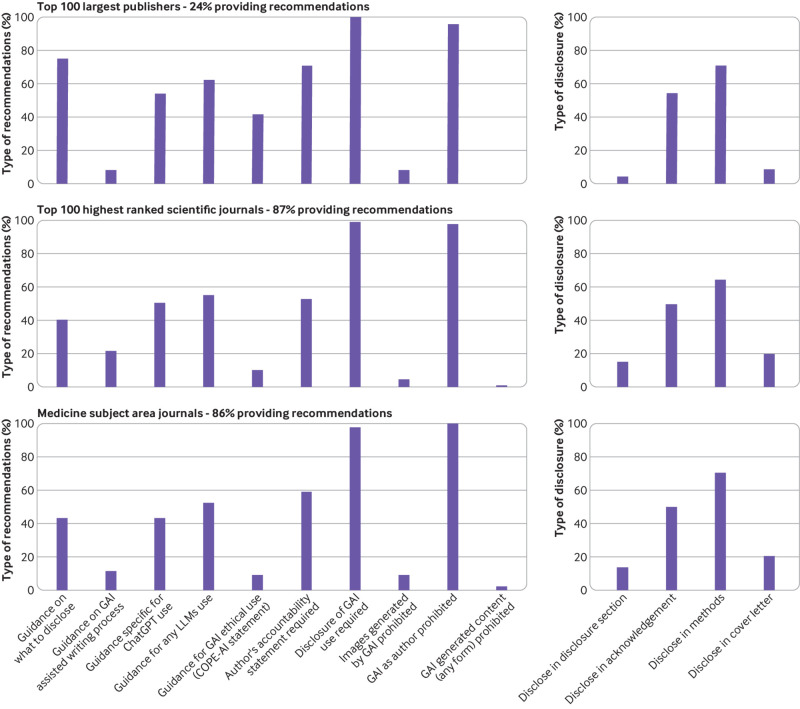
Objectives: To determine the extent and content of academic publishers’ and scientific journals’ guidance for authors on the use of generative artificial intelligence (GAI). Design: Cross sectional, bibliometric study. Setting: Websites of academic publishers and scientific journals, screened on 19-20 May 2023, with the search updated on 8-9 October 2023. Participants: Top 100 largest academic publishers and top 100 highly ranked scientific journals, regardless of subject, language, or country of origin. Publishers were identified by the total number of journals in their portfolio, and journals were identified through the Scimago journal rank using the Hirsch index (H index) as an indicator of journal productivity and impact. Main outcome measures: The primary outcomes were the content of GAI guidelines listed on the websites of the top 100 academic publishers and scientific journals, and the consistency of guidance between the publishers and their affiliated journals. Results: Among the top 100 largest publishers, 24% provided guidance on the use of GAI, of which 15 (63%) were among the top 25 publishers. Among the top 100 highly ranked journals, 87% provided guidance on GAI. Of the publishers and journals with guidelines, the inclusion of GAI as an author was prohibited in 96% and 98%, respectively. Only one journal (1%) explicitly prohibited the use of GAI in the generation of a manuscript, and two (8%) publishers and 19 (22%) journals indicated that their guidelines exclusively applied to the writing process. When disclosing the use of GAI, 75% of publishers and 43% of journals included specific disclosure criteria. Where to disclose the use of GAI varied, including in the methods or acknowledgments, in the cover letter, or in a new section. Variability was also found in how to access GAI guidelines shared between journals and publishers. GAI guidelines in 12 journals directly conflicted with those developed by the publishers. The guidelines developed by top medical journals were broadly similar to those of academic journals. Conclusions: Guidelines by some top publishers and journals on the use of GAI by authors are lacking. Among those that provided guidelines, the allowable uses of GAI and how it should be disclosed varied substantially, with this heterogeneity persisting in some instances among affiliated publishers and journals. Lack of standardization places a burden on authors and could limit the effectiveness of the regulations. As GAI continues to grow in popularity, standardized guidelines to protect the integrity of scientific output are needed.
Overview
CoChat Summary
TL;DR
This bibliometric analysis found substantial heterogeneity in guidance on generative artificial intelligence (GAI) across top academic publishers and scientific journals. While 87% of the top 100 highest-ranked journals had GAI guidelines, only 24% of the top 100 largest publishers did, and none of the guidelines were developed through a formal consensus process.
Key findings
- Among the top 100 largest publishers, 24% had released GAI guidance; 63% (n=15) of those were in the top 25 publishers, and 56% cited COPE membership. Among the top 100 highest-ranked journals, 87% had GAI guidelines, and 82% cited COPE membership.
- All 24 publishers with guidelines required disclosure in some form; 17 (71%) specified the methods section, 13 (54%) acknowledgements, and 2 (8%) the cover letter. Eighteen (75%) specified what details to disclose, only Elsevier provided a disclosure template, and 17 (71%) stated authors were accountable for AI output.
- Of the 87 journals with guidelines, all top 25 (100%) had AI guidelines; 85 (98%) had specific guidance on including GAI as an author, and all explicitly stated AI should not be listed as an author. Nineteen (22%) limited guidelines to the writing process; 48 (55%) mentioned large language models and 44 (51%) mentioned ChatGPT.
- Among 51 medical journals in the top 100, 44 (86%) had GAI guidelines; 31 (71%) specified methods disclosure, 22 (50%) acknowledgements, 9 (21%) cover letter, and 6 (14%) a new section; 26 (59%) stated authors were accountable. For consistency, 58 of 100 journals reported guidelines on the journal website, 12 (21%) linked to publisher guidelines, and among 15 journals with both journal and publisher guidelines, conflicts rose from 2 (13%) at first search to 12 (80%) at the second search.
Methods
- Cross-sectional bibliometric study of the top 100 largest academic publishers, identified from Nishikawa-Pacher’s list by number of affiliated journals, and the top 100 highest-ranked scientific journals by H index from Scimago.
- Official websites were manually searched for author guidance mentioning GPTs, large language models, or GAI. Initial data collection occurred 19–20 May 2023, with an updated search on 8–9 October 2023. If a publisher lacked guidance, at least three subsidiary journal websites were checked as a proxy; if a journal lacked guidance, publisher guidelines were used only if directly recommended or linked.
- After training and piloting the extraction form, two reviewers independently collected data, with discrepancies resolved by a third reviewer under senior author supervision. Descriptive statistics were used, including a subanalysis of journals classified as medical.
Limitations
- The paper states this is a snapshot at six and ten months after ChatGPT’s rise; guidelines were evolving rapidly, the number of publishers and journals included was limited, subsidiary journal proxies may not perfectly represent publisher policy, scholarly societies’ impact was not fully evaluated, and the study was largely qualitative and prone to subjectivity, mitigated by multiple reviewers.
- Evident from the text: reliance on publicly available website guidance and machine translation may miss unposted or non-English guidance, and the paper contains at least one internal numerical inconsistency (e.g., “Of 70 journals with GAI guidelines, 86 (99%)…”), which complicates interpretation.
Model-written summary. Check it against the paper before relying on it.
Integrity signals
Registry
Cites
Statistics
Figures
Verification
Claims the paper makes
6 Valid · 5 Not valid · 11 Not checked · 118 Own results and interpretations
The cited sources that could be checked couldn’t confirm or dispute this claim.
In the paper
“None of the proposed guidelines were listed as being developed using a formal guideline development process.30”
- Also stated in: § Results · plain
“None of the proposed guidelines was listed as being developed using any formal guideline development process.30”
§ Publishers' and journals' instructions to authors on use of generative artificial intelligence in academic and scientific publishing: bibliometric analysis > Results
What the sources say
- Could not verifycites [30] 30. Delgado-López-Cózar E, Cabezas-Clavijo Á. Ranking journals: could Google Scholar Metrics be an alternative to Journal Citation Reports and Scimago Journal Rank?Learn Publ 2013;26:101-14. doi:10.1087/20130206. sourceExperimental — accuracy not yet measured
The Introduction says that literature on how reporting guidelines were developed is sparse, and the Discussion proposes steps for robust development. Neither section assesses the proposed publisher or journal guidelines or says that none were listed as having a formal development process. Searches for that assertion and for formal guideline development found no such assessment in our copy. (LLM, conf=0.75)
plain- Asserted: passes — The authors put it forward as true.
- Checkable: passes — It can be checked against evidence.
- Load-bearing: unclear — It is unclear whether the paper’s conclusions depend on it.
- Based: passes — The paper gives a reason why it holds.
- Also stated in: § Results · plain
Every source the paper cites for this claim was checked and supports it.
In the paper
“Unlike the journal impact factor, which fluctuates often and was noticeably affected by the covid-19 pandemic, 28 the H index is considered to be more stable over time.29”
§ Publishers' and journals' instructions to authors on use of generative artificial intelligence in academic and scientific publishing: bibliometric analysis > Journal selection and data acquisition
What the sources say
- Supportedcites [29] 29. Delardas O, Giannos P. How COVID-19 Affected the Journal Impact Factor of High Impact Medical Journals: Bibliometric Analysis. J Med Internet Res 2022;24:e43089. doi:10.2196/43089 source
The Overview section describes the h-index as stable, with no abrupt changes over time. The Search interface section says the impact factor can vary each year. The COVID-19 point is attached to citation 28, not this source. (LLM, conf=0.92)
plain- Asserted: passes — The authors put it forward as true.
- Checkable: passes — It can be checked against evidence.
- Load-bearing: passes — The paper’s conclusions depend on it.
- Based: passes — The paper gives a reason why it holds.
- Supported
Every source the paper cites for this claim was checked and supports it.
In the paper
“In total, these 100 publishers are responsible for the publication of 28 060 journals.”
§ Publishers' and journals' instructions to authors on use of generative artificial intelligence in academic and scientific publishing: bibliometric analysis > Publisher selection and data acquisition
What the sources say
- Supportedcites [23] 23. Cacciamani GE, Collins GS, Gill IS. ChatGPT: standard reporting guidelines for responsible use. Nature 2023;618:238. doi:10.1038/ d41586-023-01853-w source
The Results section states that the top 100 academic publishers comprise 28,060 serial titles. Table 1 also gives 28,060 as the total number of journals for those publishers. (LLM, conf=0.95)
plain- Asserted: passes — The authors put it forward as true.
- Checkable: passes — It can be checked against evidence.
- Load-bearing: passes — The paper’s conclusions depend on it.
- Based: passes — The paper gives a reason why it holds.
- Supported
A result the paper reports from its own data — it cites no other source for it, so there is none to check. The quote shows it is in the paper.
In the paper
“Two publishers (8%), Emerald and BioMedCentral, included a policy to prohibit the submission of AI generated images.”
§ Publishers' and journals' instructions to authors on use of generative artificial intelligence in academic and scientific publishing: bibliometric analysis > Results
plain- Asserted: passes — The authors put it forward as true.
- Checkable: passes — It can be checked against evidence.
- Load-bearing: unclear — It is unclear whether the paper’s conclusions depend on it.
- Based: passes — The paper gives a reason why it holds.
A result the paper reports from its own data — it cites no other source for it, so there is none to check. The quote shows it is in the paper.
In the paper
“Twenty four (24%) of the publishers provided specific guidance on AI for authors (table 1 and fig 1).”
§ Publishers' and journals' instructions to authors on use of generative artificial intelligence in academic and scientific publishing: bibliometric analysis > Results
plain- Asserted: passes — The authors put it forward as true.
- Checkable: passes — It can be checked against evidence.
- Load-bearing: passes — The paper’s conclusions depend on it.
- Based: passes — The paper gives a reason why it holds.
63 more claims
Create a free account to see all 140 claims and to verify the 8 references still open.
- Probably not a substantial claim. 40
- It may state two separate claims as one. 44
- The quote only partly states this claim. 2
Claims other papers make about this one
Each is checked against this paper’s own text: does it say what the citing paper says it does?
The source backs part of the claim, not all of it — or backs it for a different population, condition or comparison.
In the citing paper
“However, a significant gap persists between the theoretical discourse on AI regulation and the empirical reality of AI-driven retractions across different disciplines (Ganjavi et al., 2024).”
From The Attention Mismatch: Mapping the Structural Academic Governance Deficit in the Age of Generative AI (2026) · cites this paper as Ganjavi et al., 2024
Experimental — accuracy not yet measuredThe source backs part of the claim, not all of it — or backs it for a different population, condition or comparison.
In the citing paper
“a previous study [40], which reported that 86% of top journals provided author guidelines”
From Generative artificial intelligence (GAI) usage guidelines for scholarly publishing: a cross-sectional study of medical journals (2025) · cites this paper as [40]
Experimental — accuracy not yet measuredThe source backs part of the claim, not all of it — or backs it for a different population, condition or comparison.
In the citing paper
“Major publishers have established policies on AI use in research outputs, explicitly addressing accountability, transparency, and the risk that generated content may not be traceable to verifiable sources [7,16,17].”
From A Workflow for Grant Discovery and Proposal Development Using Large Language Models: Development and Formative Evaluation (2026) · cites this paper as [17]
Experimental — accuracy not yet measuredThe source backs part of the claim, not all of it — or backs it for a different population, condition or comparison.
In the citing paper
“The reliance on author self-reporting, without independent verification or standardized auditing, raises legitimate questions about compliance in practice (Ganjavi et al., 2024).”
From Use of artificial intelligence tools in the publishing process: expectations from publishers through author guidelines (2026) · cites this paper as Ganjavi et al., 2024
Experimental — accuracy not yet measuredThe cited source says what the claim attributes to it.
In the citing paper
“Second, previous studies either focused on top ranked journals or exclusively on nursing journals [40, 41], leading to an incomplete assessment of such guidelines across non-top ranked medical journals and a lack of empirical comparisons with top ranked journals.”
From Generative artificial intelligence (GAI) usage guidelines for scholarly publishing: a cross-sectional study of medical journals (2025) · cites this paper as [40]
12 more claims about this paper
Create a free account to see every claim other papers make about this one.
Self-check
Percentages, sums and reported differences re-computed from the paper’s own numbers.
Each contradiction between two passages listed here was confirmed by an independent check.
Rated minor: it would not touch a result — a value no result rests on, a p-value that stays on the same side of the significance level, or a conflict that is clerical, resolved elsewhere in the paper, or outside its own findings.
In the paper
§ Publishers' and journals' instructions to authors on use of generative artificial intelligence in academic and scientific publishing: bibliometric analysis > Results
“Several of the 100 highest ranked journals shared the same publishers; the most represented publishers included Springer Nature, with 19% of its journals in the top 100, followed by the American Chemical Society (10%) and Elsevier (7%).”
§ Publishers' and journals' instructions to authors on use of generative artificial intelligence in academic and scientific publishing: bibliometric analysis > Results
“All 10 Elsevier journals provided a template for the disclosure and advised that it should be included in a new, separate section of the manuscript.”
Rated minor: it would not touch a result — a value no result rests on, a p-value that stays on the same side of the significance level, or a conflict that is clerical, resolved elsewhere in the paper, or outside its own findings.
In the paper
“Of 70 journals with GAI guidelines, 86 (99%) required some type of "reporting," "documenting," or "noting," with Science being the only journal that did not mention disclosure.”
§ Publishers' and journals' instructions to authors on use of generative artificial intelligence in academic and scientific publishing: bibliometric analysis > Results
Reported 99 · recomputed 122.857143
Rated minor: it would not touch a result — a value no result rests on, a p-value that stays on the same side of the significance level, or a conflict that is clerical, resolved elsewhere in the paper, or outside its own findings.
In the paper
§ Publishers' and journals' instructions to authors on use of generative artificial intelligence in academic and scientific publishing: bibliometric analysis > Publisher selection and data acquisition
“We utilized the list in Nishikawa-Pacher's study, which identified and ranked the top 100 publishers by number of affiliated journals in their portfolio.23”
§ Publishers' and journals' instructions to authors on use of generative artificial intelligence in academic and scientific publishing: bibliometric analysis > References
“23. Cacciamani GE, Collins GS, Gill IS. ChatGPT: standard reporting guidelines for responsible use. Nature 2023;618:238. doi:10.1038/ d41586-023-01853-w 24. Nishikawa-Pacher A. Who are the 100 largest scientific publishers by journal count? A webscraping approach. J Doc 2022;78:450-63. doi:10.1108/JD-04-2022-0083.”
Citations
Cites
Large language models encode clinical knowledge
Singhal, K., Azizi, S., Tu, T., Mahdavi, S. S., Wei, J., Chung, H. W., Scales, N., Tanwani, A., Cole-Lewis, H., Pfohl, S., et al. (2023) · Nature · doi:10.1038/s41586-023-06291-2 · Cited by 4,083
Large Language Models Encode Clinical Knowledge
Singhal, K., Azizi, S., Tu, T., Mahdavi, S. S., Wei, J., Chung, H. W., Scales, N., Tanwani, A., Cole-Lewis, H., Pfohl, S., et al. (2022) · arXiv · doi:10.48550/arxiv.2212.13138 · Cited by 4,083
Guidance for Developers of Health Research Reporting Guidelines
Moher, D., Schulz, K. F., Simera, I., & Altman, D. G. (2010) · PLoS Medicine · doi:10.1371/journal.pmed.1000217 · Cited by 1,437
ChatGPT is fun, but not an author
Thorp, H. H. (2023) · Science · doi:10.1126/science.adg7879 · Cited by 1,437
ChatGPT listed as author on research papers: many scientists disapprove
Stokel-Walker, C. (2023) · Nature · doi:10.1038/d41586-023-00107-z · Cited by 868 · cited 1×
“18 Even if the current COPE statement on AI is promptly endorsed by journals (eg, Journal of the American Medical Association 19 20 ) and editorial associations (eg, World Association of Medical Editors (WAME) 21 ), it does not provide a comprehensive and functional set of recommendations on key…”
BackgroundPredatory publishers are corrupting open access
Beall, J. (2012) · Nature · doi:10.1038/489179a · Cited by 658 · cited 1×
“24 Although the exact number of journals worldwide is unknown, one estimate suggests around 45 000, 25 thus the current study captured around two thirds of journals as represented by the top 100 largest academic publishers.”
BackgroundAI bot ChatGPT writes smart essays — should professors worry?
Stokel-Walker, C. (2022) · Nature · doi:10.1038/d41586-022-04397-7 · Cited by 543
Flanagin, A., Bibbins-Domingo, K., Berkwits, M., & Christiansen, S. L. (2023) · JAMA · doi:10.1001/jama.2023.1344 · Cited by 420 · cited 2×
“18 Even if the current COPE statement on AI is promptly endorsed by journals (eg, Journal of the American Medical Association 19 20 ) and editorial associations (eg, World Association of Medical Editors (WAME) 21 ), it does not provide a comprehensive and functional set of recommendations on key aspects to guide respo…”
BackgroundLecler, A., Duron, L., & Soyer, P. (2023) · Diagnostic and Interventional Imaging · doi:10.1016/j.diii.2023.02.003 · Cited by 385
de Vries, E., Schoonvelde, M., & Schumacher, G. (2018) · Political Analysis · doi:10.1017/pan.2018.26 · Cited by 243
Cited by
Items 201–263 of 263
Generative‐AI policies vary widely across top ornithology journals
McClure, C. J. W. (2026) · Ibis · doi:10.1111/ibi.70054
Ghazali, R., Finger, M. L., & Elhusseiny, A. M. (2026) · Eye · doi:10.1038/s41433-026-04421-4
Ethical Usage of Artificial Intelligence Tools in Information Science Research
Oladokun, B. D., & Tella, A. (2026) · Advances in computational intelligence and robotics book series · doi:10.4018/979-8-2600-0434-0.ch006 · Cited by 1
Tomczyk, P. (2026) · International Journal of Social Research Methodology · doi:10.1080/13645579.2026.2651311
Chen, E., Nguyen, A., Keefer, K., Bagaruka, E., Chaudhry, M., Elfar, A., Crotty, P., Young, A., Tran, A. V., Ford, A. I., et al. (2026) · Frontiers in Endocrinology · doi:10.3389/fendo.2026.1767254
Generative AI in Academic Publishing: Comparative Analysis of Five Publishers' Policies
Kumar, A., McKeown, D., Syed, H., Craig, C. J., Rupley, W. H., Ahmed, A., Kashwani, S., & Siddiqui, K. A. (2026) · Advances in computational intelligence and robotics book series · doi:10.4018/407619
Author Guidelines in Dermatology Journals Regarding Use of Artificial Intelligence
Wang, V., Yang, K., & Fernandez, J. M. (2026) · Journal of Cutaneous Medicine and Surgery · doi:10.1177/12034754261445883
Asubiaro, T., & Oguntola, O. J. (2026) · Journal of Data and Information Science · doi:10.1515/jdis-2025-0297
“These developments has spurred an increasing shift in policy changes on generative AI use policy inclusion in journal editorial policies (Ehsan and Raza 2025; Ganjavi et al. 2024).”
Chen, I.-T., & Weicht, K. K. (2026) · Studies in Higher Education · doi:10.1080/03075079.2026.2650621 · Cited by 2
Surgical innovation and technology
Matthews, J. B., Ruurda, J. P. H., Vaughan-Shaw, P. G., Winter, D. C., Beggs, A. D., Yiu, A. J., Davidson, B. R., Seeliger, B., Chen, X., Stoyanov, D. V., et al. (2026) · British journal of surgery · doi:10.1093/bjs/znaf224
Ohemu, G. P., Mufunde, T. A., Muraya, T., Essonanjo, E., Zarb, P., Elshenawy, R. A., Powell, N., Enne, V. I., & Rautemaa‐Richardson, R. (2026) · JAC-Antimicrobial Resistance · doi:10.1093/jacamr/dlag082
Asl, M. M. B., Loulida, H., Chacón-Aponte, A. A., & Spiotta, A. M. (2026) · Journal of the American College of Radiology · doi:10.1016/j.jacr.2026.06.005
Patil, S. R., Mehta, V., Karobari, M. I., & Kharat, S. (2026) · International Journal of Surgery Open · doi:10.1097/io9.0000000000000370
Author AI Disclosure in JAMA Network Journal Submissions
Mahajan, A. (2026) · JAMA · doi:10.1001/jama.2026.6515 · Cited by 1
Research and Scholarly Methods: Using Artificial Intelligence
Trinkley, K. E., & Maw, A. (2026) · JACCP JOURNAL OF THE AMERICAN COLLEGE OF CLINICAL PHARMACY · doi:10.1002/jac5.70239
“…and Committee on Publication Ethics (COPE) [45] have clarified responsible use of generative AI in scholarship: AI tools may assist, but they must be disclosed (including tool/version), cannot be listed as authors, and must not compromise confidential materials (e.g., peer review content) [46].”
Pan, Y.-L., Yu, P.-F., Yin, X.-L., Hong-sheng, Y., Long, X., & Tong, Q. (2026) · Educational Technology Research and Development · doi:10.1007/s11423-026-10659-2 · Cited by 2
Fundamentos éticos y bioéticos en la comunicación del conocimiento científico
Cabrera, G. I. B. (2026) · We Journal Review · doi:10.38202/journal22.1
“…revisión y evaluación editorial, ya que muchos autores utilizan estas herramientas para la crea-ción de documentos y citas inexistentes o no relacionadas con la temática de estudio sin informar su uso durante la producción del texto (Flanagin et al., 2023; Ganjavi et al., 2024; Kocak, 2024).”
Al-Jarf, R. (2026) · Lecture notes in networks and systems · doi:10.1007/978-3-032-22032-5_10 · Cited by 2
Chen, H., Liao, Y.-S., Liu, C., & Chiou, W. (2026) · Lecture notes in computer science · doi:10.1007/978-3-032-29900-0_13
Ikwuazom, C. T., Prasad, R., Aliyu, A. R., Benjamin, O., & USMAN, M. M. (2026) · Advances in computational intelligence and robotics book series · doi:10.4018/979-8-3373-7665-3.ch009
Ríos, R. (2026) · trilogía Ciencia Tecnología Sociedad · doi:10.22430/21457778.4038
Garcia, M. B. (2026) · Education Sciences · doi:10.3390/educsci16071127 · Cited by 2
Semantic degradation of scientific text in AI editing
Semiletova, A. N. (2026) · Language and Text · doi:10.17759/langt.2026130216
Vyas, M. B., Rhudy, L. M., Weckman, S., Ennis, J., Hundt, E., Werner, A., Smith, F. S., Bergvall, E., Chukwuneke, F., Riskey, L. M., et al. (2026) · Journal of Neuroscience Nursing · doi:10.1097/jnn.0000000000000903
Sahhar, M., Lewis, A. M., Achilova, F., Singh, M., Nassar, J. E., Callanan, T. C., Liu, J., Daniels, A. H., & Antoci, V. (2026) · The Journal of Arthroplasty · doi:10.1016/j.arth.2026.07.041
Navigating Boundaries of AI Use in Physical Education Journal Research Publications
Li, Y., Wu, C., Su, Y., Lu, B., Hamilton, X. D., Lynch, T., & Hamilton, M. F. (2026) · Quest · doi:10.1080/00336297.2026.2707164
Reconciling Efficiency and Scientific Integrity Through Human-Centered LLM Integration
Holzer, T., & Michahelles, F. (2026) · IFIP advances in information and communication technology · doi:10.1007/978-3-032-34044-3_7 · Cited by 1
ijlessjournal (2026) · مجلة القانون والأعمال الدولية · doi:10.63585/ozsp2793 · Cited by 15
Mekheimer, M. A. A. G., & Abdelhalim, W. (2026) · Discover Sustainability · doi:10.1007/s43621-026-04243-0 · Cited by 3
“When institutions provide clear guidance on acceptable use, disclosure expectations, and data protection, and when they invest in training that strengthens critical AI literacy and verification practices, faculty can adopt AI with greater clarity about boundaries and responsibilities [15, 16, 32].”
InfluentialDesbois, A. P. (2026) · Bulletin of the European Association of Fish Pathologists · doi:10.48045/001c.166391
Writing as formation: supervising AI use in early-career medical authorship
Jacinto, T. (2026) · Frontiers in Artificial Intelligence · doi:10.3389/frai.2026.1874377
Hero, J. L., & Perol, C. (2026) · Journal of interdisciplinary perspectives · doi:10.69569/jip.2026.408x · Cited by 1
Practical guide to structuring the Background section in clinical and epidemiological studies
Leboeuf‐Yde, C., & Gudex, C. M. (2026) · Chiropractic & Manual Therapies · doi:10.1186/s12998-026-00643-1
“A literature review of scientific journals by Ganjavi et al. [12] found a lack of guidelines and consensus on whether the use of AI in academic writing should be reported at all, and if so, how and where it should be reported.”
InfluentialGüneş, Z., & Mergen, E. K. (2026) · Orthopaedic Journal of Sports Medicine · doi:10.1177/23259671261463933
“However, Ganjavi et al 11 found that many journals lack clear guidelines.”
xploration and Practice of AI-Empowered Teaching Rounds in Traditional Chinese Medicine Paediatrics
Qiu, C., Monama, R., Hlatywayo, E., Lei, Z., Luo, M., Shaikjee, F., Xu, K., & Wu, J. (2026) · Complementary Medicine Education and Research · doi:10.62415/njtx5604
Uso Responsable de la Inteligencia Artificial en las Publicaciones Médicas
Herrera, M. A. O. (2026) · Revista Guatemalteca de Urología · doi:10.54212/27068048.v14i1.208
Part 1: Artificial intelligence in neurointerventional surgery: current state and challenges
Vargas, J., Hoffman, H., Schirmer, C. M., Hui, F. K., 河野健一, Booth, T. C., Kellogg, R. T., & Levitt, M. (2026) · JNIS Advances · doi:10.1136/jnisadv-2026-000011
Pilatti, L., Cantorani, J. R. H., Ferreira, C. L., & Picinin, C. T. (2026) · Human Behavior and Emerging Technologies · doi:10.1155/hbe2/6708778
Belmonte-Sánchez, J. R., Romero‐González, R., & Frenich, A. G. (2026) · Analytica Chimica Acta · doi:10.1016/j.aca.2026.346333 · Cited by 1
Artificial Intelligence in the Preparation of Scientific Articles
Aldoshin, S. M., Ananikov, V. P., Beletskaya, I. P., Berlin, A. A., Boinovich, L. B., Bukhtiyarov, V. I., Voshkin, A. A., Gorbunova, Y. G., Григорович, К. В., Dzhemilev, U. M., et al. (2026) · Russian Chemical Reviews · doi:10.59761/rcr5247
Tuyen, T. T. T., Thanh, V. T. P., & Nhung, L. N. T. (2026) · International Journal of Learning Teaching and Educational Research · doi:10.26803/ijlter.25.9.23
Li, P., Shen, W., Li, S., & Zhu, R. (2026) · Current Genomics · doi:10.1016/j.curgen.2026.09.009
Measuring attitudes of ethical use of GenAI in the work of university educators in Slovakia
Chinoracký, R., Stalmašeková, N., Bachanová, P. H., & Majerčáková, M. (2026) · Frontiers in Education · doi:10.3389/feduc.2026.1929871
Guerschberg, L., & Gutierrez, Y. E. (2026) · Revista Multidisciplinar Epistemología de las Ciencias · doi:10.71112/gpqkd594
Sperl, M. F. J., Baumgärtner, L., Bach, K. M., Bamberg, C., Behlau, C., Bergmann, B., Bienefeld, M., Bleckmann, E., Danböck, S. K., Dreston, J. H., et al. (2026) · Psychologische Rundschau · doi:10.1026/0033-3042/a000779
Guechairi, S., Smail, N., Махмудов, С., & Mohammed, K. S. (2026) · Social Sciences & Humanities Open · doi:10.1016/j.ssaho.2026.103771 · Cited by 1
Hernández, I., Souza, D., Toro, C. D., Parker, K., Falcon, A., Danton, G. H., Subhawong, T. K., & Alessandrino, F. (2026) · Academic Radiology · doi:10.1016/j.acra.2026.09.042
Goyal, R., Liang, J., Kulkarni, M. S., Nguyen, P., Gillipelli, S. R., & Patel, A. (2026) · Global Surgical Education - Journal of the Association for Surgical Education · doi:10.1007/s44186-026-00599-z
Rethinking Social Computing Research in the Age of AI: Agency, Collaboration, and Governance
Huang, Y., Contractor, N., Peng, T., Wang, D., Shen, C., Li, M., Liu, Y., Zhang, H., & Suh, S. (2026) · ACM Conference on Computer Supported Cooperative Work (CSCW) · doi:10.1145/3785651.3831580 · Cited by 1
Full stack academic publishing in seizures with artificial intelligence: a cautionary talePreprint
Kerr, W. T., Pellinen, J., McFarlane, K. N., & Goldenholz, D. M. (2026) · medRxiv · doi:10.64898/2026.10.07.26363237
Liu, X., Luo, J., Chen, Y., Zhu, J., Liu, Y., & Wang, Z. (2026) · Frontiers in Medicine · doi:10.3389/fmed.2026.1948768
“Academic consensus confirms that AI cannot be granted authorship, as it cannot assume scholarly accountability; thus, human authors retain full responsibility for all generated content, and AI utilization must be transparently reported in appropriate manuscript sections (21 – 24).”
Reference Authenticity and Citation Validity in AI-Generated Medical Writing
Aykut, A. (2026) · Uludağ Üniversitesi Tıp Fakültesi Dergisi · doi:10.32708/uutfd.1961573
Alhasnawi, S., Selvi, B., Radif, M., & Orak, S. D. (2026) · SAGE Open · doi:10.1177/21582440261491814
Hsieh, T., & Chen, Y.-T. (2026) · JMIR Metascience and Research Integrity · doi:10.2196/preprints.106068
Silva, A., Canever, B., Lino, M., & Silva, V. S. E. (2026) · PLOS Digital Health · doi:10.1371/journal.pdig.0001783
“Bibliometric analyses indicate that the vast majority of leading biomedical journals now explicitly prohibit AI authorship [10].”
Runde, A. P., Fahey, J. L., Pelit, W. S., Ortiz, C. E., Koo, S. M., Jordan, S., Chrulski, K. E., Kleberg, J. A., Buckner, H. D., Brown, N. M., et al. (2026) · Life · doi:10.3390/life16111785
Who Really Governs AI in Education Journals?
Gross, J. P. K., Sun, J. C., Mandel, M. R., et al. (2025) · Journal of Education Finance and Law · doi:10.5406/30678560.50.4.01
“Ganjavi et al. (2024) documented wide variation in how major publishers and journals govern generative AI use and disclosure, though many journals lacked sufficient guidelines at the time.”
Scientific slop: generative AI, research incentives, and the integrity of the genomic knowledge base
Greenbaum, D. (2026) · Frontiers in Genetics · doi:10.3389/fgene.2026.1894137
Rosen, J. M., Gupta, S. K., & Kellermayer, R. (2026) · Journal of Pediatric Gastroenterology and Nutrition · doi:10.1002/jpn3.70634
From Inbox to OR: Generative AI and the Modern Academic Surgeon
Unadkat, K. D., & Noland, S. S. (2026) · Journal of surgical education · doi:10.1016/j.jsurg.2026.104213
Metadata
- Authors
- Ganjavi, C., Eppler, M. B., Pekcan, A., Biedermann, B., Abreu, A., Collins, G. S., Gill, I. S., & Cacciamani, G. E.
- Affiliations
- University of Southern California (US)
- UK EQUATOR Centre, Centre for Statistics in Medicine, Nuffield Department of Orthopaedics, Rheumatology and Musculoskeletal Sciences, University of Oxford, Oxford, UK
- Corresponding author
- Cacciamani, Giovanni E
- Venue
- BMJ
- Publisher
- BMJ
- Published
- 2024-01-31
- Volume
- 384
- Pages
- e077192
- ISSN
- 1756-1833 (ISSN-L)
- PMC
- PMC10828852
- OpenAlex
- W4391403616
- Cited by
- 266
- References
- 25
- Citations by year
- 2026: 108 · 2025: 97 · 2024: 60
- FWCI
- 390.91
- Type
- journal article
- Language
- en
- Open access
- hybrid
- doi.org
- Licence
- Locations
- BMJ (publishedVersion, cc-by-nc)
- PubMed Central (publishedVersion, cc-by-nc)
- PubMed (publishedVersion)
- University of Birmingham Research Portal (University of Birmingham) (publishedVersion, cc-by-nc)
- HighWire Press Open Archive (submittedVersion)
- Funders
- American Diabetes Association
- American Association for Cancer Research
- American Heart Association
- American Thoracic Society
- American Association for the Study of Liver Diseases
- American Gastroenterological Association
- British Medical Association
- National Cancer Institute
- Topics
- Social Sciences › Library and Information Sciences › Publishing and Scholarly Communication
- Social Sciences › Education › Academic integrity and plagiarism
- Social Sciences › Library and Information Sciences › Academic Publishing and Open Access
- Keywords
- generative AI, author guidelines, AI disclosure, AI authorship, academic publishers, scientific journals, medical journals, research integrity, artificial intelligence in healthcare, artificial intelligence in industry, artificial intelligence in government, artificial intelligence in warfare, artificial intelligence in law
- MeSH terms
- Artificial Intelligence, Cross-Sectional Studies, Humans, Periodicals as Topic, Publishing, Bibliometrics
About these checks
Registry, retraction, Cites and statistics results are computed, not judged, with one exception: a printed reference that no index lists is read once by a model before it counts as a citation error. Claims are extracted by a model and kept only when their quote appears verbatim in the text; each cited source is then checked, with a model’s help, for whether it says what the claim relies on. Those verdicts can be wrong — read the claim’s quote and the cited source before relying on one.
The claim verdicts this report counts are experimental: their accuracy is not yet measured.
A language model drew the claims from the paper on 2026-10-29, under version 3 of the claim definition (model deepseek-v4.1-flash, prompt extract-v3).
A second model labelled each claim on 2026-10-29 (model jev-1.13-20260917, definition revision gold-guideline-v0.2).
Cited sources are checked with a language model’s help (gpt-6-sol).
Statistics and arithmetic are recomputed, not judged.
Confidence bands are shown only for fields calibrated on our annotated test set. None is calibrated yet, so no band is shown.
What counts as a claim ›How we measure confidence ›How we check this ›
Are you an author, or do you see a problem with this page? Request a review
Data sources
Bibliographic data: Semantic Scholar, OpenAlex, Crossref.
Contains information from the Semantic Scholar Academic Graph Datasets, made available under the ODC Attribution License (ODC-BY 1.0).
Semantic Scholar’s data is described in: Kinney, R., et al. (2023). The Semantic Scholar Open Data Platform. arXiv:2301.10140.
