

Publishers’ and journals’ instructions to authors on use of generative artificial intelligence in academic and scientific publishing: bibliometric analysis
Open accessThe DOI matches its Crossref record; 27 of the 27 references it cites were found in a registry or an index; 8 of the 22 sources its claims cite were checked for support.
Abstract
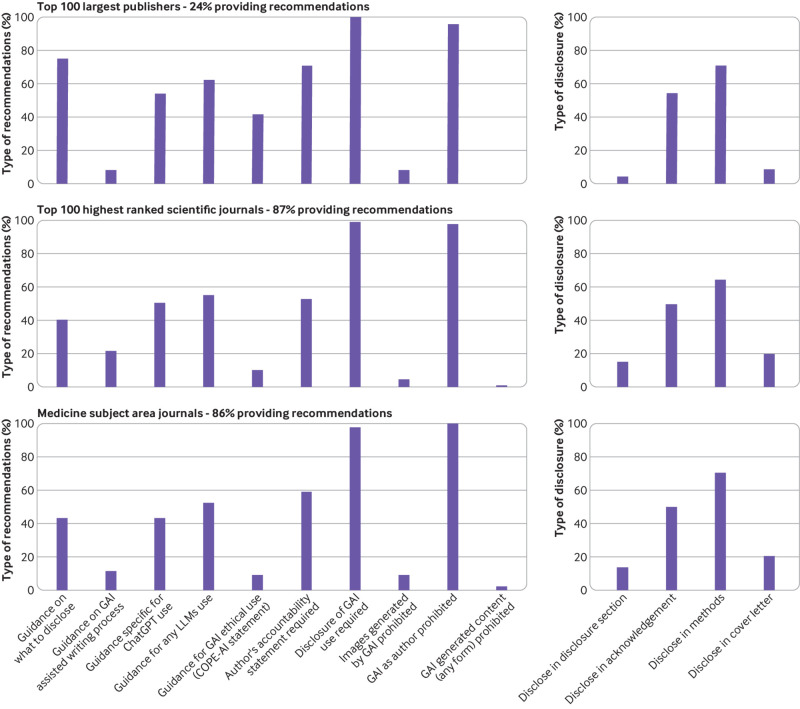
Objectives: To determine the extent and content of academic publishers’ and scientific journals’ guidance for authors on the use of generative artificial intelligence (GAI). Design: Cross sectional, bibliometric study. Setting: Websites of academic publishers and scientific journals, screened on 19-20 May 2023, with the search updated on 8-9 October 2023. Participants: Top 100 largest academic publishers and top 100 highly ranked scientific journals, regardless of subject, language, or country of origin. Publishers were identified by the total number of journals in their portfolio, and journals were identified through the Scimago journal rank using the Hirsch index (H index) as an indicator of journal productivity and impact. Main outcome measures: The primary outcomes were the content of GAI guidelines listed on the websites of the top 100 academic publishers and scientific journals, and the consistency of guidance between the publishers and their affiliated journals. Results: Among the top 100 largest publishers, 24% provided guidance on the use of GAI, of which 15 (63%) were among the top 25 publishers. Among the top 100 highly ranked journals, 87% provided guidance on GAI. Of the publishers and journals with guidelines, the inclusion of GAI as an author was prohibited in 96% and 98%, respectively. Only one journal (1%) explicitly prohibited the use of GAI in the generation of a manuscript, and two (8%) publishers and 19 (22%) journals indicated that their guidelines exclusively applied to the writing process. When disclosing the use of GAI, 75% of publishers and 43% of journals included specific disclosure criteria. Where to disclose the use of GAI varied, including in the methods or acknowledgments, in the cover letter, or in a new section. Variability was also found in how to access GAI guidelines shared between journals and publishers. GAI guidelines in 12 journals directly conflicted with those developed by the publishers. The guidelines developed by top medical journals were broadly similar to those of academic journals. Conclusions: Guidelines by some top publishers and journals on the use of GAI by authors are lacking. Among those that provided guidelines, the allowable uses of GAI and how it should be disclosed varied substantially, with this heterogeneity persisting in some instances among affiliated publishers and journals. Lack of standardization places a burden on authors and could limit the effectiveness of the regulations. As GAI continues to grow in popularity, standardized guidelines to protect the integrity of scientific output are needed.
Overview
CoChat Summary
TL;DR
This bibliometric analysis found substantial heterogeneity in guidance on generative artificial intelligence (GAI) across top academic publishers and scientific journals. While 87% of the top 100 highest-ranked journals had GAI guidelines, only 24% of the top 100 largest publishers did, and none of the guidelines were developed through a formal consensus process.
Key findings
- Among the top 100 largest publishers, 24% had released GAI guidance; 63% (n=15) of those were in the top 25 publishers, and 56% cited COPE membership. Among the top 100 highest-ranked journals, 87% had GAI guidelines, and 82% cited COPE membership.
- All 24 publishers with guidelines required disclosure in some form; 17 (71%) specified the methods section, 13 (54%) acknowledgements, and 2 (8%) the cover letter. Eighteen (75%) specified what details to disclose, only Elsevier provided a disclosure template, and 17 (71%) stated authors were accountable for AI output.
- Of the 87 journals with guidelines, all top 25 (100%) had AI guidelines; 85 (98%) had specific guidance on including GAI as an author, and all explicitly stated AI should not be listed as an author. Nineteen (22%) limited guidelines to the writing process; 48 (55%) mentioned large language models and 44 (51%) mentioned ChatGPT.
- Among 51 medical journals in the top 100, 44 (86%) had GAI guidelines; 31 (71%) specified methods disclosure, 22 (50%) acknowledgements, 9 (21%) cover letter, and 6 (14%) a new section; 26 (59%) stated authors were accountable. For consistency, 58 of 100 journals reported guidelines on the journal website, 12 (21%) linked to publisher guidelines, and among 15 journals with both journal and publisher guidelines, conflicts rose from 2 (13%) at first search to 12 (80%) at the second search.
Methods
- Cross-sectional bibliometric study of the top 100 largest academic publishers, identified from Nishikawa-Pacher’s list by number of affiliated journals, and the top 100 highest-ranked scientific journals by H index from Scimago.
- Official websites were manually searched for author guidance mentioning GPTs, large language models, or GAI. Initial data collection occurred 19–20 May 2023, with an updated search on 8–9 October 2023. If a publisher lacked guidance, at least three subsidiary journal websites were checked as a proxy; if a journal lacked guidance, publisher guidelines were used only if directly recommended or linked.
- After training and piloting the extraction form, two reviewers independently collected data, with discrepancies resolved by a third reviewer under senior author supervision. Descriptive statistics were used, including a subanalysis of journals classified as medical.
Limitations
- The paper states this is a snapshot at six and ten months after ChatGPT’s rise; guidelines were evolving rapidly, the number of publishers and journals included was limited, subsidiary journal proxies may not perfectly represent publisher policy, scholarly societies’ impact was not fully evaluated, and the study was largely qualitative and prone to subjectivity, mitigated by multiple reviewers.
- Evident from the text: reliance on publicly available website guidance and machine translation may miss unposted or non-English guidance, and the paper contains at least one internal numerical inconsistency (e.g., “Of 70 journals with GAI guidelines, 86 (99%)…”), which complicates interpretation.
Model-written summary. Check it against the paper before relying on it.
Integrity signals
Registry
Cites
Statistics
Figures
Verification
Claims the paper makes
6 Valid · 5 Not valid · 11 Not checked · 118 Own results and interpretations
The cited sources that could be checked couldn’t confirm or dispute this claim.
In the paper
“None of the proposed guidelines were listed as being developed using a formal guideline development process.30”
- Also stated in: § Results · plain
“None of the proposed guidelines was listed as being developed using any formal guideline development process.30”
§ Publishers' and journals' instructions to authors on use of generative artificial intelligence in academic and scientific publishing: bibliometric analysis > Results
What the sources say
- Could not verifycites [30] 30. Delgado-López-Cózar E, Cabezas-Clavijo Á. Ranking journals: could Google Scholar Metrics be an alternative to Journal Citation Reports and Scimago Journal Rank?Learn Publ 2013;26:101-14. doi:10.1087/20130206. sourceExperimental — accuracy not yet measured
The Introduction says that literature on how reporting guidelines were developed is sparse, and the Discussion proposes steps for robust development. Neither section assesses the proposed publisher or journal guidelines or says that none were listed as having a formal development process. Searches for that assertion and for formal guideline development found no such assessment in our copy. (LLM, conf=0.75)
plain- Asserted: passes — The authors put it forward as true.
- Checkable: passes — It can be checked against evidence.
- Load-bearing: unclear — It is unclear whether the paper’s conclusions depend on it.
- Based: passes — The paper gives a reason why it holds.
- Also stated in: § Results · plain
Every source the paper cites for this claim was checked and supports it.
In the paper
“Unlike the journal impact factor, which fluctuates often and was noticeably affected by the covid-19 pandemic, 28 the H index is considered to be more stable over time.29”
§ Publishers' and journals' instructions to authors on use of generative artificial intelligence in academic and scientific publishing: bibliometric analysis > Journal selection and data acquisition
What the sources say
- Supportedcites [29] 29. Delardas O, Giannos P. How COVID-19 Affected the Journal Impact Factor of High Impact Medical Journals: Bibliometric Analysis. J Med Internet Res 2022;24:e43089. doi:10.2196/43089 source
The Overview section describes the h-index as stable, with no abrupt changes over time. The Search interface section says the impact factor can vary each year. The COVID-19 point is attached to citation 28, not this source. (LLM, conf=0.92)
plain- Asserted: passes — The authors put it forward as true.
- Checkable: passes — It can be checked against evidence.
- Load-bearing: passes — The paper’s conclusions depend on it.
- Based: passes — The paper gives a reason why it holds.
- Supported
Every source the paper cites for this claim was checked and supports it.
In the paper
“In total, these 100 publishers are responsible for the publication of 28 060 journals.”
§ Publishers' and journals' instructions to authors on use of generative artificial intelligence in academic and scientific publishing: bibliometric analysis > Publisher selection and data acquisition
What the sources say
- Supportedcites [23] 23. Cacciamani GE, Collins GS, Gill IS. ChatGPT: standard reporting guidelines for responsible use. Nature 2023;618:238. doi:10.1038/ d41586-023-01853-w source
The Results section states that the top 100 academic publishers comprise 28,060 serial titles. Table 1 also gives 28,060 as the total number of journals for those publishers. (LLM, conf=0.95)
plain- Asserted: passes — The authors put it forward as true.
- Checkable: passes — It can be checked against evidence.
- Load-bearing: passes — The paper’s conclusions depend on it.
- Based: passes — The paper gives a reason why it holds.
- Supported
A result the paper reports from its own data — it cites no other source for it, so there is none to check. The quote shows it is in the paper.
In the paper
“Two publishers (8%), Emerald and BioMedCentral, included a policy to prohibit the submission of AI generated images.”
§ Publishers' and journals' instructions to authors on use of generative artificial intelligence in academic and scientific publishing: bibliometric analysis > Results
plain- Asserted: passes — The authors put it forward as true.
- Checkable: passes — It can be checked against evidence.
- Load-bearing: unclear — It is unclear whether the paper’s conclusions depend on it.
- Based: passes — The paper gives a reason why it holds.
A result the paper reports from its own data — it cites no other source for it, so there is none to check. The quote shows it is in the paper.
In the paper
“Twenty four (24%) of the publishers provided specific guidance on AI for authors (table 1 and fig 1).”
§ Publishers' and journals' instructions to authors on use of generative artificial intelligence in academic and scientific publishing: bibliometric analysis > Results
plain- Asserted: passes — The authors put it forward as true.
- Checkable: passes — It can be checked against evidence.
- Load-bearing: passes — The paper’s conclusions depend on it.
- Based: passes — The paper gives a reason why it holds.
63 more claims
Create a free account to see all 140 claims and to verify the 8 references still open.
- Probably not a substantial claim. 40
- It may state two separate claims as one. 44
- The quote only partly states this claim. 2
Claims other papers make about this one
Each is checked against this paper’s own text: does it say what the citing paper says it does?
The source backs part of the claim, not all of it — or backs it for a different population, condition or comparison.
In the citing paper
“However, a significant gap persists between the theoretical discourse on AI regulation and the empirical reality of AI-driven retractions across different disciplines (Ganjavi et al., 2024).”
From The Attention Mismatch: Mapping the Structural Academic Governance Deficit in the Age of Generative AI (2026) · cites this paper as Ganjavi et al., 2024
Experimental — accuracy not yet measuredThe source backs part of the claim, not all of it — or backs it for a different population, condition or comparison.
In the citing paper
“a previous study [40], which reported that 86% of top journals provided author guidelines”
From Generative artificial intelligence (GAI) usage guidelines for scholarly publishing: a cross-sectional study of medical journals (2025) · cites this paper as [40]
Experimental — accuracy not yet measuredThe source backs part of the claim, not all of it — or backs it for a different population, condition or comparison.
In the citing paper
“Major publishers have established policies on AI use in research outputs, explicitly addressing accountability, transparency, and the risk that generated content may not be traceable to verifiable sources [7,16,17].”
From A Workflow for Grant Discovery and Proposal Development Using Large Language Models: Development and Formative Evaluation (2026) · cites this paper as [17]
Experimental — accuracy not yet measuredThe source backs part of the claim, not all of it — or backs it for a different population, condition or comparison.
In the citing paper
“The reliance on author self-reporting, without independent verification or standardized auditing, raises legitimate questions about compliance in practice (Ganjavi et al., 2024).”
From Use of artificial intelligence tools in the publishing process: expectations from publishers through author guidelines (2026) · cites this paper as Ganjavi et al., 2024
Experimental — accuracy not yet measuredThe cited source says what the claim attributes to it.
In the citing paper
“Second, previous studies either focused on top ranked journals or exclusively on nursing journals [40, 41], leading to an incomplete assessment of such guidelines across non-top ranked medical journals and a lack of empirical comparisons with top ranked journals.”
From Generative artificial intelligence (GAI) usage guidelines for scholarly publishing: a cross-sectional study of medical journals (2025) · cites this paper as [40]
12 more claims about this paper
Create a free account to see every claim other papers make about this one.
Self-check
Percentages, sums and reported differences re-computed from the paper’s own numbers.
Each contradiction between two passages listed here was confirmed by an independent check.
Rated minor: it would not touch a result — a value no result rests on, a p-value that stays on the same side of the significance level, or a conflict that is clerical, resolved elsewhere in the paper, or outside its own findings.
In the paper
§ Publishers' and journals' instructions to authors on use of generative artificial intelligence in academic and scientific publishing: bibliometric analysis > Results
“Several of the 100 highest ranked journals shared the same publishers; the most represented publishers included Springer Nature, with 19% of its journals in the top 100, followed by the American Chemical Society (10%) and Elsevier (7%).”
§ Publishers' and journals' instructions to authors on use of generative artificial intelligence in academic and scientific publishing: bibliometric analysis > Results
“All 10 Elsevier journals provided a template for the disclosure and advised that it should be included in a new, separate section of the manuscript.”
Rated minor: it would not touch a result — a value no result rests on, a p-value that stays on the same side of the significance level, or a conflict that is clerical, resolved elsewhere in the paper, or outside its own findings.
In the paper
“Of 70 journals with GAI guidelines, 86 (99%) required some type of "reporting," "documenting," or "noting," with Science being the only journal that did not mention disclosure.”
§ Publishers' and journals' instructions to authors on use of generative artificial intelligence in academic and scientific publishing: bibliometric analysis > Results
Reported 99 · recomputed 122.857143
Rated minor: it would not touch a result — a value no result rests on, a p-value that stays on the same side of the significance level, or a conflict that is clerical, resolved elsewhere in the paper, or outside its own findings.
In the paper
§ Publishers' and journals' instructions to authors on use of generative artificial intelligence in academic and scientific publishing: bibliometric analysis > Publisher selection and data acquisition
“We utilized the list in Nishikawa-Pacher's study, which identified and ranked the top 100 publishers by number of affiliated journals in their portfolio.23”
§ Publishers' and journals' instructions to authors on use of generative artificial intelligence in academic and scientific publishing: bibliometric analysis > References
“23. Cacciamani GE, Collins GS, Gill IS. ChatGPT: standard reporting guidelines for responsible use. Nature 2023;618:238. doi:10.1038/ d41586-023-01853-w 24. Nishikawa-Pacher A. Who are the 100 largest scientific publishers by journal count? A webscraping approach. J Doc 2022;78:450-63. doi:10.1108/JD-04-2022-0083.”
Citations
Cites
Large language models encode clinical knowledge
Singhal, K., Azizi, S., Tu, T., Mahdavi, S. S., Wei, J., Chung, H. W., Scales, N., Tanwani, A., Cole-Lewis, H., Pfohl, S., et al. (2023) · Nature · doi:10.1038/s41586-023-06291-2 · Cited by 4,083
Large Language Models Encode Clinical Knowledge
Singhal, K., Azizi, S., Tu, T., Mahdavi, S. S., Wei, J., Chung, H. W., Scales, N., Tanwani, A., Cole-Lewis, H., Pfohl, S., et al. (2022) · arXiv · doi:10.48550/arxiv.2212.13138 · Cited by 4,083
Guidance for Developers of Health Research Reporting Guidelines
Moher, D., Schulz, K. F., Simera, I., & Altman, D. G. (2010) · PLoS Medicine · doi:10.1371/journal.pmed.1000217 · Cited by 1,437
ChatGPT is fun, but not an author
Thorp, H. H. (2023) · Science · doi:10.1126/science.adg7879 · Cited by 1,437
ChatGPT listed as author on research papers: many scientists disapprove
Stokel-Walker, C. (2023) · Nature · doi:10.1038/d41586-023-00107-z · Cited by 868 · cited 1×
“18 Even if the current COPE statement on AI is promptly endorsed by journals (eg, Journal of the American Medical Association 19 20 ) and editorial associations (eg, World Association of Medical Editors (WAME) 21 ), it does not provide a comprehensive and functional set of recommendations on key…”
BackgroundPredatory publishers are corrupting open access
Beall, J. (2012) · Nature · doi:10.1038/489179a · Cited by 658 · cited 1×
“24 Although the exact number of journals worldwide is unknown, one estimate suggests around 45 000, 25 thus the current study captured around two thirds of journals as represented by the top 100 largest academic publishers.”
BackgroundAI bot ChatGPT writes smart essays — should professors worry?
Stokel-Walker, C. (2022) · Nature · doi:10.1038/d41586-022-04397-7 · Cited by 543
Flanagin, A., Bibbins-Domingo, K., Berkwits, M., & Christiansen, S. L. (2023) · JAMA · doi:10.1001/jama.2023.1344 · Cited by 420 · cited 2×
“18 Even if the current COPE statement on AI is promptly endorsed by journals (eg, Journal of the American Medical Association 19 20 ) and editorial associations (eg, World Association of Medical Editors (WAME) 21 ), it does not provide a comprehensive and functional set of recommendations on key aspects to guide respo…”
BackgroundLecler, A., Duron, L., & Soyer, P. (2023) · Diagnostic and Interventional Imaging · doi:10.1016/j.diii.2023.02.003 · Cited by 385
de Vries, E., Schoonvelde, M., & Schumacher, G. (2018) · Political Analysis · doi:10.1017/pan.2018.26 · Cited by 243
Cited by
CONSORT 2025 explanation and elaboration: updated guideline for reporting randomised trials
Hopewell, S., Chan, A.-W., Collins, G. S., Hróbjartsson, A., Moher, D., Schulz, K. F., Tunn, R., Aggarwal, R., Berkwits, M., Berlin, J. A., et al. (2025) · BMJ · doi:10.1136/bmj-2024-081124 · Cited by 205
Self-citationGuidelines for ethical use and acknowledgement of large language models in academic writing
Porsdam Mann, S., Vazirani, A. A., Aboy, M., Earp, B. D., Minssen, T., Cohen, I. G., & Savulescu, J. (2024) · Nature Machine Intelligence · doi:10.1038/s42256-024-00922-7 · Cited by 108
Luo, X., Tham, Y. C., Giuffrè, M., Ranisch, R., Daher, M., Lam, K., Eriksen, A. V., Hsu, C.-W., Ozaki, A., Moraes, F. Y. D., et al. (2025) · BMJ Evidence-Based Medicine · doi:10.1136/bmjebm-2025-113825 · Cited by 97
Use of Artificial Intelligence in Peer Review Among Top 100 Medical Journals
Li, Z.-Q., Xu, H.-L., Cao, H.-J., Liu, Z.-L., Fei, Y.-T., & Liu, J.-P. (2024) · JAMA Network Open · doi:10.1001/jamanetworkopen.2024.48609 · Cited by 80
Adamakis, M., & Rachiotis, T. (2025) · Encyclopedia · doi:10.3390/encyclopedia5040180 · Cited by 76
“In addition, Ganjavi et al. [10] emphasize the urgent need for academic journals to develop explicit policies on the ethical use of GenAI in scholarly writing, advocating for greater transparency in AI-assisted authorship.”
InfluentialHuang, Y., Wu, R., He, J., & Xiang, Y. (2024) · Journal of Global Health · doi:10.7189/jogh.14.04070 · Cited by 72
The role of generative AI in academic and scientific authorship: an autopoietic perspective
Watson, S., Brezovec, E., & Romic, J. (2025) · AI & Society · doi:10.1007/s00146-024-02174-w · Cited by 104
“However, as these guidelines are present, there is no structured consensus-based guideline development (Ganjavi et al. 2024).”
Ahn, S. (2024) · The Korean Journal of Physiology & Pharmacology · doi:10.4196/kjpp.2024.28.5.393 · Cited by 51
“These policies should address key components such as AI authorship, disclosure of AI use, and human author responsibility [64].”
BackgroundIs ChatGPT Making Scientists Hyper-Productive? The Highs and Lows of Using AI
Prillaman, M. (2024) · Nature · doi:10.1038/d41586-024-00592-w · Cited by 41
Lee, J., Lee, J., & Yoo, J.-J. (2025) · Journal of Educational Evaluation for Health Professions · doi:10.3352/jeehp.2025.22.4 · Cited by 35
“A study by Ganjavi et al. [33] showed a 25% increase in generative AI-related guidelines among the top 100 medical journals between March and October 2023, with growing attention to reviewer usage.”
Policies on artificial intelligence chatbots among academic publishers: a cross-sectional audit
Bhavsar, D., Duffy, L., Jo, H., Lokker, C., Haynes, R. B., Iorio, A., Marušić, A., & Ng, J. Y. (2025) · Research Integrity and Peer Review · doi:10.1186/s41073-025-00158-y · Cited by 52
“However, there was also some variability between the policies of some journals and their respective publisher [20].”
InfluentialGenerative artificial intelligence and scientific publishing: urgent questions, difficult answers
Bagenal, J. D. (2024) · The Lancet · doi:10.1016/s0140-6736(24)00416-1 · Cited by 44
A review of ophthalmology education in the era of generative artificial intelligence
Heinke, A., Radgoudarzi, N., Huang, B. B., & Baxter, S. L. (2024) · Asia-Pacific Journal of Ophthalmology · doi:10.1016/j.apjo.2024.100089 · Cited by 49
“152–154 Authors are accountable for the content of their work and each author is responsible for ensuring the accuracy and integrity of the work and approving the final version.”
The long but necessary road to responsible use of large language models in healthcare research
Kwong, J. C. C., Wang, S., Nickel, G., Cacciamani, G. E., & Kvedar, J. C. (2024) · npj Digital Medicine · doi:10.1038/s41746-024-01180-y · Cited by 49
Self-citationEnhancing the trustworthiness of pain research: A call to action.
O'Connell, N. E., Belton, J. L., Crombez, G., Eccleston, C., Fisher, E., Ferraro, M. C., Hood, A., Keefe, F. J., Knaggs, R., Norris, E., et al. (2024) · Journal of Pain · doi:10.1016/j.jpain.2024.104736 · Cited by 37
Strzelecki, A. (2024) · Learned Publishing · doi:10.1002/leap.1650 · Cited by 39
“There is consensus here because major publishers like Elsevier, Springer, Taylor & Francis, Emerald, and others now apply this policy (Ganjavi et al., 2024).”
The Future of Scientific Writing: AI Tools, Benefits, and Ethical Implications
Granjeiro, J. M., Cury, A. A. D. B., Cury, J. A., Bueno, M. R., Sousa‐Neto, M. D., & Estrela, C. (2025) · Brazilian Dental Journal · doi:10.1590/0103-644020256471 · Cited by 72
“Its implementation requires a balance between innovation and responsibility, with specific regulations to maximize its benefits and minimize risks(16).”
Hutson, J. (2025) · International Journal of Changes in Education · doi:10.47852/bonviewijce52024908 · Cited by 57
“AI cannot be credited as an author; instead, any use of AI must be transparently disclosed, typically in sections like the methodology or acknowledgments, depending on the contribution it made to the research or writing process [32].”
Estimating the use of ChatGPT in dental research publications
Uribe, S. E., & Maldupa, I. (2024) · Journal of Dentistry · doi:10.1016/j.jdent.2024.105275 · Cited by 27
Scholarly Discourse on GenAI’s Impact on Academic Publishing
Dwivedi, Y. K., Malik, T., Hughes, L., & Albashrawi, M. A. (2024) · Journal of Computer Information Systems · doi:10.1080/08874417.2024.2435386 · Cited by 40
“14 In response to these concerns, several publishers have instituted policies that prohibit the recognition of AI tools as coauthors.”
AI is complicating plagiarism. How should scientists respond?
Kwon, D. (2024) · Nature · doi:10.1038/d41586-024-02371-z · Cited by 25
Pratama, A. R. (2025) · PeerJ Computer Science · doi:10.7717/peerj-cs.2953 · Cited by 22
The construction of the role of AI in qualitative data analysis in the social sciences
Paulus, T. M., Lester, J. N., & Davis, C. (2025) · AI & Society · doi:10.1007/s00146-025-02488-3 · Cited by 37
Moorhouse, B. L., Consoli, S., & Curle, S. M. (2025) · Applied Linguistics Review · doi:10.1515/applirev-2025-0021 · Cited by 30
“Similarly, Ganjavi et al. (2024) report that while 87 % of leading scienti fi c journals o ff er guidance, only 43 % outline speci fi c disclosure criteria for GenAI use.”
Yousaf, M. N. (2025) · ACG Case Reports Journal · doi:10.14309/crj.0000000000001629 · Cited by 22
Collu, M. G., Salviati, U., Confalonieri, R., Conti, M., & Apruzzese, G. (2025) · arXiv · doi:10.48550/arxiv.2508.20863 · Cited by 22
Yin, S., Huang, S., Xue, P., Xu, Z., Lian, Z., Ye, C., Ma, S., Liu, M., Hu, Y., Lu, P., et al. (2025) · BMC Medicine · doi:10.1186/s12916-025-03899-1 · Cited by 43
Integrating Artificial Intelligence into Causal Research in Epidemiology
Matthay, E. C., Neill, D. B., Titus, A. R., Desai, S. M., Troxel, A. B., Cerdá, M., Diaz, I. M., Santacatterina, M., & Thorpe, L. E. (2025) · Current Epidemiology Reports · doi:10.1007/s40471-025-00359-5 · Cited by 19
Hu, H., Zhou, Q., & Hashim, H. B. (2025) · Humanities and Social Sciences Communications · doi:10.1057/s41599-025-05351-4 · Cited by 39
“This shift calls for a critical reassessment not only of editorial and peer review practices but also of the broader academic norms that de fi ne legitimate contribution (Ganjavi et al., 2024).”
The Impact of Generative Artificial Intelligence in Scientific Content Synthesis for Authors
Chauhan, C. (2024) · American Journal Of Pathology · doi:10.1016/j.ajpath.2024.06.002 · Cited by 19
Leveraging Large Language Models in Radiology Research: A Comprehensive User Guide
Brown, J. D., Lenchik, L., Doja, B. F., Kaviani, P., Judd, D., Probyn, L. J., Lee, N., Goodman, E. M., Sedeh, A. E., Makary, M. S., et al. (2025) · Academic Radiology · doi:10.1016/j.acra.2024.11.053 · Cited by 19
Policy framework for the utilization of generative AI
Cheng, K., & Wu, H. (2024) · Critical Care · doi:10.1186/s13054-024-04917-z · Cited by 22
Strategies for integrating ChatGPT and generative AI into clinical studies
Lee, J. (2024) · Blood Research · doi:10.1007/s44313-024-00045-3 · Cited by 20
Villena, F., Véliz, C., García-Huidobro, R., & Aguayo, S. D. (2025) · Dentistry Review · doi:10.1016/j.dentre.2025.100160 · Cited by 31
“For this, many journals and publishers have incorporated clear, written guidelines regarding how GenAI should be utilized and / or disclosed in research papers [64].”
New Insights into Valve Hemodynamics
Marom, G., & Einav, S. (2020) · Rambam Maimonides Medical Journal · doi:10.5041/rmmj.10400 · Cited by 22
Can artificial intelligence help for scientific illustration? Details matter
Klug, J., & Pietsch, U. (2024) · Critical Care · doi:10.1186/s13054-024-04970-8 · Cited by 22
“The use of image generation tools for scientific illustration has generated less interest and remains mostly unregulated [3].”
BackgroundYin, S., & Chapelle, C. A. (2025) · Research Methods in Applied Linguistics · doi:10.1016/j.rmal.2025.100227 · Cited by 16
Khera, R., Pedroso, A. F., Keloth, V. K., Xu, H., Silva, G. S., & Schwamm, L. H. (2025) · Stroke · doi:10.1161/strokeaha.125.051913 · Cited by 16
Bradley, L., Perry, M., Fassetta, G., Ryan, S. D., & Nelson, E. L. (2024) · Reading Research Quarterly · doi:10.1002/rrq.540 · Cited by 21
Generative AI in Critical Care Nephrology: Applications and Future Prospects
Cheungpasitporn, W., Thongprayoon, C., Ronco, C., & KASHANI, K. B. (2024) · Blood Purification · doi:10.1159/000541168 · Cited by 23
“ICMJE authorship criteria preclude listing chatbots (such as ChatGPT) as authors, as they cannot be responsible for the work ’ s accuracy, integrity, and originality, which are the key requirements for authorship [23 – 25].”
Analyzing AI use policy in LIS: association with journal metrics and publisher volume
Kim, E. (2024) · Scientometrics · doi:10.1007/s11192-024-05189-8 · Cited by 17
“While Ganjavi et al. (2024) showed the relationship between publisher size and AI use policy adoption, their study primarily focuses on adoption rates without delving into the specific types of AI policies implemented.”
Clarifying Ethical Dilemmas of Using Artificial Intelligence in Research Writing: A Rapid Review
Ugwu, N. F., Igbinlade, A. S., Ochiaka, R. E., Ezeani, U. D., Okorie, N. C., Opele, J. K., Onayinka, T. S., Iroegbu, O., Onyekwere, O. K., Adams, A. B., et al. (2024) · Higher Learning Research Communications · doi:10.18870/hlrc.v142.1549 · Cited by 35
Ophthalmology Journals’ Guidelines on Generative Artificial Intelligence: A Comprehensive Analysis
Huang, W., Liang, Y., Wei, X., & Du, Y. (2024) · American Journal of Ophthalmology · doi:10.1016/j.ajo.2024.12.021 · Cited by 14
GPT Models Can Perform Thematic Analysis in Public Health Studies, Akin to Qualitative Researchers
Yang, Y., Alba, C., Wang, C., Wang, X., Anderson, J., & An, R. (2024) · Journal of Social Computing · doi:10.23919/jsc.2024.0024 · Cited by 16
Artificial intelligence in academic writing: Insights from journal publishers’ guidelines
Mondal, H., Mondal, S., & Behera, J. K. (2024) · Perspectives in Clinical Research · doi:10.4103/picr.picr_67_24 · Cited by 12
Impact of artificial intelligence on future clinical pharmacy research and scholarship
Chan, A., Baker, W. L., Abazia, D. T., Bauman, J. L., DeVane, C. L., Goodlet, K. J., Hall, N., Hicks, J. K., Jones, E., Lu, C., et al. (2025) · JACCP JOURNAL OF THE AMERICAN COLLEGE OF CLINICAL PHARMACY · doi:10.1002/jac5.70003 · Cited by 11
“37 Use of AI-assisted language editing to improve manuscript readability is generally considered acceptable and may promote equity by reducing language barriers to publication.”
Ethical aspects of artificial intelligence: what urologists need to know
Verma, R., MacAskill, F. E. N., Kim, A., Raison, N. T. J., & Dasgupta, P. (2025) · Current Opinion in Urology · doi:10.1097/mou.0000000000001278 · Cited by 11
Mondal, H., Mondal, S., & Juhi, A. (2024) · Indian Journal of Orthopaedics · doi:10.1007/s43465-024-01258-5 · Cited by 10
Generative artificial intelligence powered chatbots in urology
Khawaja, Z., Adhoni, M. Z. U., & Byrnes, K. G. (2025) · Current Opinion in Urology · doi:10.1097/mou.0000000000001280 · Cited by 10
Cei, F., Ganjavi, C., Layne, E., Hussari, T., Gevorkyan, R., Eppler, M., Piazza, P., Rodler, S., Checcucci, E., Rivas, J. G., et al. (2025) · Minerva Urology and Nephrology · doi:10.23736/s2724-6051.25.06133-6 · Cited by 11
Self-citationGong, E. J., Bang, C. S., & Shin, Y. S. (2026) · Bioengineering · doi:10.3390/bioengineering13030365 · Cited by 19
“As of 2024, over 80% of publisher policies require disclosure statements when AI is used in manuscript preparation [97].”
Rise of the machines: trends and challenges of implementing AI in biomedical scientific writing
Fornalik, M., Makuch, M., Lemanska, A., Moska, S., Wiczuk-Wiczewska, M., Anderko, I., Stochaj, L., Szczygieł, M. B., & Zielińska, A. (2024) · Exploration of Digital Health Technologies · doi:10.37349/edht.2024.00024 · Cited by 13
Sridharan, K., & Sivaramakrishnan, G. (2026) · Frontiers in Research Metrics and Analytics · doi:10.3389/frma.2025.1737168 · Cited by 8
Artificial intelligence in academic practices and policy discourses across ‘Big 5’ publishers
Lendvai, G. F., & Petra, A. (2026) · Research Evaluation · doi:10.1093/reseval/rvag004 · Cited by 13
de Geofroy, B., Gérard, A. O., Lupon, E. L., Desrayaud, C., Choufani, C., & Micicoi, G. (2026) · Orthopaedics & Traumatology Surgery & Research · doi:10.1016/j.otsr.2026.104653 · Cited by 13
Using Generative Artificial Intelligence When Writing Letters of Recommendation
Coraor, J., Johnson, N. R., Pelletier, A. J., Landman, A., & Bartz, D. (2025) · Academic Medicine · doi:10.1097/acm.0000000000006047 · Cited by 8
Zaffanello, M., Pietrobelli, A., Nosetti, L. M., Antoniazzi, F., Frassoldati, R., & PIACENTINI, G. L. (2025) · Pharmaceutics · doi:10.3390/pharmaceutics17050588 · Cited by 9
“During the revision process, Generative AI (ChatGPT 4 and 4o, Plus plan, OpenAI) [27,28] was used to explore appropriate statistical approaches for synthesising heterogeneous p -values derived from RCT.”
Editorial policies for use and acknowledgment of artificial intelligence in dental journals
de Queiroz, A. B. L., Sartori, L. R. M., Lima, G. D. S., & Moraes, R. R. (2025) · Journal of Dentistry · doi:10.1016/j.jdent.2025.105923 · Cited by 9
Gulumbe, B. H. (2024) · Learned Publishing · doi:10.1002/leap.1626 · Cited by 21
“This widespread integration of AI has not spared the fi eld of academic publishing (Ganjavi et al., 2024), where its in fl uence has instigated a series of challenges and potential pitfalls.”
Generative Artificial Intelligence Guidelines of Ophthalmology Journals
Rabinovitch, D., Xie, J. S., Lusterio, A., Mihalache, A., Popovic, M. M., Tailor, P. D., Tao, B. K.-L., & Margolin, E. (2025) · JAMA Ophthalmology · doi:10.1001/jamaophthalmol.2024.6229 · Cited by 6
AI and Library and Information Science Publishing: A Survey of Journal Editors
Hosier, A., & Cantwell, L. (2025) · Library trends · doi:10.1353/lib.2025.a961194 · Cited by 11
“For some editors, decisions about the acceptable use of generative AI were made at the publisher level (Ganjavi et al. 2024).”
Bobier, C. A., Rodger, D., & Hurst, D. J. (2025) · BMC Medical Ethics · doi:10.1186/s12910-025-01239-9 · Cited by 16
Ethics in quantitative sport management research: the impact of AI
Trail, G. T., Kim, A., Bang, H., & Braunstein‐Minkove, J. R. (2024) · International Journal of Sports Marketing and Sponsorship · doi:10.1108/ijsms-05-2024-0111 · Cited by 8
Evolution of the methodological requirements for surgery-related publications
Slim, K., Sauvanet, A., Barbier, L. A., Regimbeau, J., Alvès, A., & Pocard, M. D. (2025) · Journal of Visceral Surgery · doi:10.1016/j.jviscsurg.2025.03.001 · Cited by 6
Use of generative artificial intelligence in medical research
Islam, N., & van der Schaar, M. (2024) · BMJ · doi:10.1136/bmj.q119 · Cited by 11
Hsu, H.-Y., Hakouz, A., & Fotouhi, G. (2025) · AI and Ethics · doi:10.1007/s43681-025-00794-6 · Cited by 5
Chigwada, J., & Ngulube, P. (2026) · Frontiers in Research Metrics and Analytics · doi:10.3389/frma.2026.1740510 · Cited by 5
“The reliance on author self-reporting, without independent verification or standardized auditing, raises legitimate questions about compliance in practice (Ganjavi et al., 2024).”
Peng, X., Tan, F., Hu, Y., Pu, H., Zou, W., & Qu, C. (2025) · Medicine · doi:10.1097/md.0000000000044136 · Cited by 7
“[19,20] Additionally, the increasing interest in AI-driven personalized medicine underscores the shift towards tailored treatment plans for patients undergoing joint arthroplasty.”
Enhanced guidance on artificial intelligence for medical publication and communication professionals
Goldman, K., Moss, V., Griffiths, S., Patel, C. J., Dorrell, G., Foreman-Wykert, A., Mody, M., Gardner, J., Shepherd, A., & Lewis, M. (2025) · Current Medical Research and Opinion · doi:10.1080/03007995.2025.2556012 · Cited by 6
Mohamed, A. A., Rajendran, S., Colome, D., Sargent, E. C., Schirmer, C. M., Vessell, M., Lucke-Wold, B. P., Sharma, A., Adogwa, O., & Pirris, S. M. (2025) · Neurosurgical Review · doi:10.1007/s10143-025-03793-7 · Cited by 6
Zhao, L., Yang, J., Liu, T., Cao, H., Liang, Y., & Wang, B. (2024) · Heliyon · doi:10.1016/j.heliyon.2024.e32829 · Cited by 6
Fight fire with fire: why not be more tolerant of ChatGPT in academic writing?
Wang, S., & Yokoyama, H. (2024) · AI & Society · doi:10.1007/s00146-024-02025-8 · Cited by 5
Navigating the complexities of artificial intelligence in scientific writing: a dual perspective
Levin, G., Piedimonte, S., & Zand, B. (2024) · International Journal of Gynecological Cancer · doi:10.1136/ijgc-2024-005691 · Cited by 8
“39 These revolve around maintaining standards of accountability, transparency, and confidentiality.”
Ahn, S. (2024) · Journal of Yeungnam Medical Science · doi:10.12701/jyms.2024.00794 · Cited by 13
Using artificial intelligence in health research
Rodger, D., & O’Connor, S. (2025) · Evidence-Based Nursing · doi:10.1136/ebnurs-2025-104287 · Cited by 6
Yang, J. J., & Hwang, S. (2025) · Blood Research · doi:10.1007/s44313-025-00062-w · Cited by 11
“The scope of permitted AI utilization is usually defined by journal policies, with varying restrictions among publications [42].”
InfluentialMolina, J. C. C. (2024) · Derecom Derecho de la Comunicación · doi:10.5209/dere.98112 · Cited by 12
Robot pen pals: a multidisciplinary analysis of recent trends in scientific correspondencePreprint
Chaccour, C., Arrondo, G., Cancellario, T., et al. (2025) · Research Square · doi:10.21203/rs.3.rs-7992675/v1 · Cited by 5
AI humanizers and the crisis of information integrity: implications for scientific writing
Giray, L. (2026) · Naunyn-Schmiedeberg's Archives of Pharmacology · doi:10.1007/s00210-026-05200-4 · Cited by 5
“A concrete case would be using AI to generate multiple paragraphs summarizing literature and submitting them without editing or checking references (Bobier et al. 2025; Ganjavi et al. 2024).”
Uptake of Large Language Models by London Medical Students: Exploratory Qualitative Interview Study
Alazzawi, M., & Lam, K. (2026) · JMIR Formative Research · doi:10.2196/82828 · Cited by 12
Hamoda, T. A.-A. A.-M., Wyns, C., Pinggera, G., Alipour, H., Avidor‐Reiss, T., Mostafa, T., Chung, E., Ramsay, J. W. A., Çayan, S., Rambhatla, A., et al. (2025) · The World Journal of Men s Health · doi:10.5534/wjmh.240007 · Cited by 7
Liu, H., Huo, Q., Li, F., Luo, X., & Deng, R. (2025) · Frontiers in Neurology · doi:10.3389/fneur.2025.1587441 · Cited by 7
The Use of Artificial Intelligence in Urologic Oncology: Current Insights and Challenges
Cicchetti, R., Amparore, D., Tamborino, F., Tătaru, O. S., Ferro, M., Digiacomo, A., Litterio, G., Orsini, A., Granata, S., Campi, R., et al. (2025) · Research and Reports in Urology · doi:10.2147/rru.s526184 · Cited by 7
Teixeira, A. L. D. S. (2025) · Research Integrity and Peer Review · doi:10.1186/s41073-025-00182-y · Cited by 11
Park, K. S., & Choi, H. (2024) · Nuclear Medicine and Molecular Imaging · doi:10.1007/s13139-024-00876-z · Cited by 9
“Additionally, the majority of publishers and journals do not recognize generative AI as authors, and require disclosure of how and for what purpose generative AI was used [30].”
BackgroundTowards a Criteria‐Based Approach to Selecting Human‐AI Interaction Mode
Irons, J. L., Cooper, P., McGrath, M. J., Tariq, S., & Duenser, A. (2025) · Human Factors and Ergonomics in Manufacturing & Service Industries · doi:10.1002/hfm.70022 · Cited by 11
Mazzoleni, S., & Ambrosino, N. (2024) · Pulmonology · doi:10.1016/j.pulmoe.2024.04.011 · Cited by 6
Ans, M., Maggio, L. A., Algodi, H., et al. (2025) · medRxiv · doi:10.1101/2025.11.11.25340015 · Cited by 4
Zhou, X., Su, G., Zhu, L., & Liu, Y. (2025) · BMC Nursing · doi:10.1186/s12912-025-04102-9 · Cited by 4
“This pattern, where publication directives on LLM use show notable variations in scope, specificity, and enforcement and appear more influenced by the publisher than by individual publication characteristics like prestige or field, has been observed in other medical disciplines as well [18, 22].”
Mogollón, J. M. G., Rojas-Contreras, W. M., & Sanabria, M. (2025) · Revista Científica General José María Córdova · doi:10.21830/19006586.1411 · Cited by 13
Nassar, J. E., Farias, M. J., Singh, M., Dinh, P. V., Sahhar, M., Daher, M., Fallon, R. T., Marcaccio, S. E., Daniels, A. H., & Owens, B. D. (2025) · Orthopaedic Journal of Sports Medicine · doi:10.1177/23259671251371234 · Cited by 4
“14,37 However, Tang et al 38 reported that only 38% of journals explicitly mention AI use guidelines in their ‘‘Instructions to Authors.’’”
AI literacy and ethical use of generative AI in academic writing among LIS scholars in Nigeria
Oladokun, B. D., Ajani, Y. A., Enakrire, R. T., & Adefila, E. K. (2026) · Journal of Information Communication and Ethics in Society · doi:10.1108/jices-11-2025-0345 · Cited by 8
Huh, S. (2026) · Journal of Korean Medical Association · doi:10.5124/jkma.26.0008 · Cited by 3
Ethics in publishing: From plagiarism to artificial intelligence
Alnaimat, F., AlSamhori, A. R. F., Seiil, B., Qumar, A. B., & Zimba, O. (2026) · Autoimmunity Reviews · doi:10.1016/j.autrev.2026.104015 · Cited by 7
Restructuring the Landscape of Generative AI Research
Edam, S. M. I. (2024) · Advances in educational technologies and instructional design book series · doi:10.4018/979-8-3693-0884-4.ch012 · Cited by 3
White, R. R. (2025) · JDS Communications · doi:10.3168/jdsc.2024-0707 · Cited by 11
“Although not all journals have consistent policies, these boundaries represent the most up-to-date recommendation from the majority of publishers of scientific literature (Ganjavi et al., 2024).”
Wieczorek, O., Steinhardt, I., Schmidt, R., Mauermeister, S., & Schneijderberg, C. (2024) · Futures · doi:10.1016/j.futures.2024.103537 · Cited by 10
Hu, F., Chen, L.-Y., Cheng, P.-J., Liu, J.-Y., Wu, J., & Chen, W. (2025) · Asia-Pacific Journal of Ophthalmology · doi:10.1016/j.apjo.2025.100174 · Cited by 4
AI in Scholarly Communication.
Habdija, Z. P. (2024) · PubMed Central · Cited by 4
Citrome, L., DeTora, L. M., Toroser, D., et al. (2024) · Current Medical Research and Opinion · doi:10.1080/03007995.2024.2320298 · Cited by 3
“Currently, guidelines by some top publishers and journals on the use of generative artificial intelligence by authors are lacking 11 .”
Background
Metadata
- Authors
- Ganjavi, C., Eppler, M. B., Pekcan, A., Biedermann, B., Abreu, A., Collins, G. S., Gill, I. S., & Cacciamani, G. E.
- Affiliations
- University of Southern California (US)
- UK EQUATOR Centre, Centre for Statistics in Medicine, Nuffield Department of Orthopaedics, Rheumatology and Musculoskeletal Sciences, University of Oxford, Oxford, UK
- Corresponding author
- Cacciamani, Giovanni E
- Venue
- BMJ
- Publisher
- BMJ
- Published
- 2024-01-31
- Volume
- 384
- Pages
- e077192
- ISSN
- 1756-1833 (ISSN-L)
- PMC
- PMC10828852
- OpenAlex
- W4391403616
- Cited by
- 266
- References
- 25
- Citations by year
- 2026: 108 · 2025: 97 · 2024: 60
- FWCI
- 390.91
- Type
- journal article
- Language
- en
- Open access
- hybrid
- doi.org
- Licence
- Locations
- BMJ (publishedVersion, cc-by-nc)
- PubMed Central (publishedVersion, cc-by-nc)
- PubMed (publishedVersion)
- University of Birmingham Research Portal (University of Birmingham) (publishedVersion, cc-by-nc)
- HighWire Press Open Archive (submittedVersion)
- Funders
- American Diabetes Association
- American Association for Cancer Research
- American Heart Association
- American Thoracic Society
- American Association for the Study of Liver Diseases
- American Gastroenterological Association
- British Medical Association
- National Cancer Institute
- Topics
- Social Sciences › Library and Information Sciences › Publishing and Scholarly Communication
- Social Sciences › Education › Academic integrity and plagiarism
- Social Sciences › Library and Information Sciences › Academic Publishing and Open Access
- Keywords
- generative AI, author guidelines, AI disclosure, AI authorship, academic publishers, scientific journals, medical journals, research integrity, artificial intelligence in healthcare, artificial intelligence in industry, artificial intelligence in government, artificial intelligence in warfare, artificial intelligence in law
- MeSH terms
- Artificial Intelligence, Cross-Sectional Studies, Humans, Periodicals as Topic, Publishing, Bibliometrics
About these checks
Registry, retraction, Cites and statistics results are computed, not judged, with one exception: a printed reference that no index lists is read once by a model before it counts as a citation error. Claims are extracted by a model and kept only when their quote appears verbatim in the text; each cited source is then checked, with a model’s help, for whether it says what the claim relies on. Those verdicts can be wrong — read the claim’s quote and the cited source before relying on one.
The claim verdicts this report counts are experimental: their accuracy is not yet measured.
A language model drew the claims from the paper on 2026-10-29, under version 3 of the claim definition (model deepseek-v4.1-flash, prompt extract-v3).
A second model labelled each claim on 2026-10-29 (model jev-1.13-20260917, definition revision gold-guideline-v0.2).
Cited sources are checked with a language model’s help (gpt-6-sol).
Statistics and arithmetic are recomputed, not judged.
Confidence bands are shown only for fields calibrated on our annotated test set. None is calibrated yet, so no band is shown.
What counts as a claim ›How we measure confidence ›How we check this ›
Are you an author, or do you see a problem with this page? Request a review
Data sources
Bibliographic data: Semantic Scholar, OpenAlex, Crossref.
Contains information from the Semantic Scholar Academic Graph Datasets, made available under the ODC Attribution License (ODC-BY 1.0).
Semantic Scholar’s data is described in: Kinney, R., et al. (2023). The Semantic Scholar Open Data Platform. arXiv:2301.10140.
