

Publishers’ and journals’ instructions to authors on use of generative artificial intelligence in academic and scientific publishing: bibliometric analysis
Open accessThe DOI matches its Crossref record; 27 of the 27 references it cites were found in a registry or an index; 8 of the 22 sources its claims cite were checked for support.
Abstract
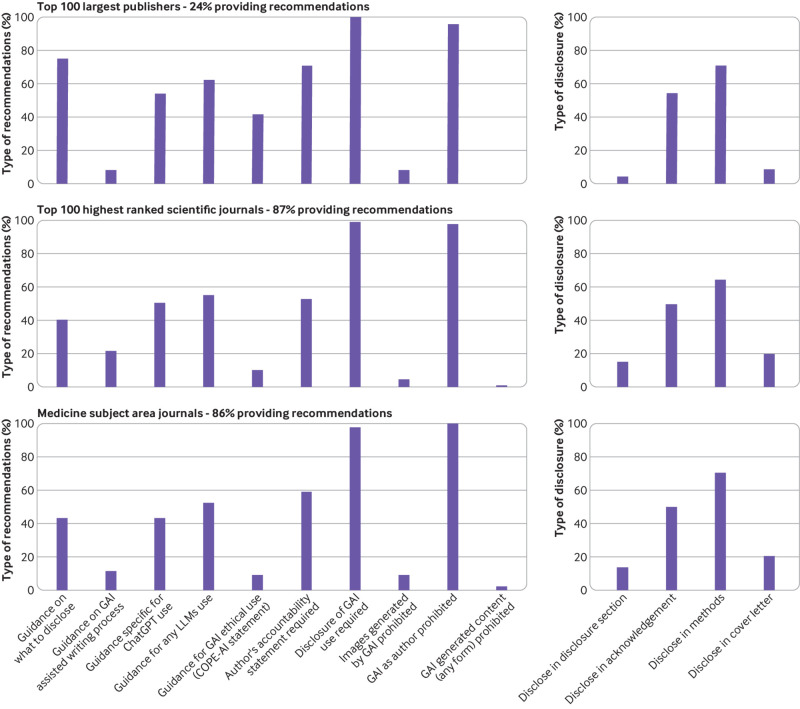
Objectives: To determine the extent and content of academic publishers’ and scientific journals’ guidance for authors on the use of generative artificial intelligence (GAI). Design: Cross sectional, bibliometric study. Setting: Websites of academic publishers and scientific journals, screened on 19-20 May 2023, with the search updated on 8-9 October 2023. Participants: Top 100 largest academic publishers and top 100 highly ranked scientific journals, regardless of subject, language, or country of origin. Publishers were identified by the total number of journals in their portfolio, and journals were identified through the Scimago journal rank using the Hirsch index (H index) as an indicator of journal productivity and impact. Main outcome measures: The primary outcomes were the content of GAI guidelines listed on the websites of the top 100 academic publishers and scientific journals, and the consistency of guidance between the publishers and their affiliated journals. Results: Among the top 100 largest publishers, 24% provided guidance on the use of GAI, of which 15 (63%) were among the top 25 publishers. Among the top 100 highly ranked journals, 87% provided guidance on GAI. Of the publishers and journals with guidelines, the inclusion of GAI as an author was prohibited in 96% and 98%, respectively. Only one journal (1%) explicitly prohibited the use of GAI in the generation of a manuscript, and two (8%) publishers and 19 (22%) journals indicated that their guidelines exclusively applied to the writing process. When disclosing the use of GAI, 75% of publishers and 43% of journals included specific disclosure criteria. Where to disclose the use of GAI varied, including in the methods or acknowledgments, in the cover letter, or in a new section. Variability was also found in how to access GAI guidelines shared between journals and publishers. GAI guidelines in 12 journals directly conflicted with those developed by the publishers. The guidelines developed by top medical journals were broadly similar to those of academic journals. Conclusions: Guidelines by some top publishers and journals on the use of GAI by authors are lacking. Among those that provided guidelines, the allowable uses of GAI and how it should be disclosed varied substantially, with this heterogeneity persisting in some instances among affiliated publishers and journals. Lack of standardization places a burden on authors and could limit the effectiveness of the regulations. As GAI continues to grow in popularity, standardized guidelines to protect the integrity of scientific output are needed.
Overview
CoChat Summary
TL;DR
This bibliometric analysis found substantial heterogeneity in guidance on generative artificial intelligence (GAI) across top academic publishers and scientific journals. While 87% of the top 100 highest-ranked journals had GAI guidelines, only 24% of the top 100 largest publishers did, and none of the guidelines were developed through a formal consensus process.
Key findings
- Among the top 100 largest publishers, 24% had released GAI guidance; 63% (n=15) of those were in the top 25 publishers, and 56% cited COPE membership. Among the top 100 highest-ranked journals, 87% had GAI guidelines, and 82% cited COPE membership.
- All 24 publishers with guidelines required disclosure in some form; 17 (71%) specified the methods section, 13 (54%) acknowledgements, and 2 (8%) the cover letter. Eighteen (75%) specified what details to disclose, only Elsevier provided a disclosure template, and 17 (71%) stated authors were accountable for AI output.
- Of the 87 journals with guidelines, all top 25 (100%) had AI guidelines; 85 (98%) had specific guidance on including GAI as an author, and all explicitly stated AI should not be listed as an author. Nineteen (22%) limited guidelines to the writing process; 48 (55%) mentioned large language models and 44 (51%) mentioned ChatGPT.
- Among 51 medical journals in the top 100, 44 (86%) had GAI guidelines; 31 (71%) specified methods disclosure, 22 (50%) acknowledgements, 9 (21%) cover letter, and 6 (14%) a new section; 26 (59%) stated authors were accountable. For consistency, 58 of 100 journals reported guidelines on the journal website, 12 (21%) linked to publisher guidelines, and among 15 journals with both journal and publisher guidelines, conflicts rose from 2 (13%) at first search to 12 (80%) at the second search.
Methods
- Cross-sectional bibliometric study of the top 100 largest academic publishers, identified from Nishikawa-Pacher’s list by number of affiliated journals, and the top 100 highest-ranked scientific journals by H index from Scimago.
- Official websites were manually searched for author guidance mentioning GPTs, large language models, or GAI. Initial data collection occurred 19–20 May 2023, with an updated search on 8–9 October 2023. If a publisher lacked guidance, at least three subsidiary journal websites were checked as a proxy; if a journal lacked guidance, publisher guidelines were used only if directly recommended or linked.
- After training and piloting the extraction form, two reviewers independently collected data, with discrepancies resolved by a third reviewer under senior author supervision. Descriptive statistics were used, including a subanalysis of journals classified as medical.
Limitations
- The paper states this is a snapshot at six and ten months after ChatGPT’s rise; guidelines were evolving rapidly, the number of publishers and journals included was limited, subsidiary journal proxies may not perfectly represent publisher policy, scholarly societies’ impact was not fully evaluated, and the study was largely qualitative and prone to subjectivity, mitigated by multiple reviewers.
- Evident from the text: reliance on publicly available website guidance and machine translation may miss unposted or non-English guidance, and the paper contains at least one internal numerical inconsistency (e.g., “Of 70 journals with GAI guidelines, 86 (99%)…”), which complicates interpretation.
Model-written summary. Check it against the paper before relying on it.
Integrity signals
Registry
Cites
Statistics
Figures
Verification
Claims the paper makes
6 Valid · 5 Not valid · 11 Not checked · 118 Own results and interpretations
The cited sources that could be checked couldn’t confirm or dispute this claim.
In the paper
“None of the proposed guidelines were listed as being developed using a formal guideline development process.30”
- Also stated in: § Results · plain
“None of the proposed guidelines was listed as being developed using any formal guideline development process.30”
§ Publishers' and journals' instructions to authors on use of generative artificial intelligence in academic and scientific publishing: bibliometric analysis > Results
What the sources say
- Could not verifycites [30] 30. Delgado-López-Cózar E, Cabezas-Clavijo Á. Ranking journals: could Google Scholar Metrics be an alternative to Journal Citation Reports and Scimago Journal Rank?Learn Publ 2013;26:101-14. doi:10.1087/20130206. sourceExperimental — accuracy not yet measured
The Introduction says that literature on how reporting guidelines were developed is sparse, and the Discussion proposes steps for robust development. Neither section assesses the proposed publisher or journal guidelines or says that none were listed as having a formal development process. Searches for that assertion and for formal guideline development found no such assessment in our copy. (LLM, conf=0.75)
plain- Asserted: passes — The authors put it forward as true.
- Checkable: passes — It can be checked against evidence.
- Load-bearing: unclear — It is unclear whether the paper’s conclusions depend on it.
- Based: passes — The paper gives a reason why it holds.
- Also stated in: § Results · plain
Every source the paper cites for this claim was checked and supports it.
In the paper
“Unlike the journal impact factor, which fluctuates often and was noticeably affected by the covid-19 pandemic, 28 the H index is considered to be more stable over time.29”
§ Publishers' and journals' instructions to authors on use of generative artificial intelligence in academic and scientific publishing: bibliometric analysis > Journal selection and data acquisition
What the sources say
- Supportedcites [29] 29. Delardas O, Giannos P. How COVID-19 Affected the Journal Impact Factor of High Impact Medical Journals: Bibliometric Analysis. J Med Internet Res 2022;24:e43089. doi:10.2196/43089 source
The Overview section describes the h-index as stable, with no abrupt changes over time. The Search interface section says the impact factor can vary each year. The COVID-19 point is attached to citation 28, not this source. (LLM, conf=0.92)
plain- Asserted: passes — The authors put it forward as true.
- Checkable: passes — It can be checked against evidence.
- Load-bearing: passes — The paper’s conclusions depend on it.
- Based: passes — The paper gives a reason why it holds.
- Supported
Every source the paper cites for this claim was checked and supports it.
In the paper
“In total, these 100 publishers are responsible for the publication of 28 060 journals.”
§ Publishers' and journals' instructions to authors on use of generative artificial intelligence in academic and scientific publishing: bibliometric analysis > Publisher selection and data acquisition
What the sources say
- Supportedcites [23] 23. Cacciamani GE, Collins GS, Gill IS. ChatGPT: standard reporting guidelines for responsible use. Nature 2023;618:238. doi:10.1038/ d41586-023-01853-w source
The Results section states that the top 100 academic publishers comprise 28,060 serial titles. Table 1 also gives 28,060 as the total number of journals for those publishers. (LLM, conf=0.95)
plain- Asserted: passes — The authors put it forward as true.
- Checkable: passes — It can be checked against evidence.
- Load-bearing: passes — The paper’s conclusions depend on it.
- Based: passes — The paper gives a reason why it holds.
- Supported
A result the paper reports from its own data — it cites no other source for it, so there is none to check. The quote shows it is in the paper.
In the paper
“Two publishers (8%), Emerald and BioMedCentral, included a policy to prohibit the submission of AI generated images.”
§ Publishers' and journals' instructions to authors on use of generative artificial intelligence in academic and scientific publishing: bibliometric analysis > Results
plain- Asserted: passes — The authors put it forward as true.
- Checkable: passes — It can be checked against evidence.
- Load-bearing: unclear — It is unclear whether the paper’s conclusions depend on it.
- Based: passes — The paper gives a reason why it holds.
A result the paper reports from its own data — it cites no other source for it, so there is none to check. The quote shows it is in the paper.
In the paper
“Twenty four (24%) of the publishers provided specific guidance on AI for authors (table 1 and fig 1).”
§ Publishers' and journals' instructions to authors on use of generative artificial intelligence in academic and scientific publishing: bibliometric analysis > Results
plain- Asserted: passes — The authors put it forward as true.
- Checkable: passes — It can be checked against evidence.
- Load-bearing: passes — The paper’s conclusions depend on it.
- Based: passes — The paper gives a reason why it holds.
63 more claims
Create a free account to see all 140 claims and to verify the 8 references still open.
- Probably not a substantial claim. 40
- It may state two separate claims as one. 44
- The quote only partly states this claim. 2
Claims other papers make about this one
Each is checked against this paper’s own text: does it say what the citing paper says it does?
The source backs part of the claim, not all of it — or backs it for a different population, condition or comparison.
In the citing paper
“However, a significant gap persists between the theoretical discourse on AI regulation and the empirical reality of AI-driven retractions across different disciplines (Ganjavi et al., 2024).”
From The Attention Mismatch: Mapping the Structural Academic Governance Deficit in the Age of Generative AI (2026) · cites this paper as Ganjavi et al., 2024
Experimental — accuracy not yet measuredThe source backs part of the claim, not all of it — or backs it for a different population, condition or comparison.
In the citing paper
“a previous study [40], which reported that 86% of top journals provided author guidelines”
From Generative artificial intelligence (GAI) usage guidelines for scholarly publishing: a cross-sectional study of medical journals (2025) · cites this paper as [40]
Experimental — accuracy not yet measuredThe source backs part of the claim, not all of it — or backs it for a different population, condition or comparison.
In the citing paper
“Major publishers have established policies on AI use in research outputs, explicitly addressing accountability, transparency, and the risk that generated content may not be traceable to verifiable sources [7,16,17].”
From A Workflow for Grant Discovery and Proposal Development Using Large Language Models: Development and Formative Evaluation (2026) · cites this paper as [17]
Experimental — accuracy not yet measuredThe source backs part of the claim, not all of it — or backs it for a different population, condition or comparison.
In the citing paper
“The reliance on author self-reporting, without independent verification or standardized auditing, raises legitimate questions about compliance in practice (Ganjavi et al., 2024).”
From Use of artificial intelligence tools in the publishing process: expectations from publishers through author guidelines (2026) · cites this paper as Ganjavi et al., 2024
Experimental — accuracy not yet measuredThe cited source says what the claim attributes to it.
In the citing paper
“Second, previous studies either focused on top ranked journals or exclusively on nursing journals [40, 41], leading to an incomplete assessment of such guidelines across non-top ranked medical journals and a lack of empirical comparisons with top ranked journals.”
From Generative artificial intelligence (GAI) usage guidelines for scholarly publishing: a cross-sectional study of medical journals (2025) · cites this paper as [40]
12 more claims about this paper
Create a free account to see every claim other papers make about this one.
Self-check
Percentages, sums and reported differences re-computed from the paper’s own numbers.
Each contradiction between two passages listed here was confirmed by an independent check.
Rated minor: it would not touch a result — a value no result rests on, a p-value that stays on the same side of the significance level, or a conflict that is clerical, resolved elsewhere in the paper, or outside its own findings.
In the paper
§ Publishers' and journals' instructions to authors on use of generative artificial intelligence in academic and scientific publishing: bibliometric analysis > Results
“Several of the 100 highest ranked journals shared the same publishers; the most represented publishers included Springer Nature, with 19% of its journals in the top 100, followed by the American Chemical Society (10%) and Elsevier (7%).”
§ Publishers' and journals' instructions to authors on use of generative artificial intelligence in academic and scientific publishing: bibliometric analysis > Results
“All 10 Elsevier journals provided a template for the disclosure and advised that it should be included in a new, separate section of the manuscript.”
Rated minor: it would not touch a result — a value no result rests on, a p-value that stays on the same side of the significance level, or a conflict that is clerical, resolved elsewhere in the paper, or outside its own findings.
In the paper
“Of 70 journals with GAI guidelines, 86 (99%) required some type of "reporting," "documenting," or "noting," with Science being the only journal that did not mention disclosure.”
§ Publishers' and journals' instructions to authors on use of generative artificial intelligence in academic and scientific publishing: bibliometric analysis > Results
Reported 99 · recomputed 122.857143
Rated minor: it would not touch a result — a value no result rests on, a p-value that stays on the same side of the significance level, or a conflict that is clerical, resolved elsewhere in the paper, or outside its own findings.
In the paper
§ Publishers' and journals' instructions to authors on use of generative artificial intelligence in academic and scientific publishing: bibliometric analysis > Publisher selection and data acquisition
“We utilized the list in Nishikawa-Pacher's study, which identified and ranked the top 100 publishers by number of affiliated journals in their portfolio.23”
§ Publishers' and journals' instructions to authors on use of generative artificial intelligence in academic and scientific publishing: bibliometric analysis > References
“23. Cacciamani GE, Collins GS, Gill IS. ChatGPT: standard reporting guidelines for responsible use. Nature 2023;618:238. doi:10.1038/ d41586-023-01853-w 24. Nishikawa-Pacher A. Who are the 100 largest scientific publishers by journal count? A webscraping approach. J Doc 2022;78:450-63. doi:10.1108/JD-04-2022-0083.”
Citations
Cites
Large language models encode clinical knowledge
Singhal, K., Azizi, S., Tu, T., Mahdavi, S. S., Wei, J., Chung, H. W., Scales, N., Tanwani, A., Cole-Lewis, H., Pfohl, S., et al. (2023) · Nature · doi:10.1038/s41586-023-06291-2 · Cited by 4,083
Large Language Models Encode Clinical Knowledge
Singhal, K., Azizi, S., Tu, T., Mahdavi, S. S., Wei, J., Chung, H. W., Scales, N., Tanwani, A., Cole-Lewis, H., Pfohl, S., et al. (2022) · arXiv · doi:10.48550/arxiv.2212.13138 · Cited by 4,083
Guidance for Developers of Health Research Reporting Guidelines
Moher, D., Schulz, K. F., Simera, I., & Altman, D. G. (2010) · PLoS Medicine · doi:10.1371/journal.pmed.1000217 · Cited by 1,437
ChatGPT is fun, but not an author
Thorp, H. H. (2023) · Science · doi:10.1126/science.adg7879 · Cited by 1,437
ChatGPT listed as author on research papers: many scientists disapprove
Stokel-Walker, C. (2023) · Nature · doi:10.1038/d41586-023-00107-z · Cited by 868 · cited 1×
“18 Even if the current COPE statement on AI is promptly endorsed by journals (eg, Journal of the American Medical Association 19 20 ) and editorial associations (eg, World Association of Medical Editors (WAME) 21 ), it does not provide a comprehensive and functional set of recommendations on key…”
BackgroundPredatory publishers are corrupting open access
Beall, J. (2012) · Nature · doi:10.1038/489179a · Cited by 658 · cited 1×
“24 Although the exact number of journals worldwide is unknown, one estimate suggests around 45 000, 25 thus the current study captured around two thirds of journals as represented by the top 100 largest academic publishers.”
BackgroundAI bot ChatGPT writes smart essays — should professors worry?
Stokel-Walker, C. (2022) · Nature · doi:10.1038/d41586-022-04397-7 · Cited by 543
Flanagin, A., Bibbins-Domingo, K., Berkwits, M., & Christiansen, S. L. (2023) · JAMA · doi:10.1001/jama.2023.1344 · Cited by 420 · cited 2×
“18 Even if the current COPE statement on AI is promptly endorsed by journals (eg, Journal of the American Medical Association 19 20 ) and editorial associations (eg, World Association of Medical Editors (WAME) 21 ), it does not provide a comprehensive and functional set of recommendations on key aspects to guide respo…”
BackgroundLecler, A., Duron, L., & Soyer, P. (2023) · Diagnostic and Interventional Imaging · doi:10.1016/j.diii.2023.02.003 · Cited by 385
de Vries, E., Schoonvelde, M., & Schumacher, G. (2018) · Political Analysis · doi:10.1017/pan.2018.26 · Cited by 243
Cited by
Items 101–200 of 263
Editorial: AI tools usage in Emerald journal articles
Ibragimova, I., & Phagava, H. (2024) · International Journal of Health Governance · doi:10.1108/ijhg-09-2024-163 · Cited by 5
Artificial Intelligence (AI) and The Journal of Pediatric and Adolescent Gynecology (JPAG)
Hillard, P. J. A. (2025) · Journal of Pediatric and Adolescent Gynecology · doi:10.1016/j.jpag.2025.04.007 · Cited by 3
Caputo, J., Ibrahim, A. H., Davis, D. W., Stone, W. J., Garver, M. J., & Johnson, S. L. (2025) · Kinesiology Review · doi:10.1123/kr.2025-0010 · Cited by 3
Challenging the dogma: why reviewers should be allowed to use AI tools
Lippi, G., Lackner, K. J., Melichar, B., Pan, S., Schlattmann, P., Greaves, R. F., Gillery, P., & Plebani, M. (2025) · Clinical Chemistry and Laboratory Medicine (CCLM) · doi:10.1515/cclm-2025-1180 · Cited by 3
Large Language Models as Peer Reviewers: Prompt Sensitivity and Model-Dependent Reproducibility
Erturk, S. M., & Durmaz, M. (2026) · Academic Radiology · doi:10.1016/j.acra.2026.04.046 · Cited by 5
Ética e Inteligência Artificial na Comunicação Científica: desafios para os Periódicos Científicos
Hayashi, M. C. P. I. (2025) · Encontros Bibli Revista Eletrônica de Biblioteconomia e Ciência da Informação · doi:10.5007/1518-2924.2025.e103497 · Cited by 13
Buitrago, J., Campos, E. M., & Romero, C. L. V. (2025) · Investigación Bibliotecológica Archivonomía Bibliotecología e Información · doi:10.22201/iibi.24488321xe.2025.104.59032 · Cited by 9
Generative AI and Scientific Authorship: A New Paradigm for Biomedical Imaging Research
Hsieh, S.-C., Lee, K.-H., Karmakar, R., Kandalkar, A., Mukundan, A., & Wang, H. (2025) · International Journal of Software Science and Computational Intelligence · doi:10.4018/ijssci.394323 · Cited by 2
Ghosh, A., & Huang, C. J. (2025) · Journal of the Society for Clinical Data Management · doi:10.47912/jscdm.438 · Cited by 2
The ethics of using artificial intelligence in writing medical research papers
Yu, S., & Hwang, H. (2025) · Kosin Medical Journal · doi:10.7180/kmj.25.141 · Cited by 2
“A review of global guidelines reveals a strict prohibition against listing generative AI as a coauthor [11,18] (Table 1).”
Charbonneau, D. H., & Zhang, M. (2026) · Accountability in Research · doi:10.1080/08989621.2026.2632083 · Cited by 9
“Several studies have also examined the AI policies from publishers or industry guidelines (Ganjavi et al. 2024; Lin 2024; Manu and Hasan 2024), and from universities (Padhan and Kampa 2024).”
Aydin, M. O., Vatansever, A., & Kafa, S. E. (2026) · Uludağ Üniversitesi Tıp Fakültesi Dergisi · doi:10.32708/uutfd.1870116 · Cited by 5
Why researchers hesitate to disclose AI use: development and validation of a multidimensional scale
Kulal, A. (2026) · Ethics & Behavior · doi:10.1080/10508422.2026.2661699 · Cited by 3
Is AI-Produced Humanities Scholarship a Case of Research Misconduct?
Metcalf, T. R. (2026) · Journal of Academic Ethics · doi:10.1007/s10805-026-09745-0 · Cited by 5
“But few journals explicitly forbid anything like persona-authored manuscripts (Ganjavi et al., 2024).”
Gruszczyński, D., Nijakowski, K., Halupczok-Żyła, J., Ruchała, M., Walkowiak, J., & Sawicka‐Gutaj, N. (2026) · Journal of Medical Science · doi:10.20883/medical.e1571 · Cited by 3
Saleem, N. H., & Jansen, B. J. J. (2026) · Machine Learning and Knowledge Extraction · doi:10.3390/make8080223 · Cited by 3
“These policies are necessary, but they do not fully address how repeated AI-assisted editing may gradually influence the rhetorical norms of published writing [7,11–14].”
InfluentialTimpka, T. (2024) · Journal of science and medicine in sport · doi:10.1016/j.jsams.2024.08.208 · Cited by 6
Could Artificial Intelligence Write, Review, Edit, and Produce This Column?
Patrikakis, C. Z., & Hurlburt, G. F. (2025) · IT Professional · doi:10.1109/mitp.2025.3530597 · Cited by 2
Buitrago, J., & Franco-Rico, J. A. (2025) · INTERdisciplina · doi:10.22201/ceiich.24485705e.2025.36.90833 · Cited by 8
Research and scholarly methods: Mixed methods studies
McLaughlin, J. E., Kane‐Gill, S. L., & Snyder, M. E. (2025) · JACCP JOURNAL OF THE AMERICAN COLLEGE OF CLINICAL PHARMACY · doi:10.1002/jac5.70068 · Cited by 4
“37 As a research tool, GenAI can support the development of participant interfaces, generate data, analyze complex datasets, and integrate quantitative and qualitative findings effectively and efficiently.”
Generative AI Guidelines in Korean Medical Journals: A Survey Using Human-AI CollaborationPreprint
Ahn, S. (2024) · medRxiv · doi:10.1101/2024.03.08.24303960 · Cited by 2
“12 These results suggest that Korean medical journals may be in the earlier stages of adopting GAI policies compared to global leaders in the field.”
BackgroundLarge Language Models in Scientific Publishing: Policy Landscape for Authors, Reviewers, and Editors
Park, S. H. (2026) · Korean Journal of Radiology · doi:10.3348/kjr.2026.0166 · Cited by 2
False Positive Risk in AI Detection of L2 Academic Writing: A Case Study
Za’rour, R., & Altakhaineh, A. R. M. (2026) · Discourses on Culture · doi:10.2478/doc-2026-0003 · Cited by 2
Barrientos, K. M., Castano-Villegas, N., Zea, J., & Velásquez, L. (2026) · doi:10.21203/rs.3.rs-10241865/v1 · Cited by 1
ERKILIÇ, E., & Çifçi, İ. (2025) · Journal of Multidisciplinary Academic Tourism · doi:10.31822/jomat.2025-10-1-111 · Cited by 2
Deterring Academic Integrity Breaches: The Roles of Institutions, Academics, and Support Services
Sivasubramaniam, S. D. (2025) · Journal of Scholarly Publishing · doi:10.3138/jsp-2024-1115 · Cited by 2
“Interestingly, a recent cross-sectional bibliometric study carried out by Ganjavi et al. ( 2024 ), using the top 100 largest academic publishers of highly indexed scientific journals, highlighted that only 24 per cent of these journals provided guidance on the effective use of GenAI tools (and…”
Hsu, M., Yudovich, M., & Raman, J. D. (2025) · Science Editing · doi:10.6087/kcse.375 · Cited by 1
XU, Z. (2025) · Proceedings of the ALISE Annual Conference · doi:10.21900/j.alise.2025.2050 · Cited by 1
Ziyang, X. (2025) · Proceedings of the Association for Information Science and Technology · doi:10.1002/pra2.1297 · Cited by 3
Cheng, P.-J., Hu, F., Chen, L.-Y., Liu, J.-Y., Wu, J., & Chen, W. (2025) · Taiwan Journal of Ophthalmology · doi:10.4103/tjo.tjo-d-25-00072 · Cited by 1
“[16,132] Transparency about GenAI usage is crucial to understand its limitations and risks.”
Hong, J., Yang, Q., Zhong, F., Fang, M., Guo, Y., & Chen, X. (2025) · Journal of Cardiothoracic Surgery · doi:10.1186/s13019-025-03599-0 · Cited by 1
“At the same time, the H-index is an indicator for evaluating scholarly contributions and predicting future research impact [27].”
Fang, M., Wu, Q., Liu, J., & Liu, X. (2025) · Nurse Educator · doi:10.1097/nne.0000000000002097 · Cited by 2
Li, Y., Shao, B., Ye, K., Liu, X., Wang, H.-D., Sun, C.-L., Xiao, Y.-Y., & Wang, H. (2026) · Cell Transplantation · doi:10.1177/09636897251410650 · Cited by 2
On the Use of Artificial Intelligence in JCAC
Belser, C. T., Taylor, D. D., Chang, M. K., & Kitching, E. (2026) · Journal of Child and Adolescent Counseling · doi:10.1080/23727810.2026.2614904 · Cited by 1
“The generation of original text or content also raises the question of whether such tools should be elevated to author status, which is expressly prohibited in many top academic journals (Flanagin et al., 2024; Ganjavi et al., 2024).”
Peterson, C., Anderson, C., Berdine, G. G., & NUGENT, K. M. (2026) · Journal of Electronic Resources in Medical Libraries · doi:10.1080/15424065.2026.2626575 · Cited by 2
“As of this writing, studies suggest that many journals do not have policies on AI use, though this should rapidly change (Ganjavi et al., 2024; Bhavsar et al., 2025; Lund & Naheem, 2024).”
InfluentialPathak, J. L., Zhang, K., Jiang, H., Zhang, Y., Zhang, W., Wang, H., Mo, Y., Liu, F., Tian, Z., & Lihong, W. U. (2026) · BMC Medical Ethics · doi:10.1186/s12910-026-01415-5 · Cited by 3
“GenAI directly and profoundly challenges these tenets by blurring concepts of author-ship and originality, enabling sophisticated fabrication of text, data, and imagery, and complicating traditional lines of accountability and oversight [7–9].”
Weaver, K. D. (2026) · Information Services & Use · doi:10.1177/18758789261435716 · Cited by 9
“20 This indicates an increase in AI disclosure as a practice over time as an earlier study found 37.6% of nursing journals and 14.5% of medical journals had a requirement for AI disclosure just a year earlier.”
InfluentialGlobal laws governing intellectual property rights for AI-generated works
Furqan, T., Aleissaee, H. M., Ghenimi, N., & Arabi, A. A. (2026) · Discover Artificial Intelligence · doi:10.1007/s44163-026-01165-8 · Cited by 3
“Although research journals do not assess originality in the copyright sense, they increasingly require disclosure of generative AI use to evaluate the originality and integrity of scholarly work [50].”
Luckett, B., Acosta, G., Bixler, E., & Bobier, C. A. (2026) · Clinical Anatomy · doi:10.1002/ca.70151 · Cited by 1
Almashour, M., Aldamen, H. A. K., & Jarrah, M. A. (2026) · Current Issues in Language Planning · doi:10.1080/14664208.2026.2685636 · Cited by 2
Jeong, I. H., Kim, H., & Hwang, H. (2026) · Kosin Medical Journal · doi:10.7180/kmj.26.173 · Cited by 2
“Major academic publishers, including Elsevier, Springer Nature, and Wiley, explicitly prohibit AI authorship and require transparent disclosure of AI-assistance in manuscript preparation [66].”
Algorithmic scholarship and academic evaluation: governance misalignment in the age of generative AI
Baciu, C., Mohan, G., & Wilson, J. (2026) · Frontiers in Artificial Intelligence · doi:10.3389/frai.2026.1862980 · Cited by 4
“These developments have prompted growing concern within academic publishing regarding transparency, disclosure, authorship attri-bution, and accountability (Ganjavi et al., 2024; Nature, 2023; Perkins and Roe, 2024; Resnik and Hosseini, 2025).”
Six misconceptions about large language models: A minimal model and diagnostic taxonomy
Lin, Z.-C. (2026) · PNAS Nexus · doi:10.1093/pnasnexus/pgag236 · Cited by 1
“Leading publishers and journals vary in what they count as “ AI use ” and how such use must be disclosed (73, 74).”
Drobniak, S. M., Cendrowska-Pek, M., Gudowska, A., Janas, K., Podkowa, P., Skorb, K., Gronowska, M., Oleś, W., Bikmurzina, F., Boroń, N., et al. (2026) · Research Integrity and Peer Review · doi:10.1186/s41073-026-00230-1 · Cited by 7
“Most allow limited use for language editing or copy-editing, if this is acknowledged, with strict bans usually associated with AI-assisted peer review or uploading manuscript drafts to AI agents (i.e., uses not directly associated with authoring a paper) [18].”
Sports science publishing in the post-ChatGPT era: longer papers without smaller teams
You, Y. (2026) · Sport Sciences for Health · doi:10.1007/s11332-026-01866-8 · Cited by 1
Aharoni, M. (2026) · International Journal of Qualitative Methods · doi:10.1177/16094069261473131 · Cited by 5
Cwik, J. C. (2026) · Research Integrity and Peer Review · doi:10.1186/s41073-026-00245-8 · Cited by 7
“This focus was motivated by prior evidence that publication policies on generative AI remain heterogeneous and vary in the level of operational detail they provide to authors [21, 22].”
Lv, J., Luo, Z., Huang, D., et al. (2024) · Asian Journal of Surgery · doi:10.1016/j.asjsur.2024.06.123 · Cited by 1
Generative Artificial Intelligence and Scientific Publications
Hegde, S. N. (2024) · APIK Journal of Internal Medicine · doi:10.4103/ajim.ajim_62_24 · Cited by 1
Bibliometric analysis of the postoperative impact of remimazolam: Hot topics and emerging trends
Huang, D., Zou, K., Yang, J., & Wang, Y. (2024) · Asian Journal of Surgery · doi:10.1016/j.asjsur.2024.09.224 · Cited by 1
ЧИ Є МАЙБУТНЄ В НАУКОВИХ ЖУРНАЛІВ? ЗМІНИ, ВИКЛИКИ Й ТЕНДЕНЦІЇ В АКАДЕМІЧНОМУ ВИДАВНИЦТВІ
Ярошенко, Т., & Ярошенко, О. (2024) · Open Science and Innovation · doi:10.62405/osi.2024.02.04 · Cited by 5
Summary Guidelines on the Use of AI in Manuscript Preparation
Mondal, H. (2025) · Indian journal of radiology and imaging - new series/Indian journal of radiology and imaging/Indian Journal of Radiology & Imaging · doi:10.1055/s-0045-1807286 · Cited by 1
Generative AI-assisted Peer Review in Medical Publications: Opportunities Or Trap (Preprint)Preprint
Li, Z., Shen, C., Cao, F., Xiang, C. J., Fei, Y., & Liu, J. (2024) · doi:10.2196/preprints.66022 · Cited by 1
Zayachkivska, О., Fass, R., Coenen, A. M. L., et al. (2025) · Proceedings of the Shevchenko Scientific Society Medical Sciences · doi:10.25040/ntsh2025.01.02 · Cited by 1
Lingard, L., Driessen, E. W., & Oswald, K. (2025) · medRxiv · doi:10.1101/2025.07.17.25331725 · Cited by 1
Gordon, A. J., Bounthavong, M., Corte, C. M., Siantz, E., Mahmoud, K. F., Finnell, D. S., Scheuermann, T. S., Kyei, E. F., Wyse, J. J. B., Oliva, E. M., et al. (2026) · Substance Use & Addiction Journal · doi:10.1177/29767342261471638 · Cited by 1
Song, Y., Moon, H., Yang, H., & Kilgore, C. (2026) · arXiv · doi:10.48550/arxiv.2603.20220 · Cited by 1
Guo, Z., Mao, H., & Zhang, F. (2026) · Publications · doi:10.3390/publications14020027
“However, a significant gap persists between the theoretical discourse on AI regulation and the empirical reality of AI-driven retractions across different disciplines (Ganjavi et al., 2024).”
Naeem, N.-I.-K., Naeem, Z.-E.-F., & Anwer, A. (2026) · BMC Medical Education · doi:10.1186/s12909-026-09405-2
“These concerns are widely noted in the international debate on responsible AI in research [39].”
Artificial intelligence, platelets and aspirin
de Gaetano, G. (2024) · Bleeding Thrombosis and Vascular Biology · doi:10.4081/btvb.2024.130
Generative artificial intelligence tools in scientific writing: entering a brave new world?
Vlachopoulos, C. V., Antonopoulos, A. S., & Terentes-Printzios, D. G. (2024) · Hellenic Journal of Cardiology · doi:10.1016/j.hjc.2024.05.014
A Values-led Approach to Technological Change
Stout, B. (2024) · International Journal of Social Sciences and Artistic Innovations · doi:10.35745/ijssai2024v04.02.0005
Revitalizing Neurology Practice: Integrating Health Humanities, Neurobiology, and Digital Innovation
Gomes, M. D. M. (2024) · Revista brasileira de neurologia · doi:10.46979/rbn.v60i1.64138
Huang, D., Zhou, H., Luo, Z., et al. (2024) · Asian Journal of Surgery · doi:10.1016/j.asjsur.2024.06.089
No Thanks: Acknowledgment in the Journals of the History of Science Society
Chacko, X. S., & Stark, L. (2024) · Isis · doi:10.1086/731444 · Cited by 1
Large language models and artificial intelligence: the coming storm for academia
Murali, M., & Wiles, M. D. (2024) · Anaesthesia · doi:10.1111/anae.16441 · Cited by 1
“Many journals, including Anaesthesia , have now produced speci fi c policies relating to the use of arti fi cial intelligence in submitted manuscripts [16, 17].”
Huang, D.-Q., Zou, K., & Zhu, Q. (2024) · Asian Journal of Surgery · doi:10.1016/j.asjsur.2024.09.056
Huang, D.-Q., Zou, K., & Zhu, Q. (2024) · Asian Journal of Surgery · doi:10.1016/j.asjsur.2024.09.059
Akpan, U. S. (2024) · Springer eBooks · doi:10.1007/978-3-031-68530-9_1 · Cited by 1
A Commitment to Quality in Musculoskeletal Research Reporting
Cornell, C. N. (2024) · HSS Journal® The Musculoskeletal Journal of Hospital for Special Surgery · doi:10.1177/15563316241290832
“With the advent of generative artificial intelligence (AI) in academic publishing [2], plus the ongoing problem of predatory publishers [3] and a record number of retractions of published studies [8], additional rigor on the part of journal editors, reviewers, and authors is critical.”
An introduction to the journal review and editorial process
Li, B., & Smeds, M. R. (2025) · Journal of Vascular Surgery Cases and Innovative Techniques · doi:10.1016/j.jvscit.2025.101745
Scientific Publications in the Age of Artificial Intelligence
Grebenshchikova, E. G. (2024) · Scientific and Technical Information Processing · doi:10.3103/s0147688224700679
“Not all publishers have requirements regarding the use of images in publications [21].”
Guidance Regarding the Use of Artificial Intelligence in Nursing Journal Author Guidelines
Carter‐Templeton, H., Oermann, M. H., Owens, J. K., Peterson, G. M., Mbadiwe, J., Quazi, M. A., & Bailey, H. E. (2025) · CIN Computers Informatics Nursing · doi:10.1097/cin.0000000000001286 · Cited by 2
Évolution des exigences méthodologiques des publications chirurgicales
Slim, K., Sauvanet, A., Barbier, L. A., Regimbeau, J., Alvès, A., & Pocard, M. D. (2025) · Journal de Chirurgie Viscérale · doi:10.1016/j.jchirv.2025.02.007
Huang, D., Zhu, Q., Zou, K., et al. (2025) · Asian Journal of Surgery · doi:10.1016/j.asjsur.2025.02.229
Hillard, P. J. A. (2025) · Journal of Pediatric and Adolescent Gynecology · doi:10.1016/j.jpag.2025.04.010
RetractedPlagiarism and Artificial Intelligence: Balancing Innovation with Academic Integrity
Aryal, M., & Sharma, A. (2025) · Nepalese Heart Journal · doi:10.3126/nhj.v22i1.78326
AI-Augmented authorship: revolutionizing histopathology publishing in the generative AI era
Gu, Q., Li, N., Littlefield, N. G., Gao, F., Saini, M. L., Wang, Y., Wheeler, B. J., Soong, T. R., Xia, R., & Tafti, A. P. (2025) · Journal of Histotechnology · doi:10.1080/01478885.2025.2505294
“BPR2 GenAI applications cannot be listed as co-authors of scientific publications under any circumstances [6,8–11].”
Azevedo, N. H., & dos Santos, P. G. F. (2025) · Ensaio · doi:10.1590/1983-2117-59484t · Cited by 8
Harrath, A. E. (2025) · International Journal of Linguistics and Translation Studies · doi:10.36892/ijlts.v6i3.593 · Cited by 2
Programming literacy for physician‐scientists in the AI era
Kani, R., Gon, H., Nakajima, S., et al. (2025) · Psychiatry and Clinical Neurosciences Reports · doi:10.1002/pcn5.70179
“9 Furthermore, beyond addressing hal-lucination risks, responsible use of generative AI in clinical research requires broader safety considerations, including version ‐ controlled prompts and temperature settings for reproducibility, and automatic log audits to prevent protected health information…”
Bibliometrics‐Based Mapping of Research on the Role of miRNAs in Oral Cancer
Wang, Y., Shi, R., Wang, B., & Li, K. (2025) · Journal of Oral Pathology and Medicine · doi:10.1111/jop.70037
Mentorship in Medical Writing: Shaping Future-Ready Publication Professionals
Toroser, D. (2025) · Trends in Scholarly Publishing · doi:10.21124/tsp.2025.54.58
Where do I submit my next paper? A practical guide for biomedical researchers
Alrashdan, M. S. (2025) · Journal of Biomedical Research · doi:10.7555/jbr.39.20250147
Integridade acadêmica na era do ChatGPT: Desafios éticos e as novas fronteiras da Inovação
de Lima, J. C. R., & Felippe, M. L. (2025) · Revista Brasileira da Educação Profissional e Tecnológica · doi:10.15628/rbept.2025.17803 · Cited by 6
Automating Visual Abstracts in Radiology with Vision-Language Models: Practical Insights
Chu, L. C. H., & Syailendra, E. A. (2025) · Radiology · doi:10.1148/radiol.252731
Mapping Scientific Trends and Collaboration Networks in Voice Rehabilitation After Laryngectomy
Doluoğlu, S., Camalan, B. V., & Özlügedik, S. (2025) · Journal of Voice · doi:10.1016/j.jvoice.2025.10.025
Rizki, I. A., & Daoud, R. (2025) · New Zealand Journal of Educational Studies · doi:10.1007/s40841-025-00417-y · Cited by 8
“Additionally, some researchers believe that GenAI tools are beneficial as research aids, helping to generate ideas, synthesise information, and summarise vast amounts of text data, thereby supporting researchers in data analysis and writing composition (Chauhan, 2024; Ganjavi et al., 2024).”
Hirosawa, T., Harada, Y., & Shimizu, T. (2025) · AI & Society · doi:10.1007/s00146-025-02750-8 · Cited by 2
Yoshida, I., & Woo, H. (2025) · Asian Journal of Occupational Therapy · doi:10.11596/asiajot.21.144
Regaining Scientific Authority in a Post-Truth Landscape
Petzold, A. M., & Nichols, M. D. (2025) · Publications · doi:10.3390/publications13040065 · Cited by 3
“…have adopted differing policies regarding AI use in the writing, editing and formatting of their articles ranging from a carte blanche of AI use to a required affidavit stating that the author has not used AI at all to a complete lack of clear policy regarding the use of AI (Ganjavi et al., 2024).”
Artificial intelligence and journals: A perspective
Jani, N. J. (2025) · Journal of Integrated Standardized Homoeopathy · doi:10.25259/jish_203_2025
Generative artificial intelligence and editorial ethics: a roadmap for Health & New Media Research
Noh, G. Y. (2025) · Health & New Media Research · doi:10.22720/hnmr.2025.00304
Editorial: The rise of the robot authors
Cancio, L. C. (2026) · Burns · doi:10.1016/j.burns.2026.107862
Application of GAI to Empirical Studies: It’s High Time to Discuss Challenges and Pitfalls
Chong, M., Ding, J., Shah, C., & Chen, H. (2025) · ACM/IEEE Joint Conference on Digital Libraries · doi:10.1109/jcdl67857.2025.00067
“These results demonstrate how these tools have changed scholarly publishing and will transform in the future [12].”
From Pen to Prompt: Navigating LLM-Generated Content in Postgraduate Pharmacy Training Applications
Bradley, K. E., Chastain, D. B., Young, H. N., & Osae, S. P. (2026) · American Journal of Pharmaceutical Education · doi:10.1016/j.ajpe.2026.101947
Sisó‐Almirall, A. (2026) · Revista Clínica de Medicina de Familia · doi:10.55783/rcmf.190101 · Cited by 1
Χρυσανθοπούλου, Κ. (2026) · Ετήσιο Ελληνόφωνο Επιστημονικό Συνέδριο Εργαστηρίων Επικοινωνίας · doi:10.12681/cclabs.9684
Increasing Use of Large Language Models for Scholarly Writing in Radiology
Phillips, V. J., Latheef, A. A. P., Sarkar, S., et al. (2026) · American Journal of Roentgenology · doi:10.2214/ajr.25.34273
Du, Y., Xu, Z., Wen, T., Jia, Y., Zhao, X., & Jia, Z. (2026) · Digital Health · doi:10.1177/20552076261430065
Metadata
- Authors
- Ganjavi, C., Eppler, M. B., Pekcan, A., Biedermann, B., Abreu, A., Collins, G. S., Gill, I. S., & Cacciamani, G. E.
- Affiliations
- University of Southern California (US)
- UK EQUATOR Centre, Centre for Statistics in Medicine, Nuffield Department of Orthopaedics, Rheumatology and Musculoskeletal Sciences, University of Oxford, Oxford, UK
- Corresponding author
- Cacciamani, Giovanni E
- Venue
- BMJ
- Publisher
- BMJ
- Published
- 2024-01-31
- Volume
- 384
- Pages
- e077192
- ISSN
- 1756-1833 (ISSN-L)
- PMC
- PMC10828852
- OpenAlex
- W4391403616
- Cited by
- 266
- References
- 25
- Citations by year
- 2026: 108 · 2025: 97 · 2024: 60
- FWCI
- 390.91
- Type
- journal article
- Language
- en
- Open access
- hybrid
- doi.org
- Licence
- Locations
- BMJ (publishedVersion, cc-by-nc)
- PubMed Central (publishedVersion, cc-by-nc)
- PubMed (publishedVersion)
- University of Birmingham Research Portal (University of Birmingham) (publishedVersion, cc-by-nc)
- HighWire Press Open Archive (submittedVersion)
- Funders
- American Diabetes Association
- American Association for Cancer Research
- American Heart Association
- American Thoracic Society
- American Association for the Study of Liver Diseases
- American Gastroenterological Association
- British Medical Association
- National Cancer Institute
- Topics
- Social Sciences › Library and Information Sciences › Publishing and Scholarly Communication
- Social Sciences › Education › Academic integrity and plagiarism
- Social Sciences › Library and Information Sciences › Academic Publishing and Open Access
- Keywords
- generative AI, author guidelines, AI disclosure, AI authorship, academic publishers, scientific journals, medical journals, research integrity, artificial intelligence in healthcare, artificial intelligence in industry, artificial intelligence in government, artificial intelligence in warfare, artificial intelligence in law
- MeSH terms
- Artificial Intelligence, Cross-Sectional Studies, Humans, Periodicals as Topic, Publishing, Bibliometrics
About these checks
Registry, retraction, Cites and statistics results are computed, not judged, with one exception: a printed reference that no index lists is read once by a model before it counts as a citation error. Claims are extracted by a model and kept only when their quote appears verbatim in the text; each cited source is then checked, with a model’s help, for whether it says what the claim relies on. Those verdicts can be wrong — read the claim’s quote and the cited source before relying on one.
The claim verdicts this report counts are experimental: their accuracy is not yet measured.
A language model drew the claims from the paper on 2026-10-29, under version 3 of the claim definition (model deepseek-v4.1-flash, prompt extract-v3).
A second model labelled each claim on 2026-10-29 (model jev-1.13-20260917, definition revision gold-guideline-v0.2).
Cited sources are checked with a language model’s help (gpt-6-sol).
Statistics and arithmetic are recomputed, not judged.
Confidence bands are shown only for fields calibrated on our annotated test set. None is calibrated yet, so no band is shown.
What counts as a claim ›How we measure confidence ›How we check this ›
Are you an author, or do you see a problem with this page? Request a review
Data sources
Bibliographic data: Semantic Scholar, OpenAlex, Crossref.
Contains information from the Semantic Scholar Academic Graph Datasets, made available under the ODC Attribution License (ODC-BY 1.0).
Semantic Scholar’s data is described in: Kinney, R., et al. (2023). The Semantic Scholar Open Data Platform. arXiv:2301.10140.
