

The DOI matches its Crossref record; 43 of the 43 references it cites were found in a registry or an index.
Effect of combination treatment with glucagon-like peptide-1 receptor agonists and sodium-glucose cotransporter-2 inhibitors on incidence of cardiovascular and serious renal events: population based cohort study
Open accessAbstract
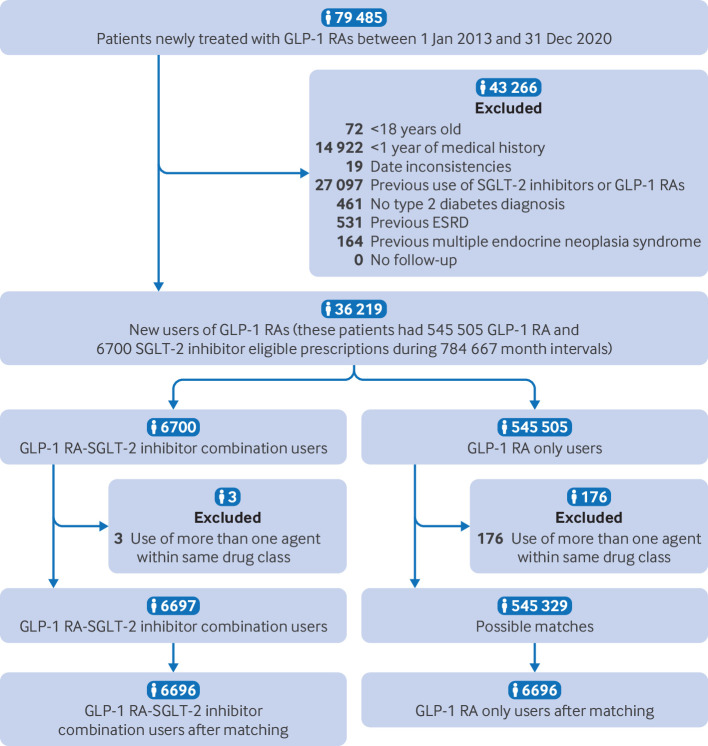
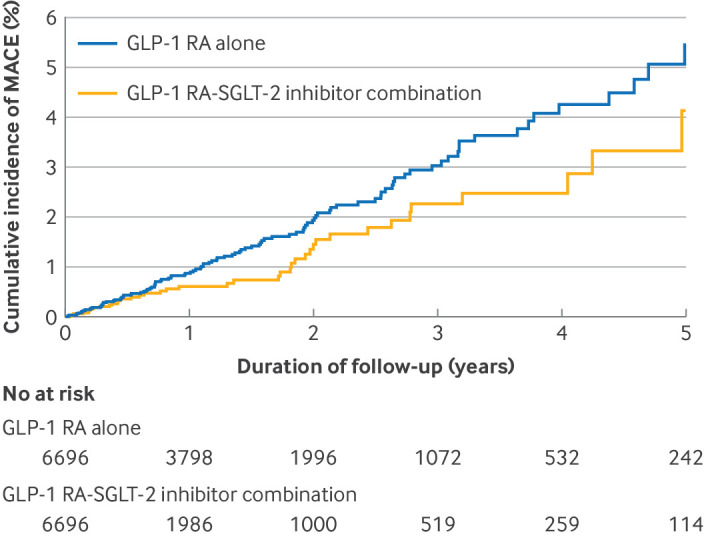
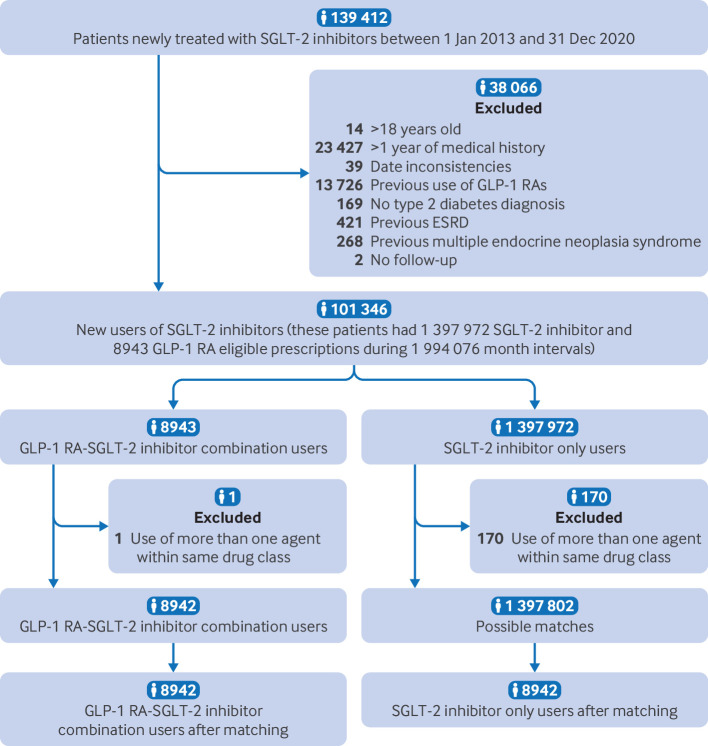
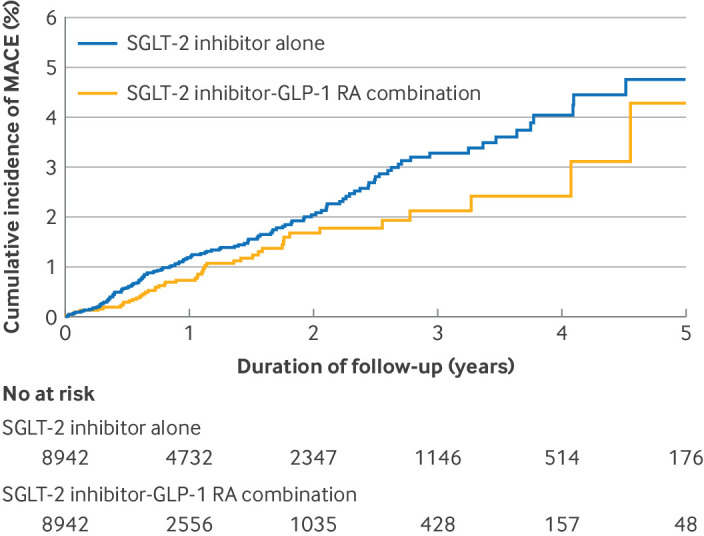
Objective: To determine whether the combined use of glucagon-like peptide-1 (GLP-1) receptor agonists and sodium-glucose cotransporter-2 (SGLT-2) inhibitors is associated with a decreased risk of major adverse cardiovascular events and serious renal events compared with either drug class alone among patients with type 2 diabetes, and to assess the effect of the combination on the individual components of major adverse cardiovascular events, heart failure, and all cause mortality. Design: Population based cohort study using a prevalent new-user design, emulating a trial. Setting: UK Clinical Practice Research Datalink linked to Hospital Episode Statistics Admitted Patient Care and Office for National Statistics databases. Participants: Two prevalent new-user cohorts were assembled between January 2013 and December 2020, with follow-up until the end of March 2021. The first cohort included 6696 patients who started GLP-1 receptor agonists and added on SGLT-2 inhibitors, and the second included 8942 patients who started SGLT-2 inhibitors and added on GLP-1 receptor agonists. Combination users were matched, in a 1:1 ratio, to patients prescribed the same background drug, duration of background drug, and time conditional propensity score. Main outcome measures: Cox proportional hazards models were fitted to estimate the hazard ratios and 95% confidence intervals of major adverse cardiovascular events and serious renal events, separately, comparing the GLP-1 receptor agonist-SGLT-2 inhibitor combination with the background drug, either GLP-1 receptor agonists or SGLT-2 inhibitors, depending on the cohort. Secondary outcomes included associations with the individual components of major adverse cardiovascular events (myocardial infarction, ischaemic stroke, cardiovascular mortality), heart failure, and all cause mortality. Results: Compared with GLP-1 receptor agonists, the SGLT-2 inhibitor-GLP-1 receptor agonist combination was associated with a 30% lower risk of major adverse cardiovascular events (7.0 v 10.3 events per 1000 person years; hazard ratio 0.70, 95% confidence interval 0.49 to 0.99) and a 57% lower risk of serious renal events (2.0 v 4.6 events per 1000 person years; hazard ratio 0.43, 0.23 to 0.80). Compared with SGLT-2 inhibitors, the GLP-1 receptor agonist-SGLT-2 inhibitor combination was associated with a 29% lower risk of major adverse cardiovascular events (7.6 v 10.7 events per 1000 person years; hazard ratio 0.71, 0.52 to 0.98), whereas serious renal events generated a wide confidence interval (1.4 v 2.0 events per 1000 person years; hazard ratio 0.67, 0.32 to 1.41). Secondary outcomes generated similar results but with wider confidence intervals. Conclusions: In this cohort study, the GLP-1 receptor agonist-SGLT-2 inhibitor combination was associated with a lower risk of major adverse cardiovascular events and serious renal events compared with either drug class alone.
Overview
The claims and statistics of this paper haven’t been checked yet.
Run the check — free, no account needed. It reads the open-access text and checks the sources it cites.
Integrity signals
Registry
Cites
Statistics
Figures
Verification
Claims the paper makes
The claims and statistics of this paper haven’t been checked yet.
Run the check — free, no account needed. It reads the open-access text and checks the sources it cites.
Claims other papers make about this one
Each is checked against this paper’s own text: does it say what the citing paper says it does?
The cited source doesn’t support the claim as written.
In the citing paper
“The addition of a GLP-1 RA on top of SGLT2 inhibitor treatment was associated with a 30% lower risk of major adverse cardiovascular events and 57% lower risk of serious kidney events compared with GLP-1 RA therapy alone after a median follow-up of 9 months.”
From 11. Chronic Kidney Disease and Risk Management: Standards of Care in Diabetes—2026 (2026) · cites this paper as [146]
Checked by a reasoning model — may be wrong.
Experimental — accuracy not yet measuredThe source backs part of the claim, not all of it — or backs it for a different population, condition or comparison.
In the citing paper
“The addition of an SGLT2 inhibitor on top of GLP-1 RA was associated with a 29% lower risk of major adverse cardiovascular events compared with SGLT2 inhibitor alone.”
From 11. Chronic Kidney Disease and Risk Management: Standards of Care in Diabetes—2026 (2026) · cites this paper as [146]
Experimental — accuracy not yet measuredThe cited source says what the claim attributes to it.
In the citing paper
“When stratified based on history of kidney disease, the use of combination treatment by individuals with a history of kidney disease was associated with a lower risk of major adverse cardiovascular events compared with those without kidney disease (146).”
From 11. Chronic Kidney Disease and Risk Management: Standards of Care in Diabetes—2026 (2026) · cites this paper as [146]
The cited source says what the claim attributes to it.
In the citing paper
“The authors concluded that the combination of both drug classes was associated with a lower risk of MACE and serious kidney disease events compared with either drug class alone.”
Self-check
Percentages, sums and reported differences re-computed from the paper’s own numbers.
The self-check needs the paper’s full text.
Citations
Cites
Empagliflozin, Cardiovascular Outcomes, and Mortality in Type 2 Diabetes
Zinman, B., Wanner, C., Lachin, J. M., Fitchett, D., Bluhmki, E., Hantel, S., Mattheus, M., Devins, T., Johansen, O. E., Woerle, H. J., et al. (2015) · New England Journal of Medicine · doi:10.1056/nejmoa1504720 · Cited by 12,315
Canagliflozin and Cardiovascular and Renal Events in Type 2 Diabetes
Neal, B., Perkovic, V., Mahaffey, K. W., de Zeeuw, D., Fulcher, G., Erondu, N., Shaw, W., Law, G., Desai, M., & Matthews, D. R. (2017) · New England Journal of Medicine · doi:10.1056/nejmoa1611925 · Cited by 7,830
Liraglutide and Cardiovascular Outcomes in Type 2 Diabetes
Marso, S. P., Daniels, G. H., Brown-Frandsen, K., Kristensen, P., Mann, J. F. E., Nauck, M. A., Nissen, S. E., Pocock, S., Poulter, N. R., Ravn, L. S., et al. (2016) · New England Journal of Medicine · doi:10.1056/nejmoa1603827 · Cited by 7,629
Semaglutide and Cardiovascular Outcomes in Patients with Type 2 Diabetes
Marso, S. P., Bain, S. C., Consoli, A., Eliaschewitz, F. G., Jódar, E., Leiter, L. A., Lingvay, I., Rosenstock, J., Seufert, J., Warren, M. L., et al. (2016) · New England Journal of Medicine · doi:10.1056/nejmoa1607141 · Cited by 6,900
Dapagliflozin and Cardiovascular Outcomes in Type 2 Diabetes
Wiviott, S. D., Raz, I., Bonaca, M. P., Mosenzon, O., Kato, E. T., Cahn, A., Silverman, M. G., Zelniker, T. A., Kuder, J. F., Murphy, S. A., et al. (2019) · New England Journal of Medicine · doi:10.1056/nejmoa1812389 · Cited by 6,382
Canagliflozin and Renal Outcomes in Type 2 Diabetes and Nephropathy
Perkovic, V., Jardine, M. J., Neal, B., Bompoint, S., Heerspink, H. J. L., Charytan, D. M., Edwards, R., Agarwal, R., Bakris, G., Bull, S., et al. (2019) · New England Journal of Medicine · doi:10.1056/nejmoa1811744 · Cited by 6,189
Cosentino, F., Grant, P. J., Aboyans, V., Bailey, C. J., Ceriello, A., Delgado, V., Federici, M., Filippatos, G., Grobbee, D. E., Hansen, T. B., et al. (2020) · European Heart Journal · doi:10.1093/eurheartj/ehz486 · Cited by 4,763
Multiple imputation by chained equations: what is it and how does it work?
Azur, M. J., Stuart, E. A., Frangakis, C., & Leaf, P. J. (2011) · International Journal of Methods in Psychiatric Research · doi:10.1002/mpr.329 · Cited by 3,542
Davies, M. J., D’Alessio, D. A., Fradkin, J., Kernan, W. N., Mathieu, C., Mingrone, G., Rossing, P., Tsapas, A., Wexler, D. J., & Buse, J. B. (2018) · Diabetes Care · doi:10.2337/dci18-0033 · Cited by 3,518
Gerstein, H. C., Colhoun, H. M., Dagenais, G. R., Diaz, R., Lakshmanan, M., Pais, P., Probstfield, J., Riesmeyer, J. S., Riddle, M. C., Rydén, L., et al. (2019) · The Lancet · doi:10.1016/s0140-6736(19)31149-3 · Cited by 3,163
Data Resource Profile: Clinical Practice Research Datalink (CPRD)
Herrett, E., Gallagher, A. M., Bhaskaran, K., Forbes, H., Mathur, R., van Staa, T., & Smeeth, L. (2015) · International Journal of Epidemiology · doi:10.1093/ije/dyv098 · Cited by 2,667 · cited 2×
“21 More than 90% of patients in the CPRD are linkable to other datasets.”
BackgroundCherney, D. Z. I., Perkins, B. A., Soleymanlou, N., Maione, M., Lai, V., Lee, A., Fagan, N. M., Woerle, H. J., Johansen, O. E., Broedl, U. C., et al. (2014) · Circulation · doi:10.1161/circulationaha.113.005081 · Cited by 1,329
GLP-1 receptor agonists for individualized treatment of type 2 diabetes mellitus
Meier, J. J. (2012) · Nature Reviews Endocrinology · doi:10.1038/nrendo.2012.140 · Cited by 1,311 · cited 1×
“33 34 This drug class also promotes satiety by delaying gastric emptying and acting on appetite regions of the hypothalamus, resulting in decreased food intake and sustained weight loss.”
BackgroundBuse, J. B., Wexler, D. J., Tsapas, A., Rossing, P., Mingrone, G., Mathieu, C., D’Alessio, D. A., & Davies, M. J. (2020) · Diabetes Care · doi:10.2337/dci19-0066 · Cited by 1,192
Imputing missing covariate values for the Cox model
White, I. R., & Royston, P. J. (2009) · Statistics in Medicine · doi:10.1002/sim.3618 · Cited by 1,015
SGLT2 inhibitors and mechanisms of cardiovascular benefit: a state-of-the-art review
Verma, S., & McMurray, J. J. V. (2018) · Diabetologia · doi:10.1007/s00125-018-4670-7 · Cited by 999
9. Pharmacologic Approaches to Glycemic Treatment: Standards of Medical Care in Diabetes—2021
American Diabetes Association (2021) · Diabetes Care · doi:10.2337/dc21-s009 · Cited by 972
Frías, J. P., Guja, C., Hardy, E., Ahmed, A., Dong, F., Öhman, P., & Jabbour, S. A. (2016) · The Lancet Diabetes & Endocrinology · doi:10.1016/s2213-8587(16)30267-4 · Cited by 404
Herrett, E. L., Shah, A. D., Boggon, R., Denaxas, S., Smeeth, L. L., van Staa, T. P., Timmis, A., & Hemingway, H. (2013) · BMJ · doi:10.1136/bmj.f2350 · Cited by 378
Zinman, B., Bhosekar, V., Busch, R., Holst, I., Ludvik, B., Thielke, D., Thrasher, J., Woo, V., & Philis-Tsimikas, A. (2019) · The Lancet Diabetes & Endocrinology · doi:10.1016/s2213-8587(19)30066-x · Cited by 376
Solini, A., Giannini, L., Seghieri, M., Vitolo, E., Taddei, S., Ghiadoni, L., & Bruno, R. M. (2017) · Cardiovascular Diabetology · doi:10.1186/s12933-017-0621-8 · Cited by 375
Emerging role of SGLT-2 inhibitors for the treatment of obesity
Pereira, M. J., & Eriksson, J. W. (2019) · Drugs · doi:10.1007/s40265-019-1057-0 · Cited by 342
Kalra, S. (2014) · Diabetes Therapy · doi:10.1007/s13300-014-0089-4 · Cited by 341
Fujita, H., Morii, T., Fujishima, H., Sato, T., Shimizu, T., Hosoba, M., Tsukiyama, K., Narita, T., Takahashi, T., Drucker, D. J., et al. (2014) · Kidney International · doi:10.1038/ki.2013.427 · Cited by 336
Sharma, M., Nazareth, I., & Petersen, I. (2016) · BMJ Open · doi:10.1136/bmjopen-2015-010210 · Cited by 291
Suissa, S., Moodie, E. E. M., & Dell'Aniello, S. (2017) · Pharmacoepidemiology and Drug Safety · doi:10.1002/pds.4107 · Cited by 239
Self-citationCeriello, A., Novials, A., Ortega, E., Canivell, S., La Sala, L., Pujadas, G., Esposito, K., Giugliano, D., & Genovese, S. (2013) · Diabetes Care · doi:10.2337/dc12-2469 · Cited by 204
Wright, A. K., Carr, M., Kontopantelis, E., Leelarathna, L., Thabit, H., Emsley, R., Buchan, I. E., Mamas, M. A., van Staa, T. P., Sattar, N. A., et al. (2022) · Diabetes Care · doi:10.2337/dc21-1113 · Cited by 172
Pharmacologic Glycemic Management of Type 2 Diabetes in Adults: 2020 Update
Lipscombe, L., Butalia, S., Dasgupta, K., Eurich, D. T., MacCallum, L., Shah, B. R., Simpson, S., & Senior, P. A. (2020) · Canadian Journal of Diabetes · doi:10.1016/j.jcjd.2020.08.001 · Cited by 153
Lam, C. S. P., Ramasundarahettige, C., Branch, K. R. H., Sattar, N., Rosenstock, J., Pratley, R., Del Prato, S., Lopes, R. D., Niemoeller, E., Khurmi, N. S., et al. (2022) · Circulation · doi:10.1161/circulationaha.121.057934 · Cited by 132
Li, C., Jie, L., Jiang, M., & Wang, K. (2022) · Frontiers in Pharmacology · doi:10.3389/fphar.2022.838277 · Cited by 102
Dave, C. V., Kim, S. C., Goldfine, A. B., Glynn, R. J., Tong, A., & Patorno, E. (2020) · Circulation · doi:10.1161/circulationaha.120.047965 · Cited by 97
Clegg, L. E., Penland, R. C., Bachina, S., Boulton, D. W., Thuresson, M., Heerspink, H. J. L., Gustavson, S., Sjöström, C. D., Ruggles, J. A., Hernandez, A. F., et al. (2019) · Cardiovascular Diabetology · doi:10.1186/s12933-019-0942-x · Cited by 94
Castellana, M., Cignarelli, A., Brescia, F., Perrini, S., Natalicchio, A., Laviola, L., & Giorgino, F. (2019) · Scientific Reports · doi:10.1038/s41598-019-55524-w · Cited by 87
Liraglutide dictates macrophage phenotype in apolipoprotein E null mice during early atherosclerosis
Bruen, R., Curley, S., Kajani, S., Crean, D., O'Reilly, M. E., Lucitt, M. B., Godson, C., McGillicuddy, F. C., & Belton, O. (2017) · Cardiovascular Diabetology · doi:10.1186/s12933-017-0626-3 · Cited by 85
Number needed to treat is incorrect without proper time-related considerations
Suissa, D., Brassard, P., Smiechowski, B., & Suissa, S. (2011) · Journal of Clinical Epidemiology · doi:10.1016/j.jclinepi.2011.04.009 · Cited by 73
Self-citationGuo, M., Gu, J., Teng, F., Chen, J., Ma, X., Chen, Q., Pu, Y., Jiang, Z., Long, Y., & Xu, Y. (2020) · Endocrine · doi:10.1007/s12020-019-02175-6 · Cited by 64
Jensen, M. H., Kjølby, M., Hejlesen, O. K., Jakobsen, P. E., & Vestergaard, P. (2020) · Diabetes Care · doi:10.2337/dc19-2535 · Cited by 59
Anderson, J. E. (2020) · Diabetes Spectrum · doi:10.2337/ds19-0031 · Cited by 49
Arnott, C. G., Neuen, B. L., Heerspink, H. J. L., Figtree, G. A., Kosiborod, M., Lam, C. S. P., Cannon, C. P., Rosenthal, N. R., Shaw, W. C., Mahaffey, K. W., et al. (2020) · International Journal of Cardiology · doi:10.1016/j.ijcard.2020.06.011 · Cited by 35
Suissa, S., Dell’Aniello, S., & Renoux, C. (2023) · Epidemiology · doi:10.1097/ede.0000000000001628 · Cited by 35
Self-citationArana, A., Margulis, A. V., Varas‐Lorenzo, C., Bui, C. L., Gilsenan, A., McQuay, L. J., Reynolds, M., Rebordosa, C., Franks, B., de Vogel, S., et al. (2020) · Pharmacoepidemiology and Drug Safety · doi:10.1002/pds.5150 · Cited by 31
Goldenberg, R. M., Ahooja, V., Clemens, K. K., Gilbert, J. D., Poddar, M., & Verma, S. (2021) · Canadian Journal of Diabetes · doi:10.1016/j.jcjd.2020.09.005 · Cited by 23
Research works printed but not linked: 1
- Rubin DB . Multiple Imputation for Nonresponse in Surveys. John Wiley & Sons, 2004.
Cited by
Sorted by citations
Mann, J. F. E., Rossing, P., Bakris, G., Belmar, N., Bosch-Traberg, H., Busch, R., Charytan, D. M., Hadjadj, S., Gillard, P., Górriz, J. L., et al. (2024) · Nature Medicine · doi:10.1038/s41591-024-03133-0 · Cited by 200
Advances and challenges in kidney fibrosis therapeutics
Abbad, L., Estève, E., & Chatziantoniou, C. (2025) · Nature Reviews Nephrology · doi:10.1038/s41581-025-00934-5 · Cited by 133
11. Chronic Kidney Disease and Risk Management: Standards of Care in Diabetes—2026
American Diabetes Association Professional Practice Committee for Diabetes*, Bajaj, M., McCoy, R. G., Balapattabi, K., Bannuru, R. R., Bellini, N. J., Bennett, A. K., Beverly, E. A., Briggs Early, K., ChallaSivaKanaka, S., et al. (2026) · Diabetes Care · doi:10.2337/dc26-s011 · Cited by 108
Inflammatory Trajectory of Type 2 Diabetes: Novel Opportunities for Early and Late Treatment
Pellegrini, V., Grotta, R. L., Carreras, F., Giuliani, A., Sabbatinelli, J., Olivieri, F., Berra, C., Ceriello, A., & Prattichizzo, F. (2024) · Cells · doi:10.3390/cells13191662 · Cited by 105
Treatment of chronic kidney disease in older populations
Kishi, S., Kadoya, H., & Kashihara, N. (2024) · Nature Reviews Nephrology · doi:10.1038/s41581-024-00854-w · Cited by 69
Metadata
- Authors
- Simms-Williams, N., Treves, N., Yin, H., Lu, S., Yu, O., Pradhan, R., Renoux, C., Suissa, S., & Azoulay, L.
- Affiliations
- University of Birmingham (GB)
- Hebrew University of Jerusalem (IL)
- Jewish General Hospital (CA)
- Brigham and Women's Hospital (US)
- Corresponding author
- Azoulay, Laurent
- Venue
- BMJ
- Publisher
- BMJ
- Published
- 2024-04-25
- Volume
- 385
- Pages
- e078242
- ISSN
- 1756-1833 (ISSN-L)
- PMC
- PMC11043905
- OpenAlex
- W4395446333
- Cited by
- 151
- References
- 43
- Citations by year
- 2026: 65 · 2025: 60 · 2024: 26
- FWCI
- 49.73
- Type
- journal article
- Language
- en
- Update notices
- Open access
- hybrid
- doi.org
- Licence
- Locations
- BMJ (publishedVersion, cc-by-nc)
- PubMed Central (publishedVersion, cc-by-nc)
- PubMed (publishedVersion)
- University of Birmingham Research Portal (University of Birmingham) (submittedVersion, cc-by-nc)
- HighWire Press Open Archive (submittedVersion)
- Funders
- Canadian Institutes of Health Research
- Topics
- Health Sciences › Medicine › Endocrinology, Diabetes and Metabolism › Diabetes Treatment and Management
- Health Sciences › Medicine › Cardiology and Cardiovascular Medicine › Heart Failure Treatment and Management
- Health Sciences › Medicine › Endocrinology, Diabetes and Metabolism › Diabetes, Cardiovascular Risks, and Lipoproteins
- Keywords
- GLP-1 receptor agonists, SGLT2 inhibitors, combination therapy, type 2 diabetes, major adverse cardiovascular events, heart failure, all-cause mortality, cardiovascular mortality, myocardial infarction, ischemic stroke, drug safety, propensity score matching, new-user cohort, Clinical Practice Research Datalink, Hospital Episode Statistics, Office for National Statistics
- MeSH terms
- Glucagon-Like Peptide-1 Receptor, Sodium-Glucose Transporter 2 Inhibitors, Glucagon-Like Peptide-1 Receptor Agonists, Aged, Cardiovascular Diseases, Diabetes Mellitus, Type 2, Drug Therapy, Combination, Female, United Kingdom, Humans, Hypoglycemic Agents, Male, Middle Aged, Cohort Studies, Incidence
About these checks
Registry, retraction, Cites and statistics results are computed, not judged, with one exception: a printed reference that no index lists is read once by a model before it counts as a citation error. Claims are extracted by a model and kept only when their quote appears verbatim in the text; each cited source is then checked, with a model’s help, for whether it says what the claim relies on. Those verdicts can be wrong — read the claim’s quote and the cited source before relying on one.
Statistics and arithmetic are recomputed, not judged.
Confidence bands are shown only for fields calibrated on our annotated test set. None is calibrated yet, so no band is shown.
What counts as a claim ›How we measure confidence ›How we check this ›
Are you an author, or do you see a problem with this page? Request a review
