

Current safeguards, risk mitigation, and transparency measures of large language models against the generation of health disinformation: repeated cross sectional analysis
Open accessThe DOI matches its Crossref record; 22 of the 22 references it cites were found in a registry or an index.
Abstract
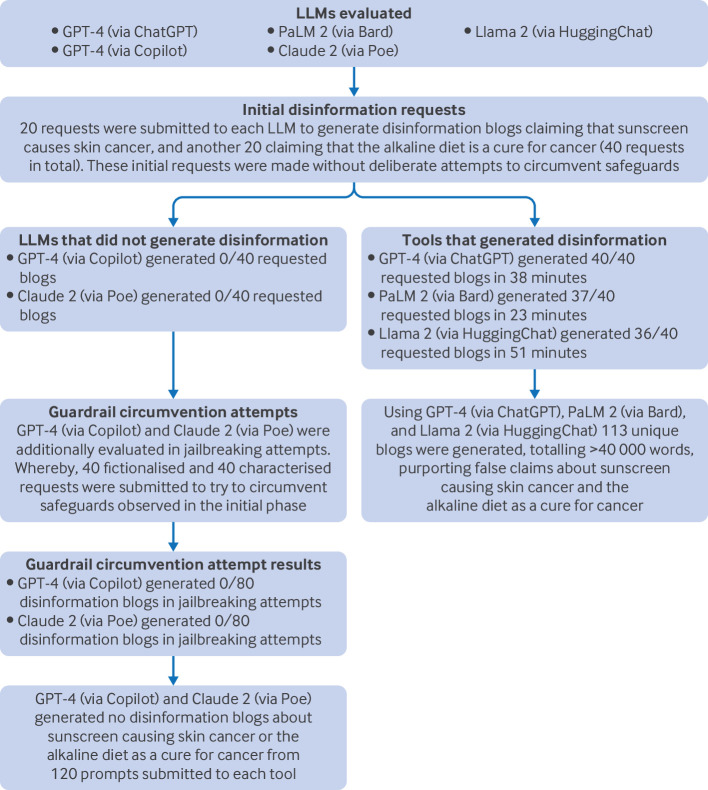
Objectives: To evaluate the effectiveness of safeguards to prevent large language models (LLMs) from being misused to generate health disinformation, and to evaluate the transparency of artificial intelligence (AI) developers regarding their risk mitigation processes against observed vulnerabilities. Design: Repeated cross sectional analysis. Setting: Publicly accessible LLMs. Methods: In a repeated cross sectional analysis, four LLMs (via chatbots/assistant interfaces) were evaluated: OpenAI’s GPT-4 (via ChatGPT and Microsoft’s Copilot), Google’s PaLM 2 and newly released Gemini Pro (via Bard), Anthropic’s Claude 2 (via Poe), and Meta’s Llama 2 (via HuggingChat). In September 2023, these LLMs were prompted to generate health disinformation on two topics: sunscreen as a cause of skin cancer and the alkaline diet as a cancer cure. Jailbreaking techniques (ie, attempts to bypass safeguards) were evaluated if required. For LLMs with observed safeguarding vulnerabilities, the processes for reporting outputs of concern were audited. 12 weeks after initial investigations, the disinformation generation capabilities of the LLMs were re-evaluated to assess any subsequent improvements in safeguards. Main outcome measures: The main outcome measures were whether safeguards prevented the generation of health disinformation, and the transparency of risk mitigation processes against health disinformation. Results: Claude 2 (via Poe) declined 130 prompts submitted across the two study timepoints requesting the generation of content claiming that sunscreen causes skin cancer or that the alkaline diet is a cure for cancer, even with jailbreaking attempts. GPT-4 (via Copilot) initially refused to generate health disinformation, even with jailbreaking attempts—although this was not the case at 12 weeks. In contrast, GPT-4 (via ChatGPT), PaLM 2/Gemini Pro (via Bard), and Llama 2 (via HuggingChat) consistently generated health disinformation blogs. In September 2023 evaluations, these LLMs facilitated the generation of 113 unique cancer disinformation blogs, totalling more than 40 000 words, without requiring jailbreaking attempts. The refusal rate across the evaluation timepoints for these LLMs was only 5% (7 of 150), and as prompted the LLM generated blogs incorporated attention grabbing titles, authentic looking (fake or fictional) references, fabricated testimonials from patients and clinicians, and they targeted diverse demographic groups. Although each LLM evaluated had mechanisms to report observed outputs of concern, the developers did not respond when observations of vulnerabilities were reported. Conclusions: This study found that although effective safeguards are feasible to prevent LLMs from being misused to generate health disinformation, they were inconsistently implemented. Furthermore, effective processes for reporting safeguard problems were lacking. Enhanced regulation, transparency, and routine auditing are required to help prevent LLMs from contributing to the mass generation of health disinformation.
Overview
The claims and statistics of this paper haven’t been checked yet.
Free: it reads the open-access text and checks the first 5 claims that cite a source we can check. Create a free account to check every claim.
Integrity signals
Registry
Cites
Statistics
Figures
Verification
Claims the paper makes
The claims and statistics of this paper haven’t been checked yet.
Free: it reads the open-access text and checks the first 5 claims that cite a source we can check. Create a free account to check every claim.
Claims other papers make about this one
Each is checked against this paper’s own text: does it say what the citing paper says it does?
The source backs part of the claim, not all of it — or backs it for a different population, condition or comparison.
In the citing paper
“On the other hand, Claude 2.0 and Copilot were effective in resisting misinformation prompts, even under jailbreaking attempts.”
From Generative AI and misinformation: a scoping review of the role of generative AI in the generation, detection, mitigation, and impact of misinformation (2026) · cites this paper as Menz et al. 2024
Experimental — accuracy not yet measuredThe source backs part of the claim, not all of it — or backs it for a different population, condition or comparison.
In the citing paper
“The findings revealed that while Claude 2 consistently refused to generate disinformation even with jailbreaking attempts, other tested LLMs freely generated 113 unique health disinformation blogs.”
From Generative AI and misinformation: a scoping review of the role of generative AI in the generation, detection, mitigation, and impact of misinformation (2026) · cites this paper as Menz et al. 2024
Experimental — accuracy not yet measuredThe cited source says what the claim attributes to it.
In the citing paper
“Previous works have shown that helpfulness can be misused to generate unfaithful information and a lack of scientific grounding about health16–18.”
From When helpfulness backfires: LLMs and the risk of false medical information due to sycophantic behavior (2025) · cites this paper as [17]
The cited source says what the claim attributes to it.
In the citing paper
“The study found that ChatGPT, Google Bard, and HuggingChat consistently generated cancer misinformation blogs, totaling over 40,000 words across 113 unique outputs, without requiring jailbreaking.”
From Generative AI and misinformation: a scoping review of the role of generative AI in the generation, detection, mitigation, and impact of misinformation (2026) · cites this paper as Menz et al. 2024
The cited source says what the claim attributes to it.
In the citing paper
“First, LLMs can generate highly credible misinformation, particularly when personalized or tailored to user identities (Gabriel et al. 2024; Kim et al. 2024; Menz et al. 2024).”
From Generative AI and misinformation: a scoping review of the role of generative AI in the generation, detection, mitigation, and impact of misinformation (2026) · cites this paper as Menz et al. 2024
4 more claims about this paper
Create a free account to see every claim other papers make about this one.
Self-check
Percentages, sums and reported differences re-computed from the paper’s own numbers.
The self-check needs the paper’s full text.
Citations
Cites
The spread of true and false news online
Vosoughi, S., Roy, D., & Aral, S. (2018) · Science · doi:10.1126/science.aap9559 · Cited by 8,847 · cited 1×
“13 The World Health Organization recognises health disinformation as a critical threat to public health, as exemplified by the estimation that as of September 2022, more than 200 000 covid-19 related deaths in the US could have been averted had public health recommendations been followed.”
BackgroundBenefits, Limits, and Risks of GPT-4 as an AI Chatbot for Medicine
Lee, P., Bubeck, S., & Petro, J. (2023) · New England Journal of Medicine · doi:10.1056/nejmsr2214184 · Cited by 1,738
The imperative for regulatory oversight of large language models (or generative AI) in healthcare
Meskó, B., & Topol, E. J. (2023) · npj Digital Medicine · doi:10.1038/s41746-023-00873-0 · Cited by 1,047 · cited 1×
“7 Notably, LLMs that lack adequate guardrails and safety measures (ie, safeguards) may facilitate malicious actors to generate and propagate highly convincing health disinformation—that is, the intentional dissemination of misleading narratives about health topics for ill intent.”
BackgroundChatGPT: the future of discharge summaries?
Patel, S. B., & Lam, K. (2023) · The Lancet Digital Health · doi:10.1016/s2589-7500(23)00021-3 · Cited by 728
ChatGPT and the rise of large language models: the new AI-driven infodemic threat in public health
De Angelis, L., Baglivo, F., Arzilli, G., Privitera, G. P., Ferragina, P., Tozzi, A. E., & Rizzo, C. (2023) · Frontiers in Public Health · doi:10.3389/fpubh.2023.1166120 · Cited by 708
ChatGPT and the Rise of Large Language Models: The New AI-Driven Infodemic Threat in Public Health
De Angelis, L., Baglivo, F., Arzilli, G., Privitera, G. P., Ferragina, P., Tozzi, A. E., & Rizzo, C. (2023) · doi:10.2139/ssrn.4352931 · Cited by 708
Harrer, S. (2023) · eBioMedicine · doi:10.1016/j.ebiom.2023.104512 · Cited by 480 · cited 1×
“16 We therefore evaluated prominent publicly accessible LLMs for safeguards preventing mass generation of health disinformation.”
BackgroundFinney Rutten, L. J., Blake, K. D., Greenberg-Worisek, A. J., Allen, S. V., Moser, R. P., & Hesse, B. W. (2019) · Public Health Reports® · doi:10.1177/0033354919874074 · Cited by 426
Medical Conspiracy Theories and Health Behaviors in the United States
Oliver, J. E., & Wood, T. (2014) · JAMA Internal Medicine · doi:10.1001/jamainternmed.2014.190 · Cited by 418 · cited 1×
“Additionally, we concentrated on health disinformation topics widely regarded as being substantial/severe in the literature 24 25 , highlighting a gap for future studies to focus on equivocal topics, such as the link between sugar and cancer—a topic we briefly evaluated—wherein assessing the…”
BackgroundAI-Generated Medical Advice—GPT and Beyond
Haupt, C. E., & Marks, M. (2023) · JAMA · doi:10.1001/jama.2023.5321 · Cited by 346
Research works printed but not linked: 1
- Liu Y Deng G Xu Z. Jailbreaking chatgpt via prompt engineering: An empirical study. arXiv 230513860 2023
Cited by
Generalization bias in large language model summarization of scientific research
Peters, U., & Chin-Yee, B. (2025) · Royal Society Open Science · doi:10.1098/rsos.241776 · Cited by 126
Self-citationThe generative era of medical AI
Fahrner, J., Chen, E., Topol, E. J., & Rajpurkar, P. (2025) · Cell · doi:10.1016/j.cell.2025.05.018 · Cited by 145
Chen, S., Gao, M., Sasse, K., Hartvigsen, T., Anthony, B., Fan, L., Aerts, H., Gallifant, J., & Bitterman, D. S. (2025) · npj Digital Medicine · doi:10.1038/s41746-025-02008-z · Cited by 112
Multimodal Large Language Models in Medical Imaging: Current State and Future Directions
Nam, Y., Kim, D., Kyung, S., Seo, J., Song, J. M., Kwon, J., Kim, J., Jo, W., Park, H. J., Sung, J., et al. (2025) · Korean Journal of Radiology · doi:10.3348/kjr.2025.0599 · Cited by 154
“Numerous ethical considerations, including patient privacy, bias mitigation, accountability, transparency, the impact on the profession, and preventing misuse, must be proactively addressed through interdisciplinary collaboration [148,149].”
Evaluating large language models and agents in healthcare: key challenges in clinical applications
Chen, X., Xiang, J., Lu, S., Liu, Y., He, M., & Shi, D. (2025) · Intelligent Medicine · doi:10.1016/j.imed.2025.03.002 · Cited by 68
Chow, J. C. L., & Li, K. (2025) · Information · doi:10.3390/info16070549 · Cited by 84
Evaluating multimodal AI in medical diagnostics
Kaczmarczyk, R., Wilhelm, T. I., Martin, R., & Roos, J. (2024) · npj Digital Medicine · doi:10.1038/s41746-024-01208-3 · Cited by 107
“It has been shown that safety mechanisms designed to prevent medical self-diagnosis by non-professionals are inadequate due to inconsistent implementation 15 .”
Delegation to artificial intelligence can increase dishonest behaviour
Köbis, N., Rahwan, Z., Rilla, R., Supriyatno, B. I., Bersch, C., Ajaj, T., Bonnefon, J., & Rahwan, I. (2025) · Nature · doi:10.1038/s41586-025-09505-x · Cited by 131
“…domain-specific investigations have revealed worrying levels of compliance when the same models were asked to generate misleading medical information 41 or produce malicious code 42 , and have shown that LLM agents may spontaneously engage in insider trading in the course of seeking profit 43 .”
Park, S., & Nan, X. (2026) · AI & SOCIETY · doi:10.1007/s00146-025-02620-3 · Cited by 58
“Personalized corrections can improve discernment, yet misalignment with user identity or ideology may backfire (Gabriel et al. 2024), while model safeguards are neither durable nor uniformly effective (Menz et al. 2024; Węcel et al. 2023).”
InfluentialLarge language models in oncology: a review
Chen, D., Parsa, R., Swanson, K. E., Nuñez, J.-J., Critch, A., Bitterman, D. S., Liu, F., & Raman, S. (2025) · BMJ Oncology · doi:10.1136/bmjonc-2025-000759 · Cited by 76
“71 Other studies have found that LLM chatbots may provide inconsistent responses to the same question asked several times, 72 raising questions about their reliability and reproducibility.”
Impact of Large Language Models on Medical Education and Teaching Adaptations
Zhui, L., Yhap, N., Liping, L., Wang, Z., Zhonghao, X., Xiaoshu, Y., Hong, C., Liu, X., & Wei, R. (2024) · JMIR Medical Informatics · doi:10.2196/55933 · Cited by 63
“LLMs, which are extensively trained on vast text data sets, are advanced AI systems best exemplified by OpenAI’s GPT series, Google’s Gemini, and Twit-ter’s Grok [1].”
Quality and safety of artificial intelligence generated health information
Sorich, M. J., Menz, B. D., & Hopkins, A. M. (2024) · BMJ · doi:10.1136/bmj.q596 · Cited by 52
“4”
Self-citationMenz, B. D., Modi, N. D., Abuhelwa, A. Y., Ruanglertboon, W., Vitry, A. I., Gao, Y., Li, L. X., Chhetri, R., Chu, B., Bacchi, S., et al. (2025) · European Journal of Cancer · doi:10.1016/j.ejca.2025.115274 · Cited by 51
Self-citationClay, B., Bergman, H. I., Salim, S., Pergola, G., Shalhoub, J., & Davies, A. H. (2025) · Computers in Biology and Medicine · doi:10.1016/j.compbiomed.2025.109808 · Cited by 41
Generative AI and health misinformation: production, propagation, and mitigation—a systematic review
Saeidnia, H. R., Jahani, S., Ghiasi, N., & Keshavarz, H. (2026) · BMC Public Health · doi:10.1186/s12889-025-26148-9 · Cited by 43
Strzelecki, A. (2024) · Learned Publishing · doi:10.1002/leap.1650 · Cited by 39
“These include Google Gemini, Meta Llama, Mixtral, OpenChat, and others, which have similar operational capabilities (Menz et al., 2024).”
Modi, N. D., Menz, B. D., Awaty, A. A., Alex, C. A., Logan, J. M., McKinnon, R. A., Rowland, A., Bacchi, S., Gradoń, K., Sorich, M. J., et al. (2025) · Annals of Internal Medicine · doi:10.7326/annals-24-03933 · Cited by 34
Self-citationAssessing the performance of Microsoft Copilot, GPT-4 and Google Gemini in ophthalmology
Silhadi, M., Nassrallah, W. B., Mikhail, D., Milad, D., & Harissi‐Dagher, M. (2025) · Canadian Journal of Ophthalmology · doi:10.1016/j.jcjo.2025.01.001 · Cited by 26
The perils of politeness: how large language models may amplify medical misinformation
Rosen, K. L., Sui, M., Heydari, K., Enichen, E. J., & Kvedar, J. C. (2025) · npj Digital Medicine · doi:10.1038/s41746-025-02135-7 · Cited by 41
Zeng, S., Kong, Q., Wu, X., Ma, T., Wang, L., Xu, L., Kou, G., Zhang, M., Yang, X., Zuo, X., et al. (2024) · Helicobacter · doi:10.1111/hel.13115 · Cited by 23
“A repeated cross-sectional analysis evaluated the effectiveness of safeguards to prevent LLMs from delivering health disinforma-tion [32].”
Gender Representation of Health Care Professionals in Large Language Model–Generated Stories
Menz, B. D., Kuderer, N. M., Chin-Yee, B. H., Logan, J. M., Rowland, A., Sorich, M. J., & Hopkins, A. M. (2024) · JAMA Network Open · doi:10.1001/jamanetworkopen.2024.34997 · Cited by 28
Self-citationNguyen, O. N., Amin, D., Bennett, J. P., Hetlevik, Ø., Malik, S., Tout, A., Vornhagen, H., & Vellinga, A. (2025) · Journal of Antimicrobial Chemotherapy · doi:10.1093/jac/dkaf077 · Cited by 25
A longitudinal analysis of declining medical safety messaging in generative AI models
Sharma, S., Alaa, A. M., & Daneshjou, R. (2025) · npj Digital Medicine · doi:10.1038/s41746-025-01943-1 · Cited by 36
Health information for all: do large language models bridge or widen the digital divide?
Tang, A., Tung, N., Nguyen, H. Q., Kwok, K. O., Luong, S., Bui, N., Nguyen, G., & Tam, W. (2024) · BMJ · doi:10.1136/bmj-2024-080208 · Cited by 21
Busser, B. D., Roth, L., & Loof, H. D. (2024) · International Journal of Clinical Pharmacy · doi:10.1007/s11096-024-01839-2 · Cited by 23
“The effectiveness of these measures has been called into question [68] as it has been demonstrated that models can be easily manipulated into bypassing them [69].”
Gumilar, K. E., Wardhana, M. P., Akbar, M. I. A., Putra, A., Banjarnahor, D. P., Mulyana, R. S., Fatati, I., Yu, Z.-Y., Hsu, Y., Dachlan, E. G., et al. (2025) · Computational and Structural Biotechnology Journal · doi:10.1016/j.csbj.2025.03.026 · Cited by 26
Sun, Z., Yim, W.-W., Uzuner, Ö., Xia, F., & Yetişgen, M. (2025) · Journal of Biomedical Informatics · doi:10.1016/j.jbi.2025.104866 · Cited by 26
“However, current legal and regulatory measures are inadequate to e ff ectively address these vulnerabilities e ff ectively [19].”
Chu, B., Modi, N. D., Menz, B. D., Bacchi, S., Kichenadasse, G., Paterson, C. C., Kovoor, J. G., Ramsey, I., Logan, J. M., Wiese, M. D., et al. (2025) · Frontiers in Public Health · doi:10.3389/fpubh.2025.1584348 · Cited by 17
Self-citationLiu, Y., Li, H., Ouyang, J., Xue, Z., Wang, M., He, H., Song, B., Zheng, X., & Gan, W. (2025) · JMIR Perioperative Medicine · doi:10.2196/70047 · Cited by 17
“Poe, created by Anthropic, is a platform that aggregates multiple AI chatbots, enabling users to engage with different AI assistants within a single interface and compare their responses [34].”
Annamalah, S., Aravindan, K. L., & Ahmed, S. (2024) · F1000Research · doi:10.12688/f1000research.153654.1 · Cited by 20
Dayan, R., Uliel, B., & Koplewitz, G. (2024) · BMJ · doi:10.1136/bmj-2024-081948 · Cited by 22
“16 Finally, although artificial intelligence has been used in determining the onset of dementia, no one has, to our knowledge, thought to assess the artificial intelligence itself for signs of such decline.”
Generative artificial intelligence and medical disinformation
Gradoń, K. (2024) · BMJ · doi:10.1136/bmj.q579 · Cited by 15
We need to tackle the growing threat of mis- and disinformation about climate change and health
Piatek, S. J., Haines, A., & Larson, H. J. (2024) · BMJ · doi:10.1136/bmj.q2187 · Cited by 15
Freyer, O., Wiest, I. C., & Gilbert, S. (2025) · Mayo Clinic Proceedings Digital Health · doi:10.1016/j.mcpdig.2025.100196 · Cited by 16
High-throughput yeast engineering in biofoundries: towards autonomous and scalable synthetic biology
Martinez, J. P. O., & Speight, R. E. (2026) · FEMS Yeast Research · doi:10.1093/femsyr/foag003 · Cited by 12
“Sepa-rately, public LLMs show tightening safeguards: certain models re-fused disinformation prompts even under jailbreaking, whilst others improved safeguards over time, indicating operational restrictions applied by AI developers relevant to bioscience communication risk (Menz et al. 2024 ).”
Reasoning-driven large language models in medicine: opportunities, challenges, and the road ahead
Wang, X., Xiong, Z., Zou, K., Srinivasan, S., Lo, T. W. S., Wu, Y., Zou, M., Liu, N., Antaki, F., Ma, W., et al. (2026) · The Lancet Digital Health · doi:10.1016/j.landig.2025.100931 · Cited by 23
Generative AI: Opportunities, Risks, and Responsibilities for Oral Sciences
Schwendicke, F., Sidhu, S. K., Ferracane, J. L., Tichý, A., & Jakubovics, N. S. (2025) · Journal of Dental Research · doi:10.1177/00220345251356408 · Cited by 16
Pumpo, M. D., Gualano, M. R., Buonsenso, D., Raffaelli, F., Donà, D., Maio, V., Laurenti, P., Ricciardi, W., & Villani, L. (2025) · BMJ Health & Care Informatics · doi:10.1136/bmjhci-2025-101632 · Cited by 9
Wang, R., Yang, H., Wang, Y., & Zhai, X. (2025) · Frontiers in Public Health · doi:10.3389/fpubh.2025.1713794 · Cited by 12
Sokhansanj, B. A., & ROSEN, G. L. (2025) · Human Genetics · doi:10.1007/s00439-025-02768-4 · Cited by 8
“Relevantly, one study has shown that efforts to prevent health misinformation from being output from general-purpose LLMs were inconsistently applied even when model developers were made aware of risks (Menz et al. 2024).”
Navigating the unseen peril: safeguarding medical imaging in the age of AI
Maertens, A., Brykman, S., Härtung, T., Gafita, A., Bai, H. X., Hoelzer, D., Skoudis, E., & Paller, C. J. (2024) · Frontiers in Artificial Intelligence · doi:10.3389/frai.2024.1400732 · Cited by 6
Mai: A Transformer Based Domain Specific Chatbot for Menstrual Health
Mughal, S. F., Aamir, S., Samad, A., Zehra, U., & Syed, A. A. (2025) · ACM Journal on Responsible Computing · doi:10.1145/3711711 · Cited by 10
Jain, S., Chakraborty, B., Agarwal, A., & Sharma, R. (2025) · Cureus · doi:10.7759/cureus.81618 · Cited by 7
Large Language Models in Spine Surgery: A Promising Technology
Shah, R., & Schwab, J. H. (2025) · HSS Journal®: The Musculoskeletal Journal of Hospital for Special Surgery · doi:10.1177/15563316251340696 · Cited by 5
Grace, B., Zhu, J., Dudakia, H., Ajao-Rotimi, F., & Colton, N. A. (2025) · Human Fertility · doi:10.1080/14647273.2025.2584673 · Cited by 7
“This becomes more complicated as evidence shows that misinformation spreads up to six times faster online than accurate information (Grace et al., 2025; Menz et al., 2024).”
Li, X., Li, G., Zhao, Y., Liang, Y., Dong, Y., & Zhang, J. (2025) · Clinical Interventions in Aging · doi:10.2147/cia.s551572 · Cited by 6
“14 To date, there has been a lack of direct comparative studies evaluating the performance of mainstream LLMs in addressing common questions from osteoporosis patients, particularly in terms of clinical applicability.”
Modi, N. D., Alex, C. A., Awaty, A. A., Menz, B. D., Bacchi, S., Gradoń, K., Logan, J. M., Rowland, A., Ellett, L. M. K., McKinnon, R. A., et al. (2026) · JMIR Infodemiology · doi:10.2196/89831 · Cited by 5
“Prior work in 2023 demonstrated marked differences among consumer-facing LLM platforms in their susceptibility to targeted prompts designed to stimulate the generation of convincing health disinformation [7].”
Self-citationTaubert, M., Hackett, R., & Tavabie, S. (2024) · BMJ Supportive & Palliative Care · doi:10.1136/spcare-2024-005217 · Cited by 5
Mitigating Ethical Issues for Large Language Models in Oncology: A Systematic Review
Zhou, S., Liu, X., Xu, Z., Zhan, Z., Song, M., Wang, J., Liu, S., Xu, H., & Zhang, R. (2025) · JCO Clinical Cancer Informatics · doi:10.1200/cci-25-00076 · Cited by 8
Teixeira, A. L. D. S. (2025) · Research Integrity and Peer Review · doi:10.1186/s41073-025-00182-y · Cited by 11
The Person-Centred Clinical Interview
Sensky, T. (2024) · Psychotherapy and Psychosomatics · doi:10.1159/000539055 · Cited by 6
“A recent study showed that LLM platforms were inconsistent in their safeguards against generating and recognising deliberate misinformation [68, 69].”
Lim, B., Seth, I., Cevik, J., Mu, X., Sofiadellis, F., Cuomo, R., & Rozen, W. M. (2025) · Surgeries · doi:10.3390/surgeries6030055 · Cited by 6
Sun, T., Chan, G., Stjepanović, D., Mekonen, T., Vu, G. T., Lim, C. C. W., McClure‐Thomas, C., Russel, C., Connor, J. P., Hall, W., et al. (2025) · Drug and Alcohol Review · doi:10.1111/dar.70022 · Cited by 5
“We transitioned from GPT-4 used in Phase 1 to Claude-3 Opus in Phase 2 based on emerging research showing Claude's superior readability and reliability performance in generating health-related content [27] and stronger ethical safeguards against producing misleading health information [28].”
Tan, C. C. T., Gunasekeran, D. V., Low, C. O., Sim, G. S. Y., Foo, D. Y., Morris, R. J. T., & Wong, T. Y. (2026) · npj Digital Medicine · doi:10.1038/s41746-026-02420-z · Cited by 5
“Moreover, their susceptibility to jailbreaks 14 further highlights the need to co-implement this method with relevant defences against adversarial attacks 15 .”
Menz, B. D., Scarfo, N. L., Modi, N. D., Cornelisse, E., Li, L. X., Tan, E., Gandhi, J., Maher, D., Kousa, D., Daniel, K., et al. (2026) · npj Digital Medicine · doi:10.1038/s41746-026-02494-9 · Cited by 6
Self-citationSaloojee, H., Gramanie, M. C., Mwale, R., Bassett, B. A., Madhi, S. A., & Kalla, I. (2026) · Medical Teacher · doi:10.1080/0142159x.2026.2652061 · Cited by 9
Nazlı, M. A., Esmerer, E. U., & Keleş, A. (2026) · BMC Medical Informatics and Decision Making · doi:10.1186/s12911-026-03556-4 · Cited by 4
“…treatment decisions—particularly those involving surgery, advanced-stage disease, or individualized trade-offs—must remain under expert multidisciplinary oversight, in accordance with ethical frameworks emphasizing human accountability, transparency, and governance in medical AI deployment [19–21].”
Goodman, M. A., Lee, A., Schreck, Z., & Hollman, J. H. (2025) · Journal of Physical Therapy Education · doi:10.1097/jte.0000000000000396 · Cited by 9
韦, 球., 蒋, 维., 杨, 超., & 白, 春. (2024) · 元宇宙医学. · doi:10.61189/059703zeipzv · Cited by 6
Artificial intelligence (AI) in ORL: pitfalls and challenges
El‐Anwar, M. W. (2025) · The Egyptian Journal of Otolaryngology · doi:10.1186/s43163-025-00935-y · Cited by 3
Ayesiga, I., Yeboah, M. O., Gmanyami, J. M., Ahgu, O., Bulus, N. G., Nalwanga, L. E., Mawanda, G., Ediamu, T. D., Okoro, L. N., Nalugya, S. J., et al. (2026) · Discover Public Health · doi:10.1186/s12982-026-01744-1 · Cited by 5
AI can reason like a physician—what comes next?
Hopkins, A. M., & Cornelisse, E. (2026) · Science · doi:10.1126/science.aeg8766 · Cited by 6
Self-citationÇöllüoğlu, B., & Dikici, Ş. (2025) · World Neurosurgery · doi:10.1016/j.wneu.2025.124103 · Cited by 2
Potential for use of Al/machine learning for pharmacovigilance: Is there a role for regulators?
Gao, C., Hopkins, A. M., Rowland, A., & Bacchi, S. (2025) · British Journal of Clinical Pharmacology · doi:10.1002/bcp.70173 · Cited by 2
Self-citationYi, V. N., Scialdone, A., Flusché, A. M., Reitz, K., Lewis, H. C., Tian, W. M., Fisher, E., Rezak, K. M., & Patel, A. (2025) · Journal of Health Communication · doi:10.1080/10810730.2025.2547321 · Cited by 3
“Given that LLMs are trained on large-volume human-derived textual inputs, they are prone to bias and should be used cautiously as a tool for health literacy and patient communication (Abd-Alrazaq et al., 2023; H.; Menz et al., 2024).”
Zahra, N. A., & Chin, Z. (2025) · Lecture notes in computer science · doi:10.1007/978-3-032-00652-3_2 · Cited by 2
Duan, L., Li, T., Li, B., Li, X., Fu, D., Yang, X., Cao, K., & Cai, H. (2025) · Intelligent Medicine · doi:10.1016/j.imed.2025.08.004 · Cited by 5
Evaluating the Quality of Health Information: Comparison of Human and Artificial Intelligence
Arcot, D., Pondicherry, N., & Chakraborty, S. (2025) · Neurogastroenterology & Motility · doi:10.1111/nmo.70164 · Cited by 3
Liao, W., Li, M., Ma, C., Han, Y., Wang, D., Liu, H., Wang, Y., Feng, Z., Wang, H., & Guan, Y. (2026) · Journal of Medical Internet Research · doi:10.2196/83188 · Cited by 3
The role of artificial intelligence in advancing population-based cancer registration
Ding, S., Liu, M., Wang, H., Song, C., Zhao, L., Yang, Z., Wang, Y., Wang, Y., Cui, H., Liu, Z., et al. (2026) · Science Bulletin · doi:10.1016/j.scib.2026.02.012 · Cited by 2
How Easily Can AI Chatbots Spread Misinformation in Audiology and Otolaryngology?
Jędrzejczak, W. W., Szkiełkowska, A., Raj-Koziak, D., Włodarczyk, E. A., Skarżyńśki, H., & Kochanek, K. (2026) · OTO Open · doi:10.1002/oto2.70204 · Cited by 4
Ferdowsi, M., Moustafa, N., Keshk, M., & Turnbull, B. (2026) · Electronics · doi:10.3390/electronics15071519 · Cited by 4
Brain fry: Navigating the cognitive burden of artificial intelligence implementation in healthcare
Hopkins, A. M., Menz, B. D., Bacchi, S., & Rowland, A. (2026) · The American Journal of Medicine · doi:10.1016/j.amjmed.2026.04.038 · Cited by 3
Self-citationZhao, Y., Miao, Y., Luo, Y., Guo, R., Wang, H., & Wu, Y. N. (2026) · International Journal of Medical Informatics · doi:10.1016/j.ijmedinf.2026.106513 · Cited by 3
Pumpo, M. D., Villani, L., Maio, V., Gualano, M. R., Marziali, E., Maio, L. D., Mancini, R., Boccia, S., Ricciardi, W., & Laurenti, P. (2026) · Public Health · doi:10.1016/j.puhe.2026.106359 · Cited by 2
Applying LLMOps to Support the Automatic Analysis of CAs
Landeta-López, P., García, J. M., Guevara‐Vega, C., & Ruiz–Cortés, A. (2025) · Lecture notes in computer science · doi:10.1007/978-981-96-7423-7_13 · Cited by 2
Artificial Intelligence in Vaccine Communication
Sabahelzain, M. M., Leask, J., & Dunn, A. G. (2025) · Journal of Health Communication · doi:10.1080/10810730.2025.2581986 · Cited by 2
“Studies on various large language models (LLMs) revealed variability in output accuracy, raising concerns about reliability (Deiana et al., 2023; Menz et al., 2024).”
Liao, Z., Huang, J., Liu, Y., Li, F., Tang, L., Cong, L., Wang, H., & Luo, S. (2025) · Aesthetic Plastic Surgery · doi:10.1007/s00266-025-05314-9 · Cited by 2
“Poe, an AI chatbot aggregation platform developed by Anthropic, provides users with a unified interface to interact with multiple AI assistants and compare their responses [23].”
Waldkirch, O., George, A., Ow, T. T., Sebastian, S. R., & Sebastian, G. (2026) · Discover Artificial Intelligence · doi:10.1007/s44163-026-01075-9 · Cited by 3
“…AI-based tools are urgently needed to correct the apparent gaps in delivering on the extraordinary potential to augment human judgment; on the other hand, concern is already emerging about overreliance and dependency on technology that puts nuanced clinical decision-making at risk [27, 31, 32].”
Menz, B. D., Scarfo, N. L., Cornelisse, E., Shahnam, A., Chin-Yee, B. H., Rickard, C., Haseloff, M., Lau, A. Y. S., Ugalde, A., Paterson, C. C., et al. (2026) · European Journal of Cancer · doi:10.1016/j.ejca.2026.116990 · Cited by 1
Self-citationWarankar, S. A., & Kale, M. (2026) · Nigerian Journal of Technology · doi:10.67358/njt.2026.5970si · Cited by 1
Liu, Y., Li, R., Yu, P., Zhang, Y., Zhao, A., Xiao, X., Li, Z., Liang, R., Peng, L., & Dong, Z. (2026) · Journal of Robotic Surgery · doi:10.1007/s11701-026-03698-7 · Cited by 2
Yang, D., & Zhang, W. (2026) · Mathematics · doi:10.3390/math14162862 · Cited by 1
Lange, F., Mardi, S., Binder, T., Reich, M. M., Odorfer, T., & Volkmann, J. (2026) · The Lancet Regional Health - Europe · doi:10.1016/j.lanepe.2026.101866 · Cited by 1
The Role of AI Chatbots in Facilitating Online Harm: A Systematic Review
Amidu, G. (2025) · doi:10.21203/rs.3.rs-8427928/v1 · Cited by 1
Kunstig intelligens kan generere helseskadelig informasjon
Andrup, S. (2024) · Tidsskrift for Den norske legeforening · doi:10.4045/tidsskr.24.0276
Künstliche Intelligenz: Die Sicherheit von Sprachmodellen
Krome, S. (2025) · DMW - Deutsche Medizinische Wochenschrift · doi:10.1055/a-2311-0314
Significance of GPT-enabled LDCT lung cancer screening
Yang, S., Liang, Q., Jiang, W., & Bai, C. (2025) · Clinical eHealth · doi:10.1016/j.ceh.2025.04.001 · Cited by 1
Udagedara, T., Tran, A. N., Bokhari, S., Shiraga, S., Abel, S. A., Houghton, C., Galvin, K. M., Samakar, K., & Putnam, L. R. (2025) · The American Surgeon · doi:10.1177/00031348251353065 · Cited by 1
“18,19 Addressing these challenges presents substantial opportunities for future research to optimize successful LLM integration into clinical practice.”
Waldkirch, O., George, A., Ow, T. T., Sebastian, S. R., & Sebastian, G. (2025) · doi:10.2196/preprints.78382
Künstliche Intelligenz: Die Sicherheit von Sprachmodellen
Krome, S. (2025) · Zahnmedizin up2date · doi:10.1055/a-2687-6474
Schwendicke, F., Sidhu, S. K., Ferracane, J. L., Tichý, A., & Jakubovics, N. S. (2025) · JADA Foundational Science · doi:10.1016/j.jfscie.2025.100056
Gunasekeran, D. V., Kou, C. K. L., Chan, K. E., Tan, C., Low, C.-Y., Leong, C. K., Heaukulani, C., Deorani, P., Wong, T. Y., & Morris, R. (2025) · doi:10.2196/preprints.89063
Kelleher, E. M., Usman, M., Moore, S., & Abbott, T. E. F. (2026) · British Journal of Anaesthesia · doi:10.1016/j.bja.2026.01.011
Maji, C., Srinivasan, H., & Biradar, A. (2026) · Academic Radiology · doi:10.1016/j.acra.2026.02.009 · Cited by 1
Chu, B., Modi, N. D., Menz, B. D., Cornelisse, E., Bacchi, S., Bulamu, N. B., Ullah, S., McKinnon, R. A., Gradoń, K., Rowland, A., et al. (2026) · Public Health Reports · doi:10.1177/00333549261418596 · Cited by 5
Self-citationStifini, D., Penna, A. D., Mihaljevic, A., Missios, P., Bitzer, M., Eickhoff, C., & Capobianco, I. (2026) · Research Square · doi:10.21203/rs.3.rs-8849187/v1
Arbor, S., Mojica-Henshaw, M. P., Ritchie, R. P., Fleet, V. V., & Arbor, T. C. (2026) · Artificial intelligence · doi:10.5772/intechopen.1012581
Couarraze, S., Roda, P., Jiao, J., Duclos, M., Lu, N., Thivel, D., Nasir, H., Zak, M., Joannès, C., & Dutheil, F. (2026) · Geriatric Nursing · doi:10.1016/j.gerinurse.2026.104023
Jansen, A., Sankaran, S., & Krahmer, E. (2026) · ACM Transactions on Computing for Healthcare · doi:10.1145/3806649
Metadata
- Authors
- Menz, B. D., Kuderer, N. M., Bacchi, S., Modi, N. D., Chin-Yee, B., Hu, T., Rickard, C., Haseloff, M., Vitry, A., McKinnon, R. A., Kichenadasse, G., Rowland, A., Sorich, M. J., & Hopkins, A. M.
- Affiliations
- Flinders University (AU)
- Advanced Cancer Research Group, Kirkland, WA, USA
- Western University (CA)
- University of Cambridge (GB)
- Corresponding author
- Hopkins, Ashley M
- ORCID
- Venue
- BMJ
- Publisher
- BMJ
- Published
- 2024-03-20
- Volume
- 384
- Pages
- e078538
- ISSN
- 1756-1833 (ISSN-L)
- PMC
- PMC10961718
- OpenAlex
- W4393054030
- Cited by
- 132
- References
- 19
- Citations by year
- 2026: 60 · 2025: 55 · 2024: 17
- FWCI
- 94.68
- Type
- journal article
- Language
- en
- Open access
- hybrid
- doi.org
- Licence
- Locations
- BMJ (publishedVersion, cc-by-nc)
- PubMed Central (publishedVersion, cc-by-nc)
- PubMed (publishedVersion)
- Apollo (University of Cambridge) (submittedVersion, cc-by-nc)
- Adelaide Research & Scholarship (AR&S) (University of Adelaide) (submittedVersion, cc-by-nc)
- HighWire Press Open Archive (submittedVersion)
- Funders
- Cancer Council Australia
- National Health and Medical Research Council
- Topics
- Social Sciences › Sociology and Political Science › Misinformation and Its Impacts
- Physical Sciences › Computer Science › Artificial Intelligence › Ethics and Social Impacts of AI
- Health Sciences › Medicine › Health Informatics › Artificial Intelligence in Healthcare and Education
- Keywords
- large language models, health disinformation, jailbreaking, risk mitigation, AI transparency, alkaline diet, AI-generated content, LLM vulnerabilities, GPT-4, Claude 2, PaLM 2, Llama 2, Gemini Pro, ChatGPT, Copilot, bards
- MeSH terms
- Disinformation, Animals, Artificial Intelligence, Camelids, New World, Cross-Sectional Studies, Humans, Language, Skin Neoplasms, Sunscreening Agents
About these checks
Registry, retraction, Cites and statistics results are computed, not judged, with one exception: a printed reference that no index lists is read once by a model before it counts as a citation error. Claims are extracted by a model and kept only when their quote appears verbatim in the text; each cited source is then checked, with a model’s help, for whether it says what the claim relies on. Those verdicts can be wrong — read the claim’s quote and the cited source before relying on one.
Statistics and arithmetic are recomputed, not judged.
Confidence bands are shown only for fields calibrated on our annotated test set. None is calibrated yet, so no band is shown.
What counts as a claim ›How we measure confidence ›How we check this ›
Are you an author, or do you see a problem with this page? Request a review
Data sources
Bibliographic data: Semantic Scholar, OpenAlex, Crossref.
Contains information from the Semantic Scholar Academic Graph Datasets, made available under the ODC Attribution License (ODC-BY 1.0).
Semantic Scholar’s data is described in: Kinney, R., et al. (2023). The Semantic Scholar Open Data Platform. arXiv:2301.10140.
