

Preferred reporting items for systematic reviews and meta-analyses: the PRISMA statement
Open accessThe DOI matches its Crossref record; 53 of the 56 references it cites were found in a registry or an index; none of the 31 sources its claims cite is checked for support yet.
Abstract
David Moher and colleagues introduce PRISMA, an update of the QUOROM guidelines for reporting systematic reviews and meta-analyses
Overview
CoChat Summary
TL;DR
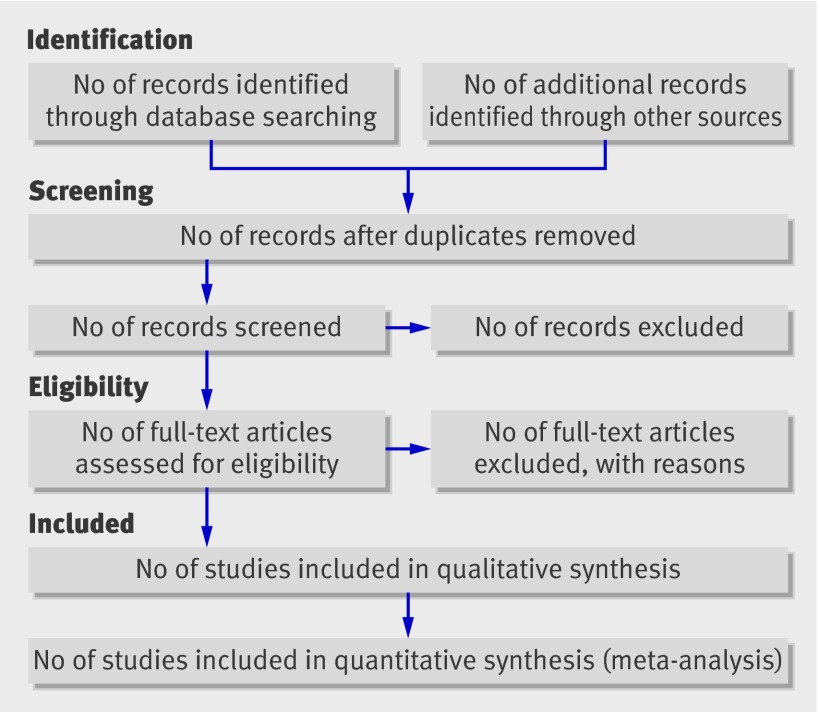
PRISMA is a 2009 revision of the QUOROM reporting guideline for systematic reviews and meta-analyses, consisting of a 27-item checklist and a four-phase flow diagram. It aims to improve reporting transparency and completeness, while acknowledging that it is not a quality assessment instrument.
Key findings
- PRISMA replaces QUOROM and comprises a 27-item checklist plus a four-phase flow diagram for reporting systematic reviews and meta-analyses.
- The revision adds new items on protocol/registration, risk of bias across studies, funding, and explicit objectives using PICOS; it also renames “quality assessment” as “risk of bias” and introduces outcome-level assessment.
- The guideline development meeting was held in Ottawa in June 2005 with 29 participants; the checklist was revised 11 times before group approval.
- The paper cites prior evidence of suboptimal reporting: Mulrow found none of 50 review articles met all eight explicit scientific criteria; Sacks et al. found reporting was generally poor, with a mean of 7.7 (SD 2.7) of 23 characteristics adequately reported; and in a review of 300 systematic reviews, few authors reported assessing publication bias.
Methods
- Guideline development: a three-day meeting in Ottawa, Canada, in June 2005 with 29 participants, including review authors, methodologists, clinicians, medical editors, and a consumer.
- Pre-meeting activities included a systematic review of studies examining reporting quality, a comprehensive literature search, and an international survey of review authors, consumers, and commissioning/using groups.
- A draft checklist was circulated, comments and revisions were compiled in a disposition file, and the checklist was revised 11 times before approval of the checklist, flow diagram, and summary paper.
Limitations
- Stated: no direct evidence was found to support retaining or adding some checklist items; evidence from other domains was believed relevant.
- Stated: PRISMA focuses on randomised trials, though it can be used as a basis for other research types; modifications may be necessary for diagnostic reviews, individual patient data meta-analyses, and other contexts.
- Stated: the PRISMA checklist is not a quality assessment instrument to gauge the quality of a systematic review.
- Evident: the paper does not report empirical validation that adopting PRISMA improves review quality or outcomes; it presents the guideline and its development process rather than testing its impact.
Model-written summary. Check it against the paper before relying on it.
Integrity signals
Registry
Cites
Statistics
Figures
Verification
Claims the paper makes
0 Valid · 0 Not valid · 20 Not checked · 11 Own results and interpretations
None of the sources cited for this claim could be matched to a paper, so there is nothing to check it against.
In the paper
“The quality of reporting of systematic reviews is still not optimal.”
- Also stated in: § Discussion · plain
“The quality of reporting of systematic reviews is still not optimal.9 30 31 32 33 34”
What the sources say
- Not matchedcites [9] 9. Moher D, Tetzlaff J, Tricco AC, Sampson M, Altman DG. Epidemiology and reporting characteristics of systematic reviews. PLoS Med 2007; 4: e78, 10.1371/journal.pmed.0040078. 17388659 10.1371/journal.pmed.0040078 PMC1831728
Couldn’t be matched to a paper, so it can’t be checked.
- Not matchedcites [30] 30. Bhandari M, Morrow F, Kulkarni AV, Tornetta P. Meta-analyses in orthopaedic surgery: a systematic review of their methodologies. J Bone Joint Surg Am 2001;83-A:15-24. 11205853
Couldn’t be matched to a paper, so it can’t be checked.
- Not matchedcites [31] 31. Kelly KD, Travers A, Dorgan M, Slater L, Rowe BH. Evaluating the quality of systematic reviews in the emergency medicine literature. Ann Emerg Med 2001; 38: 518-26. 11679863 10.1067/mem.2001.115881
Couldn’t be matched to a paper, so it can’t be checked.
plain- Asserted: passes — The authors put it forward as true.
- Checkable: passes — It can be checked against evidence.
- Load-bearing: passes — The paper’s conclusions depend on it.
- Based: passes — The paper gives a reason why it holds.
- Also stated in: § Discussion · plain
In the paper
“For studies included in a systematic review, a thorough assessment of the risk of bias requires both a study-level assessment (such as adequacy of allocation concealment) and, for some features, a newer approach called outcome-level assessment.”
§ Preferred reporting items for systematic reviews and meta-analyses: the PRISMA statement > Conceptual issues in the evolution from QUOROM to PRISMA > Study-level versus outcome-level assessment of risk of bias
What the sources say
- Not checked yetcites [11] 11. Guyatt GH, Oxman AD, Vist GE, Kunz R, Falck-Ytter Y, Alonso-Coello P, et al, for the GRADE Working Group. GRADE: an emerging consensus on rating quality of evidence and strength of recommendations. BMJ 2008; 336: 924-6. 18436948 10.1136/bmj.39489.470347.AD PMC2335261
plainstates a cause- Asserted: passes — The authors put it forward as true.
- Checkable: passes — It can be checked against evidence.
- Load-bearing: passes — The paper’s conclusions depend on it.
- Based: passes — The paper gives a reason why it holds.
None of the sources cited for this claim have been checked yet.
In the paper
“Different types of reporting biases may hamper the conduct and interpretation of systematic reviews.”
§ Preferred reporting items for systematic reviews and meta-analyses: the PRISMA statement > Conceptual issues in the evolution from QUOROM to PRISMA > Importance of reporting biases
What the sources say
- Not checked yetcites [13] 13. Dickersin K. Publication bias: recognizing the problem, understanding its origins and scope, and preventing harm. In: Rothstein HR, Sutton AJ, Borenstein M, eds. Publication bias in meta-analysis—prevention, assessment and adjustments. Chichester: John Wiley, 2005:11-33.
- Not checked yetcites [14] 14. Chan AW, Hrobjartsson A, Haahr MT, Gøtzsche PC, Altman DG. Empirical evidence for selective reporting of outcomes in randomized trials: comparison of protocols to published articles. JAMA 2004; 291: 2457-65. 15161896 10.1001/jama.291.20.2457
- Not checked yetcites [15] 15. Chan AW, Krleza-Jeric K, Schmid I, Altman DG. Outcome reporting bias in randomized trials funded by the Canadian Institutes of Health Research. CMAJ 2004; 171: 735-40. 15451835 10.1503/cmaj.1041086 PMC517858
hedgedstates a possible cause- Asserted: passes — The authors put it forward as true.
- Checkable: passes — It can be checked against evidence.
- Load-bearing: passes — The paper’s conclusions depend on it.
- Based: passes — The paper gives a reason why it holds.
In the paper
“In 1987 Mulrow examined 50 review articles published in four leading medical journals in 1985 and 1986 and found that none met all eight explicit scientific criteria, such as a quality assessment of included studies.5”
§ Preferred reporting items for systematic reviews and meta-analyses: the PRISMA statement > Abstract
What the sources say
- Not checked yetcites [5] 5. Mulrow CD. The medical review article: state of the science. Ann Intern Med 1987; 106: 485-8. 3813259 10.7326/0003-4819-106-3-485
plain- Asserted: passes — The authors put it forward as true.
- Checkable: passes — It can be checked against evidence.
- Load-bearing: passes — The paper’s conclusions depend on it.
- Based: passes — The paper gives a reason why it holds.
In the paper
“Although the implications of these biases on the conduct and reporting of systematic reviews themselves are unclear, some research has identified that selective outcome reporting may occur also in the context of systematic reviews.16”
§ Preferred reporting items for systematic reviews and meta-analyses: the PRISMA statement > Conceptual issues in the evolution from QUOROM to PRISMA > Importance of reporting biases
What the sources say
- Not checked yetcites [16] 16. Silagy CA, Middleton P, Hopewell S. Publishing protocols of systematic reviews: comparing what was done to what was planned. JAMA 2002; 287: 2831-4. 12038926 10.1001/jama.287.21.2831
hedged- Asserted: passes — The authors put it forward as true.
- Checkable: passes — It can be checked against evidence.
- Load-bearing: unclear — It is unclear whether the paper’s conclusions depend on it.
- Based: passes — The paper gives a reason why it holds.
6 more claims
Create a free account to see all 31 claims and to verify the 28 references still open.
- Probably not a substantial claim. 16
- It may state two separate claims as one. 8
Claims other papers make about this one
Each is checked against this paper’s own text: does it say what the citing paper says it does?
The source backs part of the claim, not all of it — or backs it for a different population, condition or comparison.
In the citing paper
“Many groups have called for the widespread preparation and registration of systematic review protocols in order to increase the availability and accessibility of a priori methods for systematic reviews [12–14].”
From Preferred reporting items for systematic review and meta-analysis protocols (PRISMA-P) 2015 statement (2015) · cites this paper as [13]
Experimental — accuracy not yet measuredThe source backs part of the claim, not all of it — or backs it for a different population, condition or comparison.
In the citing paper
“This systematic review and meta‐analysis meet the preferred reporting items for systematic reviews and meta‐analysis statement requirements (PRISMA) [14, 15].”
From Meta-Analysis: Chronic Gastrointestinal Symptoms and Comorbidities in Hypermobile Ehlers-Danlos Syndrome and Hypermobility Spectrum Disorders (2026) · cites this paper as [14]
Experimental — accuracy not yet measuredThe source backs part of the claim, not all of it — or backs it for a different population, condition or comparison.
In the citing paper
“Our review followed established review procedures developed by PRISMAScR and the Joanna Briggs Institute (Lockwood et al., 2019; Moher et al., 2009).”
From Mortality management and climate action: A review and reference for using Terror Management Theory methods in interdisciplinary environmental research (2022) · cites this paper as Moher et al., 2009
Experimental — accuracy not yet measuredThe source backs part of the claim, not all of it — or backs it for a different population, condition or comparison.
In the citing paper
“Our strategies for literature search were based on the guidelines of the Preferred Reporting Items for Systematic Reviews and Meta-Analyses (PRISMA), a framework for reporting and synthesising literature review (Moher et al., 2009).”
From Dimensions of teachers’ data literacy: A systematic review of literature from 1990 to 2021 (2024) · cites this paper as Moher et al., 2009
Experimental — accuracy not yet measuredThe source backs part of the claim, not all of it — or backs it for a different population, condition or comparison.
In the citing paper
“To this end, we conducted a systematic literature review in accordance with the Preferred Reporting Items for Systematic reviews and Meta-Analyses (PRISMA) method (Moher et al., 2009) (cf. Figure 2).”
From The Impact of Machine Learning on 2D/3D Registration for Image-Guided Interventions: A Systematic Review and Perspective (2021) · cites this paper as Moher et al., 2009
Experimental — accuracy not yet measured
66 more claims about this paper
Create a free account to see every claim other papers make about this one.
Citations
Cites
Liberati, A., Altman, D. G., Tetzlaff, J., Mulrow, C., Gøtzsche, P. C., Ioannidis, J. P. A., Clarke, M., Devereaux, P. J., Kleijnen, J., & Moher, D. (2009) · PLoS Medicine · doi:10.1371/journal.pmed.1000100 · Cited by 28,164
Self-citationGRADE: an emerging consensus on rating quality of evidence and strength of recommendations
Guyatt, G. H., Oxman, A. D., Vist, G. E., Kunz, R., Falck-Ytter, Y., Alonso-Coello, P., & Schünemann, H. J. (2008) · BMJ · doi:10.1136/bmj.39489.470347.ad · Cited by 23,305
von Elm, E., Altman, D. G., Egger, M., Pocock, S. J., Gøtzsche, P. C., Vandenbroucke, J. P., & Initiative, F. T. S. (2007) · PLoS Medicine · doi:10.1371/journal.pmed.0040296 · Cited by 23,020
Self-citationLiberati, A., Altman, D. G., Tetzlaff, J., Mulrow, C., Gotzsche, P. C., Ioannidis, J. P. A., Clarke, M., Devereaux, P. J., Kleijnen, J., & Moher, D. (2009) · BMJ · doi:10.1136/bmj.b2700 · Cited by 17,648
Self-citationLiberati, A., Altman, D. G., Tetzlaff, J., Mulrow, C., Gøtzsche, P. C., Ioannidis, J. P. A., Clarke, M., Devereaux, P. J., Kleijnen, J., & Moher, D. (2009) · Annals of Internal Medicine · doi:10.7326/0003-4819-151-4-200908180-00136 · Cited by 10,349
Self-citationVandenbroucke, J. P., von Elm, E., Altman, D. G., Gøtzsche, P. C., Mulrow, C. D., Pocock, S. J., Poole, C., Schlesselman, J. J., Egger, M., & Initiative, F. T. S. (2007) · PLoS Medicine · doi:10.1371/journal.pmed.0040297 · Cited by 8,613
Self-citationMoher, D., Cook, D. J., Eastwood, S., Olkin, I., Rennie, D., & Stroup, D. F. (1999) · The Lancet · doi:10.1016/s0140-6736(99)04149-5 · Cited by 4,826
Self-citationThe Revised CONSORT Statement for Reporting Randomized Trials: Explanation and Elaboration
Altman, D. G., Schulz, K. F., Moher, D., Egger, M., Davidoff, F., Elbourne, D., Gøtzsche, P. C., Lang, T., & for the CONSORT Group (2001) · Annals of Internal Medicine · doi:10.7326/0003-4819-134-8-200104170-00012 · Cited by 3,835
Self-citationVandenbroucke, J. P., Elm, E. V., Altman, D. G., Gøtzsche, P. C., Mulrow, C. D., Pocock, S. J., Poole, C., Schlesselman, J. J., Egger, M., & initiative, F. T. S. (2007) · Annals of Internal Medicine · doi:10.7326/0003-4819-147-8-200710160-00010-w1 · Cited by 3,543
Self-citationTowards complete and accurate reporting of studies of diagnostic accuracy: The STARD Initiative.
Bossuyt, P. M., Reitsma, J. B., Bruns, D. E., Gatsonis, C. A., Glasziou, P. P., Irwig, L. M., Lijmer, J. G., Moher, D., Rennie, D., de Vet, H. C. W., et al. (2003) · Annals of Internal Medicine · doi:10.7326/0003-4819-138-1-200301070-00010 · Cited by 3,219
Publication Bias in Meta‐Analysis: Prevention, Assessment and Adjustments
(2005) · doi:10.1002/0470870168 · Cited by 2,368
Chan, A.-W., Hróbjartsson, A., Haahr, M. T., Gøtzsche, P. C., & Altman, D. G. (2004) · JAMA · doi:10.1001/jama.291.20.2457 · Cited by 1,845
Self-citationReplication validity of genetic association studies
Ioannidis, J. P. A., Ntzani, E. E., Trikalinos, T. A., & Contopoulos-Ioannidis, D. G. (2001) · Nature Genetics · doi:10.1038/ng749 · Cited by 1,832
The case of the misleading funnel plot
Lau, J., Ioannidis, J. P. A., Terrin, N., Schmid, C. H., & Olkin, I. (2006) · BMJ · doi:10.1136/bmj.333.7568.597 · Cited by 1,766
Canadian Institutes of Health Research
(2019) · The Grants Register 2020 · doi:10.1057/978-1-349-95943-3_219 · Cited by 1,466
Systematic reviews of evaluations of diagnostic and screening tests
Deeks, J. J. (2001) · BMJ · doi:10.1136/bmj.323.7305.157 · Cited by 1,340
Meta-Analyses of Randomized Controlled Trials
Sacks, H. S., Berrier, J., Reitman, D., Ancona-Berk, V. A., & Chalmers, T. C. (1987) · New England Journal of Medicine · doi:10.1056/nejm198702193160806 · Cited by 1,250
Clinical Trial Registration: A Statement from the International Committee of Medical Journal Editors
De Angelis, C., Drazen, J. M., Frizelle, F. A., Haug, C., Hoey, J., Horton, R., Kotzin, S., Laine, C., Marusic, A., Overbeke, A. J. P. M., et al. (2004) · New England Journal of Medicine · doi:10.1056/nejme048225 · Cited by 1,241
The STARD Statement for Reporting Studies of Diagnostic Accuracy: Explanation and Elaboration
Bossuyt, P. M., Reitsma, J. B., Bruns, D. E., Gatsonis, C. A., Glasziou, P. P., Irwig, L. M., Moher, D., Rennie, D., de Vet, H. C. W., & Lijmer, J. G. (2003) · Annals of Internal Medicine · doi:10.7326/0003-4819-138-1-200301070-00012-w1 · Cited by 1,124
Whittington, C. J., Kendall, T., Fonagy, P., Cottrell, D., Cotgrove, A., & Boddington, E. (2004) · The Lancet · doi:10.1016/s0140-6736(04)16043-1 · Cited by 1,058
Epidemiology and reporting characteristics of systematic reviews.
Moher, D., Tetzlaff, J., Tricco, A. C., Sampson, M., & Altman, D. G. (2007) · PLoS Medicine · doi:10.1371/journal.pmed.0040078 · Cited by 891
Self-citationThe Medical Review Article: State of the Science
MULROW, C. D. (1987) · Annals of Internal Medicine · doi:10.7326/0003-4819-106-3-485 · Cited by 856
A meta-analysis of randomized controlled trials: Efficacy of selenium treatment for sepsis
Li, S., Tang, T., Guo, P., Zou, Q., Ao, X., Hu, L., & Tan, L. (2019) · Medicine · doi:10.1097/md.0000000000014733 · Cited by 802
Users' Guides to the Medical Literature: VI. How to Use an Overview
Oxman, A. D. (1994) · JAMA · doi:10.1001/jama.1994.03520170077040 · Cited by 775
Systematic reviews of evaluations of prognostic variables
Altman, D. G. (2001) · BMJ · doi:10.1136/bmj.323.7306.224 · Cited by 756
Self-citationTowards systematic reviews that inform health care management and policy-making
Lavis, J., Davies, H., Oxman, A., Denis, J.-L., Golden-Biddle, K., & Ferlie, E. (2005) · Journal of Health Services Research & Policy · doi:10.1258/1355819054308549 · Cited by 589
Schünemann, H. J., Jaeschke, R., Cook, D. J., Bria, W. F., El-Solh, A. A., Ernst, A., Fahy, B. F., Gould, M. K., Horan, K. L., Krishnan, J. A., et al. (2006) · American Journal of Respiratory and Critical Care Medicine · doi:10.1164/rccm.200602-197st · Cited by 577
Practical methodology of meta‐analyses (overviews) using updated individual patient data
Stewart, L. A., & Cochrane Working Group On Meta‐Analysis Using Individual Patient Data (1995) · Statistics in Medicine · doi:10.1002/sim.4780141902 · Cited by 492
Oxman, A. D. (1994) · JAMA · doi:10.1001/jama.272.17.1367 · Cited by 486
Users' Guides to the Medical Literature: I. How to Get Started
Oxman, A. D. (1993) · JAMA · doi:10.1001/jama.1993.03510170083036 · Cited by 469
Outcome reporting bias in randomized trials funded by the Canadian Institutes of Health Research
Chan, A.-W. (2004) · Canadian Medical Association Journal · doi:10.1503/cmaj.1041086 · Cited by 444
Publication Bias: Recognizing the Problem, Understanding Its Origins and Scope, and Preventing Harm
Dickersin, K. (2005) · Publication Bias in Meta‐Analysis · doi:10.1002/0470870168.ch2 · Cited by 291
Angelis, C. D., Drazen, J. M., Frizelle, F. A., Haug, C. J., Hoey, J., Horton, R., Kotzin, S., Laine, C. M., Marušić, A., Overbeke, A. J. P. M., et al. (2004) · PubMed · Cited by 275
Moja, L. P., Telaro, E., D'Amico, R., Moschetti, I., Coe, L., & Liberati, A. (2005) · BMJ · doi:10.1136/bmj.38414.515938.8f · Cited by 239
Self-citationPublishing Protocols of Systematic Reviews: Comparing What Was Done to What Was Planned
Silagy, C. A., Middleton, P., & Hopewell, S. (2002) · JAMA · doi:10.1001/jama.287.21.2831 · Cited by 188
Meta-Analyses in Orthopaedic Surgery: A Systematic Review of Their Methodologies
Bhandari, M., Morrow, F., Kulkarni, A. V., & Tornetta, P. (2001) · The Journal of Bone and Joint Surgery-American Volume · doi:10.2106/00004623-200101000-00003 · Cited by 188
Putting clinical trials into context
Young, C., & Horton, R. (2005) · The Lancet · doi:10.1016/s0140-6736(05)66846-8 · Cited by 185
Putting clinical trials into context.
Berman, J. (2005) · The Lancet · doi:10.1016/s0140-6736(05)67368-0 · Cited by 184
Biondi-Zoccai, G. G. L., Lotrionte, M., Abbate, A., Testa, L., Remigi, E., Burzotta, F., Valgimigli, M., Romagnoli, E., Crea, F., & Agostoni, P. (2006) · BMJ · doi:10.1136/bmj.38693.516782.7c · Cited by 149
A systematic evaluation of the quality of meta-analyses in the critical care literature
Delaney, A., Bagshaw, S. M., Ferland, A., Manns, B., Laupland, K. B., & Doig, C. J. (2005) · Critical Care · doi:10.1186/cc3803 · Cited by 142
Bagshaw, S. M., McAlister, F. A., Manns, B. J., & Ghali, W. A. (2006) · Archives of Internal Medicine · doi:10.1001/archinte.166.2.161 · Cited by 134
Ladabaum, U., Chopra, C. L., Huang, G., Scheiman, J. M., Chernew, M. E., & Fendrick, A. M. (2001) · Annals of Internal Medicine · doi:10.7326/0003-4819-135-9-200111060-00007 · Cited by 129
Sacks, H. S., Reitman, D., Pagano, D., & Kupelnick, B. (1996) · PubMed · Cited by 122
Systematic Reviews of Evaluations of Prognostic Variables
Altman, D. G. (2001) · Systematic Reviews in Health Care · doi:10.1002/9780470693926.ch13 · Cited by 120
Self-citationClinical trial registration: a statement from the International Committee of Medical Journal Editors
De Angelis, C. (2004) · Canadian Medical Association Journal · doi:10.1503/cmaj.1041281 · Cited by 118
Number of published systematic reviews and global burden of disease: database analysis
Swingler, G. H., Volmink, J., & Ioannidis, J. P. A. (2003) · BMJ · doi:10.1136/bmj.327.7423.1083 · Cited by 112
Systematic reviews: when is an update an update?
Moher, D., & Tsertsvadze, A. (2006) · The Lancet · doi:10.1016/s0140-6736(06)68358-x · Cited by 110
Self-citationEvaluating the quality of systematic reviews in the emergency medicine literature
Kelly, K. D., Travers, A. H., Dorgan, M., Slater, L., & Rowe, B. H. (2001) · Annals of Emergency Medicine · doi:10.1067/mem.2001.115881 · Cited by 84
Evidence Concerning the Consequences of Publication and Related Biases
Sutton, A. J. (2005) · Publication Bias in Meta‐Analysis · doi:10.1002/0470870168.ch10 · Cited by 78
Examining the Evidence in Anesthesia Literature: A Critical Appraisal of Systematic Reviews
T-L. Choi, P., Halpern, S. H., Malik, N., Jadad, A. R., Tramèr, M. R., & Walder, B. (2001) · Anesthesia & Analgesia · doi:10.1097/00000539-200103000-00029 · Cited by 75
Value judgments in the analysis and synthesis of evidence
Strech, D., & Tilburt, J. C. (2008) · Journal of Clinical Epidemiology · doi:10.1016/j.jclinepi.2008.01.001 · Cited by 72
The quality of systematic reviews in dentistry
Richards, D. (2004) · Evidence-Based Dentistry · doi:10.1038/sj.ebd.6400242 · Cited by 16
Bagshaw, S. M. (n.d.) · UCLA - Biblioteca de Ciencias de la Salud · Cited by 5
Cited by
The PRISMA 2020 statement: An updated guideline for reporting systematic reviews
Page, M. J., McKenzie, J. E., Bossuyt, P. M., Boutron, I., Hoffmann, T. C., Mulrow, C. D., Shamseer, L., Tetzlaff, J. M., Akl, E. A., Brennan, S. E., et al. (2021) · BMJ · doi:10.1136/bmj.n71 · Cited by 108,283
Self-citationPRISMA Extension for Scoping Reviews (PRISMA-ScR): Checklist and Explanation
Tricco, A. C., Lillie, E., Zarin, W., O'Brien, K. K., Colquhoun, H., Levac, D., Moher, D., Peters, M. D. J., Horsley, T., Weeks, L., et al. (2018) · Annals of Internal Medicine · doi:10.7326/m18-0850 · Cited by 43,565
Self-citationLiberati, A., Altman, D. G., Tetzlaff, J., Mulrow, C., Gøtzsche, P. C., Ioannidis, J. P. A., Clarke, M., Devereaux, P. J., Kleijnen, J., & Moher, D. (2009) · PLoS Medicine · doi:10.1371/journal.pmed.1000100 · Cited by 28,164
Self-citationPRISMA-P Group, Moher, D., Shamseer, L., Clarke, M., Ghersi, D., Liberati, A., Petticrew, M., Shekelle, P., & Stewart, L. A. (2015) · Systematic Reviews · doi:10.1186/2046-4053-4-1 · Cited by 26,223
Self-citationRayyan-a web and mobile app for systematic reviews.
Ouzzani, M., Hammady, H., Fedorowicz, Z., & Elmagarmid, A. (2016) · Systematic Reviews · doi:10.1186/s13643-016-0384-4 · Cited by 26,092
Metadata
- Authors
- Moher, D., Liberati, A., Tetzlaff, J., Altman, D. G., & for the PRISMA Group
- Affiliations
- University of Ottawa (CA)
- University of Modena and Reggio Emilia (IT)
- Ottawa Hospital Research Institute (CA)
- University of Oxford (GB)
- Corresponding author
- Moher, D.
- Venue
- BMJ
- Publisher
- BMJ
- Published
- 2009-07-21
- Volume
- 339
- Issue
- jul21 1
- Pages
- b2535-b2535
- ISSN
- 0007-1447 (ISSN-L)
- 0959-8138
- 1468-5833
- PMC
- PMC2714657
- OpenAlex
- W2156098321
- Cited by
- 83,823
- References
- 56
- Citations by year
- 2026: 1223 · 2025: 2325 · 2024: 3601 · 2023: 5067 · 2022: 7278 · 2021: 14834 · 2020: 12076 · 2019: 8599 · 2018: 6635 · 2017: 6088 · 2016: 5138 · 2015: 3942 · 2014: 2914 · 2013: 1936 · 2012: 1174
- FWCI
- 54.09
- Type
- journal article
- Language
- en
- Open access
- hybrid
- doi.org
- Licence
- cc-by-nc
- Locations
- BMJ (publishedVersion, cc-by-nc)
- Europe PMC (PubMed Central) (publishedVersion, cc-by-nc)
- PubMed Central (publishedVersion, cc-by-nc)
- PubMed (publishedVersion)
- Archivio Istituzionale della Ricerca (Universita Degli Studi Di Milano) (submittedVersion, other-oa)
- Funders
- GlaxoSmithKline
- Health Services Research and Development
- Johns Hopkins University
- University of Ottawa
- University of Bern
- Ottawa Hospital Research Institute
- McMaster University
- Cancer Research UK
- University of Ioannina
- Johns Hopkins Bloomberg School of Public Health
- Canadian Institutes of Health Research
- Medical Research Council
- Care and Public Health Research Institute, Universiteit Maastricht
- Topics
- Social Sciences › Decision Sciences › Statistics, Probability and Uncertainty › Meta-analysis and systematic reviews
- Health Sciences › Medicine › Public Health, Environmental and Occupational Health › Clinical practice guidelines implementation
- Social Sciences › Sociology and Political Science › Delphi Technique in Research
- Keywords
- PRISMA statement, reporting guidelines, systematic reviews, meta-analysis, reporting quality
- MeSH terms
- Humans, Terminology as Topic, Periodicals as Topic, Publishing, Quality Control, Review Literature as Topic, Meta-Analysis as Topic, Publication Bias, Evidence-Based Practice
About these checks
Registry, retraction, Cites and statistics results are computed, not judged, with one exception: a printed reference that no index lists is read once by a model before it counts as a citation error. Claims are extracted by a model and kept only when their quote appears verbatim in the text; each cited source is then checked, with a model’s help, for whether it says what the claim relies on. Those verdicts can be wrong — read the claim’s quote and the cited source before relying on one.
A language model drew the claims from the paper on 2026-09-30, under version 3 of the claim definition (model deepseek-v4.1-flash, prompt extract-v3).
A second model labelled each claim on 2026-09-30 (model jev-1.13-20260917, definition revision gold-guideline-v0.2).
Statistics and arithmetic are recomputed, not judged.
Confidence bands are shown only for fields calibrated on our annotated test set. None is calibrated yet, so no band is shown.
What counts as a claim ›How we measure confidence ›How we check this ›
Are you an author, or do you see a problem with this page? Request a review
Data sources
Bibliographic data: Semantic Scholar, OpenAlex, Crossref.
Contains information from the Semantic Scholar Academic Graph Datasets, made available under the ODC Attribution License (ODC-BY 1.0).
Semantic Scholar’s data is described in: Kinney, R., et al. (2023). The Semantic Scholar Open Data Platform. arXiv:2301.10140.
