

The DOI matches its Crossref record; 65 of the 66 references it cites were found in a registry or an index.
Antidepressant use and risk of adverse outcomes in older people: population based cohort study
Open accessAbstract
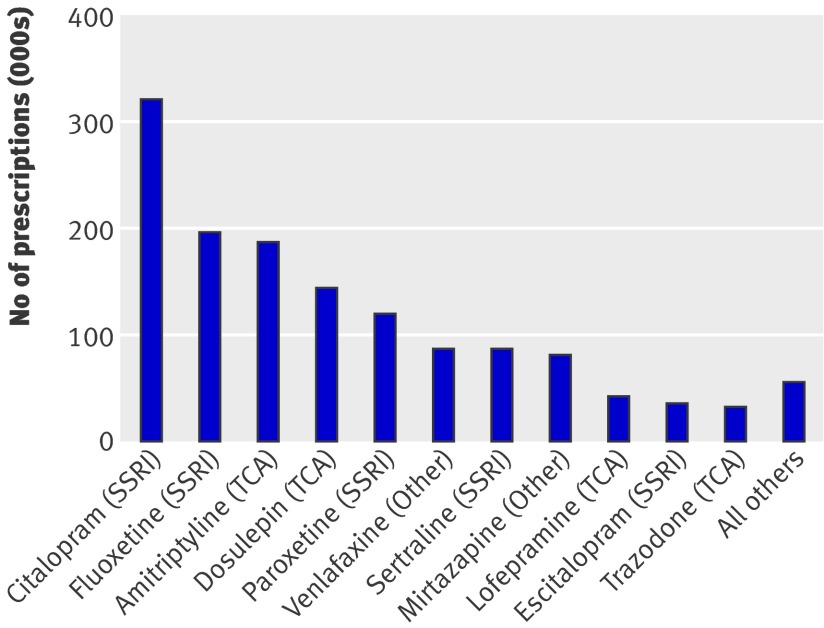
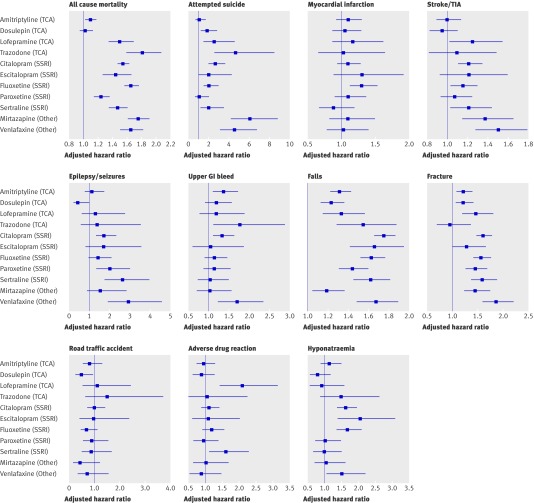
OBJECTIVES: To investigate the association between antidepressant treatment and risk of several potential adverse outcomes in older people with depression and to examine risks by class of antidepressant, duration of use, and dose. DESIGN: Cohort study of people aged 65 and over diagnosed as having depression. SETTING: 570 general practices in the United Kingdom supplying data to the QResearch primary care database. PARTICIPANTS: 60,746 patients diagnosed as having a new episode of depression between the ages of 65 and 100 years from 1 January 1996 to 31 December 2007 and followed up until 31 December 2008. MAIN OUTCOME MEASURES: Hazard ratios associated with antidepressant use for all cause mortality, attempted suicide/self harm, myocardial infarction, stroke/transient ischaemic attack, falls, fractures, upper gastrointestinal bleeding, epilepsy/seizures, road traffic accidents, adverse drug reactions, and hyponatraemia, adjusted for a range of potential confounding variables. Hazard ratios were calculated for antidepressant class (tricyclic and related antidepressants, selective serotonin reuptake inhibitors, other antidepressants), dose, and duration of use and for commonly prescribed individual drugs. RESULTS: 54,038 (89.0%) patients received at least one prescription for an antidepressant during follow-up. A total of 1,398,359 antidepressant prescriptions were issued: 764,659 (54.7%) for selective serotonin reuptake inhibitors, 442,192 (31.6%) for tricyclic antidepressants, 2203 (0.2%) for monoamine oxidase inhibitors, and 189,305 (13.5%) for the group of other antidepressants. The associations with the adverse outcomes differed significantly between the antidepressant classes for seven outcomes. Selective serotonin reuptake inhibitors were associated with the highest adjusted hazard ratios for falls (1.66, 95% confidence interval 1.58 to 1.73) and hyponatraemia (1.52, 1.33 to 1.75) compared with when antidepressants were not being used. The group of other antidepressants was associated with the highest adjusted hazard ratios for all cause mortality (1.66, 1.56 to 1.77), attempted suicide/self harm (5.16, 3.90 to 6.83), stroke/transient ischaemic attack (1.37, 1.22 to 1.55), fracture (1.64, 1.46 to 1.84), and epilepsy/seizures (2.24, 1.60 to 3.15), compared with when antidepressants were not being used. Tricyclic antidepressants did not have the highest hazard ratio for any of the outcomes. Significantly different associations also existed between the individual drugs for the same seven outcomes; trazodone (tricyclic antidepressant), mirtazapine, and venlafaxine (both in the group of other antidepressants) were associated with the highest rates for some of these outcomes. Absolute risks over 1 year for all cause mortality were 7.04% for patients while not taking antidepressants, 8.12% for those taking tricyclic antidepressants, 10.61% for selective serotonin reuptake inhibitors, and 11.43% for other antidepressants. CONCLUSIONS: Selective serotonin reuptake inhibitors and drugs in the group of other antidepressants were associated with an increased risk of several adverse outcomes compared with tricyclic antidepressants. Among individual drugs, trazodone, mirtazapine, and venlafaxine were associated with the highest risks for some outcomes. As this is an observational study, it is susceptible to confounding by indication, channelling bias, and residual confounding, so differences in characteristics between patients prescribed different antidepressant drugs that could account for some of the associations between the drugs and the adverse outcomes may remain. Further research is needed to confirm these findings, but the risks and benefits of different antidepressants should be carefully evaluated when these drugs are prescribed to older people.
Overview
The claims and statistics of this paper haven’t been checked yet.
Run the check — free, no account needed. It reads the open-access text and checks the sources it cites.
Integrity signals
Registry
Cites
Statistics
Figures
Verification
Claims the paper makes
The claims and statistics of this paper haven’t been checked yet.
Run the check — free, no account needed. It reads the open-access text and checks the sources it cites.
Claims other papers make about this one
Each is checked against this paper’s own text: does it say what the citing paper says it does?
The cited source says what the claim attributes to it.
In the citing paper
“Citalopram, a selective serotonin reuptake inhibitor (SSRI), is frequently used in older individuals11–12”
From Effect of Citalopram on Agitation in Alzheimer Disease: The CitAD Randomized Clinical Trial (2014) · cites this paper as [12]
In the citing paper
“A head-to-head comparison of these two classes in the large population-based Coupland cohort study confirmed this by showing lower HR for TCAs than for SSRIs (1:1.44, p=0.002).73”
From Addressing the Side Effects of Contemporary Antidepressant Drugs: A Comprehensive Review (2018) · cites this paper as [73]
Self-check
Percentages, sums and reported differences re-computed from the paper’s own numbers.
The self-check needs the paper’s full text.
Citations
Cites
(1958) · Journal of the American Pharmaceutical Association (Scientific ed ) · doi:10.1002/jps.3030470133 · Cited by 2,491
Health and Deprivation: Inequality and the North
Townsend, P. D., Phillimore, P., & Beattie, A. (1987) · DOAJ (DOAJ: Directory of Open Access Journals) · Cited by 1,473
Nicholson, A., Kuper, H., & Hemingway, H. (2006) · European Heart Journal · doi:10.1093/eurheartj/ehl338 · Cited by 1,353
Review of community prevalence of depression in later life
Beekman, A. T. F., Copeland, J. R. M., & Prince, M. J. (1999) · The British Journal of Psychiatry · doi:10.1192/bjp.174.4.307 · Cited by 1,139
Validation and validity of diagnoses in the General Practice Research Database: a systematic review
Herrett, E., Thomas, S. L., Schoonen, W. M., Smeeth, L., & Hall, A. J. (2010) · British Journal of Clinical Pharmacology · doi:10.1111/j.1365-2125.2009.03537.x · Cited by 1,109
Health and Deprivation: Inequality and the North
Blane, D., Townsend, P. D., Phillimore, P., & Beattie, A. (1989) · British Journal of Sociology · doi:10.2307/590279 · Cited by 756
Tutorial in biostatistics: the self‐controlled case series method
Whitaker, H. J., Paddy Farrington, C., Spiessens, B., & Musonda, P. (2006) · Statistics in Medicine · doi:10.1002/sim.2302 · Cited by 719
Calculating the number needed to treat for trials where the outcome is time to an event
Altman, D. G., & Andersen, P. K. (1999) · BMJ · doi:10.1136/bmj.319.7223.1492 · Cited by 710
Validity of diagnostic coding within the General Practice Research Database: a systematic review
Khan, N., Harrison, S., & Rose, P. W. (2010) · British Journal of General Practice · doi:10.3399/bjgp10x483562 · Cited by 702
Stone, M., Laughren, T., Jones, M. L., Levenson, M., Holland, P. C., Hughes, A., Hammad, T. A., Temple, R., & Rochester, G. (2009) · BMJ · doi:10.1136/bmj.b2880 · Cited by 609
Cassano, P., & D, M. F. M. (2002) · Journal of Psychosomatic Research · doi:10.1016/s0022-3999(02)00304-5 · Cited by 586
de Abajo, F. J., Rodríguez, L. A. G., & Montero, D. (1999) · BMJ · doi:10.1136/bmj.319.7217.1106 · Cited by 454
Psychoactive Drugs and the Risk of Injurious Motor Vehicle Crashes in Elderly Drivers
Ray, W. A., Fought, R. L., & Decker, M. D. (1992) · American Journal of Epidemiology · doi:10.1093/aje/136.7.873 · Cited by 422
Cohen, H. W., Gibson, G., & Alderman, M. H. (2000) · The American Journal of Medicine · doi:10.1016/s0002-9343(99)00301-0 · Cited by 390
Effect of Selective Serotonin Reuptake Inhibitors on the Risk of Fracture
Richards, J. B. (2007) · Archives of Internal Medicine · doi:10.1001/archinte.167.2.188 · Cited by 387
Antidepressants for depressed elderly
Mottram, P. G., Wilson, K., & Strobl, J. (2006) · Cochrane Database of Systematic Reviews · doi:10.1002/14651858.cd003491.pub2 · Cited by 289
Association of Low Bone Mineral Density With Selective Serotonin Reuptake Inhibitor Use by Older Men
Haney, E. M. (2007) · Archives of Internal Medicine · doi:10.1001/archinte.167.12.1246 · Cited by 286
Tiihonen, J., Lönnqvist, J., Wahlbeck, K., Klaukka, T., Tanskanen, A., & Haukka, J. (2006) · Archives of General Psychiatry · doi:10.1001/archpsyc.63.12.1358 · Cited by 277
Barbui, C., Esposito, E., & Cipriani, A. (2009) · Canadian Medical Association Journal · doi:10.1503/cmaj.081514 · Cited by 275
van Walraven, C., Mamdani, M., Wells, P. S., & Williams, J. (2001) · BMJ · doi:10.1136/bmj.323.7314.655 · Cited by 269
Hyponatremia Associated with Selective Serotonin-Reuptake Inhibitors in Older Adults
Jacob, S., & Spinler, S. A. (2006) · Annals of Pharmacotherapy · doi:10.1345/aph.1g293 · Cited by 261
Smoller, J. W. (2009) · Archives of Internal Medicine · doi:10.1001/archinternmed.2009.436 · Cited by 256
The importance of the β-cell in the pathogenesis of type 2 diabetes mellitus
Kahn, S. E. (2000) · The American Journal of Medicine · doi:10.1016/s0002-9343(00)00336-3 · Cited by 247
Sauer, W. H., Berlin, J. A., & Kimmel, S. E. (2003) · Circulation · doi:10.1161/01.cir.0000079172.43229.cd · Cited by 247
Martínez, C., Rietbrock, S., Wise, L., Ashby, D., Chick, J., Moseley, J., Evans, S. J. W., & Gunnell, D. (2005) · BMJ · doi:10.1136/bmj.330.7488.389 · Cited by 239
Psychoactive Medications and Injurious Motor Vehicle Collisions Involving Older Drivers
Leveille, S. G., Büchner, D. M., Koepsell, T. D., McCloskey, L. W., Wolf, M. E., & Wagner, E. H. (1994) · Epidemiology · doi:10.1097/00001648-199411000-00006 · Cited by 224
Seizures associated with antidepressants: a review.
Rosenstein, D. L., Nelson, J. C., & Jacobs, S. (1993) · PubMed · Cited by 215
de Abajo, F. J., & García‐Rodríguez, L. A. (2008) · Archives of General Psychiatry · doi:10.1001/archpsyc.65.7.795 · Cited by 204
Depression as a risk factor for ischaemic heart disease in men: population based case-control study
Hippisley‐Cox, J., Fielding, K., & Pringle, M. (1998) · BMJ · doi:10.1136/bmj.316.7146.1714 · Cited by 199
Self-citationHubbard, R. (2003) · American Journal of Epidemiology · doi:10.1093/aje/kwg114 · Cited by 199
Skop, B. P., & Brown, T. M. (1996) · Psychosomatics · doi:10.1016/s0033-3182(96)71592-x · Cited by 183
Antidepressants and Falls in the Elderly
Darowski, A., Chambers, S.-A. C. F., & Chambers, D. (2009) · Drugs & Aging · doi:10.2165/00002512-200926050-00002 · Cited by 176
Hyponatraemia and selective serotonin re‐uptake inhibitors in elderly patients
Kirby, D., & Ames, D. (2001) · International Journal of Geriatric Psychiatry · doi:10.1002/gps.367 · Cited by 169
Falls, Depression and Antidepressants in Later Life: A Large Primary Care Appraisal
Kerse, N. M., Flicker, L. A., Pfaff, J. J., Draper, B., Lautenschlager, N. T., Sim, M., Snowdon, J. A., & Almeida, O. P. (2008) · PLoS ONE · doi:10.1371/journal.pone.0002423 · Cited by 152
Kirby, D., Harrigan, S., & Ames, D. (2002) · International Journal of Geriatric Psychiatry · doi:10.1002/gps.591 · Cited by 149
Ziere, G. J., Dieleman, J. P., van der Cammen, T. J. M., Albert Hofman, D., Pols, H. A. P., & Stricker, B. H. C. (2008) · Journal of Clinical Psychopharmacology · doi:10.1097/jcp.0b013e31817e0ecb · Cited by 147
Coupland, C. A. C., Dhiman, P., Barton, G., Morriss, R. K., Arthur, A. J., Sach, T., & Hippisley‐Cox, J. (2011) · Health Technology Assessment · doi:10.3310/hta15280 · Cited by 146
Self-citationTata, L. J., West, J., Smith, C., Farrington, P., Card, T. R., Smeeth, L. L., & Hubbard, R. (2005) · Heart · doi:10.1136/hrt.2004.037457 · Cited by 143
McDougall, F. A., Matthews, F. E., Kvaal, K., Dewey, M. E., & Brayne, C. (2007) · Age and Ageing · doi:10.1093/ageing/afm111 · Cited by 137 · cited 1×
“Depression is a common condition in older people, affecting around 10-15% of those living in the community.”
BackgroundAssociation between antidepressant drug use and hyponatraemia: a case‐control study
Movig, K. L. L., Leufkens, H. G. M., Lenderink, A. W., van den Akker, V. G. A., Hodiamont, P. P. G., Goldschmidt, H. M. J., & Egberts, T. C. G. (2002) · British Journal of Clinical Pharmacology · doi:10.1046/j.1365-2125.2002.01550.x · Cited by 121
Antidepressants as risk factor for ischaemic heart disease: case–control study in primary care
Hippisley-Cox, J., Pringle, M., Hammersley, V., Crown, N., Wynn, A., Meal, A., & Coupland, C. (2001) · BMJ · doi:10.1136/bmj.323.7314.666 · Cited by 107
Self-citationSelective Serotonin Reuptake Inhibitors and Other Antidepressants and Risk of Fracture
Vestergaard, P., Rejnmark, L., & Mosekilde, L. (2008) · Calcified Tissue International · doi:10.1007/s00223-007-9099-9 · Cited by 105
Late-life depression and mortality: influence of gender and antidepressant use
Ryan, J. L., Carrière, I., Ritchie, K. A., Stewart, R. J., Toulemonde, G., Dartigues, J., Tzourio, C., & Ancelin, M. (2008) · The British Journal of Psychiatry · doi:10.1192/bjp.bp.107.039164 · Cited by 102
Gastro‐intestinal haemorrhage risks of selective serotonin receptor antagonist therapy: a new look
Opatrny, L., Delaney, J. A. ‘., & Suissa, S. (2008) · British Journal of Clinical Pharmacology · doi:10.1111/j.1365-2125.2008.03154.x · Cited by 95 · cited 1×
“A study that adjusted for a wide range of potential confounding factors found a small increased risk of gastrointestinal bleeding among users of selective serotonin reuptake inhibitors, which is comparable in magnitude to ours, with no association for tricyclic antidepressants.”
ResultCurrent Use of Selective Serotonin Reuptake Inhibitors and Risk of Acute Myocardial Infarction
Schlienger, R. G., Fischer, L., Jick, H., & Meier, C. R. (2004) · Drug Safety · doi:10.2165/00002018-200427140-00006 · Cited by 94
Reid, S., & Barbui, C. (2010) · BMJ · doi:10.1136/bmj.c1468 · Cited by 93
Drugs and falls in older people in geriatric care settings
Kallin, K., Gustafson, Y., Sandman, P., & Karlsson, S. (2004) · Aging Clinical and Experimental Research · doi:10.1007/bf03324551 · Cited by 91
Depressive Symptoms and Rates of Bone Loss at the Hip in Older Women
Diem, S. J., Blackwell, T., Stone, K. L., Yaffe, K. S., Cauley, J. A., Whooley, M. A., Ensrud, K. E., & Fractures, F. T. S. O. O. (2007) · Journal of the American Geriatrics Society · doi:10.1111/j.1532-5415.2007.01194.x · Cited by 86
Antidepressants and Risk of Upper Gastrointestinal Bleeding
de Abajo, F. J., Montero, D., Rodríguez, L. A. G., & Madurga, M. (2006) · Basic & Clinical Pharmacology & Toxicology · doi:10.1111/j.1742-7843.2006.pto_303.x · Cited by 85
Adverse reactions of antidepressants in elderly patients.
Pollock, B. G. (1999) · PubMed · Cited by 79
Effect of Selective Serotonin Reuptake Inhibitors on Platelet Activation
Schlienger, R. G., & Meier, C. R. (2003) · American Journal of Cardiovascular Drugs · doi:10.2165/00129784-200303030-00001 · Cited by 78
Low dosage tricyclic antidepressants for depression
Furukawa, T. A., McGuire, H., & Barbui, C. (2003) · Cochrane Database of Systematic Reviews · doi:10.1002/14651858.cd003197 · Cited by 74
Spigset, O., & Hedenmalm, K. (1997) · Pharmacotherapy The Journal of Human Pharmacology and Drug Therapy · doi:10.1002/j.1875-9114.1997.tb03718.x · Cited by 73
Monster, T. B. M., Johnsen, S. P., Olsen, M. L., McLaughlin, J. K., & Sørensen, H. T. (2004) · The American Journal of Medicine · doi:10.1016/j.amjmed.2004.06.027 · Cited by 71
Risk of Ischemic Stroke Associated With Antidepressant Drug Use in Elderly Persons
Trifirò, G., Dieleman, J. P., Sen, E. F., Gambassi, G., & Sturkenboom, M. (2010) · Journal of Clinical Psychopharmacology · doi:10.1097/jcp.0b013e3181dca10a · Cited by 62
Arfken, C. L., Wilson, J. G., & Aronson, S. M. (2001) · International Psychogeriatrics · doi:10.1017/s1041610201007487 · Cited by 62
Clinical trials of potential antidepressants: to what extent are the elderly represented: a review
Giron, M. S. T., Fastbom, J., & Winblad, B. G. (2005) · International Journal of Geriatric Psychiatry · doi:10.1002/gps.1273 · Cited by 49
Antidepressant drug interactions in the elderly
Cadieux, R. J. (1999) · Postgraduate Medicine · doi:10.3810/pgm.1999.11.780 · Cited by 38
Blanchette, C. M., Simoni, J. M., Zuckerman, I. H., & Stuart, B. (2008) · Annals of Epidemiology · doi:10.1016/j.annepidem.2007.11.004 · Cited by 35
Evaluation of adverse drug reactions reported to a poison control center between 2000 and 2007
Vassilev, Z. P., Chu, A. F., Ruck, B. E., Adams, E. H., & Marcus, S. M. (2009) · American Journal of Health-System Pharmacy · doi:10.2146/ajhp080267 · Cited by 32
Antidepressant-Treated Patients in Ambulatory Care
Bingefors, K., Isacson, D. G. L., von Knorring, L., Smedby, B., & Wicknertz, K. (1996) · The British Journal of Psychiatry · doi:10.1192/bjp.169.5.647 · Cited by 32
Antidepressants in the elderly: challenges for study design and their interpretation
Parikh, C. R. (2000) · British Journal of Clinical Pharmacology · doi:10.1046/j.1365-2125.2000.00201.x · Cited by 24
(2000) · Time to knit · doi:10.1016/s0084-3970(09)79072-3 · Cited by 18
Low dosage tricyclic antidepressants in depression
Jones, H. (2003) · BMJ · doi:10.1136/bmj.326.7387.499/a · Cited by 17
Effect of Selective Serotonin-Reuptake Inhibitors on the Risk of Fracture
Vestergaard, P. (2007) · Aging Health · doi:10.2217/1745509x.3.3.349 · Cited by 17
Cited by
Sorted by citations
Dementia prevention, intervention, and care
Livingston, G., Sommerlad, A., Orgeta, V., Costafreda, S. G., Huntley, J., Ames, D., Ballard, C., Banerjee, S., Burns, A., Cohen-Mansfield, J., et al. (2017) · The Lancet · doi:10.1016/s0140-6736(17)31363-6 · Cited by 6,072
Post-Stroke Depression: A Review
Robinson, R. G., & Jorge, R. E. (2015) · American Journal of Psychiatry · doi:10.1176/appi.ajp.2015.15030363 · Cited by 1,152
Malhi, G. S., Bassett, D., Boyce, P., Bryant, R., Fitzgerald, P. B., Fritz, K., Hopwood, M., Lyndon, B., Mulder, R., Murray, G., et al. (2015) · Australian & New Zealand Journal of Psychiatry · doi:10.1177/0004867415617657 · Cited by 842
“, 2013) and that treatment should be based on symptom and side effect profile and the need to avoid interactions (Coupland et al., 2011).”
BackgroundCarvalho, A. F., Sharma, M. S., Brunoni, A. R., Vieta, E., & Fava, G. A. (2016) · Psychotherapy and Psychosomatics · doi:10.1159/000447034 · Cited by 650
Bauer, M., Pfennig, A., Severus, E., Whybrow, P. C., Angst, J., Möller, H.-J., & Šon behalf of the Task Force on Unipolar Depressive Disorders (2013) · The World Journal of Biological Psychiatry · doi:10.3109/15622975.2013.804195 · Cited by 632
Metadata
- Authors
- Coupland, C., Dhiman, P., Morriss, R., Arthur, A., Barton, G., & Hippisley-Cox, J.
- Affiliations
- University of Nottingham (GB)
- University of East Anglia (GB)
- Corresponding author
- Coupland, C.
- Venue
- BMJ
- Publisher
- BMJ
- Published
- 2011-08-02
- Volume
- 343
- Issue
- aug02 1
- Pages
- d4551-d4551
- ISSN
- 0007-1447 (ISSN-L)
- 0959-8138
- 1468-5833
- PMC
- PMC3149102
- OpenAlex
- W2044170764
- Cited by
- 833
- References
- 66
- Citations by year
- 2026: 33 · 2025: 44 · 2024: 58 · 2023: 31 · 2022: 51 · 2021: 65 · 2020: 58 · 2019: 76 · 2018: 54 · 2017: 70 · 2016: 72 · 2015: 63 · 2014: 60 · 2013: 44 · 2012: 41
- FWCI
- 24.08
- Type
- journal article
- Language
- en
- Open access
- hybrid
- doi.org
- Licence
- cc-by-nc
- Locations
- BMJ (publishedVersion, cc-by-nc)
- Europe PMC (PubMed Central) (publishedVersion, cc-by-nc)
- PubMed Central (publishedVersion, cc-by-nc)
- PubMed (publishedVersion)
- HighWire Press Open Archive (submittedVersion)
- UEA Digital Repository (University of East Anglia) (submittedVersion)
- Funders
- National Institute for Health and Care Research (06/42/01)
- Topics
- Health Sciences › Medicine › Geriatrics and Gerontology › Pharmaceutical Practices and Patient Outcomes
- Health Sciences › Medicine › Pharmacology (medical) › Treatment of Major Depression
- Health Sciences › Medicine › Psychiatry and Mental health › Mental Health Treatment and Access
- Keywords
- antidepressants, geriatric depression, adverse drug outcomes, selective serotonin reuptake inhibitors, tricyclic antidepressants, hyponatremia, falls, all-cause mortality, suicide, myocardial infarction, stroke, fracture, gastrointestinal bleeding, epilepsy, traffic accidents, adverse drug reactions, primary care prescribing, older adults, drug safety
- MeSH terms
- Aged, Aged, 80 and over, Antidepressive Agents, Cause of Death, Depressive Disorder, Drug Administration Schedule, Female, United Kingdom, Humans, Male, Prognosis, Risk Factors, Cohort Studies, Comorbidity, Age Distribution
About these checks
Registry, retraction, Cites and statistics results are computed, not judged, with one exception: a printed reference that no index lists is read once by a model before it counts as a citation error. Claims are extracted by a model and kept only when their quote appears verbatim in the text; each cited source is then checked, with a model’s help, for whether it says what the claim relies on. Those verdicts can be wrong — read the claim’s quote and the cited source before relying on one.
Statistics and arithmetic are recomputed, not judged.
Confidence bands are shown only for fields calibrated on our annotated test set. None is calibrated yet, so no band is shown.
What counts as a claim ›How we measure confidence ›How we check this ›
Are you an author, or do you see a problem with this page? Request a review
