

The DOI matches its Crossref record; 59 of the 60 references it cites were found in a registry or an index.
Fruit consumption and risk of type 2 diabetes: results from three prospective longitudinal cohort studies
Open accessAbstract
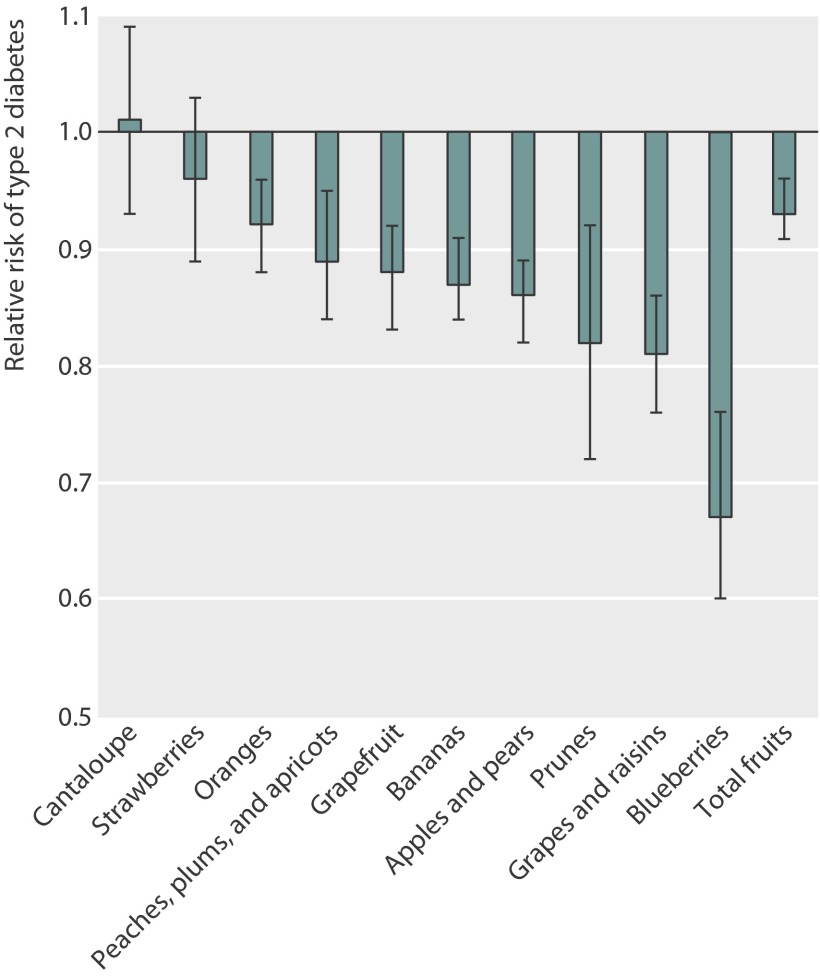
OBJECTIVE: To determine whether individual fruits are differentially associated with risk of type 2 diabetes. DESIGN: Prospective longitudinal cohort study. SETTING: Health professionals in the United States. PARTICIPANTS: 66,105 women from the Nurses' Health Study (1984-2008), 85,104 women from the Nurses' Health Study II (1991-2009), and 36,173 men from the Health Professionals Follow-up Study (1986-2008) who were free of major chronic diseases at baseline in these studies. MAIN OUTCOME MEASURE: Incident cases of type 2 diabetes, identified through self report and confirmed by supplementary questionnaires. RESULTS: During 3,464,641 person years of follow-up, 12,198 participants developed type 2 diabetes. After adjustment for personal, lifestyle, and dietary risk factors of diabetes, the pooled hazard ratio of type 2 diabetes for every three servings/week of total whole fruit consumption was 0.98 (95% confidence interval 0.97 [corrected] to 0.99). With mutual adjustment of individual fruits, the pooled hazard ratios of type 2 diabetes for every three servings/week were 0.74 (0.66 to 0.83) for blueberries, 0.88 (0.83 to 0.93) for grapes and raisins, 0.89 (0.79 to 1.01) for prunes, 0.93 (0.90 to 0.96) for apples and pears, 0.95 (0.91 to 0.98) for bananas, 0.95 (0.91 to 0.99) for grapefruit, 0.97 (0.92 to 1.02) for peaches, plums, and apricots, 0.99 (0.95 to 1.03) for oranges, 1.03 (0.96 to 1.10) for strawberries, and 1.10 (1.02 to 1.18) for cantaloupe. The pooled hazard ratio for the same increment in fruit juice consumption was 1.08 (1.05 to 1.11). The associations with risk of type 2 diabetes differed significantly among individual fruits (P<0.001 in all cohorts). CONCLUSION: Our findings suggest the presence of heterogeneity in the associations between individual fruit consumption and risk of type 2 diabetes. Greater consumption of specific whole fruits, particularly blueberries, grapes, and apples, is significantly associated with a lower risk of type 2 diabetes, whereas greater consumption of fruit juice is associated with a higher risk.
Overview
The claims and statistics of this paper haven’t been checked yet.
Run the check — free, no account needed. It reads the open-access text and checks the sources it cites.
Integrity signals
Registry
Cites
Statistics
Figures
Verification
Claims the paper makes
The claims and statistics of this paper haven’t been checked yet.
Run the check — free, no account needed. It reads the open-access text and checks the sources it cites.
Claims other papers make about this one
Each is checked against this paper’s own text: does it say what the citing paper says it does?
The check wasn’t confident either way, so it gives no verdict — never disputed.
In the citing paper
“Ezetimibe or a PCSK9 inhibitor as add‐on to statin therapy is shown to reduce the incidence of CVD in patients with diabetes and hyper‐LDL‐cholesterolemia 29 , 30 , 31 , 32 , 33 , 34 , 35 , 36 (grade B: 88% agreement).”
From Japanese clinical practice guideline for diabetes 2019 (2020) · cites this paper as [29]
Experimental — accuracy not yet measured
Self-check
Percentages, sums and reported differences re-computed from the paper’s own numbers.
The self-check needs the paper’s full text.
Citations
Cites
Report of the Expert Committee on the Diagnosis and Classification of Diabetes Mellitus
The Expert Committee on the Diagnosis and Classification of Diabetes Mellitus* (2002) · Diabetes Care · doi:10.2337/diacare.25.2007.s5 · Cited by 10,325
Report of the Expert Committee on the Diagnosis and Classification of Diabetes Mellitus
The Expert Committee on the Diagnosis and Classification of Diabetes Mellitus (1997) · Diabetes Care · doi:10.2337/diacare.20.7.1183 · Cited by 6,220
Classification and diagnosis of diabetes mellitus and other categories of glucose intolerance.
National Diabetes Data Group (1979) · Diabetes · doi:10.2337/diab.28.12.1039 · Cited by 4,909
Resveratrol improves health and survival of mice on a high-calorie diet
Baur, J. A., Pearson, K. J., Price, N. L., Jamieson, H. A., Lerin, C., Kalra, A., Prabhu, V. V., Allard, J. S., Lopez-Lluch, G., Lewis, K., et al. (2006) · Nature · doi:10.1038/nature05354 · Cited by 4,290
Alternative Dietary Indices Both Strongly Predict Risk of Chronic Disease
Chiuve, S. E., Fung, T. T., Rimm, E. B., Hu, F. B., McCullough, M. L., Wang, M., Stampfer, M. J., & Willett, W. C. (2012) · The Journal of Nutrition · doi:10.3945/jn.111.157222 · Cited by 1,951
Self-citationDietary Fiber, Glycemic Load, and Risk of Non—insulin-dependent Diabetes Mellitus in Women
Salmerón, J. (1997) · JAMA: The Journal of the American Medical Association · doi:10.1001/jama.1997.03540300040031 · Cited by 1,804
Flavonoid intake and risk of chronic diseases
Knekt, P., Kumpulainen, J. T., Järvinen, R., Rissanen, H. A., Heliövaara, M., Reunanen, A., Hakulinen, T., & Aromaa, A. (2002) · American Journal of Clinical Nutrition · doi:10.1093/ajcn/76.3.560 · Cited by 1,765
Dietary Fiber, Glycemic Load, and Risk of NIDDM in Men
Salmerón, J., Ascherio, A., Rimm, E. B., Colditz, G. A., Spiegelman, D., Jenkins, D. J., Stampfer, M. J., Wing, A. L., & Willett, W. C. (1997) · Diabetes Care · doi:10.2337/diacare.20.4.545 · Cited by 1,426
Self-citationTimmers, S., Konings, E., Bilet, L., Houtkooper, R. H., van de Weijer, T., Goossens, G. H., Hoeks, J., van der Krieken, S., Ryu, D., Kersten, S., et al. (2011) · Cell Metabolism · doi:10.1016/j.cmet.2011.10.002 · Cited by 1,320
USDA National Nutrient Database for Standard Reference, Release 22
(2018) · Cited by 1,284
Cited by
Sorted by citations
Food in the Anthropocene: the EAT–Lancet Commission on healthy diets from sustainable food systems
Willett, W., Rockström, J., Loken, B., Springmann, M., Lang, T., Vermeulen, S., Garnett, T., Tilman, D., DeClerck, F., Wood, A., et al. (2019) · The Lancet · doi:10.1016/s0140-6736(18)31788-4 · Cited by 10,880
Self-citationPrevention and management of type 2 diabetes: dietary components and nutritional strategies
Ley, S. H., Hamdy, O., Mohan, V., & Hu, F. B. (2014) · The Lancet · doi:10.1016/s0140-6736(14)60613-9 · Cited by 1,301
Self-citationSatija, A., Bhupathiraju, S. N., Rimm, E. B., Spiegelman, D., Chiuve, S. E., Borgi, L., Willett, W. C., Manson, J. E., Sun, Q., & Hu, F. B. (2016) · PLOS Medicine · doi:10.1371/journal.pmed.1002039 · Cited by 1,069
Self-citationImamura, F., O’Connor, L., Ye, Z., Mursu, J., Hayashino, Y., Bhupathiraju, S. N., & Forouhi, N. G. (2015) · BMJ · doi:10.1136/bmj.h3576 · Cited by 977
Self-citationImamura, F., O’Connor, L., Ye, Z., Mursu, J., Hayashino, Y., Bhupathiraju, S. N., & Forouhi, N. G. (2016) · British Journal of Sports Medicine · doi:10.1136/bjsports-2016-h3576rep · Cited by 968
Self-citation
Metadata
- Authors
- Muraki, I., Imamura, F., Manson, J. E., Hu, F. B., Willett, W. C., van Dam, R. M., & Sun, Q.
- Affiliations
- Harvard University (US)
- University of Cambridge (GB)
- Brigham and Women's Hospital (US)
- Corresponding author
- Sun, Q.
- Venue
- BMJ
- Publisher
- BMJ
- Published
- 2013-08-28
- Volume
- 347
- Issue
- aug28 1
- Pages
- f5001-f5001
- ISSN
- 1756-1833 (ISSN-L)
- PMC
- PMC3978819
- OpenAlex
- W2010234625
- Cited by
- 544
- References
- 60
- Citations by year
- 2026: 20 · 2025: 33 · 2024: 40 · 2023: 32 · 2022: 54 · 2021: 50 · 2020: 57 · 2019: 40 · 2018: 37 · 2017: 35 · 2016: 51 · 2015: 46 · 2014: 42 · 2013: 7
- FWCI
- 6.94
- Type
- journal article
- Language
- en
- Update notices
- correction (2013-12-04)
- Open access
- hybrid
- doi.org
- Licence
- cc-by-nc
- Locations
- BMJ (publishedVersion, cc-by-nc)
- Europe PMC (PubMed Central) (publishedVersion, cc-by-nc)
- PubMed Central (publishedVersion, cc-by-nc)
- PubMed (publishedVersion)
- Digital Access to Scholarship at Harvard (DASH) (Harvard University) (submittedVersion, cc-by)
- National University of Singapore (submittedVersion)
- Funders
- Medical Research Council (MC_UU_12015/5)
- National Heart, Lung, and Blood Institute (R00HL098459)
- National Cancer Institute (CA-167552, CA-87969, CA-55075, P01CA087969, CA50385, UM1CA176726, CA176726, P01CA055075, R01CA050385, UM1CA167552)
- National Institute of Diabetes and Digestive and Kidney Diseases (R01DK058845, DK-082486, R01DK082486, DK58845, T32DK007703)
- Topics
- Health Sciences › Medicine › Public Health, Environmental and Occupational Health › Nutritional Studies and Diet
- Health Sciences › Medicine › Endocrinology, Diabetes and Metabolism › Diet, Metabolism, and Disease
- Health Sciences › Medicine › Biochemistry (medical) › Phytochemicals and Antioxidant Activities
- Keywords
- type 2 diabetes, fruit consumption, whole fruit, fruit juice, blueberry, prunes, banana, grapefruit, strawberry, cantaloupe, dietary risk factors, Nurses' Health Study, Health Professionals Follow-up Study, prospective cohort, pooled hazard ratio, diabetes prevention
- MeSH terms
- Beverages, Diabetes Mellitus, Type 2, Diet, Epidemiologic Methods, Female, Fruit, Humans, Male, Middle Aged, Prospective Studies, Risk Factors, Body Mass Index
About these checks
Registry, retraction, Cites and statistics results are computed, not judged, with one exception: a printed reference that no index lists is read once by a model before it counts as a citation error. Claims are extracted by a model and kept only when their quote appears verbatim in the text; each cited source is then checked, with a model’s help, for whether it says what the claim relies on. Those verdicts can be wrong — read the claim’s quote and the cited source before relying on one.
Statistics and arithmetic are recomputed, not judged.
Confidence bands are shown only for fields calibrated on our annotated test set. None is calibrated yet, so no band is shown.
What counts as a claim ›How we measure confidence ›How we check this ›
Are you an author, or do you see a problem with this page? Request a review
