

The DOI matches its Crossref record; 48 of the 48 references it cites were found in a registry or an index.
Predicted lean body mass, fat mass, and all cause and cause specific mortality in men: prospective US cohort study
Open accessAbstract
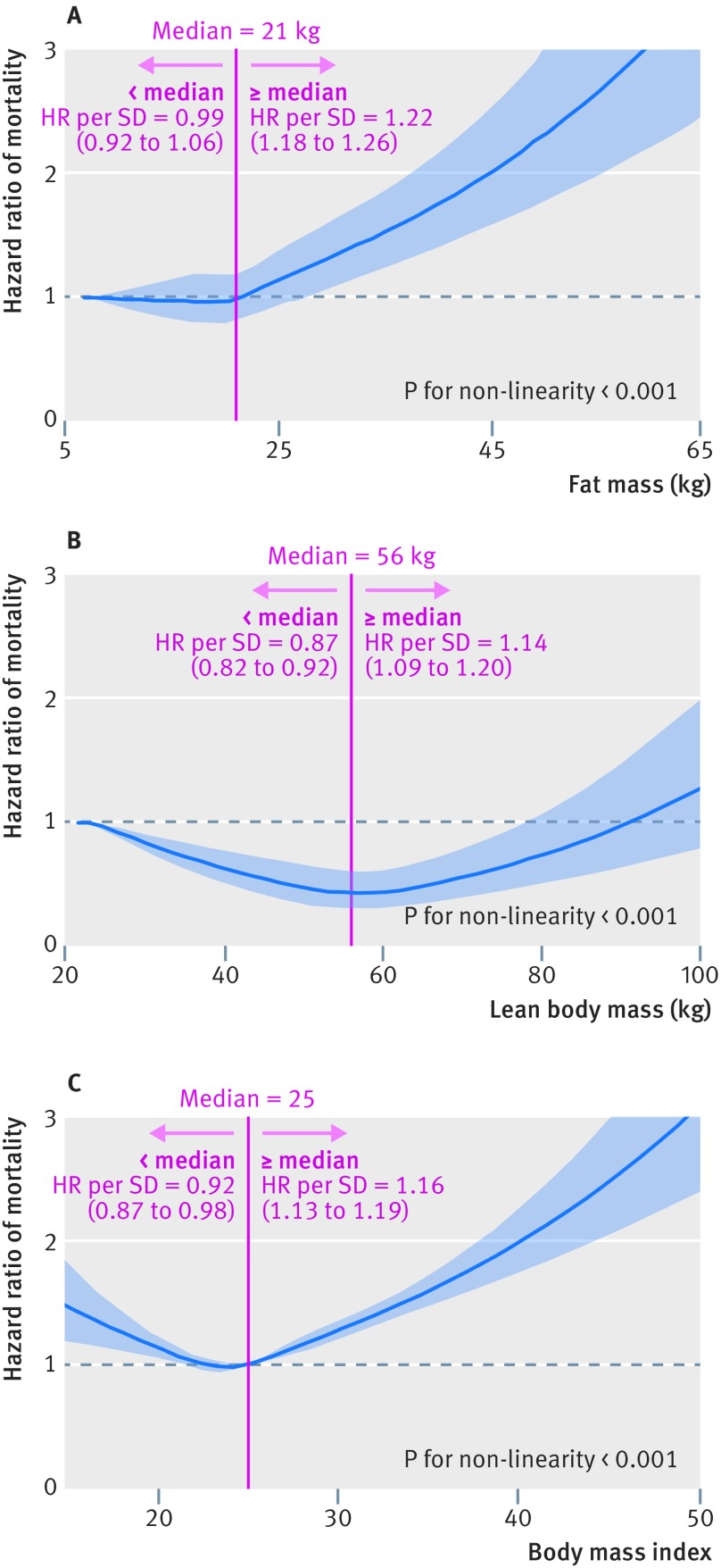
OBJECTIVE: To investigate the association of predicted lean body mass, fat mass, and body mass index (BMI) with all cause and cause specific mortality in men. DESIGN: Prospective cohort study. SETTING: Health professionals in the United States PARTICIPANTS: 38 006 men (aged 40-75 years) from the Health Professionals Follow-up Study, followed up for death (1987-2012). MAIN OUTCOME MEASURES: All cause and cause specific mortality. RESULTS: Using validated anthropometric prediction equations previously developed from the National Health and Nutrition Examination Survey, lean body mass and fat mass were estimated for all participants. During a mean of 21.4 years of follow-up, 12 356 deaths were identified. A J shaped association was consistently observed between BMI and all cause mortality. Multivariable adjusted Cox models including predicted fat mass and lean body mass showed a strong positive monotonic association between predicted fat mass and all cause mortality. Compared with those in the lowest fifth of predicted fat mass, men in the highest fifth had a hazard ratio of 1.35 (95% confidence interval 1.26 to 1.46) for mortality from all causes. In contrast, a U shaped association was found between predicted lean body mass and all cause mortality. Compared with those in the lowest fifth of predicted lean body mass, men in the second to fourth fifths had 8-10% lower risk of mortality from all causes. In the restricted cubic spline models, the risk of all cause mortality was relatively flat until 21 kg of predicted fat mass and increased rapidly afterwards, with a hazard ratio of 1.22 (1.18 to 1.26) per standard deviation. For predicted lean body mass, a large reduction of the risk was seen within the lower range until 56 kg, with a hazard ratio of 0.87 (0.82 to 0.92) per standard deviation, which increased thereafter (P for non-linearity <0.001). For cause specific mortality, men in the highest fifth of predicted fat mass had hazard ratios of 1.67 (1.47 to 1.89) for cardiovascular disease, 1.24 (1.09 to 1.43) for cancer, and 1.26 (0.97 to 1.64) for respiratory disease. On the other hand, a U shaped association was found between predicted lean body mass and mortality from cardiovascular disease and cancer. However, a strong inverse association existed between predicted lean body mass and mortality from respiratory disease (P for trend <0.001). CONCLUSIONS: The shape of the association between BMI and mortality was determined by the relation between two body components (lean body mass and fat mass) and mortality. This finding suggests that the "obesity paradox" controversy may be largely explained by low lean body mass, rather than low fat mass, in the lower range of BMI.
Overview
The claims and statistics of this paper haven’t been checked yet.
Run the check — free, no account needed. It reads the open-access text and checks the sources it cites.
Integrity signals
Registry
Cites
Statistics
Figures
Verification
Claims the paper makes
The claims and statistics of this paper haven’t been checked yet.
Run the check — free, no account needed. It reads the open-access text and checks the sources it cites.
Claims other papers make about this one
Each is checked against this paper’s own text: does it say what the citing paper says it does?
In the citing paper
“Body composition analyses have also reported that excess body fat increases all-cause and disease-cause mortality, and people with low lean mass have been found to have higher death rates (4, 5).”
From The role of obesity in sarcopenia and the optimal body composition to prevent against sarcopenia and obesity (2023) · cites this paper as [4]
In the citing paper
“In a large cohort of men, increment of fat mass was associated with mortality, which may be associated with the high prevalence of sarcopenia (4).”
From The role of obesity in sarcopenia and the optimal body composition to prevent against sarcopenia and obesity (2023) · cites this paper as [4]
Self-check
Percentages, sums and reported differences re-computed from the paper’s own numbers.
The self-check needs the paper’s full text.
Citations
Cites
Yaşlı Kadınlarda Üreme Sağlığı
Kokanalı, D., & Engin Üstün, Y. (n.d.) · DergiPark (Istanbul University) · Cited by 170,090
Home visits: a strategy to improve newborn survival - Authors' reply
(2008) · Americanae (AECID Library) · doi:10.1016/s0140 · Cited by 22,524
(2000) · PubMed · Cited by 13,173
Flegal, K. M., Kit, B. K., Orpana, H., & Graubard, B. I. (2013) · JAMA · doi:10.1001/jama.2012.113905 · Cited by 3,998
Haslam, D. W., & James, W. P. T. (2005) · The Lancet · doi:10.1016/s0140-6736(05)67483-1 · Cited by 3,757
Di Angelantonio, E., Bhupathiraju, S. N., Wormser, D., Gao, P., Kaptoge, S., de Gonzalez, A. B., Cairns, B. J., Huxley, R., Jackson, C. L., Joshy, G., et al. (2016) · The Lancet · doi:10.1016/s0140-6736(16)30175-1 · Cited by 2,821
Self-citationFlexible regression models with cubic splines
Durrleman, S., & Simon, R. M. (1989) · Statistics in Medicine · doi:10.1002/sim.4780080504 · Cited by 2,722
Body-mass index and mortality among 1.46 million white adults
Berrington de Gonzalez, A., Hartge, P., Cerhan, J. R., Flint, A. J., Hannan, L., MacInnis, R. J., Moore, S. C., Tobias, G. S., Anton-Culver, H., Freeman, L. B., et al. (2010) · New England Journal of Medicine · doi:10.1056/nejmoa1000367 · Cited by 2,317
Self-citationOverweight, Obesity, and Mortality in a Large Prospective Cohort of Persons 50 to 71 Years Old
Adams, K. F., Schatzkin, A. G., Harris, T. B., Kipnis, V., Mouw, T., Ballard-Barbash, R. R., Hollenbeck, A. R., & Leitzmann, M. F. (2006) · New England Journal of Medicine · doi:10.1056/nejmoa055643 · Cited by 2,115
Newman, A. B., Kupelian, V., Visser, M., Simonsick, E. M., Goodpaster, B. H., Kritchevsky, S. B., Tylavsky, F. A., Rubin, S. M., Harris, T. B., & on Behalf of the Health, A. A. B. C. S. I. (2006) · The Journals of Gerontology Series A: Biological Sciences and Medical Sciences · doi:10.1093/gerona/61.1.72 · Cited by 1,692
Cited by
Sorted by citations
Obesity cardiomyopathy: evidence, mechanisms, and therapeutic implications
Ren, J. T., Wu, N. N., Wang, S., Sowers, J. R., & Zhang, Y. (2021) · Physiological Reviews · doi:10.1152/physrev.00030.2020 · Cited by 387
Sultana, R. N., Sabag, A., Keating, S. E., & Johnson, N. A. (2019) · Sports Medicine · doi:10.1007/s40279-019-01167-w · Cited by 286
Liu, C., Wong, P. Y., Chung, Y. L., Chow, S. K., Cheung, W. H., Law, S. W., Chan, J. C. N., & Wong, R. M. Y. (2023) · Obesity Reviews · doi:10.1111/obr.13534 · Cited by 247
Sun, Y.-Q., Burgess, S., Staley, J. R., Wood, A. M., Bell, S., Kaptoge, S. K., Guo, Q., Bolton, T. R., Mason, A. M., Butterworth, A. S., et al. (2019) · BMJ · doi:10.1136/bmj.l1042 · Cited by 193
Jeong, S., Lee, D. H., Rezende, L. F. M., & Giovannucci, E. L. (2023) · Scientific Reports · doi:10.1038/s41598-023-30527-w · Cited by 194
Metadata
- Authors
- Lee, D. H., Keum, N., Hu, F. B., Orav, E. J., Rimm, E. B., Willett, W. C., & Giovannucci, E. L.
- Affiliations
- Harvard University (US)
- Brigham and Women's Hospital (US)
- Corresponding author
- Giovannucci, Edward L
- ORCID
- Venue
- BMJ
- Publisher
- BMJ
- Published
- 2018-07-03
- Volume
- 362
- Pages
- k2575
- ISSN
- 1756-1833 (ISSN-L)
- 0959-8138
- PMC
- PMC6028901
- OpenAlex
- W2810529814
- Cited by
- 486
- References
- 48
- Citations by year
- 2026: 37 · 2025: 74 · 2024: 103 · 2023: 78 · 2022: 69 · 2021: 62 · 2020: 43 · 2019: 14 · 2018: 6
- FWCI
- 21.43
- Type
- journal article
- Language
- en
- Open access
- hybrid
- doi.org
- Licence
- Locations
- BMJ (publishedVersion, cc-by-nc)
- Europe PMC (PubMed Central) (publishedVersion, cc-by-nc)
- PubMed Central (publishedVersion, cc-by-nc)
- PubMed (publishedVersion)
- HighWire Press Open Archive (submittedVersion)
- Funders
- National Research Foundation
- National Research Foundation of Korea (2018R1A4A1022589, NRF-2018R1A4A1022589)
- Ministry of Science and ICT, South Korea (NRF-2018R1A4A1022589)
- National Institutes of Health (UM1-CA167552, CA-167552)
- National Heart, Lung, and Blood Institute (R01HL035464)
- National Cancer Institute (R03CA223619, UM1CA167552)
- Topics
- Health Sciences › Medicine › Physiology (medical) › Body Composition Measurement Techniques
- Health Sciences › Medicine › Public Health, Environmental and Occupational Health › Obesity, Physical Activity, Diet
- Health Sciences › Medicine › Oncology › Cancer Risks and Factors
- Keywords
- fat mass, body mass index, all-cause mortality, cause-specific mortality, cardiovascular mortality, cancer mortality, respiratory mortality, anthropometric equations, men, Health Professionals Follow-up Study, obesity paradox, body composition, nonlinear relationship, sex differences in mortality
- MeSH terms
- Adult, Aged, Body Composition, Follow-Up Studies, Health Personnel, Humans, Male, Middle Aged, Mortality, Prospective Studies, United States, Body Mass Index
About these checks
Registry, retraction, Cites and statistics results are computed, not judged, with one exception: a printed reference that no index lists is read once by a model before it counts as a citation error. Claims are extracted by a model and kept only when their quote appears verbatim in the text; each cited source is then checked, with a model’s help, for whether it says what the claim relies on. Those verdicts can be wrong — read the claim’s quote and the cited source before relying on one.
Statistics and arithmetic are recomputed, not judged.
Confidence bands are shown only for fields calibrated on our annotated test set. None is calibrated yet, so no band is shown.
What counts as a claim ›How we measure confidence ›How we check this ›
Are you an author, or do you see a problem with this page? Request a review
