

The DOI matches its Crossref record; 52 of the 54 references it cites were found in a registry or an index; none of the 23 sources its claims cite is checked for support yet.
Thyroid replacement therapy, thyroid stimulating hormone concentrations, and long term health outcomes in patients with hypothyroidism: longitudinal study
Open accessAbstract
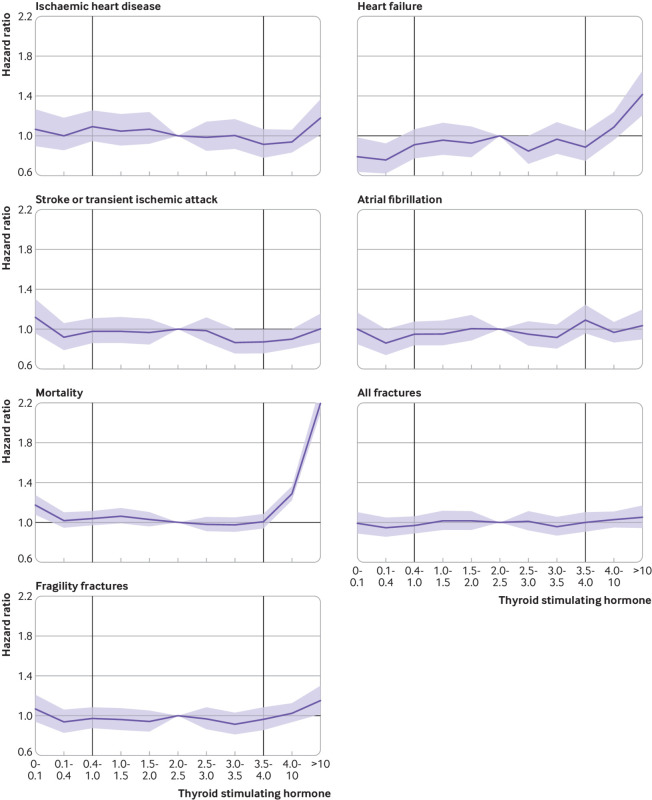
Objective: To explore whether thyroid stimulating hormone (TSH) concentration in patients with a diagnosis of hypothyroidism is associated with increased all cause mortality and a higher risk of cardiovascular disease and fractures. Design: Retrospective cohort study. Setting: The Health Improvement Network (THIN), a database of electronic patient records from UK primary care. Participants: Adult patients with incident hypothyroidism from 1 January 1995 to 31 December 2017. Exposure: TSH concentration in patients with hypothyroidism. Main outcome measures: Ischaemic heart disease, heart failure, stroke/transient ischaemic attack, atrial fibrillation, any fractures, fragility fractures, and mortality. Longitudinal TSH measurements from diagnosis to outcomes, study end, or loss to follow-up were collected. An extended Cox proportional hazards model with TSH considered as a time varying covariate was fitted for each outcome. Results: 162 369 patients with hypothyroidism and 863 072 TSH measurements were included in the analysis. Compared with the reference TSH category (2-2.5 mIU/L), risk of ischaemic heart disease and heart failure increased at high TSH concentrations (>10 mIU/L) (hazard ratio 1.18 (95% confidence interval 1.02 to 1.38; P=0.03) and 1.42 (1.21 to 1.67; P<0.001), respectively). A protective effect for heart failure was seen at low TSH concentrations (hazard ratio 0.79 (0.64 to 0.99; P=0.04) for TSH <0.1 mIU/L and 0.76 (0.62 to 0.92; P=0.006) for 0.1-0.4 mIU/L). Increased mortality was observed in both the lowest and highest TSH categories (hazard ratio 1.18 (1.08 to 1.28; P<0.001), 1.29 (1.22 to 1.36; P<0.001), and 2.21 (2.07 to 2.36; P<0.001) for TSH <0.1 mIU/L, 4-10 mIU/L, and >10 mIU/L. An increase in the risk of fragility fractures was observed in patients in the highest TSH category (>10 mIU/L) (hazard ratio 1.15 (1.01 to 1.31; P=0.03)). Conclusions: In patients with a diagnosis of hypothyroidism, no evidence was found to suggest a clinically meaningful difference in the pattern of long term health outcomes (all cause mortality, atrial fibrillation, ischaemic heart disease, heart failure, stroke/transient ischaemic attack, fractures) when TSH concentrations were within recommended normal limits. Evidence was found for adverse health outcomes when TSH concentration is outside this range, particularly above the upper reference value.
Overview
AI snapshot
Written from the paper’s full text.
TL;DR
In UK primary care patients with incident hypothyroidism, TSH concentrations within the recommended normal range were not associated with clinically meaningful differences in long-term mortality, cardiovascular disease, or fracture outcomes. Adverse outcomes were seen mainly when TSH was outside normal limits, especially above 10 mIU/L.
Key findings
- Compared with TSH 2-2.5 mIU/L, high TSH (>10 mIU/L) was associated with increased ischaemic heart disease (HR 1.18, 95% CI 1.02 to 1.38; P=0.03) and heart failure (HR 1.42, 95% CI 1.21 to 1.67; P<0.001).
- Low TSH was associated with lower heart failure risk: HR 0.79 (0.64 to 0.99; P=0.04) for TSH <0.1 mIU/L and HR 0.76 (0.62 to 0.92; P=0.006) for 0.1-0.4 mIU/L.
- Mortality was increased at both low and high TSH: HR 1.18 (1.08 to 1.28; P<0.001) for <0.1 mIU/L, HR 1.29 (1.22 to 1.36; P<0.001) for 4-10 mIU/L, and HR 2.21 (2.07 to 2.36; P<0.001) for >10 mIU/L.
- Fragility fracture risk was increased at TSH >10 mIU/L (HR 1.15, 95% CI 1.01 to 1.31; P=0.03); no association was found for all fractures.
Methods
- Retrospective cohort study using The Health Improvement Network (THIN), a UK primary care electronic records database, including adults with incident hypothyroidism from 1 January 1995 to 31 December 2017.
- The analysis included 162,369 patients with hypothyroidism and 863,072 TSH measurements; median follow-up was 6 years, and 23.2% were men and 76.8% women.
- TSH was modelled as a time-varying categorical covariate (annual mean; reference 2-2.5 mIU/L) in extended Cox proportional hazards models for ischaemic heart disease, heart failure, stroke/TIA, atrial fibrillation, all fractures, fragility fractures, and mortality, adjusted for baseline covariates; subgroup analyses were by age and sex.
Limitations
- The paper states that it did not differentiate cause of hypothyroidism; assay variability, interference, macro-TSH, age-related TSH shifts, and obesity may affect the sample; some subclinical hypothyroidism may have been miscoded; baseline covariates may have varied over time; median follow-up of 6 years may not capture all long-term outcomes; cause-specific mortality is not recorded in THIN; reverse causality is possible; and osteoporosis is poorly recorded.
- The paper also notes that pituitary disease was not excluded in the primary analysis, although a sensitivity analysis excluding 1,416 (0.9%) patients with pituitary disease had no effect on mortality findings.
- Evident from the text: this is an observational database study, so residual confounding cannot be excluded, and reliance on Read codes and primary care records may introduce misclassification.
Model-written summary. Check it against the paper before relying on it.
Integrity signals
Registry
Cites
Statistics
Figures
Verification
Claims the paper makes
51 Own result · 19 Not checked yet · 14 Own method · 11 Own interpretation
A result the paper reports from its own data — it cites no other source for it, so there is none to check. The quote shows it is in the paper.
In the paper
“Increased mortality was observed in both the lowest and highest TSH categories (hazard ratio 1.18 (1.08 to 1.28; P<0.001), 1.29 (1.22 to 1.36; P<0.001), and 2.21 (2.07 to 2.36; P<0.001) for TSH <0.1 mIU/L, 4-10 mIU/L, and >10 mIU/L.”
§ Thyroid replacement therapy, thyroid stimulating hormone concentrations, and long term health outcomes in patients with hypothyroidism: longitudinal study > Abstract > Results
plaincorrelational- Asserted: passes — The authors put it forward as true.
- Checkable: passes — It can be checked against evidence.
- Load-bearing: passes — The paper’s conclusions depend on it.
- Based: passes — The paper gives a reason why it holds.
A result the paper reports from its own data — it cites no other source for it, so there is none to check. The quote shows it is in the paper.
In the paper
“This was not the case for stroke/transient ischaemic attack; however, the risk was marginally reduced at TSH concentrations of 3-3.5 mIU/L”
§ Thyroid replacement therapy, thyroid stimulating hormone concentrations, and long term health outcomes in patients with hypothyroidism: longitudinal study > Results > Cardiovascular diseases
plain- Asserted: passes — The authors put it forward as true.
- Checkable: passes — It can be checked against evidence.
- Load-bearing: passes — The paper’s conclusions depend on it.
- Based: passes — The paper gives a reason why it holds.
A result the paper reports from its own data — it cites no other source for it, so there is none to check. The quote shows it is in the paper.
In the paper
“A protective effect for heart failure was seen at low TSH concentrations (hazard ratio 0.79 (0.64 to 0.99; P=0.04) for TSH <0.1 mIU/L and 0.76 (0.62 to 0.92; P=0.006) for 0.1-0.4 mIU/L).”
§ Thyroid replacement therapy, thyroid stimulating hormone concentrations, and long term health outcomes in patients with hypothyroidism: longitudinal study > Abstract > Results
plaincorrelational- Asserted: passes — The authors put it forward as true.
- Checkable: passes — It can be checked against evidence.
- Load-bearing: passes — The paper’s conclusions depend on it.
- Based: passes — The paper gives a reason why it holds.
A result the paper reports from its own data — it cites no other source for it, so there is none to check. The quote shows it is in the paper.
In the paper
“Compared with the reference TSH category (2-2.5 mIU/L), risk of ischaemic heart disease and heart failure increased at high TSH concentrations (>10 mIU/L) (hazard ratio 1.18 (95% confidence interval 1.02 to 1.38; P=0.03) and 1.42 (1.21 to 1.67; P<0.001), respectively).”
§ Thyroid replacement therapy, thyroid stimulating hormone concentrations, and long term health outcomes in patients with hypothyroidism: longitudinal study > Abstract > Results
plaindirect- Asserted: passes — The authors put it forward as true.
- Checkable: passes — It can be checked against evidence.
- Load-bearing: passes — The paper’s conclusions depend on it.
- Based: passes — The paper gives a reason why it holds.
A result the paper reports from its own data — it cites no other source for it, so there is none to check. The quote shows it is in the paper.
In the paper
“the risk was marginally reduced at TSH concentrations of 3-3.5 mIU/L (hazard ratio 0.86 (0.75 to 0.99; P=0.04)”
§ Thyroid replacement therapy, thyroid stimulating hormone concentrations, and long term health outcomes in patients with hypothyroidism: longitudinal study > Results > Cardiovascular diseases
plaincorrelational- Asserted: passes — The authors put it forward as true.
- Checkable: passes — It can be checked against evidence.
- Load-bearing: passes — The paper’s conclusions depend on it.
- Based: passes — The paper gives a reason why it holds.
A result the paper reports from its own data — it cites no other source for it, so there is none to check. The quote shows it is in the paper.
In the paper
“An increase in the risk of fragility fractures was observed in patients in the highest TSH category (>10 mIU/L) (hazard ratio 1.15 (1.01 to 1.31; P=0.03)).”
§ Thyroid replacement therapy, thyroid stimulating hormone concentrations, and long term health outcomes in patients with hypothyroidism: longitudinal study > Abstract > Results
plaincorrelational- Asserted: passes — The authors put it forward as true.
- Checkable: passes — It can be checked against evidence.
- Load-bearing: passes — The paper’s conclusions depend on it.
- Based: passes — The paper gives a reason why it holds.
A result the paper reports from its own data — it cites no other source for it, so there is none to check. The quote shows it is in the paper.
In the paper
“Compared with the reference TSH category (2-2.5 mIU/L), risk of ischaemic heart disease and heart failure increased at high TSH concentrations (>10 mIU/L) (hazard ratio 1.18 (95% confidence interval 1.02 to 1.38; P=0.03) and 1.42 (1.21 to 1.67; P<0.001), respectively).”
§ Thyroid replacement therapy, thyroid stimulating hormone concentrations, and long term health outcomes in patients with hypothyroidism: longitudinal study > Abstract > Results
plaindirect- Asserted: passes — The authors put it forward as true.
- Checkable: passes — It can be checked against evidence.
- Load-bearing: passes — The paper’s conclusions depend on it.
- Based: passes — The paper gives a reason why it holds.
A result the paper reports from its own data — it cites no other source for it, so there is none to check. The quote shows it is in the paper.
In the paper
“A protective effect for heart failure was seen at low TSH concentrations (hazard ratio 0.79 (0.64 to 0.99; P=0.04) for TSH <0.1 mIU/L and 0.76 (0.62 to 0.92; P=0.006) for 0.1-0.4 mIU/L).”
§ Thyroid replacement therapy, thyroid stimulating hormone concentrations, and long term health outcomes in patients with hypothyroidism: longitudinal study > Abstract > Results
plaindirect- Asserted: passes — The authors put it forward as true.
- Checkable: passes — It can be checked against evidence.
- Load-bearing: passes — The paper’s conclusions depend on it.
- Based: passes — The paper gives a reason why it holds.
A result the paper reports from its own data — it cites no other source for it, so there is none to check. The quote shows it is in the paper.
In the paper
“we found a statistically significant increase in risk of ischaemic heart disease and heart failure at high TSH concentrations (>10 mIU/L) compared with the reference category (2-2.5 mIU/L) (hazard ratio 1.18 (95% confidence interval 1.02 to 1.38; P=0.03) and 1.42 (1.21 to 1.67; P<0.001), respectively”
§ Thyroid replacement therapy, thyroid stimulating hormone concentrations, and long term health outcomes in patients with hypothyroidism: longitudinal study > Results > Cardiovascular diseases
plaincorrelational- Asserted: passes — The authors put it forward as true.
- Checkable: passes — It can be checked against evidence.
- Load-bearing: passes — The paper’s conclusions depend on it.
- Based: passes — The paper gives a reason why it holds.
A result the paper reports from its own data — it cites no other source for it, so there is none to check. The quote shows it is in the paper.
In the paper
“At low TSH concentrations (<0.4 mIU/L), no association with ischaemic heart disease or stroke/transient ischaemic attack was present”
§ Thyroid replacement therapy, thyroid stimulating hormone concentrations, and long term health outcomes in patients with hypothyroidism: longitudinal study > Results > Cardiovascular diseases
plain- Asserted: passes — The authors put it forward as true.
- Checkable: passes — It can be checked against evidence.
- Load-bearing: passes — The paper’s conclusions depend on it.
- Based: passes — The paper gives a reason why it holds.
- Probably not a substantial claim. 25
- It may state two separate claims as one. 24
- The quote only partly states this claim. 4
A result the paper reports from its own data — it cites no other source for it, so there is none to check. The quote shows it is in the paper.
In the paper
“The mean age of patients at the time of diagnosis of hypothyroidism was 58.43 (SD 17.15) years.”
§ Thyroid replacement therapy, thyroid stimulating hormone concentrations, and long term health outcomes in patients with hypothyroidism: longitudinal study > Results
plainn = 439- Asserted: passes — The authors put it forward as true.
- Checkable: passes — It can be checked against evidence.
- Load-bearing: fails — The paper’s conclusions may not depend on it.
- Based: passes — The paper gives a reason why it holds.
Probably not a substantial claim. The paper’s conclusions may not depend on it.
A result the paper reports from its own data — it cites no other source for it, so there is none to check. The quote shows it is in the paper.
In the paper
“162 369 patients with hypothyroidism and 863 072 TSH measurements were included in the analysis.”
- Also stated in: § Results · plain
“The study population included 162 369 patients with hypothyroidism; we excluded 1930 patients with a baseline TSH measurement only and no subsequent measurement.”
- Also stated in: § Results · plain
“A total of 863 072 TSH measurements were collected for the analysis.”
§ Thyroid replacement therapy, thyroid stimulating hormone concentrations, and long term health outcomes in patients with hypothyroidism: longitudinal study > Abstract > Results
plainn = 369- Asserted: passes — The authors put it forward as true.
- Checkable: passes — It can be checked against evidence.
- Load-bearing: fails — The paper’s conclusions may not depend on it.
- Based: passes — The paper gives a reason why it holds.
Probably not a substantial claim. The paper’s conclusions may not depend on it. It may state two separate claims as one.
- Also stated in: § Results · plain
A result the paper reports from its own data — it cites no other source for it, so there is none to check. The quote shows it is in the paper.
In the paper
“The remaining 160 439 included patients contributed a total of 1 073 038 person years, with a median follow-up of 6 years (supplementary table A);”
§ Thyroid replacement therapy, thyroid stimulating hormone concentrations, and long term health outcomes in patients with hypothyroidism: longitudinal study > Results
plainn = 439- Asserted: passes — The authors put it forward as true.
- Checkable: passes — It can be checked against evidence.
- Load-bearing: fails — The paper’s conclusions may not depend on it.
- Based: passes — The paper gives a reason why it holds.
Probably not a substantial claim. The paper’s conclusions may not depend on it. It may state two separate claims as one.
A result the paper reports from its own data — it cites no other source for it, so there is none to check. The quote shows it is in the paper.
In the paper
“23.2% (n=37 226) of patients were men, and 76.8% (n=123 213) were women.”
§ Thyroid replacement therapy, thyroid stimulating hormone concentrations, and long term health outcomes in patients with hypothyroidism: longitudinal study > Results
plainn = 37- Asserted: passes — The authors put it forward as true.
- Checkable: passes — It can be checked against evidence.
- Load-bearing: fails — The paper’s conclusions may not depend on it.
- Based: passes — The paper gives a reason why it holds.
Probably not a substantial claim. The paper’s conclusions may not depend on it. It may state two separate claims as one.
A result the paper reports from its own data — it cites no other source for it, so there is none to check. The quote shows it is in the paper.
In the paper
“both the lowest and highest TSH concentrations were associated with increased mortality compared with the reference TSH category (hazard ratio 1.18 (1.08 to 1.28; P<0.001), 1.29 (1.22 to 1.36; P<0.001), and 2.21 (2.07 to 2.36; P<0.001) for TSH <0.1 mIU/L, 4-10 mIU/L, and >10 mIU/L”
§ Thyroid replacement therapy, thyroid stimulating hormone concentrations, and long term health outcomes in patients with hypothyroidism: longitudinal study > Results > All cause mortality
plaincorrelational- Asserted: passes — The authors put it forward as true.
- Checkable: passes — It can be checked against evidence.
- Load-bearing: passes — The paper’s conclusions depend on it.
- Based: passes — The paper gives a reason why it holds.
The quote only partly states this claim.
A result the paper reports from its own data — it cites no other source for it, so there is none to check. The quote shows it is in the paper.
In the paper
“both the lowest and highest TSH concentrations were associated with increased mortality compared with the reference TSH category (hazard ratio 1.18 (1.08 to 1.28; P<0.001), 1.29 (1.22 to 1.36; P<0.001), and 2.21 (2.07 to 2.36; P<0.001) for TSH <0.1 mIU/L, 4-10 mIU/L, and >10 mIU/L”
§ Thyroid replacement therapy, thyroid stimulating hormone concentrations, and long term health outcomes in patients with hypothyroidism: longitudinal study > Results > All cause mortality
plaincorrelational- Asserted: passes — The authors put it forward as true.
- Checkable: passes — It can be checked against evidence.
- Load-bearing: passes — The paper’s conclusions depend on it.
- Based: passes — The paper gives a reason why it holds.
The quote only partly states this claim.
A result the paper reports from its own data — it cites no other source for it, so there is none to check. The quote shows it is in the paper.
In the paper
“We obtained similar results in age (≤65 and >65 years) and sex stratified analyses (supplementary tables B-E).”
§ Thyroid replacement therapy, thyroid stimulating hormone concentrations, and long term health outcomes in patients with hypothyroidism: longitudinal study > Results > Cardiovascular diseases
plain- Asserted: passes — The authors put it forward as true.
- Checkable: passes — It can be checked against evidence.
- Load-bearing: unclear — It is unclear whether the paper’s conclusions depend on it.
- Based: passes — The paper gives a reason why it holds.
It may state two separate claims as one.
A result the paper reports from its own data — it cites no other source for it, so there is none to check. The quote shows it is in the paper.
In the paper
“Similarly, we observed no increase in risk of ischaemic heart disease, heart failure, stroke/transient ischaemic attack, atrial fibrillation, and fractures in patients with hypothyroidism across TSH concentrations within the specified normal range.”
§ Thyroid replacement therapy, thyroid stimulating hormone concentrations, and long term health outcomes in patients with hypothyroidism: longitudinal study > Discussion
plain- Asserted: passes — The authors put it forward as true.
- Checkable: passes — It can be checked against evidence.
- Load-bearing: passes — The paper’s conclusions depend on it.
- Based: passes — The paper gives a reason why it holds.
It may state two separate claims as one.
A result the paper reports from its own data — it cites no other source for it, so there is none to check. The quote shows it is in the paper.
In the paper
“however, mortality was higher in the lowest TSH category (<0.1 mIU/L) and for concentrations above 4 mIU/L.”
§ Thyroid replacement therapy, thyroid stimulating hormone concentrations, and long term health outcomes in patients with hypothyroidism: longitudinal study > Discussion
plaincorrelational- Asserted: passes — The authors put it forward as true.
- Checkable: passes — It can be checked against evidence.
- Load-bearing: passes — The paper’s conclusions depend on it.
- Based: passes — The paper gives a reason why it holds.
It may state two separate claims as one.
A result the paper reports from its own data — it cites no other source for it, so there is none to check. The quote shows it is in the paper.
In the paper
“The risk of heart failure was elevated when TSH was above 10 mIU/L and lower when TSH was below 0.4 mIU/L.”
§ Thyroid replacement therapy, thyroid stimulating hormone concentrations, and long term health outcomes in patients with hypothyroidism: longitudinal study > Discussion
plaincorrelational- Asserted: passes — The authors put it forward as true.
- Checkable: passes — It can be checked against evidence.
- Load-bearing: passes — The paper’s conclusions depend on it.
- Based: passes — The paper gives a reason why it holds.
It may state two separate claims as one.
A result the paper reports from its own data — it cites no other source for it, so there is none to check. The quote shows it is in the paper.
In the paper
“the association was non-significant in men and patients aged 65 years or under.”
§ Thyroid replacement therapy, thyroid stimulating hormone concentrations, and long term health outcomes in patients with hypothyroidism: longitudinal study > Results > Fractures
plain- Asserted: passes — The authors put it forward as true.
- Checkable: passes — It can be checked against evidence.
- Load-bearing: passes — The paper’s conclusions depend on it.
- Based: passes — The paper gives a reason why it holds.
It may state two separate claims as one.
A result the paper reports from its own data — it cites no other source for it, so there is none to check. The quote shows it is in the paper.
In the paper
“Interestingly, we found a higher risk of fragility fractures for TSH above 10 mIU/L, driven predominantly by women and patients aged over 65 years.”
§ Thyroid replacement therapy, thyroid stimulating hormone concentrations, and long term health outcomes in patients with hypothyroidism: longitudinal study > Discussion
plaincorrelational- Asserted: passes — The authors put it forward as true.
- Checkable: passes — It can be checked against evidence.
- Load-bearing: passes — The paper’s conclusions depend on it.
- Based: passes — The paper gives a reason why it holds.
It may state two separate claims as one.
A result the paper reports from its own data — it cites no other source for it, so there is none to check. The quote shows it is in the paper.
In the paper
“However, we found a marginal protective effect at TSH concentrations of 0.1-0.4 mIU/L (hazard ratio 0.86 (0.74 to 1.00; P=0.05)”
§ Thyroid replacement therapy, thyroid stimulating hormone concentrations, and long term health outcomes in patients with hypothyroidism: longitudinal study > Results > Cardiovascular diseases
plaincorrelational- Asserted: passes — The authors put it forward as true.
- Checkable: passes — It can be checked against evidence.
- Load-bearing: passes — The paper’s conclusions depend on it.
- Based: passes — The paper gives a reason why it holds.
The quote only partly states this claim.
A result the paper reports from its own data — it cites no other source for it, so there is none to check. The quote shows it is in the paper.
In the paper
“In the study dataset, 11.6% and 32.4% of the annual TSH measures were below (<0.4 mIU/L) or above (>4 mIU/L) the recommended optimal range, respectively”
§ Thyroid replacement therapy, thyroid stimulating hormone concentrations, and long term health outcomes in patients with hypothyroidism: longitudinal study > Discussion
plain- Asserted: passes — The authors put it forward as true.
- Checkable: passes — It can be checked against evidence.
- Load-bearing: unclear — It is unclear whether the paper’s conclusions depend on it.
- Based: passes — The paper gives a reason why it holds.
It may state two separate claims as one.
A result the paper reports from its own data — it cites no other source for it, so there is none to check. The quote shows it is in the paper.
In the paper
“both the lowest and highest TSH concentrations were associated with increased mortality compared with the reference TSH category (hazard ratio 1.18 (1.08 to 1.28; P<0.001), 1.29 (1.22 to 1.36; P<0.001), and 2.21 (2.07 to 2.36; P<0.001) for TSH <0.1 mIU/L, 4-10 mIU/L, and >10 mIU/L”
§ Thyroid replacement therapy, thyroid stimulating hormone concentrations, and long term health outcomes in patients with hypothyroidism: longitudinal study > Results > All cause mortality
plaincorrelational- Asserted: passes — The authors put it forward as true.
- Checkable: passes — It can be checked against evidence.
- Load-bearing: passes — The paper’s conclusions depend on it.
- Based: passes — The paper gives a reason why it holds.
The quote only partly states this claim.
In the paper
“consequently, levothyroxine is one of the most commonly prescribed drugs in Western countries,2 3”
§ Thyroid replacement therapy, thyroid stimulating hormone concentrations, and long term health outcomes in patients with hypothyroidism: longitudinal study > Introduction
What the sources say
- Not checked yetcites 2 3
plain- Asserted: passes — The authors put it forward as true.
- Checkable: passes — It can be checked against evidence.
- Load-bearing: fails — The paper’s conclusions may not depend on it.
- Based: passes — The paper gives a reason why it holds.
Probably not a substantial claim. The paper’s conclusions may not depend on it.
In the paper
“Current guidelines in Europe and the US recommend that replacement therapy should be aimed at resolving symptoms and achieving “normalisation” of TSH.7 8”
§ Thyroid replacement therapy, thyroid stimulating hormone concentrations, and long term health outcomes in patients with hypothyroidism: longitudinal study > Introduction
What the sources say
- Not checked yetcites 7 8
plain- Asserted: passes — The authors put it forward as true.
- Checkable: passes — It can be checked against evidence.
- Load-bearing: passes — The paper’s conclusions depend on it.
- Based: passes — The paper gives a reason why it holds.
Probably not a substantial claim. It may state two separate claims as one.
What the paper did — it cites no source for this, so there is none to check. The quote shows it is in the paper.
In the paper
“In the UK, GPs are required to maintain a mandatory register of patients with ischaemic heart disease, heart failure, stroke/transient ischaemic attack, and atrial fibrillation as part of the Quality and Outcomes Framework; these diagnoses are therefore well recorded in primary care.”
§ Thyroid replacement therapy, thyroid stimulating hormone concentrations, and long term health outcomes in patients with hypothyroidism: longitudinal study > Methods > Exposure, outcomes, and covariates
boosted- Asserted: passes — The authors put it forward as true.
- Checkable: passes — It can be checked against evidence.
- Load-bearing: passes — The paper’s conclusions depend on it.
- Based: fails — The paper may give no reason why it holds.
Probably not a substantial claim. The paper may give no reason why it holds. It may state two separate claims as one.
In the paper
“from a physiological standpoint, a continuum of effects may plausibly occur across the spectrum of normal TSH concentrations9”
§ Thyroid replacement therapy, thyroid stimulating hormone concentrations, and long term health outcomes in patients with hypothyroidism: longitudinal study > Introduction
What the sources say
- Not checked yetcites [9] source
hedgedconditional- Asserted: passes — The authors put it forward as true.
- Checkable: fails — It may be too vague to check against evidence.
- Load-bearing: passes — The paper’s conclusions depend on it.
- Based: passes — The paper gives a reason why it holds.
Probably not a substantial claim. It may be too vague to check against evidence.
In the paper
“Hypothyroidism is a highly prevalent global health problem that can substantially affect patients’ wellbeing.1”
§ Thyroid replacement therapy, thyroid stimulating hormone concentrations, and long term health outcomes in patients with hypothyroidism: longitudinal study > Introduction
What the sources say
- Not checked yetcites [1] source
plaindirect- Asserted: passes — The authors put it forward as true.
- Checkable: passes — It can be checked against evidence.
- Load-bearing: fails — The paper’s conclusions may not depend on it.
- Based: passes — The paper gives a reason why it holds.
Probably not a substantial claim. The paper’s conclusions may not depend on it. It may state two separate claims as one.
In the paper
“and this is likely to increase further in the foreseeable future.4”
§ Thyroid replacement therapy, thyroid stimulating hormone concentrations, and long term health outcomes in patients with hypothyroidism: longitudinal study > Introduction
What the sources say
- Not checked yetcites [4] source
hedged- Asserted: passes — The authors put it forward as true.
- Checkable: passes — It can be checked against evidence.
- Load-bearing: fails — The paper’s conclusions may not depend on it.
- Based: passes — The paper gives a reason why it holds.
Probably not a substantial claim. The paper’s conclusions may not depend on it.
What the paper did — it cites no source for this, so there is none to check. The quote shows it is in the paper.
In the paper
“In addition, we did a sensitivity analysis for the mortality outcome by using multiple imputation to impute missing TSH values; covariates used in the imputation were sex, age, body mass index, fifth of Townsend deprivation, smoking status, diabetes, hypertension, and levothyroxine prescription (supplementary methods 1).”
§ Thyroid replacement therapy, thyroid stimulating hormone concentrations, and long term health outcomes in patients with hypothyroidism: longitudinal study > Methods > Missing data
plain- Asserted: passes — The authors put it forward as true.
- Checkable: passes — It can be checked against evidence.
- Load-bearing: fails — The paper’s conclusions may not depend on it.
- Based: passes — The paper gives a reason why it holds.
Probably not a substantial claim. The paper’s conclusions may not depend on it.
In the paper
“This is further challenged by evidence suggesting that free thyroxine concentrations are the main driver of the above clinical outcomes.23 24”
§ Thyroid replacement therapy, thyroid stimulating hormone concentrations, and long term health outcomes in patients with hypothyroidism: longitudinal study > Introduction
What the sources say
- Not checked yetcites 23 24
hedgeddirect- Asserted: passes — The authors put it forward as true.
- Checkable: passes — It can be checked against evidence.
- Load-bearing: passes — The paper’s conclusions depend on it.
- Based: passes — The paper gives a reason why it holds.
Probably not a substantial claim.
In the paper
“which suggest a wide range for TSH, 0.4-4.0 mIU/L, as an indication for optimal replacement,7 8”
§ Thyroid replacement therapy, thyroid stimulating hormone concentrations, and long term health outcomes in patients with hypothyroidism: longitudinal study > Introduction
What the sources say
- Not checked yetcites 7 8
hedged- Asserted: passes — The authors put it forward as true.
- Checkable: passes — It can be checked against evidence.
- Load-bearing: passes — The paper’s conclusions depend on it.
- Based: passes — The paper gives a reason why it holds.
Probably not a substantial claim.
What the paper did — it cites no source for this, so there is none to check. The quote shows it is in the paper.
In the paper
“For mortality, the model was also adjusted for Charlson comorbidity index.”
§ Thyroid replacement therapy, thyroid stimulating hormone concentrations, and long term health outcomes in patients with hypothyroidism: longitudinal study > Methods > Analysis
plain- Asserted: passes — The authors put it forward as true.
- Checkable: passes — It can be checked against evidence.
- Load-bearing: fails — The paper’s conclusions may not depend on it.
- Based: passes — The paper gives a reason why it holds.
Probably not a substantial claim. The paper’s conclusions may not depend on it.
In the paper
“Mortality data and clinical codes for cardiovascular diseases in THIN have been previously validated.27 28 29”
§ Thyroid replacement therapy, thyroid stimulating hormone concentrations, and long term health outcomes in patients with hypothyroidism: longitudinal study > Methods > Exposure, outcomes, and covariates
What the sources say
- Not checked yetcites 27 28 29
plain- Asserted: passes — The authors put it forward as true.
- Checkable: passes — It can be checked against evidence.
- Load-bearing: passes — The paper’s conclusions depend on it.
- Based: passes — The paper gives a reason why it holds.
It may state two separate claims as one.
What the paper did — it cites no source for this, so there is none to check. The quote shows it is in the paper.
In the paper
“Cause specific mortality is not recorded in THIN, so we could not ascertain cause of death.”
§ Thyroid replacement therapy, thyroid stimulating hormone concentrations, and long term health outcomes in patients with hypothyroidism: longitudinal study > Discussion > Strengths and limitations of study
plain- Asserted: passes — The authors put it forward as true.
- Checkable: passes — It can be checked against evidence.
- Load-bearing: passes — The paper’s conclusions depend on it.
- Based: passes — The paper gives a reason why it holds.
It may state two separate claims as one.
What the paper did — it cites no source for this, so there is none to check. The quote shows it is in the paper.
In the paper
“As we could not confirm diagnoses, a small proportion of patients with subclinical hypothyroidism may have been miscoded as having hypothyroidism in general practice.”
§ Thyroid replacement therapy, thyroid stimulating hormone concentrations, and long term health outcomes in patients with hypothyroidism: longitudinal study > Discussion > Strengths and limitations of study
hedgedconditional- Asserted: passes — The authors put it forward as true.
- Checkable: passes — It can be checked against evidence.
- Load-bearing: fails — The paper’s conclusions may not depend on it.
- Based: passes — The paper gives a reason why it holds.
Probably not a substantial claim. The paper’s conclusions may not depend on it.
What the paper did — it cites no source for this, so there is none to check. The quote shows it is in the paper.
In the paper
“Osteoporosis is poorly recorded in primary care, so we could not include osteoporosis as an outcome; we used fragility fracture as an alternative.”
§ Thyroid replacement therapy, thyroid stimulating hormone concentrations, and long term health outcomes in patients with hypothyroidism: longitudinal study > Discussion > Strengths and limitations of study
plain- Asserted: passes — The authors put it forward as true.
- Checkable: passes — It can be checked against evidence.
- Load-bearing: passes — The paper’s conclusions depend on it.
- Based: passes — The paper gives a reason why it holds.
Probably not a substantial claim. It may state two separate claims as one.
A conclusion the paper draws from its own results — it cites no other source for it, so there is none to check. The quote shows it is in the paper.
In the paper
“In clinical terms, these findings corroborate the current recommendations for management of hypothyroid patients.”
§ Thyroid replacement therapy, thyroid stimulating hormone concentrations, and long term health outcomes in patients with hypothyroidism: longitudinal study > Discussion
plain- Asserted: passes — The authors put it forward as true.
- Checkable: fails — It may be too vague to check against evidence.
- Load-bearing: passes — The paper’s conclusions depend on it.
- Based: passes — The paper gives a reason why it holds.
Probably not a substantial claim. It may be too vague to check against evidence.
What the paper did — it cites no source for this, so there is none to check. The quote shows it is in the paper.
In the paper
“We treated TSH as a time varying covariate; for other variables, we included baseline values in the model, but these too (for example, smoking status, body mass index, and drugs) may have varied over time.”
§ Thyroid replacement therapy, thyroid stimulating hormone concentrations, and long term health outcomes in patients with hypothyroidism: longitudinal study > Discussion > Strengths and limitations of study
hedged- Asserted: passes — The authors put it forward as true.
- Checkable: passes — It can be checked against evidence.
- Load-bearing: fails — The paper’s conclusions may not depend on it.
- Based: passes — The paper gives a reason why it holds.
Probably not a substantial claim. The paper’s conclusions may not depend on it. It may state two separate claims as one.
What the paper did — it cites no source for this, so there is none to check. The quote shows it is in the paper.
In the paper
“In the primary analysis, we did not exclude patients with pituitary disease, in whom TSH concentrations may not accurately reflect circulating thyroid hormone concentrations owing to TSH deficiency being caused by inadequate secretion of TSH.”
§ Thyroid replacement therapy, thyroid stimulating hormone concentrations, and long term health outcomes in patients with hypothyroidism: longitudinal study > Discussion > Strengths and limitations of study
plain- Asserted: passes — The authors put it forward as true.
- Checkable: passes — It can be checked against evidence.
- Load-bearing: fails — The paper’s conclusions may not depend on it.
- Based: passes — The paper gives a reason why it holds.
Probably not a substantial claim. The paper’s conclusions may not depend on it.
A conclusion the paper draws from its own results — it cites no other source for it, so there is none to check. The quote shows it is in the paper.
In the paper
“These findings may be the result of multiple testing, although each result occurs within the 3-4 mIU/L concentration range.”
§ Thyroid replacement therapy, thyroid stimulating hormone concentrations, and long term health outcomes in patients with hypothyroidism: longitudinal study > Discussion
hedged- Asserted: passes — The authors put it forward as true.
- Checkable: passes — It can be checked against evidence.
- Load-bearing: fails — The paper’s conclusions may not depend on it.
- Based: passes — The paper gives a reason why it holds.
Probably not a substantial claim. The paper’s conclusions may not depend on it. It may state two separate claims as one.
None of the sources cited for this claim have been checked yet.
In the paper
“Furthermore, assay variability, potential interference with rheumatoid factors or heterophilic antibodies, occasional cases of macro-TSH, the observed age related shift towards higher TSH concentrations in older iodine sufficient patients, and obesity may affect this population based sample to an extent.45 46 47 48”
§ Thyroid replacement therapy, thyroid stimulating hormone concentrations, and long term health outcomes in patients with hypothyroidism: longitudinal study > Discussion > Strengths and limitations of study
What the sources say
hedgedconditional- Asserted: passes — The authors put it forward as true.
- Checkable: passes — It can be checked against evidence.
- Load-bearing: fails — The paper’s conclusions may not depend on it.
- Based: passes — The paper gives a reason why it holds.
Probably not a substantial claim. The paper’s conclusions may not depend on it. It may state two separate claims as one.
What the paper did — it cites no source for this, so there is none to check. The quote shows it is in the paper.
In the paper
“This, combined with the rigorous selection of covariates and a large and well powered study population, enabled us to explore a comprehensive list of relevant outcomes reflecting the full spectrum of cardiovascular disease.”
§ Thyroid replacement therapy, thyroid stimulating hormone concentrations, and long term health outcomes in patients with hypothyroidism: longitudinal study > Discussion > Strengths and limitations of study
plaindirect- Asserted: passes — The authors put it forward as true.
- Checkable: passes — It can be checked against evidence.
- Load-bearing: passes — The paper’s conclusions depend on it.
- Based: passes — The paper gives a reason why it holds.
It may state two separate claims as one.
In the paper
“An earlier study by Flynn et al included multiple TSH measures for each patient but used these to create a single weighted mean value that was used to assign patients to one of four categories (suppressed, low, normal, and high TSH)6; the method did not account for changes in TSH concentration or category during the follow-up period.”
§ Thyroid replacement therapy, thyroid stimulating hormone concentrations, and long term health outcomes in patients with hypothyroidism: longitudinal study > Discussion > Strengths and limitations of study
What the sources say
- Not checked yetcites [6] source
plain- Asserted: passes — The authors put it forward as true.
- Checkable: passes — It can be checked against evidence.
- Load-bearing: passes — The paper’s conclusions depend on it.
- Based: passes — The paper gives a reason why it holds.
It may state two separate claims as one.
In the paper
“which is largely in line with previous relevant reports.44”
§ Thyroid replacement therapy, thyroid stimulating hormone concentrations, and long term health outcomes in patients with hypothyroidism: longitudinal study > Discussion
What the sources say
- Not checked yetcites [44] source
plain- Asserted: passes — The authors put it forward as true.
- Checkable: passes — It can be checked against evidence.
- Load-bearing: fails — The paper’s conclusions may not depend on it.
- Based: passes — The paper gives a reason why it holds.
Probably not a substantial claim. The paper’s conclusions may not depend on it.
A conclusion the paper draws from its own results — it cites no other source for it, so there is none to check. The quote shows it is in the paper.
In the paper
“However, by showing effects on all cause mortality when hypothyroidism is suboptimally treated, our findings challenge the notion of a “benign” disease and underline the need for diligent monitoring”
§ Thyroid replacement therapy, thyroid stimulating hormone concentrations, and long term health outcomes in patients with hypothyroidism: longitudinal study > Discussion
plaindirect- Asserted: passes — The authors put it forward as true.
- Checkable: passes — It can be checked against evidence.
- Load-bearing: passes — The paper’s conclusions depend on it.
- Based: passes — The paper gives a reason why it holds.
It may state two separate claims as one.
What the paper did — it cites no source for this, so there is none to check. The quote shows it is in the paper.
In the paper
“Firstly, we did not differentiate the cause of hypothyroidism (for example, autoimmune, post-radioiodine or thyroidectomy, and thyroiditis).”
§ Thyroid replacement therapy, thyroid stimulating hormone concentrations, and long term health outcomes in patients with hypothyroidism: longitudinal study > Discussion > Strengths and limitations of study
plain- Asserted: passes — The authors put it forward as true.
- Checkable: passes — It can be checked against evidence.
- Load-bearing: fails — The paper’s conclusions may not depend on it.
- Based: passes — The paper gives a reason why it holds.
Probably not a substantial claim. The paper’s conclusions may not depend on it.
What the paper did — it cites no source for this, so there is none to check. The quote shows it is in the paper.
In the paper
“The median follow-up period was six years; this may not be sufficient to observe all long term outcomes.”
§ Thyroid replacement therapy, thyroid stimulating hormone concentrations, and long term health outcomes in patients with hypothyroidism: longitudinal study > Discussion > Strengths and limitations of study
hedged- Asserted: passes — The authors put it forward as true.
- Checkable: passes — It can be checked against evidence.
- Load-bearing: fails — The paper’s conclusions may not depend on it.
- Based: passes — The paper gives a reason why it holds.
Probably not a substantial claim. The paper’s conclusions may not depend on it. It may state two separate claims as one.
None of the sources cited for this claim have been checked yet.
In the paper
“From a clinical perspective, this study provides strong support for the current recommendations on the clinical management of hypothyroid patients and validates with hard evidence the latest American Thyroid Association and British Thyroid Association guidelines.7 8”
§ Thyroid replacement therapy, thyroid stimulating hormone concentrations, and long term health outcomes in patients with hypothyroidism: longitudinal study > Discussion > Implications of findings
boosted- Asserted: passes — The authors put it forward as true.
- Checkable: fails — It may be too vague to check against evidence.
- Load-bearing: passes — The paper’s conclusions depend on it.
- Based: passes — The paper gives a reason why it holds.
Probably not a substantial claim. It may be too vague to check against evidence. It may state two separate claims as one.
The authors state this as an assumption.
The remaining TSH categories (0.1-0.4 and 4-10 mIU/L) include subclinical thyroid dysfunction.
“We assumed the remaining categories (TSH 0.1-0.4 and 4-10 mIU/L) to include subclinical thyroid dysfunction, serving both ease of interpretation and biological plausibility.”
The paper relies on this without support.
Determining an individual's set point for TSH is not part of routine clinical practice.
“but determining an individual’s set point is not part of routine clinical practice, and replacement treatment is generally targeted in a wide reference range.”
The paper relies on this without support.
TSH concentrations in the wide target range may be achieved by different doses of levothyroxine.
“TSH concentrations in this wide target range may be achieved by different doses of levothyroxine.”
The paper relies on this without support.
Lifelong treatment with thyroid hormone is needed when persistent thyroid hormone deficiency is confirmed.
“Lifelong treatment with thyroid hormone (replacement therapy) is needed when the diagnosis of persistent thyroid hormone deficiency is confirmed;”
The paper relies on this without support.
No specific optimal target for thyroid stimulating hormone (TSH) concentration exists in the context of thyroid hormone replacement.
“No specific optimal target for thyroid stimulating hormone (TSH) concentration exists in the context of thyroid hormone replacement”
The paper relies on this without support.
Whether variation in TSH concentration within normal limits may significantly affect patients' outcomes remains unclear.
“Whether variation in TSH concentration within normal limits may significantly affect patients’ outcomes remains unclear”
Claims other papers make about this one
Each is checked against this paper’s own text: does it say what the citing paper says it does?
The cited source doesn’t support the claim as written.
In the citing paper
“In younger individuals, increased risks of adverse outcomes were observed in patients with TSH concentrations less than 0•1 mIU/L (but not 0•1-0•4 mIU/L), in terms of all-cause mortality, 160 atrial fibrillation, and stroke risk.161”
From Hypothyroidism (2024) · cites this paper as [160]
Checked by a reasoning model — may be wrong.
Experimental — accuracy not yet measuredThe source backs part of the claim, not all of it — or backs it for a different population, condition or comparison.
In the citing paper
“These risks were particularly more pronounced in those with serum TSH levels that are consistently at the extremes (<0.1 or >10.0 mU/L).”
From ETA guidelines for the use of levothyroxine sodium preparations in monotherapy to optimize the treatment of hypothyroidism (2025) · cites this paper as [72]
Experimental — accuracy not yet measuredThe source backs part of the claim, not all of it — or backs it for a different population, condition or comparison.
In the citing paper
“Analyses of real-world data from patient registries have demonstrated that the levels of serum TSH outside the reference intervals, in patients with LT4-treated hypothyroidism, are associated with adverse health outcomes, including ischemic heart disease events, cardiac dysrhythmias, fractures, and heart failure (5, 72, 73).”
From ETA guidelines for the use of levothyroxine sodium preparations in monotherapy to optimize the treatment of hypothyroidism (2025) · cites this paper as [72]
Experimental — accuracy not yet measuredIn the citing paper
“Excessive LT4 treatment in patients of high age is associated with an increased mortality.”
From Risks of suboptimal and excessive thyroid hormone replacement across ages (2023) · cites this paper as [43]
In the citing paper
“A recent retrospective cohort study of more than 150,000 patients with incident hypothyroidism of whom 97% received LT4 therapy during the follow-up period, showed that there was an association between the highest TSH concentration and increased risk of heart failure both in patients younger and older than 65 years; whereas, the increased risk of ischemic heart disease remained significant only in”
From Risks of suboptimal and excessive thyroid hormone replacement across ages (2023) · cites this paper as [43]
In the citing paper
“The risk of stroke/transient ischemic attack was not increased in any patients.”
From Risks of suboptimal and excessive thyroid hormone replacement across ages (2023) · cites this paper as [43]
In the citing paper
“whereas, the increased risk of ischemic heart disease remained significant only in patients ≤ 65 years [43].”
From Risks of suboptimal and excessive thyroid hormone replacement across ages (2023) · cites this paper as [43]
In the citing paper
“However, several studies showed insufficiently treated overt and/or subclinical hypothyroidism as well as excessively replaced hypothyroid patients associated with increased early mortality risk in older patients [41–44].”
From Risks of suboptimal and excessive thyroid hormone replacement across ages (2023) · cites this paper as [43]
Self-check
Percentages, sums and reported differences re-computed from the paper’s own numbers.
Each contradiction between two passages listed here was confirmed by an independent check.
Rated minor: it would not touch a result — a value no result rests on, a p-value that stays on the same side of the significance level, or a conflict that is clerical, resolved elsewhere in the paper, or outside its own findings.
In the paper
§ Thyroid replacement therapy, thyroid stimulating hormone concentrations, and long term health outcomes in patients with hypothyroidism: longitudinal study > Abstract > Results
“162 369 patients with hypothyroidism and 863 072 TSH measurements were included in the analysis.”
§ Thyroid replacement therapy, thyroid stimulating hormone concentrations, and long term health outcomes in patients with hypothyroidism: longitudinal study > Results
“The study population included 162 369 patients with hypothyroidism; we excluded 1930 patients with a baseline TSH measurement only and no subsequent measurement. The remaining 160 439 included patients contributed a total of 1 073 038 person years”
Citations
Cites
1 retracted
Yang, R., Yao, L., Fang, Y., Sun, J., Guo, T., Yang, K., & Tian, L. (2017) · Journal of Bone and Mineral Metabolism · doi:10.1007/s00774-017-0828-5 · Cited by 35
RetractedJonklaas, J., Bianco, A. C., Bauer, A. J., Burman, K. D., Cappola, A. R., Celi, F. S., Cooper, D. S., Kim, B. W., Peeters, R. P., Rosenthal, M. S., et al. (2014) · Thyroid® · doi:10.1089/thy.2014.0028 · Cited by 1,928
Global epidemiology of hyperthyroidism and hypothyroidism
Taylor, P. N., Albrecht, D., Scholz, A., Gutierrez-Buey, G., Lazarus, J. H., Dayan, C. M., & Okosieme, O. E. (2018) · Nature Reviews Endocrinology · doi:10.1038/nrendo.2018.18 · Cited by 1,552
Iodine deficiency and thyroid disorders
Zimmermann, M. B., & Boelaert, K. (2015) · The Lancet Diabetes & Endocrinology · doi:10.1016/s2213-8587(14)70225-6 · Cited by 930
Self-citationDeiodinases: implications of the local control of thyroid hormone action
Bianco, A. C., & Kim, B. W. (2006) · Journal of Clinical Investigation · doi:10.1172/jci29812 · Cited by 845
Pay-for-Performance Programs in Family Practices in the United Kingdom
Doran, T., Fullwood, C., Gravelle, H. S. E., Reeves, D., Kontopantelis, E., Hiroeh, U., & Roland, M. O. (2006) · New England Journal of Medicine · doi:10.1056/nejmsa055505 · Cited by 758
Blak, B., Thompson, M., Dattani, H., & Bourke, A. (2011) · Journal of Innovation in Health Informatics · doi:10.14236/jhi.v19i4.820 · Cited by 630
Subclinical hyperthyroidism and the risk of coronary heart disease and mortality
Collet, T.-H., Gussekloo, J., Bauer, D. C., den Elzen, W. P. J., Cappola, A. R., Balmer, P., Iervasi, G., Åsvold, B. O., Sgarbi, J. A., Völzke, H., et al. (2012) · Archives of Internal Medicine · doi:10.1001/archinternmed.2012.402 · Cited by 572
Thyroid Hormones and Cardiovascular Function and Diseases
Razvi, S., Jabbar, A., Pingitore, A., Danzi, S., Biondi, B., Klein, I., Peeters, R., Zaman, A., & Iervasi, G. (2018) · Journal of the American College of Cardiology · doi:10.1016/j.jacc.2018.02.045 · Cited by 515
Meta-analysis: Subclinical Thyroid Dysfunction and the Risk for Coronary Heart Disease and Mortality
Ochs, N., Auer, R., Bauer, D. C., Nanchen, D., Gussekloo, J., Cornuz, J., & Rodondi, N. (2008) · Annals of Internal Medicine · doi:10.7326/0003-4819-148-11-200806030-00225 · Cited by 477
Cited by
Sorted by citations
Hashimoto thyroiditis: an evidence-based guide: etiology, diagnosis and treatment
Kłubo-Gwieździńska, J., & Wartofsky, L. (2022) · Polskie Archiwum Medycyny Wewnętrznej · doi:10.20452/pamw.16222 · Cited by 239
Taylor, P. N., Medici, M. M., Hubalewska-Dydejczyk, A., & Boelaert, K. (2024) · The Lancet · doi:10.1016/s0140-6736(24)01614-3 · Cited by 128
Self-citationStrategies for 3D bioprinting of spheroids: A comprehensive review
Banerjee, D., Singh, Y. P., Datta, P., Özbolat, V., O'Donnell, A., Yeo, M., & Ozbolat, I. T. (2022) · Biomaterials · doi:10.1016/j.biomaterials.2022.121881 · Cited by 121
Optimal thyroid hormone replacement
Jonklaas, J. (2022) · Endocrine Reviews · doi:10.1210/endrev/bnab031 · Cited by 89
Pathophysiology and Clinical Features of Neuropsychiatric Manifestations of Thyroid Disease
Jurado-Flores, M., Warda, F., & Mooradian, A. D. (2022) · Journal of the Endocrine Society · doi:10.1210/jendso/bvab194 · Cited by 81
Individualized Therapy for Hypothyroidism: Is T4 Enough for Everyone?
Ettleson, M. D., & Bianco, A. C. (2020) · The Journal of Clinical Endocrinology & Metabolism · doi:10.1210/clinem/dgaa430 · Cited by 75
Association of thyroid hormone treatment intensity with cardiovascular mortality among US veterans.
Evron, J. M., Hummel, S. L., Reyes-Gastelum, D., Haymart, M. R., Banerjee, M., & Papaleontiou, M. (2022) · JAMA Network Open · doi:10.1001/jamanetworkopen.2022.11863 · Cited by 75
The Influence of Thyroid Pathology on Osteoporosis and Fracture Risk: A Review
Apostu, D., LUCACIU, O. P., Oltean‐Dan, D., Mureşan, A., Moisescu-Pop, C., Maxim, A., & Benea, H. R. C. (2020) · Diagnostics · doi:10.3390/diagnostics10030149 · Cited by 61
Thyroid function across the lifespan: do age-related changes matter?
Walsh, J. P. (2022) · Endocrinology and Metabolism · doi:10.3803/enm.2022.1463 · Cited by 59
Liothyronine and Desiccated Thyroid Extract in the Treatment of Hypothyroidism
Idrees, T., Palmer, S., Maciel, R. M. B., & Bianco, A. C. (2020) · Thyroid® · doi:10.1089/thy.2020.0153 · Cited by 58
Burgos, N., Toloza, F. J. K., Singh Ospina, N. M., Brito, J. P., Salloum, R. G., Hassett, L. C., & Maraka, S. (2021) · Thyroid® · doi:10.1089/thy.2020.0679 · Cited by 53
Hypothyroidism and Risk of Cardiovascular Disease
Gluvic, Z. M., Zafirovic, S. S., Obradovic, M. M., Sudar-Milovanovic, E. M., Rizzo, M., & Isenović, E. R. (2022) · Current Pharmaceutical Design · doi:10.2174/1381612828666220620160516 · Cited by 54
Consequences of undertreatment of hypothyroidism
Feldt‐Rasmussen, U., Effraimidis, G., Bliddal, S., & Klose, M. (2023) · Endocrine · doi:10.1007/s12020-023-03460-1 · Cited by 47
Hypothyroidism and metabolic cardiovascular disease
Patrizio, A., Ferrari, S. M., Elia, G., Ragusa, F., Balestri, E., Botrini, C., Rugani, L., Mazzi, V., Antonelli, A., Fallahi, P., et al. (2024) · Frontiers in Endocrinology · doi:10.3389/fendo.2024.1408684 · Cited by 57
Centanni, M., Duntas, L., Feldt-Rasmussen, U., Koehrle, J., Peeters, R. P., Razvi, S., Trimboli, P., & Virili, C. (2025) · European Thyroid Journal · doi:10.1530/etj-25-0123 · Cited by 38
“…from patient registries have demonstrated that the levels of serum TSH outside the reference intervals, in patients with LT4-treated hypothyroidism, are associated with adverse health outcomes, including ischemic heart disease events, cardiac dysrhythmias, fractures, and heart failure (5, 72, 73).”
Expert consensus on diagnosis and treatment for elderly with thyroid diseases in China (2021)
Liu, Y., Shan, Z., & Endocrine Metabolic Diseases Group of the Chinese Geriatrics Society (2021) · Aging Medicine · doi:10.1002/agm2.12165 · Cited by 33
Endocrine system dysfunction and chronic heart failure: a clinical perspective
Lisco, G., Giagulli, V. A., Iovino, M., Zupo, R., Guastamacchia, E., Pergola, G. D., Iacoviello, M., & Triggiani, V. (2021) · Endocrine · doi:10.1007/s12020-021-02912-w · Cited by 34
Perros, P., Nagy, E. V., Papini, E., Van Der Feltz-Cornelis, C. M., Weetman, A. P., Hay, H. A., Abad-Madroñero, J., Tallett, A. J., Bilas, M., Lakwijk, P., et al. (2023) · Thyroid · doi:10.1089/thy.2022.0641 · Cited by 27
Adjuvant immunotherapy: the sting in the tail
Higham, C., Chatzimavridou-Grigoriadou, V., Fitzgerald, C. T., Trainer, P. J., Eggermont, A. M. M., & Lorigan, P. C. (2020) · European Journal of Cancer · doi:10.1016/j.ejca.2020.03.016 · Cited by 25
Neves, J. S., Fontes‐Carvalho, R., Borges‐Canha, M., Leite, A. R., Martins, S., Oliveira, A. B. F. D., Guimarães, J. T., Carvalho, D. M., Leite-Moreira, A. F., & Azevedo, A. (2020) · European Thyroid Journal · doi:10.1159/000508407 · Cited by 26
Risks of suboptimal and excessive thyroid hormone replacement across ages
Feldt-Rasmussen, U., Effraimidis, G., Bliddal, S., & Klose, M. (2023) · Journal of Endocrinological Investigation · doi:10.1007/s40618-023-02229-7 · Cited by 23
“…during the follow-up period, showed that there was an association between the highest TSH concentration and increased risk of heart failure both in patients younger and older than 65 years; whereas, the increased risk of ischemic heart disease remained significant only in patients ≤ 65 years [43].”
BackgroundRisk of over- and under- treatment with levothyroxine in primary care in Copenhagen, Denmark.
la Cour, J. L., Medici, B. R., Grand, M. K., Nicolaisdottir, D. R., Lind, B., Faber, J., Andersen, C. L., & Nygaard, B. (2021) · European Journal of Endocrinology · doi:10.1530/eje-21-0485 · Cited by 22
Evaluating health outcomes in the treatment of hypothyroidism
Ettleson, M. D., & Papaleontiou, M. (2022) · Frontiers in Endocrinology · doi:10.3389/fendo.2022.1026262 · Cited by 26
Sohn, S. Y., Seo, G. H., & Chung, J. H. (2021) · Frontiers in Endocrinology · doi:10.3389/fendo.2021.680647 · Cited by 21
Kalaria, T., Sanders, A., Fenn, J. S., Ashby, H. L., Mohammed, P., Buch, H., Ford, C., & Gama, R. M. (2021) · Clinical Endocrinology · doi:10.1111/cen.14423 · Cited by 19
Levothyroxine dose and risk of atrial fibrillation: A nested case-control study
Gong, I. Y., Atzema, C. L., Lega, I. C., Austin, P. C., Na, Y., Rochon, P. A., & Lipscombe, L. L. (2020) · American Heart Journal · doi:10.1016/j.ahj.2020.09.016 · Cited by 21
Padoan, A., Clerico, A., Zaninotto, M., Trenti, T., Tozzoli, R., Aloe, R., Alfano, A., Rizzardi, S., Dittadi, R., Migliardi, M., et al. (2020) · Clinical Chemistry and Laboratory Medicine (CCLM) · doi:10.1515/cclm-2019-1167 · Cited by 19
Casula, S., Ettleson, M. D., & Bianco, A. C. (2023) · Endocrine Practice · doi:10.1016/j.eprac.2023.04.003 · Cited by 19
Sociodemographic Disparities in the Treatment of Hypothyroidism: NHANES 2007–2012
Ettleson, M. D., Bianco, A. C., Zhu, M., & Laiteerapong, N. (2021) · Journal of the Endocrine Society · doi:10.1210/jendso/bvab041 · Cited by 18
Pressat-Laffouilhère, T., Jouffroy, R., Guillou, A. L., Kerdelhué, G., Bénichou, J., & Gillibert, A. (2021) · Journal of Clinical Epidemiology · doi:10.1016/j.jclinepi.2021.07.006 · Cited by 15
Aging and the hypothalamic-pituitary-thyroid axis
Duntas, L. H. (2021) · Vitamins and hormones · doi:10.1016/bs.vh.2020.12.001 · Cited by 16
Idrees, T., Prieto, W. H., Casula, S., Ajith, A., Ettleson, M., Narchi, F. A. A., Russo, P. S. T., Fernandes, F., Johnson, J., Mayampurath, A., et al. (2021) · Journal of the Endocrine Society · doi:10.1210/jendso/bvab038 · Cited by 17
Holley, M., Razvi, S., Farooq, M. S., Dew, R., Maxwell, I., & Wilkes, S. (2024) · Systematic Reviews · doi:10.1186/s13643-024-02548-7 · Cited by 17
Molewijk, E., Fliers, E., Dreijerink, K. M. A., van Dooren, A. A., & Heerdink, E. R. (2024) · Journal of Clinical & Translational Endocrinology · doi:10.1016/j.jcte.2024.100330 · Cited by 18
Fang, H., Zhao, R., Cui, S., & Wan, W. (2022) · Aging · doi:10.18632/aging.204352 · Cited by 15
Perros, P., Nirantharakumar, K., & Hegedüs, L. (2021) · European Journal of Endocrinology · doi:10.1530/eje-20-1229 · Cited by 14
Self-citationMehuys, E., Lapauw, B., T'Sjoen, G. G., Christiaens, T. C., Sutter, A. D., Steurbaut, S., Tongelen, I. V., & Boussery, K. (2023) · Thyroid · doi:10.1089/thy.2023.0066 · Cited by 17
Ettleson, M. D., Penna, G., Wan, W., Benseñor, I. M., Laiteerapong, N., & Bianco, A. C. (2024) · The Journal of Clinical Endocrinology & Metabolism · doi:10.1210/clinem/dgae294 · Cited by 14
Abbey, E. J., McGready, J., Ferrucci, L., Simonsick, E. M., & Mammen, J. S. (2021) · Journal of the American Geriatrics Society · doi:10.1111/jgs.17015 · Cited by 12
Suboptimal Thyroid Hormone Replacement Is Associated With Worse Hospital Outcomes
Ettleson, M. D., Bianco, A. C., Wan, W., & Laiteerapong, N. (2022) · The Journal of Clinical Endocrinology & Metabolism · doi:10.1210/clinem/dgac215 · Cited by 13
Sousa, B. É. C. A., Silva, B. C. C., Guidotti, T. D. O., Pires, M. C., Soares, M. M. S., & Kakehasi, A. M. (2021) · Journal of Endocrinological Investigation · doi:10.1007/s40618-021-01537-0 · Cited by 12
Ducharme, M., Scarsi, C., Bettazzi, E., Mautone, G., Lewis, Y., & Celi, F. S. (2022) · Thyroid · doi:10.1089/thy.2021.0604 · Cited by 13
Towards De-Implementation of low-value thyroid care in older adults
Perkins, J. M., & Papaleontiou, M. (2022) · Current Opinion in Endocrinology Diabetes and Obesity · doi:10.1097/med.0000000000000758 · Cited by 12
Impact of thyroid disease in patients with atrial fibrillation: Analysis from the JoFib registry
Al-Makhamreh, H. K., Al-Ani, A. T., Alkhulaifat, D., Shaban, L., Salah, N., Al-Marayaty, R., Al-Huneidy, Y., & Hammoudeh, A. J. (2022) · Annals of Medicine and Surgery · doi:10.1016/j.amsu.2022.103325 · Cited by 11
Management of Hypothyroidism in Patients with Acute Myocardial Infarction
Eagan, D., Spencer‐Bonilla, G., Maraka, S., Aggarwal, M., & Ospina, N. S. (2020) · Medicina · doi:10.3390/medicina56050214 · Cited by 12
Concurrent Use of Thyroid Hormone Therapy and Interfering Medications in Older US Veterans
Livecchi, R., Coe, A. B., Reyes-Gastelum, D., Banerjee, M., Haymart, M. R., & Papaleontiou, M. (2022) · The Journal of Clinical Endocrinology & Metabolism · doi:10.1210/clinem/dgac216 · Cited by 10
Triggiani, V., Cittadini, A., & Lisco, G. (2022) · Frontiers in Endocrinology · doi:10.3389/fendo.2022.1013641 · Cited by 11
Gottwald‐Hostalek, U., & Razvi, S. (2022) · Current Medical Research and Opinion · doi:10.1080/03007995.2022.2071059 · Cited by 10
Papini, E., Attanasio, R., Žarković, M., Nagy, E. V., Negro, R., Perros, P., Galofré, J. C., Cohen, C. A., Akarsu, E., Alevizaki, M. K., et al. (2024) · Endocrine · doi:10.1007/s12020-024-04002-z · Cited by 9
Holley, M., Razvi, S., Maxwell, I., Dew, R., & Wilkes, S. (2025) · The Journal of Clinical Endocrinology & Metabolism · doi:10.1210/clinem/dgaf208 · Cited by 9
Hoermann, R., Midgley, J. E. M., Larisch, R., & Dietrich, J. W. (2020) · Journal of Clinical & Translational Endocrinology · doi:10.1016/j.jcte.2020.100219 · Cited by 10
Therapie mit Schilddrüsenhormonen im Alter
Iwen, K. A., & Brabant, G. E. (2020) · Der Internist · doi:10.1007/s00108-020-00790-4 · Cited by 10
Role of Levothyroxine/Liothyronine Combinations in Treating Hypothyroidism
Jonklaas, J. (2022) · Endocrinology and Metabolism Clinics of North America · doi:10.1016/j.ecl.2021.12.003 · Cited by 7
Prevalence and predictors of adequate treatment of overt hypothyroidism – a population-based study
Graversen, J. L., Karmisholt, J., Pedersen, I. B., & Carlé, A. (2021) · EXCLI journal · doi:10.17179/excli2021-4291 · Cited by 8
Editorial: Levothyroxine Therapy in Patients With Hypothyroidism
Antonelli, A., Wartofsky, L., & Miccoli, P. (2021) · Frontiers in Endocrinology · doi:10.3389/fendo.2021.734895 · Cited by 8
Neves, J. S., Leite, A. R., Conceição, G., Gonçalves, A., Borges‐Canha, M., Vale, C., von Hafe, M., Martins, D., Miranda‐Silva, D., Leite, S., et al. (2023) · Thyroid · doi:10.1089/thy.2022.0717 · Cited by 7
Hughes, D. A., Skiadas, K., Fitzsimmons, D. F., Anderson, P., & Heald, A. H. (2021) · BMJ Open · doi:10.1136/bmjopen-2021-051702 · Cited by 7
Considerations in the Diagnosis and Management of Thyroid Dysfunction in Older Adults
Jasim, S., & Papaleontiou, M. (2025) · Thyroid · doi:10.1089/thy.2025.0128 · Cited by 13
Wang, J., Li, J., Zhang, J., Liu, A., Yang, W., Zhai, X., Teng, W., Li, Y., & Shan, Z. (2025) · Human Reproduction Open · doi:10.1093/hropen/hoaf036 · Cited by 9
Jensen, C. Z., Isaksen, J. L., Ahlberg, G., OLESEN, M. S., Nygaard, B., Ellervik, C., & Kanters, J. K. (2023) · The Journal of Clinical Endocrinology & Metabolism · doi:10.1210/clinem/dgad556 · Cited by 6
Zhang, X., Zhang, G., Wang, S., Jin, J., Zhang, S., & Teng, X. (2024) · BMC Endocrine Disorders · doi:10.1186/s12902-024-01754-7 · Cited by 7
Shah, K., Reyes‐Gastelum, D., Gay, B. L., & Papaleontiou, M. (2021) · Endocrine Practice · doi:10.1016/j.eprac.2021.08.007 · Cited by 6
Mazeto, G. M. F. D. S., Sgarbi, J. A., Ramos, H. E., Villagelin, D., Nogueira, C. R., Vaisman, M., Graf, H., & de Carvalho, G. A. (2022) · Archives of Endocrinology and Metabolism · doi:10.20945/2359-3997000000545 · Cited by 7
Zhou, X.-Z., Shi, R., Wang, J., Shi, K., Liu, X., Li, Y., Gao, Y., Guo, Y., & Yang, Z. (2021) · BMC Cardiovascular Disorders · doi:10.1186/s12872-021-02116-0 · Cited by 6
Myneni, R., Chawla, H., Grewal, A. S., Vivekanandan, G., Ndakotsu, A. K., Abubacker, A. P., Iqbal, A., & Khan, S. (2021) · Cureus · doi:10.7759/cureus.16872 · Cited by 7
Approach to the Patient Considering Thyroid Hormone Deprescribing
Maraka, S., & Papaleontiou, M. (2025) · The Journal of Clinical Endocrinology & Metabolism · doi:10.1210/clinem/dgaf697 · Cited by 6
Higher serum free thyroxine levels are associated with increased risk of hip fractures in older men
Svensson, J., Ohlsson, C., Karlsson, M. K., Herlitz, H., Lorentzon, M., Lewerin, C., & Mellström, D. (2024) · Journal of Bone and Mineral Research · doi:10.1093/jbmr/zjad005 · Cited by 6
AI Algorithm-Assisted SERS Detection of Levothyroxine Sodium in Urine by an Optoplasmonic Film
Liu, Q., Yu, W., Liu, A., Chen, Z., Xia, X., Huang, Y., & Shi, H. (2024) · The Journal of Physical Chemistry C · doi:10.1021/acs.jpcc.4c05034 · Cited by 5
Biondi, B. (2021) · Springer eBooks · doi:10.1007/978-3-030-63277-9_7 · Cited by 5
Mathiphanit, S., Yenseung, N., Chatchomchuan, W., Butadej, S., Nakasatien, S., Wanothayaroj, E., Rajatanavin, R., Himathongkam, T., & Thewjitcharoen, Y. (2022) · Journal of the ASEAN Federation of Endocrine Societies · doi:10.15605/jafes.037.01.19 · Cited by 5
Zhang, X., Yang, L., Jin, J., Wang, H., Zhao, B., Wang, S., Shan, Z., Teng, W., & Teng, X. (2023) · Frontiers in Endocrinology · doi:10.3389/fendo.2023.1242110 · Cited by 6
Heald, A. H., Premawardhana, L. D. K. E., Taylor, P. N., Bahl, S., Okosieme, O. E., Fryer, A. A., Bianco, A. C., Dayan, C. M., & Stedman, M. (2025) · Clinical Endocrinology · doi:10.1111/cen.70074 · Cited by 4
Systematic review of thyroid function in NKX2-1-related disorders: Treatment and follow-up
Carmona‐Hidalgo, B., Herrera‐Ramos, E., López, R. R., Nou‐Fontanet, L., Moreno, J. C., Blasco‐Amaro, J. A., Léger, J., Ortigoza‐Escobar, J. D., & NKX2-1-Related Disorders Guideline Working Group (2024) · PLoS ONE · doi:10.1371/journal.pone.0309064 · Cited by 4
GlycA as a Novel Biomarker of Systemic Inflammation in Hypothyroidism
Galvão, S., Benseñor, I. M., Blaha, M. J., Jones, S., Toth, P. P., Santos, R. D., Bittencourt, M. S., Lotufo, P. A., & Teixeira, P. D. F. D. S. (2023) · Thyroid · doi:10.1089/thy.2023.0070 · Cited by 4
Wang, D., Zhang, Y., He, Y., Song, F., Tang, Y., Chen, L., Wang, Y., Yang, F., & Yao, X. (2024) · Nutrients · doi:10.3390/nu16162658 · Cited by 4
Stieben, L. A. R., Pustilnik, E., Feldman, R. N., Paladini, L., Mancinelli, L., Pellizzón, N. A., & Schwarzstein, D. (2022) · Revista de la Facultad de Ciencias Médicas de Córdoba · doi:10.31053/1853.0605.v79.n4.35157 · Cited by 5
Yue, C. S., Scarsi, C., Bettazzi, E., Mautone, G., Celi, F. S., & Ducharme, M. P. (2024) · Endocrine Practice · doi:10.1016/j.eprac.2024.03.388 · Cited by 6
Central hypothyroidism and cardiovascular disease: a Spanish cohort observational study
Guerrero‐Pérez, F., Iglesias, P., Fano, M. P., Rodríguez, M. D. M., Biagetti, B., Cordido, F., Novoa-Testa, I., García-Centeno, R., Fernández, L. G., Araujo-Castro, M., et al. (2025) · HORMONES · doi:10.1007/s42000-025-00707-6 · Cited by 4
Wang, L., Chen, Y. J., Grabner, M., Nepal, B., Bodhani, A. R., Espaillat, R., & Hennessey, J. V. (2021) · Advances in Therapy · doi:10.1007/s12325-021-01969-3 · Cited by 3
Levothyroxine Monotherapy: What Works Better for the Individual With Hypothyroidism?
Hennessey, J. V. (2023) · Endocrine Practice · doi:10.1016/j.eprac.2022.12.013 · Cited by 3
Measuring Hypothyroidism Disease Control Using a TSH-based “Time-in-range”
Ettleson, M. D., Thomas, N., Ramírez, M., Wan, W., Hedeker, D., Bianco, A. C., & Laiteerapong, N. (2025) · The Journal of Clinical Endocrinology & Metabolism · doi:10.1210/clinem/dgaf393 · Cited by 3
Knowledge gaps about the diagnosis and treatment of hypothyroidism: an international patient survey
Perros, P., Poots, A. J., Nagy, E. V., Papini, E., Hay, H. A., Abad-Madroñero, J., Tallett, A. J., Lakwijk, P., & Hegedűs, L. D. (2025) · Frontiers in Endocrinology · doi:10.3389/fendo.2025.1663497 · Cited by 3
Teng, W. (2021) · Springer eBooks · doi:10.1007/978-3-030-63277-9_8 · Cited by 3
Torlińska, B., Hazlehurst, J., Nirantharakumar, K., Thomas, G. N., Priestley, J., Finnikin, S., Saunders, P., Abrams, K. R., & Boelaert, K. (2021) · BMJ Open · doi:10.1136/bmjopen-2021-055219 · Cited by 4
Self-citationHow Does Thyroid Hormone Profile Differ on and Off Replacement Treatment?
Heald, A. H., Premawardhana, L. D. K. E., Taylor, P. N., Baker, A. R., Chaudhury, N., Fryer, A. A., Okosieme, O. E., Dayan, C. M., & Stedman, M. (2024) · Clinical Endocrinology · doi:10.1111/cen.15185 · Cited by 3
The Impact of Thyroid Hormone Imbalance on Cardiovascular Health: A Population-Based Study
Anwar, U., Arshad, J., Naeem, U. H., Zahid, A., Jehan, A. S., Ramzan, S., & Awan, M. A. (2024) · Cureus · doi:10.7759/cureus.76457 · Cited by 5
Zhang, Y., Wei, J., Qiao, L., Yu, R. E., Ren, H., Zhao, A., Sun, Y., Wang, A., Li, B., Wang, X., et al. (2025) · Frontiers in Pharmacology · doi:10.3389/fphar.2025.1641422 · Cited by 3
Interspecies Blastocyst Complementation and the Genesis of Chimeric Solid Human Organs
Bigliardi, E., Shetty, A. V., Low, W. C., & Steer, C. J. (2025) · Genes · doi:10.3390/genes16020215 · Cited by 4
Association between over- and under-replacement with thyroid hormone and incident heart failure
Evron, J. M., Moretti, B., Evans, R. R., Burns, J., Hummel, S. L., Esfandiari, N. H., Hawley, S. T., Haymart, M. R., & Papaleontiou, M. (2025) · The Journal of Clinical Endocrinology & Metabolism · doi:10.1210/clinem/dgaf677 · Cited by 2
Levothyroxine in the Older Patient
Razvi, S. (2021) · Springer eBooks · doi:10.1007/978-3-030-63277-9_6 · Cited by 2
Stempler, M., Bakos, B., Solymosi, T., Kiss, A., Armos, R., Szili, B., Mészáros, S., Tõke, J., Szücs, N., Reismann, P., et al. (2024) · Heliyon · doi:10.1016/j.heliyon.2024.e39639 · Cited by 2
Jonklaas, J. (2025) · Expert Review of Endocrinology & Metabolism · doi:10.1080/17446651.2025.2492789 · Cited by 2
Muneer, R., Naqvi, S. A. A., Gul, O., Zaidi, S. D. H., & Dar, M. I. (2019) · Cureus · doi:10.7759/cureus.6095 · Cited by 2
Endocrinology of Bone and Growth Disorders
Farquharson, C., Stephen, L. A., & Wong, S. C. (2021) · Elsevier eBooks · doi:10.1016/b978-0-12-820472-6.00086-4 · Cited by 3
Shidlovskyi, А. V., Shidlovskyy, V. O., Sheremet, M. I., Pankiv, І. V., Кравців, В. В., Lazaruk, O. V., & Golovatyi, V. Z. (2022) · INTERNATIONAL JOURNAL OF ENDOCRINOLOGY (Ukraine) · doi:10.22141/2224-0721.18.1.2022.1147 · Cited by 3
Medical Applications of Molecular Biotechnologies in the Context of Hashimoto’s Thyroiditis
Trovato, M. C., & Valenti, A. (2023) · Diagnostics · doi:10.3390/diagnostics13122114 · Cited by 3
Freitas, C., Rodrigues, F., Rocha, G., Simões, H., Miguel, M., & Azevedo, T. (1999) · Revista Portuguesa de Endocrinologia Diabetes e Metabolismo · doi:10.26497/na190056 · Cited by 2
Medical Applications of Molecular Biotechnologies in the Context of the Hashimoto’s ThyroiditisPreprint
Trovato, M. C., & Valenti, A. (2023) · Preprints.org · doi:10.20944/preprints202304.0694.v1 · Cited by 2
Markers of Bone Mineral Metabolism in Thyroid Disorders
Singh, R., Garg, S., Aggarwal, S., Mahajan, B., Pandit, S., Mastebhakti, B., & Vijayakumar, S. (2024) · Indian Journal of Medical Specialities · doi:10.4103/injms.injms_47_24 · Cited by 1
Optimizing Levothyroxine Replacement in Primary Care Practice
Gunasekaran, K., & Tan, N. C. (2024) · IntechOpen eBooks · doi:10.5772/intechopen.1005906 · Cited by 2
Metadata
- Authors
- Thayakaran, R., Adderley, N. J., Sainsbury, C., Torlinska, B., Boelaert, K., Šumilo, D., Price, M., Thomas, G. N., Toulis, K. A., & Nirantharakumar, K.
- Affiliations
- University of Birmingham (GB)
- NHS Greater Glasgow and Clyde (GB)
- 424 General Military Hospital (GR)
- Health Data Research UK (GB)
- Corresponding author
- Nirantharakumar, Krishnarajah
- ORCID
- Venue
- BMJ
- Publisher
- BMJ
- Published
- 2019-09-03
- Volume
- 366
- Pages
- l4892
- ISSN
- 1756-1833 (ISSN-L)
- 0959-8138
- PMC
- PMC6719286
- OpenAlex
- W2971614705
- Semantic Scholar
- bf5bdeaf372dfe7b221183446c75c400d3f317b4
- Cited by
- 138
- References
- 54
- Citations by year
- 2026: 9 · 2025: 18 · 2024: 30 · 2023: 16 · 2022: 23 · 2021: 27 · 2020: 12 · 2019: 2
- FWCI
- 12.98
- Type
- journal article
- Language
- en
- Open access
- hybrid
- doi.org
- Licence
- Locations
- BMJ (publishedVersion, cc-by-nc)
- PubMed Central (publishedVersion, cc-by-nc)
- PubMed (publishedVersion)
- HighWire Press Open Archive (submittedVersion)
- University of Birmingham Research Portal (University of Birmingham) (submittedVersion, cc-by-nc)
- Topics
- Health Sciences › Medicine › Endocrinology, Diabetes and Metabolism › Thyroid Disorders and Treatments
- Health Sciences › Medicine › Surgery › Thyroid and Parathyroid Surgery
- Health Sciences › Medicine › Endocrinology, Diabetes and Metabolism › Hormonal and reproductive studies
- Keywords
- hypothyroidism, thyroid-stimulating hormone, thyroid hormone replacement, levothyroxine, all-cause mortality, cardiovascular disease, ischemic heart disease, heart failure, stroke, atrial fibrillation, fracture, fragility fractures, TSH suppression, time-varying covariates, primary care, Health Improvement Network, health outcomes, dose-response relationship
- MeSH terms
- Adult, Aged, Cardiovascular Diseases, Female, Humans, Hypothyroidism, Longitudinal Studies, Male, Middle Aged, Reference Values, Retrospective Studies, Risk Factors, Thyroid Gland, Thyrotropin, Thyroxine, Fractures, Bone
About these checks
Registry, retraction, Cites and statistics results are computed, not judged, with one exception: a printed reference that no index lists is read once by a model before it counts as a citation error. Claims are extracted by a model and kept only when their quote appears verbatim in the text; each cited source is then checked, with a model’s help, for whether it says what the claim relies on. Those verdicts can be wrong — read the claim’s quote and the cited source before relying on one.
A language model drew the claims from the paper on 2026-10-07, under version 3 of the claim definition (model deepseek-v4.1-flash, prompt extract-v3).
A second model labelled each claim on 2026-10-07 (model jev-1.13-20260917, definition revision gold-guideline-v0.2).
Statistics and arithmetic are recomputed, not judged.
Confidence bands are shown only for fields calibrated on our annotated test set. None is calibrated yet, so no band is shown.
What counts as a claim ›How we measure confidence ›How we check this ›
Are you an author, or do you see a problem with this page? Request a review
