

The DOI matches its Crossref record; 35 of the 36 references it cites were found in a registry or an index.
Impact of blinding on estimated treatment effects in randomised clinical trials: meta-epidemiological study
Open accessAbstract
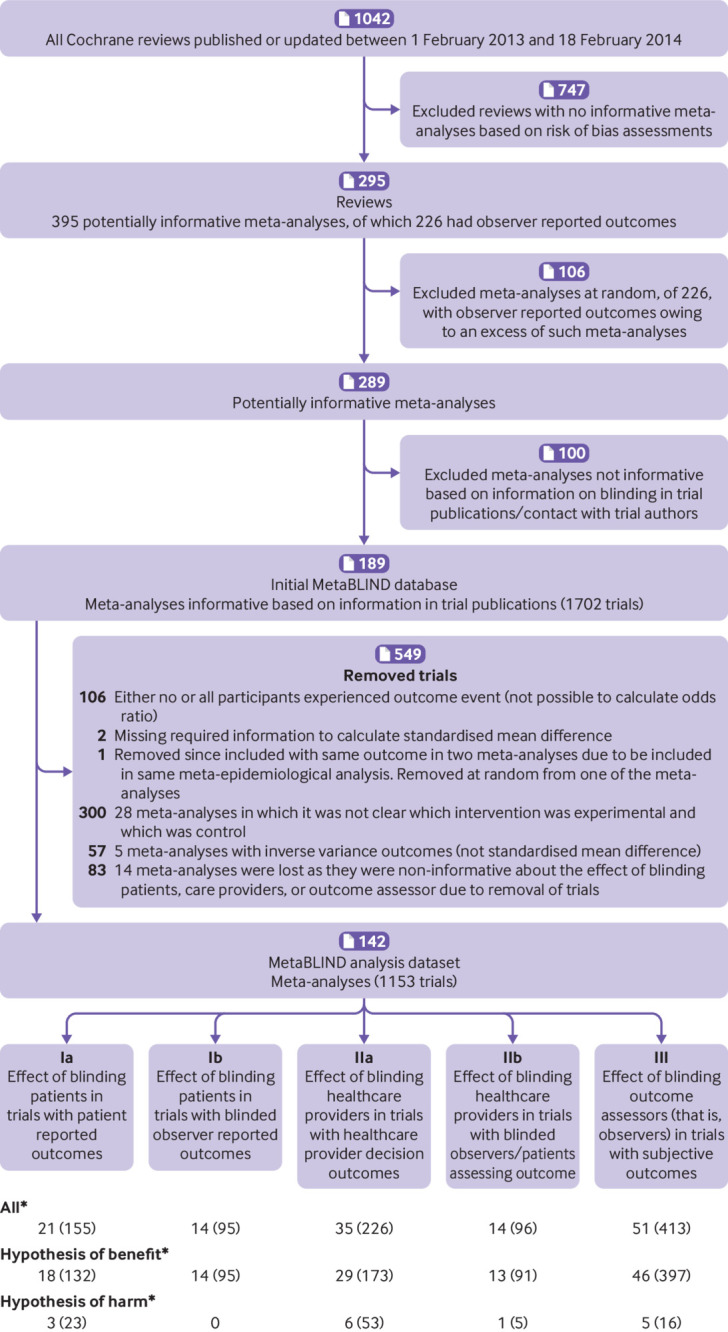
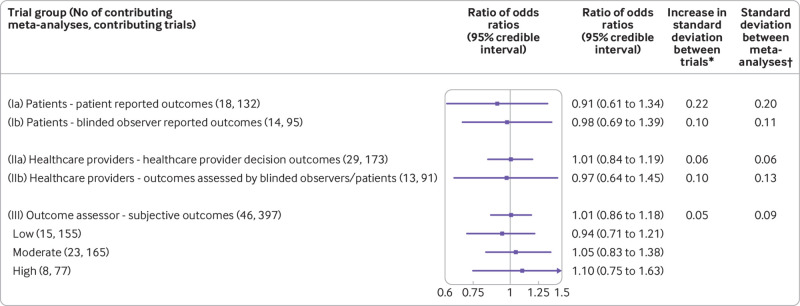
Objectives: To study the impact of blinding on estimated treatment effects, and their variation between trials; differentiating between blinding of patients, healthcare providers, and observers; detection bias and performance bias; and types of outcome (the MetaBLIND study). Design: Meta-epidemiological study. Data source: Cochrane Database of Systematic Reviews (2013-14). Eligibility criteria for selecting studies: Meta-analyses with both blinded and non-blinded trials on any topic. Review methods: Blinding status was retrieved from trial publications and authors, and results retrieved automatically from the Cochrane Database of Systematic Reviews. Bayesian hierarchical models estimated the average ratio of odds ratios (ROR), and estimated the increases in heterogeneity between trials, for non-blinded trials (or of unclear status) versus blinded trials. Secondary analyses adjusted for adequacy of concealment of allocation, attrition, and trial size, and explored the association between outcome subjectivity (high, moderate, low) and average bias. An ROR lower than 1 indicated exaggerated effect estimates in trials without blinding. Results: The study included 142 meta-analyses (1153 trials). The ROR for lack of blinding of patients was 0.91 (95% credible interval 0.61 to 1.34) in 18 meta-analyses with patient reported outcomes, and 0.98 (0.69 to 1.39) in 14 meta-analyses with outcomes reported by blinded observers. The ROR for lack of blinding of healthcare providers was 1.01 (0.84 to 1.19) in 29 meta-analyses with healthcare provider decision outcomes (eg, readmissions), and 0.97 (0.64 to 1.45) in 13 meta-analyses with outcomes reported by blinded patients or observers. The ROR for lack of blinding of observers was 1.01 (0.86 to 1.18) in 46 meta-analyses with subjective observer reported outcomes, with no clear impact of degree of subjectivity. Information was insufficient to determine whether lack of blinding was associated with increased heterogeneity between trials. The ROR for trials not reported as double blind versus those that were double blind was 1.02 (0.90 to 1.13) in 74 meta-analyses. Conclusion: No evidence was found for an average difference in estimated treatment effect between trials with and without blinded patients, healthcare providers, or outcome assessors. These results could reflect that blinding is less important than often believed or meta-epidemiological study limitations, such as residual confounding or imprecision. At this stage, replication of this study is suggested and blinding should remain a methodological safeguard in trials.
Overview
The claims and statistics of this paper haven’t been checked yet.
Run the check — free, no account needed. It reads the open-access text and checks the sources it cites.
Integrity signals
Registry
Cites
Statistics
Figures
Verification
Claims the paper makes
The claims and statistics of this paper haven’t been checked yet.
Run the check — free, no account needed. It reads the open-access text and checks the sources it cites.
Claims other papers make about this one
Each is checked against this paper’s own text: does it say what the citing paper says it does?
The source backs part of the claim, not all of it — or backs it for a different population, condition or comparison.
In the citing paper
“However, this overemphasizes the assumed effect of blinding in trials, which is not reflected in clinical data [59].”
From Efficacy and Acceptance of Cognitive Behavioral Therapy in Adults with Chronic Fatigue Syndrome: A Meta-analysis. (2024) · cites this paper as [59]
Experimental — accuracy not yet measuredThe source backs part of the claim, not all of it — or backs it for a different population, condition or comparison.
In the citing paper
“based on meta-epidemiological studies [22][23][24][25] that found little to no effect of blinding on treatment results among randomised trials (including a review of oral health trials 26 )”
From Management of chronic pain secondary to temporomandibular disorders: a systematic review and network meta-analysis of randomised trials (2023) · cites this paper as [22]
Experimental — accuracy not yet measuredThe cited source says what the claim attributes to it.
In the citing paper
“However, a recent meta-epidemiological study found no evidence that lack of patients’ blinding had an impact on estimate effects.39”
From Efficacy and safety of osteopathic manipulative treatment: an overview of systematic reviews (2022) · cites this paper as [39]
Self-check
Percentages, sums and reported differences re-computed from the paper’s own numbers.
The self-check needs the paper’s full text.
Citations
Cites
RoB 2: a revised tool for assessing risk of bias in randomised trials
Sterne, J. A. C., Savović, J., Page, M. J., Elbers, R. G., Blencowe, N. S., Boutron, I., Cates, C. J., Cheng, H.-Y., Corbett, M. S., Eldridge, S. M., et al. (2019) · BMJ · doi:10.1136/bmj.l4898 · Cited by 34,787
Self-citationThe Cochrane Collaboration's tool for assessing risk of bias in randomised trials
Higgins, J. P. T., Altman, D. G., Gotzsche, P. C., Juni, P., Moher, D., Oxman, A. D., Savovic, J., Schulz, K. F., Weeks, L., Sterne, J. A. C., et al. (2011) · BMJ · doi:10.1136/bmj.d5928 · Cited by 33,817
Self-citationDermyshi, E., Wang, Y., Yan, C., Hong, W., Qiu, G., Gong, X., & Zhang, T. (2017) · Neonatology · doi:10.1159/000454668 · Cited by 24,586
Confirmation Bias: A Ubiquitous Phenomenon in Many Guises
Nickerson, R. S. (1998) · Review of General Psychology · doi:10.1037/1089-2680.2.2.175 · Cited by 7,267 · cited 1×
“30 31 Comparisons within trials 13 17-19 provide strong evidence that in specific settings lack of blinding in trials causes considerable bias.”
Schulz (1995) · doi:10.1001/jama.1995.03520290060030 · Cited by 5,634
Savović, J., Jones, H. E., Altman, D. G., Harris, R. J., Jüni, P., Pildal, J., Als-Nielsen, B., Balk, E. M., Gluud, C., Gluud, L. L., et al. (2012) · Annals of Internal Medicine · doi:10.7326/0003-4819-157-6-201209180-00537 · Cited by 1,049 · cited 2×
“12 We further categorised experimental interventions as alternative/complementary or conventional medicine, to facilitate comparison with a systematic review of trials randomising patients to blinded and unblinded substudies.”
Self-citationHróbjartsson, A., Thomsen, A. S. S., Emanuelsson, F., Tendal, B., Hilden, J., Boutron, I., Ravaud, P., & Brorson, S. (2013) · Canadian Medical Association Journal · doi:10.1503/cmaj.120744 · Cited by 527
Self-citationHróbjartsson, A., Thomsen, A. S. S., Emanuelsson, F., Tendal, B., Hilden, J., Boutron, I., Ravaud, P., & Brorson, S. (2012) · BMJ · doi:10.1136/bmj.e1119 · Cited by 505 · cited 3×
“17 Similarly, a systematic review of 12 trials randomising patients to blinded and non-blinded substudies reported a pronounced bias due to lack of patient blinding in complementary/ alternative medicine trials with patient reported outcomes, exaggerating effect sizes by 0.56 standard deviations.”
InfluentialSelf-citationEpidemiology and reporting of randomised trials published in PubMed journals
Chan, A.-W., & Altman, D. G. (2005) · The Lancet · doi:10.1016/s0140-6736(05)71879-1 · Cited by 474
Hróbjartsson, A., Emanuelsson, F., Skou Thomsen, A. S., Hilden, J., & Brorson, S. (2014) · International Journal of Epidemiology · doi:10.1093/ije/dyu115 · Cited by 462
Self-citation
Cited by
Sorted by citations
Minozzi, S., Cinquini, M., Gianola, S., Gonzalez-Lorenzo, M., & Banzi, R. (2020) · Journal of Clinical Epidemiology · doi:10.1016/j.jclinepi.2020.06.015 · Cited by 471
Coventry, P. A., Meader, N., Melton, H., Temple, M., Dale, H., Wright, K., Cloitre, M., Karatzias, T., Bisson, J., Roberts, N. P., et al. (2020) · PLoS Medicine · doi:10.1371/journal.pmed.1003262 · Cited by 358
“However, there is compelling meta-epidemiological evidence that estimated treatment effects do not differ between trials with and without blinding of patients, healthcare providers, or outcome assessors [170].”
Butler, C., Dorward, J., Yu, L., Gbinigie, O. A., Hayward, G., Saville, B. R., van Hecke, O., Berry, N., Detry, M. A., Saunders, C. T., et al. (2021) · The Lancet · doi:10.1016/s0140-6736(21)00461-x · Cited by 306
“32 In our study, any potential placebo effect will have probably biased results towards a positive effect of azithromycin, meaning our finding of no effect on self-reported time to first recovery is robust to potential type II error.”
CONSORT 2025 explanation and elaboration: updated guideline for reporting randomised trials
Hopewell, S., Chan, A.-W., Collins, G. S., Hróbjartsson, A., Moher, D., Schulz, K. F., Tunn, R., Aggarwal, R., Berkwits, M., Berlin, J. A., et al. (2025) · BMJ · doi:10.1136/bmj-2024-081124 · Cited by 205
Self-citationMcIsaac, D. I., Kidd, G., Gillis, C., Branje, K., Al-Bayati, M., Baxi, A., Grudzinski, A. L., Boland, L., Veroniki, A.-A., Wolfe, D., et al. (2025) · BMJ · doi:10.1136/bmj-2024-081164 · Cited by 168
“58 59 While blinding in non-drug studies, especially for exercise interventions, is challenging, existing reviews synthesise a number of potential approaches.”
Home-based versus centre-based cardiac rehabilitation
McDonagh, S. T. J., Dalal, H. M., Moore, S. F., Clark, C. E., Dean, S. G., Jolly, K. B., Cowie, A., Afzal, J., & Taylor, R. S. (2023) · Cochrane Database of Systematic Reviews · doi:10.1002/14651858.cd007130.pub5 · Cited by 178
Minozzi, S., Dwan, K., Borrelli, F., & Filippini, G. (2022) · Journal of Clinical Epidemiology · doi:10.1016/j.jclinepi.2021.09.021 · Cited by 150
Blinding in Clinical Trials: Seeing the Big Picture
Monaghan, T. F., Agudelo, C. W., Rahman, S. N., Wein, A. J., Lazar, J., Everaert, K., & Dmochowski, R. R. (2021) · Medicina · doi:10.3390/medicina57070647 · Cited by 154
“Therefore, multiple factors appear to impact the magnitude of bias imposed by a lack of blinding, and recent meta-epidemiological evidence suggests that many relevant study factors remain incompletely characterized in this regard [33].”
BackgroundResultD'Angelica, M. I., Ellis, R. J., Liu, J. B., Brajcich, B. C., Gönen, M., Thompson, V. M., Cohen, M. E., Seo, S. K., Zabor, E. C., Babicky, M. L., et al. (2023) · JAMA · doi:10.1001/jama.2023.5728 · Cited by 137
Juul, S., Gluud, C., Simonsen, S., Frandsen, F. W., Kirsch, I., & Jakobsen, J. C. (2021) · BMJ Evidence-Based Medicine · doi:10.1136/bmjebm-2020-111407 · Cited by 135
Espín, E., Solís‐Peña, A., Pellino, G., Kreisler, E., Fraccalvieri, D., Lorenzo, M. M., Díaz, O. M., García-González, J. M., Olabarrieta, M. S., Cazador, A. C., et al. (2020) · The Lancet. Gastroenterology & hepatology · doi:10.1016/s2468-1253(20)30075-3 · Cited by 121
Leucht, S., Priller, J., & Davis, J. M. (2024) · American Journal of Psychiatry · doi:10.1176/appi.ajp.20240738 · Cited by 117
Zhang, M., Murphy, B., Cabanilla, A., & Yidi, C. (2021) · Journal of Occupational Health · doi:10.1002/1348-9585.12243 · Cited by 125
Hohenschurz‐Schmidt, D., Vase, L., Scott, W., Annoni, M., Ajayi, O. K., Barth, J., Bennell, K. L., Berna, C., Bialosky, J. E., BRAITHWAITE, F., et al. (2023) · BMJ · doi:10.1136/bmj-2022-072108 · Cited by 110
Efficacy and safety of osteopathic manipulative treatment: an overview of systematic reviews
Bagagiolo, D., Rosa, D., & Borrelli, F. (2022) · BMJ Open · doi:10.1136/bmjopen-2021-053468 · Cited by 104
“39 Other issues that emerge from our overview are the lack of treatment description and timing of measuring outcomes (short term and long term) in the SRs as well as in primary trials.”
Lugones-Sanchez, C., Recio-Rodriguez, J. I., Agudo-Conde, C., Repiso-Gento, I., G Adalia, E., Ramirez-Manent, J. I., Sanchez-Calavera, M. A., Rodriguez-Sanchez, E., Gomez-Marcos, M. A., Garcia-Ortiz, L., et al. (2022) · Journal of Medical Internet Research · doi:10.2196/30416 · Cited by 85
“In addition, the nature of the intervention precludes blinding of the participants, although recent findings suggest that blinding is less important than often believed [68].”
How to design high quality acupuncture trials—a consensus informed by evidence
Zhang, Y., Jiao, R., Witt, C. M., Lao, L., Liu, J., Thabane, L., Sherman, K. J., Cummings, M., Richards, D. P., Kim, E.-K. A., et al. (2022) · BMJ · doi:10.1136/bmj-2021-067476 · Cited by 80
“52 Considering all the evidence, the effect of the type of sham remains uncertain and might vary with the type of medical condition.”
Eze, P., Lawani, L. O., & Acharya, Y. (2021) · BMJ Global Health · doi:10.1136/bmjgh-2021-005035 · Cited by 66
Splinting for carpal tunnel syndrome
Karjalainen, T., Lusa, V., Page, M. J., O’Connor, D. A., Massy‐Westropp, N., & Peters, S. E. (2023) · Cochrane Database of Systematic Reviews · doi:10.1002/14651858.cd010003.pub2 · Cited by 70
Schwingshackl, L., Balduzzi, S., Beyerbach, J., Bröckelmann, N., Werner, S. S., Zähringer, J., Nagavci, B., & Meerpohl, J. J. (2021) · BMJ · doi:10.1136/bmj.n1864 · Cited by 64
Urgently seeking efficiency and sustainability of clinical trials in global health
Park, J., Grais, R. F., Taljaard, M., Nakimuli‐Mpungu, E., Jehan, F., Nachega, J. B., Ford, N. P., Xavier, D., Kengne, A. P., Ashorn, P., et al. (2021) · The Lancet Global Health · doi:10.1016/s2214-109x(20)30539-8 · Cited by 59
Yao, L., Sadeghirad, B., Li, M., Li, J., Wang, Q., Crandon, H. N., Martin, G., Morgan, R., Florez, I. D., Hunskaar, B. S., et al. (2023) · BMJ · doi:10.1136/bmj-2023-076226 · Cited by 57
“…the only criterion not met, we referred to prior meta-epidemiological studies which showed no systematic difference in estimated treatment effect between trials with and without blinded patients, healthcare providers, or outcome assessors, 22-26 and rated the overall risk of bias as “probably low.””
MethodResultWang, Y., Parpia, S., Couban, R., Wang, Q., Armijo-Olivo, S., Bassler, D., Briel, M., Brignardello-Petersen, R., Gluud, L. L., Keitz, S. A., et al. (2024) · Journal of Clinical Epidemiology · doi:10.1016/j.jclinepi.2023.11.001 · Cited by 58
Self-citationLou, S., Yin, X., Wang, Y., Zhang, Y., & Xue, Y. (2022) · International Journal of Surgery · doi:10.1016/j.ijsu.2022.106678 · Cited by 59
Hohenschurz‐Schmidt, D., Draper‐Rodi, J., Vase, L., Scott, W., McGregor, A. H., Soliman, N., MacMillan, A., Olivier, A., Cherian, C. A., Corcoran, D., et al. (2022) · Pain · doi:10.1097/j.pain.0000000000002730 · Cited by 57
“It needs to be noted that the prominent role of blinding in clinical trial research has recently been questioned in opinion papers [1] and by a meta-analysis that did not find differences in outcomes between blinded and non-blinded studies [57].”
Lugones‐Sánchez, C., Sánchez-Calavera, M. A., Repiso-Gento, I., Adalia, E. G., Ramírez‐Manent, J. I., Agudo‐Conde, C., Rodríguez‐Sánchez, E., Gómez-Marcos, M. Á., Recio-Rodriguez, J. I., García‐Ortiz, L., et al. (2020) · JMIR mhealth and uhealth · doi:10.2196/21771 · Cited by 55
“Despite this fact, losses were similar in both the IG and the CG. Due to the nature of the intervention, this could not be blinded to the participants; however, a recent meta-epidemiological study [54] suggested that blinding is less important than often believed.”
ResultBennell, K. L., Schwartz, S., Teo, P. L., Hawkins, S., Mackenzie, D., McManus, F. J., Lamb, K. E., Kimp, A. J., Metcalf, B., Hunter, D. J., et al. (2022) · Annals of Internal Medicine · doi:10.7326/m22-1761 · Cited by 49
“Furthermore, a recent large meta-epidemiologic study showed no difference in estimated treatment effects between trials with and without patient blinding (49).”
BackgroundEfficacy of hypnosis in adults undergoing surgical procedures: a meta-analytic update
Holler, M., Koranyi, S., Strauss, B., & Rosendahl, J. (2021) · Clinical Psychology Review · doi:10.1016/j.cpr.2021.102001 · Cited by 53
Hohenschurz‐Schmidt, D., Draper‐Rodi, J., Vase, L., Scott, W., McGregor, A. H., Soliman, N., MacMillan, A., Olivier, A., Cherian, C. A., Corcoran, D., et al. (2022) · Pain · doi:10.1097/j.pain.0000000000002723 · Cited by 50
“On the other hand, emerging conflicting evidence regarding the impact of blinding status and blinding success warrants further scientific attention.(12,66,117)”
BackgroundMoustgaard, H., Jones, H. E., Savović, J., Clayton, G., Sterne, J. A. C., Higgins, J. P. T., & Hróbjartsson, A. (2019) · Research Synthesis Methods · doi:10.1002/jrsm.1392 · Cited by 45
“34]).(3) In all analyses, the 95% credible intervals were wide, consistent with no bias as well as some degree of bias in either direction.”
BackgroundMethodResultInfluentialSelf-citationHoorntje, A., Witjes, S., Koenraadt, K. L. M., Kuijer, P., Blankevoort, L., Kerkhoffs, G. M. M. J., & van Geenen, R. C. I. (2020) · Journal of Bone and Joint Surgery · doi:10.2106/jbjs.19.01471 · Cited by 45
Efficace, F., Cella, D. F., Aaronson, N. K., Calvert, M., Cottone, F., Maïo, M. D., Perrone, F., Sparano, F., Gamper, E., Vignetti, M., et al. (2021) · JNCI Journal of the National Cancer Institute · doi:10.1093/jnci/djab177 · Cited by 43
“only found small effects or failed to demonstrate such an effect (even when relying on large numbers of trials), we agree with Moustgaard et al.(11) that future studies should target settings”
ResultFehm, T. N., Cottone, F., Dunton, K., André, F., Krop, I. E., Park, Y. H., Laurentiis, M. D., Miyoshi, Y., Armstrong, A. C., Borrego, M. R., et al. (2024) · The Lancet Oncology · doi:10.1016/s1470-2045(24)00128-1 · Cited by 45
Ademuyiwa, A. O., Adisa, A., Bach, S. P., Bhangu, A. A., Harrison, E. M., Ingabire, J. A., Haque, P. D., Lawani, I., Glasbey, J. C., Ghosh, D., et al. (2022) · The Lancet Infectious Diseases · doi:10.1016/s1473-3099(22)00133-5 · Cited by 42
Álvarez, G., Núñez‐Cortés, R., Solà, I., Sitjà‐Rabert, M., Vanmeerhaeghe, A. F., Fernández, C., Bonfill, X., & Urrútia, G. (2020) · Journal of Clinical Epidemiology · doi:10.1016/j.jclinepi.2020.10.018 · Cited by 42
Berg, H., & Steinsbekk, A. (2021) · Advances in Health Sciences Education · doi:10.1007/s10459-020-10019-6 · Cited by 41
de Almeida, F. O., Santana, V. P., Corcos, D. M., Ugrinowitsch, C., & Silva‐Batista, C. (2022) · Sports Medicine · doi:10.1007/s40279-022-01650-x · Cited by 38
“However, a recent large meta-epidemiological study found no evidence for an average difference in estimated treatment effect between trials with and without blinded participants, which indicates that blinding is less important than often thought [74].”
BackgroundFreed, B., Williams, B., Situ, X., Landsman, V., Kim, J., Moroz, A., Bang, H., & Park, J. J. (2021) · Clinical Trials · doi:10.1177/1740774520984870 · Cited by 38
Blinding of study statisticians in clinical trials: a qualitative study in UK clinical trials units
Iflaifel, M., Partlett, C., Bell, J., Cook, A., Gamble, C. L., Julious, S. A., Juszczak, E., Linsell, L., Montgomery, A. A., & Sprange, K. (2022) · Trials · doi:10.1186/s13063-022-06481-9 · Cited by 35
“However, there is literature that has challenged the dogma that blinding is always necessary and highlighted some challenges that might arise from using it [4, 6].”
BackgroundMiguel, C., Harrer, M., Karyotaki, E., Plessen, C. Y., Čihařová, M., Furukawa, T. A., Cristea, I. A., & Cuijpers, P. J. (2025) · Epidemiology and Psychiatric Sciences · doi:10.1017/s2045796025000095 · Cited by 38
The impact of blinding on trial results: A systematic review and meta‐analysis
(2023) · doi:10.1002/cesm.12015 · Cited by 35
“The MetaBLIND study, for example, did not find evidence that trials with and without blinding produce different results — contrary to several other studies of similar magnitude included in our review [13, 40, 56, 66].”
InfluentialBetsu, B. D., Medhanyie, A. A., Gebrehiwet, T. G., & Wall, L. L. (2024) · PLoS ONE · doi:10.1371/journal.pone.0302523 · Cited by 63
Wang, X., Ye, Z., Busse, J. W., Hill, M. D., Smith, E. E., Guyatt, G. H., Prasad, K., Lindsay, M. P., Yang, H., Zhang, Y., et al. (2022) · Stroke and Vascular Neurology · doi:10.1136/svn-2022-001547 · Cited by 34
Martin, G. L., Trioux, T., Gaudry, S., Tubach, F., Hajage, D., & Dechartres, A. (2021) · Critical Care Medicine · doi:10.1097/ccm.0000000000005065 · Cited by 22
“Blinding may be difficult to achieve though: it is costly, can discourage recruitment and continuation in clinical trials(4,44), or can simply be unfeasible in critical-care settings.”
White, P. D., Abbey, S. E., Angus, B., Ball, H. A., Buchwald, D., Burness, C. E., Carson, A. J., Chalder, T., Clauw, D. J., Coebergh, J. A., et al. (2023) · Journal of Neurology Neurosurgery & Psychiatry · doi:10.1136/jnnp-2022-330463 · Cited by 35
“35 The NICE guideline provided a description of what CBT entails.”
BackgroundSurgery for the treatment of obesity in children and adolescents
Torbahn, G., Brauchmann, J., Axon, E., Clare, K., Metzendorf, M., Wiegand, S., Pratt, J. S. A., & Ells, L. J. (2022) · Cochrane Database of Systematic Reviews · doi:10.1002/14651858.cd011740.pub2 · Cited by 42
Wong, S. S. C., Chan, W. S., Fang, C. X., Chan, C. W., Lau, T.-W., Leung, F. K. L., & Cheung, C. W. (2020) · BMC Anesthesiology · doi:10.1186/s12871-020-01044-4 · Cited by 31
Pelzer, F., Loef, M., Martin, D. D., & Baumgartner, S. (2022) · Supportive Care in Cancer · doi:10.1007/s00520-022-06921-x · Cited by 31
“A recent meta-epidemiological study suggests that missing blinding has no substantial impact on treatment effect [52] and thereby cautiously questions two meta-analyses suggesting a placebo effect in CRF-treatment [53, 54].”
BackgroundHayward, G., Yu, L.-M., Little, P., Gbinigie, O., Shanyinde, M., Harris, V., Dorward, J., Saville, B. R., Berry, N., Evans, P. H., et al. (2024) · Journal of Infection · doi:10.1016/j.jinf.2024.106130 · Cited by 31
Yeh, M., Liao, R., Yeh, P.-H., Lin, C.-J., & Wang, Y.-J. (2024) · BMC Complementary Medicine and Therapies · doi:10.1186/s12906-024-04603-1 · Cited by 30
“A previous study indicated that there was no significant difference in intervention effects between trials with and without blinded participants, healthcare providers, or outcome asses-sors [75].”
ResultCashin, A. G., Lee, H., Bagg, M. K., O’Hagan, E. T., Traeger, A. C., Kamper, S. J., Folly, T., Jones, M. D., Booth, J., & McAuley, J. H. (2020) · Journal of Clinical Epidemiology · doi:10.1016/j.jclinepi.2020.06.025 · Cited by 34
“It is possible that these crude associations between methodological techniques and bias reflect limitations in the meta-epidemiological approaches used, such as confounding bias [37].”
BackgroundHu, H., Wang, J., Wu, Z., Liu, Y., Ma, Y., & Zhao, J. (2021) · European Journal of Vascular and Endovascular Surgery · doi:10.1016/j.ejvs.2021.09.034 · Cited by 30
Hohenschurz‐Schmidt, D., Phalip, J., Chan, J., Gauhe, G., Soliman, N., Vollert, J., Lunde, S. J., & Vase, L. (2023) · European Journal of Pain · doi:10.1002/ejp.2205 · Cited by 32
Arnold, M. M., Müller-Oerlinghausen, B., Hemrich, N., & Bönsch, D. (2020) · Brain Sciences · doi:10.3390/brainsci10100676 · Cited by 32
“However, according to a recent meta-analysis, the absolute postulate of blinding when carrying out a sound study might be somewhat questioned in the future [65].”
Use of Placebo and Nonoperative Control Groups in Surgical Trials
Karjalainen, T., Heikkinen, J., Busija, L., Jokihaara, J., Lewin, A. M., Naylor, J., Harris, L., Harris, I. A., Buchbinder, R., & Adie, S. (2022) · JAMA Network Open · doi:10.1001/jamanetworkopen.2022.23903 · Cited by 29
Rodríguez, E. J. F., Gómez, C. S., Hernández, J. J. C., Recio-Rodriguez, J. I., Puente-González, A. S., Sánchez, R. M., Galve, M. I. R., & Sánchez, J. G. (2023) · International Journal of Environmental Research and Public Health · doi:10.3390/ijerph20064938 · Cited by 34
“Due to the nature of the intervention, it was not possible to completely blind the participants; however, a recent meta-epidemiological study suggested that blinding is less important than is commonly believed [49].”
BackgroundMaas genannt Bermpohl, F., Kucharczyk-Bodenburg, A.-C., & Martin, A. (2024) · International Journal of Behavioral Medicine · doi:10.1007/s12529-023-10254-2 · Cited by 29
“However, this overempha-sizes the assumed effect of blinding in trials, which is not reflected in clinical data [59].”
Strijkers, R., Schreijenberg, M., Gerger, H., Koes, B. W., & Chiarotto, A. (2021) · Pain · doi:10.1097/j.pain.0000000000002272 · Cited by 27
Hayward, G., Butler, C., Yu, L., Saville, B. R., Berry, N., Dorward, J., Gbinigie, O. A., van Hecke, O., Ogburn, E., Swayze, H., et al. (2021) · BMJ Open · doi:10.1136/bmjopen-2020-046799 · Cited by 27
Methodology and design of platform trials: a meta-epidemiological study
Pitre, T., Cheng, S., Cusano, E., Khan, N., Mikhail, D., Leung, G., Vernooij, R. W. M., Yarnell, C. J., Goligher, E. C., Murthy, S., et al. (2023) · Journal of Clinical Epidemiology · doi:10.1016/j.jclinepi.2023.02.010 · Cited by 32
“There has been conflicting evidence on whether the lack of blinding actually increases the risk of bias [122].”
BackgroundIngman, T., Smakowski, A., Goldsmith, K., & Chalder, T. (2022) · Psychological Medicine · doi:10.1017/s0033291722002471 · Cited by 27
Gbinigie, O. A., Ogburn, E., Allen, J., Dorward, J., Dobson, M., Madden, T., Yu, L., Lowe, D. M., Rahman, N. M., Petrou, S., et al. (2023) · BMJ Open · doi:10.1136/bmjopen-2022-069176 · Cited by 25
White, P. D., & Etherington, J. (2021) · Journal of Psychosomatic Research · doi:10.1016/j.jpsychores.2021.110533 · Cited by 25
Evidence-Based Care for People with Chronic Fatigue Syndrome and Myalgic Encephalomyelitis
Sharpe, M., Chalder, T., & White, P. D. (2021) · Journal of General Internal Medicine · doi:10.1007/s11606-021-07188-4 · Cited by 27
Kristoffersen, P. M., Bråten, L. C. H., Vetti, N., Grøvle, L., Hellum, C., Storheim, K., Zwart, J., Aßmus, J., & Espeland, A. (2020) · European Radiology · doi:10.1007/s00330-020-07542-w · Cited by 26
Measuring the success of blinding in placebo-controlled trials: should we be so quick to dismiss it?
Webster, R., Bishop, F. L., Collins, G., Evers, A., Hoffmann, T., Knottnerus, J., Lamb, S. E., Macdonald, H., Madigan, C., Napadow, V., et al. (2021) · Journal of Clinical Epidemiology · doi:10.1016/j.jclinepi.2021.02.022 · Cited by 22
Eze, P., Mezue, K. N., Nduka, C. U., Obianyo, I., & Egbuche, O. (2021) · PubMed Central · Cited by 24
Effectiveness of osteopathic manipulative treatment for pediatric conditions: A systematic review
Franke, H., Franke, J.-D., & Fryer, G. (2022) · Journal of Bodywork and Movement Therapies · doi:10.1016/j.jbmt.2022.03.013 · Cited by 23
Cayrol, T., van den Broeke, E. N., Gerard, E., Meeus, M., Mouraux, A., Roussel, N. A., & Pitance, L. (2022) · Pain · doi:10.1097/j.pain.0000000000002803 · Cited by 23
Liu, T., Jiang, L., Li, S., Cheng, S., Zhuang, R., Xiong, Z., Sun, C., Liu, B., Zhang, H., & Yan, S. (2024) · Systematic Reviews · doi:10.1186/s13643-024-02692-0 · Cited by 22
“…than merely indicating single-or double-blinding; (2) the timing of blinding assessments, such as immediately after the first treatment or post-final treatment, or multiple assessments to monitor blinding status [87]; and (3) transparent and comprehensive reporting of blinding assessment results.”
Salazar, J., Moustgaard, H., Bracchiglione, J., & Hróbjartsson, A. (2025) · Journal of Clinical Epidemiology · doi:10.1016/j.jclinepi.2025.111787 · Cited by 24
Self-citationSetting and techniques for monitoring blood pressure during pregnancy
Ashworth, D., Maule, S. P., Stewart, F. A., Nathan, H. L., Shennan, A. H., & Chappell, L. C. (2020) · Cochrane Database of Systematic Reviews · doi:10.1002/14651858.cd012739.pub2 · Cited by 22
Thorud, H.-M. S., Aurjord, R., & Falkenberg, H. K. (2021) · Scientific Reports · doi:10.1038/s41598-021-81497-w · Cited by 21
The Effect of Nature-Based Adventure Interventions on Depression: A Systematic Review
Rosa, C. D., Chaves, T. S., Collado, S., Larson, L. R., & Profice, C. C. (2023) · Environment and Behavior · doi:10.1177/00139165231174615 · Cited by 20
“Nonetheless, a recent study assessing the impact of participants’ awareness of the intervention (i.e., lack of blinding) on studies’ results did not find evidence that this design limitation impacted the results (Moustgaard et al., 2020).”
BackgroundInfluentialHarris, V. C., Holmes, J., Gbinigie, O. A., Rahman, N. M., Richards, D. B., Hayward, G., Dorward, J., Lowe, D. M., Standing, J. F., Breuer, J., et al. (2024) · The Lancet Infectious Diseases · doi:10.1016/s1473-3099(24)00431-6 · Cited by 21
“31 Small, absolute differences could be statistically significant but not necessary clinically meaningful.”
Douglas, K. M., Milanovic, M., Porter, R., & Bowie, C. R. (2020) · BJPsych Open · doi:10.1192/bjo.2020.53 · Cited by 20
Larsen, R. T., Korfitsen, C. B., Keller, C., Christensen, J., Andersen, H. B., Juhl, C. B., & Langberg, H. (2021) · European Review of Aging and Physical Activity · doi:10.1186/s11556-021-00269-7 · Cited by 23
Armijo-Olivo, S. L., Mohamad, N., de Oliveira‐Souza, A. I. S., de Castro‐Carletti, E. M., Ballenberger, N., & Fuentes, J. (2021) · American Journal of Physical Medicine & Rehabilitation · doi:10.1097/phm.0000000000001893 · Cited by 22
Large randomized controlled trials in infertility
Wang, R., Chen, Z., Vuong, L. N., Legro, R. S., Mol, B. W., & Wilkinson, J. (2020) · Fertility and Sterility · doi:10.1016/j.fertnstert.2020.04.037 · Cited by 20
Jong, F. J. X., Ooi, D. J., & Teoh, S. L. (2023) · International Journal of Dental Hygiene · doi:10.1111/idh.12725 · Cited by 21
Redfors, B., Spertus, J. A., Yancy, C. W., Creber, R. M., Stone, G. W., & Gaudino, M. F. L. (2024) · Current Opinion in Cardiology · doi:10.1097/hco.0000000000001177 · Cited by 18
“Importantly, a recent meta-analysis found no evidence for a difference in the estimated treatment effect of trials with and without blinded patients, or outcome asses-sors [30].”
Specific Probiotics for the Treatment of Pediatric Acute Gastroenteritis in India
McFarland, L. V., Srinivasan, R., Setty, R., Ganapathy, S., Bavdekar, A., Mitra, M., Raju, B. B., & Mohan, N. (2021) · JPGN Reports · doi:10.1097/pg9.0000000000000079 · Cited by 17
“This confirms the finding by Moustgaard et al (71) who reviewed 142 meta-analyses and found no significant effect of blinding or placebo use on estimated treatment effects.”
Holtedahl, R., Bøe, B., & Brox, J. I. (2021) · Arthroscopy The Journal of Arthroscopic and Related Surgery · doi:10.1016/j.arthro.2021.08.019 · Cited by 17
Stadelmaier, J., Roux, I., Πετροπούλου, Μ., & Schwingshackl, L. (2022) · BMC Medicine · doi:10.1186/s12916-022-02540-9 · Cited by 19
“A recent meta-epidemiological study investigated the impact of blinding and found no evidence for an average difference in estimated treatment effect between trials with and without blinded patients, healthcare providers, or outcome assessors [90].”
BackgroundSpatola, C. A. M., Rapelli, G., Giusti, E. M., Cattivelli, R., Goodwin, C. L., Pietrabissa, G., Malfatto, G., Facchini, M., Cappella, E. A. M., Varallo, G., et al. (2024) · BMJ Open · doi:10.1136/bmjopen-2024-084070 · Cited by 17
Rotter, G., Fernholz, I., Binting, S., Keller, T., Roll, S., Kass, B., Reinhold, T., Willich, S. N., Schmidt, A., & Brinkhaus, B. (2020) · Therapeutic Advances in Musculoskeletal Disease · doi:10.1177/1759720x20979853 · Cited by 19
“74 Nonetheless, the lack of blinding of outcome assessors could have led to an overestimation of the treatment effects.”
Zhao, G., Sun, Y., Zhang, Y., Lu, T., Lu, Z., Kang, Z., Schneider‐Thoma, J., Xie, W., Yang, Y., Guo, J., et al. (2025) · American Journal of Psychiatry · doi:10.1176/appi.ajp.20250111 · Cited by 16
Coenen, S., van der Velden, A. W., Cianci, D., Goossens, H., Bongard, E., Saville, B. R., Gobat, N., de Paor, M., Ieven, M. M., Verheij, T. J., et al. (2020) · British Journal of General Practice · doi:10.3399/bjgp20x711941 · Cited by 16
“Comorbidity Heart disease 6 (4) 9 (6) Diabetes 6 (4) 7 (5) Chronic respiratory condition 12 (8) 11 (7) Hepatic, hematologic, neurological, 2 (1) 0 (0) neurodevelopmental condition Stroke/transient ischaemic attack 1 (1) 1 (1) Overnight hospital stay in preceding year 5 (3) 4 (3)”
Zhou, M., Zhang, N., Zhang, Y., Yan, X., Li, M., Guo, W., Guo, X., He, H., Guo, K., & Ma, G. (2021) · International Journal of Environmental Research and Public Health · doi:10.3390/ijerph18168825 · Cited by 21
“However, the outcome measures are all objective, which makes the blinding is less important [35].”
Backgroundvan der Steen, J. T., Bloomer, M. J., & Pereira, S. M. (2021) · Palliative Medicine · doi:10.1177/02692163211069566 · Cited by 16
Straat, A. C., Maarleveld, J. M., Smit, D. J. M., Visch, L., Hulsegge, G., Huirne, J. A. F., van Dongen, J. M., van Geenen, R. C. I., Kerkhoffs, G. M. M. J., Anema, J. R., et al. (2023) · BMC Musculoskeletal Disorders · doi:10.1186/s12891-023-06236-w · Cited by 16
Andreasen, E. M., Berg, H., Steinsbekk, A., Høigaard, R., & Haraldstad, K. (2023) · BMC Medical Education · doi:10.1186/s12909-023-04966-y · Cited by 16
Ueno, N. T., Cottone, F., Dunton, K., Jacot, W., Yamashita, T., Sohn, J., Tokunaga, E., Prat, A., Tsurutani, J., Park, Y. H., et al. (2025) · The Oncologist · doi:10.1093/oncolo/oyaf048 · Cited by 17
Gaudineau, A., Sénat, M.-V., Ehlinger, V., Gallini, A., Morin, M., Olivier, P., Roth, E., Orusco, E., Javoise, S., Fort, J., et al. (2021) · American Journal of Obstetrics and Gynecology · doi:10.1016/j.ajog.2021.04.226 · Cited by 16
Rothman, B., Slomkowski, M., Speier, A., Rush, A. J., Trivedi, M. H., Lakhan, S. E., Lawson, E., Fahmy, M., Carpenter, D., Chen, D., et al. (2025) · Journal of Affective Disorders · doi:10.1016/j.jad.2025.119409 · Cited by 15
Zhang, N., Tu, J., Lin, Y., Li, J., Zou, X., Wang, Y., Li, H., Wei, X., Wang, Y., Shi, G., et al. (2021) · Journal of Pain Research · doi:10.2147/jpr.s319195 · Cited by 15
Antibiotics for hospital-acquired pneumonia in neonates and children
Korang, S. K., Nava, C., Mohana, S. P., Nygaard, U., & Jakobsen, J. C. (2021) · Cochrane Database of Systematic Reviews · doi:10.1002/14651858.cd013864.pub2 · Cited by 17
Xu, C., Zhang, F., Doi, S. A. R., Furuya‐Kanamori, L., Lin, L., Chu, H., Yang, X., Li, S., Zorzela, L., Golder, S., et al. (2024) · BMC Medicine · doi:10.1186/s12916-024-03300-7 · Cited by 14
Nwosu, M., Agyeman, W. Y., Bisht, A., Gopinath, A., Cheema, A. H., Chaludiya, K., Khalid, M., & Yu, A. K. (2023) · Cureus · doi:10.7759/cureus.37114 · Cited by 16
“In clinical studies, there is also a risk of certain expectations influencing research outcomes, and blinding eliminates such bias, especially when the response criteria are subjective, as is the case in pain alleviation [36].”
Background
Metadata
- Authors
- Moustgaard, H., Clayton, G. L., Jones, H. E., Boutron, I., Jørgensen, L., Laursen, D. R. T., Olsen, M. F., Paludan-Müller, A., Ravaud, P., Savović, J., Sterne, J. A. C., Higgins, J. P. T., & Hróbjartsson, A.
- Affiliations
- Odense University Hospital (DK)
- University of Bristol (GB)
- Hôtel-Dieu de Paris (FR)
- Cochrane (DK)
- University Hospitals Bristol NHS Foundation Trust (GB)
- University of Southern Denmark (DK)
- Corresponding author
- Moustgaard, Helene
- ORCID
- Venue
- BMJ
- Publisher
- BMJ
- Published
- 2020-01-21
- Volume
- 368
- Issue
- 2
- Pages
- l6802
- ISSN
- 1756-1833 (ISSN-L)
- PMC
- PMC7190062
- OpenAlex
- W3001993019
- Cited by
- 300
- References
- 36
- Citations by year
- 2026: 21 · 2025: 45 · 2024: 55 · 2023: 50 · 2022: 49 · 2021: 50 · 2020: 27
- FWCI
- 9.08
- Type
- journal article
- Language
- en
- Update notices
- correction (2020-02-05)
- Open access
- hybrid
- doi.org
- Licence
- Locations
- BMJ (publishedVersion, cc-by-nc)
- PubMed Central (publishedVersion, cc-by-nc)
- PubMed (publishedVersion)
- Bristol Research (University of Bristol) (publishedVersion, cc-by)
- University of Southern Denmark Research Portal (University of Southern Denmark) (acceptedVersion, cc-by-nc)
- HAL (submittedVersion)
- HighWire Press Open Archive (submittedVersion)
- Funders
- University Hospitals Bristol NHS Foundation Trust
- NIHR Bristol Biomedical Research Centre (NF-SI-0617-10145)
- National Institute for Health and Care Research (NF-SI-0611-10168, NF-SI-0616-10111, NIHR200268, NF-SI-0617-10145)
- Department of Health and Social Care
- University of Bristol
- Medical Research Council (MR/K025643/1, MR/M014533/1, MR/L004933/1, MR/L004933/2)
- Topics
- Social Sciences › Decision Sciences › Statistics, Probability and Uncertainty › Meta-analysis and systematic reviews
- Physical Sciences › Mathematics › Statistics and Probability › Statistical Methods in Clinical Trials
- Physical Sciences › Mathematics › Statistics and Probability › Advanced Causal Inference Techniques
- Keywords
- blinding, randomized controlled trials, treatment effect estimation, detection bias, performance bias, trial heterogeneity, meta-analysis bias, double blinding, allocation concealment, attrition, meta-epidemiology, patient-reported outcomes
- MeSH terms
- Clinical Trials as Topic, Humans, Research Design, Epidemiologic Research Design, Observer Variation, Outcome Assessment, Health Care
About these checks
Registry, retraction, Cites and statistics results are computed, not judged, with one exception: a printed reference that no index lists is read once by a model before it counts as a citation error. Claims are extracted by a model and kept only when their quote appears verbatim in the text; each cited source is then checked, with a model’s help, for whether it says what the claim relies on. Those verdicts can be wrong — read the claim’s quote and the cited source before relying on one.
Statistics and arithmetic are recomputed, not judged.
Confidence bands are shown only for fields calibrated on our annotated test set. None is calibrated yet, so no band is shown.
What counts as a claim ›How we measure confidence ›How we check this ›
Are you an author, or do you see a problem with this page? Request a review
