

Flash glucose monitoring helps achieve better glycemic control than conventional self-monitoring of blood glucose in non-insulin-treated type 2 diabetes: a randomized controlled trial
Open accessThe DOI matches its Crossref record; 28 of the 31 references it cites were found in a registry or an index.
Abstract
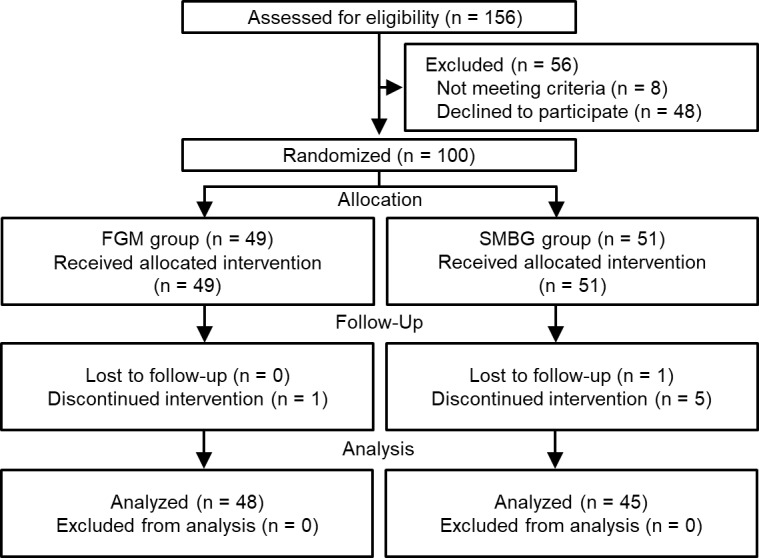
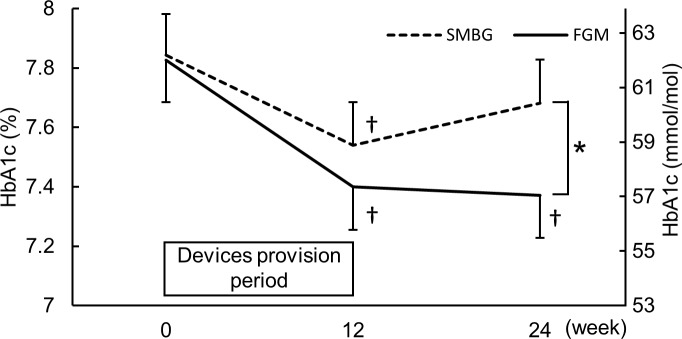
Introduction: The present study aimed to evaluate the effects of flash glucose monitoring (FGM) and conventional self-monitoring of blood glucose (SMBG) on glycemic control in patients with non-insulin-treated type 2 diabetes. Research design and methods: In this 24-week, multicenter, open-label, randomized (1:1), parallel-group study, patients with non-insulin-treated type 2 diabetes at five hospitals in Japan were randomly assigned to the FGM (n=49) or SMBG (n=51) groups and were provided each device for 12 weeks. The primary outcome was change in glycated hemoglobin (HbA1c) level, and was compared using analysis of covariance model that included baseline values and group as covariates. Results: Forty-eight participants in the FGM group and 45 in the SMBG group completed the study. The mean HbA1c levels were 7.83% (62.1 mmol/mol) in the FGM group and 7.84% (62.2 mmol/mol) in the SMBG group at baseline, and the values were reduced in both FGM (−0.43% (−4.7 mmol/mol), p<0.001) and SMBG groups (−0.30% (−3.3 mmol/mol), p=0.001) at 12 weeks. On the other hand, HbA1c was significantly decreased from baseline values in the FGM group, but not in the SMBG group at 24 weeks (FGM: −0.46% (−5.0 mmol/mol), p<0.001; SMBG: −0.17% (−1.8 mmol/mol), p=0.124); a significant between-group difference was also observed (difference −0.29% (−3.2 mmol/mol), p=0.022). Diabetes Treatment Satisfaction Questionnaire score was significantly improved, and the mean glucose levels, SD of glucose, mean amplitude of glycemic excursions and time in hyperglycemia were significantly decreased in the FGM group compared with the SMBG group. Conclusions: Glycemic control was better with FGM than with SMBG after cessation of glucose monitoring in patients with non-insulin-treated type 2 diabetes. Trial registration number: UMIN000026452, jRCTs041180082.
Overview
The claims and statistics of this paper haven’t been checked yet.
Free: it reads the open-access text and checks the first 5 claims that cite a source we can check. Create a free account to check every claim.
Integrity signals
Registry
Cites
Statistics
Figures
Verification
Claims the paper makes
The claims and statistics of this paper haven’t been checked yet.
Free: it reads the open-access text and checks the first 5 claims that cite a source we can check. Create a free account to check every claim.
Claims other papers make about this one
Each is checked against this paper’s own text: does it say what the citing paper says it does?
In the citing paper
“In these RCTs, people with type 2 diabetes not on intensive insulin therapy used CGM intermittently compared with those randomized to BGM.Both early (60) and late improvements in A1C levels were found (60,73).”
From 7. Diabetes Technology: Standards of Care in Diabetes—2025 (2025) · cites this paper as [73]
Self-check
Percentages, sums and reported differences re-computed from the paper’s own numbers.
The self-check needs the paper’s full text.
Citations
Cites
Revised Equations for Estimated GFR From Serum Creatinine in Japan
Matsuo, S., Imai, E., Horio, M., Yasuda, Y., Tomita, K., Nitta, K., Yamagata, K., Tomino, Y., Yokoyama, H., & Hishida, A. (2009) · American Journal of Kidney Diseases · doi:10.1053/j.ajkd.2008.12.034 · Cited by 6,422
Bolinder, J., Antuna, R., Geelhoed-Duijvestijn, P., Kröger, J., & Weitgasser, R. (2016) · The Lancet · doi:10.1016/s0140-6736(16)31535-5 · Cited by 893 · cited 6×
“9 14 It is not clear from this study why the improved glycemic control was sustained even after the cessation of glucose monitoring in the FGM group.”
Influential6. Glycemic Targets: Standards of Medical Care in Diabetes—2019
American Diabetes Association (2019) · Diabetes Care · doi:10.2337/dc19-s006 · Cited by 655
Haak, T., Hanaire, H., Ajjan, R., Hermanns, N., Riveline, J.-P., & Rayman, G. (2017) · Diabetes Therapy · doi:10.1007/s13300-016-0223-6 · Cited by 623 · cited 3×
“9 14 In our study, the time in hyperglycemia was significantly decreased while that of hypoglycemia Emerging Technologies, Pharmacology and Therapeutics was not changed in the FGM group compared with the SMBG group.”
Karter, A. J., Ackerson, L. M., Darbinian, J. A., D’Agostino, R. B., Ferrara, A., Liu, J., & Selby, J. V. (2001) · The American Journal of Medicine · doi:10.1016/s0002-9343(01)00742-2 · Cited by 595
Miller, K. M., Beck, R. W., Bergenstal, R. M., Goland, R. S., Haller, M. J., McGill, J. B., Rodriguez, H., Simmons, J. H., Hirsch, I. B., & for the T1D Exchange Clinic Network (2013) · Diabetes Care · doi:10.2337/dc12-1770 · Cited by 505
A Novel Approach to Continuous Glucose Analysis Utilizing Glycemic Variation
McDonnell, C. M., Donath, S. M., Vidmar, S. I., Werther, G. A., & Cameron, F. J. (2005) · Diabetes Technology & Therapeutics · doi:10.1089/dia.2005.7.253 · Cited by 358
Japanese Clinical Practice Guideline for Diabetes 2016
Haneda, M., Noda, M., Origasa, H., Noto, H., Yabe, D., Fujita, Y., Goto, A., Kondo, T., & Araki, E. (2018) · Diabetology International · doi:10.1007/s13340-018-0345-3 · Cited by 319
Guerci, B., Drouin, P., Grangé, V, Bougnères, P., Fontaine, P., Kerlan, V, Passa, P., Thivolet, C., Vialettes, B., & Charbonnel, B. (2003) · Diabetes & Metabolism · doi:10.1016/s1262-3636(07)70073-3 · Cited by 287
Statistical Tools to Analyze Continuous Glucose Monitor Data
Clarke, W., & Kovatchev, B. (2009) · Diabetes Technology & Therapeutics · doi:10.1089/dia.2008.0138 · Cited by 249
Cited by
Items 101–173 of 173
Chen, X., Kim, G. E., Kim, N. A., & Kim, K. J. (2026) · Healthcare · doi:10.3390/healthcare14081019 · Cited by 3
Hecquet, S. K., Ballegaard, S., Eldrup, E., Hansen, C. S., Hansen, T. W., Harboe, G. S., Rossing, P. R., Pichat, C. S. H., Watt, T., Gyntelberg, F., et al. (2024) · Diabetes Metabolic Syndrome and Obesity · doi:10.2147/dmso.s455216 · Cited by 3
Han, G., Zhang, X., Ye, Y., Wang, C., Hu, L., Wu, H.-B., Qiu, Z.-K., Fang, Y., Chen, J., & Lai, S. (2025) · Diabetes Obesity and Metabolism · doi:10.1111/dom.70333 · Cited by 3
“11,12 Evidence confirms CGM benefits not only for type 1 diabetes 13 but also improves glycemic control in insulin-and non-insulin-treated T2D, 14 – 17 increases time-in-range (TIR), reduces time-below-range (TBR), 18 decreases acute complication-related hospitalizations, and enhances quality of…”
Type 2 diabetes in latin America: recommendations on the flash glucose monitoring system
Krakauer, M., Gómez, A. M., Almeda‐Valdés, P., Manrique-Hurtado, H., Morosini, M. L. R., Jorquera, G., Salles, J. E. N., Sanhueza, D., Siqueira, R. D. A., Faradji, R. N., et al. (2024) · Diabetology & Metabolic Syndrome · doi:10.1186/s13098-024-01343-7 · Cited by 5
Santo, K., Nieri, J., Risério, K., & Melo, K. (2025) · Diabetology & Metabolic Syndrome · doi:10.1186/s13098-025-01610-1 · Cited by 2
“Randomized clinical trials (RCTs) have shown improvements in glycemic control and reductions in hypoglycemia events [7–9].”
Rädel, C., Wienke, A., & Pliquett, R. U. (2025) · Diabetology & Metabolic Syndrome · doi:10.1186/s13098-025-01976-2 · Cited by 2
“As for CGM in NIDDM with a mid-term follow-up of 6 months, Wada, E et al. [18], showed that CGM use associates with an improved glycemia after 6 months in non-insulin-treated type-2 diabetics.”
InfluentialMizutani, K., Uenishi, E., Onoue, T., Maeda, R., Suzuki, K. A. O., Handa, T., Kobayashi, T., Iwama, S., Miyata, T., Sugiyama, M., et al. (2025) · Journal of Diabetes Investigation · doi:10.1111/jdi.70191 · Cited by 2
“In 27 – 29 In Japan, several SGLT2 inhibitors have been approved for patients with type 1 diabetes.”
Self-citationSebastian, S. A., Padda, I., Bimal, T., Varma, S., Collins, J. S. P., Ahmad, Z., & Safarova, M. S. (2025) · Disease-a-Month · doi:10.1016/j.disamonth.2025.102043 · Cited by 3
Diabetes and metabolic disorders: Early identification and monitoring strategies
Goyat, J., Tiwari, B. K., & Sharma, R. (2026) · Elsevier eBooks · doi:10.1016/b978-0-443-33263-0.00001-2 · Cited by 2
Giaccari, A., Gliozzo, G., Ciccarelli, G., Giuseppe, G. D., Castellano, C., Cum, S., Monache, L. D., Gallo, M., Lastretti, M., Medea, G., et al. (2026) · Acta Diabetologica · doi:10.1007/s00592-026-02693-6 · Cited by 2
Pasyechko, N. V., Naumova, L. V., Krytskyy, T., & Савченко, І. П. (2024) · INTERNATIONAL JOURNAL OF ENDOCRINOLOGY (Ukraine) · doi:10.22141/2224-0721.19.8.2023.1343 · Cited by 2
Susanti, S., & Bistara, D. N. (2023) · Jurnal Keperawatan Respati Yogyakarta · doi:10.35842/jkry.v10i2.745 · Cited by 3
“Based on research by (Wada et al., 2020), the superiority of SMBG in patients treated with SMBG frequency will increase the rapid adjustment of treatment by 143 Copyright © Author, 2023.”
Backgrounddos Santos, L. G. F., Corrêa, V. G. F. L., Paredes, B. D., de Paula, A. C. M. R., Santos, K. C., de Souza, S. L., Fabiano, É. D., Ramos, L. P. M., Simioni, M. D. S., & da Silveira, A. C. Z. (2023) · Revista Eletrônica Acervo Saúde · doi:10.25248/reas.e15090.2023 · Cited by 4
Deniz, M. S. (2024) · IntechOpen eBooks · doi:10.5772/intechopen.1006990 · Cited by 1
Gopalan, A., CHRISTINE BOARD, Alexeeff, S., Nugent, J. R., Mishra, P., Karter, A. J., & Grant, R. W. (2025) · Medical Care · doi:10.1097/mlr.0000000000002164 · Cited by 1
Nishikage, S., Hirota, Y., Nakagawa, Y., Nakatsuji, M., Saito, S., Yoshimura, K., Ueda, M., Yamamoto, A., Takayoshi, T., Matsuoka, A., et al. (2025) · Diabetology International · doi:10.1007/s13340-025-00838-6 · Cited by 1
Willis, H. J., Gustafson, S. K., Johnson, E. M., JaKa, M. M., & Bergenstal, R. M. (2025) · Journal of Diabetes Science and Technology · doi:10.1177/19322968251404496 · Cited by 1
Barriers to use of continuous glucose monitoring among adults with type 2 diabetes
Argueta, A. S., Ng, J. M., & Zupa, M. F. (2026) · Diabetes Research and Clinical Practice · doi:10.1016/j.diabres.2026.113217 · Cited by 1
Kesavadev, J., Toh, S. A., Kong, A. P.-S., McGill, M. J., Ashik, A., Lee, M. H., Chun Kwan, O., & Twigg, S. M. (2026) · International Journal of Diabetes and Technology · doi:10.4103/ijdt.ijdt_40_25 · Cited by 1
Pal, A. W., Chong, W. L., Huri, H. Z., & Ratnasingam, J. (2026) · Diabetic Medicine · doi:10.1111/dme.70360 · Cited by 1
“28,40,45,47 Improvements were reported in overall Diabetes Treatment Satisfaction Questionnaire (DTSQs/DTSQc) scores ( p 0.001 to p 0.0001), 28,40,45,47 largely driven by perceived treatment flexibility (p 0.001 to p = 0.019), awareness of hyperglycaemia and hypoglycaemia ( p 0.05) and…”
InfluentialOutcomes of Diabetes Management with Continuous Glucose Monitoring Technology
Vayser, D., Wang, P., Dafesh, N., & Agrawal, D. K. (2026) · Archives of Internal Medicine Research · doi:10.26502/aimr.0243 · Cited by 1
“Wada et al. [81] showed that usage improved TIR (+2.36 hours/day), lowered hyperglycemia (−2.66 hours/day), improved glucose variability and maintained HbA1c improvement even after discontinuation.”
InfluentialWRIGHT, E. E., Gavin, J. R., ROWES, J. R., Lee, A., & Poon, Y. (2026) · Diabetes Technology and Obesity Medicine · doi:10.1177/29986702261438674 · Cited by 1
Primary Care–Initiated Continuous Glucose Monitoring in Adults With Insulin-Treated Diabetes
Milosavljevic, J., Leon, L. R., Rikin, S., Schechter, C. B., Hodgson, S., & Agarwal, S. (2026) · JAMA Network Open · doi:10.1001/jamanetworkopen.2026.21713 · Cited by 1
Association between Flash Glucose Monitors and A1C: A Retrospective Pre-Post Analysis
Tekarli, M., Turner, K. M., & Witt, D. M. (2021) · INNOVATIONS in pharmacy · doi:10.24926/iip.v12i3.3977 · Cited by 1
Meta-Analysis of the Effect of Nursing Intervention on Children with Type 2 Diabetes
Tang, L., Xu, Z., Yao, P., & Zhu, H. (2022) · Computational and Mathematical Methods in Medicine · doi:10.1155/2022/6185739 · Cited by 1
“The reason is that triglycerides and systolic blood pressure are closely related to dietary obesity and lack of exercise [34, 35].”
BackgroundRetractedIl monitoraggio in continuo della glicemia: stato dell’arte
Irace, C., & Molfetta, S. D. (2022) · il Diabete · doi:10.30682/ildia2204g · Cited by 1
Salasa, W., Seredyński, T., Mądry, W., Mazurkiewicz, A., Kołodziej, M., Męczyńska, J., Saiuk, N., Kozicz, M. A., Wojciechowska, A., & Marcicka, J. (2024) · Journal of Education Health and Sport · doi:10.12775/jehs.2024.67.50885 · Cited by 1
Seufert, J., Dänschel, I., Gölz, S., Haller, N., Kulzer, B., Tan, S., Schnell, O., Wiesner, T., & Kroeger, J. (2024) · Diabetologie und Stoffwechsel · doi:10.1055/a-2305-9093 · Cited by 1
“5 RCTs [24, 42, 43, 44, 45] (p 0,05).”
InfluentialGlucose meters and sensors for type 2 diabetes (part 3)
Stolk, M., & Slee, P. H. T. J. (2024) · Geneesmiddelenbulletin · doi:10.35351/gebu.2024.5.7 · Cited by 1
Hiemstra, M. S. (2021) · Scholarship@Western (Western University) · Cited by 1
Diabetes Mellitus: A Biopsychosocial Perspective
Hendrieckx, C., de Wit, M., Gray, S., van Duinkerken, E., & Snoek, F. J. (2021) · Elsevier eBooks · doi:10.1016/b978-0-12-818697-8.00206-5
Glucose flash monitoring systems: sources of funding, procurement and delivering to patients
Федоров, А. А., Сергеевна, П. О., & Ratushnyak, S. S. (2021) · Medical Technologies Assessment and Choice · doi:10.17116/medtech20214304144
DePietro, R., & Cronk, N. J. (2023) · Evidence-Based Practice · doi:10.1097/ebp.0000000000001860
Importance of continuous glucose monitoring in the treatment of diabetes mellitus
Moon, S. J., & Lee, W. (2023) · Journal of Korean Medical Association · doi:10.5124/jkma.2023.66.7.432
Investigation on laparoscopic sleeve gastrectomy for the management of type II diabetes mellitus
Tiwari, Y., Baig, S., & Malathi, H. (2023) · Multidisciplinary Science Journal · doi:10.31893/multiscience.2023ss0527
“One of the various ways to lose weight is laparoscopic sleeve gastrectomy (LSG) (Fernández-Ananín et al 2022) has drawn a lot of interest as a potential alternative treatment method for people with T2-DM who want to lose weight and regulate their blood sugar levels (Wada et al 2020).”
BackgroundCongreso Nacional de la Sociedad Española de Diabetes 2023
Vela, N. S., & Sanz, F. V. (2023) · Diabetes práctica · doi:10.52102/diabet/pract.2023.2.art5
Seidu, S., Kunutsor, S. K., Ajjan, R., & Choudhary, P. (2023) · doi:10.2337/figshare.24291334.v1
Alomari, A. O. M., Aljohani, M. S. A., Alharbi, M. S. M., Balawi, S. S. F. A., Albalawi, M. S. H., Aljohani, A. A. A., Albalawi, M. M. M., Alenazi, K. A., Alalwani, Y. E. S., Albalawi, A. A. A., et al. (2022) · Journal of Survey in Fisheries Sciences · doi:10.53555/sfs.v9i3.2524
Hirsch, B. R. (2024) · Journal of the American Association of Nurse Practitioners · doi:10.1097/jxx.0000000000000993
Lameijer, A. (2024) · University of Groningen research database (University of Groningen / Centre for Information Technology) · doi:10.33612/diss.1021051970
Expanding Use of Continuous Glucose Monitoring in Type 2 Diabetes
Balata, S., Chiang, J., Hassan, A., & Reid, D. J. (2024) · ADCES in Practice · doi:10.1177/2633559x241296156
Langfristige Verbesserungen der glykämischen Kontrolle
Thomas, A. (2025) · Info Diabetologie · doi:10.1007/s15034-024-5075-y
Assessment of basal insulin adherence in people with type 2 diabetes
Nørlev, J. T. D. (2024) · VBN Forskningsportal (Aalborg Universitet) · doi:10.54337/aau771502052
Eer, A., Hachem, M., Hearn, T., Koye, D. N., Atkinson‐Briggs, S., Jones, J. L., Eades, S., Braat, S., Twigg, S. M., Sinha, A. K., et al. (2025) · Pilot and Feasibility Studies · doi:10.1186/s40814-025-01607-7
“…basal insulin users study [46] and multiple daily injections and continuous glucose monitoring in diabetes [45] trial demonstrated improvements in HbA1c in people with insulin-treated type 2 diabetes [49, 51], and one RCT has shown FGM can improve HbA1c in non-insulin-treated type 2 diabetes [49].”
Hassan, T. A. M., Abusnana, S., Mussa, B. M., Bhamidimarri, P. M., Zakaria, H., Ashfaq, A., Merie, H., & Alawadi, F. (2025) · Clinical Diabetology · doi:10.5603/cd.103990
Badawi, S. A. A., Alhajri, A. H. M., Altayb, N. M. O., Mohmmed, E., Hassabelrasoul, R. K. E., Mohammed, S. A. S., Mohammed, W. H. A., & Ghali, J. A. E. (2025) · Cureus · doi:10.7759/cureus.89534 · Cited by 3
“Follow-up periods ranged from 12 weeks to 12 months, with glycemic outcomes measured as changes in HbA1c, TIR, and other secondary metrics [9-11].”
InfluentialShah, S. A., Ahmad, S., Bilal, M., Khan, Y. N., Ullah, S., & Khan, M. T. (2025) · Pakistan Journal of Health Sciences · doi:10.54393/pjhs.v6i7.3219
Getting Started with Continuous Glucose Monitoring: From Guidelines to Implementation
(2024) · The Singapore Family Physician · doi:10.33591/sfp.50.6.u2
Jensen, M. K., & Bjerre, N. (2025) · JMIR Research Protocols · doi:10.2196/69852
Kubo, M., Haraguchi, A., Horie, I., Yano, H., Tsuchiyama, H., Nakaji, E., Nishikido, S., Nakamura, Y., Nakaji, K., Sako, A., et al. (2025) · Medicine Case Reports and Study Protocols · doi:10.1097/md9.0000000000000380
de Pouvourville, G., Timmons, J., Levrat‐Guillen, F., Zara, A. T., & Poon, Y. (2025) · Cost Effectiveness and Resource Allocation · doi:10.1186/s12962-025-00673-1
“FSL use has been shown to lead to reductions in the proportion of time spent in hypoglycaemia and increases in the time spent in the recommended glycaemic range [11–14].”
Auch Ältere profitieren von CGM mit intermittierendem Scannen
Thomas, A. (2025) · Info Diabetologie · doi:10.1007/s15034-025-5191-3
Richardson, K., & Richardson, K. (2024) · UA Campus Repository (The University of Arizona) · Cited by 1
Ventajas y desventajas del sistema Flash de monitorización de glucosa
Zapatero Buendía, A., & Romero Martín, M. M. (2025) · Dialnet (Universidad de la Rioja)
Gavin, J. R., & Virdi, N. S. (2026) · Diabetes Obesity and Cardiometabolic CARE · doi:10.2337/doc25-0058
Consensus on Applications and Emerging Needs for Continuous Glucose Monitoring in Portugal
Neves, J. S., Teixeira, S., Neves, Â. S., Sampaio, L., Reis, M., Paiva, S., Mirante, A., Freitas, P., Nortadas, R., Melo, M., et al. (2026) · Endocrinology Insights · doi:10.1159/000551692
“On the other hand, although studies in people with non-insulin-treated T2D are still limited in number and sample size, the available data suggest reductions in HbA 1c and decreased glycaemic variability [30–32].”
Bouix‐Picasso, J. (2023) · theses.fr (ABES) · doi:10.70675/62875347z83b9z4cf4z99f6zc4f1a6725d5b
Shepherd, M. E., Harris-Shapiro, J., Hines, D. W., Steele‐Adjognon, M., Lee, A., & Poon, Y. (2026) · Journal of Diabetes Science and Technology · doi:10.1177/19322968261428484
Ji, Y. (2026) · cIRcle (University of British Columbia)
Zhang, H., Li, J., Wang, D., Du, Q., & Zhang, J. (2026) · Frontiers in Endocrinology · doi:10.3389/fendo.2026.1830980 · Cited by 1
“After any single study among Kim (2024), Haak (2017), Lau (2024), Wada (2020), or Lind (2024) was sequentially omitted, the recalculated pooled effect sizes (SMD) varied between 1.41 and 3.04.”
InfluentialLiu, X., Zheng, D., Yang, Y., XiujuanZhang, M. D., PhD, C., Jin, X., Tian, Z., Dai, A., Xu, C., Xu, F.-Y., et al. (2026) · Journal of Diabetes Science and Technology · doi:10.1177/19322968261442573
Zhang, J. R., Yeung, R. O., Manca, D. P., Singh, P., Olu-Jordan, I., Perry, T., Rahim, G., Hagen, E. M., & Lau, D. (2026) · Diabetes Obesity and Metabolism · doi:10.1111/dom.71048
“While there is increasing evidence that CGM improves short-term glycemic outcomes in this population [1], the few randomized trials with follow-up to 6 months do not agree whether there is a sustained effect beyond the initial usage period [7–9].”
Leung, C. W., Leung, W. Y., Wong, C. K., Yung, W. K., Mak, M. W., Lee, K. F., Lau, W. L., & Leung, W. C. (2026) · Hong Kong Journal of Gynaecology Obstetrics and Midwifery · doi:10.12809/hkjgom.v26i1.442
Hannah, K. L., Nemlekar, P. M., & Norman, G. J. (2026) · Journal of Managed Care & Specialty Pharmacy · doi:10.18553/jmcp.2026.26112
Asias-Dinh, B. D., Rosario, N., Garey, K. W., Hussein, A., Madi, M., & Gee, J. S. (2026) · Annals of Pharmacotherapy · doi:10.1177/10600280261470410
Cost-effective procurement and prescribing of continuous glucose monitors in the NHS
Cranston, I., Atkin, M., Dashora, U. K., Neely, C., Pender, S., Stockley, S., & Smyth, T. (2026) · British Journal of Nursing · doi:10.12968/bjon.2026.0316
Dapagliflozin Beyond Glucose Lowering: Mechanisms of Renal and Systemic Protection
Wise, M. L., & Alli, A. A. (2026) · Pathophysiology · doi:10.3390/pathophysiology33030068
“For example, glucose monitoring technology allows patients to have greater glycemic control [4].”
Yale, J., Bouchard, S., Lee, A., & Poon, Y. (2026) · Canadian Journal of Diabetes · doi:10.1016/j.jcjd.2026.09.008
Freckmann, G., König, I. R., Grube, H. C. B., Vens, M., Witt, O., Kappelmeier, V., Pethahn, K. L., Sina, C., Moser, O., & Schröder, T. (2026) · Diabetologia · doi:10.1007/s00125-026-06880-6
Hayek, A. A., Zahrani, W. M. A., Alotaibi, H. F., Jammal, M. E., & Dawish, M. A. A. (2026) · Journal of Diabetes Science and Technology · doi:10.1177/19322968261489265
Continuous Glucose Monitoring in Non–Insulin-Treated Type 2 Diabetes
Oser, T. K., Martens, T. W., Ruedy, K. J., Bergford, S., Calhoun, P. M., Chang, K.-L., Kramer, E. S., Klug, B. A., Anderson, R. L., Cook, B., et al. (2026) · New England Journal of Medicine · doi:10.1056/nejmoa2608571
Kesavadev, J., Agrawal, J., Shankar, A., & Saboo, B. (2026) · International Journal of Diabetes and Technology · doi:10.4103/ijdt.ijdt_1_26
Liang, B., Koye, D. N., Hachem, M., Zafari, N., Braat, S., & Ekinci, E. I. (2022) · doi:10.3389/fcdhc.2022.849725.s001
Metadata
- Authors
- Wada, E., Onoue, T., Kobayashi, T., Handa, T., Hayase, A., Ito, M., Furukawa, M., Okuji, T., Okada, N., Iwama, S., Sugiyama, M., Tsunekawa, T., Takagi, H., Hagiwara, D., Ito, Y., Suga, H., Banno, R., Kuwatsuka, Y., Ando, M., Goto, M., & Arima, H.
- Affiliations
- Nagoya University (JP)
- Research Center of Health, Physical Fitness and Sports, Nagoya University (JP)
- Nagoya University Hospital (JP)
- Corresponding author
- Onoue, Takeshi
- Arima, Hiroshi
- ORCID
- Venue
- BMJ Open Diabetes Research & Care
- Publisher
- BMJ
- Published
- 2020-06
- Volume
- 8
- Issue
- 1
- Pages
- e001115
- ISSN
- 2052-4897 (ISSN-L)
- PMC
- PMC7292039
- OpenAlex
- W3033947135
- Cited by
- 157
- References
- 31
- Citations by year
- 2026: 22 · 2025: 35 · 2024: 38 · 2023: 28 · 2022: 18 · 2021: 15 · 2020: 1
- FWCI
- 11.69
- Type
- journal article
- Language
- en
- Open access
- gold
- doi.org
- Licence
- Locations
- BMJ Open Diabetes Research & Care (publishedVersion, cc-by-nc)
- PubMed Central (publishedVersion, cc-by-nc)
- PubMed (publishedVersion)
- Institutional Repositories DataBase (IRDB) (submittedVersion, cc-by-nc-nd)
- Funders
- Nagoya University (the Nagoya University Hospital Funding for Clinica)
- Topics
- Health Sciences › Medicine › Endocrinology, Diabetes and Metabolism › Diabetes Management and Research
- Health Sciences › Medicine › Endocrinology, Diabetes and Metabolism › Diabetes Treatment and Management
- Health Sciences › Medicine › Endocrinology, Diabetes and Metabolism › Diabetes Management and Education
- Keywords
- flash glucose monitoring, continuous glucose monitoring, self-monitoring of blood glucose, type 2 diabetes, non-insulin-treated diabetes, glycemic control, HbA1c, diabetes treatment satisfaction, glycemic variability, glycemic excursions, hypoglycemia, diabetes self-management education, patient education
- MeSH terms
- Glycemic Control, Blood Glucose, Diabetes Mellitus, Type 2, Glucose, Humans, Hypoglycemic Agents, Japan, Blood Glucose Self-Monitoring
About these checks
Registry, retraction, Cites and statistics results are computed, not judged, with one exception: a printed reference that no index lists is read once by a model before it counts as a citation error. Claims are extracted by a model and kept only when their quote appears verbatim in the text; each cited source is then checked, with a model’s help, for whether it says what the claim relies on. Those verdicts can be wrong — read the claim’s quote and the cited source before relying on one.
Statistics and arithmetic are recomputed, not judged.
Confidence bands are shown only for fields calibrated on our annotated test set. None is calibrated yet, so no band is shown.
What counts as a claim ›How we measure confidence ›How we check this ›
Are you an author, or do you see a problem with this page? Request a review
Data sources
Bibliographic data: Semantic Scholar, OpenAlex, Crossref.
Contains information from the Semantic Scholar Academic Graph Datasets, made available under the ODC Attribution License (ODC-BY 1.0).
Semantic Scholar’s data is described in: Kinney, R., et al. (2023). The Semantic Scholar Open Data Platform. arXiv:2301.10140.
