

Flash glucose monitoring helps achieve better glycemic control than conventional self-monitoring of blood glucose in non-insulin-treated type 2 diabetes: a randomized controlled trial
Open accessThe DOI matches its Crossref record; 28 of the 31 references it cites were found in a registry or an index.
Abstract
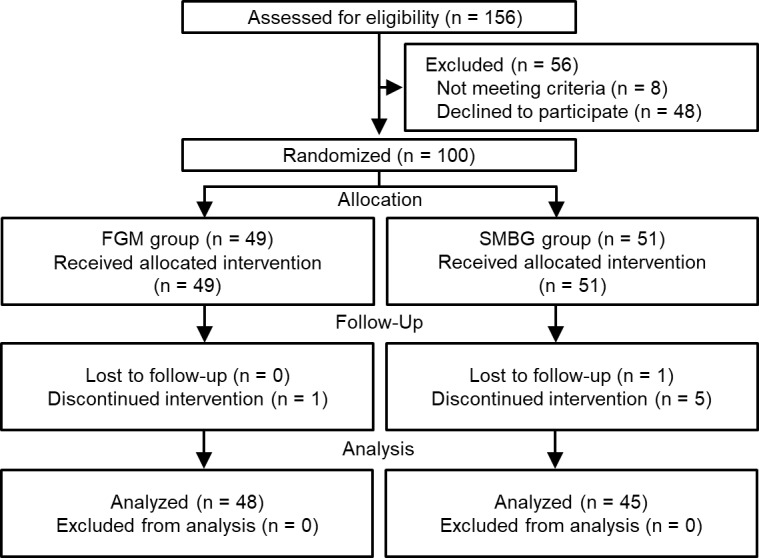
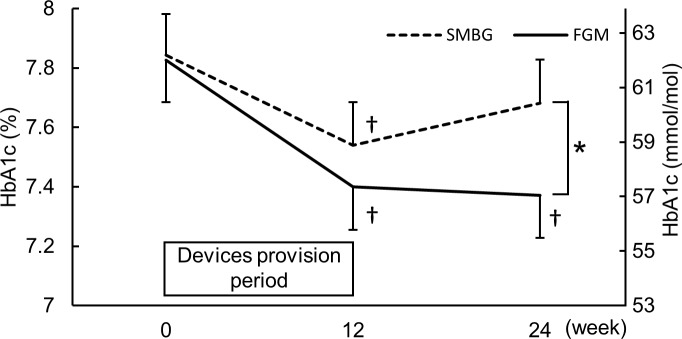
Introduction: The present study aimed to evaluate the effects of flash glucose monitoring (FGM) and conventional self-monitoring of blood glucose (SMBG) on glycemic control in patients with non-insulin-treated type 2 diabetes. Research design and methods: In this 24-week, multicenter, open-label, randomized (1:1), parallel-group study, patients with non-insulin-treated type 2 diabetes at five hospitals in Japan were randomly assigned to the FGM (n=49) or SMBG (n=51) groups and were provided each device for 12 weeks. The primary outcome was change in glycated hemoglobin (HbA1c) level, and was compared using analysis of covariance model that included baseline values and group as covariates. Results: Forty-eight participants in the FGM group and 45 in the SMBG group completed the study. The mean HbA1c levels were 7.83% (62.1 mmol/mol) in the FGM group and 7.84% (62.2 mmol/mol) in the SMBG group at baseline, and the values were reduced in both FGM (−0.43% (−4.7 mmol/mol), p<0.001) and SMBG groups (−0.30% (−3.3 mmol/mol), p=0.001) at 12 weeks. On the other hand, HbA1c was significantly decreased from baseline values in the FGM group, but not in the SMBG group at 24 weeks (FGM: −0.46% (−5.0 mmol/mol), p<0.001; SMBG: −0.17% (−1.8 mmol/mol), p=0.124); a significant between-group difference was also observed (difference −0.29% (−3.2 mmol/mol), p=0.022). Diabetes Treatment Satisfaction Questionnaire score was significantly improved, and the mean glucose levels, SD of glucose, mean amplitude of glycemic excursions and time in hyperglycemia were significantly decreased in the FGM group compared with the SMBG group. Conclusions: Glycemic control was better with FGM than with SMBG after cessation of glucose monitoring in patients with non-insulin-treated type 2 diabetes. Trial registration number: UMIN000026452, jRCTs041180082.
Overview
The claims and statistics of this paper haven’t been checked yet.
Free: it reads the open-access text and checks the first 5 claims that cite a source we can check. Create a free account to check every claim.
Integrity signals
Registry
Cites
Statistics
Figures
Verification
Claims the paper makes
The claims and statistics of this paper haven’t been checked yet.
Free: it reads the open-access text and checks the first 5 claims that cite a source we can check. Create a free account to check every claim.
Claims other papers make about this one
Each is checked against this paper’s own text: does it say what the citing paper says it does?
In the citing paper
“In these RCTs, people with type 2 diabetes not on intensive insulin therapy used CGM intermittently compared with those randomized to BGM.Both early (60) and late improvements in A1C levels were found (60,73).”
From 7. Diabetes Technology: Standards of Care in Diabetes—2025 (2025) · cites this paper as [73]
Self-check
Percentages, sums and reported differences re-computed from the paper’s own numbers.
The self-check needs the paper’s full text.
Citations
Cites
Revised Equations for Estimated GFR From Serum Creatinine in Japan
Matsuo, S., Imai, E., Horio, M., Yasuda, Y., Tomita, K., Nitta, K., Yamagata, K., Tomino, Y., Yokoyama, H., & Hishida, A. (2009) · American Journal of Kidney Diseases · doi:10.1053/j.ajkd.2008.12.034 · Cited by 6,422
Bolinder, J., Antuna, R., Geelhoed-Duijvestijn, P., Kröger, J., & Weitgasser, R. (2016) · The Lancet · doi:10.1016/s0140-6736(16)31535-5 · Cited by 893 · cited 6×
“9 14 It is not clear from this study why the improved glycemic control was sustained even after the cessation of glucose monitoring in the FGM group.”
Influential6. Glycemic Targets: Standards of Medical Care in Diabetes—2019
American Diabetes Association (2019) · Diabetes Care · doi:10.2337/dc19-s006 · Cited by 655
Haak, T., Hanaire, H., Ajjan, R., Hermanns, N., Riveline, J.-P., & Rayman, G. (2017) · Diabetes Therapy · doi:10.1007/s13300-016-0223-6 · Cited by 623 · cited 3×
“9 14 In our study, the time in hyperglycemia was significantly decreased while that of hypoglycemia Emerging Technologies, Pharmacology and Therapeutics was not changed in the FGM group compared with the SMBG group.”
Karter, A. J., Ackerson, L. M., Darbinian, J. A., D’Agostino, R. B., Ferrara, A., Liu, J., & Selby, J. V. (2001) · The American Journal of Medicine · doi:10.1016/s0002-9343(01)00742-2 · Cited by 595
Miller, K. M., Beck, R. W., Bergenstal, R. M., Goland, R. S., Haller, M. J., McGill, J. B., Rodriguez, H., Simmons, J. H., Hirsch, I. B., & for the T1D Exchange Clinic Network (2013) · Diabetes Care · doi:10.2337/dc12-1770 · Cited by 505
A Novel Approach to Continuous Glucose Analysis Utilizing Glycemic Variation
McDonnell, C. M., Donath, S. M., Vidmar, S. I., Werther, G. A., & Cameron, F. J. (2005) · Diabetes Technology & Therapeutics · doi:10.1089/dia.2005.7.253 · Cited by 358
Japanese Clinical Practice Guideline for Diabetes 2016
Haneda, M., Noda, M., Origasa, H., Noto, H., Yabe, D., Fujita, Y., Goto, A., Kondo, T., & Araki, E. (2018) · Diabetology International · doi:10.1007/s13340-018-0345-3 · Cited by 319
Guerci, B., Drouin, P., Grangé, V, Bougnères, P., Fontaine, P., Kerlan, V, Passa, P., Thivolet, C., Vialettes, B., & Charbonnel, B. (2003) · Diabetes & Metabolism · doi:10.1016/s1262-3636(07)70073-3 · Cited by 287
Statistical Tools to Analyze Continuous Glucose Monitor Data
Clarke, W., & Kovatchev, B. (2009) · Diabetes Technology & Therapeutics · doi:10.1089/dia.2008.0138 · Cited by 249
Cited by
Continuous glucose monitoring and metrics for clinical trials: an international consensus statement
Battelino, T., Alexander, C. M., Amiel, S. A., Arreaza-Rubin, G., Beck, R. W., Bergenstal, R. M., Buckingham, B. A., Carroll, J., Ceriello, A., Chow, E., et al. (2023) · The Lancet Diabetes & Endocrinology · doi:10.1016/s2213-8587(22)00319-9 · Cited by 831
7. Diabetes Technology: Standards of Medical Care in Diabetes—2022
American Diabetes Association Professional Practice Committee (2022) · Diabetes Care · doi:10.2337/dc22-s007 · Cited by 358
“Both early (59) and late improvements in A1C were found (59,89).”
Background7. Diabetes Technology: Standards of Care in Diabetes—2025
American Diabetes Association Professional Practice Committee, ElSayed, N. A., McCoy, R. G., Aleppo, G., Balapattabi, K., Beverly, E. A., Briggs Early, K., Bruemmer, D., Echouffo-Tcheugui, J. B., Ekhlaspour, L., et al. (2025) · Diabetes Care · doi:10.2337/dc25-s007 · Cited by 348
7. Diabetes Technology: Standards of Care in Diabetes — 2023
ElSayed, N. A., Aleppo, G., Aroda, V. R., Bannuru, R. R., Brown, F. M., Bruemmer, D., Collins, B. S., Hilliard, M. E., Isaacs, D., Johnson, E. L., et al. (2023) · Diabetes Care · doi:10.2337/dc23-s007 · Cited by 301
7. Diabetes Technology: Standards of Care in Diabetes—2024
American Diabetes Association Professional Practice Committee, ElSayed, N. A., Aleppo, G., Bannuru, R. R., Bruemmer, D., Collins, B. S., Ekhlaspour, L., Hilliard, M. E., Johnson, E. L., Khunti, K., et al. (2024) · Diabetes Care · doi:10.2337/dc24-s007 · Cited by 281
7. Diabetes Technology: Standards of Care in Diabetes—2026
Bajaj, M. S., McCoy, R. G., Balapattabi, K., Bannuru, R. R., Bellini, N. J., Bennett, A. K., Beverly, E. A., Early, K. B., ChallaSivaKanaka, S., Echouffo-Tcheugui, J. B., et al. (2025) · Diabetes Care · doi:10.2337/dc26-s007 · Cited by 293
7. Diabetes Technology: Standards of Medical Care in Diabetes—2021
American Diabetes Association (2021) · Diabetes Care · doi:10.2337/dc21-s007 · Cited by 202
“There are some data showing benefit of intermittent use of CGM (rtCGM or isCGM) in individuals with type 2 diabetes on noninsulin and/or basal insulin therapies (68,94).”
BackgroundContinuous glucose monitoring in adults with type 2 diabetes: a systematic review and meta-analysis
Jancev, M., Vissers, T. A. C. M., Visseren, F. L. J., van Bon, A. C., Serné, E. H., DeVries, J. H., de Valk, H. W., & van Sloten, T. T. (2024) · Diabetologia · doi:10.1007/s00125-024-06107-6 · Cited by 191
Seidu, S., Kunutsor, S. K., Ajjan, R. A., & Choudhary, P. (2024) · Diabetes Care · doi:10.2337/dc23-1520 · Cited by 124
Aronson, R., Brown, R. E., Chu, L., Bajaj, H. S., Khandwala, H., Abitbol, A., Malakieh, N., & Goldenberg, R. (2023) · Diabetes, Obesity and Metabolism · doi:10.1111/dom.14949 · Cited by 118
“this population, a controlled study providing isCGM with only basic self-management guidance, at five Japanese hospital-based practices, had mixed results.(12) At the end of the 12-week phase of isCGM wear, both groups showed equally improved HbA1c.”
BackgroundMethodInfluentialContinuous glucose monitoring for the routine care of type 2 diabetes mellitus
Ajjan, R. A., Battelino, T., Cos, X., Del Prato, S., Philips, J.-C., Meyer, L., Seufert, J., & Seidu, S. (2024) · Nature Reviews Endocrinology · doi:10.1038/s41574-024-00973-1 · Cited by 117
“…in people with T2DM not on insulin therapy, include: increased hypo-glycaemic confidence, reduced diabetes mellitus distress and better overall wellbeing 79,80 , as well as improved psychological function, diabetes mellitus empowerment and greater diabetes mellitus treatment satisfaction 62,63 .”
Zahedani, A. D., McLaughlin, T., Veluvali, A., Aghaeepour, N., Hosseinian, A., Agarwal, S., Ruan, J., Tripathi, S., Woodward, M., Hashemi, N., et al. (2023) · npj Digital Medicine · doi:10.1038/s41746-023-00956-y · Cited by 96
“Wada et al. 28 examined individuals with non-insulin-treated T2D with baseline HbA1c of 7.8%; the researchers did not measure lifestyle changes, but showed that use of fl ash CGM as compared to SMBG resulted in a reduction in HbA1c at 24 weeks (0.29%, p = 0.02).”
InfluentialFerreira, R. O. M., Trevisan, T., Pasqualotto, E., Chavez, M. P., Marques, B. F., Lamounier, R. N., & van de Sande-Lee, S. (2024) · Diabetes Technology & Therapeutics · doi:10.1089/dia.2023.0390 · Cited by 92
“…two studies compared is-GCM with structured SMBG. 23,24 Regarding glucose monitoring regimen, four studies used continuous use of CGM, 14,20,23,24 and two studies used periodic use of CGM. 21,22 In periodic use of CGM, the device was used in sessions (generally 1 week) with a…”
InfluentialExpanding the Role of Continuous Glucose Monitoring in Modern Diabetes Care Beyond Type 1 Disease
Klupa, T., Czupryniak, L., Dzida, G. J., Fichna, P., Jarosz-Chobot, P. A., Gumprecht, J., Myśliwiec, M., Szadkowska, A., Bomba-Opon, D. A., Czajkowski, K., et al. (2023) · Diabetes Therapy · doi:10.1007/s13300-023-01431-3 · Cited by 97
“The incidence of LGA births was also reduced for women with GDM who used CGM, compared to those using SMBG [179, 180].”
BackgroundInfluentialOser, T. K., Hall, T. L., Dickinson, L. M., Callen, E., Carroll, J. K., Nease, D. E., Michaels, L., & Oser, S. M. (2022) · The Annals of Family Medicine · doi:10.1370/afm.2876 · Cited by 72
Advances in Continuous Glucose Monitoring: Clinical Applications
Kwon, S. Y., & Moon, J. S. (2025) · Endocrinology and Metabolism · doi:10.3803/enm.2025.2370 · Cited by 94
“In non-insulin-treated T2D, CGM outperforms SMBG. Wada et al. [27] report that CGM users achieved a sustained and greater reduction in HbA1c at 24 weeks (–0.46% vs. –0.17”
InfluentialGuerci, B., Roussel, R., Levrat-Guillen, F., Detournay, B., Vicaut, E., De Pouvourville, G., Emery, C., & Riveline, J.-P. (2023) · Diabetes Technology & Therapeutics · doi:10.1089/dia.2022.0271 · Cited by 69
Uhl, S., Choure, A., Rouse, B., Loblack, A., & Reaven, P. (2024) · The Journal of Clinical Endocrinology & Metabolism · doi:10.1210/clinem/dgad652 · Cited by 76
Moon, S. J., Kim, K., Lee, W. J., Lee, M. Y., Vigersky, R., & Park, C. (2023) · Diabetes, Obesity and Metabolism · doi:10.1111/dom.14852 · Cited by 69
“Those studies included subjects who used a small number of or no OADs.(16,28) Also, they did not assess SMBG use in the CGM group.”
BackgroundInfluentialDehghani Zahedani, A., Shariat Torbaghan, S., Rahili, S., Karlin, K., Scilley, D., Thakkar, R., Saberi, M., Hashemi, N., Perelman, D., Aghaeepour, N., et al. (2021) · Diabetes Therapy · doi:10.1007/s13300-021-01081-3 · Cited by 62
“4 The group with poor time in range (TIR) at baseline. a Percentage of users within each cohort with TIR improvement. b Percentage of users within each cohort for whom the 8-day improvement exceeded the daily TIR variation. c Comparison of days 2–3 and days 8–9 TIR for participants who started below 72% (6.5% HbA1c eq…”
BackgroundInfluentialRichardson, K. M., Jospe, M. R., Bohlen, L. C., Crawshaw, J., Saleh, A. A., & Schembre, S. M. (2024) · International Journal of Behavioral Nutrition and Physical Activity · doi:10.1186/s12966-024-01692-6 · Cited by 61
Emerging Diabetes Technologies: Continuous Glucose Monitors/Artificial Pancreases
ALMURASHI, A. M., Rodriguez, E., & Garg, S. K. (2023) · Journal of the Indian Institute of Science · doi:10.1007/s41745-022-00348-3 · Cited by 67
Aggarwal, A., Pathak, S., & Goyal, R. (2022) · Diabetes Research and Clinical Practice · doi:10.1016/j.diabres.2022.109825 · Cited by 55
Flash glucose monitoring in gestational diabetes mellitus (FLAMINGO): a randomised controlled trial
Majewska, A., Stanirowski, P. J., Tatur, J., Wojda, B. K., Radosz, I., Wielgoś, M., & Bomba-Opon, D. A. (2023) · Acta Diabetologica · doi:10.1007/s00592-023-02091-2 · Cited by 51
“Additionally, rtCGM as well as FGM do not require finger pricking for each glycaemia assessment, and consequently improve the quality of life of diabetic patients [11].”
BackgroundOser, T. K., Litchman, M. L., Allen, N. A., Kwan, B. M., Fisher, L., Jortberg, B. T., Polonsky, W. H., & Oser, S. M. (2021) · Current Diabetes Reports · doi:10.1007/s11892-021-01408-1 · Cited by 43
Ajjan, R. A., Heller, S. R., Everett, C. C., Vargas-Palacios, A., Higham, R., Sharples, L., Gorog, D. A., Rogers, A., Reynolds, C., Fernandez, C., et al. (2023) · Diabetes Care · doi:10.2337/dc22-1219 · Cited by 44
“Furthermore, the duration of glycemic monitoring part of the trial was short at 3 months, and it is unclear hether a longer period would have had a greater effect, particularly because 6 months of isCGM may be required to show a difference in HbA1c in non–insulin-treated individuals with T2D (37).”
BackgroundRuissen, M. M., Torres-Peña, J. D., Uitbeijerse, B. S., Arenas de Larriva, A. P., Huisman, S. D., Namli, T., Salzsieder, E., Vogt, L., Ploessnig, M., van der Putte, B., et al. (2023) · Diabetologia · doi:10.1007/s00125-023-06006-2 · Cited by 43
“…the effect of POWER2DM can only be evaluated as a whole, acknowledging that both an increase in consulta-tion frequency [36] and the use of intermittently scanned continuous glucose monitoring devices [37, 38] improve glycaemic control and also decrease diabetes distress [38] and improve QoL [36].”
BackgroundGarg, S. K., Hirsch, I. B., Repetto, E., Snell‐Bergeon, J. K., Ulmer, B. J., Perkins, C., & Bergenstal, R. M. (2024) · Diabetes Obesity and Metabolism · doi:10.1111/dom.15866 · Cited by 43
Lu, J., Ying, Z., Wang, P., Fu, M., Han, C., & Zhang, M. (2024) · Diabetes, Obesity and Metabolism · doi:10.1111/dom.15328 · Cited by 39
Nathanson, D., Eeg‐Olofsson, K., Spelman, T. D., Bülow, E., Kyhlstedt, M., Levrat‐Guillen, F., & Bolinder, J. (2024) · Diabetologia · doi:10.1007/s00125-024-06289-z · Cited by 40
Tan, Y. Y., Suan, E., Koh, G. C. H., Suhairi, S. B., & Tyagi, S. (2024) · Archives of Public Health · doi:10.1186/s13690-024-01459-2 · Cited by 35
Layne, J. E., Jepson, L. H., Carite, A. M., Parkin, C. G., & Bergenstal, R. M. (2024) · Diabetes Technology & Therapeutics · doi:10.1089/dia.2024.0197 · Cited by 37
“13,16 Although these studies are not directly comparable with the present investigation due to”
InfluentialKong, S.-Y., & Cho, M.-K. (2024) · Healthcare · doi:10.3390/healthcare12050571 · Cited by 36
Eeg-Olofsson, K., Svensson, A.-M., Franzén, S., Ahmed Ismail, H., Törnblom, M., & Levrat-Guillen, F. (2023) · Diabetes and Vascular Disease Research · doi:10.1177/14791641211067418 · Cited by 29
“001) at 24weeks.(11) However, comparisons cannot be realistically drawn between a prospective RCT and our retrospective real-world analysis.”
BackgroundResultBattelino, T., Lalic, N. M., Hussain, S., Ceriello, A., Majanović, S. K., Davies, S., Topsever, P., Heverly, J., Ulivi, F., Brady, K., et al. (2025) · Diabetes Research and Clinical Practice · doi:10.1016/j.diabres.2025.112111 · Cited by 36
Aleppo, G., Hirsch, I. B., Parkin, C. G., McGill, J., Galindo, R., Kruger, D. F., Levy, C. J., Forlenza, G. P., Umpierrez, G. E., Grunberger, G., et al. (2023) · Diabetes Technology & Therapeutics · doi:10.1089/dia.2023.0268 · Cited by 34
“Wada et al. 48 in this 24-week, multicenter, open-label, randomized parallel-group study, randomly assigned 93 adult patients with noninsulin-treated T2D (1:1) to isCGM ( n = 49) or BGM ( n = 51) use.”
Aronson, R., Abitbol, A., Bajaj, H. S., Cheng, A. Y. Y., Christopoulos, S., Harris, S. B., Jain, A. B., & Goldenberg, R. M. (2025) · Diabetes, Obesity and Metabolism · doi:10.1111/dom.70008 · Cited by 33
“Patient satisfaction measures like the DTSQ (Diabetes Treatment Satisfaction Questionnaire), 48 DTSQ-c (Diabetes Treatment Satisfaction Questionnaire-change in satisfaction), 44 and GMSS (Glucose Monitoring Satisfaction Survey) 49 as well as participant reported quality of life outcome…”
Leveraging continuous glucose monitoring as a catalyst for behaviour change: a scoping review
Jospe, M. R., Richardson, K. M., Saleh, A. A., Bohlen, L. C., Crawshaw, J., Liao, Y., Konnyu, K. J., & Schembre, S. M. (2024) · International Journal of Behavioral Nutrition and Physical Activity · doi:10.1186/s12966-024-01622-6 · Cited by 34
Making Diabetes Care Fit—Are We Making Progress?
Ruissen, M. M., Rodríguez‐Gutiérrez, R., Montori, V. M., & Kunneman, M. (2021) · Frontiers in Clinical Diabetes and Healthcare · doi:10.3389/fcdhc.2021.658817 · Cited by 33
Continuous glucose monitoring in persons with type 2 diabetes not using insulin
Cowart, K., Updike, W. H., & Franks, R. (2021) · Expert Review of Medical Devices · doi:10.1080/17434440.2021.1992274 · Cited by 27
Soriano, E. C., & Polonsky, W. H. (2022) · Journal of Diabetes Science and Technology · doi:10.1177/19322968221094831 · Cited by 26
The use of technology in type 2 diabetes and prediabetes: a narrative review
Liarakos, A. L., Lim, J. Z. M., Leelarathna, L., & Wilmot, E. G. (2024) · Diabetologia · doi:10.1007/s00125-024-06203-7 · Cited by 27
“In another RCT [30], isCGM users showed a higher HbA 1c reduction than SMBG users at 24 weeks (MD –3.2 mmol/mol [−0.29 pp]; p =0.022).”
BackgroundInfluentialMartens, T. W., Willis, H. J., Bergenstal, R. M., Kruger, D. F., French, E. K., & Steenkamp, D. (2025) · Diabetes Technology & Therapeutics · doi:10.1089/dia.2024.0579 · Cited by 25
Frank, J., Son, D., Szafranski, K., & Poon, Y. (2024) · Journal of Managed Care & Specialty Pharmacy · doi:10.18553/jmcp.2024.24025 · Cited by 25
Wright, E. E., Roberts, G. J., Chuang, J. S., Nabutovsky, Y., Virdi, N., & Miller, E. (2024) · Diabetes Technology & Therapeutics · doi:10.1089/dia.2024.0015 · Cited by 22
Conti, M., Massari, G., Meneghini, E., Pasquino, B., Agosti, B., Chinotti, F., Pintaudi, B., Girelli, A., & Bertuzzi, F. (2024) · Journal of Clinical Medicine · doi:10.3390/jcm13030642 · Cited by 21
“However, evidence regarding the use of isCGM in patients under basal insulin or noninsulin therapy is more limited [8–17].”
BackgroundResultInfluentialRizos, E. C., Markozannes, G., Charitakis, N., Filis, P., Stoimeni, A. E., Nørgaard, K., Ntzani, E. E., & Tsilidis, K. K. (2025) · Diabetes Technology & Therapeutics · doi:10.1089/dia.2024.0599 · Cited by 21
Evolving Use of Continuous Glucose Monitoring Beyond Intensive Insulin Treatment
Wright, E. E., & Subramanian, S. (2021) · Diabetes Technology & Therapeutics · doi:10.1089/dia.2021.0191 · Cited by 21
Bannuru, R. R., Bellini, N. J., Bergenstal, R. M., Beverly, E. A., Christofides, E. A., Cox, D. J., Ehrhardt, N. M., Fazioli, K., Fischl, A. H., Kerr, D. E., et al. (2025) · Journal of Diabetes Science and Technology · doi:10.1177/19322968251384318 · Cited by 20
Prato, S. D., Giorgino, F., Szafranski, K., & Poon, Y. (2024) · Diabetes Obesity and Metabolism · doi:10.1111/dom.15703 · Cited by 19
“…ICER was found when HbA1c reductions were taken from an RCT evaluating the use of flash CGM by patients living with T2DM using non-insulin treatment 12 — although this scenario is conservative, the resultant ICER is still likely to be considered cost effective from an Italian healthcare system…”
Willis, H. J., Asche, S. E., McKenzie, A. L., Adams, R. N., Roberts, C. G. P., Volk, B. M., Krizka, S., Athinarayanan, S. J., Zoller, A. R., & Bergenstal, R. M. (2025) · Diabetes Technology & Therapeutics · doi:10.1089/dia.2024.0406 · Cited by 17
“22 In this study, general dietary guidance was provided, but diet and 2 .”
Patient‐reported outcomes in studies of diabetes technology: What matters
Liarakos, A. L., Crabtree, T. S. J., & Wilmot, E. G. (2024) · Diabetes Obesity and Metabolism · doi:10.1111/dom.15858 · Cited by 19
Agarwal, S., Varghese, R. T., SAVIAN, R. E. N. A. T. O. R. E. Z. E. N. D. E., Wang, C. C. L., & Galindo, R. J. (2025) · Endocrine Practice · doi:10.1016/j.eprac.2025.05.749 · Cited by 15
Chang, Y.-T., Tu, Y.-Z., Chiou, H., Lai, K., & Yu, N. C. (2022) · JMIR mhealth and uhealth · doi:10.2196/31764 · Cited by 15
“Among self-care measures, the self-monitoring of blood glucose (SMBG) is a critical component for checking blood glucose levels [5-7].”
BackgroundAl Hayek, A., Al Dawish, M., & El Jammal, M. (2021) · Cureus · doi:10.7759/cureus.16007 · Cited by 11
“A number of studies on the use of flash glucose monitoring in T2D have emerged globally, supporting the notion that the system contributes to improvements in selfmanagement in terms of both glycaemic control and quality of life [2-8].”
BackgroundResultHarris, S. B., & Levrat‐Guillen, F. (2023) · Diabetes Obesity and Metabolism · doi:10.1111/dom.15025 · Cited by 16
Molfetta, S. D., Rossi, A., Assaloni, R., Cherubini, V., Consoli, A., Bartolo, P. D., Guardasole, V., Laurenzi, A., Lombardo, F., Maffeis, C., et al. (2022) · Diabetes Research and Clinical Practice · doi:10.1016/j.diabres.2022.109867 · Cited by 14
Harris, S., Cimino, S., Nguyen, Y., Szafranski, K., & Poon, Y. (2025) · Diabetes Therapy · doi:10.1007/s13300-024-01677-5 · Cited by 12
“For persons living with T2DM not using insulin, a reduction of 0.3% versus SMBG was applied, based on the 16-week Canadian RCT IMMEDIATE [27]; this reduction versus SMBG is consistent with the results seen at week 24 in a Japanese RCT [10].”
InfluentialContinuous Glucose Monitoring for Type 2 Diabetes: How Does It Compare with Type 1 Diabetes?
Beck, R. W., & Bergenstal, R. M. (2022) · Diabetes Technology & Therapeutics · doi:10.1089/dia.2021.0374 · Cited by 12
“In a 10-week randomized trial of 100 persons with T2D using MDI, Yaron et al. reported HbA1c change of - 0.8% with the Libre compared with - 0.3% with BGM. 5 In contrast, the REPLACE randomized trial did not show a benefit of CGM on HbA1c but did show benefit in reducing hypoglycemia.”
InfluentialDiabetes Technology in People with Type 2 Diabetes: Novel Indications
Agarwal, S., Galindo, R. J., Shah, A. V., & Abreu, M. (2024) · Current Diabetes Reports · doi:10.1007/s11892-024-01536-4 · Cited by 12
“It improves glycemic control (HbA1c, mean glucose, standard deviation of glucose, mean amplitude of glycemic excursions) in non-insulin-treated T2D [23], T2D treated with basal insulin only [24], and in a randomized controlled, open-label trial of people with T2D treated with multiple daily…”
Glennie, J. L., Berard, L., & Levrat‐Guillen, F. (2022) · ClinicoEconomics and Outcomes Research · doi:10.2147/ceor.s346736 · Cited by 35
“46% reduction in HbA1c after 24 weeks with the FreeStyle Libre system.(17) A larger, retrospective observational review of 728 adults with T2DM indicated a −1.”
MethodLiang, B., Koye, D. N., Hachem, M., Zafari, N., Braat, S., & Ekinci, E. I. (2022) · Frontiers in Clinical Diabetes and Healthcare · doi:10.3389/fcdhc.2022.849725 · Cited by 13
Gao, Y., Zhou, M., Xu, X., & Chen, W. Y. (2022) · Journal of Diabetes and its Complications · doi:10.1016/j.jdiacomp.2022.108314 · Cited by 13
Legris, P., Bouillet, B., Pâris, J., Pistre, P., Devaux, M., Bost, S., Simoneau, I., Manfrédi, S., Drouillard, A., Bastie, J.-N., et al. (2023) · Acta Diabetologica · doi:10.1007/s00592-023-02032-z · Cited by 12
“When we compare the time spent under the target in our study with the scarce literature data on CGM in type 2 diabetics without cancer, it appears that this time is longer in our patients [7, 8].”
ResultBendixen, B. E., Wilhelmsen‐Langeland, A., Lomborg, K. E., Måkestad, E., Iversen, M. M., Søfteland, E. W., & Haugstvedt, A. (2025) · The Science of Diabetes Self-Management and Care · doi:10.1177/26350106251326517 · Cited by 12
Lameijer, A., Bakker, J. J., Kao, K., Xu, Y., Gans, R. O. B., Bilo, H. J. G., Dunn, T. C., & van Dijk, P. R. (2023) · Diabetes Research and Clinical Practice · doi:10.1016/j.diabres.2023.110735 · Cited by 12
Rama Chandran, S., Rahman, N., Gandhi, M., Tan, N. C., Phoon, I. K. Y., Seah, D. E. J., Cheah, M. H., Sek, K., & Gardner, D. S.-L. (2024) · Diabetes Research and Clinical Practice · doi:10.1016/j.diabres.2024.111678 · Cited by 10
Di Molfetta, S., Bosi, E., Ceriello, A., Cucinotta, D., Tiengo, A., Scavini, M., Piccolo, C., Bonizzoni, E., Acmet, E., & Giorgino, F. (2021) · Diabetes Research and Clinical Practice · doi:10.1016/j.diabres.2021.109070 · Cited by 10
“In recent years, the advent of continuous glucose monitoring (CGM) technology has revolutionized the approach to diabetes care, with ever-growing evidence supporting its efficacy also in T2D patients on less intensive insulin regimens [21] or non-insulin-based therapies [22].”
Ratzki‐Leewing, A. A., Harris, S. B., RABASA-LHORET, R. P. R., & Poon, Y. (2025) · Diabetes Obesity and Metabolism · doi:10.1111/dom.16266 · Cited by 10
Alvarez, S. D., Fellas, A., Santos, D., Sculley, D., Wynne, K., Acharya, S., Navathe, P. D., Gironès, X., & Coda, A. (2023) · JMIR Diabetes · doi:10.2196/42389 · Cited by 11
Use of technology in prediabetes and precision prevention
He, J., Chu, N. H. S., Wan, H., Ling, J., Xue, Y., Leung, K. H. T., Yang, A., Shen, J., & Chow, E. (2025) · Journal of Diabetes Investigation · doi:10.1111/jdi.70057 · Cited by 10
Miller, E., Chuang, J. S., Roberts, G. J., Nabutovsky, Y., Virdi, N., & Wright, E. E. (2024) · Diabetes Therapy · doi:10.1007/s13300-024-01619-1 · Cited by 9
“For example, in a randomized controlled study, Wada et al. showed that measuring glucose levels with flash glucose monitoring, such as FSL, resulted in significantly reduced A1c levels by 0.43% in patients with T2D treated with non-insulin ( n = 48) after 12 weeks of use [27].”
BackgroundResultInfluentialWright, E. E., Miller, E. M., Bindal, A., & Poon, Y. (2025) · Journal of Managed Care & Specialty Pharmacy · doi:10.18553/jmcp.2025.24253 · Cited by 10
Ajjan, R., Seidu, S., & Riveline, J. (2024) · Diabetes Therapy · doi:10.1007/s13300-024-01607-5 · Cited by 9
“While there are studies on CGM use in non-insulin-treated individuals with T2D [27, 28], the subgroup on monotherapy is too small to allow reliable, and adequately powered, separate analysis.”
BackgroundHayek, A. A., Klonoff, D. C., Zahrani, W. M. A., Saeed, A. H. A., & Dawish, M. A. A. (2025) · Diabetes Research and Clinical Practice · doi:10.1016/j.diabres.2025.112458 · Cited by 8
Riveline, J., Levrat‐Guillen, F., Detournay, B., Vicaut, É., de Pouvourville, G., Emery, C., & Guerci, B. (2024) · Diabetes Technology & Therapeutics · doi:10.1089/dia.2024.0171 · Cited by 8
“6,9,10 Recently, the RELIEF study (Real world Evidence of Free-Style Libre: analysis of the SNDS database in France) was conducted using the French national health claims database, the Système National des Données de Santé (SNDS), 11 which covers the entire French population (approx.”
Ehrhardt, N. M., Cedeno, B., Montour, L., Sinclair, K., Ferguson, G., Berberian, P., Comstock, B. A., & Wright, L. A.-C. (2023) · BMJ Open · doi:10.1136/bmjopen-2023-082005 · Cited by 9
“26 27 A key factor behind these benefits may be behaviour modification associated with RT-CGM, however, studies are lacking.”
BackgroundFaber, J. O., Eldrup, E., Selmer, C., Pichat, C. S. H., Hecquet, S. K., Watt, T., Kreiner, S., Karpatschof, B., Gyntelberg, F., Ballegaard, S., et al. (2021) · Frontiers in Neuroscience · doi:10.3389/fnins.2021.613858 · Cited by 8
Ko, J., Moon, S., Ajjan, R. A., Lee, M. Y., Lee, H., Choi, B., Park, J., Lee, S., Kang, J., & Park, C. (2025) · Diabetes, Obesity and Metabolism · doi:10.1111/dom.16304 · Cited by 7
“38 For the power calculation of the pre-diabetes group, we utilised the difference in body weight (mean, 1.5 kg and standard deviation, 4.5 kg) calculated from another previous study.”
InfluentialEnhancing Type 2 Diabetes Care With CGM Integration: Insights From an Italian Expert Group
Irace, C., Avogaro, A., Bertuzzi, F., Buzzetti, R., Candido, R., Prato, S. D., Bartolo, P. D., Fiorina, P., Giorda, C. B., & Giorgino, F. (2025) · Diabetes/Metabolism Research and Reviews · doi:10.1002/dmrr.70059 · Cited by 7
The Role, Potential Benefits and Cost-effectiveness of Digital Tools for Diabetes Management
Carlson, A. L., Badlani, S., & Shah, V. N. (2025) · Clinical Therapeutics · doi:10.1016/j.clinthera.2025.05.002 · Cited by 8
Kitae, A., Kimura, T., Munekawa, C., Hosomi, Y., Osaka, T., Kitagawa, N., Ushigome, E., Yamazaki, M., Hamaguchi, M., & Fukui, M. (2021) · Diabetes Obesity and Metabolism · doi:10.1111/dom.14457 · Cited by 7
“Mean amplitude of glycaemic excursions (MAGE) is calculated by selecting blood glucose fluctuations above the standard deviation (SD) from 24-hour blood glucose data and calculating the average, which quantifies the magnitude of daily blood glucose fluctuations,(1) and is one of the commonly used variables in clinical…”
MethodA Position Statement of the Utilization and Support Status of Continuous Glucose Monitoring in Korea
Kim, W. J., Kim, J. H., Yoo, H. J., Son, J. W., Khang, A. R., Kwon, S. K., Kim, J. H., Kim, T. H., Ryu, O. H., Park, K. H., et al. (2021) · Journal of Korean Diabetes · doi:10.4093/jkd.2021.22.4.225 · Cited by 7
“경구혈당강하제 병용 또는 경구혈당강하제를 단독 사용하는 2형당뇨병 성인은 개인형 CGM의 간헐적 사용으로 당화혈색 소가 개선되었다[39-42].”
Ssemmondo, E., Shah, N., Newham, M., Rigby, A., Buckland, R., Deshmukh, H., & Sathyapalan, T. (2025) · Diabetes, Obesity and Metabolism · doi:10.1111/dom.16116 · Cited by 6
“20 In this study, like ours, both SMBG and isCGM reduced HbA1c at 12 weeks compared to their respective baseline.”
InfluentialSon, H., Moon, S. J., & Cho, Y. M. (2025) · Diabetes Therapy · doi:10.1007/s13300-025-01830-8 · Cited by 7
“Initially developed and applied in type 1 diabetes mellitus (T1DM) [2–5], CGM has since demonstrated significant value in the care of patients with T2DM as well [6–9].”
InfluentialClinical Impact of Continuous Glucose Monitoring in Noninsulin Treated Type 2 Diabetes: A Review
Aleppo, G., Carlson, A. L., McGill, J. B., Alshannaq, H. A., Galindo, R. J., Kruger, D. F., Levy, C. J., Matuoka, J. Y., Ilham, S., Umpierrez, G. E., et al. (2026) · Diabetes Technology & Therapeutics · doi:10.1177/15209156251414980 · Cited by 6
“5,30,33,36,47 Regarding QoL, mixed results were observed.”
InfluentialHayase, A., Onoue, T., Kobayashi, T., Wada, E., Handa, T., Kinoshita, T., Yamagami, A., Yasuda, Y., Iwama, S., Kawaguchi, Y., et al. (2023) · Primary Care Diabetes · doi:10.1016/j.pcd.2023.09.009 · Cited by 5
Self-citationWong, C., de Bray, A., Hassan, N. U., Almohandes, A., Thant, K. Z., Gill, S., Gill, D., Forsdick, H., Sinclair, A. J., Karamat, M. A., et al. (2024) · Therapeutic Advances in Endocrinology and Metabolism · doi:10.1177/20420188241269133 · Cited by 5
Continuous Glucose Monitoring in Individuals With Type 2 Diabetes: A Quality Improvement Program
Kinson, L., & Inman, K. (2024) · Clinical Diabetes · doi:10.2337/cd24-0006 · Cited by 5
Empowering People with Diabetes: Role of Continuous Glucose Monitor Systems
Srivastava, S. B. (2023) · American Journal of Lifestyle Medicine · doi:10.1177/15598276231158044 · Cited by 5
“Lifestyle Changes Improve Health Outcomes in Diabetes Patients Sufficiently intensive lifestyle interventions have shown to induce diabetes remission and it is recommended that intensive lifestyle changes be the primary modality for type 2 diabetes care with remission as the goal.7 The 2013 Obesity Guidelines describe…”
BackgroundFaber, J. O., Ballegaard, S., Ørsted, N., Eldrup, E., Karpatschof, B., Gyntelberg, F., Hecquet, S. K., & GJEDDE, A. H. (2023) · Frontiers in Neuroscience · doi:10.3389/fnins.2023.1067098 · Cited by 5
“We know that cognitive reflection on homemeasurements of HbA1c can improve measures of glucose metabolism (Wada et al., 2020), as can continuous professional surveillance by means of telemedicine (Faruque et al.”
BackgroundBohlen, L. C., Crawshaw, J., Jospe, M. R., Richardson, K. M., Konnyu, K. J., & Schembre, S. M. (2025) · International Journal of Behavioral Nutrition and Physical Activity · doi:10.1186/s12966-025-01833-5 · Cited by 4
Inequity in Continuous Glucose Monitor (CGM) Prescribing Behaviors in Primary Care
Milosavljevic, J., Schechter, C. B., Fazzari, M. J., Mathias, P., Mathew, J. T., & Agarwal, S. (2026) · Journal of General Internal Medicine · doi:10.1007/s11606-025-09923-7 · Cited by 5
“3,26,27 Partnership with specialty care may lower barriers to CGM use in primary care by bolstering clinicians’ confidence and familiarity with device initiation.”
Trolle, C., Christensen, M., & Hansen, K. W. (2024) · Diabetic Medicine · doi:10.1111/dme.15298 · Cited by 4
Molfetta, S. D., Laviola, L., Natalicchio, A., Leonardini, A., Cignarelli, A., Bonizzoni, E., Acmet, E., & Giorgino, F. (2023) · Diabetes Research and Clinical Practice · doi:10.1016/j.diabres.2023.110836 · Cited by 4
Ługowski, F., Babińska, J., Awiżeń-Panufnik, Z., Litwińska-Korcz, E., Litwińska, M., Ludwin, A., & Stanirowski, P. J. (2024) · Journal of Clinical Medicine · doi:10.3390/jcm13237129 · Cited by 6
“For instance, CGM offers constant glucose measurements, and both CGM and FGM do not require finger pricking, which is more patient-friendly and might increase compliance [17,18].”
Alsifri, S. N., Almalki, A., Alsifri, S., Alsifri, N., Moatism, M., Alsifri, S., & Issak, E. R. (2022) · International Journal of Clinical Medicine · doi:10.4236/ijcm.2022.138027 · Cited by 4
Ratzki-Leewing, A., Harris, S. B., Rabasa-Lhoret, R., & Poon, Y. (2025) · Diabetes Technology & Therapeutics · doi:10.1089/dia.2024.0609 · Cited by 3
“11 15 In addition, several cohort studies have shown use of FSL to be associated with reductions in HCRU due to acute complications.”
Lilly, A. N., King, C. A., & Ortiz, J. (2025) · JACCP JOURNAL OF THE AMERICAN COLLEGE OF CLINICAL PHARMACY · doi:10.1002/jac5.70090 · Cited by 4
Fériz, K., Rincón, A. R., Tovar, H., Restrepo-Erazo, K., Yepes, C. A., Brito, E. M., Gómez, N. B., Amézquita, Y. C. H., Iriarte-Durán, M. B., Jimenez, L., et al. (2025) · Revista Colombiana de Endocrinología Diabetes & Metabolismo · doi:10.53853/encr.12.3.907 · Cited by 3
Metadata
- Authors
- Wada, E., Onoue, T., Kobayashi, T., Handa, T., Hayase, A., Ito, M., Furukawa, M., Okuji, T., Okada, N., Iwama, S., Sugiyama, M., Tsunekawa, T., Takagi, H., Hagiwara, D., Ito, Y., Suga, H., Banno, R., Kuwatsuka, Y., Ando, M., Goto, M., & Arima, H.
- Affiliations
- Nagoya University (JP)
- Research Center of Health, Physical Fitness and Sports, Nagoya University (JP)
- Nagoya University Hospital (JP)
- Corresponding author
- Onoue, Takeshi
- Arima, Hiroshi
- ORCID
- Venue
- BMJ Open Diabetes Research & Care
- Publisher
- BMJ
- Published
- 2020-06
- Volume
- 8
- Issue
- 1
- Pages
- e001115
- ISSN
- 2052-4897 (ISSN-L)
- PMC
- PMC7292039
- OpenAlex
- W3033947135
- Cited by
- 157
- References
- 31
- Citations by year
- 2026: 22 · 2025: 35 · 2024: 38 · 2023: 28 · 2022: 18 · 2021: 15 · 2020: 1
- FWCI
- 11.69
- Type
- journal article
- Language
- en
- Open access
- gold
- doi.org
- Licence
- Locations
- BMJ Open Diabetes Research & Care (publishedVersion, cc-by-nc)
- PubMed Central (publishedVersion, cc-by-nc)
- PubMed (publishedVersion)
- Institutional Repositories DataBase (IRDB) (submittedVersion, cc-by-nc-nd)
- Funders
- Nagoya University (the Nagoya University Hospital Funding for Clinica)
- Topics
- Health Sciences › Medicine › Endocrinology, Diabetes and Metabolism › Diabetes Management and Research
- Health Sciences › Medicine › Endocrinology, Diabetes and Metabolism › Diabetes Treatment and Management
- Health Sciences › Medicine › Endocrinology, Diabetes and Metabolism › Diabetes Management and Education
- Keywords
- flash glucose monitoring, continuous glucose monitoring, self-monitoring of blood glucose, type 2 diabetes, non-insulin-treated diabetes, glycemic control, HbA1c, diabetes treatment satisfaction, glycemic variability, glycemic excursions, hypoglycemia, diabetes self-management education, patient education
- MeSH terms
- Glycemic Control, Blood Glucose, Diabetes Mellitus, Type 2, Glucose, Humans, Hypoglycemic Agents, Japan, Blood Glucose Self-Monitoring
About these checks
Registry, retraction, Cites and statistics results are computed, not judged, with one exception: a printed reference that no index lists is read once by a model before it counts as a citation error. Claims are extracted by a model and kept only when their quote appears verbatim in the text; each cited source is then checked, with a model’s help, for whether it says what the claim relies on. Those verdicts can be wrong — read the claim’s quote and the cited source before relying on one.
Statistics and arithmetic are recomputed, not judged.
Confidence bands are shown only for fields calibrated on our annotated test set. None is calibrated yet, so no band is shown.
What counts as a claim ›How we measure confidence ›How we check this ›
Are you an author, or do you see a problem with this page? Request a review
Data sources
Bibliographic data: Semantic Scholar, OpenAlex, Crossref.
Contains information from the Semantic Scholar Academic Graph Datasets, made available under the ODC Attribution License (ODC-BY 1.0).
Semantic Scholar’s data is described in: Kinney, R., et al. (2023). The Semantic Scholar Open Data Platform. arXiv:2301.10140.
