

Flash glucose monitoring helps achieve better glycemic control than conventional self-monitoring of blood glucose in non-insulin-treated type 2 diabetes: a randomized controlled trial
Open accessThe DOI matches its Crossref record; 28 of the 31 references it cites were found in a registry or an index.
Abstract
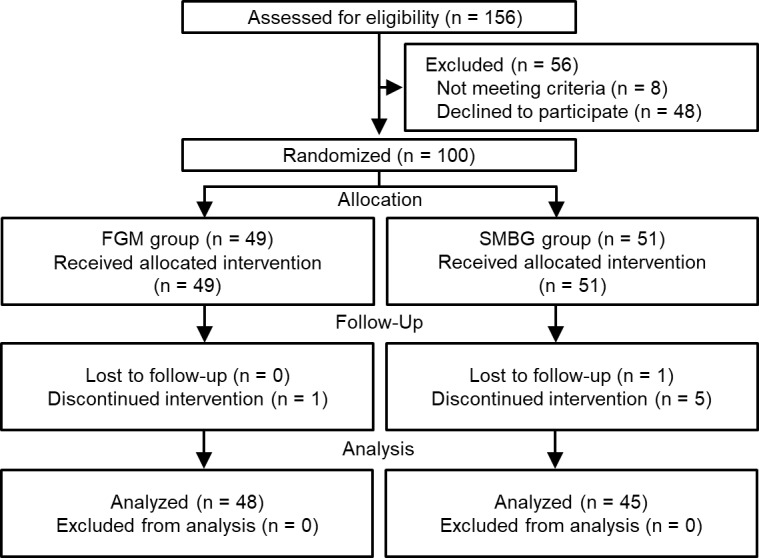
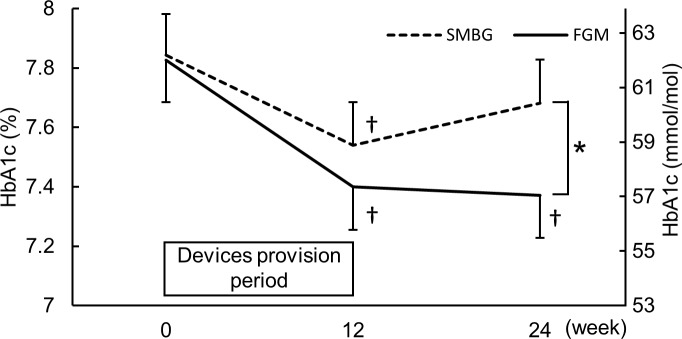
Introduction: The present study aimed to evaluate the effects of flash glucose monitoring (FGM) and conventional self-monitoring of blood glucose (SMBG) on glycemic control in patients with non-insulin-treated type 2 diabetes. Research design and methods: In this 24-week, multicenter, open-label, randomized (1:1), parallel-group study, patients with non-insulin-treated type 2 diabetes at five hospitals in Japan were randomly assigned to the FGM (n=49) or SMBG (n=51) groups and were provided each device for 12 weeks. The primary outcome was change in glycated hemoglobin (HbA1c) level, and was compared using analysis of covariance model that included baseline values and group as covariates. Results: Forty-eight participants in the FGM group and 45 in the SMBG group completed the study. The mean HbA1c levels were 7.83% (62.1 mmol/mol) in the FGM group and 7.84% (62.2 mmol/mol) in the SMBG group at baseline, and the values were reduced in both FGM (−0.43% (−4.7 mmol/mol), p<0.001) and SMBG groups (−0.30% (−3.3 mmol/mol), p=0.001) at 12 weeks. On the other hand, HbA1c was significantly decreased from baseline values in the FGM group, but not in the SMBG group at 24 weeks (FGM: −0.46% (−5.0 mmol/mol), p<0.001; SMBG: −0.17% (−1.8 mmol/mol), p=0.124); a significant between-group difference was also observed (difference −0.29% (−3.2 mmol/mol), p=0.022). Diabetes Treatment Satisfaction Questionnaire score was significantly improved, and the mean glucose levels, SD of glucose, mean amplitude of glycemic excursions and time in hyperglycemia were significantly decreased in the FGM group compared with the SMBG group. Conclusions: Glycemic control was better with FGM than with SMBG after cessation of glucose monitoring in patients with non-insulin-treated type 2 diabetes. Trial registration number: UMIN000026452, jRCTs041180082.
Overview
The claims and statistics of this paper haven’t been checked yet.
Free: it reads the open-access text and checks the first 5 claims that cite a source we can check. Create a free account to check every claim.
Integrity signals
Registry
Cites
Statistics
Figures
Verification
Claims the paper makes
The claims and statistics of this paper haven’t been checked yet.
Free: it reads the open-access text and checks the first 5 claims that cite a source we can check. Create a free account to check every claim.
Claims other papers make about this one
Each is checked against this paper’s own text: does it say what the citing paper says it does?
In the citing paper
“In these RCTs, people with type 2 diabetes not on intensive insulin therapy used CGM intermittently compared with those randomized to BGM.Both early (60) and late improvements in A1C levels were found (60,73).”
From 7. Diabetes Technology: Standards of Care in Diabetes—2025 (2025) · cites this paper as [73]
Self-check
Percentages, sums and reported differences re-computed from the paper’s own numbers.
The self-check needs the paper’s full text.
Citations
Cites
Revised Equations for Estimated GFR From Serum Creatinine in Japan
Matsuo, S., Imai, E., Horio, M., Yasuda, Y., Tomita, K., Nitta, K., Yamagata, K., Tomino, Y., Yokoyama, H., & Hishida, A. (2009) · American Journal of Kidney Diseases · doi:10.1053/j.ajkd.2008.12.034 · Cited by 6,422
Bolinder, J., Antuna, R., Geelhoed-Duijvestijn, P., Kröger, J., & Weitgasser, R. (2016) · The Lancet · doi:10.1016/s0140-6736(16)31535-5 · Cited by 893 · cited 6×
“9 14 It is not clear from this study why the improved glycemic control was sustained even after the cessation of glucose monitoring in the FGM group.”
Influential6. Glycemic Targets: Standards of Medical Care in Diabetes—2019
American Diabetes Association (2019) · Diabetes Care · doi:10.2337/dc19-s006 · Cited by 655
Haak, T., Hanaire, H., Ajjan, R., Hermanns, N., Riveline, J.-P., & Rayman, G. (2017) · Diabetes Therapy · doi:10.1007/s13300-016-0223-6 · Cited by 623 · cited 3×
“9 14 In our study, the time in hyperglycemia was significantly decreased while that of hypoglycemia Emerging Technologies, Pharmacology and Therapeutics was not changed in the FGM group compared with the SMBG group.”
Karter, A. J., Ackerson, L. M., Darbinian, J. A., D’Agostino, R. B., Ferrara, A., Liu, J., & Selby, J. V. (2001) · The American Journal of Medicine · doi:10.1016/s0002-9343(01)00742-2 · Cited by 595
Miller, K. M., Beck, R. W., Bergenstal, R. M., Goland, R. S., Haller, M. J., McGill, J. B., Rodriguez, H., Simmons, J. H., Hirsch, I. B., & for the T1D Exchange Clinic Network (2013) · Diabetes Care · doi:10.2337/dc12-1770 · Cited by 505
A Novel Approach to Continuous Glucose Analysis Utilizing Glycemic Variation
McDonnell, C. M., Donath, S. M., Vidmar, S. I., Werther, G. A., & Cameron, F. J. (2005) · Diabetes Technology & Therapeutics · doi:10.1089/dia.2005.7.253 · Cited by 358
Japanese Clinical Practice Guideline for Diabetes 2016
Haneda, M., Noda, M., Origasa, H., Noto, H., Yabe, D., Fujita, Y., Goto, A., Kondo, T., & Araki, E. (2018) · Diabetology International · doi:10.1007/s13340-018-0345-3 · Cited by 319
Guerci, B., Drouin, P., Grangé, V, Bougnères, P., Fontaine, P., Kerlan, V, Passa, P., Thivolet, C., Vialettes, B., & Charbonnel, B. (2003) · Diabetes & Metabolism · doi:10.1016/s1262-3636(07)70073-3 · Cited by 287
Statistical Tools to Analyze Continuous Glucose Monitor Data
Clarke, W., & Kovatchev, B. (2009) · Diabetes Technology & Therapeutics · doi:10.1089/dia.2008.0138 · Cited by 249
Schütt, M., Kern, Krause, U., Busch, Dapp, A., Grziwotz, Mayer, I., Rosenbauer, Wagner, C., Zimmermann, et al. (2006) · Experimental and Clinical Endocrinology & Diabetes · doi:10.1055/s-2006-924152 · Cited by 218
Bradley, C., Gamsu, D. S., & Psychological Well‐being Working Group of the WHO/IDF St Vincent Declaration Action Programme for Diabetes (1994) · Diabetic Medicine · doi:10.1111/j.1464-5491.1994.tb00316.x · Cited by 213 · cited 1×
“The Diabetes Treatment Satisfaction Questionnaire (DTSQ) is used to assess patient satisfaction with the diabetes treatment, 20 and the Japanese version of DTSQ 21 was answered anonymously at enrollment and at 12 weeks.”
Yaron, M., Roitman, E., Aharon-Hananel, G., Landau, Z., Ganz, T., Yanuv, I., Rozenberg, A., Karp, M., Ish-Shalom, M., Singer, J., et al. (2019) · Diabetes Care · doi:10.2337/dc18-0166 · Cited by 211
Kovatchev, B. P., Clarke, W. L., Breton, M., Brayman, K., & McCall, A. (2005) · Diabetes Technology & Therapeutics · doi:10.1089/dia.2005.7.849 · Cited by 201 · cited 1×
“22–24 sample size Based on the results of previous clinical trials that evaluated the effects of educational intervention on patients with type 2 diabetes, 25 26 the geometric SD of change in HbA1c at the last observation period was assumed to be 0.7% (7.7 mmol/mol).”
InfluentialArambepola, C., Ricci-Cabello, I., Manikavasagam, P., Roberts, N., French, D. P., & Farmer, A. (2016) · Journal of Medical Internet Research · doi:10.2196/jmir.5425 · Cited by 187
Davidson, M. B., Castellanos, M., Kain, D., & Duran, P. (2005) · The American Journal of Medicine · doi:10.1016/j.amjmed.2004.12.006 · Cited by 178
Tyndall, V., Stimson, R. H., Zammitt, N. N., Ritchie, S. A., McKnight, J. A., Dover, A. R., & Gibb, F. W. (2019) · Diabetologia · doi:10.1007/s00125-019-4894-1 · Cited by 165
Saisho, Y. (2018) · International Journal of Environmental Research and Public Health · doi:10.3390/ijerph15050947 · Cited by 149 · cited 1×
“28 All these could have contributed to the result of this study.”
Orsama, A.-L., Lähteenmäki, J., Harno, K., Kulju, M., Wintergerst, E., Schachner, H., Stenger, P., Leppänen, J., Kaijanranta, H., Salaspuro, V., et al. (2013) · Diabetes Technology & Therapeutics · doi:10.1089/dia.2013.0056 · Cited by 117
Flash Glucose Monitoring Improves Outcomes in a Type 1 Diabetes Clinic
Dover, A. R., Stimson, R. H., Zammitt, N. N., & Gibb, F. W. (2016) · Journal of Diabetes Science and Technology · doi:10.1177/1932296816661560 · Cited by 113 · cited 1×
“Compared with SMBG with conventional finger-pricking method, FGM has been shown to reduce the time and frequency of hypoglycemia in a randomized controlled trial (RCT) 9 and to reduce glycated hemoglobin (HbA1c) in observational studies 10–13 in patients with type 1 diabetes.”
Towfigh, A., Romanova, M., Weinreb, J. E., Munjas, B. A., Suttorp, M. J., Zhou, A., & Shekelle, P. (2008) · PubMed · Cited by 101
Paris, I., Henry, C., Pirard, F., Gérard, A., & Colin, I. M. (2018) · Endocrinology, Diabetes & Metabolism · doi:10.1002/edm2.23 · Cited by 84 · cited 1×
“Compared with SMBG with conventional finger-pricking method, FGM has been shown to reduce the time and frequency of hypoglycemia in a randomized controlled trial (RCT) 9 and to reduce glycated hemoglobin (HbA1c) in observational studies 10–13 in patients with type 1 diabetes.”
Ajjan, R. A., Jackson, N., & Thomson, S. A. (2019) · Diabetes and Vascular Disease Research · doi:10.1177/1479164119827456 · Cited by 79 · cited 1×
“FGM has also been shown to be superior to SMBG in reducing hypoglycemia 14 and HbA1c level 15 16 in patients with type 2 diabetes treated with insulin.”
Al Hayek, A. A., Robert, A. A., & Al Dawish, M. A. (2019) · Clinical Medicine Insights: Endocrinology and Diabetes · doi:10.1177/1179551419861102 · Cited by 44
McIntosh, B., Yu, C., Lal, A., Chelak, K., Cameron, C. G., Singh, S. R., & Dahl, M. (2010) · PubMed Central · Cited by 40
Ishii, H., Bradley, C., Riazi, A., Barendse, S., & Yamamoto, T. (2000) · Royal Holloway Digital Repository (Royal Holloway University of London) · Cited by 24
Kramer, G., Michalak, L., Müller, U., Kloos, C., Werner, C., & Kuniß, N. (2019) · Experimental and Clinical Endocrinology & Diabetes · doi:10.1055/a-0875-3988 · Cited by 23
Shaker, R. (2001) · The American Journal of Medicine · doi:10.1016/s0002-9343(01)00886-5 · Cited by 9
Cited by
Continuous glucose monitoring and metrics for clinical trials: an international consensus statement
Battelino, T., Alexander, C. M., Amiel, S. A., Arreaza-Rubin, G., Beck, R. W., Bergenstal, R. M., Buckingham, B. A., Carroll, J., Ceriello, A., Chow, E., et al. (2023) · The Lancet Diabetes & Endocrinology · doi:10.1016/s2213-8587(22)00319-9 · Cited by 831
7. Diabetes Technology: Standards of Medical Care in Diabetes—2022
American Diabetes Association Professional Practice Committee (2022) · Diabetes Care · doi:10.2337/dc22-s007 · Cited by 358
“Both early (59) and late improvements in A1C were found (59,89).”
Background7. Diabetes Technology: Standards of Care in Diabetes—2025
American Diabetes Association Professional Practice Committee, ElSayed, N. A., McCoy, R. G., Aleppo, G., Balapattabi, K., Beverly, E. A., Briggs Early, K., Bruemmer, D., Echouffo-Tcheugui, J. B., Ekhlaspour, L., et al. (2025) · Diabetes Care · doi:10.2337/dc25-s007 · Cited by 348
7. Diabetes Technology: Standards of Care in Diabetes — 2023
ElSayed, N. A., Aleppo, G., Aroda, V. R., Bannuru, R. R., Brown, F. M., Bruemmer, D., Collins, B. S., Hilliard, M. E., Isaacs, D., Johnson, E. L., et al. (2023) · Diabetes Care · doi:10.2337/dc23-s007 · Cited by 301
7. Diabetes Technology: Standards of Care in Diabetes—2024
American Diabetes Association Professional Practice Committee, ElSayed, N. A., Aleppo, G., Bannuru, R. R., Bruemmer, D., Collins, B. S., Ekhlaspour, L., Hilliard, M. E., Johnson, E. L., Khunti, K., et al. (2024) · Diabetes Care · doi:10.2337/dc24-s007 · Cited by 281
Metadata
- Authors
- Wada, E., Onoue, T., Kobayashi, T., Handa, T., Hayase, A., Ito, M., Furukawa, M., Okuji, T., Okada, N., Iwama, S., Sugiyama, M., Tsunekawa, T., Takagi, H., Hagiwara, D., Ito, Y., Suga, H., Banno, R., Kuwatsuka, Y., Ando, M., Goto, M., & Arima, H.
- Affiliations
- Nagoya University (JP)
- Research Center of Health, Physical Fitness and Sports, Nagoya University (JP)
- Nagoya University Hospital (JP)
- Corresponding author
- Onoue, Takeshi
- Arima, Hiroshi
- ORCID
- Venue
- BMJ Open Diabetes Research & Care
- Publisher
- BMJ
- Published
- 2020-06
- Volume
- 8
- Issue
- 1
- Pages
- e001115
- ISSN
- 2052-4897 (ISSN-L)
- PMC
- PMC7292039
- OpenAlex
- W3033947135
- Cited by
- 157
- References
- 31
- Citations by year
- 2026: 22 · 2025: 35 · 2024: 38 · 2023: 28 · 2022: 18 · 2021: 15 · 2020: 1
- FWCI
- 11.69
- Type
- journal article
- Language
- en
- Open access
- gold
- doi.org
- Licence
- Locations
- BMJ Open Diabetes Research & Care (publishedVersion, cc-by-nc)
- PubMed Central (publishedVersion, cc-by-nc)
- PubMed (publishedVersion)
- Institutional Repositories DataBase (IRDB) (submittedVersion, cc-by-nc-nd)
- Funders
- Nagoya University (the Nagoya University Hospital Funding for Clinica)
- Topics
- Health Sciences › Medicine › Endocrinology, Diabetes and Metabolism › Diabetes Management and Research
- Health Sciences › Medicine › Endocrinology, Diabetes and Metabolism › Diabetes Treatment and Management
- Health Sciences › Medicine › Endocrinology, Diabetes and Metabolism › Diabetes Management and Education
- Keywords
- flash glucose monitoring, continuous glucose monitoring, self-monitoring of blood glucose, type 2 diabetes, non-insulin-treated diabetes, glycemic control, HbA1c, diabetes treatment satisfaction, glycemic variability, glycemic excursions, hypoglycemia, diabetes self-management education, patient education
- MeSH terms
- Glycemic Control, Blood Glucose, Diabetes Mellitus, Type 2, Glucose, Humans, Hypoglycemic Agents, Japan, Blood Glucose Self-Monitoring
About these checks
Registry, retraction, Cites and statistics results are computed, not judged, with one exception: a printed reference that no index lists is read once by a model before it counts as a citation error. Claims are extracted by a model and kept only when their quote appears verbatim in the text; each cited source is then checked, with a model’s help, for whether it says what the claim relies on. Those verdicts can be wrong — read the claim’s quote and the cited source before relying on one.
Statistics and arithmetic are recomputed, not judged.
Confidence bands are shown only for fields calibrated on our annotated test set. None is calibrated yet, so no band is shown.
What counts as a claim ›How we measure confidence ›How we check this ›
Are you an author, or do you see a problem with this page? Request a review
Data sources
Bibliographic data: Semantic Scholar, OpenAlex, Crossref.
Contains information from the Semantic Scholar Academic Graph Datasets, made available under the ODC Attribution License (ODC-BY 1.0).
Semantic Scholar’s data is described in: Kinney, R., et al. (2023). The Semantic Scholar Open Data Platform. arXiv:2301.10140.
