

Recommendations for management of diabetes during Ramadan: update 2020, applying the principles of the ADA/EASD consensus
Open accessThe DOI matches its Crossref record; 120 of the 120 references it cites were found in a registry or an index.
Abstract
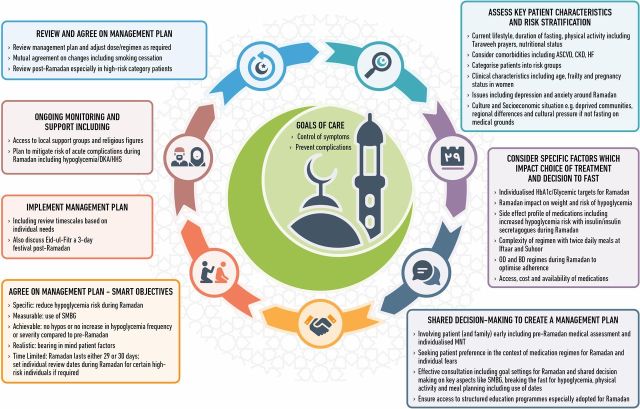
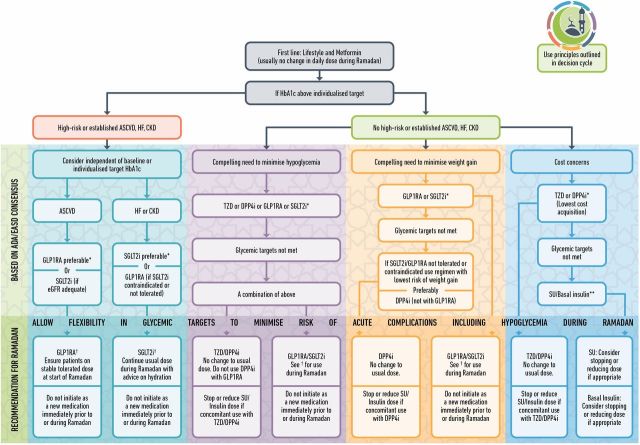
Fasting the Holy month of Ramadan constitutes one of the five pillars of the Muslim faith. Although there is some evidence that intermittent fasting during Ramadan may be of benefit in losing weight and cardiometabolic risk factors, there is no strong evidence these benefits apply to people with diabetes. The American Diabetes Association/European Association for the Study of Diabetes consensus recommendations emphasize the importance of patient factors and comorbidities when choosing diabetes medications including the presence of comorbidities, atherosclerotic cardiovascular disease, heart failure, chronic kidney disease, hypoglycemia risk, weight issues and costs. Structured education and pre-Ramadan counseing are key components to successful management of patients with diabetes. These should cover important aspects like glycemic targets, self-monitoring of blood glucose, diet, physical activity including Taraweeh prayers, medication and dose adjustment, side effects and when to break the fast. The decision cycle adapted for the specific situation of Ramadan provides an aid for such an assessment. Children with type 1 diabetes should strongly be advised not to fast due to the high risk of acute complications such as hypoglycemia and probably diabetic ketoacidosis (DKA), although there is very little evidence that DKA is increased in Ramadan. Pregnant women with diabetes or gestational diabetes should be advised to avoid fasting because of possible negative maternal and fetal outcomes. Hypoglycemia is a common concern during Ramadan fasting. To prevent hypoglycemic and hyperglycemic events, we recommend the adoption of diabetes self-management education and support principles. The use of the emerging technology and continuous glucose monitoring during Ramadan could help to recognize hypoglycemic and hyperglycemic complications related to omission and/or medication adjustment during fasting; however, the cost represents a significant barrier.
Overview
The claims and statistics of this paper haven’t been checked yet.
Free: it reads the open-access text and checks the first 5 claims that cite a source we can check. Create a free account to check every claim.
Integrity signals
Registry
Cites
Statistics
Figures
Verification
Claims the paper makes
The claims and statistics of this paper haven’t been checked yet.
Free: it reads the open-access text and checks the first 5 claims that cite a source we can check. Create a free account to check every claim.
Claims other papers make about this one
Each is checked against this paper’s own text: does it say what the citing paper says it does?
The cited source says what the claim attributes to it.
In the citing paper
“Fasting may increase the risk for hypoglycemia among individuals treated with insulin or insulin secretagogues if not properly planned for, so clinicians need to engage these individuals to codevelop a diabetes treatment plan that is safe and respectful of their traditions (123).”
From 6. Glycemic Goals, Hypoglycemia, and Hyperglycemic Crises: Standards of Care in Diabetes-2026. (2026) · cites this paper as [123]
Self-check
Percentages, sums and reported differences re-computed from the paper’s own numbers.
The self-check needs the paper’s full text.
Citations
Cites
International Diabetes Federation 2017
Carracher, A. M., Marathe, P. H., & Close, K. L. (2018) · Journal of Diabetes · doi:10.1111/1753-0407.12644 · Cited by 13,418
Empagliflozin, Cardiovascular Outcomes, and Mortality in Type 2 Diabetes
Zinman, B., Wanner, C., Lachin, J. M., Fitchett, D., Bluhmki, E., Hantel, S., Mattheus, M., Devins, T., Johansen, O. E., Woerle, H. J., et al. (2015) · New England Journal of Medicine · doi:10.1056/nejmoa1504720 · Cited by 12,315
Liraglutide and Cardiovascular Outcomes in Type 2 Diabetes
Marso, S. P., Daniels, G. H., Brown-Frandsen, K., Kristensen, P., Mann, J. F. E., Nauck, M. A., Nissen, S. E., Pocock, S., Poulter, N. R., Ravn, L. S., et al. (2016) · New England Journal of Medicine · doi:10.1056/nejmoa1603827 · Cited by 7,629
Dapagliflozin in Patients with Heart Failure and Reduced Ejection Fraction
McMurray, J. J. V., Solomon, S. D., Inzucchi, S. E., Køber, L., Kosiborod, M. N., Martinez, F. A., Ponikowski, P., Sabatine, M. S., Anand, I. S., Bělohlávek, J., et al. (2019) · New England Journal of Medicine · doi:10.1056/nejmoa1911303 · Cited by 7,140
Semaglutide and Cardiovascular Outcomes in Patients with Type 2 Diabetes
Marso, S. P., Bain, S. C., Consoli, A., Eliaschewitz, F. G., Jódar, E., Leiter, L. A., Lingvay, I., Rosenstock, J., Seufert, J., Warren, M. L., et al. (2016) · New England Journal of Medicine · doi:10.1056/nejmoa1607141 · Cited by 6,900
Dapagliflozin and Cardiovascular Outcomes in Type 2 Diabetes
Wiviott, S. D., Raz, I., Bonaca, M. P., Mosenzon, O., Kato, E. T., Cahn, A., Silverman, M. G., Zelniker, T. A., Kuder, J. F., Murphy, S. A., et al. (2019) · New England Journal of Medicine · doi:10.1056/nejmoa1812389 · Cited by 6,382
Canagliflozin and Renal Outcomes in Type 2 Diabetes and Nephropathy
Perkovic, V., Jardine, M. J., Neal, B., Bompoint, S., Heerspink, H. J. L., Charytan, D. M., Edwards, R., Agarwal, R., Bakris, G., Bull, S., et al. (2019) · New England Journal of Medicine · doi:10.1056/nejmoa1811744 · Cited by 6,189
Davies, M. J., D’Alessio, D. A., Fradkin, J., Kernan, W. N., Mathieu, C., Mingrone, G., Rossing, P., Tsapas, A., Wexler, D. J., & Buse, J. B. (2018) · Diabetes Care · doi:10.2337/dci18-0033 · Cited by 3,518
Self-citationGerstein, H. C., Colhoun, H. M., Dagenais, G. R., Diaz, R., Lakshmanan, M., Pais, P., Probstfield, J., Riesmeyer, J. S., Riddle, M. C., Rydén, L., et al. (2019) · The Lancet · doi:10.1016/s0140-6736(19)31149-3 · Cited by 3,163
Effects of once-weekly exenatide on cardiovascular outcomes in type 2 diabetes
Holman, R. R., Bethel, M. A., Mentz, R. J., Thompson, V. P., Lokhnygina, Y., Buse, J. B., Chan, J. C., Choi, J., Gustavson, S. M., Iqbal, N., et al. (2017) · New England Journal of Medicine · doi:10.1056/nejmoa1612917 · Cited by 2,162
Research works printed but not linked: 4
- International Diabetes Federation IDF diabetes atlas. 9th edition Brussels, 2019 http://www.diabetesatlas.org
- Handy O, Yusof BNM, Reda WH, et al Chapter 7: the Ramadan nutrition plan (RNP) for patients with diabetes, 2016 Available: http://www.daralliance.org/daralliance/
- Al-Mssallem MQ Consumption of dates among Saudi adults and its association with the prevalence of type 2 diabetes. Asian J. Clin. Nutr 2018; 10: 58– 64.
- Bencharif M, Fenaghra A, Boudaoud C, et al Impact of Ramadan fasting on energy intake and anthropometry of type 2 diabetics – study in 2 regions of the central highlands and southeastern Algeria. Journal of nutrition fasting & health 2017; 5: 31– 7.
Cited by
Items 101–136 of 136
Şat, S., Aydınkoç-Tuzcu, K., Berger, F., Barakat, A., Danquah, I., Schindler, K., & Fasching, P. (2024) · Diabetologie und Stoffwechsel · doi:10.1055/a-2377-3854 · Cited by 1
Bouchareb, S., Harms, P. P., Hassanein, M., Nijpels, G., & Elders, P. J. M. (2025) · Primary care diabetes · doi:10.1016/j.pcd.2025.04.002 · Cited by 1
Al‐Saleh, Y., Sabico, S., Al-Furqani, A., Jayyousi, A., Alromaihi, D., Ba-Essa, E. M., Alawadi, F., Alkaabi, J., Hassanein, M. M., Alsifri, S. N., et al. (2021) · Diabetes Therapy · doi:10.1007/s13300-021-01109-8 · Cited by 1
Self-citationApport des inhibiteurs du SGLT2 dans la gestion du diabète au cours du Ramadan
Ibrahim, A.-Z., Amouin, S., Kadiri, S., Sollier, M., Nassouri, S., Garcia, C., Bauduceau, B., & Bordier, L. (2021) · Médecine des Maladies Métaboliques · doi:10.1016/j.mmm.2021.03.008
(2020) · Journal of the Academy of Nutrition and Dietetics · doi:10.1016/j.jand.2020.06.010
Şat, S., Aydınkoç-Tuzcu, K., Berger, F., Barakat, A., Schindler, K., & Fasching, P. (2022) · Der Diabetologe · doi:10.1007/s11428-022-00865-w
“Ketonspiegelmessungen sind erforderlich bei Unwohlsein bei allen Patienten, die sich für das Fasten entscheiden und einer SGLT-2-Hemmer-Therapie unterliegen [66].”
Şat, S., Aydınkoç-Tuzcu, K., Berger, F., Barakat, A., Schindler, K., & Fasching, P. (2021) · Der Diabetologe · doi:10.1007/s11428-020-00713-9
Culturally sensitive recommendations for the clinical pharmacist to engage the Arab American patient
Alosaimy, S., Mohammad, I., Chahine, E. B., Saad, A. H., Jaber, L. A., & Ghali, A. E. (2022) · JACCP JOURNAL OF THE AMERICAN COLLEGE OF CLINICAL PHARMACY · doi:10.1002/jac5.1649
“hemoglobin and were less likely to experience severe hypoglycemia or hospitalization during Ramadan compared to control.(35,36)”
BackgroundReligious fasting and eating habits in older people
Иванникова, Е. В., & Dudinskaya, Е. N. (2022) · Russian Journal of Geriatric Medicine · doi:10.37586/2686-8636-2-2022-86-95
“В частности, пациентам, получающим инсулинотерапию, необходимо снизить дозу [65].”
Ramadan: Health, Human Capital, and Economic Outcomes
van Ewijk, R. J. G. (2022) · Springer eBooks · doi:10.1007/978-3-319-57365-6_250-1
Şat, S., Aydınkoç-Tuzcu, K., Berger, F., Barakat, A., Danquah, I., Schindler, K., & Fasching, P. (2023) · Die Diabetologie · doi:10.1007/s11428-023-01010-x
“In Anbetracht der Gefahr einer euglykämischen diabetischen Ketoazidose ist jedoch bei Insulinmangel Vorsicht geboten [101].”
Alhaj, A., & Shatnawi, O. F. (2023) · JAP Academy Journal · doi:10.58877/japaj.v1i1.24
Diabetes und Migration (Update 2023)
Aydınkoç-Tuzcu, K., Şat, S., Berger, F., Barakat, A., Danquah, I., Schindler, K., & Fasching, P. (2023) · Wiener klinische Wochenschrift · doi:10.1007/s00508-023-02175-7 · Cited by 1
Cetoacidose metabólica: condições clínicas e abordagens terapêuticas
Frazão, L. F. N., de Oliveira, J. M. G., Pereira, M. M., Ramos, J. L. B., dos Santos, D. R. L., Neto, O. B. D. O., Matos, J. P. A., Santos, T. G. D., dos Santos, M. M., dos Santos, G. D., et al. (2024) · Brazilian Journal of Implantology and Health Sciences · doi:10.36557/2674-8169.2024v6n5p1035-1043
Li, L., Liu, S., & Yang, P. C. (2024) · Research Square · doi:10.21203/rs.3.rs-4610003/v1
Şat, S., Aydınkoç-Tuzcu, K., Berger, F., Barakat, A., Danquah, I., Schindler, K., & Fasching, P. (2025) · Die Diabetologie · doi:10.1007/s11428-024-01272-z · Cited by 1
Al-Sharafi, B. A., Mohsen, D., & Almurtadha, A. S. (2025) · Diabetes Metabolic Syndrome and Obesity · doi:10.2147/dmso.s458654
Other important areas of diabetes care
(2025) · Oxford University Press eBooks · doi:10.1093/med/9780198831846.003.0017
Getting Started with Continuous Glucose Monitoring: From Guidelines to Implementation
(2024) · The Singapore Family Physician · doi:10.33591/sfp.50.6.u2
Baseline Patient Profile of ErtuRamadan Study: A Real-world Evaluation of Ertugliflozin
Pathan, M. F., Akter, N., Mustari, M., Saifuddin, M., Sharifuzzaman, M., Rahman, M. M., Ripon, M., Mohiuddin, S. M., Kamrul-Hasan, A. B. M., Hannan, M. A., et al. (2025) · Bangladesh Journal of Endocrinology and Metabolism · doi:10.4103/bjem.bjem_12_25
Li, W., Huang, L., Wang, R., Peng, P., Song, A., Zeng, Y., & Zhang, Z. (2025) · Diabetes Obesity and Metabolism · doi:10.1111/dom.70084
“37 This study's findings are aligned with some of the conclusions of recent cross-racial investigations.”
Alguwaihes, A. M., Hassanein, M., Alzaman, N. S., Al‐Sofiani, M. E., & Alotaibi, M. S. (2025) · Clinical Medicine Insights Endocrinology and Diabetes · doi:10.1177/11795514251376888
Health Professional's Knowledge Practices in Morocco: The DTMAR Study
Habbadi, Z., Benabdeslam, R., Rifai, K., Sabbar, G., Toulali, F., Gharbi, M. E. H., & Iraqi, H. (2025) · Journal of Diabetes and Endocrine Practice · doi:10.1055/s-0045-1814095
Self-citationManagement of diabetes in Muslim patients during Ramadan
Fernández, J. C. (2024) · UCrea (University of Cantabria)
Fariduddin, M., Khan, M. A., Gaffar, M. A. J., Alam, M. J., Akter, F., Hassan, M. Q., Hossain, M. A., Nabi, M. M. U., Asaduzzaman, M., Islam, A. S., et al. (2026) · Journal of Association of Clinical Endocrinologist and Diabetologist of Bangladesh · doi:10.3329/jacedb.v5i1.87008
Energy Adequacy During Suhoor and Glycemic Stability for Elderly Diabetics
Kurnia, A., Prodjokusumo, H. M., & Dahlan, R. (2026) · Journal of Scientific Research Education and Technology (JSRET) · doi:10.58526/jsret.v5i1.1058
Puspitasari, A. D., Perwitasari, R. K., Hisbiyah, Y., Abu-Libdeh, A. I., Rochmah, N., & Faizi, M. (2026) · Pediatric Endocrinology Diabetes and Metabolism · doi:10.5114/pedm.2026.163207
“…potential for serious adverse effects, especially those with a history of severe hypoglycemia, hypoglycemia unawareness, or poor glycemic control [1, 2], social pressures, the desire for peer inclusion, and spiritual fulfillment often drive many young patients to fast against medical advice [3–5].”
InfluentialMuzaffar, T. H., Steitieh, H., Khudadah, K., Alrandi, M., Subbarao, G., Chetty, S., Shalaby, A., & Shaghouli, A. A. (2026) · Endocrine and Metabolic Science · doi:10.1016/j.endmts.2026.100325
Saman, A., Patumanond, J., Chatatikun, M., & Phongphithakchai, A. (2026) · Medical Sciences · doi:10.3390/medsci14050522
“In accordance with standard recommendations [4], antidiabetic regimens were preemptively adjusted through the modification of oral agents and a 15–30% prophylactic reduction in insulin doses, tailored to individualized clinical assessments.”
Yılmaz, C. T., & Alvur, T. M. (2026) · British Journal of Hospital Medicine · doi:10.31083/bjhm51130
Mousa, M. G., Mawla, T. S. A., & Abdelrazek, G. (2026) · Pakistan Heart Journal · doi:10.47144/phj.v59i4.3485
Dr. Raghad Ahmed AlFaidi, D. M. M. Z., & Dr.Khulood Saleh Najdeyah, D. A. H. A. (2025) · Cultura
EDUKASI BIJAK PENGGUNAAN OBAT SAAT PUASA PADA MASYARAKAT TUGU KERIS SIGINJAI KOTA JAMBI
Hidayat, R., Amelia, A., Putri, K. M., Fitrianto, R., Menrisal, M., Khutami, C., Anggraini, P. D., Rahmawati, D., Azzahra, T. S., Karimah, S., et al. (2026) · Community Development Journal Jurnal Pengabdian Masyarakat
Patients’ Awareness Of Dealing With Diabetes Mellitus During Fasting: A Cross-Sectional Study
Murad, M. A. (2025) · African Journal of Biomedical Research · doi:10.53555/ajbr.v28i2s.7978
Alfayez, O. M., Alfuhaydi, G. L., Alkhezi, O. S., Sawan, Y. H., Almutairi, R. M., Alahmed, A. A., Alsalloum, M. A., & Algeffari, M. A. (2026) · International Journal of General Medicine · doi:10.2147/ijgm.s636533
“2,3 In parallel, advances such as continuous glucose monitoring (CGM) and sensor-augmented insulin delivery have introduced new tools for managing these risks.”
Puasa dan Penuaan: Perspektif Fisiologi Molekuler hingga Adaptasi Sistemik
Rejeki, P. S., & Purnomo, S. E. C. (2026) · Airlangga University Press eBooks · doi:10.20473/aup.1710
Metadata
- Authors
- Ibrahim, M., Davies, M. J., Ahmad, E., Annabi, F. A., Eckel, R. H., Ba-Essa, E. M., El Sayed, N. A., Hess Fischl, A., Houeiss, P., Iraqi, H., Khochtali, I., Khunti, K., Masood, S. N., Mimouni-Zerguini, S., Shera, S., Tuomilehto, J., & Umpierrez, G. E.
- Affiliations
- EDC Center for Diabetes Education, McDonough, Georgia, USA
- University of Leicester (GB)
- Islamic Hospital (JO)
- University of Colorado Anschutz (US)
- Dammam Medical Complex, Dammam, Saudi Arabia
- Adult Diabetes, Joslin Diabetes Center, Boston, Massachusetts, USA
- Section of Adult and Pediatric Endocrinology, Diabetes and Metabolism, University of Chicago Medicine, Chicago, Illinois, USA
- American University of Beirut (LB)
- Mohammed V University (MA)
- Tunis University (TN)
- Obstetrics & Gynecology, ISRA Medical University, Karachi, Sindh, Pakistan
- Pierre & Marie Curie Center, University of Algiers, Algiers, Algeria
- Diabetic Association of Pakistan, Karachi, Pakistan
- Finnish Institute for Health and Welfare (FI)
- Emory University (US)
- Corresponding author
- Ibrahim, Mahmoud
- ORCID
- Venue
- BMJ Open Diabetes Research & Care
- Publisher
- BMJ
- Published
- 2020-05
- Volume
- 8
- Issue
- 1
- Pages
- e001248
- ISSN
- 2052-4897 (ISSN-L)
- PMC
- PMC7223028
- OpenAlex
- W3021583569
- Semantic Scholar
- f54851c216601f9fb3d7bf5936f8f4f149edf062
- Cited by
- 124
- References
- 120
- Citations by year
- 2026: 6 · 2025: 26 · 2024: 19 · 2023: 23 · 2022: 27 · 2021: 18 · 2020: 5
- FWCI
- 2.33
- Type
- journal article
- Language
- en
- Open access
- gold
- doi.org
- Licence
- Locations
- BMJ Open Diabetes Research & Care (publishedVersion, cc-by-nc)
- PubMed Central (publishedVersion, cc-by-nc)
- PubMed (publishedVersion)
- DOAJ (DOAJ: Directory of Open Access Journals) (submittedVersion, cc-by-sa)
- Figshare (submittedVersion, cc-by-nc)
- Minerva Access (University of Melbourne) (submittedVersion, cc-by-nc)
- STM:n Hallinnonalan avoin julkaisuarkisto (Julkari) (submittedVersion)
- Funders
- National Institute for Health and Care Research
- Department of Health and Social Care
- NIHR Leicester Biomedical Research Centre
- NIHR Leicester Clinical Research Facility
- Topics
- Health Sciences › Medicine › Physiology (medical) › Dietary Effects on Health
- Health Sciences › Medicine › Endocrinology, Diabetes and Metabolism › Diabetes Management and Research
- Health Sciences › Medicine › Endocrinology, Diabetes and Metabolism › Diabetes Treatment and Management
- Keywords
- Ramadan fasting, diabetes management, intermittent fasting, hypoglycemia, diabetes self-management education, continuous glucose monitoring, type 1 diabetes in children, gestational diabetes mellitus, medication dose adjustment, glycemic targets, self-monitoring of blood glucose, diabetic ketoacidosis, financial barriers to care
- MeSH terms
- Blood Glucose, Child, Consensus Statements as Topic, Diabetes Mellitus, Fasting, Female, Humans, Hypoglycemia, Pregnancy, Blood Glucose Self-Monitoring, Consensus
About these checks
Registry, retraction, Cites and statistics results are computed, not judged, with one exception: a printed reference that no index lists is read once by a model before it counts as a citation error. Claims are extracted by a model and kept only when their quote appears verbatim in the text; each cited source is then checked, with a model’s help, for whether it says what the claim relies on. Those verdicts can be wrong — read the claim’s quote and the cited source before relying on one.
Statistics and arithmetic are recomputed, not judged.
Confidence bands are shown only for fields calibrated on our annotated test set. None is calibrated yet, so no band is shown.
What counts as a claim ›How we measure confidence ›How we check this ›
Are you an author, or do you see a problem with this page? Request a review
Data sources
Bibliographic data: Semantic Scholar, OpenAlex, Crossref.
Contains information from the Semantic Scholar Academic Graph Datasets, made available under the ODC Attribution License (ODC-BY 1.0).
Semantic Scholar’s data is described in: Kinney, R., et al. (2023). The Semantic Scholar Open Data Platform. arXiv:2301.10140.
