

The DOI matches its Crossref record; 44 of the 45 references it cites were found in a registry or an index.
Understanding and defining sanitation insecurity: Women’s gendered experiences of urination, defecation and menstruation in rural Odisha, India.
Open accessAbstract
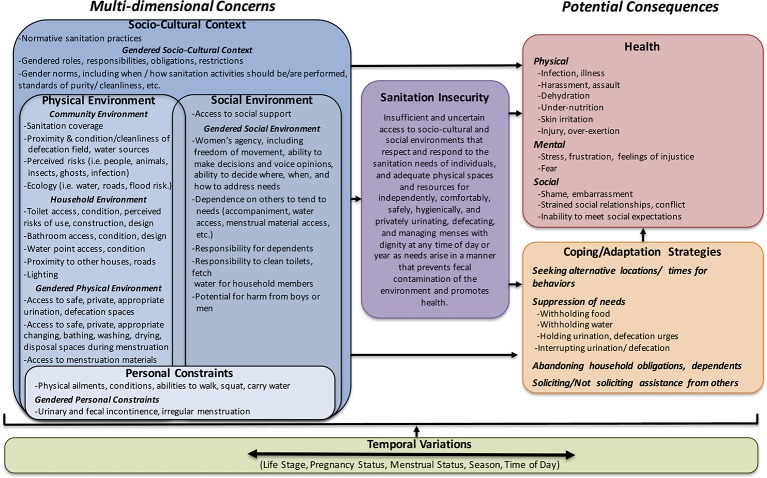
Background Research suggests that the lived experience of inadequate sanitation may contribute to poor health outcomes above and beyond pathogen exposure, particularly among women. The goal of this research was to understand women’s lived experiences of sanitation by documenting their urination-related, defecation-related and menstruation-related concerns, to use findings to develop a definition of sanitation insecurity among women in low-income settings and to develop a conceptual model to explain the factors that contribute to their experiences, including potential behavioural and health consequences. Methods We conducted 69 Free-List Interviews and eight focus group discussions in a rural population in Odisha, India to identify women’s sanitation concerns and to build an understanding of sanitation insecurity. Findings We found that women at different life stages in rural Odisha, India have a multitude of unaddressed urination, defecation and menstruation concerns. Concerns fell into four domains: the sociocultural context, the physical environment, the social environment and personal constraints. These varied by season, time of day, life stage and toilet ownership, and were linked with an array of adaptations (ie, suppression, withholding food and water) and consequences (ie, scolding, shame, fear). Our derived definition and conceptual model of sanitation insecurity reflect these four domains. Discussion To sincerely address women’s sanitation needs, our findings indicate that more is needed than facilities that change the physical environment alone. Efforts to enable urinating, defecating and managing menstruation independently, comfortably, safely, hygienically, privately, healthily, with dignity and as needed require transformative approaches that also address the gendered, sociocultural and social environments that impact women despite facility access. This research lays the groundwork for future sanitation studies to validate or refine the proposed definition and to assess women’s sanitation insecurity, even among those who have latrines, to determine what may be needed to improve women’s sanitation circumstances.
Overview
The claims and statistics of this paper haven’t been checked yet.
Run the check — free, no account needed. It reads the open-access text and checks the sources it cites.
Integrity signals
Registry
Cites
Statistics
Figures
Verification
Claims the paper makes
The claims and statistics of this paper haven’t been checked yet.
Run the check — free, no account needed. It reads the open-access text and checks the sources it cites.
Claims other papers make about this one
Each is checked against this paper’s own text: does it say what the citing paper says it does?
The source backs part of the claim, not all of it — or backs it for a different population, condition or comparison.
In the citing paper
“In many settings, menstrual blood—and by extension, menstruating women—were considered ritually impure or polluting”
From Women’s and girls’ experiences of menstruation in low- and middle-income countries: A systematic review and qualitative metasynthesis (2019) · cites this paper as [16]
Experimental — accuracy not yet measuredThe cited source says what the claim attributes to it.
In the citing paper
“Rural Indian women reportedly suppressed urination and defecation urges when caregiving and household obligations were pressing [184]”
From Water, sanitation, and women’s empowerment: A systematic review and qualitative metasynthesis (2022) · cites this paper as [184]
The cited source says what the claim attributes to it.
In the citing paper
“These findings seem inconsistent with high reports of stress associated with menstrual management in studies amongst school girls in sub-Saharan Africa [2,5,13,34], and among adult women in India [16,18,35].”
From The relationship between household sanitation and women’s experience of menstrual hygiene: Findings from a cross-sectional survey in Kaduna State, Nigeria. (2018) · cites this paper as [35]
In the citing paper
“Movement restrictions influenced women and girls' access to water [101, 110, 178] and defecation, urination, and menstrual management locations, and are most widely reported in India [62, 135, 174, 181, 182, 184, 187], [101,110,187,[189][190][191].”
From Water, sanitation, and women’s empowerment: A systematic review and qualitative metasynthesis (2022) · cites this paper as [184]
In the citing paper
“Women reported different health concerns, mostly negative, based on life stage and circumstance.Notably, pregnant women expressed health fears related to sanitationrelated superstitions (India [184, 189]), women with trouble controlling urination or defecation stressed about accessing sanitation sites (India [2]), women reliant on bags, buckets, or open defecation had substantially lower odds of”
From Water, sanitation, and women’s empowerment: A systematic review and qualitative metasynthesis (2022) · cites this paper as [184]
In the citing paper
“Women reported challenges related to privacy and water, specifically concerning hygiene.Women and girls in Bangladesh, [199] India, [184, 189, 226] Indonesia, [115] and Mozambique [175, 261] described challenges obtaining privacy at water sources used for bathing, post-defecation cleansing, and washing, particularly during menstruation.”
From Water, sanitation, and women’s empowerment: A systematic review and qualitative metasynthesis (2022) · cites this paper as [184]
In the citing paper
“Women in Nairobi, Kenya who rely on bags, buckets, or open defecation had lower odds of experiencing privacy [256].Household or shared toilets do not always prevent women from being seen or heard while defecating [123, 184, 186].”
From Water, sanitation, and women’s empowerment: A systematic review and qualitative metasynthesis (2022) · cites this paper as [184]
In the citing paper
“Women coped with sanitation stressors by seeking social support, withholding food or drink, or changing the timing of sanitation behaviors, though adaptations could also cause stress [168, 177, 184, 189].”
From Water, sanitation, and women’s empowerment: A systematic review and qualitative metasynthesis (2022) · cites this paper as [184]
In the citing paper
“Women who withheld food and water or suppressed urination and defecation when lacking access to safe, clean latrines reported experiencing urinary tract infections, headaches, stomach aches, constipation, diarrhea, and other illnesses [135, 168, 172-174, 184, 190, 214, 248].”
From Water, sanitation, and women’s empowerment: A systematic review and qualitative metasynthesis (2022) · cites this paper as [184]
In the citing paper
“Women reported myriad sanitation-related stressors, including fear of being attacked by men or ghosts, [177, 181, 184, 189, 229, 238] being shamed for using open defecation sites, [172] suppressing urination or defecation, [184] withholding food and water, [184] needing help to meet sanitation needs, [184] being hurried while using shared facilities, [168, 185, 188] sanitation-related costs, [170,”
From Water, sanitation, and women’s empowerment: A systematic review and qualitative metasynthesis (2022) · cites this paper as [184]
In the citing paper
“Privacy of household and shared latrines is compromised by broken [189] or missing doors, [184, 248] missing locks, [175,191,248,251] and poor construction [175,191,240,251].Furthermore, women worried about being seen walking to latrines; [189, 227] waiting in queues; [130] having others hear or smell their activity; [175] or the proximity of latrines to houses, main roads, or public spaces [69,1”
From Water, sanitation, and women’s empowerment: A systematic review and qualitative metasynthesis (2022) · cites this paper as [184]
In the citing paper
“Social capital has facilitated sanitation access.Women and girls have formed and maintained social connections when accessing sanitation locations, [130, 182, 189] and sought social support to ensure privacy and safety and to protect reputations when urinating or defecating [173, 182, 184, 187-190, 223, 226].”
From Water, sanitation, and women’s empowerment: A systematic review and qualitative metasynthesis (2022) · cites this paper as [184]
In the citing paper
“Studies in India, and Odisha specifically, have explored women’s MHM challenges beyond adolescence, but have focused primarily on issues related to water, sanitation, and hygiene (WASH) conditions, including sanitation insecurity, experiences with sanitation-related psychosocial stress, and reproductive tract infections [19, 28, 44–46].”
From ’It’s like a burden on the head’: Redefining adequate menstrual hygiene management throughout women’s varied life stages in Odisha, India. (2019) · cites this paper as [19]
In the citing paper
“Wet seasons and weather presented challenges for thoroughly and discretely drying reusable menstrual materials [16, 79].”
From Women’s and girls’ experiences of menstruation in low- and middle-income countries: A systematic review and qualitative metasynthesis (2019) · cites this paper as [16]
In the citing paper
“Studies with greater interpretive depth noted that a lack of confidence to manage menses influenced how women and girls perceived themselves and their bodies, internalising a sense that ‘their bodies are beyond their control’ [5, 16, 47].”
From Women’s and girls’ experiences of menstruation in low- and middle-income countries: A systematic review and qualitative metasynthesis (2019) · cites this paper as [16]
In the citing paper
“Authors identified health impacts resulting from adherence to taboos such as dietary restrictions on the consumption of common foods, linked to fatigue, or withholding urination for fear of others observing menstrual blood in latrines [16, 41, 56, 57].”
From Women’s and girls’ experiences of menstruation in low- and middle-income countries: A systematic review and qualitative metasynthesis (2019) · cites this paper as [16]
In the citing paper
“Availability of a toilet still leaves an unmet need for addressing the women’s need for menstruation related privacy [38].”
From Menstrual hygiene management among women and adolescent girls in the aftermath of the earthquake in Nepal (2018) · cites this paper as [38]
In the citing paper
“In the south Asian context especially in India and Nepal, menstruation comes with many social restrictions including for religious rituals [9, 12, 38].”
From Menstrual hygiene management among women and adolescent girls in the aftermath of the earthquake in Nepal (2018) · cites this paper as [38]
Self-check
Percentages, sums and reported differences re-computed from the paper’s own numbers.
The self-check needs the paper’s full text.
Citations
Cites
(1996) · Cited by 11,584
Guest, G., MacQueen, K., & Namey, E. (2012) · doi:10.4135/9781483384436 · Cited by 7,924
The State of Food Insecurity in the World
WFP, W. (2015) · Cited by 2,947
(2008) · World Health Organization eBooks · Cited by 905
The impoverished gut—a triple burden of diarrhoea, stunting and chronic disease
Guerrant, R. L., DeBoer, M. D., Moore, S. R., Scharf, R. J., & Lima, A. A. M. (2013) · Nature Reviews Gastroenterology & Hepatology · doi:10.1038/nrgastro.2012.239 · Cited by 604
Clasen, T., Boisson, S., Routray, P., Torondel, B., Bell, M., Cumming, O., Ensink, J., Freeman, M., Jenkins, M., Odagiri, M., et al. (2014) · The Lancet Global Health · doi:10.1016/s2214-109x(14)70307-9 · Cited by 537
Patil, S. R., Arnold, B. F., Salvatore, A. L., Briceno, B., Ganguly, S., Colford, J. M., & Gertler, P. J. (2014) · PLoS Medicine · doi:10.1371/journal.pmed.1001709 · Cited by 487
Sommer, M., Hirsch, J. S., Nathanson, C., & Parker, R. G. (2015) · American Journal of Public Health · doi:10.2105/ajph.2014.302525 · Cited by 401
The Human Right to Water and Sanitation
Kirschner, A. J. (2011) · Max Planck Yearbook of United Nations Law · doi:10.1163/18757413-90000075 · Cited by 352
Sahoo, K. C., Hulland, K. R. S., Caruso, B. A., Swain, R., Freeman, M. C., Panigrahi, P., & Dreibelbis, R. (2015) · Social Science & Medicine · doi:10.1016/j.socscimed.2015.06.031 · Cited by 300
Self-citation
Research works printed but not linked: 1
- Coffey, 2014, Revealed preference for open defecation, Economic & Political Weekly, 49, 43
Cited by
Sorted by citations
Hennegan, J., Shannon, A. K., Rubli, J., Schwab, K. J., & Melendez-Torres, G. J. (2019) · PLOS Medicine · doi:10.1371/journal.pmed.1002803 · Cited by 577
“…Ullrich 1992 [96]; Umeora 2008 [97]; UN Women 2017 [98]; Wall 2016 [99]; WSSCC 2014 [102] Behavioural expectations: Internally enforced (n = 8) Caruso 2017 [16]; Chebii 2018 [43]; Daniels 2016 [51]; Hemachandra 2009 [105]; Rheinlander 2018 [81]; Scorgie 2016 [84]; Sommer 2015 [88, 89];…”
BackgroundMethodInfluentialJones, D. L., Quintela‐Baluja, M., Graham, D. W., Corbishley, A., McDonald, J. E., Malham, S. K., Hillary, L. S., Connor, T. R., Gaze, W. H., Moura, I. B., et al. (2020) · The Science of The Total Environment · doi:10.1016/j.scitotenv.2020.141364 · Cited by 404
Wutich, A., Brewis, A., & Tsai, A. C. (2020) · Wiley Interdisciplinary Reviews Water · doi:10.1002/wat2.1461 · Cited by 201
Budhathoki, S. S., Bhattachan, M., Castro-Sánchez, E., Sagtani, R. A., Rayamajhi, R. B., Rai, P., & Sharma, G. (2018) · BMC Women's Health · doi:10.1186/s12905-018-0527-y · Cited by 144
“Availability of a toilet still leaves an unmet need for addressing the women’s need for menstruation related privacy [38].”
BackgroundWater, sanitation and hygiene: measuring gender equality and empowerment
Kayser, G., Rao, N., Jose, R., & Raj, A. (2019) · Bulletin of the World Health Organization · doi:10.2471/blt.18.223305 · Cited by 139
Sclar, G. D., Penakalapati, G., Caruso, B. A., Rehfuess, E. A., Garn, J. V., Alexander, K. T., Freeman, M. C., Boisson, S., Medlicott, K., & Clasen, T. (2018) · Social Science & Medicine · doi:10.1016/j.socscimed.2018.09.016 · Cited by 113
Self-citationMacRae, E. R., Clasen, T., Dasmohapatra, M., & Caruso, B. A. (2019) · PLOS ONE · doi:10.1371/journal.pone.0220114 · Cited by 111
Self-citationWhat motivates open defecation? A qualitative study from a rural setting in Nepal.
Bhatt, N., Budhathoki, S. S., Lucero-Prisno, D. E. I., Shrestha, G., Bhattachan, M., Thapa, J., Sunny, A. K., Upadhyaya, P., Ghimire, A., & Pokharel, P. K. (2019) · PLoS ONE · doi:10.1371/journal.pone.0219246 · Cited by 95
Water, sanitation, and women’s empowerment: A systematic review and qualitative metasynthesis
Caruso, B. A., Conrad, A., Patrick, M., Owens, A., Kviten, K., Zarella, O., Rogers, H., & Sinharoy, S. S. (2022) · PLOS Water · doi:10.1371/journal.pwat.0000026 · Cited by 94
Self-citationBrewis, A., Choudhary, N., & Wutich, A. (2019) · Social Science & Medicine · doi:10.1016/j.socscimed.2019.112520 · Cited by 97
Caruso, B. A., Cooper, H. L. F., Haardörfer, R., Yount, K. M., Routray, P., Torondel, B., & Clasen, T. (2018) · SSM - Population Health · doi:10.1016/j.ssmph.2018.06.005 · Cited by 87
Self-citationChirgwin, H., Cairncross, S., Zehra, D., & Waddington, H. S. (2021) · Campbell Systematic Reviews · doi:10.1002/cl2.1194 · Cited by 106
Caruso, B., Clasen, T., Yount, K., Cooper, H., Hadley, C., & Haardörfer, R. (2017) · International Journal of Environmental Research and Public Health · doi:10.3390/ijerph14070755 · Cited by 79
Self-citationNabwera, H., Shah, V., Neville, R., Sosseh, F., Saidykhan, M., Faal, F., Sonko, B. J., Keita, O., Schmidt, W., & Torondel, B. (2021) · PLoS ONE · doi:10.1371/journal.pone.0247554 · Cited by 85
Plesons, M., Patkar, A., Babb, J., Balapitiya, A., Carson, F., Caruso, B. A., Franco, M. M., Hansen, M. M., Haver, J., Jahangir, A., et al. (2021) · Reproductive Health · doi:10.1186/s12978-021-01082-2 · Cited by 82
Self-citationCalderón-Villarreal, A., Schweitzer, R., & Kayser, G. (2022) · International Journal for Equity in Health · doi:10.1186/s12939-022-01626-3 · Cited by 78
Making the Case for a Female-Friendly Toilet
Schmitt, M., Clatworthy, D., Ogello, T., & Sommer, M. (2018) · Water · doi:10.3390/w10091193 · Cited by 68
Kimutai, J. J., Lund, C., Moturi, W. N., Shewangizaw, S., Feyasa, M. B., & Hanlon, C. (2023) · PLoS ONE · doi:10.1371/journal.pone.0286146 · Cited by 79
Baker, K. K., Story, W. T., Walser-Kuntz, E. T., & Zimmerman, M. B. (2018) · PLoS ONE · doi:10.1371/journal.pone.0205345 · Cited by 72
Shared sanitation and the spread of COVID-19: risks and next steps
Caruso, B. A., & Freeman, M. C. (2020) · The Lancet Planetary Health · doi:10.1016/s2542-5196(20)30086-3 · Cited by 57
Self-citationMacArthur, J., Carrard, N., & Willetts, J. (2020) · Journal of Water Sanitation and Hygiene for Development · doi:10.2166/washdev.2020.232 · Cited by 63
Ross, I., Cumming, O., Dreibelbis, R., Adriano, Z., Nalá, R., & Greco, G. (2021) · Social Science & Medicine · doi:10.1016/j.socscimed.2021.113709 · Cited by 61
Systematic review of menstrual health and hygiene in Nepal employing a social ecological model
Sharma, A., McCall‐Hosenfeld, J. S., & Cuffee, Y. (2022) · Reproductive Health · doi:10.1186/s12978-022-01456-0 · Cited by 68
Cross-sectional study to measure household water insecurity and its health outcomes in urban Mexico
Jepson, W. E., Stoler, J. B., Baek, J., Morán‐Martínez, J., Uribe-Salas, F. J., & Carrillo, G. (2021) · BMJ Open · doi:10.1136/bmjopen-2020-040825 · Cited by 55
Schmitt, M. L., Wood, O. R., Clatworthy, D., Rashid, S. F., & Sommer, M. (2021) · Conflict and Health · doi:10.1186/s13031-021-00346-9 · Cited by 53
Wilson, L. C., Rademacher, K. H., Rosenbaum, J., Callahan, R. L., Nanda, G., Fry, S., & Mackenzie, A. C. L. (2021) · Sexual and Reproductive Health Matters · doi:10.1080/26410397.2021.1882791 · Cited by 51
Camenga, D. R., Brady, S. S., Hardacker, C. T., Williams, B. R., Hebert‐Beirne, J., James, A. S., Burgio, K. L., Nodora, J., Wyman, J. F., Berry, A. K., et al. (2019) · International Journal of Environmental Research and Public Health · doi:10.3390/ijerph16183338 · Cited by 46
Adams, E. A., Adams, Y. J., & Koki, C. (2021) · Sustainability Science Practice and Policy · doi:10.1080/15487733.2021.1875682 · Cited by 51
Ellis, A. S., McClintic, E. E., Awino, E. O., Caruso, B. A., Arriola, K. J., Ventura, S. G., Kowalski, A. J., Linabarger, M., Wodnik, B. K., Girard, A. W., et al. (2020) · American Journal of Tropical Medicine and Hygiene · doi:10.4269/ajtmh.19-0389 · Cited by 43
Self-citationHennegan, J., Zimmerman, L., Shannon, A. K., Exum, N. G., OlaOlorun, F., Omoluabi, E., & Schwab, K. J. (2018) · International Journal of Environmental Research and Public Health · doi:10.3390/ijerph15050905 · Cited by 38
Taboo in consumption: Social structure, gender and sustainable menstrual products
Meenakshi, N. (2020) · International Journal of Consumer Studies · doi:10.1111/ijcs.12562 · Cited by 37
Gold-Watts, A., Hovdenak, M., Daniel, M., Gandhimathi, S., Sudha, R., & Bastien, S. (2020) · International Journal of Qualitative Studies on Health and Well-Being · doi:10.1080/17482631.2020.1845924 · Cited by 46
Drivers of menstrual material disposal and washing practices: A systematic review
Robinson, H. J., & Barrington, D. (2021) · PLoS ONE · doi:10.1371/journal.pone.0260472 · Cited by 32
Datta, S. (2020) · ChemRxiv · doi:10.26434/chemrxiv.13102877 · Cited by 31
Augsburg, B., Malde, B., Olorenshaw, H., & Wahhaj, Z. (2023) · Journal of Development Economics · doi:10.1016/j.jdeveco.2023.103074 · Cited by 33
Exum, N. G., Gorin, E. M., Sadhu, G., Khanna, A., & Schwab, K. J. (2020) · BMJ Global Health · doi:10.1136/bmjgh-2019-002277 · Cited by 33
Caruso, B. A., Portela, G., McManus, S., & Clasen, T. (2020) · International Journal of Environmental Research and Public Health · doi:10.3390/ijerph17103468 · Cited by 32
Self-citationCaruso, B. A., Sclar, G. D., Routray, P., Nagel, C., Majorin, F., Sola, S. Q., Koehne, W. J., & Clasen, T. (2022) · The Lancet Planetary Health · doi:10.1016/s2542-5196(21)00324-7 · Cited by 30
Self-citation‘Choice’ in occupational therapy theory: A critique from the situation of patriarchy in India
Murthi, K., & Hammell, K. W. (2020) · Scandinavian Journal of Occupational Therapy · doi:10.1080/11038128.2020.1769182 · Cited by 29
Curious eyes and awkward smiles: Menstruation and adolescent boys in India
Gundi, M., & Subramanyam, M. A. (2020) · Journal of Adolescence · doi:10.1016/j.adolescence.2020.09.013 · Cited by 29
Alda‐Vidal, C., Lawhon, M., Iossifova, D., & Browne, A. L. (2023) · Geoforum · doi:10.1016/j.geoforum.2023.103724 · Cited by 28
Freeman, M. C., Delea, M. G., Snyder, J. S., Garn, J. V., Belew, M. L., Caruso, B. A., Clasen, T., Sclar, G. D., Tesfaye, Y. A., Woreta, M., et al. (2022) · PLOS Global Public Health · doi:10.1371/journal.pgph.0000056 · Cited by 33
Self-citationKouassi, H. A. A., Andrianisa, H. A., Traoré, M. B., Sossou, S. K., Nguematio, R. M., Saapi, S. S. Y., & Ahossouhe, M. S. (2023) · International Journal of Hygiene and Environmental Health · doi:10.1016/j.ijheh.2023.114160 · Cited by 33
Gender and Sanitation: Women’s Experiences in Rural Regions and Urban Slums in India
Vogel, W., Hwang, C. D., & Hwang, S. S. (2022) · Societies · doi:10.3390/soc12010018 · Cited by 33
Ogutu, E. A., Ellis, A. S., Rodriguez, K., Caruso, B. A., McClintic, E. E., Ventura, S. G., Arriola, K. J., Kowalski, A. J., Linabarger, M., Wodnik, B. K., et al. (2022) · BMC Public Health · doi:10.1186/s12889-022-14259-6 · Cited by 27
Self-citationLinking water (in)security and wellbeing in low-and middle-income countries
Kangmennaang, J., & Elliott, S. J. (2021) · Water Security · doi:10.1016/j.wasec.2021.100089 · Cited by 28
Woyessa, E. T., Ashenafi, T., Ashuro, Z., & Ejeso, A. (2022) · Environmental Health Insights · doi:10.1177/11786302221114819 · Cited by 26
Sustaining latrine use: Peers, policies, and sanitation behaviors
Pakhtigian, E. L., Dickinson, K. L., Orgill-Meyer, J., & Pattanayak, S. K. (2022) · Journal of Economic Behavior & Organization · doi:10.1016/j.jebo.2022.05.024 · Cited by 25
Ross, I., Greco, G., Adriano, Z., Nalá, R., Brown, J. M., Opondo, C., & Cumming, O. (2022) · BMJ Open · doi:10.1136/bmjopen-2022-062517 · Cited by 24
Jewitt, S., Mahanta, A., & Gaur, K. (2018) · Geographical Journal · doi:10.1111/geoj.12258 · Cited by 23
Jain, A., Fernald, L. C. H., Smith, K. R., & Subramanian, S. V. (2019) · International Journal of Environmental Research and Public Health · doi:10.3390/ijerph16050734 · Cited by 23
Narratives of sanitation: Motivating toilet use in India
Leong, C. (2020) · Geoforum · doi:10.1016/j.geoforum.2019.10.001 · Cited by 24
Multidimensional Benefits of Improved Sanitation: Evaluating ‘PEE POWER®’in Kisoro, Uganda.
You, J., Staddon, C., Cook, A., Walker, J., Boulton, J., Powell, W., & Ieropoulos, I. (2020) · International Journal of Environmental Research and Public Health · doi:10.3390/ijerph17072175 · Cited by 20
Behera, M. R., Parida, S., Pradhan, H. S., Priyabadini, D. S., Dehury, R. K., & Mishra, B. (2022) · Journal of Family Medicine and Primary Care · doi:10.4103/jfmpc.jfmpc_1593_21 · Cited by 22
Delea, M. G., Snyder, J. S., Belew, M. L., Caruso, B. A., Garn, J. V., Sclar, G. D., Woreta, M., Zewudie, K., Gebremariam, A., & Freeman, M. C. (2019) · BMC Public Health · doi:10.1186/s12889-019-7040-6 · Cited by 18
Self-citationTorondel, B., Ferma, J., Francis, S. C., Caruso, B. A., Routray, P., Reese, H. E., & Clasen, T. (2021) · International Journal of Hygiene and Environmental Health · doi:10.1016/j.ijheh.2021.113866 · Cited by 19
Self-citationSchmitt, M. L., Hagstrom, C., Gruer, C., Nowara, A., Keeley, K., Adenu-Mensah, N. E., & Sommer, M. (2022) · Journal of Adolescent Research · doi:10.1177/07435584221139342 · Cited by 18
Robinson, H. J., Barrington, D., Evans, B., Hutchings, P., & Narayanaswamy, L. (2023) · Development Policy Review · doi:10.1111/dpr.12741 · Cited by 17
Wilbur, J., Clemens, F., Sweet, E., Banks, L. M., & Morrison, C. (2022) · Frontiers in Water · doi:10.3389/frwa.2022.983789 · Cited by 14
Plesons, M., Torondel, B., Caruso, B. A., Hennegan, J. M., Sommer, M., Haver, J., Keiser, D., van Eijk, A. M., Zulaika, G., Mason, L., et al. (2023) · Global Health Action · doi:10.1080/16549716.2023.2279396 · Cited by 15
Self-citationWomen are more likely to expect social sanctions for open defecation: Evidence from Tamil Nadu India
Kuang, J., Ashraf, S., Shpenev, A., Delea, M. G., Das, U., & Bicchieri, C. (2020) · PLoS ONE · doi:10.1371/journal.pone.0240477 · Cited by 17
Haver, J., Long, J. L., Caruso, B. A., & Dreibelbis, R. (2018) · Studies in Social Justice · doi:10.26522/ssj.v12i2.1947 · Cited by 15
Self-citationLogie, C. H., Loutet, M. G., Mackenzie, F., Okumu, M., Leggett, R., Akinwande, S. F., Lukone, S. O., Kisubi, N., Kyambadde, P., Otika, L., et al. (2025) · Global Public Health · doi:10.1080/17441692.2025.2503863 · Cited by 13
Water, sanitation and hygiene at sex work venues to support menstrual needs
Phillips‐Howard, P. A., Osire, E. A., Akinyi, C., Zulaika, G., Otieno, F., & Mehta, S. D. (2024) · Frontiers in Public Health · doi:10.3389/fpubh.2024.1305601 · Cited by 13
Purity, Pollution, and Space: Barriers to Latrine Adoption in Post-disaster India
Juran, L., Adams, E. A., & Prajapati, S. (2019) · Environmental Management · doi:10.1007/s00267-019-01202-6 · Cited by 13
Community Perceptions of a Multilevel Sanitation Behavior Change Intervention in Rural Odisha, India
Shay, R. D., Comeau, D. L., Sclar, G. D., Routray, P., & Caruso, B. A. (2020) · International Journal of Environmental Research and Public Health · doi:10.3390/ijerph17124472 · Cited by 12
Self-citationZaman, R. T., & Mohiuddin, M. F. (2021) · South Asian Journal of Business Studies · doi:10.1108/sajbs-08-2020-0274 · Cited by 14
Influences on water source selection and use among women in rural Odisha, India
Patrick, M., Hennink, M. M., Dasmohapatra, M., Rout, M., Clasen, T., & Caruso, B. A. (2023) · Frontiers in Water · doi:10.3389/frwa.2023.1040981 · Cited by 13
Self-citationGlobal Health Priorities and the Neglect of Menstrual Health and Hygiene
Jalali, R. (2023) · Sociology of Development · doi:10.1525/sod.2023.9.4.317 · Cited by 13
Sanitation policy in India – designed to fail?
Kedia, M. (2022) · Policy Design and Practice · doi:10.1080/25741292.2022.2069650 · Cited by 10
Development of a behaviour change intervention to promote sanitation and latrine use in rural India
Talat, U., Ravenscroft, L., & Vlaev, I. (2023) · BMC Public Health · doi:10.1186/s12889-023-17061-0 · Cited by 10
WaSH insecurity and anxiety among people who inject drugs in the Tijuana-San Diego border region
Portillo, L. J. A., Calderón-Villarreal, A., Abramovitz, D. A., Vera, A., Cassels, S. L., Vera, C. F., Muñoz, S., Tornez, A., Rangel, G., Strathdee, S. A., et al. (2024) · BMC Public Health · doi:10.1186/s12889-023-17341-9 · Cited by 10
Factors influencing women to participate in cervical cancer screening by providing menstrual pads
Budukh, A. M., Maheshwari, A., Bagal, S. S., Singh, A., Deodhar, K., Panse, N. S., Palyekar, V., Dikshit, R. P., & Badwe, R. A. (2021) · Indian Journal of Cancer · doi:10.4103/ijc.ijc_910_19 · Cited by 8
Unlocking the Role of Social Norms: How They Shape Women’s Public Toilet Usage in India
Babbar, K., Das, U., Ashraf, S., Shpenev, A., & Bicchieri, C. (2023) · American Journal of Tropical Medicine and Hygiene · doi:10.4269/ajtmh.23-0220 · Cited by 7
Audio Diaries: A Novel Method for Water, Sanitation, and Hygiene-Related Maternal Stress Research
O’Reilly, K., Ramanaik, S., Story, W. T., Gnanaselvam, N. A., Baker, K. K., Cunningham, L. T., Mukherjee, A., & Pujar, A. (2022) · International Journal of Qualitative Methods · doi:10.1177/16094069211073222 · Cited by 9
Belle, S. V. (2022) · International Journal for Equity in Health · doi:10.1186/s12939-022-01644-1 · Cited by 7
Sommer, M., Zulaika, G., Schmitt, M. L., Khandakji, S., Neudorf, K., Gellis, L., & Phillips‐Howard, P. A. (2020) · Journal of Global Health Reports · doi:10.29392/001c.12105 · Cited by 9
Hamlet, L. C., Gutierrez, V. B., Soto, A., & Dickin, S. (2022) · H2Open Journal · doi:10.2166/h2oj.2022.021 · Cited by 6
Sebesta, E. M., Furuyama, W. M., Dmochowski, R., & Reynolds, W. S. (2024) · Urology · doi:10.1016/j.urology.2024.06.071 · Cited by 6
Women as Pioneers: Examining Their Role in Decision Making on Toilet Construction in India
Das, U., Kuang, J., Ashraf, S., Shpenev, A., & Bicchieri, C. (2022) · Journal of Human Development and Capabilities · doi:10.1080/19452829.2022.2111410 · Cited by 5
Rickey, L., Camenga, D. R., Brady, S. S., Williams, B. R., Wyman, J. F., Brault, M. A., Smith, A. L., LaCoursiere, D. Y., James, A. S., Lavender, M. D., et al. (2022) · Current Bladder Dysfunction Reports · doi:10.1007/s11884-022-00655-6 · Cited by 6
Clasen, T. F., & Sugden, S. S. S. (2009) · Oxford University Press eBooks · doi:10.1093/med/9780198816805.003.0012 · Cited by 6
Kimutai, J. J., Lund, C., Moturi, W. N., Shewangizaw, S., & Hanlon, C. (2025) · Social Science & Medicine · doi:10.1016/j.socscimed.2025.118118 · Cited by 7
Logie, C. H., Hasham, A., Kagunda, J., Evelia, H., Pellatt, A., Gachoki, C., Chege, M. W., & Gittings, L. (2025) · Preventive Medicine Reports · doi:10.1016/j.pmedr.2025.103325 · Cited by 4
Khan, S., Kumar, V., Gawde, N. C., & Dash, A. (2022) · International Journal of Community Medicine and Public Health · doi:10.18203/2394-6040.ijcmph20223223 · Cited by 4
Chakraborty, S., Novotný, J., Das, J., Patel, P. P., Maity, I., & Roy, U. (2024) · The Professional Geographer · doi:10.1080/00330124.2023.2287167 · Cited by 4
Bourne, M. P., & Ahsan, K. Z. (2025) · Health Promotion Practice · doi:10.1177/15248399241308901 · Cited by 3
Okoro, R. N., Aluh, D. O., & Aguiyi-Ikeanyi, C. (2025) · Journal of Health Reports and Technology · doi:10.5812/jhrt-147981 · Cited by 3
Bhan, T., Caruso, B. A., & Sinharoy, S. S. (2025) · Sustainable Development · doi:10.1002/sd.3495 · Cited by 3
Self-citationHayashi, M. A. L., Simon, S., Zou, K., Wyk, H. V., Zahid, M. H., Eisenberg, J. N. S., & Freeman, M. C. (2024) · Risk Analysis · doi:10.1111/risa.17633 · Cited by 5
Stephan, N., Sinharoy, S. S., Waford, R., Patrick, M., Mink, T. L., Bhan, T., Ahmed, T., Ahmed, A., & Caruso, B. A. (2025) · Health & Place · doi:10.1016/j.healthplace.2025.103515 · Cited by 3
Self-citationVenugopal, V., Kumar, A. P., Shanmugam, R., & Latha, P. K. (2021) · Journal of Public Health · doi:10.1007/s10389-021-01615-w · Cited by 4
An evaluation of different provision strategies for scaled-up container-based sanitation
Ferguson, C., Mallory, A., Hutchings, P., Remington, C., Lloyd, E., Kiogora, D., Anciano, F., & Parker, A. (2021) · H2Open Journal · doi:10.2166/h2oj.2021.112 · Cited by 3
Social and physical environment effects on toileting disability among older adults in India
Fong, J. H. Y., & Selvamani, Y. (2024) · BMC Geriatrics · doi:10.1186/s12877-024-05198-5 · Cited by 2
Logie, C. H., Admassu, Z., Hasham, A., Evelia, H., Kagunda, J., Omondi, B., Gachoki, C., Chege, M. W., Gittings, L., Dorea, C. C., et al. (2025) · Journal of the International Association of Providers of AIDS Care (JIAPAC) · doi:10.1177/23259582251362938 · Cited by 3
Chi, H., Puno, A., Jain, A., Subramanian, S. V., & Kim, R. (2026) · Social Science & Medicine · doi:10.1016/j.socscimed.2026.119005 · Cited by 2
Baddianaah, I., Naazie, G. K., Amaning, A. W. Z., & Terkper, P. (2024) · Environmental Challenges · doi:10.1016/j.envc.2024.100965 · Cited by 2
Aluko, O. O. (2024) · Transactions of the Royal Society of Tropical Medicine and Hygiene · doi:10.1093/trstmh/trae101 · Cited by 3
Trivedy, A., & Khatun, M. (2025) · SN Social Sciences · doi:10.1007/s43545-025-01073-1 · Cited by 2
Sanitation-related withholding and suppression among women in urban Uganda and India
Sinclair, E., Hüls, A., Patrick, M., Arun, S., Ramanarayanan, V., Sinharoy, S. S., & Caruso, B. A. (2025) · Nature Water · doi:10.1038/s44221-025-00452-5 · Cited by 2
Self-citation
Metadata
- Authors
- Caruso, B. A., Clasen, T. F., Hadley, C., Yount, K. M., Haardörfer, R., Rout, M., Dasmohapatra, M., & Cooper, H. L.
- Affiliations
- Emory University (US)
- London School of Hygiene & Tropical Medicine (GB)
- Corresponding author
- Caruso, Bethany A
- ORCID
- Venue
- BMJ Global Health
- Publisher
- BMJ
- Published
- 2017-10
- Volume
- 2
- Issue
- 4
- Pages
- e000414
- ISSN
- 2059-7908 (ISSN-L)
- PMC
- PMC5640070
- OpenAlex
- W2762747131
- Cited by
- 165
- References
- 45
- Citations by year
- 2026: 20 · 2025: 20 · 2024: 13 · 2023: 16 · 2022: 23 · 2021: 31 · 2020: 21 · 2019: 10 · 2018: 9 · 2017: 1
- FWCI
- 23.37
- Type
- journal article
- Language
- en
- Open access
- gold
- doi.org
- Licence
- cc-by
- Locations
- BMJ Global Health (publishedVersion, cc-by)
- PubMed Central (publishedVersion, cc-by)
- PubMed (publishedVersion)
- LSHTM Research Online (London School of Hygiene and Tropical Medicine) (acceptedVersion)
- Funders
- Bill and Melinda Gates Foundation
- National Institutes of Health
- Topics
- Social Sciences › Gender Studies › Gender Studies and Social Issues
- Health Sciences › Nursing › Nutrition and Dietetics › Child Nutrition and Water Access
- Physical Sciences › Environmental Science › Pollution › Energy and Environment Impacts
- Keywords
- micturition, defecation, menstruation, gendered experiences, rural Odisha, latrine ownership, socio-cultural barriers, stigma and shame, life stages, conceptual model
About these checks
Registry, retraction, Cites and statistics results are computed, not judged, with one exception: a printed reference that no index lists is read once by a model before it counts as a citation error. Claims are extracted by a model and kept only when their quote appears verbatim in the text; each cited source is then checked, with a model’s help, for whether it says what the claim relies on. Those verdicts can be wrong — read the claim’s quote and the cited source before relying on one.
Statistics and arithmetic are recomputed, not judged.
Confidence bands are shown only for fields calibrated on our annotated test set. None is calibrated yet, so no band is shown.
What counts as a claim ›How we measure confidence ›How we check this ›
Are you an author, or do you see a problem with this page? Request a review
