

The DOI matches its Crossref record; 52 of the 52 references it cites were found in a registry or an index.
Trust, culture and communication: determinants of eye health and care among Indigenous people with diabetes in Australia
Abstract
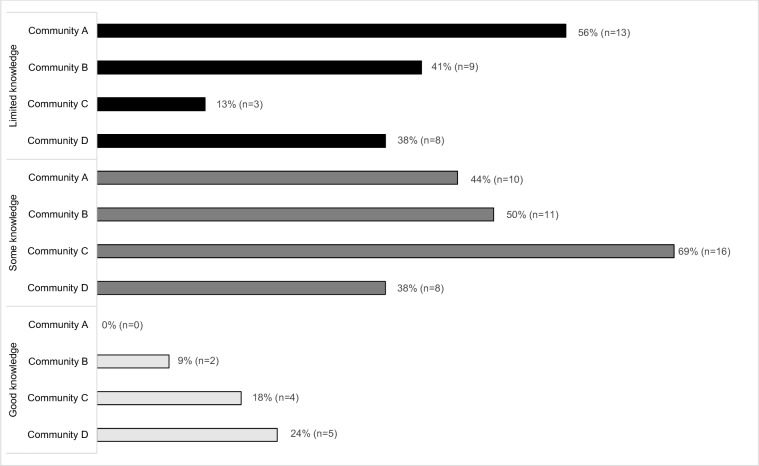
Introduction: Our study aimed to identify factors that influence access to eye care and eye health outcomes for remote Indigenous Australians living with diabetes. Methods: In collaboration with Indigenous Community-Based Researchers (CBR) and Aboriginal Community Controlled Health Services (ACCHS), a qualitative, participatory action research approach was taken, drawing on Indigenist and decolonising methodologies. The study was undertaken in four remote communities, in the Katherine region, Northern Territory and north-western New South Wales, Australia. Interviews and focus groups were undertaken with Indigenous adults aged ≥40 years living with diabetes (n=110), and primary care clinicians working in ACCHSs (n=37). A series of interviews with CBRs (n=13) were undertaken before and after data collection to add cultural insights and validation to participant accounts. Data were analysed inductively using grounded theory, in-depth discussion and NVivo V.11. Results: More than one-third of all patients had little to no knowledge of how diabetes affects eye health. Limited access to health information and interpreters, language barriers, distrust of health providers and services, and limited cultural responsivity among non-Indigenous clinicians, were identified as determining factors in eye health and care. Discussion: We outline a need to address gaps in trust and communication, through increased access to and resourcing of Indigenous language interpreters and cultural brokers, understandable and culturally sensitive diabetic eye health information and cultural responsivity training for non-Indigenous clinicians. Centring Indigenous cultures in healthcare practice will enable a shared understanding between clinicians and Indigenous patients, and subsequently more equitable eye health outcomes.
Overview
The claims and statistics of this paper haven’t been checked yet.
Run the check — free, no account needed. It reads the open-access text and checks the sources it cites.
Integrity signals
Registry
Cites
Statistics
Figures
Verification
Claims the paper makes
The claims and statistics of this paper haven’t been checked yet.
Run the check — free, no account needed. It reads the open-access text and checks the sources it cites.
Claims other papers make about this one
Each is checked against this paper’s own text: does it say what the citing paper says it does?
The source backs part of the claim, not all of it — or backs it for a different population, condition or comparison.
In the citing paper
“Lack of provider cultural sensitivity has been found to compound chronic disease pathogenesis in patients, and impede provider to patient communication, care use, and health outcomes (Wakerman et al., 2019; Yashadhana et al., 2020).”
From On race, human variation, and who gets and dies of sepsis (2022) · cites this paper as Yashadhana et al., 2020
Experimental — accuracy not yet measured
Self-check
Percentages, sums and reported differences re-computed from the paper’s own numbers.
The self-check needs the paper’s full text.
Citations
Cites
The Discovery of Grounded Theory: Strategies for Qualitative Research.
Wagner, H. R., Glaser, B. G., & Strauss, A. L. (1968) · Social Forces · doi:10.2307/2575405 · Cited by 46,361
The Discovery of Grounded Theory; Strategies for Qualitative Research
Glaser, B. G., Strauss, A. L., & Strutzel, E. (1968) · Nursing Research · doi:10.1097/00006199-196807000-00014 · Cited by 39,449
8 Decolonizing Methodologies: Research and Indigenous Peoples
Tuhiwai Smith, L. (2024) · Foundational Concepts of Decolonial and Southern Epistemologies · doi:10.21832/9781800418868-012 · Cited by 9,810
Fanon, F. (2000) · Posthumanism · doi:10.1007/978-1-137-05194-3_4 · Cited by 7,493
Baum, F., MacDougall, C., & Smith, D. (2006) · Journal of Epidemiology and Community Health · doi:10.1136/jech.2004.028662 · Cited by 2,420
Indigenous health part 1: Determinants and disease patterns
Gracey, M., & King, M. (2009) · The Lancet · doi:10.1016/s0140-6736(09)60914-4 · Cited by 1,303
Martin-Booran Mirraboopa, K. (2003) · Journal of Australian Studies · doi:10.1080/14443050309387838 · Cited by 1,242
Understanding health literacy: an expanded model
Zarcadoolas, C., Pleasant, A., & Greer, D. S. (2005) · Health Promotion International · doi:10.1093/heapro/dah609 · Cited by 548
Wilson, R. W. (1997) · Medical Entomology and Zoology · Cited by 443
Wilkie, M. (1997) · Medical Entomology and Zoology · Cited by 402
Research works printed but not linked: 2
- Rigney, 1997, Internationalism of an Aboriginal or Torres Strait Islander anti-colonial cultural critique of research methodologies: a guide to Indigenist research methodology and its principles, Research and development in higher education: advancing international perspectives, 20, 629
- Freire, 1970, Pedagogy of the Oppressed (New York), Continuum, 72, 43
Cited by
On race, human variation, and who gets and dies of sepsis
Brinkworth, J. F., & Shaw, J. G. (2022) · American Journal of Biological Anthropology · doi:10.1002/ajpa.24527 · Cited by 9
Metadata
- Authors
- Yashadhana, A., Fields, T., Blitner, G., Stanley, R., & Zwi, A. B.
- Affiliations
- School of Public Health and Community Medicine, University of New South Wales, Sydney, New South Wales, Australia
- Vision Cooperative Research Centre, Sydney, New South Wales, Australia
- Faculty of Arts and Social Sciences, School of Social Sciences, The University of New South Wales, Sydney, New South Wales, Australia
- Venue
- BMJ Global Health
- Publisher
- BMJ
- Published
- 2020-01
- Volume
- 5
- Issue
- 1
- Pages
- e001999
- ISSN
- 2059-7908
- PMC
- PMC7042588
- Cited by
- 47
- References
- 52
- Language
- en
- Funders
- Cooperative Research Centres, Australian Government Department of Industry
About these checks
Registry, retraction, Cites and statistics results are computed, not judged, with one exception: a printed reference that no index lists is read once by a model before it counts as a citation error. Claims are extracted by a model and kept only when their quote appears verbatim in the text; each cited source is then checked, with a model’s help, for whether it says what the claim relies on. Those verdicts can be wrong — read the claim’s quote and the cited source before relying on one.
Statistics and arithmetic are recomputed, not judged.
Confidence bands are shown only for fields calibrated on our annotated test set. None is calibrated yet, so no band is shown.
What counts as a claim ›How we measure confidence ›How we check this ›
Are you an author, or do you see a problem with this page? Request a review
Data sources
Bibliographic data: Semantic Scholar, OpenAlex, Crossref.
Contains information from the Semantic Scholar Academic Graph Datasets, made available under the ODC Attribution License (ODC-BY 1.0).
Semantic Scholar’s data is described in: Kinney, R., et al. (2023). The Semantic Scholar Open Data Platform. arXiv:2301.10140.
