

The DOI matches its Crossref record; 18 of the 18 references it cites were found in a registry or an index.
Inequalities in early childhood care and development in low/middle-income countries: 2010–2018
Open accessAbstract
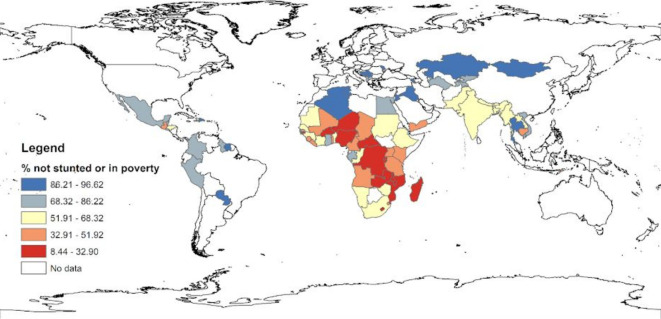
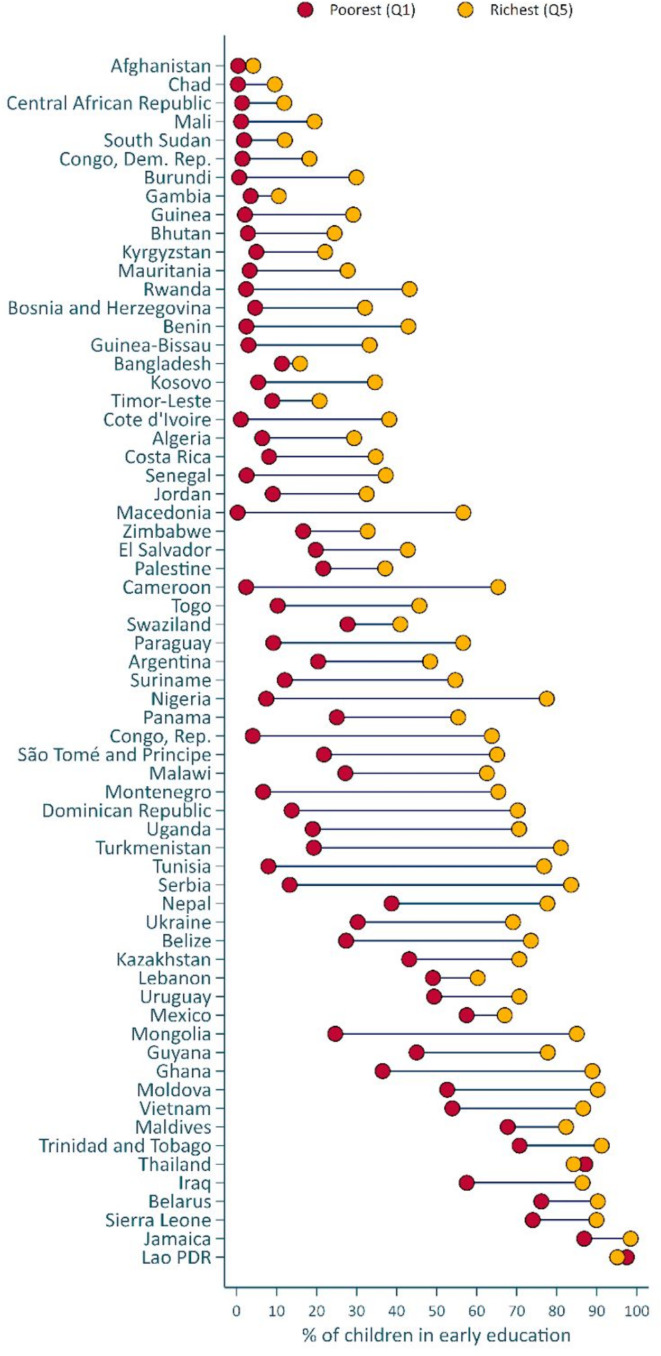
Background: Inequalities in early childhood development (ECD) tend to persist into adulthood and amplify across the life course. To date, little research on inequalities in early childhood care and development in low/middle-income countries has been available to guide governments, donors and civil society in identifying which young children and families should be targeted by policies and programmes to improve nurturing care that could prevent them from being left behind. Methods: Using data from 135 Demographic and Health Surveys and Multiple Indicator Cluster Surveys between 2010 and 2018, we assessed levels and trends of inequalities in exposure to risks of stunting or extreme poverty (under age 5; levels in 85 and trends in 40 countries), early attendance of early care and education programmes (36-59 months; 65 and 17 countries), home stimulation (36-59 months; 62 and 14 countries) and child development according to the Early Childhood Development Index (36-59 months; 60 and 13 countries). Inequalities within countries were measured as the absolute gap in three domains-child gender, household wealth and residential area-and compared across regions and country income groups. Results: 63% of children were not exposed to stunting or extreme poverty; 39% of 3-4-year olds attended early care and education; and 69% received a level of reported home stimulation defined as adequate. Sub-Saharan Africa had the lowest proportion of children not exposed to stunting or extreme poverty (45%), attending early care and education (24%) and receiving adequate home stimulation (47%). Substantial gaps in all indicators were found across country income groups, residential areas and household wealth categories. There were no significant reductions in gaps over time for a subset of countries with available data in two survey rounds. Conclusions: Available data indicate large inequalities in early experiences and outcomes. Efforts of reducing these inequalities must focus on the poorest families and those living in rural areas in the poorest countries. Improving and applying population-level measurements on ECD in more countries over time are important for ensuring equal opportunities for young children globally.
Overview
The claims and statistics of this paper haven’t been checked yet.
Run the check — free, no account needed. It reads the open-access text and checks the sources it cites.
Integrity signals
Registry
Cites
Statistics
Figures
Verification
Claims the paper makes
The claims and statistics of this paper haven’t been checked yet.
Run the check — free, no account needed. It reads the open-access text and checks the sources it cites.
Claims other papers make about this one
Each is checked against this paper’s own text: does it say what the citing paper says it does?
The source backs part of the claim, not all of it — or backs it for a different population, condition or comparison.
In the citing paper
“The study also highlighted that the children had less home stimulation and low attendance at early childcare education; indicators associated with a poorer status in subsequent school learning, labour market productivity and health [3].”
From Assessing early child development and its association with stunting and schistosome infections in rural Zimbabwean children using the Griffiths Scales of Child Development (2021) · cites this paper as [3]
Experimental — accuracy not yet measuredThe source backs part of the claim, not all of it — or backs it for a different population, condition or comparison.
In the citing paper
“The authors of this study correctly highlight that these studies were handicapped by the lack of reliable data from several low-income countries and in cases where there were data available; there was poor representation of rural communities [3].”
From Assessing early child development and its association with stunting and schistosome infections in rural Zimbabwean children using the Griffiths Scales of Child Development (2021) · cites this paper as [3]
Experimental — accuracy not yet measuredThe source backs part of the claim, not all of it — or backs it for a different population, condition or comparison.
In the citing paper
“Furthermore, the analysis also showed that children in urban areas or those in the richest household scored better on all indicators of child development than those in rural areas or those from poorer households.”
From Assessing early child development and its association with stunting and schistosome infections in rural Zimbabwean children using the Griffiths Scales of Child Development (2021) · cites this paper as [3]
Experimental — accuracy not yet measuredThe cited source says what the claim attributes to it.
In the citing paper
“A recent analysis of indicators of early childhood experiences and outcomes in low and middle-income countries comprised of 135 national household surveys, collected between 2010 and 2018 from 94 countries indicated that children in sub-Saharan Africa were exposed to stunting or extreme poverty [3].”
Self-check
Percentages, sums and reported differences re-computed from the paper’s own numbers.
The self-check needs the paper’s full text.
Citations
Cites
Filmer, D. P., & Pritchett, L. H. (2001) · Demography · doi:10.2307/3088292 · Cited by 5,992
Developmental potential in the first 5 years for children in developing countries
Grantham-McGregor, S., Cheung, Y. B., Cueto, S., Glewwe, P., Richter, L., & Strupp, B. (2007) · The Lancet · doi:10.1016/s0140-6736(07)60032-4 · Cited by 3,630
Self-citationEarly childhood development coming of age: science through the life course
Black, M. M., Walker, S. P., Fernald, L. C. H., Andersen, C. T., DiGirolamo, A. M., Lu, C., McCoy, D. C., Fink, G., Shawar, Y. R., Shiffman, J., et al. (2017) · The Lancet · doi:10.1016/s0140-6736(16)31389-7 · Cited by 3,014
Self-citationChild development: risk factors for adverse outcomes in developing countries
Walker, S. P., Wachs, T. D., Meeks Gardner, J., Lozoff, B., Wasserman, G. A., Pollitt, E., & Carter, J. A. (2007) · The Lancet · doi:10.1016/s0140-6736(07)60076-2 · Cited by 2,133
Nurturing care: Promoting early childhood development
Britto, P. R., Lye, S. J., Proulx, K., Yousafzai, A. K., Matthews, S. G., Vaivada, T., Perez-Escamilla, R., Rao, N., Ip, P., Fernald, L. C. H., et al. (2017) · The Lancet · doi:10.1016/s0140-6736(16)31390-3 · Cited by 1,796
Sexual dimorphism of brain developmental trajectories during childhood and adolescence
Lenroot, R. K., Gogtay, N., Greenstein, D. K., Wells, E. M., Wallace, G. L., Clasen, L. S., Blumenthal, J. D., Lerch, J., Zijdenbos, A. P., Evans, A. C., et al. (2007) · NeuroImage · doi:10.1016/j.neuroimage.2007.03.053 · Cited by 1,309
Origins of lifetime health around the time of conception: causes and consequences
Fleming, T. P., Watkins, A. J., Velazquez, M. A., Mathers, J. C., Prentice, A. M., Stephenson, J., Barker, M., Saffery, R., Yajnik, C. S., Eckert, J. J., et al. (2018) · The Lancet · doi:10.1016/s0140-6736(18)30312-x · Cited by 1,147
Richter, L., Daelmans, B. M. E. G., Lombardi, J., Heymann, J. S., Bóo, F. L., Behrman, J. R., Lu, C., Lucas, J. E., Pérez‐Escamilla, R., Dua, T., et al. (2016) · The Lancet · doi:10.1016/s0140-6736(16)31698-1 · Cited by 982
Self-citationEarly childhood poverty and adult attainment, behavior, and health
Duncan, G. J., Ziol-Guest, K. M., & Kalil, A. (2010) · Child Development · doi:10.1111/j.1467-8624.2009.01396.x · Cited by 859
Lu, C., Black, M. M., & Richter, L. (2016) · The Lancet Global Health · doi:10.1016/s2214-109x(16)30266-2 · Cited by 623
Self-citationMcCoy, D. C., Peet, E. D., Ezzati, M., Danaei, G., Black, M. M., Sudfeld, C. R., Fawzi, W. W., & Fink, G. (2016) · PLoS Medicine · doi:10.1371/journal.pmed.1002034 · Cited by 603
Self-citationThe Productivity Argument for Investing in Young Children
Heckman, J. J., & Masterov, D. V. (2007) · National Bureau of Economic Research · doi:10.3386/w13016 · Cited by 603
The economic rationale for investing in stunting reduction
Hoddinott, J. F., Alderman, H., Behrman, J. R., Haddad, L., & Horton, S. (2013) · Maternal and Child Nutrition · doi:10.1111/mcn.12080 · Cited by 570
An Integrated Scientific Framework for Child Survival and Early Childhood Development
Shonkoff, J. P., Richter, L., van der Gaag, J., & Bhutta, Z. A. (2012) · PEDIATRICS · doi:10.1542/peds.2011-0366 · Cited by 387
Self-citationCognitive and socioemotional caregiving in developing countries
Bornstein, M. H., & Putnick, D. L. (2012) · Child Development · doi:10.1111/j.1467-8624.2011.01673.x · Cited by 274
Home- and center-based learning opportunities for preschoolers in low- and middle-income countries
McCoy, D. C., Salhi, C., Yoshikawa, H., Black, M., Britto, P., & Fink, G. (2018) · Children and Youth Services Review · doi:10.1016/j.childyouth.2018.02.021 · Cited by 106
Self-citationChildhood Circumstances and the Intergenerational Transmission of Socioeconomic Status
Carvalho, L. (2012) · Demography · doi:10.1007/s13524-012-0120-1 · Cited by 78
Requejo, J. H., Diaz, T., Park, L., Chou, D., Choudhury, A., Guthold, R., Jackson, D. J., Moller, A., Monet, J.-P., Moran, A. C., et al. (2020) · BMJ · doi:10.1136/bmj.l6915 · Cited by 48
Research works printed but not linked: 2
- Grantham-McGregor S , Cheung YB , Cueto S , et al . Developmental potential in the first 5 years for children in developing countries. Lancet 2007. · DOI · Paper page
- 10.1353/dem.2001.0003 · DOI
Cited by
Sorted by citations
McCoy, D. C., Cuartas, J. A., Behrman, J. R., Cappa, C., Heymann, J. S., Bóo, F. L., Lu, C., Raikes, A., Richter, L., Stein, A. L., et al. (2021) · Child Development · doi:10.1111/cdev.13658 · Cited by 138
Self-citationMcCoy, D. C., Seiden, J., Cuartas, J. A., Pisani, L., & Waldman, M. R. (2022) · The Lancet Child & Adolescent Health · doi:10.1016/s2352-4642(22)00076-1 · Cited by 87
Self-citationBliznashka, L., Udo, I. E., Sudfeld, C. R., Fawzi, W. W., & Yousafzai, A. K. (2021) · PLoS Medicine · doi:10.1371/journal.pmed.1003781 · Cited by 73
Global tracking of access and quality in early childhood care and education
Raikes, A., Rao, N., Yoshikawa, H., Cohrssen, C., Behrman, J. R., Cappa, C., Devercelli, A. E., Bóo, F. L., McCoy, D. C., & Richter, L. (2023) · International journal of child care and education policy/International journal of child care and education · doi:10.1186/s40723-023-00116-5 · Cited by 66
Self-citationCorporal punishment and early childhood development in 49 low- and middle-income countries
Cuartas, J. A. (2021) · Child Abuse & Neglect · doi:10.1016/j.chiabu.2021.105205 · Cited by 62
Self-citation
Metadata
- Authors
- Lu, C., Cuartas, J., Fink, G., McCoy, D., Liu, K., Li, Z., Daelmans, B., & Richter, L.
- Affiliations
- Brigham and Women's Hospital (US)
- Harvard University (US)
- Swiss Tropical and Public Health Institute (CH)
- Renmin University of China (CN)
- World Health Organization (CH)
- University of the Witwatersrand (ZA)
- Corresponding author
- Lu, Chunling
- ORCID
- Venue
- BMJ Global Health
- Publisher
- BMJ
- Published
- 2020-02
- Volume
- 5
- Issue
- 2
- Pages
- e002314
- ISSN
- 2059-7908 (ISSN-L)
- PMC
- PMC7042597
- OpenAlex
- W3004471233
- Cited by
- 188
- References
- 18
- Citations by year
- 2026: 20 · 2025: 33 · 2024: 28 · 2023: 42 · 2022: 26 · 2021: 35 · 2020: 4
- FWCI
- 17.07
- Type
- journal article
- Language
- en
- Open access
- gold
- doi.org
- Locations
- BMJ Global Health (publishedVersion, cc-by)
- Europe PMC (PubMed Central) (publishedVersion, cc-by)
- PubMed Central (publishedVersion, cc-by)
- PubMed (publishedVersion)
- edoc (University of Basel) (acceptedVersion)
- DOAJ (DOAJ: Directory of Open Access Journals) (submittedVersion, cc-by-sa)
- edoc (University of Basel)
- Funders
- Countdown to 2030 for Maternal Child and Adolescent Health
- Topics
- Health Sciences › Nursing › Nutrition and Dietetics › Child Nutrition and Water Access
- Social Sciences › Education › Early Childhood Education and Development
- Social Sciences › Development › Poverty, Education, and Child Welfare
- Keywords
- early childhood care and development, inequality, stunting, extreme poverty, early care and education, home stimulation, child development, household wealth, residential areas, gender inequality, urban-rural differences, low-middle income countries, sub-Saharan Africa
- MeSH terms
- Adult, Child, Child, Preschool, Developing Countries, Humans, Income, Infant, Poverty, Surveys and Questionnaires, Socioeconomic Factors
About these checks
Registry, retraction, Cites and statistics results are computed, not judged, with one exception: a printed reference that no index lists is read once by a model before it counts as a citation error. Claims are extracted by a model and kept only when their quote appears verbatim in the text; each cited source is then checked, with a model’s help, for whether it says what the claim relies on. Those verdicts can be wrong — read the claim’s quote and the cited source before relying on one.
Statistics and arithmetic are recomputed, not judged.
Confidence bands are shown only for fields calibrated on our annotated test set. None is calibrated yet, so no band is shown.
What counts as a claim ›How we measure confidence ›How we check this ›
Are you an author, or do you see a problem with this page? Request a review
