

Does cognitive behaviour therapy have an enduring effect that is superior to keeping patients on continuation pharmacotherapy? A meta-analysis
Open accessThe DOI matches its Crossref record; 30 of the 31 references it cites were found in a registry or an index.
Abstract
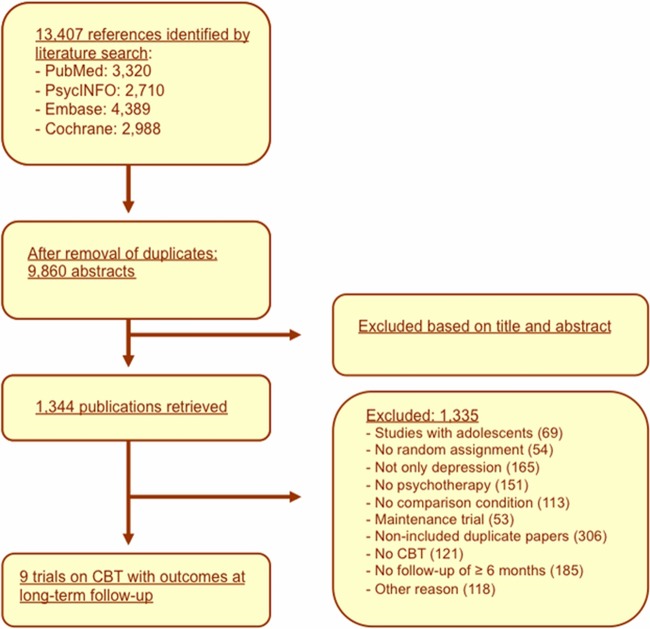
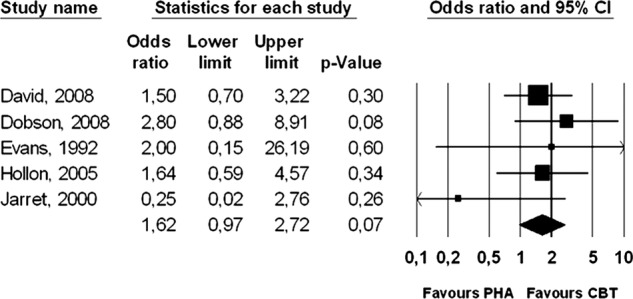
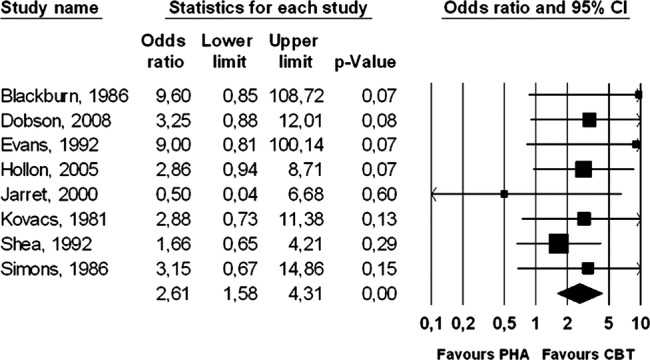
Objectives: Although cognitive behaviour therapy (CBT) and pharmacotherapy are equally effective in the acute treatment of adult depression, it is not known how they compare across the longer term. In this meta-analysis, we compared the effects of acute phase CBT without any subsequent treatment with the effects of pharmacotherapy that either were continued or discontinued across 6–18 months of follow-up. Design: We conducted systematic searches in bibliographical databases to identify relevant studies, and conducted a meta-analysis of studies meeting inclusion criteria. Setting: Mental healthcare. Participants: Patients with depressive disorders. Interventions: CBT and pharmacotherapy for depression. Outcome measures: Relapse rates at long-term follow-up. Results: 9 studies with 506 patients were included. The quality was relatively high. Short-term outcomes of CBT and pharmacotherapy were comparable, although drop out from treatment was significantly lower in CBT. Acute phase CBT was compared with pharmacotherapy discontinuation during follow-up in eight studies. Patients who received acute phase CBT were significantly less likely to relapse than patients who were withdrawn from pharmacotherapy (OR=2.61, 95% CI 1.58 to 4.31, p<0.001; numbers-needed-to-be-treated, NNT=5). The acute phase CBT was compared with continued pharmacotherapy at follow-up in five studies. There was no significant difference between acute phase CBT and continued pharmacotherapy, although there was a trend (p<0.1) indicating that patients who received acute phase CBT may be less likely to relapse following acute treatment termination than patients who were continued on pharmacotherapy (OR=1.62, 95% CI 0.97 to 2.72; NNT=10). Conclusions: We found that CBT has an enduring effect following termination of the acute treatment. We found no significant difference in relapse after the acute phase CBT versus continuation of pharmacotherapy after remission. Given the small number of studies, this finding should be interpreted with caution pending replication.
Overview
The claims and statistics of this paper haven’t been checked yet.
Free: it reads the open-access text and checks the first 5 claims that cite a source we can check. Create a free account to check every claim.
Integrity signals
Registry
Cites
Statistics
Figures
Verification
Claims the paper makes
The claims and statistics of this paper haven’t been checked yet.
Free: it reads the open-access text and checks the first 5 claims that cite a source we can check. Create a free account to check every claim.
Claims other papers make about this one
Each is checked against this paper’s own text: does it say what the citing paper says it does?
The cited source says what the claim attributes to it.
In the citing paper
“Cognitive behaviour therapy (CBT) appears to have an enduring effect that reduces risk for relapse to the same extent as continuation ADM (Cuijpers et al., 2013)”
From Risk factors for relapse and recurrence of depression in adults and how they operate: A four-phase systematic review and meta-synthesis (2018) · cites this paper as Cuijpers et al., 2013
In the citing paper
“Subsequent studies, however, have reported that the acute phase of CBT is effective at reducing the risk of depressive relapse.[48][49][50][51]”
From Mindfulness-based cognitive therapy for prevention and time to depressive relapse: Systematic review and network meta-analysis (2021) · cites this paper as [48]
Self-check
Percentages, sums and reported differences re-computed from the paper’s own numbers.
The self-check needs the paper’s full text.
Citations
Cites
Measuring inconsistency in meta-analyses
Higgins, J. P. T., Thompson, S. G., Deeks, J. J., & Altman, D. G. (2003) · BMJ · doi:10.1136/bmj.327.7414.557 · Cited by 63,139 · cited 1×
“A value of 0% indicates no observed heterogeneity, and larger values show increasing heterogeneity, with 25% as low, 50% as moderate, and 75% as high heterogeneity.(15) We calculated 95% CIs around I(2),(16) using the non-central χ(2)-based approach within the heterogi module for Stata.”
MethodCochrane Handbook for Systematic Reviews of Interventions: Cochrane Book Series
(2008) · doi:10.1002/9780470712184 · Cited by 25,048
Borenstein, M., Hedges, L. V., Higgins, J. P. T., & Rothstein, H. R. (2009) · doi:10.1002/9780470743386 · Cited by 14,225
Duval, S., & Tweedie, R. (2000) · Biometrics · doi:10.1111/j.0006-341x.2000.00455.x · Cited by 14,099
Borenstein, M., Hedges, L. V., Higgins, J. P. T., & Rothstein, H. R. (2021) · doi:10.1002/9781119558378 · Cited by 9,799
Cognitive Therapy for Depression: (675542012-001)
(2012) · PsycEXTRA Dataset · doi:10.1037/e675542012-001 · Cited by 9,663
The file drawer problem and tolerance for null results.
Rosenthal, R. (1979) · Psychological Bulletin · doi:10.1037/0033-2909.86.3.638 · Cited by 9,068 · cited 1×
“We also calculated Orwin’s fail-safe N, which indicates the number of missing studies needed to make the effect size insignificant.(20)”
MethodFrank, E. (1991) · Archives of General Psychiatry · doi:10.1001/archpsyc.1991.01810330075011 · Cited by 1,959 · cited 2×
“intended to reduce the risk for recurrence, the onset of a wholly new episode, and is standard for chronic or recurrent patients.(7) Although several studies have compared the long-term”
BackgroundAn Assessment of Clinically Useful Measures of the Consequences of Treatment
Laupacis, A., Sackett, D. L., & Roberts, R. S. (1988) · New England Journal of Medicine · doi:10.1056/nejm198806303182605 · Cited by 1,681 · cited 1×
“NNT indicates the number of patients that would have to be treated in order to generate one additional positive outcome.(14) Therefore, we also calculated NNT for all comparisons.”
PRACTICE GUIDELINE FOR THE Treatment of Patients With Major Depressive Disorder
Gelenberg, A. J., Freeman, P. B., Markowitz, J. C., Rosenbaum, J. F., Thase, M. E., Trivedi, M. H., & Rhoads, R. S. (2010) · Cited by 1,521
Research works printed but not linked: 2
- Cuijpers P Berking M Andersson G A meta-analysis of cognitive behavior therapy for adult depression, alone and in comparison to other treatments. Can J Psychiat 2013 (in press) 23870719 · DOI · Paper page
- Beck AT Rush J Shaw B Cognitive therapy of depression. New York: Guilford Press, 1979
Cited by
Items 201–254 of 254
A Primate Model of the Effects of Childhood Antidepressant Treatment
Brent, D. A., Cameron, J. L., & Lewis, D. A. (2014) · American Journal of Psychiatry · doi:10.1176/appi.ajp.2013.13121575 · Cited by 1
Greetfeld, M., Voderholzer, U., & Berger, M. (2015) · Elsevier eBooks · doi:10.1016/b978-3-437-22107-1.50374-5
Development of Clinical Practice
Craske, M. G., Crawford, K. A., Kivlahan, D. R., Magnavita, J. J., Ollendick, T. H., Sexton, T. L., Bufka, L. F., Galper, D. I., & Kurtzman, H. S. (2014)
Authors’ reply to Gøtzsche and Hamilton
Amick, H. R., Gartlehner, G., Gaynes, B. N., & Lohr, K. N. (2016) · BMJ · doi:10.1136/bmj.i617
Bei chronischer Depression ähnlich effektiv wie Escitalopram
Schweiger, U. (2015) · InFo Neurologie + Psychiatrie · doi:10.1007/s15005-015-1528-0
Innovative Psychological Treatments for Depression
Hollon, S. D., & Williams, C. J. (2016) · FOCUS The Journal of Lifelong Learning in Psychiatry · doi:10.1176/appi.focus.20150044 · Cited by 1
Self-citationCuijpers, P. J. (2015)
Self-citationPsychotherapie oder Psychopharmakotherapie oder Kombinationstherapie?
Brunner, J. (2016) · Psychotherapeut · doi:10.1007/s00278-016-0112-5
“Zudem lassen sich durch Psychotherapie nachhaltigere Effekte erzielen als durch eine Monotherapie mit Psychopharmaka (Cuijpers et al. 2013a).”
BackgroundInfluentialToward a Rational Model of Depression Treatment
Forand, N. R., Richards, D. A., Huibers, M. J. H., & Bockting, C. (2016) · Oxford University Press eBooks · doi:10.1093/oxfordhb/9780199973965.013.41
Self-citationComparative Look at the Depression Treatment Modalities of Cognitive
Page, T. M. (2016) · Digital Commons (Liberty University)
Vaz, A. (2016) · Portuguese National Funding Agency for Science, Research and Technology (RCAAP Project by FCT)
Droege, J. R. (2017) · Digital Commons-DePaul (DePaul University)
Psychotherapie, Psychopharmakotherapie oder Kombinationstherapie?
Brunner, J. (2017) · DNP - Der Neurologe und Psychiater · doi:10.1007/s15202-017-1507-z
Varieties of Psychotherapy for Major Depressive Disorder in Adults
David, D., Cristea, I. A., & Beck, A. T. (2017) · Wiley eBooks · doi:10.1002/9781119462996.ch2 · Cited by 1
Treating depression with activation
Nyström, M. B. T. (2018) · DiVA at Umeå University (Umeå University) · Cited by 1
Differenzielle Therapieentscheidung bei unipolaren Depressionen
Gärtner, T., & Voderholzer, U. (2018) · DNP - Der Neurologe und Psychiater · doi:10.1007/s15202-018-2092-5
Linardon, J. (2017) · Research Bank (Australian Catholic University) · doi:10.26199/5b8dcc74f80b7
“treatment for adult depression (Cuijpers et al., 2013), which found that while CBT was superior to pharmacotherapy at 12 month follow-up in studies that discontinued medication at post-treatment, CBT and pharmacotherapy were equally efficacious in studies that continued”
MethodCognitieve therapie: Theorie en praktijk
(2019) · Bohn Stafleu van Loghum eBooks · doi:10.1007/978-90-368-2021-9 · Cited by 1
Bellingham, G. L. (2019) · Digital Commons (Liberty University) · Cited by 2
Long-term efficacy of psychotherapy in major depression: protocol of a network meta-analysis
Vieira, P. M., & Cunha, C. A. C. (2019) · The Psychologist Practice & Research Journal · doi:10.33525/pprj.v2i1.35
“…in group versus individual formats (Tolin, 2010), group versus individual versus face-to-face versus self-help formats (Cuijpers et al., 2013a), psychotherapeutic versus pharmacological treatments (Cuijpers et al., 2013b), or treatments for different diagnoses (Marcus et al., 2014; Tolin, 2010).”
BackgroundA Multi-Study Investigation of Patient Engagement in Psychological Treatment
Gumport, N. B. (2020) · eScholarship (California Digital Library)
Personalized treatment strategies for depression
van Bronswijk, S. C. (2020) · Research Publications (Maastricht University) · doi:10.26481/dis.20201211sb
Breaking the Cycle of Learned Fear: An Experimental Approach
van Dis, E. A. M. (2021) · Utrecht University Repository (Utrecht University) · doi:10.33540/934
Käll, A. (2021) · Linköping studies in behavioural science · doi:10.3384/9789179290580 · Cited by 1
Cognitieve therapie bij depressieve stoornissen
Bockting, C., & Lemmens, L. H. J. M. (2019) · Bohn Stafleu van Loghum eBooks · doi:10.1007/978-90-368-2021-9_4
Self-citationPetersen, T., Sprich, S. E., & Wilhelm, S. (2015) · Springer eBooks · doi:10.1007/978-1-4939-2605-3_1
Andersson, G., & Cuijpers, P. J. (2015) · Elsevier eBooks · doi:10.1016/b978-0-12-397045-9.00143-9 · Cited by 1
Self-citation(2020) · Elsevier eBooks · doi:10.1016/b978-0-12-816426-6.16001-3
(2016) · Elsevier eBooks · doi:10.1016/b978-3-437-21833-0.16001-2
Greetfeld, M., Voderholzer, U., & Berger, M. (2018) · Elsevier eBooks · doi:10.1016/b978-3-437-24950-1.00098-6
Klein, D. N., & Calentino, A. E. (2022) · Elsevier eBooks · doi:10.1016/b978-0-323-91497-0.00182-x · Cited by 2
Irving Kirsch opens a window on antidepressant medications
Chen, E., Oliver, A. K., & Raz, A. (2023) · American Journal of Clinical Hypnosis · doi:10.1080/00029157.2022.2121678
“Furthermore, psychotherapy and placebo treatments show a lower relapse rate than that reported for antidepressant medication (Cuijpers et al., 2013).”
BackgroundReinforcement sensitivity theory and clinical psychology
Sasaki, Y. (2023) · The Japanese journal of psychology · doi:10.4992/jjpsy.94.22404
Sprich, S. E., Petersen, T., & Wilhelm, S. (2023) · Current clinical psychiatry · doi:10.1007/978-3-031-29368-9_1
iCCBT, an Interactive Approach of CBT for Online Psychological Intervention
Liao, Y., Liu, F., Lin, L., Hou, M., She, Y., Wu, H., Hu, B., & Wu, Q. (2024) · International Conference on Computer Supported Cooperative Work in Design (CSCWD) · doi:10.1109/cscwd61410.2024.10580063 · Cited by 1
“More than 2000 studies have confirmed that CBT can effectively alleviate cognitive-induced psychological problems [4]–[6].”
BackgroundTERAPIA COGNITIVO-COMPORTAMENTAL NO TRATAMENTO DA DEPRESSÃO: EVIDÊNCIAS ATUAIS E FUTURAS DIREÇÕES
Caporossi, J. V. A., Costa, S. C., Saraiva, A. F. F., Nogueira, E. S., Magalhães, A. L. S., Magalhães, A. C. S., Kunzendorff, R. C., ANDRADE, P. R. M., Martins, D. P., & Zambrzycki, I. T. (2024) · Revista Ibero-Americana de Humanidades, Ciências e Educação · doi:10.51891/rease.v10i7.13889 · Cited by 1
Cognitive and Behavioral Therapies
Thase, M. E., Khazanov, G. K., & Wright, J. H. (2024) · Springer eBooks · doi:10.1007/978-3-030-51366-5_35 · Cited by 1
Psychopharmacology and Personality Disorder: Treatment or Enhancement?
Jerotić, S., & Kostic, M. V. (2025) · Cambridge University Press eBooks · doi:10.1017/9781009445955.009
Depression too often gets deemed ‘hard to treat’ when medication falls short
Patterson, E. H., & Kayser, J. (2023) · The Conversation · doi:10.64628/aai.f7epp7rcs
IBD-specific Cognitive Behavioral Therapy: Sustainability of effect after three years
Evertsz, F. B., Goes, F. L. S., Stokkers, P. C. F., Sanderman, R., Verdam, M. G. E., Sprangers, M. A. G., & Bockting, C. (2025) · Clinical Psychology in Europe · doi:10.32872/cpe.14717
“However, sustainable effects of CBT have been reported for depressive disorder (Cuijpers et al., 2013, 2023; Furukawa et al., 2021; Legemaat et al., 2023).”
Self-citationHuang, W., Pan, Q., Ma, H., Na, L., Yang, H., & Wu, M. (2025) · Frontiers in Psychiatry · doi:10.3389/fpsyt.2025.1675224
“Studies have demonstrated that CBT is effective in alleviating depression severity (18) and lowering the recurrence rate of depressive episodes (19, 20), indicating its substantial bene fi t for depression (21).”
Turner, M. (2025) · Journal of Psychiatric Research · doi:10.1016/j.jpsychires.2025.12.026
Moradveisi, L. (2015) · Research Publications (Maastricht University) · doi:10.26481/dis.20150108lm · Cited by 1
Invisible Struggles: Loneliness in Higher Education
Swiercz, A., Charalampidou, S., & Tariq, U. E. H. (2025) · IGI Global eBooks · doi:10.4018/979-8-3373-5811-6.ch005
Thew, G. R., Lee, M., Wolsey, I., Giles, F., Hayden, E., Jell, G., Peacock, J., Pimm, J., Ryder, J., Salvadori, A., et al. (2026) · JMIR Human Factors · doi:10.2196/68671 · Cited by 1
Psychotherapy Compared to Pharmacotherapy
Sunzeri, F. (2026) · Springer eBooks · doi:10.1007/978-3-032-14465-2_18
van Tol, M., van Kleef, R. S., Eike, R. M., van Valen, E., Marsman, J.-B. C., Renken, R. J., Aleman, A., & Bockting, C. (2026) · Biological Psychiatry Global Open Science · doi:10.1016/j.bpsgos.2026.100781
Self-citationKlungsøyr, O., Røssberg, J. I., Papageorgiou, C., Evensen, J. H., Løvgren, A., Malkomsen, A., Osnes, K., Ulberg, R., Wilberg, T., & Dammen, T. (2026) · Psychotherapy Research · doi:10.1080/10503307.2026.2682995
Ezawa, I. D., Ramos, F. N., Hollon, S. D., Han, G. T., & Robinson, N. J. (2026) · Journal of Medical Internet Research · doi:10.2196/92347 · Cited by 1
“Over the past several decades, numerous interventions have been developed and rigorously tested [5], with cognitive behavioral therapy (CBT) [6] standing out for its efficacy in both treating active depression [7] and preventing subsequent relapse [8].”
Self-citationKallarackal, J., Dyer, B. J., & Huang, J. (2026) · Springer eBooks · doi:10.1007/978-3-032-25214-2_36
Purgato, M., Tedeschi, F., Prina, E., Turrini, G., Compri, B., Chiccoli, A., Castaner, M. M., Allegri, M. D., Nguyen, H. T., Feenstra, S., et al. (2026) · Frontiers in Public Health · doi:10.3389/fpubh.2026.1905759
Metadata
- Authors
- Cuijpers, P., Hollon, S. D., van Straten, A., Bockting, C., Berking, M., & Andersson, G.
- Affiliations
- Amsterdam Public Health (NL)
- Vanderbilt University (US)
- University of Groningen (NL)
- Philipps University of Marburg (DE)
- Linköping University (SE)
- Corresponding author
- Cuijpers, Pim
- Venue
- BMJ Open
- Publisher
- BMJ
- Published
- 2013
- Volume
- 3
- Issue
- 4
- Pages
- e002542
- ISSN
- 2044-6055 (ISSN-L)
- PMC
- PMC3641456
- OpenAlex
- W2154672619
- Cited by
- 253
- References
- 31
- Citations by year
- 2026: 8 · 2025: 6 · 2024: 10 · 2023: 10 · 2022: 24 · 2021: 26 · 2020: 24 · 2019: 28 · 2018: 11 · 2017: 29 · 2016: 25 · 2015: 31 · 2014: 17 · 2013: 3
- FWCI
- 4.21
- Type
- journal article
- Language
- en
- Open access
- gold
- doi.org
- Licence
- cc-by-nc
- Locations
- BMJ Open (publishedVersion, cc-by-nc)
- Europe PMC (PubMed Central) (publishedVersion, cc-by-nc)
- PubMed Central (publishedVersion, cc-by-nc)
- PubMed (publishedVersion)
- University of Groningen research database (University of Groningen / Centre for Information Technology) (publishedVersion, cc-by-nc)
- VU Research Portal (publishedVersion, other-oa)
- Ghent University Academic Bibliography (Ghent University) (submittedVersion, cc-by-nc)
- Data Archiving and Networked Services (DANS) (submittedVersion, other-oa)
- Data Archiving and Networked Services (DANS) (submittedVersion)
- DiVA (Linkoping University) (submittedVersion, other-oa)
- Digital Academic REpository of VU University Amsterdam (Vrije Universiteit Amsterdam) (submittedVersion)
- Pure Amsterdam UMC (submittedVersion)
- Multilingual Matters (Channel View Publications) (submittedVersion, cc-by-nc)
- University of Groningen research database (University of Groningen / Centre for Information Technology) (submittedVersion, cc-by-nc)
- Topics
- Social Sciences › Psychology › Experimental and Cognitive Psychology › Anxiety, Depression, Psychometrics, Treatment, Cognitive Processes
- Social Sciences › Psychology › Clinical Psychology › Psychotherapy Techniques and Applications
- Health Sciences › Medicine › Pharmacology (medical) › Treatment of Major Depression
- Keywords
- cognitive behavioral therapy, depression, relapse prevention, long-term follow-up, acute phase treatment, treatment withdrawal, treatment discontinuation, remission
About these checks
Registry, retraction, Cites and statistics results are computed, not judged, with one exception: a printed reference that no index lists is read once by a model before it counts as a citation error. Claims are extracted by a model and kept only when their quote appears verbatim in the text; each cited source is then checked, with a model’s help, for whether it says what the claim relies on. Those verdicts can be wrong — read the claim’s quote and the cited source before relying on one.
Statistics and arithmetic are recomputed, not judged.
Confidence bands are shown only for fields calibrated on our annotated test set. None is calibrated yet, so no band is shown.
What counts as a claim ›How we measure confidence ›How we check this ›
Are you an author, or do you see a problem with this page? Request a review
Data sources
Bibliographic data: Semantic Scholar, OpenAlex, Crossref.
Contains information from the Semantic Scholar Academic Graph Datasets, made available under the ODC Attribution License (ODC-BY 1.0).
Semantic Scholar’s data is described in: Kinney, R., et al. (2023). The Semantic Scholar Open Data Platform. arXiv:2301.10140.
