

Selective reporting of outcomes in randomised controlled trials in systematic reviews of cystic fibrosis
Open accessThe DOI matches its Crossref record; 20 of the 20 references it cites were found in a registry or an index.
Abstract
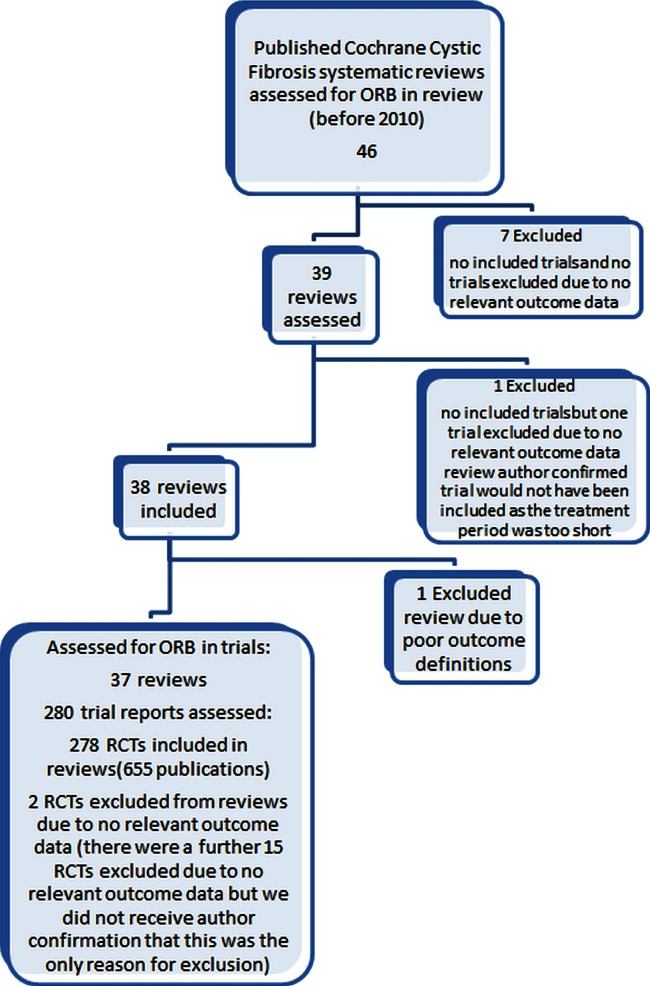
Background: Outcome reporting bias (ORB) in randomised trials has been identified as a threat to the validity of systematic reviews. Previous work highlighting this problem is limited to considering a single primary review outcome. The aim of this study was to assess ORB across all efficacy outcomes in the Cochrane systematic reviews of cystic fibrosis. Methods: Systematic reviews of interventions for cystic fibrosis published on the Cochrane Library by the Cochrane Cystic Fibrosis and Genetic Disorders Group before 2010 were assessed for discrepancies in outcomes between review protocol and full review. ORB in eligible trials was also assessed for all efficacy review outcomes. Two authors independently classified each outcome using a nine-point classification system developed by the Outcome Reporting Bias In Trials study. These classifications were used to inform the assessment of the risk of bias for selective outcome reporting for each trial. Results: –46 Cochrane cystic fibrosis systematic reviews were included. The median number of primary outcomes, number of trials and participants per trial in the reviews were 3 (IQR 2, 3), 4 (IQR 2, 8) and 21 (IQR 14, 41), respectively. 18 reviews (39%, 18/46) had a discrepancy in outcomes between protocol and full review. 37 reviews were eligible to be included in the ORB assessment. When considering review primary outcomes and all review outcomes, ORB was suspected in at least one trial in 86% and 100%, respectively. Conclusions: Assessment of ORB within a systematic review of a single primary outcome underestimates the risk of ORB in comparison to the assessment of multiple primary and secondary outcomes. ORB in trials is highly prevalent within systematic reviews of cystic fibrosis when assessed across all outcomes. This could be reduced by the development of a core outcome set for trials and systematic reviews in cystic fibrosis.
Overview
The claims and statistics of this paper haven’t been checked yet.
Free: it reads the open-access text and checks the first 5 claims that cite a source we can check. Create a free account to check every claim.
Integrity signals
Registry
Cites
Statistics
Figures
Verification
Claims the paper makes
The claims and statistics of this paper haven’t been checked yet.
Free: it reads the open-access text and checks the first 5 claims that cite a source we can check. Create a free account to check every claim.
Claims other papers make about this one
Each is checked against this paper’s own text: does it say what the citing paper says it does?
The source backs part of the claim, not all of it — or backs it for a different population, condition or comparison.
In the citing paper
“Studies examining selective reporting of results in systematic reviews have found that 11% to 22% of reviews did not present results for at least one pre-specified outcome of the review.140 141 142 143”
From PRISMA 2020 explanation and elaboration: updated guidance and exemplars for reporting systematic reviews (2021) · cites this paper as [142]
Experimental — accuracy not yet measured
Self-check
Percentages, sums and reported differences re-computed from the paper’s own numbers.
The self-check needs the paper’s full text.
Citations
Cites
Assessing the quality of controlled clinical trials
Jüni, P., Altman, D. G., & Egger, M. (2001) · BMJ · doi:10.1136/bmj.323.7303.42 · Cited by 3,309
Systematic Review of the Empirical Evidence of Study Publication Bias and Outcome Reporting Bias
Dwan, K., Altman, D. G., Arnaiz, J. A., Bloom, J., Chan, A.-W., Cronin, E., Decullier, E., Easterbrook, P. J., Von Elm, E., Gamble, C., et al. (2008) · PLoS ONE · doi:10.1371/journal.pone.0003081 · Cited by 1,546
Self-citationKirkham, J. J., Dwan, K. M., Altman, D. G., Gamble, C., Dodd, S., Smyth, R., & Williamson, P. R. (2010) · BMJ · doi:10.1136/bmj.c365 · Cited by 1,133
Self-citationStandardising outcomes for clinical trials and systematic reviews
Clarke, M. (2007) · Trials · doi:10.1186/1745-6215-8-39 · Cited by 483
Sinha, I., Jones, L., Smyth, R. L., & Williamson, P. R. (2008) · PLoS Medicine · doi:10.1371/journal.pmed.0050096 · Cited by 202
Self-citationRamsey, B. W., & Boat, T. F. (1994) · The Journal of Pediatrics · doi:10.1016/s0022-3476(94)70301-9 · Cited by 200
Bias in Meta-Analysis Due to Outcome Variable Selection Within Studies
Hutton, J. L., & Williamson, P. R. (2000) · Journal of the Royal Statistical Society Series C: Applied Statistics · doi:10.1111/1467-9876.00197 · Cited by 194
Self-citationOutcome selection bias in meta-analysis
Williamson, P. R., Gamble, C., Altman, D. G., & Hutton, J. L. (2005) · Statistical Methods in Medical Research · doi:10.1191/0962280205sm415oa · Cited by 188
Self-citationBias Due to Changes in Specified Outcomes during the Systematic Review Process
Kirkham, J. J., Altman, D. G., & Williamson, P. R. (2010) · PLoS ONE · doi:10.1371/journal.pone.0009810 · Cited by 164 · cited 2×
“This compares with 22% of reviews (64/288) that contained a discrepancy in at least one outcome measure in the main ORBIT study which looked at reviews covering all 50 Cochrane review groups.(2) However, this is confounded by the different publication date ranges of the reviews (assessed as up to date between 2006 and…”
ResultSelf-citationUsing observational data from registries to compare treatments: The fallacy of omnimetrics
Green, S. B., & Byar, D. P. (1984) · Statistics in Medicine · doi:10.1002/sim.4780030413 · Cited by 161 · cited 1×
“BACKGROUND The value of systematic reviews in establishing an evidence base is widely acknowledged with well-conducted systematic reviews of randomised controlled trials (RCTs) being placed at the top of the hierarchy of evidence.(1) It is essential, when conducting systematic reviews, to consider the potential for bi…”
Background
Research works printed but not linked: 2
- Von Mosch S Dwan K Reporting of harm and efficacy outcomes of randomised clinical trials in cystic fibrosis before and after the publication of the revised CONSORT (CONsolidated Standards Of Reporting Trials) statement in 2001—a comparison of trial reports published from 1994 and from 2008 [ thesis]. The University of Liverpool, 2011
- The Cochrane Library, Issue 4, Chichester: Wiley, 2009
Cited by
Page, M. J., Moher, D., Bossuyt, P. M., Boutron, I., Hoffmann, T. C., Mulrow, C. D., Shamseer, L., Tetzlaff, J. M., Akl, E. A., Brennan, S. E., et al. (2021) · BMJ · doi:10.1136/bmj.n160 · Cited by 13,262
Page, M. J., Moher, D., Bossuyt, P., Boutron, I., Hoffmann, T., mulrow, C., Shamseer, L., Tetzlaff, J., Akl, E., Brennan, S. E., et al. (2020) · doi:10.31222/osf.io/gwdhk · Cited by 916
Page, M. J., McKenzie, J. E., Kirkham, J., Dwan, K., Kramer, S., Green, S., & Forbes, A. (2014) · Cochrane Database of Systematic Reviews · doi:10.1002/14651858.mr000035.pub2 · Cited by 281
Self-citationDimairo, M., Pallmann, P., Wason, J., Todd, S., Jaki, T., Julious, S. A., Mander, A. P., Weir, C. J., Koenig, F., Walton, M. K., et al. (2020) · BMJ · doi:10.1136/bmj.m115 · Cited by 149
Boney, O., Moonesinghe, R., Myles, P. S., Grocott, M. P. W., Bartoszko, J., Beattie, W. S., Bellomo, R., Buggy, D. J., Cabrini, L., Canet, J., et al. (2021) · British Journal of Anaesthesia · doi:10.1016/j.bja.2021.09.027 · Cited by 126
Bentley, C., Cressman, S., van der Hoek, K., Arts, K., Dancey, J., & Peacock, S. (2019) · Clinical Trials · doi:10.1177/1740774518820060 · Cited by 104
Systematic reviews with published protocols compared to those without: more effort, older search
Allers, K., Hoffmann, F., Mathes, T., & Pieper, D. (2017) · Journal of Clinical Epidemiology · doi:10.1016/j.jclinepi.2017.12.005 · Cited by 98
Declaration of transparency for each research article
Altman, D. G., & Moher, D. (2013) · BMJ · doi:10.1136/bmj.f4796 · Cited by 90
Tricco, A. C., Cogo, E., Page, M. J., Polisena, J., Booth, A., Dwan, K. M., MacDonald, H. R., Clifford, T., Stewart, L. A., Straus, S. E., et al. (2016) · Journal of Clinical Epidemiology · doi:10.1016/j.jclinepi.2016.03.025 · Cited by 75
“Page 17 of 28 this is the same approach to other studies examinin g outcome reporting bias [4-7].”
BackgroundResultInfluentialSelf-citationIdentifying a Core Domain Set to Assess Psoriasis in Clinical Trials
Duffin, K. C., Merola, J. F., Christensen, R., Latella, J., Garg, A., Gottlieb, A. B., & Armstrong, A. W. (2018) · JAMA Dermatology · doi:10.1001/jamadermatol.2018.1165 · Cited by 61
Rethinking the assessment of risk of bias due to selective reporting: a cross-sectional study
Page, M. J., & Higgins, J. P. T. (2016) · Systematic Reviews · doi:10.1186/s13643-016-0289-2 · Cited by 60
“When all outcomes were assessed in 46 Cochrane cystic fibrosis reviews, 100 % of reviews included at least one study suspected of outcome non-reporting bias [17].”
BackgroundDimairo, M., Pallmann, P., Wason, J., Todd, S., Jaki, T., Julious, S. A., Mander, A. P., Weir, C. J., Koenig, F., Walton, M. K., et al. (2020) · Trials · doi:10.1186/s13063-020-04334-x · Cited by 58
Selecting and measuring optimal outcomes for randomised controlled trials in surgery
Macefield, R. C., Boulind, C. E., & Blazeby, J. M. (2013) · Langenbeck s Archives of Surgery · doi:10.1007/s00423-013-1136-8 · Cited by 56
“Such selective reporting of outcomes leads to outcome reporting bias and causes further problems for systematic reviews by distorting the available evidence [39–41].”
BackgroundKing, C., Kirkham, J. J., Hawcutt, D. B., & Sinha, I. P. (2018) · PeerJ · doi:10.7717/peerj.5352 · Cited by 47
“We desired to only meta-analyse results from cohort studies, as they provide the strongest observational evidence in the absence of RCTs. Case crossover studies allow for case events to act as their own controls, with excess risk evaluated using conditional logistic regression (Maclure, 1991), thus adjust for age as a…”
BackgroundSelf-citationTARG Meta-Research Group & Collaborators (2023) · BMJ Open · doi:10.1136/bmjopen-2023-076264 · Cited by 33
Koensgen, N., Rombey, T., Allers, K., Mathes, T., Hoffmann, F., & Pieper, D. (2019) · Journal of Clinical Epidemiology · doi:10.1016/j.jclinepi.2019.02.012 · Cited by 34
Saldanha, I. J., Lindsley, K. B., Money, S., Kimmel, H. J., Smith, B. T., & Dickersin, K. (2020) · BMC Medical Research Methodology · doi:10.1186/s12874-020-0898-2 · Cited by 43
Ioannidis, J. P. A., Horbar, J. D., Ovelman, C., Brosseau, Y., Thorlund, K., Buus‐Frank, M. E., Mills, E. J., & Soll, R. (2015) · BMJ · doi:10.1136/bmj.h72 · Cited by 34
Pandis, N., Fleming, P. S., Worthington, H., Dwan, K., & Salanti, G. (2015) · PLOS ONE · doi:10.1371/journal.pone.0137667 · Cited by 30
“However, in a more recent review [16] discrepancies were mentioned in 39%, albeit based on a smaller sample of 46 reviews overall.”
BackgroundMethodResultInfluentialSelf-citationLi, G., Bhatt, M., Wang, M., Mbuagbaw, L. C. E., Samaan, Z., & Thabane, L. (2018) · Proceedings of the National Academy of Sciences · doi:10.1073/pnas.1708286114 · Cited by 25
“For example, inconsistencies between protocols or registrations and full reports can be found in observational studies (68) and systematic reviews (69), while inconsistencies between abstracts and full reports have also been identified in diagnostic studies (70) and veterinary science (66).”
BackgroundFrosi, G., Riley, R. D., Williamson, P. R., & Kirkham, J. J. (2014) · Journal of Clinical Epidemiology · doi:10.1016/j.jclinepi.2014.11.017 · Cited by 27
“Similar to the [4] study that looked at all review outcomes in a cohort of Cochrane Fibrosis reviews, all the reviews considered in this study included at least one study which contained missing data on at least one core outcome.”
ResultSelf-citationManaging the incidence of selective reporting bias: a survey of Cochrane review groups
Reid, E. K., Tejani, A. M., Huan, L., Egan, G., O’Sullivan, C., Mayhew, A., & Kabir, M. (2015) · Systematic Reviews · doi:10.1186/s13643-015-0070-y · Cited by 23
Thibault, R. T., Clark, R. W. A., Pedder, H., van den Akker, O. R., Westwood, S. J., Thompson, J., & Munafo, M. R. (2021) · medRxiv · doi:10.1101/2021.07.07.21259868 · Cited by 18
Palser, S. C., Smith, S. J., Nash, E. F., Agarwal, A., & Smyth, A. R. (2019) · Cochrane Database of Systematic Reviews · doi:10.1002/14651858.cd012300.pub2 · Cited by 19
“Dwan 2013 Dwan K, Kirkham JJ, Williamson PR, Gamble C. Selective reporting of outcomes in randomised controlled trials in systematic reviews of cystic fibrosis.”
BackgroundA systematic review of outcomes reported in small bowel obstruction research
Mellor, K., Hind, D., & Lee, M. J. (2018) · Journal of Surgical Research · doi:10.1016/j.jss.2018.03.044 · Cited by 21
Dawson, S., Girling, C.-J., Cowap, L., & Clark-Carter, D. (2023) · Cochrane Database of Systematic Reviews · doi:10.1002/14651858.cd013766.pub2 · Cited by 14
Outcome reporting bias in Cochrane systematic reviews: a cross-sectional analysis
Shah, K., Egan, G., Huan, L., Kirkham, J. J., Reid, E. K., & Tejani, A. M. (2020) · BMJ Open · doi:10.1136/bmjopen-2019-032497 · Cited by 18
Self-citationRombey, T., Puljak, L., Allers, K., Ruano, J., & Pieper, D. (2020) · Journal of Clinical Epidemiology · doi:10.1016/j.jclinepi.2020.03.010 · Cited by 14
Komukai, K., Sugita, S., & Fujimoto, S. (2023) · Archives of Physical Medicine and Rehabilitation · doi:10.1016/j.apmr.2023.06.006 · Cited by 20
Hu, K., Mei, F., Gao, Q., Zhao, L., Chen, F., Liu, Q., Suo, L., Ma, Y., Zhang, T., Zhang, W., et al. (2020) · bioRxiv (Cold Spring Harbor Laboratory) · doi:10.1101/2020.04.14.040865 · Cited by 14
Preregistration of Psychology Meta-Analyses: A Cross-Sectional Study of Prevalence and Practice
Sandoval‐Lentisco, A., Tortajada, M., López‐Nicolás, R., López-López, J. A., Wagenmakers, E., Sánchez‐Meca, J., & Hardwicke, T. E. (2025) · Advances in Methods and Practices in Psychological Science · doi:10.1177/25152459241300113 · Cited by 17
“Studies have also found that 22% to 39% of systematic reviews and meta-analyses omitted or changed the outcomes of interest compared with what was stated in the registered protocol (Dwan et al., 2013; Kirkham et al., 2010; Page et al., 2014; Tricco et al., 2016).”
Outcome Reporting bias in Exercise Oncology trials (OREO): a cross-sectional studyPreprint
Singh, B., Fairman, C. M., Christensen, J. F., Bolam, K. A., Twomey, R., Nunan, D., & Lahart, I. M. (2021) · medRxiv · doi:10.1101/2021.03.12.21253378 · Cited by 13
“participants [median (min-max) participants per study: 65 (23-420)].”
BackgroundSystematic Reviews and Meta‐Analysis
Crombie, I. (2021) · Wiley eBooks · doi:10.1002/9781394322183.ch5 · Cited by 9
Exercise reduces depressive symptoms in adults with arthritis: Evidential value
Kelley, G. A., & Kelley, K. S. (2016) · World Journal of Rheumatology · doi:10.5499/wjr.v6.i2.23 · Cited by 10
Kelley, G. A., & Kelley, K. S. (2015) · BioMed Research International · doi:10.1155/2015/151985 · Cited by 11
Siebert, M., Caquelin, L., Madera, M., Acosta‐Dighero, R., Naudet, F., & Figuls, M. R. I. (2023) · PeerJ · doi:10.7717/peerj.16016 · Cited by 10
“However, most studies that have looked at the differences between the registered protocols and the published SRs have focused on changes in primary outcomes (Tricco et al., 2016; Dwan et al., 2013).”
BackgroundInconsistent Reporting Between Meta-analysis Protocol and Publication – A Cross-Sectional Study
Delgado, A. F., & Delgado, A. F. (2017) · Anticancer Research · doi:10.21873/anticanres.11928 · Cited by 4
Improving the ACGIH threshold limit value (TLV) process
Smith, C. J., & Perfetti, T. A. (2018) · Toxicology Research and Application · doi:10.1177/2397847318801758 · Cited by 3
Declaration of transparency for each research articlea
Altman, D. G., & Moher, D. (2013) · Family Medicine and Community Health · doi:10.15212/fmch.2013.0301
“Selective non-publication favours statistically significant findings, biasing the literature [11, 12].”
BackgroundSyed, M., Martin, H. M., Sena, E. S., Williamson, P. R., & Salman, R. A. (2023) · European Stroke Journal · doi:10.1177/23969873231194811 · Cited by 4
“…there was a slightly lower prevalence of ORB in stroke/TIA RCTs (5% high risk of ORB) in comparison to the overall prevalence of ORB in RCTs (14% high risk of ORB), 7 and a small number of estimates of ORB in RCTs of other diseases (e.g. 29% of cystic fibrosis RCTs were at high risk of ORB 19 ).”
BackgroundSelf-citationVaganay, A. (2014) · London School of Economics and Political Science Theses Online (London School of Economics and Political Science) · Cited by 5
Siebert, M. (2021) · MetArXiv (OSF Preprints) · doi:10.31222/osf.io/zdfu9
The applicability and utilization of systematic reviews for clinical practice
Lindsley, K. B. (2022) · Utrecht University Repository (Utrecht University) · doi:10.33540/1513
Fujimoto, S., Sugita, S., & Nakayama, T. (2022) · doi:10.2196/preprints.44133
Nguyen, P., Turner, S., Korevaar, E., Page, M. J., & McKenzie, J. E. (2025) · medRxiv · doi:10.1101/2025.11.06.25339702
“Many studies have investigated outcome reporting bias in clinical trials (12,35,36) or systematic reviews of RCTs (17), but few have been undertaken for non-randomised studies, potentially due to the difficulty in creating an inception cohort (i.e. a set of studies known to have been initiated,…”
Dimairo, M., Pallmann, P., Wason, J. M. S., Todd, S., Jaki, T., Julious, S. A., Mander, A., Weir, C. J., Koenig, F., Walton, M. K., et al. (2020) · Figshare · doi:10.6084/m9.figshare.12494876
Dimairo, M., Pallmann, P., Wason, J. M. S., Todd, S., Jaki, T., Julious, S. A., Mander, A., Weir, C. J., Koenig, F., Walton, M. K., et al. (2020) · Figshare · doi:10.6084/m9.figshare.12494858
Dimairo, M., Pallmann, P., Wason, J. M. S., Todd, S., Jaki, T., Julious, S. A., Mander, A., Weir, C. J., Koenig, F., Walton, M. K., et al. (2020) · Figshare · doi:10.6084/m9.figshare.12494891
Dimairo, M., Pallmann, P., Wason, J. M. S., Todd, S., Jaki, T., Julious, S. A., Mander, A., Weir, C. J., Koenig, F., Walton, M. K., et al. (2020) · Figshare · doi:10.6084/m9.figshare.12494900
Dimairo, M., Pallmann, P., Wason, J. M. S., Todd, S., Jaki, T., Julious, S. A., Mander, A., Weir, C. J., Koenig, F., Walton, M. K., et al. (2020) · Figshare · doi:10.6084/m9.figshare.12494870
Dimairo, M., Pallmann, P., Wason, J. M. S., Todd, S., Jaki, T., Julious, S. A., Mander, A., Weir, C. J., Koenig, F., Walton, M. K., et al. (2020) · Figshare · doi:10.6084/m9.figshare.12494909
Dimairo, M., Pallmann, P., Wason, J. M. S., Todd, S., Jaki, T., Julious, S. A., Mander, A., Weir, C. J., Koenig, F., Walton, M. K., et al. (2020) · Figshare · doi:10.6084/m9.figshare.12494861
Dimairo, M., Pallmann, P., Wason, J. M. S., Todd, S., Jaki, T., Julious, S. A., Mander, A., Weir, C. J., Koenig, F., Walton, M. K., et al. (2020) · Figshare · doi:10.6084/m9.figshare.12494882
Dimairo, M., Pallmann, P., Wason, J. M. S., Todd, S., Jaki, T., Julious, S. A., Mander, A., Weir, C. J., Koenig, F., Walton, M. K., et al. (2020) · Figshare · doi:10.6084/m9.figshare.12494849
Nguyen, P.-Y., Turner, S., Korevaar, E., Page, M. J., & McKenzie, J. E. (2026) · BMC Public Health · doi:10.1186/s12889-026-27475-1
“Many studies have investigated outcome reporting bias in clinical trials [12, 37, 38] or systematic reviews of RCTs [17], but few have been undertaken for non-randomised studies, potentially due to the difficulty in creating an inception cohort (i.e. a set of studies known to have been initiated,…”
Metadata
- Authors
- Dwan, K., Kirkham, J. J., Williamson, P. R., & Gamble, C.
- Affiliations
- University of Liverpool (GB)
- Corresponding author
- Dwan, Kerry
- Venue
- BMJ Open
- Publisher
- BMJ
- Published
- 2013-05
- Volume
- 3
- Issue
- 6
- Pages
- e002709
- ISSN
- 2044-6055 (ISSN-L)
- PMC
- PMC3669728
- OpenAlex
- W2084159208
- Semantic Scholar
- aee6386dd505c80bb0b60c6abc1c2f0e0b2c08c3
- Cited by
- 55
- References
- 20
- Citations by year
- 2026: 1 · 2025: 2 · 2023: 5 · 2022: 2 · 2021: 6 · 2020: 16 · 2019: 3 · 2018: 5 · 2017: 2 · 2016: 3 · 2015: 4 · 2014: 3 · 2013: 3
- FWCI
- 0.89
- Type
- journal article
- Language
- en
- Open access
- gold
- doi.org
- Licence
- cc-by-nc
- Locations
- BMJ Open (publishedVersion, cc-by-nc)
- Europe PMC (PubMed Central) (publishedVersion, cc-by-nc)
- PubMed Central (publishedVersion, cc-by-nc)
- PubMed (publishedVersion)
- Research Explorer (The University of Manchester) (submittedVersion)
- Funders
- National Institute for Health and Care Research
- Medical Research Council
- Topics
- Social Sciences › Decision Sciences › Statistics, Probability and Uncertainty › Meta-analysis and systematic reviews
- Health Sciences › Nursing › Issues, ethics and legal aspects › Pharmaceutical industry and healthcare
- Physical Sciences › Mathematics › Statistics and Probability › Statistical Methods in Clinical Trials
- Keywords
- selective reporting, selective outcome reporting, cystic fibrosis, systematic reviews, risk of bias assessment, core outcome set, randomized controlled trials, primary and secondary outcomes
About these checks
Registry, retraction, Cites and statistics results are computed, not judged, with one exception: a printed reference that no index lists is read once by a model before it counts as a citation error. Claims are extracted by a model and kept only when their quote appears verbatim in the text; each cited source is then checked, with a model’s help, for whether it says what the claim relies on. Those verdicts can be wrong — read the claim’s quote and the cited source before relying on one.
Statistics and arithmetic are recomputed, not judged.
Confidence bands are shown only for fields calibrated on our annotated test set. None is calibrated yet, so no band is shown.
What counts as a claim ›How we measure confidence ›How we check this ›
Are you an author, or do you see a problem with this page? Request a review
Data sources
Bibliographic data: Semantic Scholar, OpenAlex, Crossref.
Contains information from the Semantic Scholar Academic Graph Datasets, made available under the ODC Attribution License (ODC-BY 1.0).
Semantic Scholar’s data is described in: Kinney, R., et al. (2023). The Semantic Scholar Open Data Platform. arXiv:2301.10140.
