

Modelling the impact of specific food policy options on coronary heart disease and stroke deaths in Ireland
Open accessThe DOI matches its Crossref record; 22 of the 22 references it cites were found in a registry or an index.
Abstract
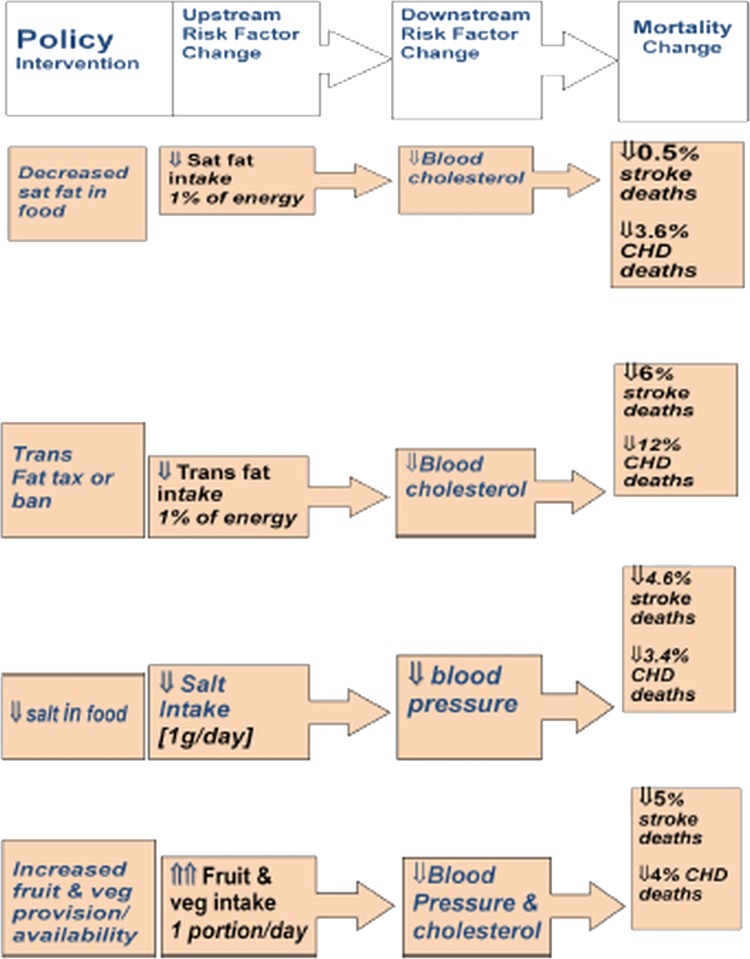
Objective: To estimate the potential reduction in cardiovascular (CVD) mortality possible by decreasing salt, trans fat and saturated fat consumption, and by increasing fruit and vegetable (F/V) consumption in Irish adults aged 25–84 years for 2010. Design: Modelling study using the validated IMPACT Food Policy Model across two scenarios. Sensitivity analysis was undertaken. First, a conservative scenario: reductions in dietary salt by 1 g/day, trans fat by 0.5% of energy intake, saturated fat by 1% energy intake and increasing F/V intake by 1 portion/day. Second, a more substantial but politically feasible scenario: reductions in dietary salt by 3 g/day, trans fat by 1% of energy intake, saturated fat by 3% of energy intake and increasing F/V intake by 3 portions/day. Setting: Republic of Ireland. Outcomes: Coronary heart disease (CHD) and stroke deaths prevented. Results: The small, conservative changes in food policy could result in approximately 395 fewer cardiovascular deaths per year; approximately 190 (minimum 155, maximum 230) fewer CHD deaths in men, 50 (minimum 40, maximum 60) fewer CHD deaths in women, 95 (minimum 75, maximum 115) fewer stroke deaths in men, and 60 (minimum 45, maximum 70) fewer stroke deaths in women. Approximately 28%, 22%, 23% and 26% of the 395 fewer deaths could be attributable to decreased consumptions in trans fat, saturated fat, dietary salt and to increased F/V consumption, respectively. The 395 fewer deaths represent an overall 10% reduction in CVD mortality. Modelling the more substantial but feasible food policy options, we estimated that CVD mortality could be reduced by up to 1070 deaths/year, representing an overall 26% decline in CVD mortality. Conclusions: A considerable CVD burden is attributable to the excess consumption of saturated fat, trans fat, salt and insufficient fruit and vegetables. There are significant opportunities for Government and industry to reduce CVD mortality through effective, evidence-based food policies.
Overview
The claims and statistics of this paper haven’t been checked yet.
Free: it reads the open-access text and checks the first 5 claims that cite a source we can check. Create a free account to check every claim.
Integrity signals
Registry
Cites
Statistics
Figures
Verification
Claims the paper makes
The claims and statistics of this paper haven’t been checked yet.
Free: it reads the open-access text and checks the first 5 claims that cite a source we can check. Create a free account to check every claim.
Claims other papers make about this one
Each is checked against this paper’s own text: does it say what the citing paper says it does?
The source backs part of the claim, not all of it — or backs it for a different population, condition or comparison.
In the citing paper
“Moreover, legislation promoting a healthy lifestyle, such as reduced salt intake and smoking bans, are cost effective in preventing CVD. 18-22”
From 2016 ESC/EAS Guidelines for the Management of Dyslipidaemias (2016) · cites this paper as [21]
Experimental — accuracy not yet measured
Self-check
Percentages, sums and reported differences re-computed from the paper’s own numbers.
The self-check needs the paper’s full text.
Citations
Cites
Food, nutrition, physical activity, and the prevention of cancer: a global perspective
(2008) · Choice Reviews Online · doi:10.5860/choice.45-5024 · Cited by 5,350
Diet, nutrition and the prevention of chronic diseases
Joint, W. (2002) · Medical Entomology and Zoology · Cited by 4,916
Diet, Nutrition, and the Prevention of Chronic Diseases
Leong, A. S.-Y. (1992) · Pathology · doi:10.1016/s0031-3025(16)36541-2 · Cited by 1,628 · cited 3×
“It is estimated that 80% of premature coronary heart disease (CHD) and stroke can be prevented.(1) Even small reductions in incidence and mortality will lead to large population health gains and potential reductions in direct and indirect healthcare costs.”
BackgroundInfluentialSalt intake, stroke, and cardiovascular disease: meta-analysis of prospective studies
Strazzullo, P., D'Elia, L., Kandala, N.-B., & Cappuccio, F. P. (2009) · BMJ · doi:10.1136/bmj.b4567 · Cited by 1,580 · cited 4×
“of randomised controlled trials and cohort studies.(10) 12–15 The 2010–2019 Irish national cardiovascular strategy(11) has outlined targeted recommendations on specific eating habits within the lifetime of this policy report (table 1).”
BackgroundInfluentialProjected effect of dietary salt reductions on future cardiovascular disease
Bibbins-Domingo, K., Chertow, G. M., Coxson, P. G., Moran, A., Lightwood, J. M., Pletcher, M. J., & Goldman, L. (2010) · New England Journal of Medicine · doi:10.1056/nejmoa0907355 · Cited by 1,253 · cited 1×
“A modelling study in the USA estimated that between 8% and 16% of the 565 000 CHD and stroke deaths could be averted in a year if dietary salt intake was reduced to 3 g/day.(20) Children and the elderly are particularly vulnerable to the adverse effects of high salt intake, and the Irish national strategy(11) has outl…”
MethodMozaffarian, D., Micha, R., & Wallace, S. (2010) · PLoS Medicine · doi:10.1371/journal.pmed.1000252 · Cited by 1,215
Dauchet, L., Amouyel, P., Hercberg, S., & Dallongeville, J. (2006) · The Journal of Nutrition · doi:10.1093/jn/136.10.2588 · Cited by 1,204 · cited 1×
“One additional portion of fruit and vegetables a day would reduce CHD and stroke deaths by approximately 4% and 5%, respectively.(12) 13 The aim of this study is to estimate the potential reductions in CHD and stroke mortality achievable by specific and feasible decreases in consumption of saturated fat, trans fat, sa…”
MethodHe, F. J., & MacGregor, G. A. (2009) · Journal of Human Hypertension · doi:10.1038/jhh.2008.144 · Cited by 1,123 · cited 1×
“overwhelmingly supports action to reduce population exposure to this dietary additive.(8) There is also evidence that high salt intake directly increases the risk of stroke and heart attack.”
BackgroundJakobsen, M. U., O’Reilly, E. J., Heitmann, B. L., Pereira, M. A., Bälter, K., Fraser, G. E., Goldbourt, U., Hallmans, G., Knekt, P., Liu, S., et al. (2009) · The American Journal of Clinical Nutrition · doi:10.3945/ajcn.2008.27124 · Cited by 1,026
Public health: ethical issues.
Kar-Purkayastha, I. (2009) · International Journal of Epidemiology · doi:10.1093/ije/dyn150 · Cited by 485
Research works printed but not linked: 1
- Salt and Health: review of the scientific evidence and recommendations for public policy in Ireland. Food Safety Authority of Ireland, 2005
Cited by
Mach, F., Baigent, C., Catapano, A. L., Koskinas, K. C., Casula, M., Badimon, L., Chapman, M. J., De Backer, G. G., Delgado, V., Ference, B. A., et al. (2020) · European Heart Journal · doi:10.1093/eurheartj/ehz455 · Cited by 8,961
European Guidelines on cardiovascular disease prevention in clinical practice (version 2012)
Authors/Task Force Members:, Perk, J., De Backer, G., Gohlke, H., Graham, I., Reiner, Ž., Verschuren, M., Albus, C., Benlian, P., Boysen, G., et al. (2012) · European Heart Journal · doi:10.1093/eurheartj/ehs092 · Cited by 8,490
2016 European Guidelines on cardiovascular disease prevention in clinical practice
Piepoli, M. F., Hoes, A. W., Agewall, S., Albus, C., Brotons, C., Catapano, A. L., Cooney, M.-T., Corrà, U., Cosyns, B., Deaton, C., et al. (2016) · European Heart Journal · doi:10.1093/eurheartj/ehw106 · Cited by 6,457
Mach, F., Baigent, C., Catapano, A. L., Koskinas, K. C., Casula, M., Badimon, L., Chapman, M. J., De Backer, G. G., Delgado, V., Ference, B. A., et al. (2019) · Atherosclerosis · doi:10.1016/j.atherosclerosis.2019.08.014 · Cited by 4,854
2016 ESC/EAS Guidelines for the Management of Dyslipidaemias
Catapano, A. L., Graham, I., De Backer, G., Wiklund, O., Chapman, M. J., Drexel, H., Hoes, A. W., Jennings, C. S., Landmesser, U., Pedersen, T. R., et al. (2016) · European Heart Journal · doi:10.1093/eurheartj/ehw272 · Cited by 3,162
Metadata
- Authors
- O'Keeffe, C., Kabir, Z., O'Flaherty, M., Walton, J., Capewell, S., & Perry, I. J.
- Affiliations
- University College Cork (IE)
- University of Liverpool (GB)
- Corresponding author
- Kabir, Zubair
- Venue
- BMJ Open
- Publisher
- BMJ
- Published
- 2013-07
- Volume
- 3
- Issue
- 7
- Pages
- e002837
- ISSN
- 2044-6055 (ISSN-L)
- PMC
- PMC3703570
- OpenAlex
- W2115831451
- Cited by
- 47
- References
- 21
- Citations by year
- 2023: 2 · 2022: 2 · 2021: 2 · 2020: 2 · 2019: 6 · 2017: 9 · 2016: 16 · 2015: 6 · 2013: 1
- FWCI
- 7.84
- Type
- journal article
- Language
- en
- Open access
- gold
- doi.org
- Licence
- cc-by-nc
- Locations
- BMJ Open (publishedVersion, cc-by-nc)
- Europe PMC (PubMed Central) (publishedVersion, cc-by-nc)
- PubMed Central (publishedVersion, cc-by-nc)
- PubMed (publishedVersion)
- Arrow@dit (Dublin Institute of Technology) (submittedVersion, cc-by-nc)
- Cork Open Research Archive (University College Cork, Ireland) (submittedVersion, cc-by-nc)
- Funders
- Health Research Board
- Topics
- Health Sciences › Medicine › Public Health, Environmental and Occupational Health › Nutritional Studies and Diet
- Health Sciences › Nursing › Nutrition and Dietetics › Sodium Intake and Health
- Health Sciences › Medicine › Public Health, Environmental and Occupational Health › Global Public Health Policies and Epidemiology
- Keywords
- food policy, cardiovascular mortality, coronary artery disease, stroke, salt reduction, trans fatty acids, saturated fat, fruit and vegetable intake, dietary intake, Ireland, mortality prevention
About these checks
Registry, retraction, Cites and statistics results are computed, not judged, with one exception: a printed reference that no index lists is read once by a model before it counts as a citation error. Claims are extracted by a model and kept only when their quote appears verbatim in the text; each cited source is then checked, with a model’s help, for whether it says what the claim relies on. Those verdicts can be wrong — read the claim’s quote and the cited source before relying on one.
Statistics and arithmetic are recomputed, not judged.
Confidence bands are shown only for fields calibrated on our annotated test set. None is calibrated yet, so no band is shown.
What counts as a claim ›How we measure confidence ›How we check this ›
Are you an author, or do you see a problem with this page? Request a review
Data sources
Bibliographic data: Semantic Scholar, OpenAlex, Crossref.
Contains information from the Semantic Scholar Academic Graph Datasets, made available under the ODC Attribution License (ODC-BY 1.0).
Semantic Scholar’s data is described in: Kinney, R., et al. (2023). The Semantic Scholar Open Data Platform. arXiv:2301.10140.
