

Contact with the baby following stillbirth and parental mental health and well-being: a systematic review
Open accessThe DOI matches its Crossref record; 65 of the 66 references it cites were found in a registry or an index.
Abstract
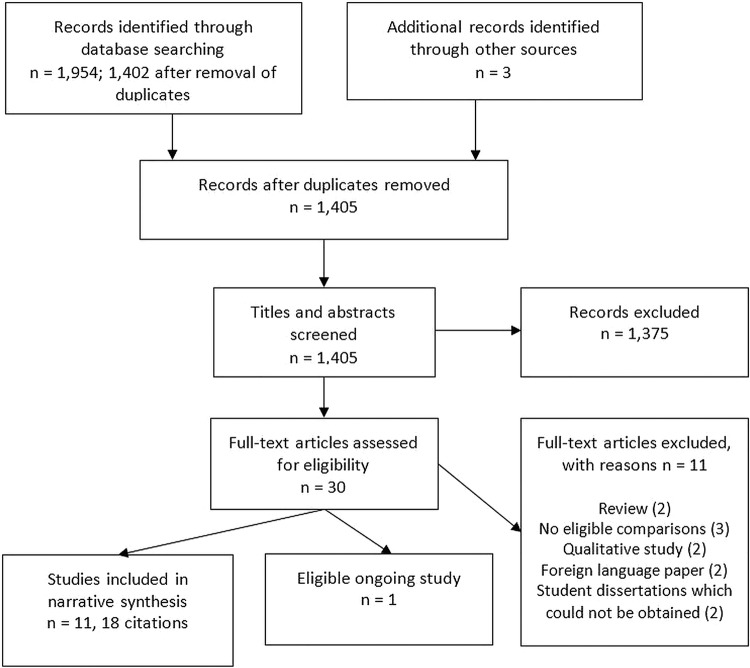
Objective: To collate and critically appraise extant evidence for the impact of contact with the stillborn infant on parental mental health, well-being and satisfaction. Design: Systematic review. Data sources: A structured systematic search was conducted in 13 databases, complemented by hand-searching. Study eligibility criteria: English language studies providing quantitative comparison of outcomes for parents who held their baby or engaged in other memory-making activities, such as having photos and handprints, compared to those who did not, were eligible for inclusion. Outcome measures: Primary outcomes included clinically diagnosed mental health issues, standardised assessment of mental health issues or self-reported psychological distress. Secondary outcomes included poor health, relationship difficulties and satisfaction with the decision to have contact with the baby. Results: Two authors independently screened abstracts, selected potentially eligible studies, extracted data and evaluated the quality of included papers. 11 eligible studies, reported in 18 papers, were included. Studies were heterogeneous, precluding quantitative synthesis, thus a narrative synthesis is presented. Studies presented high risks of bias, particularly in regard to sample representativeness, and confounder identification and adjustment. Results were mixed concerning the impact of holding the stillborn baby on mental health and well-being. One study found no significant effects, and two studies reported no impact on depression. Conflicting effects were found for anxiety and post-traumatic stress. Other memory-making activities were not found to have a significant association with mental health or well-being outcomes. Across studies, mothers were satisfied with their decision to hold their baby or engage in other memory making. Conclusions: Evidence for the impact of holding the stillborn baby on mental health and well-being is sparse, and of poor quality. High-quality research guided by a priori hypotheses, with attention to potential confounders and moderating effects, is needed to provide more rigorous evidence to guide practitioners’ and parents’ decision-making for care following stillbirth. Review protocol number: PROSPERO CRD42014013890.
Overview
The claims and statistics of this paper haven’t been checked yet.
Free: it reads the open-access text and checks the first 5 claims that cite a source we can check. Create a free account to check every claim.
Integrity signals
Registry
Cites
Statistics
Figures
Verification
Claims the paper makes
The claims and statistics of this paper haven’t been checked yet.
Free: it reads the open-access text and checks the first 5 claims that cite a source we can check. Create a free account to check every claim.
Claims other papers make about this one
Each is checked against this paper’s own text: does it say what the citing paper says it does?
The cited source says what the claim attributes to it.
In the citing paper
“Overall, these reviews report adverse short- and long-term psychological outcomes in parents following SB.”
From Depression, anxiety, PTSD, and OCD after stillbirth: a systematic review (2021) · cites this paper as [28]
The cited source says what the claim attributes to it.
In the citing paper
“Inconclusive findings are in accordance with previous systematic reviews on the effect of holding versus not holding the stillborn [28, 49].”
From Depression, anxiety, PTSD, and OCD after stillbirth: a systematic review (2021) · cites this paper as [28]
Self-check
Percentages, sums and reported differences re-computed from the paper’s own numbers.
The self-check needs the paper’s full text.
Citations
Cites
Preferred Reporting Items for Systematic Reviews and Meta-Analyses: the PRISMA statement
Moher, D., Liberati, A., Tetzlaff, J., Altman, D. G., & for the PRISMA Group (2009) · BMJ · doi:10.1136/bmj.b2535 · Cited by 83,823
The CES-D Scale: A Self-Report Depression Scale for Research in the General Population
Radloff, L. S. (1977) · Applied Psychological Measurement · doi:10.1177/014662167700100306 · Cited by 53,267
Preferred reporting items for systematic reviews and meta-analyses: the PRISMA Statement.
(2009) · PubMed Central · Cited by 44,859
An inventory for measuring depression
BECK, A. T. (1961) · Archives of General Psychiatry · doi:10.1001/archpsyc.1961.01710120031004 · Cited by 38,032
Preferred reporting items for systematic reviews and meta-analyses: The PRISMA statement
Moher, D., Liberati, A., Tetzlaff, J., Altman, D. G., & the PRISMA Group* (2009) · Annals of Internal Medicine · doi:10.7326/0003-4819-151-4-200908180-00135 · Cited by 37,554
Cochrane Handbook for Systematic Reviews of Interventions: Cochrane Book Series
(2008) · doi:10.1002/9780470712184 · Cited by 25,048
(1970) · Cited by 24,983
Dermyshi, E., Wang, Y., Yan, C., Hong, W., Qiu, G., Gong, X., & Zhang, T. (2017) · Neonatology · doi:10.1159/000454668 · Cited by 24,451
von Elm, E., Altman, D. G., Egger, M., Pocock, S. J., Gøtzsche, P. C., Vandenbroucke, J. P., & Initiative, F. T. S. (2007) · PLoS Medicine · doi:10.1371/journal.pmed.0040296 · Cited by 23,020
Meta-analysis of Observational Studies in Epidemiology<SUBTITLE>A Proposal for Reporting</SUBTITLE>
Stroup, D. F. (2000) · JAMA · doi:10.1001/jama.283.15.2008 · Cited by 20,623
Research works printed but not linked: 6
- National Institute for Health and Clinical Excellence (NICE). Routine postnatal care of women and their babies. London: NICE, 2006. 31825570
- National Institute for Health and Clinical Excellence (NICE). Antenatal and postnatal mental health: clinical management and service guidance. London: NICE uidelines[CG192], 2014. 31990493
- Redshaw M, Rowe R, Henderson J Listening to Parents after stillbirth or the death of their baby after birth. Oxford: National Perinatal Epidemiology Unit, 2014.
- Higgins JP, Green S Cochrane handbook for systematic reviews of interventions. Wiley Online Library, 2011.
- Critical Appraisal Skills Program (CASP). 12 Questions to help you make sense of a cohort study. Oxford: CASP, 2013 http://www.casp-uk.net/#!casp-tools-checklists/c18f8 (accessed Jun 2014).
- Critical Appraisal Skills Program (CASP). 11 Questions to help you make sense of a case control study. Oxford: CASP, 2013 http://www.casp-uk.net/#!casp-tools-checklists/c18f8 (accessed Jun 2014).
Cited by
Tortella-Feliu, M., Fullana, M. A., Pérez-Vigil, A., Torres, X., Chamorro, J., Littarelli, S. A., Solanes, A., Ramella-Cravaro, V., Vilar, A., González-Parra, J. A., et al. (2019) · Neuroscience & Biobehavioral Reviews · doi:10.1016/j.neubiorev.2019.09.013 · Cited by 253
Depression, anxiety, PTSD, and OCD after stillbirth: a systematic review
Westby, C. L., Erlandsen, A. R., Nilsen, S. A., Visted, E., & Thimm, J. C. (2021) · BMC Pregnancy and Childbirth · doi:10.1186/s12884-021-04254-x · Cited by 148
“Inconclusive findings are in accordance with previous systematic reviews on the effect of holding versus not holding the stillborn [28, 49].”
ResultImpact of perinatal death on the social and Family context of the parents
Fernández-Sola, C., Camacho-Ávila, M., Hernández-Padilla, J. M., Fernández-Medina, I. M., Jiménez-López, F. R., Hernández-Sánchez, E., Conesa-Ferrer, M. B., & Granero-Molina, J. (2020) · International Journal of Environmental Research and Public Health · doi:10.3390/ijerph17103421 · Cited by 89
“On the one hand, the father is imbued with a social role of providing physical and emotional support for mothers, rendering his feelings, experiences and needs invisible [30]; on the other hand, the attachment and bond of a father is considered to be more rational and less passionate [31] since a mother creates her bo…”
BackgroundCare of late intrauterine fetal death and stillbirth: Green‐top Guideline No. 55
Burden, C., Merriel, A., Bakhbakhi, D., Heazell, A. E. P., & Siassakos, D. M. (2024) · BJOG An International Journal of Obstetrics & Gynaecology · doi:10.1111/1471-0528.17844 · Cited by 68
“194 The studies included within the systematic review were too heterogeneous in their outcome measurements and the authors were unable to quantitatively synthesise the results to form a meaningful conclusion.”
Bakhbakhi, D., Burden, C., Storey, C., & Siassakos, D. (2017) · Seminars in Fetal and Neonatal Medicine · doi:10.1016/j.siny.2017.02.008 · Cited by 66
“A subsequent systematic review found that the evidence of impact of holding the stillborn baby on mental health and wellbeing was sparse and poor quality [28].”
BackgroundSupporting women, families, and care providers after stillbirths
Homer, C., Malata, A. M., & ten Hoope‐Bender, P. (2016) · The Lancet · doi:10.1016/s0140-6736(15)01278-7 · Cited by 65
Stillbirth: prevention and supportive bereavement care
Atkins, B., Kindinger, L. M., Mahindra, M. P., Moatti, Z., & Siassakos, D. M. (2023) · BMJ Medicine · doi:10.1136/bmjmed-2022-000262 · Cited by 57
“108 However, across studies mothers were consistently satisfied with choosing to have had contact with their baby.”
Horey, D., Boyle, F. M., Cassidy, J., Cassidy, P. R., Erwich, J. J. H. M., Gold, K. J., Gross, M. M., Heazell, A. E. P., Leisher, S. H., Murphy, M., et al. (2021) · Birth · doi:10.1111/birt.12546 · Cited by 44
Wool, C., Repke, J. T., & Woods, A. B. (2016) · The Journal of Maternal-Fetal & Neonatal Medicine · doi:10.1080/14767058.2016.1195362 · Cited by 44
“Evidence suggests women find the experiences of parenting, such as dressing and bathing, and talking to the baby, most valuable in creating a bond [27] and often wish to spend time and hold their infant if stillborn [28].”
BackgroundMidwives’ experience of delivery care in late foetal death: a qualitative study
Martínez-Serrano, P., Palmar-Santos, A. M., Solís-Muñoz, M., Álvarez-Plaza, C., & Pedraz-Marcos, A. (2018) · Midwifery · doi:10.1016/j.midw.2018.08.010 · Cited by 39
Redshaw, M., Hennegan, J. M., & Henderson, J. (2016) · BMJ Open · doi:10.1136/bmjopen-2015-010996 · Cited by 30
“between mothers who held or did not hold their stillborn baby.(21) Risk of bias appraisal revealed poor study quality.”
BackgroundResultSelf-citationRiegel, M., Randall, S., & Buckley, T. A. (2019) · Australian Critical Care · doi:10.1016/j.aucc.2018.12.002 · Cited by 37
Jones, E. E., Crawley, R. A., Brierley‐Jones, L., & Kenny, C. (2021) · Journal of Reproductive and Infant Psychology · doi:10.1080/02646838.2021.1972951 · Cited by 29
“Following a review of the literature pertaining to parent-baby contact following stillbirth and mental health sequelae, Hennegan et al. (2015) similarly concluded that the findings remain inconclusive.”
BackgroundInfluentialRoberts, L. R., Nick, J. M., Sarpy, N. L., Peters, J., & Tamares, S. (2024) · JBI Evidence Synthesis · doi:10.11124/jbies-23-00149 · Cited by 27
Love, listen and learn: grandmothers' experiences of grief following their child's pregnancy loss
Lockton, J., Due, C., & Oxlad, M. (2020) · Women and Birth · doi:10.1016/j.wombi.2019.07.007 · Cited by 19
Smith, P. C., Vasileiou, K., & Jordan, A. L. (2020) · BMC Pregnancy and Childbirth · doi:10.1186/s12884-020-02865-4 · Cited by 18
Hennegan, J. M., Henderson, J., & Redshaw, M. (2018) · Journal of Reproductive and Infant Psychology · doi:10.1080/02646838.2018.1424325 · Cited by 17
“In interpreting the findings of this study it should be noted that parents are consistently satisfied with their decision to hold the stillborn baby, and those who do not do so often regret it later (Hennegan et al., 2015).”
BackgroundResultInfluentialSelf-citationBereaved parents’ experience of care and follow‐up after stillbirth in Sydney hospitals
Bond, D., Raynes‐Greenow, C., & Gordon, A. (2018) · Australian and New Zealand Journal of Obstetrics and Gynaecology · doi:10.1111/ajo.12684 · Cited by 17
Protocol for the development of a core outcome set for stillbirth care research (iCHOOSE Study)
Bakhbakhi, D., Fraser, A., Siasakos, D., Hinton, L., Davies, A. K., Merriel, A., Duffy, J. M., Redshaw, M., Lynch, M., Timlin, L., et al. (2022) · BMJ Open · doi:10.1136/bmjopen-2021-056629 · Cited by 17
Self-citationBakhbakhi, D., Siassakos, D. M., Davies, A. K., Merriel, A., Barnard, K., Stead, E., Shakespeare, C., Duffy, J. M., Hinton, L., McDowell, K., et al. (2023) · BJOG An International Journal of Obstetrics & Gynaecology · doi:10.1111/1471-0528.17390 · Cited by 17
Self-citationEstudio fenomenológico sobre la experiencia de las familias en el duelo perinatal
Ávila, M. C. (2020) · Repositorio de Patentes de la Universidad de Almería (Universidad de Almería) · Cited by 16
Posttraumatic stress and affecting factors in couples after perinatal loss: a Turkish sample
Baransel, E. S., & Uçar, T. (2020) · Perspectives In Psychiatric Care · doi:10.1111/ppc.12390 · Cited by 13
Hein, K., Flaig, F., Schramm, A., Borasio, G. D., & Führer, M. (2022) · Children · doi:10.3390/children9101555 · Cited by 13
“They argue that evidence is scarce and of poor quality [64,65,81,82] and claim that seeing and holding a dead child may have adverse effects on the mental health and wellbeing of mothers [82,83] and their partners [84].”
BackgroundResultGrief, bereavement and prolonged grief disorder: scoping and mapping the evidence
Raine, G., Khouja, C., Khatwa, M., Fulbright, H., Sutcliffe, K., & Sowden, A. J. (2025) · BJPsych Open · doi:10.1192/bjo.2025.10050 · Cited by 12
Bereavement Care Practices Following Stillbirths: Health-Care Provider's Perspective
Sharma, B., Kulshreshtha, S., Aggarwal, N., Suri, V., & Nehra, R. (2022) · Indian Journal of Community Medicine · doi:10.4103/ijcm.ijcm_676_21 · Cited by 12
“Even available literature did not find enough evidence to support the effect of memory-making on short-term or long-term mental health and well-being of mother.[11] Still, memory-making is practiced worldwide and found to provide satisfaction to bereaved parents and make them happy with their decision of holding the s…”
BackgroundUphoff, E., Zamperoni, V., Yap, J., Simmonds, R., Rodgers, M., Dawson, S., Seymour, C., Kousoulis, A. A., & Churchill, R. C. (2022) · Journal of Mental Health · doi:10.1080/09638237.2022.2069724 · Cited by 12
Continuing bonds: parent's experience of an ongoing relationship with their stillborn baby.
Jones, E. E. (2020) · Sunderland Repository (University of Sunderland) · Cited by 12
Language, Gender and Pregnancy Loss
Malory, B. (2025) · Cambridge University Press eBooks · doi:10.1017/9781009633840 · Cited by 10
Salvini, S., D’Souza, L., McDowell, C., & Vivekananda, K. (2024) · OMEGA - Journal of Death and Dying · doi:10.1177/00302228241265525 · Cited by 8
“…resource in validation of the baby ’ s existence, legitimises mourning, facilitates bonding and memory-making, and allows the enactment of parenting rituals (Blood & Cacciatore, 2014a; Cacciatore & Flint, 2012; Cholette, 2012; Flenady et al., 2014; Hennegan et al., 2015; Koopmans et al., 2013).”
Maurya, S., Yadav, K. K., Vats, P., Dixit, K., Hashmi, M., Bisht, S., Mukherjee, R., Mazumder, S., & Pathak, B. G. (2026) · Frontiers in Psychiatry · doi:10.3389/fpsyt.2026.1736722 · Cited by 7
“This is in accordance with a systematic review that cautioned about the mixed effects of contact/memory making on parents wellbeing and satisfaction (59).”
Stanhope, K. K., Temple, J. R., Christiansen‐Lindquist, L., Dudley, D. J., Stoll, B. J., Varner, M. W., & HOGUE, C. J. R. (2024) · Maternal and Child Health Journal · doi:10.1007/s10995-023-03894-z · Cited by 6
“…perinatal loss, current findings add to existing evidence demonstrating the benefits families receive from support following loss (Caicedo et al., 2019 ; Hennegan et al., 2015 ; our study recommended further contact with the care team following the loss (Ellis et al., 2016 ; Heazell et al., 2016).”
Stillbirth aftercare in a tertiary obstetric center – parents’ experiences
Pekkola, M., Tikkanen, M., Loukovaara, M. J., Paavonen, J. A., & Stefanović, V. (2022) · Journal of Perinatal Medicine · doi:10.1515/jpm-2022-0246 · Cited by 5
“According to a subsequent systematic review the evidence of the impact of seeing and holding the child was sparse [21].”
BackgroundSun, S., Qian, J., Wang, F., Tian, Y., Sun, Y., Zheng, Q., & Yu, X. (2023) · International Journal of Nursing Practice · doi:10.1111/ijn.13146 · Cited by 5
Kang, Z., Wu, Q., Cao, J., Zhu, M., You, Z., Li, D., & Liu, W. (2024) · Frontiers in Genetics · doi:10.3389/fgene.2024.1434762 · Cited by 4
“Additionally, it remains uncertain whether stillbirth contributes to the development of depression during the postpartum period (Hennegan et al., 2015; Huberty et al., 2014).”
BackgroundPartners in Pain, Two Sides of a Zipper – Midwives’ Experiences With Stillbirth: A Qualitative Study
Bingöl, F. B., Yılmaz, Z. D. K., & Topaloğlu, S. (2024) · OMEGA - Journal of Death and Dying · doi:10.1177/00302228241235429 · Cited by 4
“Since the effects of this situation on mental health are not known with certainty, the mother ’ s wishes should be respected (Hennegan et al., 2015).”
Actuación de enfermería en el duelo por pérdida perinatal.
Díaz, B. L. (2017) · UVaDOC UVaDOC University of Valladolid Documentary Repository (University of Valladolid) · Cited by 4
Malory, B., & Parr, E. (2025) · Journal of Language and Discrimination · doi:10.3138/jld-2025-1007 · Cited by 2
Psychosozialmedizinische Betreuung – Hilfestellung für Eltern und Angehörige
Klapp, C. (2016) · Springer eBooks · doi:10.1007/978-3-662-50424-6_44 · Cited by 1
Bakhbakhi, D., Burden, C., Davies, A. K., Fraser, A., Siassakos, D. M., Lynch, M., Timlin, L., Duffy, J. M., Redshaw, M., Dangerfield, H., et al. (2026) · PLoS ONE · doi:10.1371/journal.pone.0347544 · Cited by 1
“Grief alone is not a unique outcome, and several studies have measured grief when evaluating care after stillbirth [3,33–38].”
Self-citationExperiences of couples in pregnancy after stillbirth: an interpretative phenomenological analysis
Murphy, M. (2018) · Cork Open Research Archive (University College Cork, Ireland) · Cited by 1
Serrano, P. M. (2020) · Tesis Doctorals en Xarxa (Consorci de Serveis Universitaris de Catalunya) · doi:10.6035/14103.2020.686142 · Cited by 1
Impacto psicológico de la pérdida perinatal en una gestación gemelar monocorial
Serra, M. (2019) · Tesis Doctorals en Xarxa (Consorci de Serveis Universitaris de Catalunya) · Cited by 1
Wheeler, N. (2021) · UWE Research Repository (UWE Bristol) · Cited by 1
Breaking the Silence around Stillbirth by Improving Caregivers' Skills, Education, and Support
Avagliano, L. (2022) · Clinical and Experimental Obstetrics & Gynecology · doi:10.31083/j.ceog4910218
“Seeing and holding the baby is a positive experience for many parents [10], however, it is important to support and facilitate parents to take their own decisions without any imposition [2].”
BackgroundPhotography and perinatal loss: parents’ experiences of memory-making and meaning
Wolf, L. D., Stegen, H., Dewinter, H., Backer, F. D., & Vandermeersche, G. (2025) · Arts & Health · doi:10.1080/17533015.2025.2581964
Smith, P. C., Vasileiou, K., & Jordan, A. (2020) · Figshare · doi:10.6084/m9.figshare.12004944
Love, Listen and Learn: Grandparents’ Experiences of Pregnancy Loss
Lockton, J. (2018) · Adelaide Research & Scholarship (AR&S) (University of Adelaide)
Robinson, N. M. (2019) · Adelaide Research & Scholarship (AR&S) (University of Adelaide)
Nursing intervention in the perinatal grief process
Díez, A. U. (2024) · UCrea (University of Cantabria)
Stage-based bereavement support for parents after stillbirth: an umbrella review
Chen, L.-L., Tsai, C.-H., & Yang, C. (2026) · Journal of Reproductive and Infant Psychology · doi:10.1080/02646838.2026.2675706
Qian, J., Yang, M., Wang, M., Sun, S., & Yu, X. (2026) · BMC Pregnancy and Childbirth · doi:10.1186/s12884-026-09240-9
“The formulation of unified procedures and principles is of paramount importance, as it not only affects maternal psychological outcomes but also contributes to improved satisfaction with perinatal bereavement care [49].”
Impacto de los cuidados de enfermería en el duelo perinatal: revisión narrativa
Salazar-Estrada, K. J., Lomas-Males, D. M., Ruano-Paspuel, J. A., & Cano, J. R. M. (2026) · Cuaderno de enfermería. Revista científica. · doi:10.62574/avzrkz27
Metadata
- Authors
- Hennegan, J. M., Henderson, J., & Redshaw, M.
- Affiliations
- University of Oxford (GB)
- Corresponding author
- Redshaw, Maggie
- Venue
- BMJ Open
- Publisher
- BMJ
- Published
- 2015-11
- Volume
- 5
- Issue
- 11
- Pages
- e008616
- ISSN
- 2044-6055 (ISSN-L)
- PMC
- PMC4663431
- OpenAlex
- W2194360202
- Cited by
- 44
- References
- 66
- Citations by year
- 2026: 5 · 2025: 4 · 2024: 7 · 2023: 3 · 2022: 6 · 2021: 3 · 2020: 4 · 2019: 4 · 2018: 2 · 2017: 2 · 2016: 4
- FWCI
- 0.38
- Type
- journal article
- Language
- en
- Open access
- gold
- doi.org
- Licence
- cc-by
- Locations
- BMJ Open (publishedVersion, cc-by)
- PubMed Central (publishedVersion, cc-by)
- PubMed (publishedVersion)
- Funders
- National Institute for Health and Care Research
- Topics
- Social Sciences › Psychology › Clinical Psychology › Grief, Bereavement, and Mental Health
- Health Sciences › Medicine › Pediatrics, Perinatology and Child Health › Global Maternal and Child Health
- Health Sciences › Medicine › Public Health, Environmental and Occupational Health › Maternal Mental Health During Pregnancy and Postpartum
- Keywords
- stillbirth, parental mental health, parental well-being, post-traumatic stress, anxiety, depression, parental satisfaction, maternal mental health
- MeSH terms
- Anxiety, Bereavement, Depression, Humans, Mental Health, Parents, Touch, Randomized Controlled Trials as Topic, Stillbirth, Self Report
About these checks
Registry, retraction, Cites and statistics results are computed, not judged, with one exception: a printed reference that no index lists is read once by a model before it counts as a citation error. Claims are extracted by a model and kept only when their quote appears verbatim in the text; each cited source is then checked, with a model’s help, for whether it says what the claim relies on. Those verdicts can be wrong — read the claim’s quote and the cited source before relying on one.
Statistics and arithmetic are recomputed, not judged.
Confidence bands are shown only for fields calibrated on our annotated test set. None is calibrated yet, so no band is shown.
What counts as a claim ›How we measure confidence ›How we check this ›
Are you an author, or do you see a problem with this page? Request a review
Data sources
Bibliographic data: Semantic Scholar, OpenAlex, Crossref.
Contains information from the Semantic Scholar Academic Graph Datasets, made available under the ODC Attribution License (ODC-BY 1.0).
Semantic Scholar’s data is described in: Kinney, R., et al. (2023). The Semantic Scholar Open Data Platform. arXiv:2301.10140.
