

The UK Out of Hospital Cardiac Arrest Outcome (OHCAO) project
Open accessThe DOI matches its Crossref record; 28 of the 29 references it cites were found in a registry or an index.
Abstract
Introduction: Reducing premature death is a key priority for the UK National Health Service (NHS). NHS Ambulance services treat approximately 30 000 cases of suspected cardiac arrest each year but survival rates vary. The British Heart Foundation and Resuscitation Council (UK) have funded a structured research programme—the Out of Hospital Cardiac Arrest Outcomes (OHCAO) programme. The aim of the project is to establish the epidemiology and outcome of OHCA, explore sources of variation in outcome and establish the feasibility of setting up a national OHCA registry. Methods and analysis: This is a prospective observational study set in UK NHS Ambulance Services. The target population will be adults and children sustaining an OHCA who are attended by an NHS ambulance emergency response and where resuscitation is attempted. The data collected will be characterised broadly as system characteristics, emergency medical services (EMS) dispatch characteristics, patient characteristics and EMS process variables. The main outcome variables of interest will be return of spontaneous circulation and medium—long-term survival (30 days to 10-year survival). Ethics and dissemination: Ethics committee permissions were gained and the study also has received approval from the Confidentiality Advisory Group Ethics and Confidentiality committee which provides authorisation to lawfully hold identifiable data on patients without their consent. To identify the key characteristics contributing to better outcomes in some ambulance services, reliable and reproducible systems need to be established for collecting data on OHCA in the UK. Reports generated from the registry will focus on data completeness, timeliness and quality. Subsequent reports will summarise demographic, patient, process and outcome variables with aim of improving patient care through focus quality improvement initiatives.
Overview
The claims and statistics of this paper haven’t been checked yet.
Free: it reads the open-access text and checks the first 5 claims that cite a source we can check. Create a free account to check every claim.
Integrity signals
Registry
Cites
Statistics
Figures
Verification
Claims the paper makes
The claims and statistics of this paper haven’t been checked yet.
Free: it reads the open-access text and checks the first 5 claims that cite a source we can check. Create a free account to check every claim.
Claims other papers make about this one
Each is checked against this paper’s own text: does it say what the citing paper says it does?
The cited source says what the claim attributes to it.
In the citing paper
“Core outcomes are identified as ROSC, survival at hospital discharge/30-days, and neurological outcome at hospital discharge. 302,303”
From European Resuscitation Council Guidelines 2021: Ethics of resuscitation and end of life decisions (2021) · cites this paper as [303]
Self-check
Percentages, sums and reported differences re-computed from the paper’s own numbers.
The self-check needs the paper’s full text.
Citations
Cites
Jacobs, I., Nadkarni, V., the ILCOR Task Force on Cardiac Arrest and Cardiopulmonary Resuscitation Outcomes, PARTICIPANTS, C., Bahr, J., Berg, R. A., Billi, J. E., Bossaert, L., Cassan, P., Coovadia, A., et al. (2004) · Circulation · doi:10.1161/01.cir.0000147236.85306.15 · Cited by 2,560
Regional Variation in Out-of-Hospital Cardiac Arrest Incidence and Outcome
Nichol, G. (2008) · JAMA · doi:10.1001/jama.300.12.1423 · Cited by 1,961
Cummins, R. O., Chamberlain, D. A., Abramson, N. S., Allen, M., Baskett, P. J., Becker, L., Bossaert, L., Delooz, H. H., Dick, W. F., & Eisenberg, M. S. (1991) · Circulation · doi:10.1161/01.cir.84.2.960 · Cited by 1,670
Wissenberg, M., Lippert, F. K., Folke, F., Weeke, P., Hansen, C. M., Christensen, E. F., Jans, H., Hansen, P. A., Lang-Jensen, T., Olesen, J. B., et al. (2013) · JAMA · doi:10.1001/jama.2013.278483 · Cited by 1,191 · cited 1×
“Structural factors may include geography,(18) the provision and uptake of public access defibrillation,(19) 20 community initiatives.(21) Process variables include EMS response time,(22) time to first shock and likely the facilities at the receiving hospital.”
BackgroundJacobs, I., Nadkarni, V., Bahr, J., Berg, R. A., Billi, J. E., Bossaert, L., Cassan, P., Coovadia, A., D’Este, K., Finn, J., et al. (2004) · Resuscitation · doi:10.1016/j.resuscitation.2004.09.008 · Cited by 914
Chamberlain, D., Cummins, R. O., Abramson, N., Allen, M., Baskett, P., Becker, L., Bossaert, L., Delooz, H., Dick, W., Eisenberg, M., et al. (1991) · Resuscitation · doi:10.1016/0300-9572(91)90061-3 · Cited by 914
Sunde, K., Pytte, M., Jacobsen, D., Mangschau, A., Jensen, L. P., Smedsrud, C., Draegni, T., & Steen, P. A. (2007) · Resuscitation · doi:10.1016/j.resuscitation.2006.08.016 · Cited by 886 · cited 1×
“Process variables include EMS response time,(22) time to first shock and likely the facilities at the receiving hospital.(23) Variation attributable to the individual care provider most likely relates to the quality of CPR(24) and thresholds for initiating resuscitation.”
BackgroundChristenson, J., Andrusiek, D., Everson-Stewart, S., Kudenchuk, P., Hostler, D., Powell, J., Callaway, C. W., Bishop, D., Vaillancourt, C., Davis, D., et al. (2009) · Circulation · doi:10.1161/circulationaha.109.852202 · Cited by 759
Perkins, G. D., Jacobs, I. G., Nadkarni, V. M., Berg, R. A., Bhanji, F., Biarent, D., Bossaert, L. L., Brett, S. J., Chamberlain, D., de Caen, A. R., et al. (2015) · Resuscitation · doi:10.1016/j.resuscitation.2014.11.002 · Cited by 726
Self-citationPerkins, G. D., Lall, R., Quinn, T., Deakin, C. D., Cooke, M. W., Horton, J., Lamb, S. E., Slowther, A.-M., Woollard, M., Carson, A., et al. (2015) · The Lancet · doi:10.1016/s0140-6736(14)61886-9 · Cited by 538 · cited 2×
“The remaining 70% are transferred to hospital of which approximately two-thirds have resuscitation efforts terminated in the emergency department.(32) Of those patients who initially survive and are admitted to hospital, only approximately half survive to go home.”
BackgroundSelf-citationLilford, R., Mohammed, M. A., Spiegelhalter, D., & Thomson, R. (2004) · The Lancet · doi:10.1016/s0140-6736(04)15901-1 · Cited by 448 · cited 2×
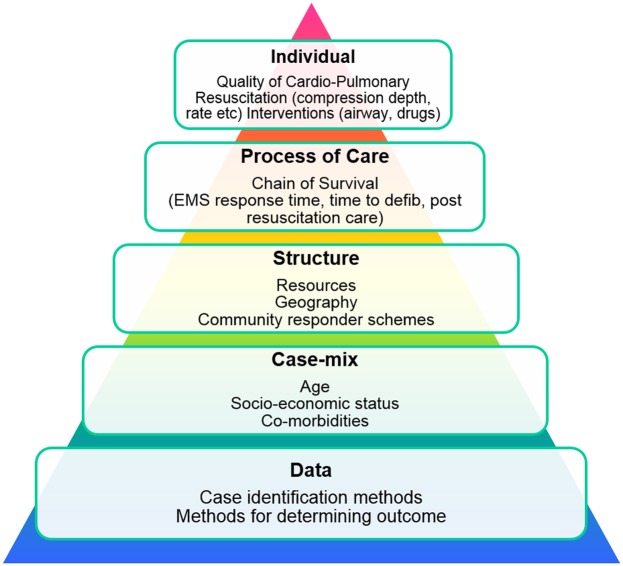
“Figure 2 Sources of special cause variation in cardiac arrest likely to influence survival rates adapted from Lilford et al.5 EMS, emergency medical services.”
BackgroundChest compression depth and survival in out-of-hospital cardiac arrest
Vadeboncoeur, T., Stolz, U., Panchal, A., Silver, A., Venuti, M., Tobin, J., Smith, G., Nunez, M., Karamooz, M., Spaite, D., et al. (2014) · Resuscitation · doi:10.1016/j.resuscitation.2013.10.002 · Cited by 302 · cited 1×
“More complex statistical adjustments for case mix may be helpful in reducing variation due to differences in case mix.(17) Structural factors may include geography,(18) the provision and uptake of public access defibrillation,(19) 20 community initiatives.”
BackgroundPredicting Survival After Out-of-Hospital Cardiac Arrest: Role of the Utstein Data Elements
Rea, T. D., Cook, A. J., Stiell, I. G., Powell, J., Bigham, B., Callaway, C. W., Chugh, S., Aufderheide, T. P., Morrison, L., Terndrup, T. E., et al. (2010) · Annals of Emergency Medicine · doi:10.1016/j.annemergmed.2009.09.018 · Cited by 218 · cited 1×
“The Utstein comparator group (bystander witnessed cardiac arrest who are in VF) attempts to allow some adjustment for case mix, although it likely accounts for only 40% of the observed variation.(16) More complex statistical adjustments for case mix may be helpful in reducing variation due to differences in case mix.”
MethodRole of ambulance response times in the survival of patients with out-of-hospital cardiac arrest
O'Keeffe, C., Nicholl, J., Turner, J., & Goodacre, S. (2011) · Emergency Medicine Journal · doi:10.1136/emj.2009.086363 · Cited by 173
Variability in cardiac arrest survival: the NHS Ambulance Service Quality Indicators: Figure 1
Perkins, G. D., & Cooke, M. W. (2012) · Emergency Medicine Journal · doi:10.1136/emermed-2011-200758 · Cited by 123 · cited 1×
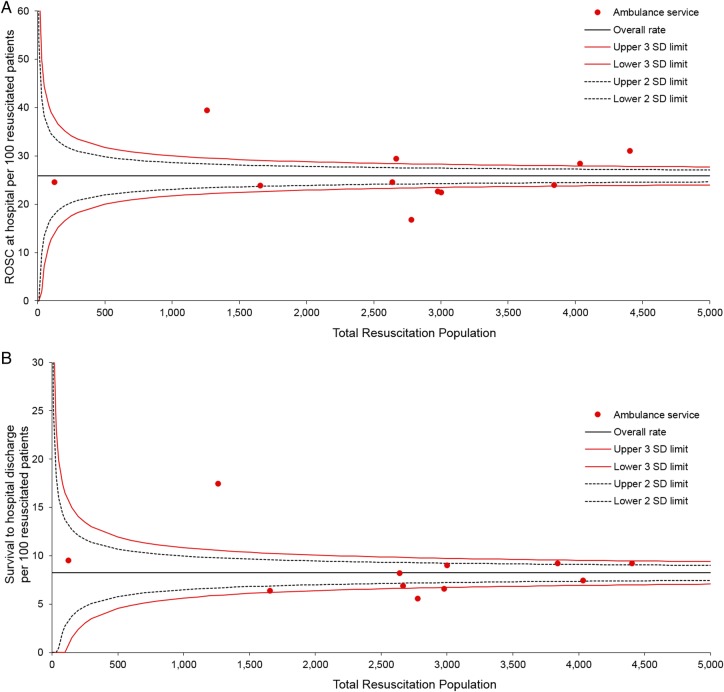
“There is significant variability between ambulance services in rates of the reported successful initial resuscitation (13– 27%) and survival to hospital discharge (2– 12%).(3) Nichol et al identified evidence of regional variation in incidence and outcomes from OHCA in 10 North American sites.”
BackgroundSelf-citationSafdar, B., Stolz, U., Stiell, I. G., Cone, D. C., Bobrow, B. J., deBoehr, M., Dreyer, J. F., Maloney, J. P., & Spaite, D. W. (2014) · Academic Emergency Medicine · doi:10.1111/acem.12540 · Cited by 119
Deakin, C. D., Shewry, E., & Gray, H. H. (2014) · Heart · doi:10.1136/heartjnl-2013-305030 · Cited by 117
Rajan, S., Wissenberg, M., Folke, F., Hansen, C. M., Lippert, F. K., Weeke, P. E., Karlsson, L., Søndergaard, K. B., Kragholm, K. H., Christensen, E. F., et al. (2014) · Resuscitation · doi:10.1016/j.resuscitation.2014.11.025 · Cited by 87
Nishiyama, C., Brown, S. P., May, S., Iwami, T., Koster, R. W., Beesems, S. G., Kuisma, M., Salo, A., Jacobs, I., Finn, J., et al. (2014) · Resuscitation · doi:10.1016/j.resuscitation.2014.06.031 · Cited by 85 · cited 1×
“However, it is important that definitions are consistently applied to reduce variation.(9) Differences in the case mix of patients attended by ambulance services, for example, age,(10) 11 sex,(12) body Figure 1 Funnel plot showing percentage return of spontaneous circulation (A) and survival to hospital discharge (B)…”
BackgroundBody Mass Index and Survival After In-Hospital Cardiac Arrest
Jain, R., Nallamothu, B. K., Chan, P. S., & for the American Heart Association National Registry of Cardiopulmonary Resuscitation (NRCPR) Investigators* (2010) · Circulation: Cardiovascular Quality and Outcomes · doi:10.1161/circoutcomes.109.912501 · Cited by 83
Population density, call-response interval, and survival of out-of-hospital cardiac arrest
Yasunaga, H., Miyata, H., Horiguchi, H., Tanabe, S., Akahane, M., Ogawa, T., Koike, S., & Imamura, T. (2011) · International Journal of Health Geographics · doi:10.1186/1476-072x-10-26 · Cited by 82
A national scheme for public access defibrillation in England and Wales: Early results
Colquhoun, M. C., Chamberlain, D. A., Newcombe, R. G., Harris, R., Harris, S., Peel, K., Davies, C., & Boyle, R. (2008) · Resuscitation · doi:10.1016/j.resuscitation.2008.03.226 · Cited by 80
Jolliffe, D. M. (2011) · Anaesthesia · doi:10.1111/j.1365-2044.2011.06734.x · Cited by 76
Nehme, Z., Andrew, E., Bray, J., Cameron, P. A., Bernard, S., Meredith, I. T., & Smith, K. L. (2014) · Resuscitation · doi:10.1016/j.resuscitation.2014.12.009 · Cited by 42
Shah, A. S. V., Bhopal, R., Gadd, S., & Donohoe, R. T. (2009) · Heart · doi:10.1136/hrt.2009.170183 · Cited by 36
Janghorbani, M., Jones, R. B., & Nelder, R. (2006) · Acta Cardiologica · doi:10.2143/ac.61.3.2014834 · Cited by 16
Variation in epidemiology and outcomes from cardiac arrest
Fothergill, R. T., Brace-McDonnell, S. J., & Perkins, G. D. (2014) · Resuscitation · doi:10.1016/j.resuscitation.2014.08.016 · Cited by 7 · cited 1×
“Early exploratory work in the UK has identified five different ways through which ambulance services identify cases of cardiac arrest.(6) Each approach may identify patients with subtly different characteristics and outcomes.”
BackgroundSelf-citationUrgent & Emergency Care Review: response of the Association of Ambulance Chief Executives
́Flaherty, M. O. (2013) · Journal of Paramedic Practice · doi:10.12968/jpar.2013.5.12.664 · Cited by 1
Cited by
European Resuscitation Council Guidelines 2021: Epidemiology of cardiac arrest in Europe
Gräsner, J.-T., Herlitz, J., Tjelmeland, I. B. M., Wnent, J., Masterson, S., Lilja, G., Bein, B., Böttiger, B. W., Rosell-Ortiz, F., Nolan, J. P., et al. (2021) · Resuscitation · doi:10.1016/j.resuscitation.2021.02.007 · Cited by 745
“quality of CPR, interventions provided, decisions about when to start and stop resuscitation).(4) In the early 1990s, the”
BackgroundSelf-citationKiguchi, T., Okubo, M., Nishiyama, C., Maconochie, I., Ong, M. E. H., Kern, K. B., Wyckoff, M. H., McNally, B., Christensen, E. F., Tjelmeland, I., et al. (2020) · Resuscitation · doi:10.1016/j.resuscitation.2020.02.044 · Cited by 557
“0) 11 (9, 15) N/A 66 (49, 79) N/A N/A 205 (83.”
Self-citationEpidemiology and outcomes from out-of-hospital cardiac arrests in England
Hawkes, C., Booth, S., Ji, C., Brace-McDonnell, S. J., Whittington, A., Mapstone, J., Cooke, M. W., Deakin, C. D., Gale, C. P., Fothergill, R., et al. (2017) · Resuscitation · doi:10.1016/j.resuscitation.2016.10.030 · Cited by 327
Self-citationEuropean Resuscitation Council Guidelines 2021: Ethics of resuscitation and end of life decisions
Mentzelopoulos, S. D., Couper, K., Voorde, P. V. D., Druwé, P., Blom, M., Perkins, G. D., Lulic, I., Djakow, J., Raffay, V., Lilja, G., et al. (2021) · Resuscitation · doi:10.1016/j.resuscitation.2021.02.017 · Cited by 246
“Variation may reflect differences at several levels, including data collection methods, case-mix, and treatment.(293,294) From an ethical perspective, the key concern occurs when variability is caused by”
BackgroundSelf-citationNational initiatives to improve outcomes from out-of-hospital cardiac arrest in England
Perkins, G. D., Lockey, A. S., de Belder, M., Moore, F. P., Weissberg, P. L., & Gray, H. (2015) · Emergency Medicine Journal · doi:10.1136/emermed-2015-204847 · Cited by 160
Self-citation
Metadata
- Authors
- Perkins, G. D., & Brace-McDonnell, S. J.
- Affiliations
- University of Warwick (GB)
- Corresponding author
- Perkins, Gavin D
- Venue
- BMJ Open
- Publisher
- BMJ
- Published
- 2015-10
- Volume
- 5
- Issue
- 10
- Pages
- e008736
- ISSN
- 2044-6055 (ISSN-L)
- PMC
- PMC4606389
- OpenAlex
- W1497007582
- Semantic Scholar
- a2ba34c2fd493632aafc24dd11f1d55132829a62
- Cited by
- 80
- References
- 29
- Citations by year
- 2026: 5 · 2025: 8 · 2024: 5 · 2023: 10 · 2022: 9 · 2021: 13 · 2020: 10 · 2019: 3 · 2018: 8 · 2017: 4 · 2016: 3 · 2015: 2
- FWCI
- 5.52
- Type
- journal article
- Language
- en
- Open access
- gold
- doi.org
- Licence
- cc-by
- Locations
- BMJ Open (publishedVersion, cc-by)
- PubMed Central (publishedVersion, cc-by)
- PubMed (publishedVersion)
- Warwick Research Archive Portal (University of Warwick) (acceptedVersion)
- Figshare (submittedVersion, cc-by)
- Funders
- Resuscitation Council (UK)
- National Institute for Health and Care Research
- British Heart Foundation
- University of Warwick
- Topics
- Health Sciences › Medicine › Emergency Medicine › Cardiac Arrest and Resuscitation
- Health Sciences › Medicine › Public Health, Environmental and Occupational Health › Palliative Care and End-of-Life Issues
- Health Sciences › Medicine › Emergency Medicine › Trauma and Emergency Care Studies
- Keywords
- out-of-hospital cardiac arrest, OHCA registry, ambulance services, return of spontaneous circulation, long-term survival, resuscitation outcomes, emergency medical services, data quality, quality improvement
- MeSH terms
- Ambulances, Emergency Medical Services, Humans, Prospective Studies, Registries, Incidence, Survival Rate, Cardiopulmonary Resuscitation, Outcome Assessment, Health Care, Out-of-Hospital Cardiac Arrest, Quality Improvement
About these checks
Registry, retraction, Cites and statistics results are computed, not judged, with one exception: a printed reference that no index lists is read once by a model before it counts as a citation error. Claims are extracted by a model and kept only when their quote appears verbatim in the text; each cited source is then checked, with a model’s help, for whether it says what the claim relies on. Those verdicts can be wrong — read the claim’s quote and the cited source before relying on one.
Statistics and arithmetic are recomputed, not judged.
Confidence bands are shown only for fields calibrated on our annotated test set. None is calibrated yet, so no band is shown.
What counts as a claim ›How we measure confidence ›How we check this ›
Are you an author, or do you see a problem with this page? Request a review
Data sources
Bibliographic data: Semantic Scholar, OpenAlex, Crossref.
Contains information from the Semantic Scholar Academic Graph Datasets, made available under the ODC Attribution License (ODC-BY 1.0).
Semantic Scholar’s data is described in: Kinney, R., et al. (2023). The Semantic Scholar Open Data Platform. arXiv:2301.10140.
