

Combined cognitive–behavioural and mindfulness programme for people living with dystonia: a proof-of-concept study
Open accessThe DOI matches its Crossref record; 44 of the 44 references it cites were found in a registry or an index.
Abstract
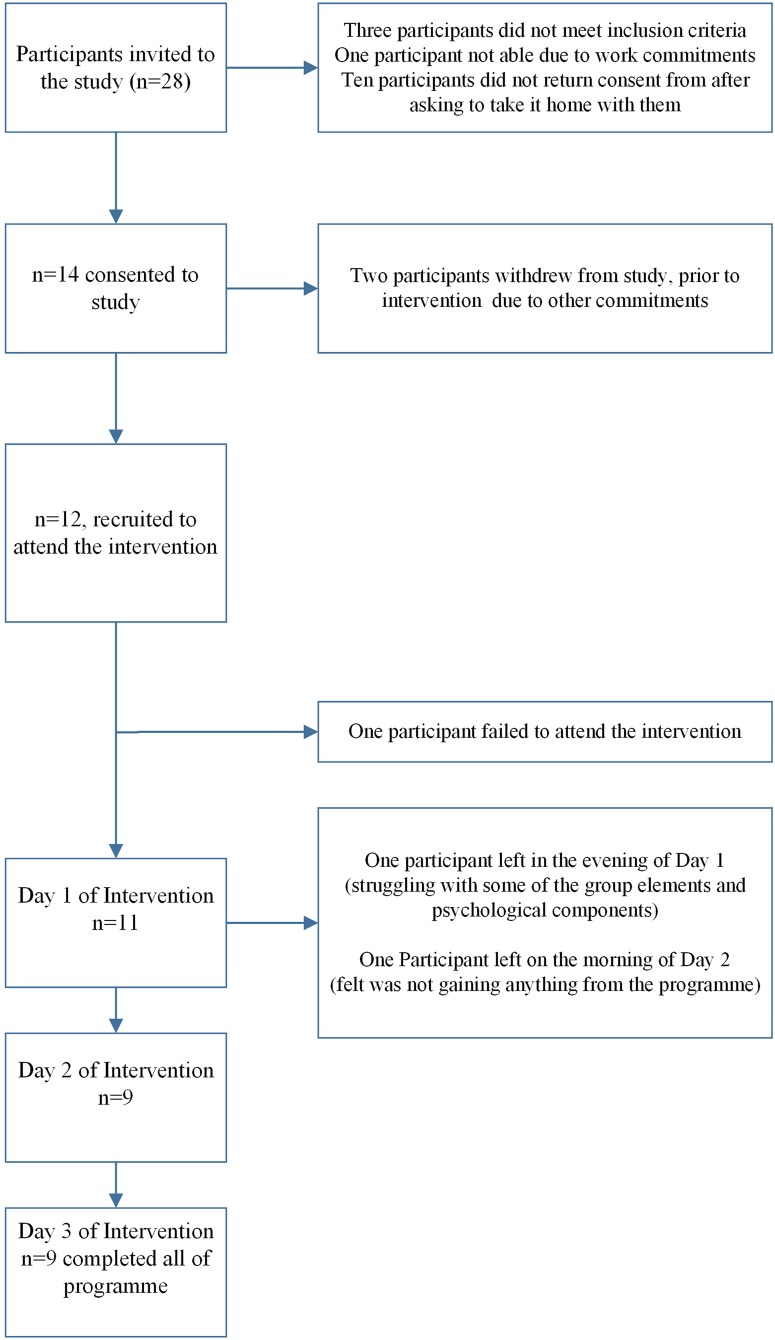
Objectives: To design and test the delivery of an intervention targeting the non-motor symptoms of dystonia and pilot key health and well-being questionnaires in this population. Design: A proof-of-concept study to test the delivery, acceptability, relevance, structure and content for a 3-day group residential programme for the management of dystonia. Setting: Participants were recruited from a single botulinum toxin clinic. The intervention was delivered in the community. Participants: 14 participants consented to take part (2 withdrew prior to the starting of intervention). The average age was 60 years (range 44–77), 8 of whom were female. After drop-out, 9 participants completed the 3-day programme. Intervention: A 3-day group residential programme. Primary and secondary outcome measures: Process evaluation and interviews were carried out before and after the intervention to explore participant's views and expectations, as well as experiences of the intervention. Select questionnaires were completed at baseline, 1-month and 3-month follow-up. Results: Although participants were not sure what to expect from the programme, they found it informative and for many this together with being in a group with other people with dystonia legitimised their condition. Mindfulness was accepted and adopted as a coping strategy. This was reflected in the 1-month follow-up. Conclusions: We successfully delivered a 3-day residential programme to help those living with dystonia manage their condition. Further improvements are suggested. The quantitative outcome measures were acceptable to this group of patients with dystonia.
Overview
The claims and statistics of this paper haven’t been checked yet.
Free: it reads the open-access text and checks the first 5 claims that cite a source we can check. Create a free account to check every claim.
Integrity signals
Registry
Cites
Statistics
Figures
Verification
Claims the paper makes
The claims and statistics of this paper haven’t been checked yet.
Free: it reads the open-access text and checks the first 5 claims that cite a source we can check. Create a free account to check every claim.
Claims other papers make about this one
Each is checked against this paper’s own text: does it say what the citing paper says it does?
The source backs part of the claim, not all of it — or backs it for a different population, condition or comparison.
In the citing paper
“with a recent feasibility study demonstrating the ability for face-to-face CBT combined with mindfulness to substantially reduce depression and anxiety scores using standardised questionnaires [12].”
From Internet-based cognitive behavioural therapy programme as an intervention for people diagnosed with adult-onset, focal, isolated, idiopathic cervical dystonia: A feasibility study protocol (2020) · cites this paper as [12]
Experimental — accuracy not yet measured
Self-check
Percentages, sums and reported differences re-computed from the paper’s own numbers.
The self-check needs the paper’s full text.
Citations
Cites
The theory of planned behavior
Ajzen, I. (1991) · Organizational Behavior and Human Decision Processes · doi:10.1016/0749-5978(91)90020-t · Cited by 90,587
The Hospital Anxiety and Depression Scale
Zigmond, A. S., & Snaith, R. P. (1983) · Acta Psychiatrica Scandinavica · doi:10.1111/j.1600-0447.1983.tb09716.x · Cited by 47,139
Cornally, N. (2015) · Springer Publishing Company eBooks · doi:10.1891/9780826164056.0005 · Cited by 36,743
EuroQol: a new facility for the measurement of health-related quality of life
(1990) · Health Policy · doi:10.1016/0168-8510(90)90421-9 · Cited by 15,736
Depression and quality of life in older persons: A review
Sivertsen, H., Bjørkløf, G. H., Engedal, K., Selbæk, G., & Helvik, A.-S. (2015) · Dementia and Geriatric Cognitive Disorders · doi:10.1159/000437299 · Cited by 14,152
Michie, S., van Stralen, M. M., & West, R. (2011) · Implementation Science · doi:10.1186/1748-5908-6-42 · Cited by 13,697 · cited 1×
“The framework included problem solving, goal setting and coping strategies using self-regulation theory,(25) the Theory of Planned Behaviour(26) 27 and Michie’s Behaviour Change Wheel.(28) The self-regulation theory(25) draws on an individual’s own representation of their illness such as: identity (What is dystonia? W…”
MethodEfficacy of the Theory of Planned Behaviour: A meta‐analytic review
Armitage, C. J., & Conner, M. (2001) · British Journal of Social Psychology · doi:10.1348/014466601164939 · Cited by 9,970 · cited 1×
“The framework included problem solving, goal setting and coping strategies using self-regulation theory, 25 the Theory of Planned Behaviour 26 27 and Michie ’ s Behaviour Change Wheel.”
MethodThe Warwick-Edinburgh Mental Well-being Scale (WEMWBS): development and UK validation
Tennant, R., Hiller, L., Fishwick, R., Platt, S., Joseph, S., Weich, S., Parkinson, J., Secker, J., & Stewart-Brown, S. (2007) · Health and Quality of Life Outcomes · doi:10.1186/1477-7525-5-63 · Cited by 5,031
(2012) · doi:10.1016/j.wem.2012.08.011 · Cited by 3,694
The estimation of a preference-based measure of health from the SF-36
Brazier, J., Roberts, J., & Deverill, M. (2002) · Journal of Health Economics · doi:10.1016/s0167-6296(01)00130-8 · Cited by 3,026
Cited by
A Systematic Review of Cognition in Cervical Dystonia
O’Connor, S. S., Hevey, D., Burke, T., Rafee, S., Pender, N. P., & O’Keeffe, F. M. (2023) · Neuropsychology Review · doi:10.1007/s11065-022-09558-z · Cited by 27
“While the evidence base for cognitive rehabilitation in CD is lacking, there is emerging evidence suggesting that cognitive behaviour therapy and mindfulness may be effective psychological interventions for pwCD (Kobayashi et al., 2020; Sandhu et al., 2016; Wadon et al., 2020 ).”
BackgroundExperiences of living with dystonia
Morgan, A. J., Eccles, F. J. R., & Greasley, P. (2019) · Disability and Rehabilitation · doi:10.1080/09638288.2019.1645217 · Cited by 34
“[63], who concluded that a combined cognitive behavioural and mindfulness programme could assist self-management and an integrated approach to managing the psychosocial impact of dystonia.”
BackgroundNon-motor symptoms in dystonia: from diagnosis to treatment
Peall, K. J., Berman, B. D., Bruggemann, N., Defazio, G., Gimeno, H., Jinnah, H., Perlmutter, J., Richardson, S. P., Roze, E., Schrag, A., et al. (2023) · Dystonia · doi:10.3389/dyst.2023.11860 · Cited by 15
Useros-Olmo, A. I., Martínez‐Pernía, D., & Huepe, D. (2018) · Physiotherapy Theory and Practice · doi:10.1080/09593985.2018.1488319 · Cited by 14
“…relaxation programs with conventional physiotherapy (Andrews and Gill, 1982; Boyce et al, 2013; Duddy and McLellan, 1995; Gildenberg, 1981; Jahanshahi, Sartory, and Marsden, 1991; Zetterberg et al, 2008); and a combined cognitive-behavioral intervention and mindfulness program (Sandhu et al, 2016).”
BackgroundWadon, M. E., MacIver, C., Winter, M., & Peall, K. J. (2021) · Clinical Parkinsonism & Related Disorders · doi:10.1016/j.prdoa.2021.100121 · Cited by 11
“This may also have had an impact on QoL scores, particularly relating to the uncertainty around regular receipt of neurotoxin injections, recognised as providing a positive impact on QoL for individuals with AOIFCD [13], possibly providing some explanation for the variation observed across both groups on an individual…”
Influential
Metadata
- Authors
- Sandhu, H., Bernstein, C. J., Davies, G., Tang, N. K. Y., Belhag, M., Tingle, A., Field, M., Foss, J., Lindahl, A., Underwood, M., & Ellard, D. R.
- Affiliations
- University of Warwick (GB)
- University of Southampton (GB)
- University Hospital Coventry (GB)
- The Dystonia Society (West Midlands Group), West Midlands, UK
- Corresponding author
- Sandhu, H
- Venue
- BMJ Open
- Publisher
- BMJ
- Published
- 2016-08
- Volume
- 6
- Issue
- 8
- Pages
- e011495
- ISSN
- 2044-6055 (ISSN-L)
- PMC
- PMC4985914
- OpenAlex
- W2497451540
- Cited by
- 16
- References
- 42
- Citations by year
- 2026: 1 · 2025: 1 · 2024: 2 · 2023: 2 · 2021: 3 · 2020: 3 · 2019: 2 · 2018: 2
- FWCI
- 1.00
- Type
- journal article
- Language
- en
- Open access
- gold
- doi.org
- Licence
- cc-by-nc
- Locations
- BMJ Open (publishedVersion, cc-by-nc)
- PubMed Central (publishedVersion, cc-by-nc)
- PubMed (publishedVersion)
- Warwick Research Archive Portal (University of Warwick) (acceptedVersion)
- HighWire Press Open Archive (submittedVersion)
- Funders
- Advantage West Midlands
- National Institute for Health and Care Research (NF-SI-0512-10103)
- Topics
- Health Sciences › Medicine › Clinical Neurology › Deep Brain Stimulation and Movement Disorders
- Health Sciences › Medicine › Clinical Neurology › Botulinum Toxin and Related Neurological Disorders
- Social Sciences › Psychology › Clinical Psychology › Mindfulness and Compassion Interventions
- Keywords
- dystonia, non-motor symptoms, cognitive behavioral therapy, mindfulness, coping strategies, treatment acceptability, process evaluation, well-being
- MeSH terms
- Proof of Concept Study, Adaptation, Psychological, Adult, Aged, Dystonia, Female, United Kingdom, Humans, Interviews as Topic, Male, Middle Aged, Psychiatric Status Rating Scales, Quality of Life, Surveys and Questionnaires, Residential Treatment, Cognitive Behavioral Therapy, Qualitative Research, Mindfulness
About these checks
Registry, retraction, Cites and statistics results are computed, not judged, with one exception: a printed reference that no index lists is read once by a model before it counts as a citation error. Claims are extracted by a model and kept only when their quote appears verbatim in the text; each cited source is then checked, with a model’s help, for whether it says what the claim relies on. Those verdicts can be wrong — read the claim’s quote and the cited source before relying on one.
Statistics and arithmetic are recomputed, not judged.
Confidence bands are shown only for fields calibrated on our annotated test set. None is calibrated yet, so no band is shown.
What counts as a claim ›How we measure confidence ›How we check this ›
Are you an author, or do you see a problem with this page? Request a review
How to cite
Cite CoChat for the checks on this page, and the paper for its own findings.
- This page
- CoChat. (2026). Citation check: Combined cognitive–behavioural and mindfulness programme for people living with dystonia: a proof-of-concept study. https://app.cochat.ai/papers/10.1136/bmjopen-2016-011495
- The paper
- Sandhu, H., Bernstein, C. J., Davies, G., Tang, N. K. Y., Belhag, M., Tingle, A., Field, M., Foss, J., Lindahl, A., Underwood, M., & Ellard, D. R. (2016). Combined cognitive–behavioural and mindfulness programme for people living with dystonia: a proof-of-concept study. BMJ Open. https://doi.org/10.1136/bmjopen-2016-011495
Data sources
Bibliographic data: Semantic Scholar, OpenAlex, Crossref.
Contains information from the Semantic Scholar Academic Graph Datasets, made available under the ODC Attribution License (ODC-BY 1.0).
Semantic Scholar’s data is described in: Kinney, R., et al. (2023). The Semantic Scholar Open Data Platform. arXiv:2301.10140.
