

The DOI matches its Crossref record; 46 of the 46 references it cites were found in a registry or an index.
Glycated haemoglobin A1c as a risk factor of cardiovascular outcomes and all-cause mortality in diabetic and non-diabetic populations: a systematic review and meta-analysis
Open accessAbstract
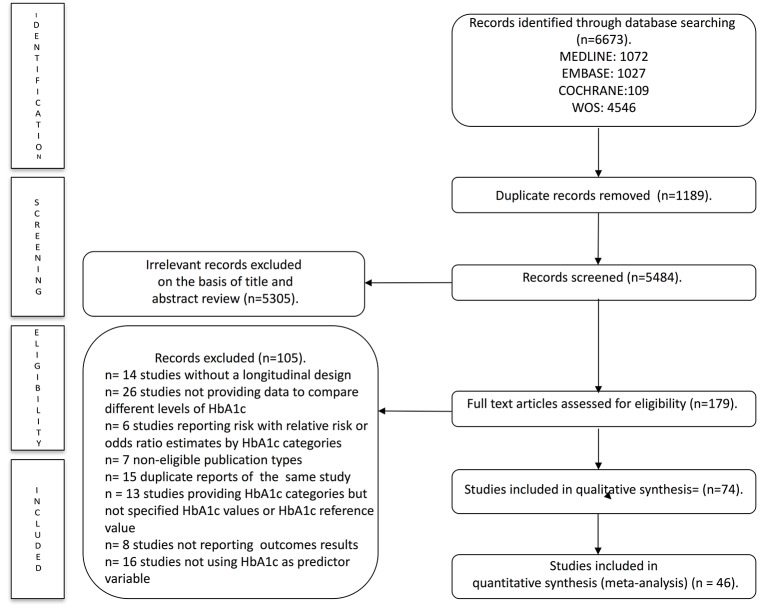
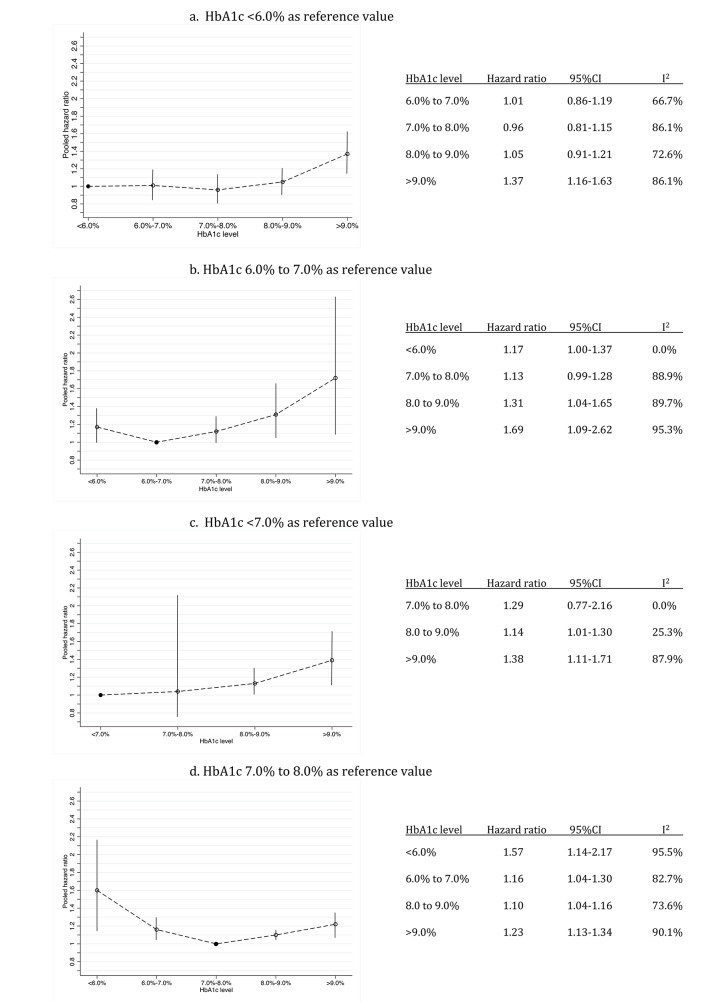
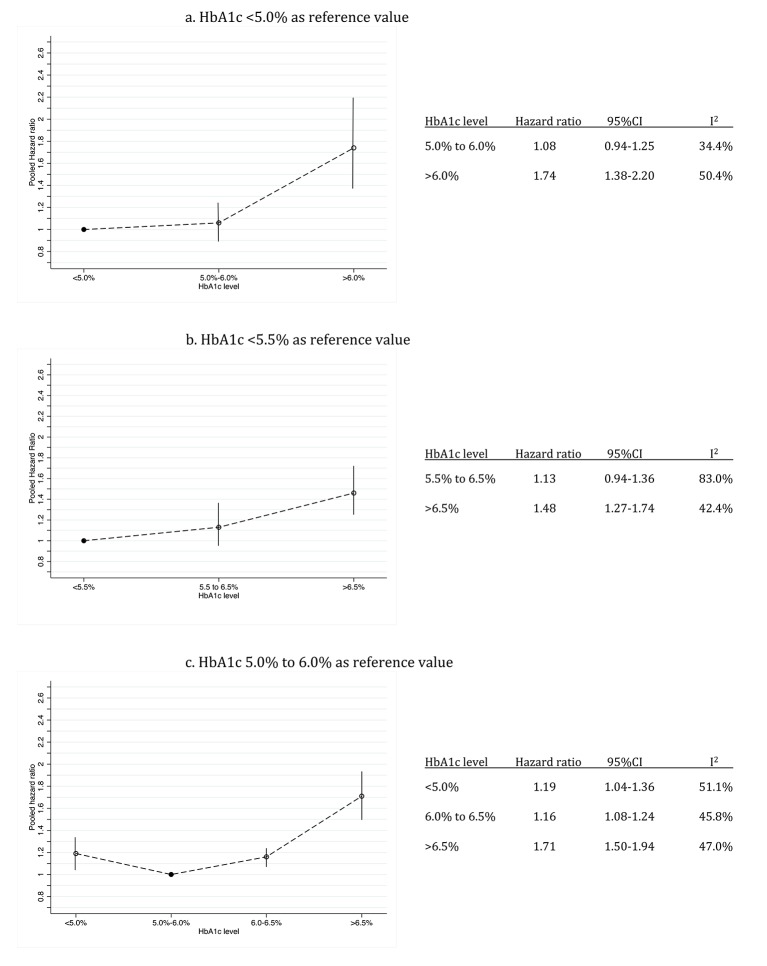
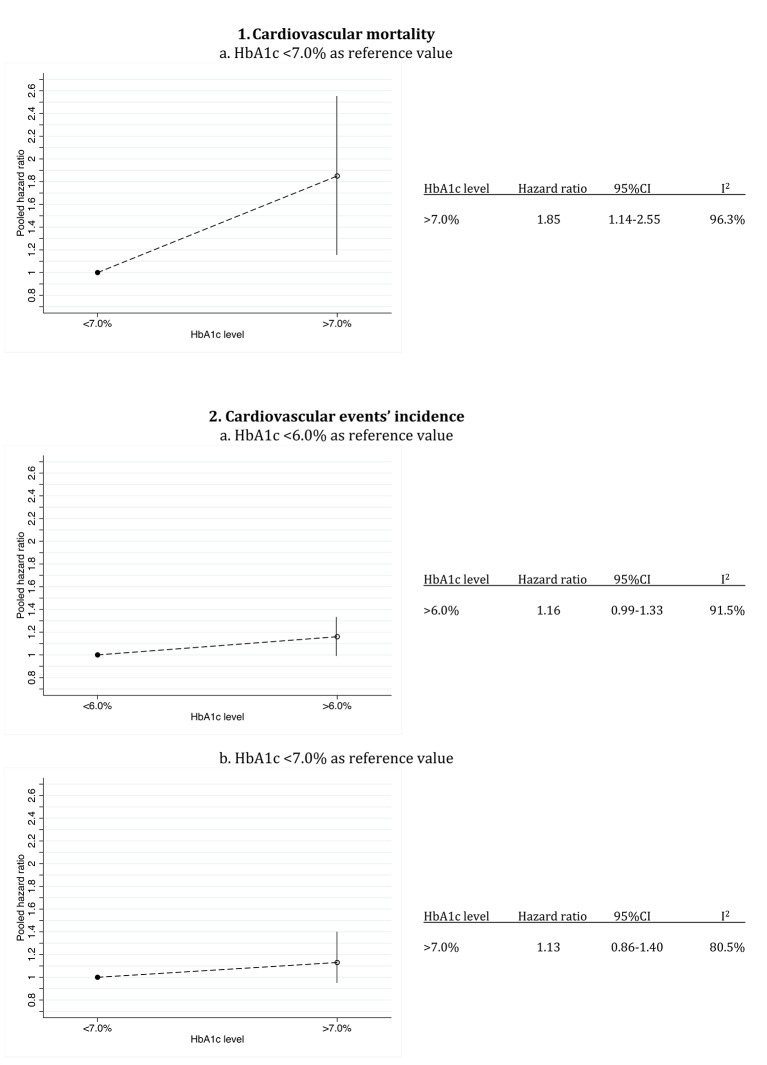
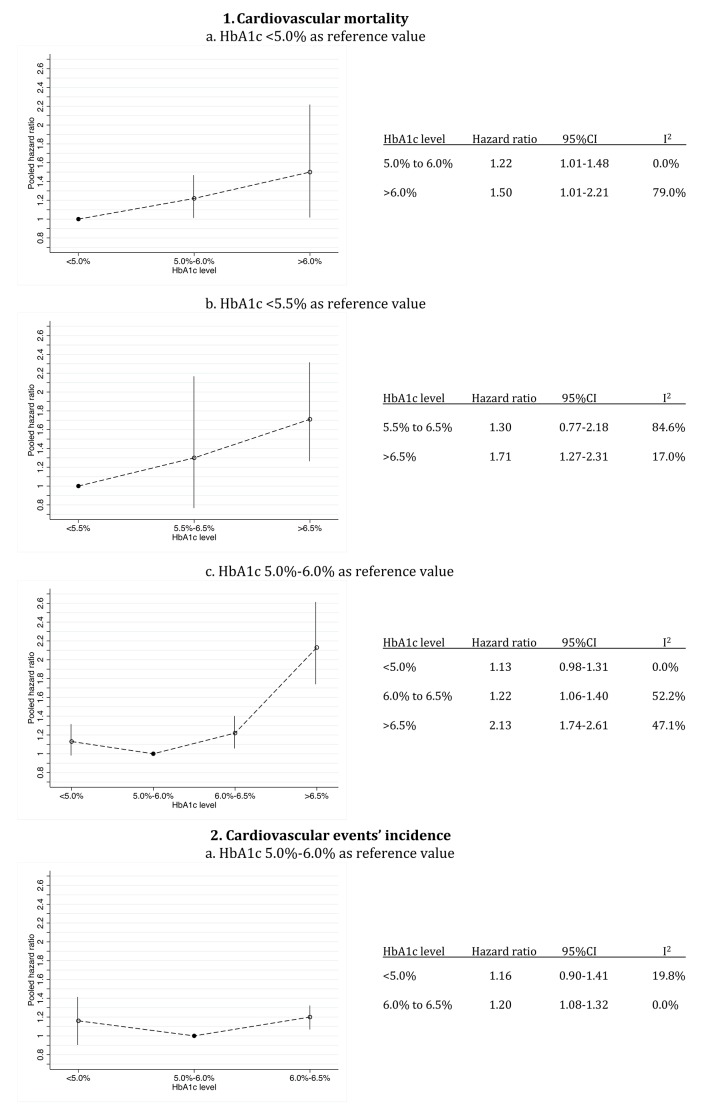
OBJECTIVE: To examine the relationship between glycated haemoglobin A1c (HbA1c) levels and the risk of cardiovascular outcomes and all-cause mortality based on data from observational studies and to determine the optimal levels of HbA1c for preventing cardiovascular events and/or mortality in diabetic and non-diabetic populations. REVIEW METHODS: We systematically searched Medline, Embase, the Cochrane Central Register of Controlled Trials, the Cochrane Database of Systematic Reviews and Web of Science databases, from inception to July 2016, for observational studies addressing the association of HbA1c levels with mortality and cardiovascular outcomes. Random effects models were used to compute pooled estimates of HR and respective 95% CI for all-cause mortality, cardiovascular mortality and risk of cardiovascular events, separately for people with and without diabetes. RESULTS: Seventy-four published studies were included in the systematic review, but only 46 studies could be incorporated in the meta-analysis. In both diabetic and non-diabetic populations, there was an increase in the risk of all-cause mortality when HbA1c levels were over 8.0% and 6.0%, respectively. The highest all-cause mortality in people with diabetes was HbA1c above 9.0% (HR=1.69; 95% CI 1.09 to 2.66) and in those without diabetes was HbA1c above 6.0% (HR=1.74; 95% CI 1.38 to 2.20). However, both diabetic and non-diabetic populations with lower HbA1c levels (below 6.0% HR=1.57; 95% CI 1.14 to 2.17 and below 5.0% HR=1.19; 95% CI 1.04 to 1.36, respectively) had higher all-cause mortality. Similar pooled estimates were found when cardiovascular mortality was the outcome variable. CONCLUSION: HbA1c is a reliable risk factor of all-cause and cardiovascular mortality in both diabetics and non-diabetics. Our findings establish optimal HbA1c levels, for the lowest all-cause and cardiovascular mortality, ranging from 6.0% to 8.0% in people with diabetes and from 5.0% to 6.0% in those without diabetes.
Overview
The claims and statistics of this paper haven’t been checked yet.
Run the check — free, no account needed. It reads the open-access text and checks the sources it cites.
Integrity signals
Registry
Cites
Statistics
Figures
Verification
Claims the paper makes
The claims and statistics of this paper haven’t been checked yet.
Run the check — free, no account needed. It reads the open-access text and checks the sources it cites.
Claims other papers make about this one
Each is checked against this paper’s own text: does it say what the citing paper says it does?
The check wasn’t confident either way, so it gives no verdict — never disputed.
In the citing paper
“analyses of the fidelity of DM diagnosis using A1C have reported a lower sensitivity than FPG or 2-hour OGTT.4,5,7-10”
From American Association of Clinical Endocrinology Clinical Practice Guideline: Developing a Diabetes Mellitus Comprehensive Care Plan-2022 Update. (2022) · cites this paper as [7]
Experimental — accuracy not yet measuredIn the citing paper
“A meta-analysis of 46 observational studies reported that patients with diabetes with HbA1c ranging from 6.0% to 8.0% had the lowest all-cause and CVD mortality (27).”
From Time in Range in Relation to All-Cause and Cardiovascular Mortality in Patients With Type 2 Diabetes: A Prospective Cohort Study (2021) · cites this paper as [27]
Self-check
Percentages, sums and reported differences re-computed from the paper’s own numbers.
The self-check needs the paper’s full text.
Citations
Cites
Preferred Reporting Items for Systematic Reviews and Meta-Analyses: the PRISMA statement
Moher, D., Liberati, A., Tetzlaff, J., Altman, D. G., & for the PRISMA Group (2009) · BMJ · doi:10.1136/bmj.b2535 · Cited by 83,823
Preferred reporting items for systematic reviews and meta-analyses: the PRISMA Statement.
(2009) · PubMed Central · Cited by 44,859
Quantifying heterogeneity in a meta‐analysis
Higgins, J. P. T., & Thompson, S. G. (2002) · Statistics in Medicine · doi:10.1002/sim.1186 · Cited by 36,763
Dermyshi, E., Wang, Y., Yan, C., Hong, W., Qiu, G., Gong, X., & Zhang, T. (2017) · Neonatology · doi:10.1159/000454668 · Cited by 24,586
von Elm, E., Altman, D. G., Egger, M., Pocock, S. J., Gøtzsche, P. C., Vandenbroucke, J. P., & Initiative, F. T. S. (2007) · PLoS Medicine · doi:10.1371/journal.pmed.0040296 · Cited by 23,020
Meta-analysis of Observational Studies in Epidemiology<SUBTITLE>A Proposal for Reporting</SUBTITLE>
Stroup, D. F. (2000) · JAMA · doi:10.1001/jama.283.15.2008 · Cited by 20,623
Preferred Reporting Items for Systematic Reviews and Meta-Analyses: The PRISMA Statement
Moher, D., Liberati, A., Tetzlaff, J., & Altman, D. G. (2009) · Journal of Clinical Epidemiology · doi:10.1016/j.jclinepi.2009.06.005 · Cited by 19,575
Wild, S., Roglic, G., Green, A., Sicree, R., & King, H. (2004) · Diabetes Care · doi:10.2337/diacare.27.5.1047 · Cited by 15,297
Report of the Expert Committee on the Diagnosis and Classification of Diabetes Mellitus
The Expert Committee on the Diagnosis and Classification of Diabetes Mellitus* (2002) · Diabetes Care · doi:10.2337/diacare.25.2007.s5 · Cited by 10,325
The file drawer problem and tolerance for null results.
Rosenthal, R. (1979) · Psychological Bulletin · doi:10.1037/0033-2909.86.3.638 · Cited by 9,068
Research works printed but not linked: 3
- 10.1037//0033-2909.86.3.638 · DOI · Paper page
- 10.2337/diacare.20.7.1183 · DOI · Paper page
- 10.2337/dc15-S005 · DOI · Paper page
Cited by
Sorted by citations
Blonde, L., Umpierrez, G. E., Reddy, S. S., McGill, J. B., Berga, S. L., Bush, M., Chandrasekaran, S., DeFronzo, R. A., Einhorn, D., Galindo, R. J., et al. (2022) · Endocrine Practice · doi:10.1016/j.eprac.2022.08.002 · Cited by 507
Age-related changes in glucose metabolism, hyperglycemia, and cardiovascular risk
Chia, C. W., Egan, J. M., & Ferrucci, L. (2018) · Circulation Research · doi:10.1161/circresaha.118.312806 · Cited by 454
Quagliariello, V., Laurentiis, M. D., Rea, D., Barbieri, A., Monti, M. G., Carbone, A., Paccone, A., Altucci, L., Conte, M., Canale, M. L., et al. (2021) · Cardiovascular Diabetology · doi:10.1186/s12933-021-01346-y · Cited by 371
Lu, J., Wang, C., Shen, Y., Chen, L., Zhang, L., Cai, J., Lu, W., Zhu, W., Hu, G., Xia, T., et al. (2021) · Diabetes Care · doi:10.2337/dc20-1862 · Cited by 282
Beverly, J., & Budoff, M. J. (2019) · Journal of Diabetes · doi:10.1111/1753-0407.12970 · Cited by 219
Metadata
- Authors
- Cavero-Redondo, I., Peleteiro, B., Álvarez-Bueno, C., Rodriguez-Artalejo, F., & Martínez-Vizcaíno, V.
- Affiliations
- Universidad de Castilla—La Mancha, Health and Social Research Center, Cuenca, Spain
- EPI Unit, Instituto de Saúde Pública,Universidade do Porto, Porto, Portugal
- Department of Preventive Medicine and Public Health, Universidad Autónoma de Madrid/ IdiPaz, CIBERESP, and IMDEA-Food Institute. CEI UAM+CSIC, Madrid, Spain
- Venue
- BMJ Open
- Publisher
- BMJ
- Published
- 2017-07
- Volume
- 7
- Issue
- 7
- Pages
- e015949
- ISSN
- 2044-6055 (ISSN-L)
- PMC
- PMC5642750
- OpenAlex
- W2739699420
- Cited by
- 260
- References
- 46
- Citations by year
- 2026: 13 · 2025: 26 · 2024: 27 · 2023: 46 · 2022: 45 · 2021: 44 · 2020: 26 · 2019: 24 · 2018: 8 · 2017: 1
- FWCI
- 2.35
- Type
- journal article
- Language
- en
- Open access
- gold
- doi.org
- Licence
- cc-by-nc
- Locations
- BMJ Open (publishedVersion, cc-by-nc)
- PubMed Central (publishedVersion, cc-by-nc)
- PubMed (publishedVersion)
- LA Referencia (Red Federada de Repositorios Institucionales de Publicaciones Científicas) (submittedVersion, other-oa)
- HighWire Press Open Archive (submittedVersion)
- Portuguese National Funding Agency for Science, Research and Technology (RCAAP Project by FCT) (submittedVersion, other-oa)
- Funders
- Universidad de Castilla-La Mancha (FPU13/01582, FPU13/03137)
- Fundação para a Ciência e a Tecnologia (SFRH/BPD/108751/2015)
- Topics
- Health Sciences › Medicine › Endocrinology, Diabetes and Metabolism › Diabetes, Cardiovascular Risks, and Lipoproteins
- Health Sciences › Medicine › Endocrinology, Diabetes and Metabolism › Diabetes Management and Research
- Health Sciences › Medicine › Endocrinology, Diabetes and Metabolism › Diabetes Treatment and Management
- Keywords
- glycated haemoglobin A1c, HbA1c targets, all-cause mortality, cardiovascular mortality, cardiovascular events, diabetes mellitus, glycemic control, cardiovascular risk factors, non-diabetic population, HbA1c thresholds, cardiovascular disease prevention
- MeSH terms
- Cardiovascular Diseases, Diabetes Mellitus, Type 2, Glycated Hemoglobin, Humans, Risk Factors, Observational Studies as Topic
About these checks
Registry, retraction, Cites and statistics results are computed, not judged, with one exception: a printed reference that no index lists is read once by a model before it counts as a citation error. Claims are extracted by a model and kept only when their quote appears verbatim in the text; each cited source is then checked, with a model’s help, for whether it says what the claim relies on. Those verdicts can be wrong — read the claim’s quote and the cited source before relying on one.
Statistics and arithmetic are recomputed, not judged.
Confidence bands are shown only for fields calibrated on our annotated test set. None is calibrated yet, so no band is shown.
What counts as a claim ›How we measure confidence ›How we check this ›
Are you an author, or do you see a problem with this page? Request a review
