

Scoping review on the use of socially assistive robot technology in elderly care
Open accessThe DOI matches its Crossref record; 69 of the 70 references it cites were found in a registry or an index.
Abstract
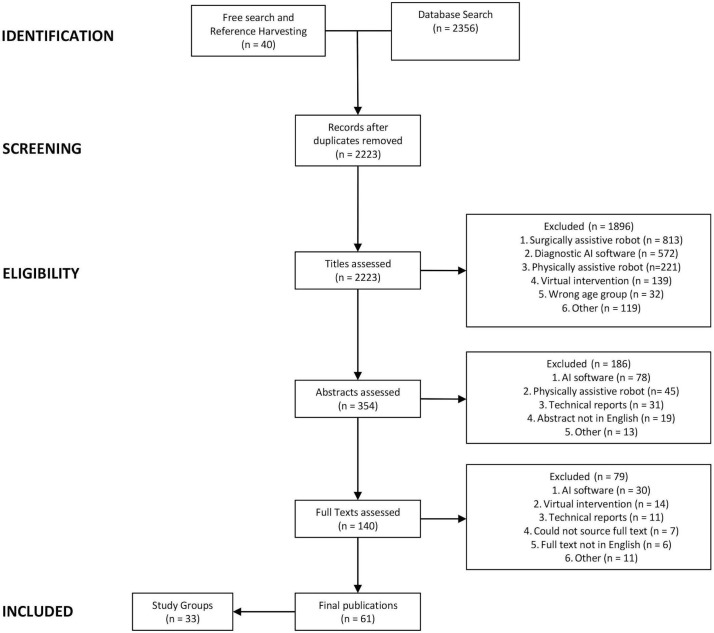
Objective: With an elderly population that is set to more than double by 2050 worldwide, there will be an increased demand for elderly care. This poses several impediments in the delivery of high-quality health and social care. Socially assistive robot (SAR) technology could assume new roles in health and social care to meet this higher demand. This review qualitatively examines the literature on the use of SAR in elderly care and aims to establish the roles this technology may play in the future. Design: Scoping review. Data sources: Search of CINAHL, Cochrane Library, Embase, MEDLINE, PsychINFO and Scopus databases was conducted, complemented with a free search using Google Scholar and reference harvesting. All publications went through a selection process, which involved sequentially reviewing the title, abstract and full text of the publication. No limitations regarding date of publication were imposed, and only English publications were taken into account. The main search was conducted in March 2016, and the latest search was conducted in September 2017. Eligibility criteria: The inclusion criteria consist of elderly participants, any elderly healthcare facility, humanoid and pet robots and all social interaction types with the robot. Exclusions were acceptability studies, technical reports of robots and publications surrounding physically or surgically assistive robots. Results: In total, 61 final publications were included in the review, describing 33 studies and including 1574 participants and 11 robots. 28 of the 33 papers report positive findings. Five roles of SAR were identified: affective therapy, cognitive training, social facilitator, companionship and physiological therapy. Conclusions: Although many positive outcomes were reported, a large proportion of the studies have methodological issues, which limit the utility of the results. Nonetheless, the reported value of SAR in elderly care does warrant further investigation. Future studies should endeavour to validate the roles demonstrated in this review. Systematic review registration: NIHR 58672.
Overview
The claims and statistics of this paper haven’t been checked yet.
Free: it reads the open-access text and checks the first 5 claims that cite a source we can check. Create a free account to check every claim.
Integrity signals
Registry
Cites
Statistics
Figures
Verification
Claims the paper makes
The claims and statistics of this paper haven’t been checked yet.
Free: it reads the open-access text and checks the first 5 claims that cite a source we can check. Create a free account to check every claim.
Claims other papers make about this one
Each is checked against this paper’s own text: does it say what the citing paper says it does?
The source backs part of the claim, not all of it — or backs it for a different population, condition or comparison.
In the citing paper
“but also highlight substantial heterogeneity and predominantly low-to-moderate study quality [46,56].”
From The Effectiveness of Artificial Intelligence-Based Pet Therapy in Improving the Care of Patients: A Systematic Review (2026) · cites this paper as [46]
Experimental — accuracy not yet measuredThe source backs part of the claim, not all of it — or backs it for a different population, condition or comparison.
In the citing paper
“In some settings, simple alternatives, such as plush toys or digital programs, produce similar benefits, depending on preferences and care context [32,40,46].”
From The Effectiveness of Artificial Intelligence-Based Pet Therapy in Improving the Care of Patients: A Systematic Review (2026) · cites this paper as [46]
Experimental — accuracy not yet measuredThe cited source says what the claim attributes to it.
In the citing paper
“systematic reviews point to potentially beneficial effects on quality of life and biopsychological outcomes”
From The Effectiveness of Artificial Intelligence-Based Pet Therapy in Improving the Care of Patients: A Systematic Review (2026) · cites this paper as [46]
Self-check
Percentages, sums and reported differences re-computed from the paper’s own numbers.
The self-check needs the paper’s full text.
Citations
Cites
Preferred reporting items for systematic reviews and meta-analyses: The PRISMA statement
Moher, D., Liberati, A., Tetzlaff, J., Altman, D. G., & the PRISMA Group* (2009) · Annals of Internal Medicine · doi:10.7326/0003-4819-151-4-200908180-00135 · Cited by 37,554
Cochrane Handbook for Systematic Reviews of Interventions: Cochrane Book Series
(2008) · doi:10.1002/9780470712184 · Cited by 25,048
Social Relationships and Mortality Risk: A Meta-analytic Review
Holt-Lunstad, J., Smith, T. B., & Layton, J. B. (2010) · PLoS Medicine · doi:10.1371/journal.pmed.1000316 · Cited by 7,272
The Handbook of Research Synthesis and Meta-Analysis
(2019) · doi:10.7758/9781610448864 · Cited by 4,553
Reprint—Preferred Reporting Items for Systematic Reviews and Meta-Analyses: The PRISMA Statement
Moher, D., Liberati, A., Tetzlaff, J., Altman, D. G., & and the PRISMA Group (2009) · Physical Therapy · doi:10.1093/ptj/89.9.873 · Cited by 2,486
Division, U. P. (1991) · Cited by 1,434
Being alone in later life: Loneliness, social isolation and living alone
Victor, C., Scambler, S., Bond, J., & Bowling, A. (2000) · Reviews in Clinical Gerontology · doi:10.1017/s0959259800104101 · Cited by 730
Wada, K., & Shibata, T. (2007) · IEEE Transactions on Robotics · doi:10.1109/tro.2007.906261 · Cited by 583
Animal-Assisted Therapy and Loneliness in Nursing Homes: Use of Robotic versus Living Dogs
Banks, M. R., Willoughby, L. M., & Banks, W. A. (2008) · Journal of the American Medical Directors Association · doi:10.1016/j.jamda.2007.11.007 · Cited by 548
The Psychosocial Effects of a Companion Robot: A Randomized Controlled Trial
Robinson, H., MacDonald, B., Kerse, N., & Broadbent, E. (2013) · Journal of the American Medical Directors Association · doi:10.1016/j.jamda.2013.02.007 · Cited by 546
Research works printed but not linked: 2
- Wada K, Shibata T, Musha T, et al Robot Therapy for Elders Affected by Dementia 2014 IEEE Long Isl Syst Appl Technol Conf LISAT. 2014.
- Thodberg K, Sørensen LU, Christensen JW, et al Therapeutic effects of dog visits in nursing homes for the elderly. Psychogeriatrics 2016; 16: 289– 97. 10.1111/psyg.12159 26510632 · DOI · Paper page
Cited by
Items 201–300 of 582
AI-driven Innovations in Assessing Stress, Anxiety, and Mental Health
Inamdar, A., Gurupadayya, B., Gautam, M., Sharma, A., Pathak, R., & Sharma, H. (2025) · Current Psychiatry Research and Reviews · doi:10.2174/0126660822334997241216062002 · Cited by 16
Mlakar, I., Kampič, T., Flis, V., Kobilica, N., Molan, M., Smrke, U., Plohl, N., & Bergauer, A. (2022) · BMJ Open · doi:10.1136/bmjopen-2021-054310 · Cited by 22
Systematic Review of Computer Vision Semantic Analysis in Socially Assistive Robotics
Lundgren, A., dos Santos, M. A. O., Bezerra, B. L. D., & Bastos-Filho, C. J. A. (2022) · AI · doi:10.3390/ai3010014 · Cited by 14
“Recent advances in technology, including information technologies, accelerated and diversified SAR studies, including a simulation of companionship [1], assistance with mental health issues [2], and robotic caretakers [3–6].”
BackgroundEirale, A., Martini, M., & Chiaberge, M. (2022) · Robotics · doi:10.3390/robotics11050108 · Cited by 22
“Robotic solutions are often focused on the interactive social aspects with the user [6,7], or, conversely, they try to continuously check the health status of the patient [8,9].”
BackgroundLing, K., Langlois, D., Preusse, H. R., Rheman, J. M., Parson, D., Kuballa, S., Šimeček, M., Tsui, K. M., & Fraune, M. R. (2023) · Frontiers in Public Health · doi:10.3389/fpubh.2023.1177683 · Cited by 15
“Some researchers are working on technology to address some of these limitations of social technology and improve presence and realism (67), such as technology that includes physical touch (68– 71).”
BackgroundAMIGO—A Socially Assistive Robot for Coaching Multimodal Training of Persons with Dementia
Paletta, L., Schüssler, S., Zuschnegg, J., Steiner, J., Pansy-Resch, S., Lammer, L., Prodromou, D., Brunsch, S., Lodron, G., & Fellner, M. (2019) · Human-computer interaction series · doi:10.1007/978-3-030-17107-0_13 · Cited by 20
Assche, M. V., Petrović, M., Cambier, D. C., Calders, P., Gelder, P. V., & VELDE, D. V. D. (2022) · Disability and Rehabilitation Assistive Technology · doi:10.1080/17483107.2022.2075477 · Cited by 14
“Assistive Technologies are considered to have the potential to support independence and care of older adults [2,9,10].”
BackgroundAssche, M. V., Petrović, M., Cambier, D. C., Calders, P., Gelder, P. V., Werner, F., & VELDE, D. V. D. (2024) · International Journal of Social Robotics · doi:10.1007/s12369-024-01115-3 · Cited by 14
“B Maaike Van Assche maaike.vanassche@ugent.be Assistive technologies are considered having the potential to support independence and care of older adults [1, 5, 6].”
Disability 4.0: bioethical considerations on the use of embodied artificial intelligence
Micco, F. D., Tambone, V., Frati, P., Cingolani, M., & Scendoni, R. (2024) · Frontiers in Medicine · doi:10.3389/fmed.2024.1437280 · Cited by 16
“The effectiveness in cognitive training is acknowledged, but further studies are needed to confirm the benefits in dementia and to demonstrate clinical utility in physiological therapy (45).”
BackgroundArtificial Intelligence in Human Growth and Development: Applications Through the Lifespan
Fulmer, R., & Zhai, Y. (2024) · The Family Journal · doi:10.1177/10664807241282331 · Cited by 23
“…2017 Maturity Promoting independence; Caregiver assistance with elder care, such as through robot technology Ma et al., 2023; Andtfolk et al., 2022; Abdi et al., 2018; Asgharian et al., 2022 Fulmer and Zhai By analyzing vast amounts of data, AI can uncover patterns and provide personalized…”
InfluentialHernandez, J. P. T. (2024) · Biomimetics · doi:10.3390/biomimetics9110687 · Cited by 21
“Abdi et al. [61] and Guemghar et al. [62] studied the use of socially assistive robots for older adults that could contribute to promoting independence and reducing feelings of loneliness.”
A Networked Intelligent Elderly Care Model Based on Nursing Robots to Achieve Healthy Aging
Ji, W., Luo, R., Sun, Y., Yang, M., Liu, Y., Chen, H. Q., Lin, D., Su, Z., Tao, G., Chen, D., et al. (2025) · Research · doi:10.34133/research.0592 · Cited by 13
“Existing social robots serve various functions, including emotional therapy, cognitive training, social facilitation, companionship, and physiological treatment [ 67 ].”
Review of innovative models of aged care
Dyer, S. M., van den Berg, M., Brown, A., Johnstone, G., Laver, K., Lowthian, J. A., Maeder, A., Meyer, C., Moores, C. J., Ogrin, R., et al. (2020) · Cited by 20
Elsheikh, A., Al‐Thani, D., & Othman, A. (2025) · Frontiers in Robotics and AI · doi:10.3389/frobt.2025.1626471 · Cited by 18
Noh, D., & Shim, M. (2023) · Healthcare · doi:10.3390/healthcare11162341 · Cited by 12
“Socially assistive pet-type robots can act as companions for older adults by imitating the appearances and behaviors of animals, whereas socially assistive humanoid robots have human-like shapes and features; both types of robots can interact with older adults [13].”
BackgroundAmabili, G., Maranesi, E., Margaritini, A., Benadduci, M., Barbarossa, F., Casaccia, S., Nap, H. H., & Bevilacqua, R. (2023) · Bioengineering · doi:10.3390/bioengineering11010020 · Cited by 14
“However, current research highlights how the usability and acceptability of technology, including SARs, are still challenges in elderly care [19].”
BackgroundMethodLuperto, M., Romeo, M., Lunardini, F., Monroy, J., García, D. H., Abbate, C., Cangelosi, A., Ferrante, S., González-Jiménez, J., Basilico, N., et al. (2024) · International Journal of Social Robotics · doi:10.1007/s12369-024-01158-6 · Cited by 11
“The benefits of using SARs for remote health monitoring functionalities [18, 24] are widely recognised [1, 43], and have been increased by their integration in Ambient Assisted Living (AAL) arrangements.”
Kabacińska, K., Teng, K. A., & Robillard, J. M. (2025) · Multimodal Technologies and Interaction · doi:10.3390/mti9020014 · Cited by 10
New Approaches for the Treatment of Delirium: A Case for Robotic Pets
Schulman‐Marcus, J., Mookherjee, S., Rice, L., & Lyubarova, R. (2019) · The American Journal of Medicine · doi:10.1016/j.amjmed.2018.12.039 · Cited by 11
Kachaturoff, M., Shidler, K., Fasbinder, A., & Caboral-Stevens, M. F. (2021) · Journal of Gerontological Nursing · doi:10.3928/00989134-20210803-05 · Cited by 11
Using LEGO® SERIOUS® Play with stakeholders for RRI
de Saille, S., Greenwood, A., Law, J., Ball, M. W., Levine, M., Vallejos, E. P., Ritchie, C., & Cameron, D. S. (2022) · Journal of Responsible Technology · doi:10.1016/j.jrt.2022.100055 · Cited by 17
Designing Robots with the Context in Mind- One Design Does Not Fit All
Liberman-Pincu, E., van Grondelle, E. D., & Oron-Gilad, T. (2023) · Springer proceedings in advanced robotics · doi:10.1007/978-3-031-22731-8_8 · Cited by 11
“[46] identified five roles of SAR in elder care: affective therapy, cognitive training, social facilitator, companionship, and physiological therapy.”
BackgroundExperimental Investigation of an Interactive Animatronic Robotic Head Connected to ChatGPT
Said, S., Alasfour, G., Alghannam, F., Khalaf, S., Susilo, T., Prasad, B., Youssef, K., Kork, S. A., & Beyrouthy, T. (2023) · International Conference on Bio-engineering for Smart Technologies (BioSMART) · doi:10.1109/biosmart58455.2023.10162099 · Cited by 11
“An animatronic robot head is a robotic device that imitates the movements and expressions of a human or animal head, they can be used in areas, such as education [10], children companionship [3], medical research [1] and, military training simulations.”
BackgroundIglesias, A. M., Viciana-Abad, R., Pérez-Lorenzo, J. M., Ting, K. L. H., Tudela, A., Marfil, R., Qbilat, M., Hurtado, A., Jerez, A., & Bandera, J. P. (2024) · Robotics · doi:10.3390/robotics13040061 · Cited by 12
Feasibility of AI and Robotics in Indian Healthcare
Joshi, R., & Badola, R. (2024) · Wiley eBooks · doi:10.1002/9781394234196.ch18 · Cited by 16
Design Attributes of Socially Assistive Robots for People with Dementia: A Systematic Review
Green, M., Dao, D. V., & Moyle, W. (2023) · International Journal of Social Robotics · doi:10.1007/s12369-023-01087-w · Cited by 10
“Most literature reviews that go beyond the efficacy of SARs are limited by suggesting abilities [ 11, 12] or the role they should play [13].”
Socially assistive robots and meaningful work: the case of aged care
Voinea, C., & Wangmo, T. (2025) · Humanities and Social Sciences Communications · doi:10.1057/s41599-025-05498-0 · Cited by 20
“…assist caregivers in physical care, such as monitoring, lifting people or assisting them with mobility, hygiene or feeding; or (2) companion robots, which communicate and engage with care recipients to alleviate loneliness, prevent cognitive decline or to provide companionship (Abdi et al. 2018).”
Improving Inclusivity in Robotics Design: An Exploration of Methods for Upstream Co-Creation
de Saille, S., Kipnis, E., Potter, S., Cameron, D. S., Webb, C., Winter, P., O’Neill, P., Gold, R., Halliwell, K., Alboul, L., et al. (2022) · Frontiers in Robotics and AI · doi:10.3389/frobt.2022.731006 · Cited by 15
“…the literature show that (rehabilitative robotics notwithstanding) the field is largely dominated by research targeting elderly care (Broadbent et al., 2009; Lazar et al., 2016; Abdi et al., 2018; Alnajjar et al., 2019), particularly the elderly with dementia (Koh et al., 2021; Ong et al., 2021).”
BackgroundSocially Interactive Agents for Supporting Aging
Ghafurian, M., Muñoz, J. E., Boger, J. N., Hoey, J., & Dautenhahn, K. (2022) · ACM eBooks · doi:10.1145/3563659.3563671 · Cited by 13
“Companion robots such as Paro, which has a balanced set of relatively simplistic sensors/actuators, have demonstrated more positive effects on older adult’s wellbeing (e.g., mood, anxiety) than other existing, more complex robots [Abdi et al. 2018].”
Bradwell, H. L., Cooper, L., Edwards, K. J., Baxter, R., Tomaz, S. A., Ritchie, J., Gaudl, S. E., Reyes, A. V., Ryde, G. C., Križaj, T., et al. (2023) · BMJ Open · doi:10.1136/bmjopen-2023-073307 · Cited by 11
A Non-Array Type Cut to Shape Soft Slip Detection Sensor Applicable to Arbitrary Surface
Kim, S. J., Lee, S. H., Moon, H., Choi, H. R., & Koo, J. C. (2020) · Sensors · doi:10.3390/s20216185 · Cited by 11
“When a robot gets out of the existing factory and performs the role of a service robot, it is essential to grasp and manipulate the unknown objects [4].”
BackgroundMishra, N., Bharti, T., Tiwari, A. K., & Pfajfar, G. (2024) · Technological Forecasting and Social Change · doi:10.1016/j.techfore.2024.123578 · Cited by 20
Integrating advanced vision-language models for context recognition in risks assessment
Rodriguez-Juan, J., Ortiz-Pérez, D., García‐Rodríguez, J., Tomás, D., & Nalepa, G. J. (2024) · Neurocomputing · doi:10.1016/j.neucom.2024.129131 · Cited by 13
Cesário, L. C., Barbosa, P., Miguel, P. A. C., & Mendes, G. H. D. S. (2025) · Archives of Gerontology and Geriatrics · doi:10.1016/j.archger.2025.105755 · Cited by 13
Co-design methodology for rapid prototyping of modular robots in care settings
Colle, A., Donaldson, K., & Dragone, M. (2025) · Frontiers in Robotics and AI · doi:10.3389/frobt.2025.1581506 · Cited by 11
Social Robots in Care Homes for Older Adults: Observations from Participatory Design Workshops
Thunberg, S., & Ziemke, T. (2021) · Lecture notes in computer science · doi:10.1007/978-3-030-90525-5_41 · Cited by 16
Corti, L., Brizi, M. R., Pennacchini, M., & Bertolaso, M. (2023) · AI & Society · doi:10.1007/s00146-023-01645-w · Cited by 16
“In particular, in line with an empirically based approach, we affirm the possibility to re-consider the issue of technological empowerment of the elderly (Abdi et al. 2018; Grossi et al. 2020; Neves and Amaro 2012).”
ResultWagner-Hartl, V., Gleichauf, K., & Schmid, R. (2019) · Advances in intelligent systems and computing · doi:10.1007/978-3-030-27928-8_21 · Cited by 9
9 Assistive robots in care: Expectations and perceptions of older people
Hoppe, J. A., Johansson‐Pajala, R., Gustafsson, C., Melkas, H., Tuisku, O., Pekkarinen, S., Hennala, L., & Thommes, K. (2020) · De Gruyter eBooks · doi:10.1515/9783110677485-009 · Cited by 17
Rong, J., Ji, X., Xin, F., & Jee, M.-H. (2022) · Applied Bionics and Biomechanics · doi:10.1155/2022/7058477 · Cited by 9
“The design of computer algorithms related to illness concepts preceded problem-solving in healthcare [2].”
RetractedAssistive Healthcare Robotics – Challenges in Nursing Service Innovation: Critical Review
Badr, N. G., & Dankar, M. J. (2022) · ITM Web of Conferences · doi:10.1051/itmconf/20224102002 · Cited by 10
“While there is widespread agreement that robotic systems are not intended to substitute human interaction in health and social care [20], but rather to minimize workload [2], these concerns must be taken seriously.”
BackgroundInfluentialLiu, H., Wang, F., & Zhang, D. (2023) · Applied Sciences · doi:10.3390/app13020676 · Cited by 11
Robotic technologies, touch and posthuman embodiment in queer dementia care
Shildrick, M. (2023) · The Senses and Society · doi:10.1080/17458927.2023.2179239 · Cited by 12
“models, though even Aibo – a metallic robot dog – scores more highly than most humanoid devices (Abdi et al. 2018).”
BackgroundTakaeda, K., Kamimura, T., Inoue, T., & Nishiura, Y. (2019) · Geriatrics and gerontology international/Geriatrics & gerontology international · doi:10.1111/ggi.13655 · Cited by 13
“9 Although current mainstream CCT involve performance-based testing using a touch screen, keyboard or mouse, 5,6 widely used screening tests to measure global cognitive function mainly take a question-and-answer format, such as the Mini-Mental State Examination, 10 the Telephone Interview for…”
MethodHuman Robot Interaction for Blind and Low Vision People: A Systematic Literature Review
Wei, Y., Rocher, N., Gupta, C., Nguyen, M. H., Zimmermann, R., Ooi, W. T., Jouffrais, C., & Nanayakkara, S. C. (2025) · CHI Conference on Human Factors in Computing Systems · doi:10.1145/3706598.3713438 · Cited by 20
“These robots are designed to provide elderly with physical assistance in accomplishing daily tasks, and psychological support [1].”
Felber, N. A., Lipworth, W. L., Tian, Y. J., Duong, V., & Wangmo, T. (2025) · Science and Engineering Ethics · doi:10.1007/s11948-025-00541-4 · Cited by 11
“…robots support older persons with tasks of daily living (Bedaf et al., 2019; Fattal et al., 2022), provide social interaction and combat loneliness (Abdi et al., 2018; Bemelmans et al., 2012; Kachouie et al., 2017 ) or are used in dementia care (Berridge et al., 2021; Hung et al., 2019; Wangmo et…”
Benchmarks for evaluating human-robot interaction: lessons learned from human-animal interactions
Lagerstedt, E., & Thill, S. (2020) · IEEE RO-MAN · doi:10.1109/ro-man47096.2020.9223347 · Cited by 12
“There are, however, also within robot-assisted therapy current methodological issues and a lack of sufficient empirical evidence for these techniques to be applicable among practitioners [57], and there are overlaps in roles of service, assistance, companion and therapy robots.”
BackgroundAI and Robotics-Based Cognitive Training for Elderly: A Systematic Review
Gochoo, M., Vogan, A. A., Khalid, S., & Alnajjar, F. (2020) · IEEE/ITU International Conference on Artificial Intelligence for Good (AI4G) · doi:10.1109/ai4g50087.2020.9311076 · Cited by 13
“It is expected that by 2065 up to 38.4% of the population will be elderly, worldwide [6].”
BackgroundInfluentialThe positive–negative–competence (PNC) model of psychological responses to representations of robots
Krpan, D., Booth, J. E., & Damien, A. (2023) · Nature Human Behaviour · doi:10.1038/s41562-023-01705-7 · Cited by 10
Factors associated with intention to use care robots among people with physical disabilities
Jung, S. H., & Shin, Y. S. (2024) · Nursing Outlook · doi:10.1016/j.outlook.2024.102145 · Cited by 9
Diño, M., Dion, K. W., Abadir, P., Budhathoki, C., Huang, C.-M., Padula, W., Himmelfarb, C. D., & Davidson, P. M. (2024) · Frontiers in Public Health · doi:10.3389/fpubh.2024.1383407 · Cited by 6
“More than ever, the increased aging of the population requires technology-driven nursing services (20) to complement the demand for quality health services, especially for older adults with declining health and physical and mental challenges (21, 22).”
BackgroundParanoid About Androids: A Review of Robotics in Radiology
Hughes, H., Cornélis, F., Scaglione, M., & Patlas, M. N. (2024) · Canadian Association of Radiologists Journal · doi:10.1177/08465371241290076 · Cited by 8
Romeo, M., García, D. H., Jones, R. B., & Cangelosi, A. (2019) · International Conference on Human-Agent Interaction (HAI) · doi:10.1145/3349537.3351886 · Cited by 10
“In [1] a clear distinction between different type of SARs is out-lined: service robots, aiming at helping in daily life activities; companion robots, whose objective is to sustain and improve the psychological well-being of their users.”
BackgroundNakamura, M., Nihei, M., Kato, N., & Inoue, T. (2020) · SN Applied Sciences · doi:10.1007/s42452-020-03434-2 · Cited by 9
Strünck, C., Reuter, V., Gerling, V., Berg, P.-S., & Ehlers, A. (2022) · Zeitschrift für Gerontologie und Geriatrie · doi:10.1007/s00391-022-02087-7 · Cited by 9
“A scoping review comes up with similar conclusions [1].”
BackgroundInfluentialNew development: Digital social care—the ‘high-tech and low-touch’ transformation in public services
Leite, H., Hodgkinson, I. R., & Volochtchuk, A. V. L. (2022) · Public Money & Management · doi:10.1080/09540962.2022.2140897 · Cited by 8
“For example, observed social benefits reported in the literature include reduced loneliness, improved quality of life, and increased self-esteem and independence as immediate positive impacts (Abdi et al., 2018; Dratsiou et al., 2022).”
BackgroundRobotics in Nursing: Protocol for a Scoping Review
Darko, E. M., Kleib, M., Lemermeyer, G., & Tavakoli, M. (2023) · JMIR Research Protocols · doi:10.2196/50626 · Cited by 14
“Socially assistive robots, such as Nao and Pepper robots, are used to provide affective therapy, social facilitation, companionship, and physiological therapy in patients [28,30,33].”
Heart Disease Prediction Using Machine Learning
Yadav, S., Yadav, A., Srivastava, D. S., & Rai, P. (2024) · INTERANTIONAL JOURNAL OF SCIENTIFIC RESEARCH IN ENGINEERING AND MANAGEMENT · doi:10.55041/ijsrem36858 · Cited by 12
A narrative review on the current uses of artificial intelligence in endodontics
Bakhsh, A. (2024) · Saudi Endodontic Journal · doi:10.4103/sej.sej_199_23 · Cited by 7
SONARIOS: A Design Futuring-Driven Exploration of Acoustophoresis
Beşevli, C., Gao, L., Kemsaram, N., Brianza, G., Georgiou, O., Subramanian, S., & Obrist, M. (2025) · Designing Interactive Systems Conference · doi:10.1145/3715336.3735775 · Cited by 10
“Over-reliance on technology could dehumanise caregiving, substituting meaningful human interactions with mediated solutions [1].”
Ruan, Y., & Cheung, M. (2025) · Journal of Nursing Scholarship · doi:10.1111/jnu.70035 · Cited by 9
Che, R., Ruan, Y., Kodate, N., Shi, Y., Liu, X., Donnelly, S., Suwa, S., Yu, W., Kong, D., & Cheung, M. (2025) · Digital Health · doi:10.1177/20552076251370058 · Cited by 10
“61,62 Therefore, their fi ndings may not be generalizable to frail older adults without other impairment.”
Diño, M., Dion, K. W., Abadir, P., Budhathoki, C., Huang, C.-M., Ong, I. L., Balbin, P. T., Himmelfarb, C., & Davidson, P. M. (2024) · Comput. Hum. Behav. Artif. Humans · doi:10.1016/j.chbah.2024.100071 · Cited by 7
Horgan, S. A., Prorok, J. C., Conn, D. K., Checkland, C., Saunders, J., Watson-Borg, B. E., & Tinley, L. (2024) · Healthcare · doi:10.3390/healthcare12111111 · Cited by 9
A Study for Detecting Mild Cognitive Impairment by Analyzing Conversations with Humanoid Robots
Yoshii, K., Nishimura, M., Kimura, D., Kosugi, A., Shinkawa, K., Takase, T., Kobayashi, M., Yamada, Y., Nemoto, M., Watanabe, R., et al. (2021) · IEEE Global Conference on Life Sciences and Technologies (LifeTech) · doi:10.1109/lifetech52111.2021.9391934 · Cited by 9
“The use of conversational humanoid robots is anticipated in the near future to care for the elderly and to help increase their quality of life through interactions [9].”
BackgroundEmotion Classification from Speech by an Ensemble Strategy
Novais, R., Cardoso, P. J. S., & Rodrigues, J. M. F. (2022) · International Conference on Software Development and Technologies for Enhancing Accessibility and Fighting Info-exclusion (DSAI) · doi:10.1145/3563137.3563170 · Cited by 12
“This research is important as, the worldwide elderly population is set to be more than double by 2050 [3] and robots are expected to assume new roles in health and social care to meet that higher demand [4, 5].”
BackgroundDesign, Fabrication, and Evaluation of the “Maya” Social Robot
Ranjkar, E., Rafatnejad, R., Nobaveh, A. A., Meghdari, A. F., & Alemi, M. (2019) · RSI International Conference on Robotics and Mechatronics (ICRoM) · doi:10.1109/icrom48714.2019.9071795 · Cited by 9
“In recent years, there has been considerable interest in the application of social robots in the care of the elderly [6–8], and a wide-ranging review was recently published in this area [9].”
BackgroundTian, Y. J., Dunn, M., Schicktanz, S., Savulescu, J., & Wangmo, T. (2025) · BMC Medical Ethics · doi:10.1186/s12910-025-01210-8 · Cited by 7
“Robotic technologies for service tasks and companionship may also aid elder care [19, 20].”
A review on an AI-driven face robot for human-robot expression interaction
Sheng, Q., Tang, W., Qin, H., Kong, Y., Dai, H., Zhong, Y., Wang, Y., Zou, J. T., & Yang, H. (2025) · Science China Technological Sciences · doi:10.1007/s11431-025-3027-x · Cited by 10
“For example, robots like PARO provide affective therapy, mitigating loneliness and agitation [215,216].”
Hofstede, B. M., Askari, S. I., van Hoesel, T. R. C., Cuijpers, R. H., de Witte, L., IJsselsteijn, W. A., & Nap, H. H. (2025) · Frontiers in Robotics and AI · doi:10.3389/frobt.2025.1646353 · Cited by 9
Lee, K., Wong, J., Wong, K. L. Y., Wong, J., Cabrera-Guerra, J., Singh, R., Fong, A., Lou, R., Mann, J., Jackson, L., et al. (2025) · Digital Health · doi:10.1177/20552076251393299 · Cited by 7
Weisswange, T. H., Javed, H., Dietrich, M., Jung, M. F., & Jamali, N. (2026) · ACM Transactions on Human-Robot Interaction · doi:10.1145/3777455 · Cited by 18
A Robotic Assistant for Disabled Chess Players in Competitive Games
Pozzi, L., Guerini, S., Arrigoni, S., Pedrocchi, A., & Gandolla, M. (2023) · International Journal of Social Robotics · doi:10.1007/s12369-023-01069-y · Cited by 6
Haltaufderheide, J., Lucht, A., Strünck, C., & Vollmann, J. (2023) · BMC Medical Ethics · doi:10.1186/s12910-023-00984-z · Cited by 7
Lukkien, D., Nap, H. H., ter Stal, M., Boon, W., Peine, A., Minkman, M. M. N., & Moors, E. H. M. (2024) · Journal of Responsible Technology · doi:10.1016/j.jrt.2024.100091 · Cited by 12
A Survey on Artificial Neural Networks in Human—Robot Interaction
Świetlicka, A. (2025) · Neural Computation · doi:10.1162/neco_a_01764 · Cited by 9
Senior housing in Scotland: a development and investment opportunity?
Fyfe, A., & Hutchison, N. E. (2020) · Journal of Property Investment and Finance · doi:10.1108/jpif-10-2020-0119 · Cited by 9
Robot-Assisted Training with Swedish and Israeli Older Adults
Akalın, N., Krakovski, M., Avioz-Sarig, O., Loutfi, A., & Edan, Y. (2021) · Lecture notes in computer science · doi:10.1007/978-3-030-90525-5_42 · Cited by 10
Olivier, M., Rey, S., Voilmy, D., Ganascia, J., & Ting, K. L. H. (2022) · IRBM · doi:10.1016/j.irbm.2022.06.004 · Cited by 8
Bagchegi, O., Tabatabaeichehr, M., Lashkardoost, H., & Mortazavi, H. (2021) · Ethiopian Journal of Health Sciences · doi:10.4314/ejhs.v31i6.24 · Cited by 9
“It is estimated that the number of people over the age of 60 will nearly double by 2050 (2, 3).”
BackgroundKodate, N., Maeda, Y., Hauray, B., Tsujimura, M., Chan, W. C. H., Mannan, H., Yu, W., Dalgalarrondo, S., Cheung, M., Yumoto, A., et al. (2022) · Frontiers in Rehabilitation Sciences · doi:10.3389/fresc.2022.1019089 · Cited by 20
“The “promise” of social robots described in the media and scientific literature includes effective therapy, companionship and social facilitation in cognitive training and physiological therapy (52).”
BackgroundTowards the Deployment of a Social Robot at an Elderly Day Care Facility
Cooper, S., & Ros, R. (2022) · Lecture notes in computer science · doi:10.1007/978-3-031-24670-8_25 · Cited by 6
Review of Robotics Technologies and Its Applications
Yang, G., & Hu, S. (2023) · International Conference on Advanced Robotics and Mechatronics (ICARM) · doi:10.1109/icarm58088.2023.10218815 · Cited by 6
“In the previous literature of reviews on robotics [2-4], most of them focused on a specific field to review its technology and applications, e.”
BackgroundPalmier, C., Rigaud, A., Ogawa, T., Wieching, R., Dacunha, S., Barbarossa, F., Stara, V., Bevilacqua, R., & Pino, M. (2024) · Journal of Medical Internet Research · doi:10.2196/48126 · Cited by 14
Roboter zur Unterstützung im Alter
Ruf, E., Lehmann, S., Pauli, C., & Misoch, S. (2020) · HMD Praxis der Wirtschaftsinformatik · doi:10.1365/s40702-020-00681-0 · Cited by 9
“Bezüglich Sozial Assistiver Roboter zeigten Abdi et al. (2018) in ihrem Review fünf mögliche Einsatzbereiche auf und fanden überwiegend positive Befunde bei deren Einsatz.”
BackgroundKim, S. J., Choi, J. Y., Moon, H., Choi, H. R., & Koo, J. C. (2020) · Sensors and Materials · doi:10.18494/sam.2020.2995 · Cited by 7
Haltaufderheide, J., Hovemann, J., & Vollmann, J. (2020) · De Gruyter eBooks · doi:10.1515/9783110677485 · Cited by 9
“The Western countries’ healthcare systems face a resource crisis in which healthcare is likely to become a scarce good which may no longer be available for all members of society (Abdi et al. 2018; Manzeschke et al. 2013).”
BackgroundInfluentialChen, X., & Li, K. (2021) · PubMed Central · doi:10.7507/1001-5515.202011039 · Cited by 9
Designing a Socially Assistive Robot to Support Older Adults with Low Vision
Zhou, E., Shi, Z., Qiao, X., Matarić, M. J., & Bittner, A. K. (2021) · Lecture notes in computer science · doi:10.1007/978-3-030-90525-5_38 · Cited by 8
Robotics Technology for Pain Treatment and Management: A Review
Higgins, A., Llewellyn, A. M., Dures, E. K., & Caleb-Solly, P. (2022) · Lecture notes in computer science · doi:10.1007/978-3-031-24667-8_47 · Cited by 7
Klier, C., & Lugrin, B. (2025) · Frontiers in Robotics and AI · doi:10.3389/frobt.2025.1607373 · Cited by 6
Fu, Z., Yan, M., Han, X., Zhang, K., & Zhao, X. (2025) · Archives of Gerontology and Geriatrics · doi:10.1016/j.archger.2025.106056 · Cited by 7
Multimodal Emotion Classification Supported in the Aggregation of Pre-trained Classification Models
Cardoso, P. J. S., Rodrigues, J. M. F., & Novais, R. (2023) · Lecture notes in computer science · doi:10.1007/978-3-031-36030-5_35 · Cited by 7
“For example, research on the latter subject is fundamental, as the worldwide elderly population is set to be more than double by 2050 and robots are expected to assume new roles in health and social care, to meet that higher demand [1,21].”
Robots in Geriatric Care: A Future with No Return?
Michieli, L. D., Petrushin, A., Bustreo, M., Bue, A. D., & Barresi, G. (2023) · Practical issues in geriatrics · doi:10.1007/978-3-031-32246-4_10 · Cited by 7
Research on the Emotional Impact of AI Care Robots on Elderly Living Alone
Jia, X. (2023) · Journal of Artificial Intelligence Practice · doi:10.23977/jaip.2023.060608 · Cited by 6
“The study focuses on the emotional intimacy formed through feedback on expressions, voices, sensations, and movements in AI robot interactions, and elaborates on the various elements involved[4-5].”
BackgroundLas personas mayores, las tecnologías y los cuidados. Avances y retos
Hernandis, S. P. (2024) · SCIO Revista de Filosofía · doi:10.46583/scio_2024.26.1152 · Cited by 16
Papadopoulos, I., & Lazzarino, R. (2024) · Digital Health · doi:10.1177/20552076241271792 · Cited by 8
“1,6,17,18 Enablers for their use have been shown to be enjoyment, usability, personalisation and familiarisation.”
BackgroundNakae, A., Chang, W., Kishimoto, C., Bu-Omer, H. M., Onishi, Y., Sumioka, H., & Shiomi, M. (2025) · Life · doi:10.3390/life15020229 · Cited by 8
“Participants were informed of their right to withdraw from the study at any time without penalty.”
Galeas, J., Tudela, A., Pons, Ó., Bandera, J. P., Bandera, A. J., & Bustos, P. (2025) · Computer Vision and Image Understanding · doi:10.1016/j.cviu.2025.104437 · Cited by 6
Smart Aging: Harnessing Artificial Intelligence to Enhance Elderly Health Care and Independence
Garg, R. (2025) · Journal of The Indian Academy of Geriatrics · doi:10.4103/jiag.jiag_67_24 · Cited by 5
Metadata
- Authors
- Abdi, J., Al-Hindawi, A., Ng, T., & Vizcaychipi, M. P.
- Affiliations
- Imperial College London (GB)
- Magill Department of Anaesthesia, Intensive Care Medicine and Pain Management, Chelsea and Westminster Hospital, London, UK
- Chelsea and Westminster Hospital NHS Foundation Trust (GB)
- Corresponding author
- Abdi, Jordan
- Venue
- BMJ Open
- Publisher
- BMJ
- Published
- 2018-02
- Volume
- 8
- Issue
- 2
- Pages
- e018815
- ISSN
- 2044-6055 (ISSN-L)
- PMC
- PMC5829664
- OpenAlex
- W2789445850
- Cited by
- 583
- References
- 70
- Citations by year
- 2026: 60 · 2025: 83 · 2024: 80 · 2023: 81 · 2022: 104 · 2021: 72 · 2020: 59 · 2019: 35 · 2018: 9
- FWCI
- 6.61
- Type
- journal article
- Language
- en
- Open access
- gold
- doi.org
- Licence
- cc-by-nc
- Locations
- BMJ Open (publishedVersion, cc-by-nc)
- PubMed Central (publishedVersion, cc-by-nc)
- PubMed (publishedVersion)
- Spiral (Imperial College London) (submittedVersion, cc-by-nc)
- Funders
- National Institute for Health and Care Research
- Topics
- Social Sciences › Psychology › Social Psychology › Social Robot Interaction and HRI
- Health Sciences › Medicine › Geriatrics and Gerontology › Technology Use by Older Adults
- Life Sciences › Agricultural and Biological Sciences › Animal Science and Zoology › Human-Animal Interaction Studies
- Keywords
- socially assistive robots, elderly care, older adults, humanoid robots, pet robots, cognitive training, social facilitation, companionship, social interaction with robots, population aging
- MeSH terms
- Aged, Aging, Humans, Interpersonal Relations, Quality of Health Care, Quality of Life, Robotics, Randomized Controlled Trials as Topic
About these checks
Registry, retraction, Cites and statistics results are computed, not judged, with one exception: a printed reference that no index lists is read once by a model before it counts as a citation error. Claims are extracted by a model and kept only when their quote appears verbatim in the text; each cited source is then checked, with a model’s help, for whether it says what the claim relies on. Those verdicts can be wrong — read the claim’s quote and the cited source before relying on one.
Statistics and arithmetic are recomputed, not judged.
Confidence bands are shown only for fields calibrated on our annotated test set. None is calibrated yet, so no band is shown.
What counts as a claim ›How we measure confidence ›How we check this ›
Are you an author, or do you see a problem with this page? Request a review
Data sources
Bibliographic data: Semantic Scholar, OpenAlex, Crossref.
Contains information from the Semantic Scholar Academic Graph Datasets, made available under the ODC Attribution License (ODC-BY 1.0).
Semantic Scholar’s data is described in: Kinney, R., et al. (2023). The Semantic Scholar Open Data Platform. arXiv:2301.10140.
