

Scoping review on the use of socially assistive robot technology in elderly care
Open accessThe DOI matches its Crossref record; 69 of the 70 references it cites were found in a registry or an index.
Abstract
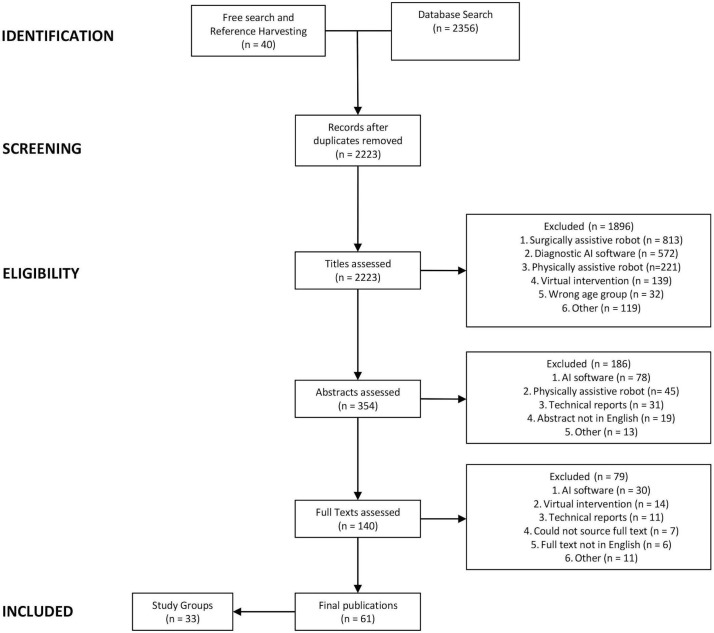
Objective: With an elderly population that is set to more than double by 2050 worldwide, there will be an increased demand for elderly care. This poses several impediments in the delivery of high-quality health and social care. Socially assistive robot (SAR) technology could assume new roles in health and social care to meet this higher demand. This review qualitatively examines the literature on the use of SAR in elderly care and aims to establish the roles this technology may play in the future. Design: Scoping review. Data sources: Search of CINAHL, Cochrane Library, Embase, MEDLINE, PsychINFO and Scopus databases was conducted, complemented with a free search using Google Scholar and reference harvesting. All publications went through a selection process, which involved sequentially reviewing the title, abstract and full text of the publication. No limitations regarding date of publication were imposed, and only English publications were taken into account. The main search was conducted in March 2016, and the latest search was conducted in September 2017. Eligibility criteria: The inclusion criteria consist of elderly participants, any elderly healthcare facility, humanoid and pet robots and all social interaction types with the robot. Exclusions were acceptability studies, technical reports of robots and publications surrounding physically or surgically assistive robots. Results: In total, 61 final publications were included in the review, describing 33 studies and including 1574 participants and 11 robots. 28 of the 33 papers report positive findings. Five roles of SAR were identified: affective therapy, cognitive training, social facilitator, companionship and physiological therapy. Conclusions: Although many positive outcomes were reported, a large proportion of the studies have methodological issues, which limit the utility of the results. Nonetheless, the reported value of SAR in elderly care does warrant further investigation. Future studies should endeavour to validate the roles demonstrated in this review. Systematic review registration: NIHR 58672.
Overview
The claims and statistics of this paper haven’t been checked yet.
Free: it reads the open-access text and checks the first 5 claims that cite a source we can check. Create a free account to check every claim.
Integrity signals
Registry
Cites
Statistics
Figures
Verification
Claims the paper makes
The claims and statistics of this paper haven’t been checked yet.
Free: it reads the open-access text and checks the first 5 claims that cite a source we can check. Create a free account to check every claim.
Claims other papers make about this one
Each is checked against this paper’s own text: does it say what the citing paper says it does?
The source backs part of the claim, not all of it — or backs it for a different population, condition or comparison.
In the citing paper
“but also highlight substantial heterogeneity and predominantly low-to-moderate study quality [46,56].”
From The Effectiveness of Artificial Intelligence-Based Pet Therapy in Improving the Care of Patients: A Systematic Review (2026) · cites this paper as [46]
Experimental — accuracy not yet measuredThe source backs part of the claim, not all of it — or backs it for a different population, condition or comparison.
In the citing paper
“In some settings, simple alternatives, such as plush toys or digital programs, produce similar benefits, depending on preferences and care context [32,40,46].”
From The Effectiveness of Artificial Intelligence-Based Pet Therapy in Improving the Care of Patients: A Systematic Review (2026) · cites this paper as [46]
Experimental — accuracy not yet measuredThe cited source says what the claim attributes to it.
In the citing paper
“systematic reviews point to potentially beneficial effects on quality of life and biopsychological outcomes”
From The Effectiveness of Artificial Intelligence-Based Pet Therapy in Improving the Care of Patients: A Systematic Review (2026) · cites this paper as [46]
Self-check
Percentages, sums and reported differences re-computed from the paper’s own numbers.
The self-check needs the paper’s full text.
Citations
Cites
Preferred reporting items for systematic reviews and meta-analyses: The PRISMA statement
Moher, D., Liberati, A., Tetzlaff, J., Altman, D. G., & the PRISMA Group* (2009) · Annals of Internal Medicine · doi:10.7326/0003-4819-151-4-200908180-00135 · Cited by 37,554
Cochrane Handbook for Systematic Reviews of Interventions: Cochrane Book Series
(2008) · doi:10.1002/9780470712184 · Cited by 25,048
Social Relationships and Mortality Risk: A Meta-analytic Review
Holt-Lunstad, J., Smith, T. B., & Layton, J. B. (2010) · PLoS Medicine · doi:10.1371/journal.pmed.1000316 · Cited by 7,272
The Handbook of Research Synthesis and Meta-Analysis
(2019) · doi:10.7758/9781610448864 · Cited by 4,553
Reprint—Preferred Reporting Items for Systematic Reviews and Meta-Analyses: The PRISMA Statement
Moher, D., Liberati, A., Tetzlaff, J., Altman, D. G., & and the PRISMA Group (2009) · Physical Therapy · doi:10.1093/ptj/89.9.873 · Cited by 2,486
Division, U. P. (1991) · Cited by 1,434
Being alone in later life: Loneliness, social isolation and living alone
Victor, C., Scambler, S., Bond, J., & Bowling, A. (2000) · Reviews in Clinical Gerontology · doi:10.1017/s0959259800104101 · Cited by 730
Wada, K., & Shibata, T. (2007) · IEEE Transactions on Robotics · doi:10.1109/tro.2007.906261 · Cited by 583
Animal-Assisted Therapy and Loneliness in Nursing Homes: Use of Robotic versus Living Dogs
Banks, M. R., Willoughby, L. M., & Banks, W. A. (2008) · Journal of the American Medical Directors Association · doi:10.1016/j.jamda.2007.11.007 · Cited by 548
The Psychosocial Effects of a Companion Robot: A Randomized Controlled Trial
Robinson, H., MacDonald, B., Kerse, N., & Broadbent, E. (2013) · Journal of the American Medical Directors Association · doi:10.1016/j.jamda.2013.02.007 · Cited by 546
Research works printed but not linked: 2
- Wada K, Shibata T, Musha T, et al Robot Therapy for Elders Affected by Dementia 2014 IEEE Long Isl Syst Appl Technol Conf LISAT. 2014.
- Thodberg K, Sørensen LU, Christensen JW, et al Therapeutic effects of dog visits in nursing homes for the elderly. Psychogeriatrics 2016; 16: 289– 97. 10.1111/psyg.12159 26510632 · DOI · Paper page
Cited by
Items 501–582 of 582
Villalobos, M. D. F. C., & Villanueva, M. T. (2025) · Innovación y software · doi:10.48168/innosoft.s23.a240
Design and Implementation of Humanoid Robot for Elderly Support System
Bhaskar, N., Bekal, A., Poojary, P., Harshitha, G., Sinchana Bangera, M., & Bekal, A. (2024) · International Conference on Data, Computation and Communication (ICDCC) · doi:10.1109/icdcc62744.2024.10961058
“Similarly, numerous papers in the literature describe how researchers have developed various robotic applications to assist people across different domains [10].”
Social Robots at Homes: Exploring Potential Value Together with Older Adults
Alenljung, B., Billing, E., & Gillsjö, C. (2025) · Lecture notes in computer science · doi:10.1007/978-3-031-93861-0_15
Tamura, T., Ikegami, T., Nguyen, N. H., Matsumoto, S., & Ho, V. A. (2025) · IEEE International Conference on Soft Robotics (RoboSoft) · doi:10.1109/robosoft63089.2025.11020891
“In the super-aging society, coexistence and cooperation between humans and robots are required; while safety, robustness, and cost performance remain issues for the practical application of service robots [1].”
Kawasaki, M., Mizuno, J., & Inoue, T. (2025) · Assistive Technology · doi:10.1080/10400435.2025.2508264
“SARs help reduce neuropsychiatric symptoms of anxiety and improve social interaction through conversations (Abdi et al., 2018; Hsieh et al., 2023).”
Practical Applications of Wearable Devices for Diagnosis and Monitoring
Kim, H. (2024) · MechEcology · doi:10.23104/me.2024.10.3.2.23
Robot-Supported Remote Caregiving Systems
Kim, H. (2024) · MechEcology · doi:10.23104/me.2024.4.3.1.1
Brouwers, M. (2025) · Research Publications (Maastricht University) · doi:10.26481/dis.20250703mb · Cited by 1
Gépi tanulás alkalmazása a magatartástudományban és a pszichológiában: előnyök és hátrányok
Matuz, A. (2025) · Mentálhigiéné és Pszichoszomatika · doi:10.1556/0406.2025.00077
Anticipating the adoption of technological innovations for robotic interaction with older adults
Chameau, C., Caritu, S., Landry, A., Pellier, D., & Monfort, E. (2025) · Cognition Technology & Work · doi:10.1007/s10111-025-00821-w
“Research into robotic solutions for older adults remains lacking in terms of the degree to which robots engage with old users, as well as the potential consequences of this degree of engagement (Abdi et al. 2018 ; Kramer et al. 2009 ).”
Human Versus Robot Assistance: Older Adults’ Preferences for Assistance on Domestic Tasks
Lee, L. Y. K., Yeung, C.-K., Choi, C.-W., Leung, M.-N., Lui, S.-Y., Tam, W.-Y., Tang, K.-Y., Wong, C.-S., Wong, Y.-S., Yau, C.-Y., et al. (2025) · Sage Open Aging · doi:10.1177/30495334251360417
“A scoping review indicates that robotic systems have long been recognized for their potential to ease workforce challenges, especially in healthcare (Abdi et al., 2018).”
Innovating Sustainable Healthcare with Humanoid Robotics
Molka-Danielsen, J., Smith, C. H., & Hanson, D. F. (2025) · IFIP advances in information and communication technology · doi:10.1007/978-3-031-95334-7_12
Smart Elderly Care With Integrated Human-AI Decision Support
Bhimavarapu, U. (2025) · Advances in computational intelligence and robotics book series · doi:10.4018/979-8-3373-5462-0.ch004
Robotics And Artificial Intelligence In Clinical Psychology
Desideri, L. (2024) · Emerald Group Publishing Limited eBooks · doi:10.1108/979-8-88730-594-30251013
Haltaufderheide, J., Lucht, A., Strünck, C., & Vollmann, J. (2024) · Figshare · doi:10.6084/m9.figshare.26647593
Koh, W. Q., Felding, S. A., Budak, K. B., Toomey, E., & Casey, D. (2021) · Figshare · doi:10.6084/m9.figshare.14759579
Koh, W. Q., Felding, S. A., Budak, K. B., Toomey, E., & Casey, D. (2021) · Figshare · doi:10.6084/m9.figshare.14759576
Bradwell, H. L., Winnington, R., Thill, S., & Jones, R. B. (2020) · Figshare · doi:10.6084/m9.figshare.12655682
Peng, R., Huang, J., & Deng, X. (2024) · Figshare · doi:10.6084/m9.figshare.26628298
Brouwers, M., Broekharst, D. S. E., de Boer, B., Groen, W. G., & Verbeek, H. (2024) · Figshare · doi:10.6084/m9.figshare.26604964
Brouwers, M., Broekharst, D. S. E., de Boer, B., Groen, W. G., & Verbeek, H. (2024) · Figshare · doi:10.6084/m9.figshare.26604961
Haltaufderheide, J., Lucht, A., Strünck, C., & Vollmann, J. (2024) · Figshare · doi:10.6084/m9.figshare.26647596
Koh, W. Q., Felding, S. A., Budak, K. B., Toomey, E., & Casey, D. (2021) · Figshare · doi:10.6084/m9.figshare.14759570
Koh, W. Q., Felding, S. A., Budak, K. B., Toomey, E., & Casey, D. (2021) · Figshare · doi:10.6084/m9.figshare.14759573
A review on AI-driven face robot for human-robot expression interaction
Sheng, Q., Wei, T. A. N. G., Hao, Q. I. N., YuJie, K. O. N. G., HaoKai, D. A. I., Zhong, Y., YongHao, W. A. N. G., Zou, J. T., & HuaYong, Y. A. N. G. (2025) · Scientia Sinica Technologica · doi:10.1360/sst-2025-0217 · Cited by 1
Gupta, A., Singh, T. K., & Singla, E. (2025) · Lecture notes in bioengineering · doi:10.1007/978-981-95-1470-0_3
Blanco, A., Condón, A., Clavijo, Z., Rodríguez, T., & Núñez, P. (2025) · Lecture notes in computer science · doi:10.1007/978-981-95-2382-5_6
Do We View Robots as We Do Ourselves? Examining Robotic Face Processing Using EEG
Pérez-Arenas, X., Rivera-Rei, Á. A., Huepe, D., & Soto, V. (2025) · Brain Sciences · doi:10.3390/brainsci16010009 · Cited by 1
“…of research across diverse fields such as psychology [4], social robotics [5], and communication sciences [6], as well as extended to the real-world implementation of socially assistive robots for affective therapy, cognitive training, social facilitation, and even companionship (reviewed in [7]).”
Yao, L., Chen, K., Yang, Q.-Y., & Lyu, P. (2025) · CIN Computers Informatics Nursing · doi:10.1097/cin.0000000000001437
Amabili, G., Sgolastra, A., Margaritini, A., Barbarossa, F., Maranesi, E., Cucchieri, G., Pascucci, L., Ferrara, L., & Bevilacqua, R. (2025) · JMIR Research Protocols · doi:10.2196/81395 · Cited by 2
Häussl, A., Zwigl, I., Stojec, L., Smolak, I. S., Stijic, M., Stross, T. M., Lenger, M., Fellendorf, F. T., Guggemos, S., Schönthaler, E. M. D., et al. (2026) · Frontiers in Psychiatry · doi:10.3389/fpsyt.2025.1661730 · Cited by 1
A First Glimpse Into Hybrid Simulation for Inpatient Healthcare Robotics
Amaya-Ceballos, S., Escudero, P., Carreno‐Medrano, P., & Guerrero, W. J. (2025) · Winter Simulation Conference · doi:10.1109/wsc68292.2025.11339076
“The use of service robots has emerged as a potential tool to help reduce workload and improve workflow efficiency (Abdi et al. 2018).”
Artificial Intelligence (AI) in Geriatric Care: Opportunities, Challenges, and Future Directions
Patra, B. P., Tiwari, P., & Gupta, M. (2026) · Advances in computational intelligence and robotics book series · doi:10.4018/979-8-3373-6400-1.ch016
Armeni, P., Polat, I., Rossi, L. M. D., Diaferia, L., Padova, S. D., Gatti, A., & Meregalli, S. (2026) · Frontiers in Aging · doi:10.3389/fragi.2026.1687784 · Cited by 1
Prevention of Mild Cognitive Impairment: An Integrated Intervention
D’Iorio, A., Benedetto, G. L. D., Laora, L. D., Sorrentino, A., Cavallo, F., Santangelo, G., Cordasco, G., & Esposito, A. A. (2026) · Smart innovation, systems and technologies · doi:10.1007/978-981-95-4076-1_1
Lin, Z.-H., & Woo, J.-C. (2026) · Educational Gerontology · doi:10.1080/03601277.2026.2617493
Adaptive planning for assistive-care robotic missions
Stefanakos, I., Hamilton, J., Călinescu, R., Cámara, J., Peyrucain, T., & Miguel, N. (2026) · The International Journal of Robotics Research · doi:10.1177/02783649261420234 · Cited by 2
Care Robots as Emerging Health Technologies: A Systematic Review and Meta-Analysis (Preprint)Preprint
Kim, G., & Jeon, J. (2026) · doi:10.2196/preprints.95232
Digital Nursing: A Walker and Avant Concept Analysis
Bulgurcu, R. A., Özdemir, H., Ceylan, S., Güvenç, G., & İyigün, E. (2026) · Ordu Üniversitesi Hemşirelik Çalışmaları Dergisi · doi:10.38108/ouhcd.1575968
Robot Behavior Generation and Human Behavior Understanding in Natural Human-Robot Interaction
Yu, C. (2021) · theses.fr (ABES) · doi:10.70675/a2fb1584z6eacz4152za8d9zcda53ec825e0 · Cited by 10
Lee, G., Sohn, S., & Yoon, H. C. (2026) · AI & Society · doi:10.1007/s00146-026-03027-4 · Cited by 1
“…research shows how grounded theoretical frameworks can provide conceptualizations of anthropomorphism’s role in mediating autonomy, companionship, and care outcomes, thus informing robot design and care policies sensitive to lived realities of older adults (Abdi et al. 2018; Lambert et al. 2020).”
Volting ˸ a wheelchair and human-machine interface for physical activity
Rocha, J. M. (2025) · theses.fr (ABES) · doi:10.70675/443e5d48z16bdz43f4z9d66z2689dc3732e8
Hong, S. (2026) · Assistive Technology · doi:10.1080/10400435.2026.2657284
“While prior reviews have focused on the technical and clinical dimensions of AT implementation (Abdi et al., 2018; Kachouie et al., 2014; Martinez-Martin & Costa, 2021; Boyle et al., 2022; Franke et al., 2021), few studies have systematically analyzed how rapport as a culturally embedded construct…”
Che, R., Li, J., Zhao, Z., Ho, J. C. F., & Wang, H. (2025) · International Conference on Human-Engaged Computing (ICHEC) · doi:10.1145/3786995.3787055
“Aging populations worldwide face increasing challenges in maintaining emotional and cognitive health [1] [2].”
Ma, Y., & Zhao, W. (2025) · International Conference on Human-Engaged Computing (ICHEC) · doi:10.1145/3786995.3787002
“The emergence of interactive AI technologies, including socially assistive robots (SARs) [1], virtual agents [99], and conversational AI systems [45] offers a promising alternatives for eldercare.”
Rubeis, G. (2026) · Springer eBooks · doi:10.1007/978-3-032-14301-3_6
Trajbarič, T., Muršec, D., Svenšek, A., Štiglic, G., & Gosak, L. (2026) · Applied Sciences · doi:10.3390/app16104683
MAI: Eine sehr kurze Geschichte und der aktuelle Stand der Technik
Rubeis, G. (2026) · Springer eBooks · doi:10.1007/978-3-032-14301-3_3
Awang, N. A., Chua, S. J. L., Saleh, A. F. A., Baydoun, R., & Mustafa, M. H. (2026) · Journal of Public Health · doi:10.1007/s10389-026-02776-2
Khodaei, B., Alishani, M. M., Mirtajaddini, S., Jafari, B., & Alizadeh, S. (2025) · International Journal of Aging · doi:10.34172/ija.9099 · Cited by 1
“13 Furthermore, robots can help human caregivers and family members by doing repetitive tasks and providing interaction.”
InfluentialZhang, Y., & Liu, Y. (2026) · Journal of Intelligence · doi:10.3390/jintelligence14050085 · Cited by 1
“…vary across measures and populations, this literature supports the use of EI as a theoretically meaningful lens for examining how emotional-support technologies may influence later-life adaptation and socio-emotional functioning (Abdi et al., 2018; Kachouie et al., 2014; Pu et al., 2019).”
Maukel, L., Bouchard, K., Fiedorowicz, J. G., Dautenhahn, K., Ghafurian, M., Coutinho, T. A., McGuinty, C., Liu, P. P., & Tulloch, H. E. (2026) · JMIR Cardio · doi:10.2196/83163
“In addition, patients ranked the perceived usefulness of various SR capabilities and features using a 25-item questionnaire [10,23], for providing in-home care.”
Kim, G., & Jeon, J. (2026) · Journal of Medical Internet Research · doi:10.2196/95232
“Technology acceptance is supported by a parallel body of qualitative and survey-based literature [7,8,71] indicating generally positive acceptance when sessions are facilitator-supported, culturally aligned, and adequately introduced; but acceptance ratings are variable across populations and…”
Chew, E., Hu, S., Jinyu, L., Wei, H., & Yang, J. (2026) · International Conference on Information Technology Based Higher Education and Training (ITHET) · doi:10.1109/ithet69978.2026.11585069
“This design orientation is also consistent with the current trend in domestic assistive robots and older people’s care robots, which is shifting from function-specific devices towards systematic support platforms [6], [26].”
Yang, Y.-T. T., Neef, C., & Bruno, B. (2026) · ACM Interactive Health Conference · doi:10.1145/3786579.3804921
Hung, L., dos Santos, Í. K., Kim, Y., Zhang, C., Ravichander, V., & Wong, J. (2026) · Lecture notes in computer science · doi:10.1007/978-3-032-31048-4_5
Düzgün, A. L., Vrecar, R., & Dobrosovestnova, A. (2026) · Nordic Conference on Human-Computer Interaction · doi:10.1145/3821402.3830142
“…suggests that these qualities were primarily shaped by its conversational design and embodiment rather than by language alone, aligning with prior work in HRI emphasizing that perceived warmth, acceptance and companionship emerge from the inter-play of interaction design and embodiment [1, 24].”
Technology at the service of longevity: a paradoxical view of service robot acceptance in aged care
Cesário, L. C., Cauchick-Miguel, P. A., Lizarelli, F. L., Teixeira, J., & Mendes, G. H. D. S. (2026) · International Journal of Quality and Service Sciences · doi:10.1108/ijqss-01-2026-0022
Digital Medicine in the Light of Orthodox Anthropology: Ethics of Service in the Age of Technology
Seliverstov, P. V. (2026) · Meditsinskaya sestra · doi:10.29296/25879979-2026-04-02
Cubero, G., Villa, L., & Hervás, R. (2025) · Revista de la Asociación Interacción Persona Ordenador (AIPO) · doi:10.65234/interaccion.131
“Los robots sociales asistenciales (SARs) emergen como solución prometedora para abordar necesidades de acompañamiento, monitorización de salud y asistencia en actividades diarias (Abdi et al., 2018; Kachouie et al.,2014).”
Einsatzpotenziale des Sozial Assistiven Roboters „Moflin“ in der stationären Altenpflege
Pauli, C., Hüsler, S.-S., & Eicher, S. (2026) · Zeitschrift für Gerontologie und Geriatrie · doi:10.1007/s00391-026-02616-8
Gaze Analysis System for Emotional Attunement in Human–Robot Interactions
Sone, Y., & Woo, J. (2026) · Journal of Advanced Computational Intelligence and Intelligent Informatics · doi:10.20965/jaciii.2026.p1258
Intelligent assistive technology for people with dementia: A meta-analysis
Saragih, I. D., Lai, F., Hwang, P., Susanto, H., & Lee, B. (2026) · Geriatric Nursing · doi:10.1016/j.gerinurse.2026.104181
Omar, S. H., Ghani, A., Sanober, A., & Umar, A. (2026) · International Journal of Medical Informatics · doi:10.1016/j.ijmedinf.2026.106627
Design of an autonomous charging system for robot NAO
Dhanasekaran, A., Bonaiuto, V., & Zanela, A. (2026) · Discover Robotics · doi:10.1007/s44430-026-00036-2
Malhotra, S. (2026) · IntechOpen eBooks · doi:10.5772/intechopen.1015983
Chu, K., & Chan, H.-C. (2026) · Journal of Applied Gerontology · doi:10.1177/07334648261473667
Arthanat, S., Wang, J., LaRoche, D. P., Fritz, H., DiZazzo-Miller, R., Hussein, M., Ghattas, O., Akash, M., & Begum, M. (2026) · International Journal of Environmental Research and Public Health · doi:10.3390/ijerph23081019 · Cited by 1
“Although SARs have been in development for the past two decades, their primary deployment has occurred in supervised living facilities to provide social companionship for older adults [28,29].”
Jeong, M.-A., & Kim, S.-D. (2026) · Applied Sciences · doi:10.3390/app16167899
Socially Assistive Robots for Cognitive Assessment and Training in Older Adults: A Systematic Review
Zubair, M., Tamantini, C., Benedictis, R. D., Fracasso, F., Umbrico, A., Beraldo, G., Orlandini, A., & Cortellessa, G. (2026) · Robotics · doi:10.3390/robotics15080152 · Cited by 1
“Abdi et al. identified multiple roles for SARs in elderly care but emphasized that the predominantly positive findings were weakened by methodological limitations [24].”
Shin, Y. S., & Kim, M. Y. (2026) · IEEE Access · doi:10.1109/access.2026.3721953
“…robots that support activities of daily living, social robots that provide companionship and emotional engagement, rehabilitation robots that facilitate physical recovery, service robots that perform household tasks, and monitoring robots that track health status and detect emergencies [5].”
Priority-Driven Hierarchical Multi-Agent Systems with Fine-Tuned LLMs
Tudela, A., Pons, Ó., Galeas, J., Bandera, J. P., & Bandera, A. J. (2026) · Applied Sciences · doi:10.3390/app16168250
Vallès-Carvajal, C., Selva‐Pareja, L., Masot, O., Villaitodo, M. F., Garanto, C. C., & Botigué, T. (2026) · Nutrients · doi:10.3390/nu18162715
“This is because they can facilitate routine and repetitive tasks, such as monitoring [22,23], thereby reducing stress and care workload and allowing care staff to dedicate more time to individualized and empathetic care [23].”
Díaz‐de‐Mera, C., Fernández, F., García, F., Marín, A., Blanco, N., Domínguez-Jiménez, I., & Pulido, J. C. (2026) · International Journal of Social Robotics · doi:10.1007/s12369-026-01434-7
Dittert, D. D., Pleșea, D., Olaru, M., & Söhner, S. (2026) · Proceeding Papers · doi:10.24818/basiq/2026/12/030
Mohsen, F., Zaim, T., & Safa, A. (2026) · Communications in computer and information science · doi:10.1007/978-3-032-27235-5_30
Losada-Floriano, D., Thygesen, E., Sanfilippo, F., Hansen, M. R., & Fossum, M. (2026) · doi:10.2196/preprints.112099
Zhou, C., Wu, H., Li, G., & CHEN, Y. (2026) · Frontiers in Psychology · doi:10.3389/fpsyg.2026.1915597
“Subsequent reviews found that socially assistive robots may improve engagement and reduce loneliness among older adults, although effects vary across settings, intervention duration, and user characteristics (Abdi et al., 2018; Bemelmans et al., 2012).”
Fernández, R., Baldeón, I., Moon, H., Fajardo-Pruna, M., & Yumbla, F. (2026) · IEEE Access · doi:10.1109/access.2026.3735901
“The review conducted by Abdi et al. [5], which included 61 publications describing 33 studies, identified five principal roles of robots in older adult care: affective therapy, cognitive training, social facilitation, companionship, and physiological therapy.”
Horiuchi, S. (2026) · AI & Society · doi:10.1007/s00146-026-03381-3
Raß, E., Unbehaun, D., Lenz, G., Fischer, A., Thiel, K., Lüssem, J., & Wulf, V. (2026) · ACM Transactions on Computing for Healthcare · doi:10.1145/3849697
Awang, N. A., Myeda, N. E., Saleh, A. F. A., & Baydoun, R. (2026) · Journal of Facilities Management · doi:10.1108/jfm-09-2025-0157
Metadata
- Authors
- Abdi, J., Al-Hindawi, A., Ng, T., & Vizcaychipi, M. P.
- Affiliations
- Imperial College London (GB)
- Magill Department of Anaesthesia, Intensive Care Medicine and Pain Management, Chelsea and Westminster Hospital, London, UK
- Chelsea and Westminster Hospital NHS Foundation Trust (GB)
- Corresponding author
- Abdi, Jordan
- Venue
- BMJ Open
- Publisher
- BMJ
- Published
- 2018-02
- Volume
- 8
- Issue
- 2
- Pages
- e018815
- ISSN
- 2044-6055 (ISSN-L)
- PMC
- PMC5829664
- OpenAlex
- W2789445850
- Cited by
- 583
- References
- 70
- Citations by year
- 2026: 60 · 2025: 83 · 2024: 80 · 2023: 81 · 2022: 104 · 2021: 72 · 2020: 59 · 2019: 35 · 2018: 9
- FWCI
- 6.61
- Type
- journal article
- Language
- en
- Open access
- gold
- doi.org
- Licence
- cc-by-nc
- Locations
- BMJ Open (publishedVersion, cc-by-nc)
- PubMed Central (publishedVersion, cc-by-nc)
- PubMed (publishedVersion)
- Spiral (Imperial College London) (submittedVersion, cc-by-nc)
- Funders
- National Institute for Health and Care Research
- Topics
- Social Sciences › Psychology › Social Psychology › Social Robot Interaction and HRI
- Health Sciences › Medicine › Geriatrics and Gerontology › Technology Use by Older Adults
- Life Sciences › Agricultural and Biological Sciences › Animal Science and Zoology › Human-Animal Interaction Studies
- Keywords
- socially assistive robots, elderly care, older adults, humanoid robots, pet robots, cognitive training, social facilitation, companionship, social interaction with robots, population aging
- MeSH terms
- Aged, Aging, Humans, Interpersonal Relations, Quality of Health Care, Quality of Life, Robotics, Randomized Controlled Trials as Topic
About these checks
Registry, retraction, Cites and statistics results are computed, not judged, with one exception: a printed reference that no index lists is read once by a model before it counts as a citation error. Claims are extracted by a model and kept only when their quote appears verbatim in the text; each cited source is then checked, with a model’s help, for whether it says what the claim relies on. Those verdicts can be wrong — read the claim’s quote and the cited source before relying on one.
Statistics and arithmetic are recomputed, not judged.
Confidence bands are shown only for fields calibrated on our annotated test set. None is calibrated yet, so no band is shown.
What counts as a claim ›How we measure confidence ›How we check this ›
Are you an author, or do you see a problem with this page? Request a review
Data sources
Bibliographic data: Semantic Scholar, OpenAlex, Crossref.
Contains information from the Semantic Scholar Academic Graph Datasets, made available under the ODC Attribution License (ODC-BY 1.0).
Semantic Scholar’s data is described in: Kinney, R., et al. (2023). The Semantic Scholar Open Data Platform. arXiv:2301.10140.
