

Are noise and air pollution related to the incidence of dementia? A cohort study in London, England
Open accessThe DOI matches its Crossref record; 49 of the 49 references it cites were found in a registry or an index.
Abstract
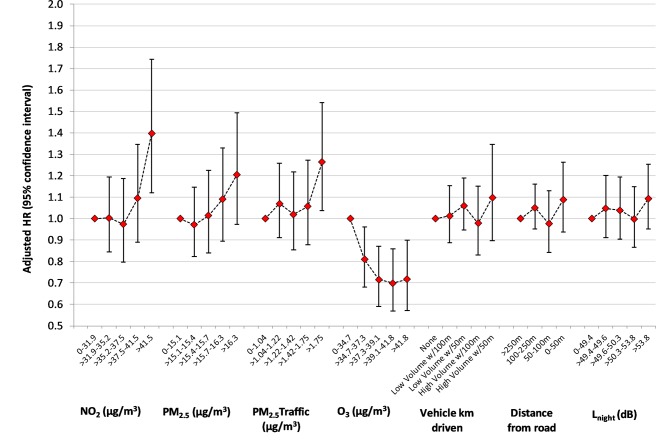
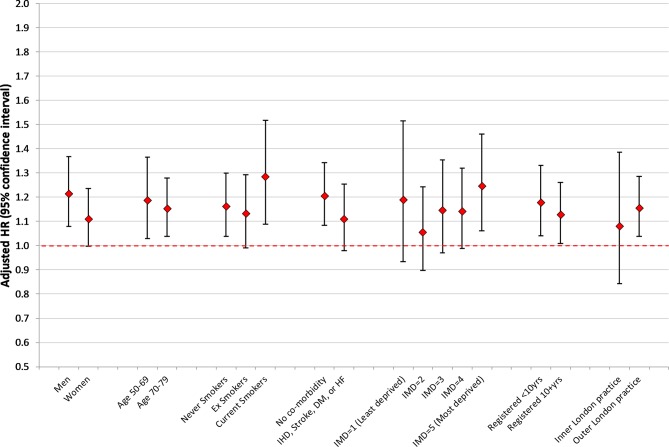
Objective: To investigate whether the incidence of dementia is related to residential levels of air and noise pollution in London. Design: Retrospective cohort study using primary care data. Setting: 75 Greater London practices. Participants: 130 978 adults aged 50–79 years registered with their general practices on 1 January 2005, with no recorded history of dementia or care home residence. Primary and secondary outcome measures: A first recorded diagnosis of dementia and, where specified, subgroups of Alzheimer’s disease and vascular dementia during 2005–2013. The average annual concentrations during 2004 of nitrogen dioxide (NO 2), particulate matter with a median aerodynamic diameter ≤2.5 µm (PM 2.5) and ozone (O 3) were estimated at 20×20 m resolution from dispersion models. Traffic intensity, distance from major road and night-time noise levels (L night) were estimated at the postcode level. All exposure measures were linked anonymously to clinical data via residential postcode. HRs from Cox models were adjusted for age, sex, ethnicity, smoking and body mass index, with further adjustments explored for area deprivation and comorbidity. Results: 2181 subjects (1.7%) received an incident diagnosis of dementia (39% mentioning Alzheimer’s disease, 29% vascular dementia). There was a positive exposure response relationship between dementia and all measures of air pollution except O 3, which was not readily explained by further adjustment. Adults living in areas with the highest fifth of NO 2 concentration (>41.5 µg/m 3) versus the lowest fifth (<31.9 µg/m 3) were at a higher risk of dementia (HR=1.40, 95% CI 1.12 to 1.74). Increases in dementia risk were also observed with PM 2.5, PM 2.5 specifically from primary traffic sources only and L night, but only NO 2 and PM 2.5 remained statistically significant in multipollutant models. Associations were more consistent for Alzheimer’s disease than vascular dementia. Conclusions: We have found evidence of a positive association between residential levels of air pollution across London and being diagnosed with dementia, which is unexplained by known confounding factors.
Overview
The claims and statistics of this paper haven’t been checked yet.
Free: it reads the open-access text and checks the first 5 claims that cite a source we can check. Create a free account to check every claim.
Integrity signals
Registry
Cites
Statistics
Figures
Verification
Claims the paper makes
The claims and statistics of this paper haven’t been checked yet.
Free: it reads the open-access text and checks the first 5 claims that cite a source we can check. Create a free account to check every claim.
Claims other papers make about this one
Each is checked against this paper’s own text: does it say what the citing paper says it does?
The source backs part of the claim, not all of it — or backs it for a different population, condition or comparison.
In the citing paper
“High nitrogen dioxide (NO2) concentration (>41·5 μg/m3; adjusted HR 1·2, 95% CI 1·0–1·3), fine ambient particulate matter (PM)2·5 from traffic exhaust (1·1, 1·0–1·2)127, 128, 129 and PM2·5 from residential wood burning (HR=1·6, 95% CI 1·0–2·4 for a 1 μg/m3 increase) are associated with increased dementia incidence.”
From Dementia prevention, intervention, and care: 2020 report of the Lancet Commission (2020) · cites this paper as [129]
Experimental — accuracy not yet measuredThe source backs part of the claim, not all of it — or backs it for a different population, condition or comparison.
In the citing paper
“although evidence for additive effects of different pollutants exists.”
From Dementia prevention, intervention, and care: 2020 report of the Lancet Commission (2020) · cites this paper as [129]
Experimental — accuracy not yet measuredThe cited source says what the claim attributes to it.
In the citing paper
“To date, studies with data on noise and air pollution have not found noise to be a substantial source of confounding (Andersson et al. 2018; Carey et al. 2018; Tzivian et al. 2016).”
From Exposure to Air Pollution in Relation to Risk of Dementia and Related Outcomes: An Updated Systematic Review of the Epidemiological Literature (2021) · cites this paper as Carey et al. 2018
Self-check
Percentages, sums and reported differences re-computed from the paper’s own numbers.
The self-check needs the paper’s full text.
Citations
Cites
Cohen, A. J., Brauer, M., Burnett, R., Anderson, H. R., Frostad, J., Estep, K., Balakrishnan, K., Brunekreef, B., Dandona, L., Dandona, R., et al. (2017) · The Lancet · doi:10.1016/s0140-6736(17)30505-6 · Cited by 6,583 · cited 1×
“6 While air pollution is a well-established risk factor for cardiovascular and respiratory disease, 7 its role in relation to dementia is less well considered and understood.”
Self-citationThe global prevalence of dementia: a systematic review and metaanalysis.
Prince, M., Bryce, R., Albanese, E., Wimo, A., Ribeiro, W., & Ferri, C. P. (2013) · Alzheimer's & Dementia · doi:10.1016/j.jalz.2012.11.007 · Cited by 4,941 · cited 1×
“Therefore, primary prevention of all dementia is a major global public health concern for the coming decades.(3) For Alzheimer’s disease for example, while it has been estimated that small delays in its onset and progression could significantly reduce its estimated future burden,(4) research has primarily focused on l…”
BackgroundForecasting the global burden of Alzheimer's disease
Brookmeyer, R., Johnson, E., Ziegler‐Graham, K., & Arrighi, H. M. (2007) · Alzheimer's & Dementia · doi:10.1016/j.jalz.2007.04.381 · Cited by 3,370 · cited 1×
“There would be significant public health gains even if the impact was only to delay the progression of dementia.(4) With the future global burden of dementia likely to be substantial,(3) further epidemiological work is urgently needed to confirm and understand better recent findings linking air pollution to dementia.”
BackgroundData Resource Profile: Clinical Practice Research Datalink (CPRD)
Herrett, E., Gallagher, A. M., Bhaskaran, K., Forbes, H., Mathur, R., van Staa, T., & Smeeth, L. (2015) · International Journal of Epidemiology · doi:10.1093/ije/dyv098 · Cited by 2,667 · cited 2×
“It has been shown to be broadly representative of the UK population, with about 7% of all people in the UK actively registered on it in 2011.(14) Approximately three-quarters of contributing CPRD practices in England have consented to their data being linked to external sources.”
BackgroundMethodPotential for primary prevention of Alzheimer's disease: an analysis of population-based data
Norton, S., Matthews, F. E., Barnes, D. E., Yaffe, K., & Brayne, C. (2014) · The Lancet Neurology · doi:10.1016/s1474-4422(14)70136-x · Cited by 2,466 · cited 1×
“For Alzheimer’s disease for example, while it has been estimated that small delays in its onset and progression could significantly reduce its estimated future burden,(4) research has primarily focused on lifestyle factors, where a large systematic review estimated that about a third of Alzheimer’s disease may be attr…”
BackgroundCalderón-Garcidueñas, L., Solt, A. C., Henríquez-Roldán, C., Torres-Jardón, R., Nuse, B., Herritt, L., Villarreal-Calderón, R., Osnaya, N., Stone, I., García, R., et al. (2008) · Toxicologic Pathology · doi:10.1177/0192623307313011 · Cited by 937
Expert position paper on air pollution and cardiovascular disease
Newby, D. E., Mannucci, P. M., Tell, G. S., Baccarelli, A. A., Brook, R. D., Donaldson, K., Forastiere, F., Franchini, M., Franco, O. H., Graham, I., et al. (2015) · European Heart Journal · doi:10.1093/eurheartj/ehu458 · Cited by 869 · cited 1×
“Context The established body of epidemiological evidence linking long-term concentrations of air pollution to adverse health effects has mainly focused on cardiovascular disease.(36) The Global Burden of Disease studies, which have described the worldwide impact of air pollution, considered a wide range of outcomes (I…”
BackgroundChen, H., Kwong, J. C., Copes, R., Tu, K., Villeneuve, P. J., van Donkelaar, A., Hystad, P., Martin, R. V., Murray, B. J., Jessiman, B., et al. (2017) · The Lancet · doi:10.1016/s0140-6736(16)32399-6 · Cited by 776 · cited 3×
“Research linking air pollution exposure to neurocognitive function has gradually increased from observational findings in 2002 from dogs in Mexico City,(37) to larger studies which assessed cognitive decline,(38) 39 and large population cohorts that specifically investigated the association in relation to diagnoses of…”
BackgroundSunyer, J., Esnaola, M., Alvarez-Pedrerol, M., Forns, J., Rivas, I., López-Vicente, M., Suades-González, E., Foraster, M., Garcia-Esteban, R., Basagaña, X., et al. (2015) · PLOS Medicine · doi:10.1371/journal.pmed.1001792 · Cited by 590 · cited 1×
“8 30 46 Traffic-related air pollution has been linked to poorer cognitive development in young children, 47 and continued significant exposure may produce neuroinflammation and altered brain innate immune responses in early adulthood.”
BackgroundThe outdoor air pollution and brain health workshop
Block, M. L., Elder, A., Auten, R. L., Bilbo, S. D., Chen, H., Chen, J.-C., Cory-Slechta, D. A., Costa, D., Diaz-Sanchez, D., Dorman, D. C., et al. (2012) · NeuroToxicology · doi:10.1016/j.neuro.2012.08.014 · Cited by 539 · cited 1×
“8 30 46 Traffic-related air pollution has been linked to poorer cognitive development in young children, 47 and continued significant exposure may produce neuroinflammation and altered brain innate immune responses in early adulthood.”
Background
Cited by
Items 101–200 of 317
Franz, C. E., Gustavson, D. E., Elman, J. A., Fennema‐Notestine, C., Hagler, D. J., Baraff, A. J., Tu, X. M., Wu, T., Anda, J. D., Beck, A. I., et al. (2023) · Journal of Alzheimer s Disease · doi:10.3233/jad-221054 · Cited by 34
Traffic-related air pollution: Emissions, human exposures, and health: An introduction
Khreis, H., Nieuwenhuijsen, M. J., Zietsman, J., & Ramani, T. L. (2020) · Elsevier eBooks · doi:10.1016/b978-0-12-818122-5.00001-6 · Cited by 44
Chen, J., Kuo, T.-Y., Yu, H., Wu, C., Yeh, S., Chiou, J., Chen, T., & Chen, Y. (2020) · Journal of Alzheimer s Disease · doi:10.3233/jad-200614 · Cited by 34
Shim, J.-I., Byun, G., & Lee, J.-T. T. (2023) · Environmental Health · doi:10.1186/s12940-023-00986-9 · Cited by 33
Christensen, G. M., Li, Z., Liang, D., Ebelt, S., Gearing, M., Levey, A. I., Lah, J. J., Wingo, A. P., Wingo, T. S., & Hüls, A. (2024) · Neurology · doi:10.1212/wnl.0000000000209162 · Cited by 34
Contador, I., Buch-Vicente, B., del Ser, T., Velasco, S. L., Villarejo‐Galende, A., Benito‐León, J., & Bermejo‐Pareja, F. (2024) · Journal of Clinical Medicine · doi:10.3390/jcm13144100 · Cited by 32
Impact of long-term exposure to air pollution on cognitive decline in older adults without dementia
Park, S. Y., Han, J., Kim, S. H., Suk, H. W., Park, J. E., & Lee, D. Y. (2022) · Journal of Alzheimer's Disease · doi:10.3233/jad-215120 · Cited by 30
Bagheri, N., Mavoa, S., Tabatabaei‐Jafari, H., Knibbs, L. D., Coffee, N. T., Salvador‐Carulla, L., & Anstey, K. J. (2021) · Journal of Alzheimer s Disease · doi:10.3233/jad-210208 · Cited by 30
Long-term exposure to low-level air pollution, genetic susceptibility and risk of dementia
Ma, H., Li, X., Zhou, T., Wang, M., Heianza, Y., & Qi, L. (2022) · International Journal of Epidemiology · doi:10.1093/ije/dyac146 · Cited by 31
Tham, R., & Schikowski, T. (2021) · Journal of Alzheimer’s Disease · doi:10.3233/jad-200813 · Cited by 29
Ru, M., Brauer, M. D., Lamarque, J., & Shindell, D. T. (2021) · GeoHealth · doi:10.1029/2020gh000356 · Cited by 30
The Global Health Cost of Ambient PM2.5 Air Pollution
Bank, W. (2020) · World Bank, Washington, DC eBooks · doi:10.1596/35721 · Cited by 57
“…et al. 2015), such as infant mortality (Heft-Neal et al. 2018), low birth weight (Ezziane 2013), preterm delivery, diabetes (Bowe et al. 2018), mental health (Shin et al. 2018), and neurological impairment (Xu et al. 2016; Zhang et al. 2018) including dementia in later life (Carey et al. 2018).”
BackgroundAir pollution: a latent key driving force of dementia
Mohammadzadeh, M., Khoshakhlagh, A. H., & Grafman, J. H. (2024) · BMC Public Health · doi:10.1186/s12889-024-19918-4 · Cited by 26
“A cohort study conducted in England estimated the prevalence of VaD among men and women aged 50–79 years old at 29%, but found little evidence of the effect of air pollution on this neurological disorder [21].”
InfluentialEnvironmental Violence: A Tool for Planetary Health Research
Marcantonio, R. A., & Fuentes, A. (2021) · The Lancet Planetary Health · doi:10.1016/s2542-5196(23)00190-0 · Cited by 32
Tuffier, S., Zhang, J., Bergmann, M. L., So, R., Napolitano, G. M., Cole‐Hunter, T., Marić, M., Antić, S., Brandt, J. G., Ketzel, M., et al. (2024) · Alzheimer s & Dementia · doi:10.1002/alz.13814 · Cited by 27
“15,17,19 Here we examine the association between long-term exposure to both air pollution and road traffic noise and dementia incidence for up to 14 years in a cohort of female nurses in Denmark, for which we havepreviouslydocumentedassociationsofairpollutionorroadtraffic noise 20,21 with…”
BackgroundResultInfluentialAir Pollution as an Environmental Risk Factor for Alzheimer’s Disease and Related Dementias
Park, H. H., Armstrong, M. J., Gorin, F. A., & Lein, P. J. (2024) · Medical Research Archives · doi:10.18103/mra.v12i10.5825 · Cited by 28
“In line with these findings, other studies reported the association of PM 2.5 to be more pronounced with AD than with non-AD or VaD 61,64,65,74 , but contrary results showed more significant association with non-AD or VaD than with AD 82,84,100 .”
InfluentialPollution, Particles, and Dementia: A Hypothetical Causative Pathway
Seaton, A., Tran, L., Chen, R., Maynard, R. L., & Whalley, L. J. (2020) · International Journal of Environmental Research and Public Health · doi:10.3390/ijerph17030862 · Cited by 27
Fania, A., Monaco, A., Amoroso, N., Bellantuono, L., Gatti, R. C., Firza, N., Lacalamita, A., Pantaleo, E., Tangaro, S., Velichevskaya, A. I., et al. (2024) · Scientific Reports · doi:10.1038/s41598-024-55439-1 · Cited by 25
“61 reported evidence of a positive correlation among residential levels of air pollution across London (in particular NO 2 ) and people diagnosed with AD and vascular dementia.”
BackgroundLetellier, N., Gutierrez, L., Duchesne, J., Chen, C., Ilango, S., Helmer, C., Berr, C., Mortamais, M., & Benmarhnia, T. (2022) · Alzheimer's & Dementia · doi:10.1002/alz.12606 · Cited by 23
Chen, G., Hukportie, D. N., Wan, Z., Li, F., & Wu, X. (2022) · The Journals of Gerontology Series A · doi:10.1093/gerona/glac228 · Cited by 23
Wei, S., & Semple, S. E. (2022) · Air Quality Atmosphere & Health · doi:10.1007/s11869-022-01288-8 · Cited by 25
Zhang, H., Shi, L., Ebelt, S., D’Souza, R. R., Schwartz, J. D., Scovronick, N., & Chang, H. H. (2022) · Environmental Epidemiology · doi:10.1097/ee9.0000000000000237 · Cited by 24
McLachlan, J., Cox, S. R., Pearce, J. R., & Hernández, M. D. C. V. (2023) · Frontiers in Environmental Health · doi:10.3389/fenvh.2023.1205443 · Cited by 25
The exposome from neurodevelopment to neurodegeneration: A narrative review
Dallere, S., Rasà, D. M., Pavarino, G., Schellino, R., Vercelli, A., & Boido, M. (2025) · Neuroscience & Biobehavioral Reviews · doi:10.1016/j.neubiorev.2025.106247 · Cited by 23
“Traffic noise Hahad et al., (2022); Weuve et al., (2021); Andersson et al., (2018); Carey et al., (2018); Yuchi et al., (2020) Increase in cognitive impairment and higher risk of AD (controversial).”
Wood, D. L., Evangelopoulos, D., Beevers, S. D., Kitwiroon, N., & Katsouyanni, K. (2022) · International Journal of Environmental Research and Public Health · doi:10.3390/ijerph192315889 · Cited by 23
“Most notably for the present study, Carey et al. (2018) found adverse relationships for NO2 (HR = 1.15 [1.04, 1.28] per 7.47 µg/m3 increase) and PM2.”
BackgroundResultSelf-citationYu, Y., Haan, M. N., Paul, K. C., Mayeda, E. R., Jerrett, M., Wu, J. Y., Lee, E. Y., Su, J. G., Shih, I., Inoue, K., et al. (2020) · Environmental Epidemiology · doi:10.1097/ee9.0000000000000122 · Cited by 22
Ye, M., Yang, J., Li, J., Wang, Y., Chen, W., Zhu, L., Wang, T., Liu, J., Geng, D., & Yu, Z. (2023) · Reviews of Environmental Contamination and Toxicology · doi:10.1007/s44169-023-00034-0 · Cited by 23
“Cohort studies in the Americas (Yitshak-Sade et al. 2021; Smargiassi et al. 2020) and Europe (Carey et al. 2018) have also shown that PM 2.5 is a risk factor for AD.”
BackgroundInfluentialShi, J., Wang, B., Jiang, T., Gao, L., Zhang, Y., & Xu, J. L. (2020) · Journal of Alzheimer s Disease · doi:10.3233/jad-200359 · Cited by 20
Kriit, H. K., Forsberg, B., Åström, D. O., & Oudin, A. (2021) · Environmental Health · doi:10.1186/s12940-021-00750-x · Cited by 21
“Carey et al. 2018 conducted a retrospective cohort study in England including a total of 130,978 people aged between 50 and 79 years [18].”
BackgroundGriffiths, C. J., & Mudway, I. (2018) · BMJ · doi:10.1136/bmj.k4904 · Cited by 21
Dhiman, V., Trushna, T., Raj, D., & Tiwari, R. (2022) · Neurology India · doi:10.4103/0028-3886.349654 · Cited by 20
Kilian, J., Mejias‐Ortega, M., Hsu, H.-W., Herman, D. A., Vidal, J., Arechavala, R. J., Renusch, S. R., Dalal, H., Hasen, I., Ting, A., et al. (2023) · Toxicological Sciences · doi:10.1093/toxsci/kfad036 · Cited by 21
Elements of a Planetary Emergency: Environment of Peace (Part 1)
Smith, D. J. B., Bell, N., Faller, J., Galaz, V., Norström, A. V., Pattison, C., & Queiroz, C. (2022) · doi:10.55163/mdeb4357 · Cited by 20
Metabolome informs about the chemical exposome and links to brain health
Orešič, M., Karu, N., Zhao, H. N., Moseley, M. A., Hankemeier, T., Wishart, D. S., Dorrestein, P. C., Fiehn, O., Hyötyläinen, T., & Kaddurah‐Daouk, R. (2025) · Environment International · doi:10.1016/j.envint.2025.109741 · Cited by 18
“…to airborne particulate matter (up to 2.5 μm) was associated with higher risk of dementia and AD in meta-analysis of four large cohorts (Taiwan (Jung et al., 2015), Canada (Chen et al., 2017), US (Kioumourtzoglou et al., 2016), UK (Carey et al., 2018); total n > 12 million) (Tsai et al., 2019).”
InfluentialBai, W., Zhao, X., Yin, B., Guo, L.-Y., Zhang, W., Wang, X., & Yang, W. (2022) · International Journal of Environmental Research and Public Health · doi:10.3390/ijerph19095443 · Cited by 18
Traffic-related air pollution and dementia incidence in the Adult Changes in Thought Study
Blanco, M. N., Shaffer, R. M., Li, G., Adar, S. D., Carone, M., Szpiro, A. A., Kaufman, J. D., Larson, T. V., Hajat, A., Larson, E. B., et al. (2024) · Environment International · doi:10.1016/j.envint.2024.108418 · Cited by 22
“Carey et al. (2018) also reported a higher risk of dementia based on primary care data of 130,978 adults ages 50–79 living in the Greater London area and NO 2 dispersion models to assess exposure (Carey et al., 2018).”
BackgroundKrishnan, A., Pathak, A., Nicholas, T. B., Lee, J., Waite, L. M., & Stanaway, F. (2024) · BMJ Open · doi:10.1136/bmjopen-2024-085592 · Cited by 18
Trevenen, M., Heyworth, J. S., Almeida, O. P., Yeap, B. B., Hankey, G. J., Golledge, J., Etherton‐Beer, C., Robinson, S., Nieuwenhuijsen, M. J., & Flicker, L. A. (2022) · Environmental Research · doi:10.1016/j.envres.2022.114349 · Cited by 19
Ambient Air Pollution and Parkinson’s Disease and Alzheimer’s Disease: An Updated Meta-Analysis
Xie, C., Xia, X., Wang, K., Yan, J. Y., Bai, L., Guo, L., Li, X., & Wu, S. (2025) · Toxics · doi:10.3390/toxics13020139 · Cited by 22
“Estimated Effects of Particulate Matter 34– 56] and”
Marín-Castañeda, L. A., González-Garibay, G., Garcia-Quintana, I., Aispuro, G. P., & Rubio, C. (2024) · Frontiers in Aging Neuroscience · doi:10.3389/fnagi.2024.1494356 · Cited by 18
The role of the components of PM2.5 in the incidence of Alzheimer’s disease and related disorders
Zhang, H., Wang, Y., Li, H., Zhu, Q., Ma, T., Liu, Y., & Steenland, K. (2025) · Environment International · doi:10.1016/j.envint.2025.109539 · Cited by 16
“In both WQS and qgcomp models, SO 42,”
Choisdealbha, Á. N., Timmons, S., & Lunn, P. (2020) · Journal of Cleaner Production · doi:10.1016/j.jclepro.2020.120140 · Cited by 19
Yang, C.-H., Wu, C.-H., Luo, K., Chang, H., Wu, S.-C., & Chuang, H. (2024) · Ecotoxicology and Environmental Safety · doi:10.1016/j.ecoenv.2024.116885 · Cited by 16
Lucht, S. A., Glaubitz, L., Moebus, S., Schramm, S. H., Jockwitz, C., Caspers, S., & Hoffmann, B. H. (2021) · International Journal of Hygiene and Environmental Health · doi:10.1016/j.ijheh.2021.113867 · Cited by 15
Pocevičiūtė, D., Nuñez‐Diaz, C., Roth, B., Janelidze, S., Bank, T. N. B., Giannisis, A., Hansson, O., & Wennström, M. (2022) · Alzheimer s Research & Therapy · doi:10.1186/s13195-022-01062-z · Cited by 15
Nugrahaningsih, D. A. A., Wihadmadyatami, H., Widyarini, S., & Wijayaningsih, R. A. (2023) · International Journal of Genomics · doi:10.1155/2023/4961487 · Cited by 17
Havyarimana, E., Gong, X., Jephcote, C., Johnson, S., Suri, S., Xie, W., Clark, C., Hansell, A., & Cai, Y. S. (2025) · Environmental Research · doi:10.1016/j.envres.2025.121787 · Cited by 14
Petkus, A. J., Younan, D., Wang, X., Beavers, D. P., Espeland, M. A., Gatz, M., Gruenewald, T. L., Kaufman, J. D., Chui, H. C., Millstein, J., et al. (2021) · Journal of Alzheimer s Disease · doi:10.3233/jad-210518 · Cited by 15
Kreft, D., & Doblhammer, G. (2022) · Journal of Alzheimer s Disease · doi:10.3233/jad-215030 · Cited by 15
León, C. J., Alemán, A. H., Hernández, C. F., & Araña, J. E. (2023) · Ecological Economics · doi:10.1016/j.ecolecon.2023.107784 · Cited by 14
Wang, X., Yang, C., Lu, L., Bai, J., Wu, H., Chen, T., Liao, W., Duan, Z., Chen, D., Liu, Z., et al. (2023) · Ecotoxicology and Environmental Safety · doi:10.1016/j.ecoenv.2023.114811 · Cited by 14
Air Pollution: A Silent Key Driver of Dementia
Serafin, P., Zaremba, M., Sulejczak, D., & Kleczkowska, P. (2023) · Biomedicines · doi:10.3390/biomedicines11051477 · Cited by 15
Wang, J., Gao, Y., Lin, Y., Sun, X., Ye, S., Shi, Y., Wu, X., Dai, W., & Xiao, F. (2023) · Environmental Research Letters · doi:10.1088/1748-9326/acdf73 · Cited by 14
Dong, S., Braun, D., Wu, X., Yitshak‐Sade, M., Blacker, D., Kioumourtzoglou, M., Schwartz, J. D., Mork, D., Dominici, F., & Zanobetti, A. (2025) · The Lancet Planetary Health · doi:10.1016/s2542-5196(25)00001-4 · Cited by 15
Gong, X., Eminson, K., Atilola, G. O., Jephcote, C., Adams, K., Captur, G., Hall, A. P., Blangiardo, M., Gulliver, J., Rowlands, A. V., et al. (2024) · Environmental Health Perspectives · doi:10.1289/ehp14156 · Cited by 15
Self-citationHuang, L., Hu, X., Liu, J., Wang, J., Zhou, Y., Li, G., Dong, G., & Dong, H. (2024) · Environmental Health · doi:10.1186/s12940-024-01148-1 · Cited by 12
“A cohort study in England (aged 50–79 years) found a positive exposure-response relationship between dementia and PM 2.5 , NO 2 , but not O 3 [32].”
InfluentialBalachandar, R., Viramgami, A., Singh, D. P., Kulkarni, N., Chudasama, B., Sivaperumal, P., & Upadhyay, K. D. (2025) · BMC Public Health · doi:10.1186/s12889-025-22641-3 · Cited by 12
“…studies from different parts of world have demonstrated increased hazard ratio (greater than 1) of dementia with exposure to air pollutants [10, 12, 15, 26] Exposure to particulate matter (PM), especially PM 2.5 and ultrafine particulate matter (UFPM), are associated with increased levels…”
InfluentialFuller‐Thomson, E., & Ahlin, K. M. (2021) · Journal of Alzheimer s Disease · doi:10.3233/jad-210561 · Cited by 14
D’Amico, G., Santonocito, R., Vitale, A. M., Scalia, F., Marino, A., Campanella, C., Bucchieri, F., Cappello, F., & Bavisotto, C. C. (2023) · Cells · doi:10.3390/cells12111498 · Cited by 12
Salerno, P. R. V. D. O., Dong, W., Motairek, I. K., Makhlouf, M. H. E., Saifudeen, M., Moorthy, S., Dalton, J. E., Perzynski, A. T., Rajagopalan, S., & Al-Kindi, S. G. (2023) · Archives of Gerontology and Geriatrics · doi:10.1016/j.archger.2023.105121 · Cited by 12
Air Pollution and Urban Green Space: Evidence of Environmental Injustice in Adama, Ethiopia
Flanagan, E., Mattisson, K., Walles, J. K., Abera, A., Eriksson, A. C., Balidemaj, F., Oudin, A., Isaxon, C., & Malmqvist, E. (2021) · Frontiers in Sustainable Cities · doi:10.3389/frsc.2021.728384 · Cited by 14
Savignac, C., Villeneuve, S., Badhwar, A., Saltoun, K., Shafighi, K., Zajner, C., Sharma, V., Taliun, S. A. G., Farhan, S. M. K., Poirier, J., et al. (2022) · PLoS Biology · doi:10.1371/journal.pbio.3001863 · Cited by 12
Xie, X., Huang, L.-Y., Cheng, G., Liu, D., Hu, F., Zhang, J., Han, G., Liu, X.-C., Wang, J., Zhou, J. H., et al. (2024) · Journal of Alzheimer s Disease · doi:10.3233/jad-231186 · Cited by 12
Trentalange, A., Badaloní, C., Porta, D., Michelozzi, P., & Renzi, M. (2025) · International Journal of Hygiene and Environmental Health · doi:10.1016/j.ijheh.2025.114578 · Cited by 12
Andersen, Z. J., Lim, Y.-H., Zhang, J., Tuffier, S., Cole‐Hunter, T., Bergmann, M., Loft, S. H., Mortensen, L. H., Chen, J., Stafoggia, M., et al. (2025) · Environment International · doi:10.1016/j.envint.2025.109607 · Cited by 11
“…a study in London found no difference in estimated associations between air pollution exposure and dementia by area-level deprivation index (Carey et al., 2018), whereas Wang et al. found no difference in the association of air pollution with dementia in US women by education (Wang et al.,…”
InfluentialSelf-citationClancy, Ú., Cheng, Y., Brara, A., Doubal, F., & Wardlaw, J. M. (2024) · Alzheimer s & Dementia · doi:10.1002/alz.13647 · Cited by 12
Alzheimer's Disease and Suicide: An Integrative Literature Review
Rodrigues, J. F. R., Rodrigues, L. P., & Filho, G. M. D. A. (2023) · Current Alzheimer Research · doi:10.2174/0115672050292472240216052614 · Cited by 11
Making DEEP Sense of Lifestyle Risk and Resilience
Kempermann, G. (2019) · Frontiers in Aging Neuroscience · doi:10.3389/fnagi.2019.00171 · Cited by 13
Ozone and Particulate Matter Exposure and Alzheimer’s Disease: A Review of Human and Animal Studies
Liu, R.-M., Chong, Z., & Chen, J. (2020) · Journal of Alzheimer s Disease · doi:10.3233/jad-200435 · Cited by 13
Air Pollution: A Neglected Risk Factor for Dementia in Latin America and the Caribbean
dos Santos, N. V., Yariwake, V. Y., Marques, K. D. V., Veras, M. M., & Fajersztajn, L. (2021) · Frontiers in Neurology · doi:10.3389/fneur.2021.684524 · Cited by 15
“Reducing traffic intensity is an example of a pollution control policy that has already been successfully adopted in other large urban areas in Europe, for example.”
BackgroundWu, Y., Kitwiroon, N., Beevers, S. D., Barratt, B., Brayne, C., Cerin, E., Franklin, R. S., Houlden, V., Woods, B. T., Abozied, E. Z., et al. (2024) · BMC Public Health · doi:10.1186/s12889-024-18723-3 · Cited by 10
“The same air pollution model [22] was applied to generate exposure estimates in ELSA [16], CPRD [14] and the current study.”
BackgroundMethodResultInfluentialSelf-citationA systematic review of associations between the environment, DNA methylation, and cognition
Glover, S., Illyuk, J., Hill, C., McGuinness, B., McKnight, A. J., & Hunter, R. F. (2024) · Environmental Epigenetics · doi:10.1093/eep/dvae027 · Cited by 10
“Several studies have found that constitutes of air pollution are associated with epigenetic markers and dementia incidence [36] or pathological marks of AD [37] for example.”
Wang, X., Younan, D., Petkus, A. J., Beavers, D. P., Espeland, M. A., Chui, H. C., Resnick, S. M., Gatz, M., Kaufman, J. D., Wellenius, G. A., et al. (2021) · Environmental Health Perspectives · doi:10.1289/ehp7668 · Cited by 12
“…evidence suggests that higher levels of ambient NO 2 exposure are associated with increased risk of Alzheimer ’ s disease and related dementias (Carey et al. 2018; Chang et al. 2014; Chen et al. 2017; Grande et al. 2020; Li et al. 2019; Oudin et al. 2016), but fi ndings from studies of NO 2…”
The impact of Alzheimer’s disease risk factors on the pupillary light response
Sparks, S., Pinto, J., Hayes, G., Spitschan, M., & Bulte, D. P. (2023) · Frontiers in Neuroscience · doi:10.3389/fnins.2023.1248640 · Cited by 12
Zhu, Q., Lyu, Y., Huang, K., Zhou, J., Wang, W., Steenland, K., Chang, H. H., Ebelt, S., Shi, X., & Liu, Y. (2025) · GeoHealth · doi:10.1029/2024gh001023 · Cited by 10
New cyclooctathienopyridine derivatives in the aim of discovering better Anti-Alzheimer's agents
El‐Malah, A., Abouelatta, A. I., Mahmoud, Z., & Salem, H. H. (2019) · Journal of Molecular Structure · doi:10.1016/j.molstruc.2019.06.071 · Cited by 10
Outdoor Air Pollution, Environmental Injustice, and Cognitive Decline: a Review
Dickerson, A. S., Frndak, S., Gorski, I., Deng, Z., Jenson, T. E., Mohan, A., Kim, J. D., Boerner, V. Q., & Thorpe, R. J. (2023) · Current Epidemiology Reports · doi:10.1007/s40471-023-00326-y · Cited by 9
Zhang, S., Cao, H., Chen, K., Gao, T., Zhao, H., Zheng, C., Wang, T., Zeng, P., & Wang, K. (2024) · International Journal of Public Health · doi:10.3389/ijph.2024.1606868 · Cited by 9
“In addition, gaseous air pollutants (e.g., NO 2 ) were evaluated previously [44]; one study showed the strongest association between NO 2 and incident dementia [9], but another study did not repeat such an association.”
BackgroundResultInfluentialLynch, K. M., Bennett, E. E., Ying, Q., Park, E. S., Xu, X., Smith, R. L., Stewart, J. D., Liao, D., Kaufman, J. D., Whitsel, E. A., et al. (2024) · Environmental Health Perspectives · doi:10.1289/ehp13906 · Cited by 9
“41 Studies on carbon monoxide (CO) and cognition are more limited; one study found higher exposure to ambient CO was associated with lower global cognition, attention, and executive function scores among older adults in South Korea.”
Floss, M., Zandavalli, R. B., Leão, J. R. B., Lima, C. V., Vianna, N., Barros, E., & Saldiva, P. H. N. (2022) · Revista Brasileira de Medicina de Família e Comunidade · doi:10.5712/rbmfc17(44)3038 · Cited by 14
CoAN: A system framework correlating the air and noise pollution sensor data
Maity, B., Polapragada, Y., Bhattacharjee, S., & Nandi, S. (2022) · Pervasive and Mobile Computing · doi:10.1016/j.pmcj.2022.101546 · Cited by 9
Preventive Measures against the Development of Dementia in Old Age
Ayenigbara, I. O. (2022) · Korean Journal of Family Medicine · doi:10.4082/kjfm.21.0030 · Cited by 11
Cleaner air, healthier hospitals: Implementing the UK's Clean Air Hospital Framework
Okeowo, B., Dixon, J., Entwistle, J., James, P., Malone, D. M., Middlemass, L., Mills, A.-L., Namdeo, A. K., & Deary, M. E. (2025) · Journal of Environmental Management · doi:10.1016/j.jenvman.2025.126468 · Cited by 8
Geto, A. K., Feleke, S. F., Yimer, A., Kidie, A. A., Tesfa, N. A., Mislu, E. K., Yesuf, H. A., Hailu, M., & Ayal, B. G. (2025) · BMC Public Health · doi:10.1186/s12889-025-24560-9 · Cited by 8
“Moreover, a positive association between air pollution and cognitive impairment was found in some studies [74–76], whereas significant association was not observed in other studies [77–79], which signals the presence of inconsistencies across different studies.”
Chen, C.-R., Lai, H., Hsiao, M.-C., & Ma, H. (2022) · Aerosol and Air Quality Research · doi:10.4209/aaqr.210381 · Cited by 8
“…is a major environmental and human health problem, and long-term exposure increases the risk of cardiovascular disease acute and chronic respiratory disease dementia and depressive responses (Laden et al. , 2006; Pope III and Dockery, 2006; Wu et al. , 2015; Carey et al. , 2018; Chu et al. , 2019).”
BackgroundBrakemeier, E., Karl, S., Stapel, S., & Meyer‐Lindenberg, A. (2024) · Nervenheilkunde · doi:10.1055/a-2109-0556 · Cited by 9
“Luftverschmutzung, häufig resul-tierend aus der Verbrennung fossiler Brennstoffe, be-einträchtigt Auf-tretenshäufigkeit von Demenz assoziiert ist [6].”
Acharyya, S., Kumar, S. H., Chouksey, A., Soni, N., Nazeer, N., & Mishra, P. K. (2024) · NeuroToxicology · doi:10.1016/j.neuro.2024.10.002 · Cited by 8
Aderinto, N., Babalola, A. E., Ajagbe͓, A. O., Obasanjo, O. M., Moradeyo, A. A., Ukoaka, B. M., Oyetola, E. O., Babalola, D. O., Abraham, I. C., Olatunji, G. D., et al. (2025) · The Egyptian Journal of Neurology Psychiatry and Neurosurgery · doi:10.1186/s41983-025-00957-6 · Cited by 9
“Similarly, a retrospective study among London residents has corroborated a relationship between long-term exposure to nitric oxide (NO 2 ) and PM 2.5 [82].”
InfluentialMortamais, M., Gutierrez, L. A., de Hoogh, K., Benmarhnia, T., Helmer, C., Tzourio, C., Dartigues, J., Letellier, N., Jacquemin, B., & Berr, C. (2020) · Alzheimer s & Dementia · doi:10.1002/alz.041059 · Cited by 8
Soeterboek, J., Deckers, K., van Boxtel, M. P. J., Backes, W. H., Eussen, S. J. P. M., van Greevenbroek, M. M. J., Jansen, J. F. A., Koster, A., Schram, M. T., Stehouwer, C. D. A., et al. (2024) · Environment International · doi:10.1016/j.envint.2024.109048 · Cited by 7
Kokubun, K., Nemoto, K., Ikaga, T., & Yamakawa, Y. (2025) · NeuroImage · doi:10.1016/j.neuroimage.2025.121033 · Cited by 8
“Previous studies have suggested that living near major roads, particularly exposure to nighttime traffic noise, is associated with an increased risk of dementia (Carey et al., 2018; Chen et al., 2017).”
Predicting Alzheimer's Disease Onset
Zeliger, H. I. (2019) · European Journal of Medical and Health Sciences · doi:10.24018/ejmed.2019.1.1.16 · Cited by 8
Hossain, S. R., Karem, H., Jafari, Z., Kolb, B. E., & Mohajerani, M. H. (2023) · Experimental Neurology · doi:10.1016/j.expneurol.2023.114498 · Cited by 8
Ji, X., Li, S., Jiang, N., Wang, F., Fan, L., & Niu, X. (2022) · Frontiers in Marine Science · doi:10.3389/fmars.2022.954361 · Cited by 8
“Mar. Sci. 9:954361. doi: 10.3389/fmars.2022.954361 The Impact of Economic Development of the GuangdongHongkong-Macao Greater Bay Area on Air Pollution: Investigation Based on Remote Sensing Data of Nighttime Lights and Air Pollution Xiaole Ji 1†, Shaoxing Li 2,3†, Na Jiang 4*, Fei Wang 5, Liya Fan 6 and Xiao Niu 4 1Jo…”
BackgroundInfluentialVereecke, S., Bennett, K., Schrempft, S., Kobor, M. S., Brauer, M. D., & Stringhini, S. (2025) · International Journal of Environmental Research and Public Health · doi:10.3390/ijerph22081241 · Cited by 9
Air pollution as a key risk factor for alzheimer’s disease: A comprehensive review
Zhu, X., Guo, C., Zhang, Y., & Wei, Y. (2025) · Environmental Technology & Innovation · doi:10.1016/j.eti.2025.104555 · Cited by 6
A Comprehensive Systematic Review and Meta-Analysis to Unravel the Noise-Dementia Nexus
Hwang, S. A., Singhvi, A., Patil, L., Gohari, K., Yitshak‐Sade, M., Colicino, E., Aldridge, M. D., Baccarelli, A., Kloog, I., Schwartz, J. D., et al. (2025) · Public health reviews · doi:10.3389/phrs.2025.1607355 · Cited by 7
“From our review, four studies adjusted for air pollution measures [22, 24, 25, 28], while three examined joint effects [23, 26, 27].”
InfluentialWu, Y., Beevers, S. D., Barratt, B., Brayne, C., Cerin, E., Franklin, R. S., Houlden, V., Woods, B. T., Abozied, E. Z., Prina, M. A., et al. (2025) · Preventive Medicine · doi:10.1016/j.ypmed.2025.108348 · Cited by 6
“The joint associations between air pollution, noise and dementia have been investigated in longitudinal studies using health administrative and cohort data (Carey et al., 2018; Andersson et al., 2018; Tuffier et al., 2024; Yu et al., 2023).”
InfluentialSelf-citationHur, H., Kwon, H., Jung, Y. J., Choi, E., Shin, J., Jo, S., Lee, Y.-J., Kim, M., Maeng, Y., & Kwon, J. (2025) · Cells · doi:10.3390/cells14171317 · Cited by 6
Crane, B. M., Moored, K., Donahue, P. T., Corrigan, A. E., Curriero, F. C., Shields, T. M., Desjardins, M. R., Richards, E. A., Rosso, A. L., Lovasi, G. S., et al. (2024) · The Science of The Total Environment · doi:10.1016/j.scitotenv.2024.173706 · Cited by 6
Metadata
- Authors
- Carey, I. M., Anderson, H. R., Atkinson, R. W., Beevers, S. D., Cook, D. G., Strachan, D. P., Dajnak, D., Gulliver, J., & Kelly, F. J.
- Affiliations
- University of London (GB)
- King's College London (GB)
- MRC Centre for Environment and Health (GB)
- Corresponding author
- Carey, Iain M
- ORCID
- Venue
- BMJ Open
- Publisher
- BMJ
- Published
- 2018-09
- Volume
- 8
- Issue
- 9
- Pages
- e022404
- ISSN
- 2044-6055 (ISSN-L)
- PMC
- PMC6144407
- OpenAlex
- W2891597364
- Cited by
- 302
- References
- 49
- Citations by year
- 2026: 19 · 2025: 50 · 2024: 43 · 2023: 39 · 2022: 50 · 2021: 39 · 2020: 45 · 2019: 13 · 2018: 3
- FWCI
- 12.35
- Type
- journal article
- Language
- en
- Open access
- gold
- doi.org
- Licence
- cc-by-nc
- Locations
- BMJ Open (publishedVersion, cc-by-nc)
- Europe PMC (PubMed Central) (publishedVersion, other-oa)
- PubMed Central (publishedVersion, cc-by-nc)
- PubMed (publishedVersion)
- St George's Online Research Archive (St George's University of London) (acceptedVersion)
- DOAJ (DOAJ: Directory of Open Access Journals) (submittedVersion)
- Figshare (submittedVersion, cc-by-nc)
- Research Portal (King's College London) (submittedVersion, other-oa)
- Leicester Research Archive (University of Leicester) (submittedVersion, cc-by-nc)
- HighWire Press Open Archive (submittedVersion)
- Spiral (Imperial College London) (submittedVersion, other-oa)
- Funders
- Wellcome Trust
- National Institute for Health Research Health Protection Research Unit
- National Institute for Health and Care Research (NE/I008039/1, NE/I007806/1, NE/I00789X/1)
- Imperial College London
- King's College London
- Public Health England
- Medical Research Council (MR/L01341X/1)
- Economic and Social Research Council
- Natural Environment Research Council (NE/I008039/1, NE/I00789X/1, NE/I007857/1)
- Health Technology Assessment Programme
- Topics
- Physical Sciences › Environmental Science › Health, Toxicology and Mutagenesis › Air Quality and Health Impacts
- Physical Sciences › Physics and Astronomy › Acoustics and Ultrasonics › Noise Effects and Management
- Health Sciences › Medicine › Psychiatry and Mental health › Dementia and Cognitive Impairment Research
- Keywords
- dementia, air pollution, noise pollution, nitrogen dioxide, PM2.5, ozone, night-time noise, Alzheimer's disease, vascular dementia, traffic-related pollution, residential exposure, area deprivation, London
- MeSH terms
- Aged, Air Pollution, Alzheimer Disease, Vehicle Emissions, Environmental Exposure, Female, Humans, London, Male, Middle Aged, Nitrogen Dioxide, Noise, Primary Health Care, Residence Characteristics, Risk Factors, Dementia, Vascular, Particulate Matter
About these checks
Registry, retraction, Cites and statistics results are computed, not judged, with one exception: a printed reference that no index lists is read once by a model before it counts as a citation error. Claims are extracted by a model and kept only when their quote appears verbatim in the text; each cited source is then checked, with a model’s help, for whether it says what the claim relies on. Those verdicts can be wrong — read the claim’s quote and the cited source before relying on one.
Statistics and arithmetic are recomputed, not judged.
Confidence bands are shown only for fields calibrated on our annotated test set. None is calibrated yet, so no band is shown.
What counts as a claim ›How we measure confidence ›How we check this ›
Are you an author, or do you see a problem with this page? Request a review
Data sources
Bibliographic data: Semantic Scholar, OpenAlex, Crossref.
Contains information from the Semantic Scholar Academic Graph Datasets, made available under the ODC Attribution License (ODC-BY 1.0).
Semantic Scholar’s data is described in: Kinney, R., et al. (2023). The Semantic Scholar Open Data Platform. arXiv:2301.10140.
