

Are noise and air pollution related to the incidence of dementia? A cohort study in London, England
Open accessThe DOI matches its Crossref record; 49 of the 49 references it cites were found in a registry or an index.
Abstract
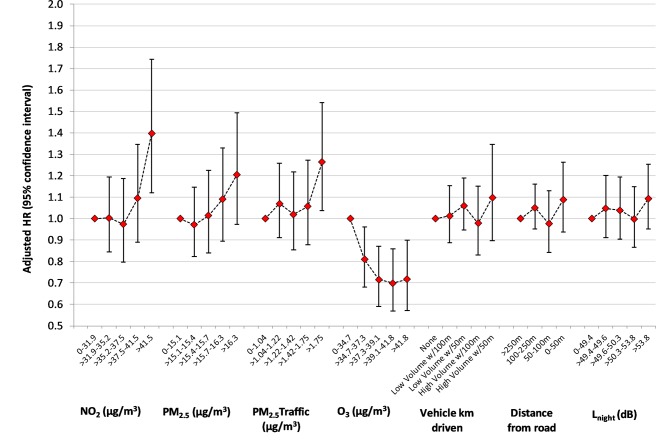
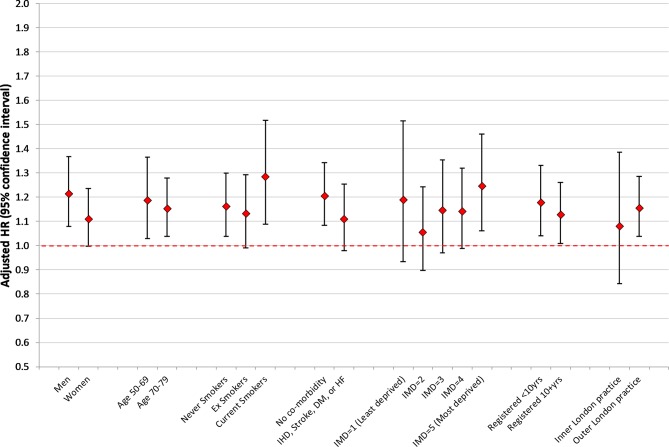
Objective: To investigate whether the incidence of dementia is related to residential levels of air and noise pollution in London. Design: Retrospective cohort study using primary care data. Setting: 75 Greater London practices. Participants: 130 978 adults aged 50–79 years registered with their general practices on 1 January 2005, with no recorded history of dementia or care home residence. Primary and secondary outcome measures: A first recorded diagnosis of dementia and, where specified, subgroups of Alzheimer’s disease and vascular dementia during 2005–2013. The average annual concentrations during 2004 of nitrogen dioxide (NO 2), particulate matter with a median aerodynamic diameter ≤2.5 µm (PM 2.5) and ozone (O 3) were estimated at 20×20 m resolution from dispersion models. Traffic intensity, distance from major road and night-time noise levels (L night) were estimated at the postcode level. All exposure measures were linked anonymously to clinical data via residential postcode. HRs from Cox models were adjusted for age, sex, ethnicity, smoking and body mass index, with further adjustments explored for area deprivation and comorbidity. Results: 2181 subjects (1.7%) received an incident diagnosis of dementia (39% mentioning Alzheimer’s disease, 29% vascular dementia). There was a positive exposure response relationship between dementia and all measures of air pollution except O 3, which was not readily explained by further adjustment. Adults living in areas with the highest fifth of NO 2 concentration (>41.5 µg/m 3) versus the lowest fifth (<31.9 µg/m 3) were at a higher risk of dementia (HR=1.40, 95% CI 1.12 to 1.74). Increases in dementia risk were also observed with PM 2.5, PM 2.5 specifically from primary traffic sources only and L night, but only NO 2 and PM 2.5 remained statistically significant in multipollutant models. Associations were more consistent for Alzheimer’s disease than vascular dementia. Conclusions: We have found evidence of a positive association between residential levels of air pollution across London and being diagnosed with dementia, which is unexplained by known confounding factors.
Overview
The claims and statistics of this paper haven’t been checked yet.
Free: it reads the open-access text and checks the first 5 claims that cite a source we can check. Create a free account to check every claim.
Integrity signals
Registry
Cites
Statistics
Figures
Verification
Claims the paper makes
The claims and statistics of this paper haven’t been checked yet.
Free: it reads the open-access text and checks the first 5 claims that cite a source we can check. Create a free account to check every claim.
Claims other papers make about this one
Each is checked against this paper’s own text: does it say what the citing paper says it does?
The source backs part of the claim, not all of it — or backs it for a different population, condition or comparison.
In the citing paper
“High nitrogen dioxide (NO2) concentration (>41·5 μg/m3; adjusted HR 1·2, 95% CI 1·0–1·3), fine ambient particulate matter (PM)2·5 from traffic exhaust (1·1, 1·0–1·2)127, 128, 129 and PM2·5 from residential wood burning (HR=1·6, 95% CI 1·0–2·4 for a 1 μg/m3 increase) are associated with increased dementia incidence.”
From Dementia prevention, intervention, and care: 2020 report of the Lancet Commission (2020) · cites this paper as [129]
Experimental — accuracy not yet measuredThe source backs part of the claim, not all of it — or backs it for a different population, condition or comparison.
In the citing paper
“although evidence for additive effects of different pollutants exists.”
From Dementia prevention, intervention, and care: 2020 report of the Lancet Commission (2020) · cites this paper as [129]
Experimental — accuracy not yet measuredThe cited source says what the claim attributes to it.
In the citing paper
“To date, studies with data on noise and air pollution have not found noise to be a substantial source of confounding (Andersson et al. 2018; Carey et al. 2018; Tzivian et al. 2016).”
From Exposure to Air Pollution in Relation to Risk of Dementia and Related Outcomes: An Updated Systematic Review of the Epidemiological Literature (2021) · cites this paper as Carey et al. 2018
Self-check
Percentages, sums and reported differences re-computed from the paper’s own numbers.
The self-check needs the paper’s full text.
Citations
Cites
Cohen, A. J., Brauer, M., Burnett, R., Anderson, H. R., Frostad, J., Estep, K., Balakrishnan, K., Brunekreef, B., Dandona, L., Dandona, R., et al. (2017) · The Lancet · doi:10.1016/s0140-6736(17)30505-6 · Cited by 6,583 · cited 1×
“6 While air pollution is a well-established risk factor for cardiovascular and respiratory disease, 7 its role in relation to dementia is less well considered and understood.”
Self-citationThe global prevalence of dementia: a systematic review and metaanalysis.
Prince, M., Bryce, R., Albanese, E., Wimo, A., Ribeiro, W., & Ferri, C. P. (2013) · Alzheimer's & Dementia · doi:10.1016/j.jalz.2012.11.007 · Cited by 4,941 · cited 1×
“Therefore, primary prevention of all dementia is a major global public health concern for the coming decades.(3) For Alzheimer’s disease for example, while it has been estimated that small delays in its onset and progression could significantly reduce its estimated future burden,(4) research has primarily focused on l…”
BackgroundForecasting the global burden of Alzheimer's disease
Brookmeyer, R., Johnson, E., Ziegler‐Graham, K., & Arrighi, H. M. (2007) · Alzheimer's & Dementia · doi:10.1016/j.jalz.2007.04.381 · Cited by 3,370 · cited 1×
“There would be significant public health gains even if the impact was only to delay the progression of dementia.(4) With the future global burden of dementia likely to be substantial,(3) further epidemiological work is urgently needed to confirm and understand better recent findings linking air pollution to dementia.”
BackgroundData Resource Profile: Clinical Practice Research Datalink (CPRD)
Herrett, E., Gallagher, A. M., Bhaskaran, K., Forbes, H., Mathur, R., van Staa, T., & Smeeth, L. (2015) · International Journal of Epidemiology · doi:10.1093/ije/dyv098 · Cited by 2,667 · cited 2×
“It has been shown to be broadly representative of the UK population, with about 7% of all people in the UK actively registered on it in 2011.(14) Approximately three-quarters of contributing CPRD practices in England have consented to their data being linked to external sources.”
BackgroundMethodPotential for primary prevention of Alzheimer's disease: an analysis of population-based data
Norton, S., Matthews, F. E., Barnes, D. E., Yaffe, K., & Brayne, C. (2014) · The Lancet Neurology · doi:10.1016/s1474-4422(14)70136-x · Cited by 2,466 · cited 1×
“For Alzheimer’s disease for example, while it has been estimated that small delays in its onset and progression could significantly reduce its estimated future burden,(4) research has primarily focused on lifestyle factors, where a large systematic review estimated that about a third of Alzheimer’s disease may be attr…”
BackgroundCalderón-Garcidueñas, L., Solt, A. C., Henríquez-Roldán, C., Torres-Jardón, R., Nuse, B., Herritt, L., Villarreal-Calderón, R., Osnaya, N., Stone, I., García, R., et al. (2008) · Toxicologic Pathology · doi:10.1177/0192623307313011 · Cited by 937
Expert position paper on air pollution and cardiovascular disease
Newby, D. E., Mannucci, P. M., Tell, G. S., Baccarelli, A. A., Brook, R. D., Donaldson, K., Forastiere, F., Franchini, M., Franco, O. H., Graham, I., et al. (2015) · European Heart Journal · doi:10.1093/eurheartj/ehu458 · Cited by 869 · cited 1×
“Context The established body of epidemiological evidence linking long-term concentrations of air pollution to adverse health effects has mainly focused on cardiovascular disease.(36) The Global Burden of Disease studies, which have described the worldwide impact of air pollution, considered a wide range of outcomes (I…”
BackgroundChen, H., Kwong, J. C., Copes, R., Tu, K., Villeneuve, P. J., van Donkelaar, A., Hystad, P., Martin, R. V., Murray, B. J., Jessiman, B., et al. (2017) · The Lancet · doi:10.1016/s0140-6736(16)32399-6 · Cited by 776 · cited 3×
“Research linking air pollution exposure to neurocognitive function has gradually increased from observational findings in 2002 from dogs in Mexico City,(37) to larger studies which assessed cognitive decline,(38) 39 and large population cohorts that specifically investigated the association in relation to diagnoses of…”
BackgroundSunyer, J., Esnaola, M., Alvarez-Pedrerol, M., Forns, J., Rivas, I., López-Vicente, M., Suades-González, E., Foraster, M., Garcia-Esteban, R., Basagaña, X., et al. (2015) · PLOS Medicine · doi:10.1371/journal.pmed.1001792 · Cited by 590 · cited 1×
“8 30 46 Traffic-related air pollution has been linked to poorer cognitive development in young children, 47 and continued significant exposure may produce neuroinflammation and altered brain innate immune responses in early adulthood.”
BackgroundThe outdoor air pollution and brain health workshop
Block, M. L., Elder, A., Auten, R. L., Bilbo, S. D., Chen, H., Chen, J.-C., Cory-Slechta, D. A., Costa, D., Diaz-Sanchez, D., Dorman, D. C., et al. (2012) · NeuroToxicology · doi:10.1016/j.neuro.2012.08.014 · Cited by 539 · cited 1×
“8 30 46 Traffic-related air pollution has been linked to poorer cognitive development in young children, 47 and continued significant exposure may produce neuroinflammation and altered brain innate immune responses in early adulthood.”
Background
Cited by
Items 201–300 of 317
Oudin, A., Raza, W., Flanagan, E., Segersson, D., Jalava, P., Kanninen, K. M., Rönkkö, T., Giugno, R., Sandström, T., Muala, A., et al. (2024) · Scientific Reports · doi:10.1038/s41598-024-66166-y · Cited by 7
“Given that local emissions have been associated with higher risk coefficients compared to urban background concentrations 26,27 , it is possible that investigations into urban background air pollution underestimate its health effects.”
BackgroundInfluentialVojtíšek-Lom, M., Suta, M., Sikorová, J., & Šrám, R. J. (2021) · Atmosphere · doi:10.3390/atmos12050649 · Cited by 7
Cai, Y. S., Huang, J., Havyarimana, E., & Hansell, A. (2025) · Oxford Open Climate Change · doi:10.1093/oxfclm/kgaf021 · Cited by 5
Systems-level risks of the climate crisis are currently missed: A mental health lens
Mikaelsson, M. A., Jennings, N. R., & Lawrance, E. L. (2025) · PLOS Climate · doi:10.1371/journal.pclm.0000722 · Cited by 6
Scaria, E. B., & Dhanda, N. (2026) · PLOS Global Public Health · doi:10.1371/journal.pgph.0006139 · Cited by 5
Oh, M., & Weaver, D. F. (2023) · Frontiers in Neuroscience · doi:10.3389/fnins.2023.1106623 · Cited by 7
“As an example, it has been recently suggested that air and noise pollution can be risk factors for AD and dementia (Carey et al., 2018; Younan et al., 2019).”
BackgroundFerrari, S., Santus, A., & Tendas, L. (2024) · EPJ Web of Conferences · doi:10.1051/epjconf/202429901010 · Cited by 6
“…of health-related effects continues to grow, and the list now includes effects that some decades ago were not associated with traffic-related air pollution, including: autism and the behavioral problems of children [12], cognitive decline [13], dementia [14-15], and also obesity in children [16].”
BackgroundNeighbourhood Urban Environments and Cognitive Health in Ageing Populations
Soloveva, M. V., Poudel, G. R., Barnett, A. H., & Cerin, E. (2024) · Springer eBooks · doi:10.1007/978-3-031-64699-7_13 · Cited by 6
Zhu, Y., Shi, Y. V., Bartell, S. M., Corrada, M. M., Manson, S. M., O’Connell, J., & Jiang, L. (2024) · International Journal of Environmental Research and Public Health · doi:10.3390/ijerph21020128 · Cited by 5
“Moreover, some studies reported different results for different air pollutants [10,12,14,19,20,23].”
BackgroundResultInfluentialMarcantonio, R. A. (2022) · World Development Perspectives · doi:10.1016/j.wdp.2022.100471 · Cited by 7
Lu, S. S. M., Ekbäck, E., Sommar, J. N., Anderson, S., Olstrup, H., Harlid, S., Gustafsson, S., Mattisson, K., Stockfelt, L., Rein, T., et al. (2025) · Environmental Research · doi:10.1016/j.envres.2025.122435 · Cited by 4
“Previous cohort studies that have examined both air pollution and traffic noise also found no significant associations between road traffic noise and dementia, while the positive associations remained significant for air pollution (Andersson et al., 2018; Oudin et al., 2016; Carey et al., 2018).”
The Impact of Air Pollution and Obesity on Cognitive Decline and Risk of Alzheimer’s Disease
Keller, Z. A., Eggers, K. M., Nixon, J. P., & Butterick, T. A. (2025) · International Journal of Molecular Sciences · doi:10.3390/ijms27010092 · Cited by 4
“Current evidence suggests that air pollution may also contribute to the progression of AD by promoting neuroinflammatory pathways, oxidative damage, and blood–brain barrier (BBB) disruption [15,16].”
Wang, Q., Li, S., Cai, B., Zhong, L., Liu, F., Wang, X., & Chen, T. (2024) · Ecotoxicology and Environmental Safety · doi:10.1016/j.ecoenv.2024.116664 · Cited by 4
Jahedi, F., Goudarzi, G., Ahmadi, M., & Safdari, F. (2025) · Journal of Alzheimer s Disease Reports · doi:10.1177/25424823251368883 · Cited by 4
Ata, G. A. A. E., Abdelghany, F. H. A., Ahmed, M. F., Abdelgwad, M., & Ramadan, M. A. (2023) · NeuroToxicology · doi:10.1016/j.neuro.2023.01.011 · Cited by 4
Wildfire Risk Mitigation through Systems Analysis of the Planetary Emergency
Lambert, J. H., Dorn, R. R., Ayyub, B. M., Barletta, W. A., Organek, J. F., Piras, M., Gunn, M. E., & Zichichi, S. F. (2024) · ASCE OPEN Multidisciplinary Journal of Civil Engineering · doi:10.1061/aomjah.aoeng-0040 · Cited by 6
Can “fine scale” data on air pollution be an evaluation tool for public health professionals?
Nisticò, F., Messina, G., Quercioli, C., Errico, S., Fanti, E., Frilli, E., Postiglione, M., Luca, A. D., D'Urso, A., & Nante, N. (2025) · Atmospheric Pollution Research · doi:10.1016/j.apr.2025.102487 · Cited by 4
Neurotoxic Effects of Airborne Particulate Matter: Mechanisms and Health Implications
Thangavel, P., Park, D., & Lee, Y. (2025) · Journal of Biochemical and Molecular Toxicology · doi:10.1002/jbt.70322 · Cited by 6
“Many of these investigations point to a direct correlation between PM exposure and AD pathology across various cohorts [88 – 92].”
InfluentialBishop, K. C., Husain-Krautter, S., Ketcham, J. D., Kuminoff, N. V., & Schimming, C. (2020) · Journal of Alzheimer s Disease · doi:10.3233/jad-200497 · Cited by 4
Johnson, H., Longden, J., Cameron, G. A., Waiter, G. D., Waldron, F. M., Gregory, J. M., & Spence, H. (2026) · Scientific Reports · doi:10.1038/s41598-026-64389-9 · Cited by 3
“These pollutants have been suggested to be detrimental to human health through activation pathways including oxidative stress and neuroinflammation induction 14,16 .”
Liang, L., Sheffield, P. E., Calixte, R., Xia, T., Zhang, S. X., & Lin, J. J. (2025) · NeuroToxicology · doi:10.1016/j.neuro.2025.103336 · Cited by 3
Ji, Q., Liu, Q., Xu, Y., Mt, X., & Zhan, Y. (2026) · Ecotoxicology and Environmental Safety · doi:10.1016/j.ecoenv.2026.119750 · Cited by 3
Huang, L., Ma, J., Jiang, F., Zhang, S., Lan, Y., & Zhang, Y. (2024) · Journal of Alzheimer s Disease · doi:10.3233/jad-240061 · Cited by 3
The Epidemiological and Toxicological Intersection of Air Pollution and Dementia
Kotha, S., Kuo, G., Kammula, S. V., Shi, L., Zhang, X., Liu, P. F., & Mao, X. (2025) · Reviews of Environmental Contamination and Toxicology · doi:10.1007/s44169-025-00092-6 · Cited by 4
“A study in London from 2005 to 2013 similarly demonstrated an inconsistency in the associations between pollutant types with dementia (Carey et al. 2018).”
InfluentialMultiple Causes of Dementia as Engineered Senescence
Garrett, M. D. (2020) · European Journal of Medical and Health Sciences · doi:10.24018/ejmed.2020.2.2.227 · Cited by 4
Perception of Noise Pollution Among Youths and Adults in Urban Puducherry, South India
Bhattacharya, D., James, T. D., Lakshminarayanan, S., Meenu, S., Swathy Madhusoodanan, L., & Thulasingam, M. (2023) · Cureus · doi:10.7759/cureus.49573 · Cited by 3
“Those with a higher exposure to transportation noise are associated with a higher risk for dementia [11] and Alzheimer's [12,13].”
BackgroundSustainable development and gender well-being
Grown, C. A., Floro, M. S., & Onyechi, O. (2025) · Environmental Research Climate · doi:10.1088/2752-5295/add363 · Cited by 4
Sebastijanović, A., Camassa, L. M. A., Malmborg, V., Kralj, S., Pagels, J., Vogel, U. B., Zienolddiny, S., Urbančič, I., Koklič, T., & Štrancar, J. (2024) · Nanotoxicology · doi:10.1080/17435390.2024.2362367 · Cited by 4
“5), are associated with cognitive decline and alzheimer’s disease (aD) (carey et al. 2018; Younan et al. 2020; Zhang, chen, and Zhang 2018). however, it is important to note that the strength of this association does not necessarily imply causation. how air pollution particles enter the brain and…”
Psyche in der Klimakrise? Update zur ökologischen Psychiatrie und Psychotherapie
Brakemeier, E., Karl, S., Stapel, S., & Meyer‐Lindenberg, A. (2025) · DMW - Deutsche Medizinische Wochenschrift · doi:10.1055/a-2447-2517 · Cited by 2
“Zudem gibt es Hinweise darauf, dass das Ausmaß von Luftverschmutzung mit der Auftretenshäufigkeit von Demenz assoziiert ist [6].”
Alzhrani, A. S., Stockfelt, L., Xu, Y., Harari, F., Gustafsson, S., Engström, G., Hansson, O., & Oudin, A. (2025) · Journal of Alzheimer s Disease · doi:10.1177/13872877251360225 · Cited by 2
“25 This highlights the need for research that investigates these exposures independently as well as in combination to understand their potential contributions to cognitive disorders.”
Balachandar, R., Viramgami, A., Singh, D. P., Kulkarni, N., Chudasama, B., Sivaperumal, P., & Upadhyay, K. D. (2025) · Scientific Reports · doi:10.1038/s41598-025-30715-w · Cited by 3
“These findings complement previous cohort studies that adjusted for cardiovascular/metabolic factors and still found strong pollution-neurodegeneration associations 5,6,14 .”
Hildt, C., Tzivian, L., Ogurtsova, K., & Hoffmann, B. H. (2025) · Environmental Research · doi:10.1016/j.envres.2025.123589 · Cited by 2
Bozigar, M., Weuve, J., Clark, S. N., Grady, S. T., Cantuaria, M. L., Cai, Y. S., Roscoe, C., Röösli, M., Peters, J. L., Seto, E., et al. (2026) · Alzheimer s & Dementia · doi:10.1002/alz.71513 · Cited by 2
“1,52,54,57,103,104 Therefore, care in the design or analytic phase of a project is required to isolate the independent impacts of noise.”
Education and Environment Dementia Risk Factors: A Literature Review
Gallistl, J. (2022) · Journal of Intellectual Disability - Diagnosis and Treatment · doi:10.6000/2292-2598.2022.10.01.3 · Cited by 3
The Solution to Pollution: Is it Technological? [Opinion]
Pitt, S., & Mudway, I. (2020) · IEEE Technology and Society Magazine · doi:10.1109/mts.2020.3012321 · Cited by 2
“Links have also been made between pollutant exposures with cardiovascular disease, diabetes, cancer [3], and dementia [4], [5].”
BackgroundTHE ROLE OF ENVIRONMENTAL AIR POLLUTION IN THE DEVELOPMENT OF ALZHEIMER’S DISEASE
Beriashvili, M., Gigiadze, M., & Gorgadze, G. (2023) · JUNIOR RESEARCHERS · doi:10.52340/2023.01.01.13 · Cited by 2
An Overview on Dementia: A Major Symptom of Alzheimer's Disease
Kaur, J., Melkani, I., Singh, A., Singh, A. P., & Bala, K. (2022) · Journal of Drug Delivery and Therapeutics · doi:10.22270/jddt.v12i4.5445 · Cited by 2
Marcantonio, R. A., Lederach, J. P., & Fuentes, A. (2024) · Cambridge University Press eBooks · doi:10.1017/9781009417150.001 · Cited by 1
Berkman, J. M., Budhu, J. A., Torres, J., & Saadi, A. (2024) · Springer eBooks · doi:10.1007/978-3-031-62727-9_1 · Cited by 1
Psyche in der Klimakrise? Update zur ökologischen Psychiatrie und Psychotherapie
Brakemeier, E., Karl, S., Stapel, S., & Meyer‐Lindenberg, A. (2025) · Fortschritte der Neurologie · Psychiatrie · doi:10.1055/a-2444-5039 · Cited by 1
Zhang, S., Chen, Z., Du, Z., Wang, S., Chen, D., Ruan, X., Lin, Z., Zheng, Z., Li, K., Chen, X., et al. (2025) · Journal of Advanced Research · doi:10.1016/j.jare.2025.02.041 · Cited by 1
“Besides, evidence is mounting that PM 2.5 exposure may increase the risk of age-related diseases such as dementia [58] and chronic obstructive pulmonary disease (COPD) [59].”
InfluentialTaha, A. Y., Shen, Q. X., Otoki, Y., Liang, N., Patten, K. T., Valenzuela, A. E., Wallis, C., Rowland, D. J., Chaudhari, A. J., Bein, K. J., et al. (2025) · JCI Insight · doi:10.1172/jci.insight.175917 · Cited by 2
“Consistent with these observations, increased exposure to TRAP components including ozone, particulate matter 2.5, and/or nitrogen dioxide has been linked to a greater risk of AD (8, 9) or incident dementia (10).”
InfluentialMendelian randomization study supports the causal effects of air pollutants on cognitive function
Guo, Y., Gao, F., & Liang, Y. (2025) · Atmospheric Pollution Research · doi:10.1016/j.apr.2025.102598 · Cited by 1
The Interconnection Between Climate Change and Mental Health and Well-Being
Kurebwa, J., & Mahela, T. M. (2025) · IGI Global eBooks · doi:10.4018/979-8-3373-3281-9.ch001 · Cited by 1
The Invisible Enemy: Nanoparticle Exposure and Neurodegenerative Decline
Hasanova, A. S., & Hasanova, F. S. (2025) · Journal of Nanotechnology and Innovative Materials · doi:10.54414/fkvt6156 · Cited by 2
Impact of Residential Noise Exposure on Neurological Health: A Systematic Scoping Review
Asllani, I. I., & Agahi, R. (2025) · Journal of Urban Health · doi:10.1007/s11524-025-01026-2 · Cited by 1
“For example, Havyarimana found significant positive associations in those with greater than 6 h of sleep, no comorbidities, or those under 60, suggesting stronger effects in less vulnerable populations [128].”
Dissecting the effect of long-term exposure to air pollution on risk of dementia in UK Biobank
Palacios, E. R., Shapland, C. Y., Wolf, L. J., Nordestgaard, L. T., Anderson, E. L., Slaney, C., Bernie, D. J., Mitchell, D., Kehoe, P. G., Griffith, G. J., et al. (2025) · Environmental Health · doi:10.1186/s12940-025-01243-x · Cited by 1
“These results are in line with other studies that found stronger evidence for an effect on AD than VAD [14, 16, 34], but are also at odds with known mechanistic pathways linking air pollution to cardiovascular disease [35], and cardiovascular disease to dementia [36].”
Zhang, Y., & Xu, W. (2026) · Frontiers in Public Health · doi:10.3389/fpubh.2025.1695462 · Cited by 1
Zhao, N., Chen, Z., & Sun, H. (2026) · Frontiers in Public Health · doi:10.3389/fpubh.2026.1757872 · Cited by 1
Alzheimer’s disease and exposome: is there really a connection? Literature review and meta-analysis
Zayani, C. B. H. Y., Abdelhédi, R., & Gargouri, I. (2026) · Euro-Mediterranean Journal for Environmental Integration · doi:10.1007/s41207-025-01023-6 · Cited by 1
Cho, J. I., & Kim, K. (2026) · Journal of the Air & Waste Management Association · doi:10.1080/10962247.2026.2639371 · Cited by 1
“…Fu and Yung 2020; Alemany et al. 2021; Lin et al. 2021; He et al. 2022; Lee et al. 2023; Ma et al. 2023) and vascular dementia (Wu et al. 2015; Carey et al. 2018; Cerza et al. 2019; Li et al. 2019; Peters et al. 2019; Grande et al. 2020; Jones et al. 2025), as these conditions impose…”
InfluentialNguyen, H. X. T., Hyde, Z., Watson, R., Smith, K., Malay, R., Flicker, L. A., Radford, K. A., Russell, S., Quigley, R., Sagigi, B., et al. (2026) · International Psychogeriatrics · doi:10.1016/j.inpsyc.2026.100206 · Cited by 1
Transportation noise in relation to depression and dementia: A burden of disease study for Europe
Engelmann, N., Vienneau, D., JIANG, X., & Röösli, M. (2026) · Environmental Research · doi:10.1016/j.envres.2026.125005 · Cited by 1
Microplastics in the air and potential health risks – a narrative review
Joss, M. K., & Probst-Hensch, N. M. (2026) · Swiss Medical Weekly · doi:10.57187/4935 · Cited by 1
Finlay, J. (2026) · Scottish Geographical Journal · doi:10.1080/14702541.2026.2733062 · Cited by 1
Abolhasani, E. (2021) · Scholarship@Western (Western University) · Cited by 1
Impact of Air Pollution on Human Capital
Karakülah, K., Lange, G., Awe, Y., & Chonabayashi, S. (2021) · World Bank, Washington, DC eBooks · doi:10.1596/978-1-4648-1590-4_ch8 · Cited by 3
Kosherbayeva, L., Сейдуанова, Л. Б., & Төлегенова, А. М. (2025) · Journal of Health Development · doi:10.32921/2663-1776-2025-60-5-jhd027 · Cited by 2
Asociaciones entre dieta y función cognitiva en el Proyecto SUN
Muñoz, M. I. (2022) · Depósito Académico Digital Universidad de Navarra (University of Navarra) · doi:10.15581/10171/63292 · Cited by 1
Aretz, B. (2023) · University of Groningen research database (University of Groningen / Centre for Information Technology) · doi:10.33612/diss.829747624 · Cited by 1
Fine Particulate Matter, Neuropathologies, & Dementia
Shaffer, R. M. (2020) · ResearchWorks at the University of Washington (University of Washington)
Skopec, R. (2022) · Neuroscience and Neurological Surgery · doi:10.31579/2578-8868/208
Schmidt, C. W. (2019) · Huanjing yu jiankang zhanwang · doi:10.1289/ehp4579-zh
The impact of air pollution on dementia and preventive measures in China: A qualitative studyPreprint
Tang, J., Zhou, Q., Guo, H., Partridge, M., Lim, J. N., Clifford, A., Sixsmith, J., & Chen, R. (2022) · Research Square · doi:10.21203/rs.3.rs-1709656/v1
Back Matter: Appendices A through D and Bibliography
Bank, W. (2022) · World Bank, Washington, DC eBooks · doi:10.1596/978-1-4648-1816-5_bm
Bank, W. (2022) · World Bank, Washington, DC eBooks · doi:10.1596/978-1-4648-1816-5_es
Zeliger, H. I. (2022) · Elsevier eBooks · doi:10.1016/b978-0-323-91890-9.00016-7
Do Air Pollution and Climate Matter for Health?
Peszko, G., Amann, M. C., Awe, Y., Kleiman, G. N., & Rabie, T. (2023) · World Bank, Washington, DC eBooks · doi:10.1596/978-1-4648-1835-6_ch1
Bystron, J. M., Dziekiewicz, A., Kobiałka, J., & Giordano, U. (2023) · Environmental Medicine · doi:10.26444/ms/170262
“Reducing emissions from industries and transportation can lead to improved air quality, positively impacting mental health [57, 58].”
BackgroundSkopec, R. (2021) · Bioinformatics & Proteomics Open Access Journal · doi:10.23880/bpoj-16000146
Low, K. J. Y. (2023) · DR-NTU (Nanyang Technological University) · doi:10.32657/10356/173158
fang, L., Zhao, S., & Liang, P. (2024) · Research Square · doi:10.21203/rs.3.rs-3921273/v1
Bachand, A. M., & Dell, L. D. (2024) · Journal of Alzheimer s Disease · doi:10.3233/jad-231046
Mechanisms of organic dust induced neuroinflammation
Massey, N. (2021) · doi:10.31274/td-20240329-498
Pollution atmosphérique et vieillissement cognitif : une approche épidémiologique
Duchesne, J. (2022) · theses.fr (ABES) · doi:10.70675/fc9a92a9z04ddz4b08za7a7z113a34e0db65
Forbes, M. (2024) · IU Journal of Undergraduate Research · doi:10.14434/iujur.v8i1.32571
Galán, A. S. (2024) · Elsevier eBooks · doi:10.1016/b978-0-443-29240-8.00005-5 · Cited by 1
Nanoparticles and Pulmonary Exposures
Elder, A. C. P., & Stapleton, P. A. (2024) · Elsevier eBooks · doi:10.1016/b978-0-323-95488-4.00184-4
Environmental factors and machine learning for Alzheimer’s disease prediction
Mohammadi, S., & Zarei, S. (2024) · Environmental Health Engineering and Management · doi:10.34172/ehem.2024.48
Opportunities arising from the tech revolution
Čepukaitytė, G., & Chan, D. (2025) · Elsevier eBooks · doi:10.1016/b978-0-12-822240-9.00006-5
The Unseen Stressor: How Pollution Impacts Mental Health - A Narrative Review of Literature
Hamid, Z., & Muzamil, M. (2025) · IGI Global eBooks · doi:10.4018/979-8-3693-9755-8.ch018
Population insights and big data in brain cancer research and patient care
Alaouna, M., Hull, R., Marutha, T., Makrogkikas, S., Lolas, G., & Dlamini, Z. (2025) · Elsevier eBooks · doi:10.1016/b978-0-443-45495-0.00003-6
Ding, H., Li, L., Han, L., & Xu, C. (2025) · The Aging Male · doi:10.1080/13685538.2025.2590251
“Analysis of a UK cohort (aged 50−79) identified a positive relationship between nitrogen dioxide (NO₂) and dementia incidence, whereas ozone demonstrated no statistically meaningful relationship with dementia risk [40].”
Sparks, S. (2025) · Oxford University Research Archive (ORA) (University of Oxford) · doi:10.5287/ora-gwbznonxm
Domhnaill, C. M., Douglas, O., Lyons, S., Murphy, E., & Nolan, A. (2021) · Figshare · doi:10.6084/m9.figshare.16778402
Dementia and location: lessons from geography and data linkage to routinely collected data
Walesby, K. E. (2025) · ERA · doi:10.7488/era/6048
Wu, Y., Kitwiroon, N., Beevers, S. D., Barratt, B., Brayne, C., Cerin, E., Franklin, R., Houlden, V., Woods, B. T., Abozied, E. Z., et al. (2024) · Figshare · doi:10.6084/m9.figshare.26716039
Self-citationCerin, E., Barnett, A. H., Shaw, J. E., Martino, E., Knibbs, L. D., Tham, R., Wheeler, A. J., & Anstey, K. J. (2021) · Figshare · doi:10.6084/m9.figshare.17468498
Χατζηδάκη, Ε. (2023) · Institutional Repository Hellanicus · doi:10.26215/heal.uoa.4167
Klompmaker, J. O., Janssen, N., Bloemsma, L. D., Marra, M., Lebret, E., Gehring, U., & Hoek, G. (2021) · Figshare · doi:10.6084/m9.figshare.14985123
Shim, J.-I., 변가람, & Lee, J.-T. T. (2024) · Figshare · doi:10.6084/m9.figshare.26582336
Predictors of Mortality in African Americans With Alzheimer’s Disease-Related Dementias
Noonan, L. (2024) · ScholarWorks (Walden University)
Jentzsch, J. (2023) · Qucosa (Saxon State and University Library Dresden)
Andersson, J. (2023) · DiVA at Umeå University (Umeå University)
Canonical correlation analysis methods for examining brain structure and behaviour
Pigeau, S. (2023) · eScholarship@McGill (McGill) · doi:10.82308/48712
The role of digital media in the electromobility transition
Alkhalisi, A. F. (2020) · ePrints Soton (University of Southampton)
Saúde e Solidão: As relações entre demência e solidão na população idosa da Região Centro
da Silva, D. M. S. N. (2019) · Portuguese National Funding Agency for Science, Research and Technology (RCAAP Project by FCT)
Aschenbrenner, O., Tonekaboni, N. H., Kramer, M., & Mollalo, A. (2025) · IEEE-EMBS International Conference on Biomedical and Health Informatics (BHI ...) · doi:10.1109/bhi67747.2025.11269558
“A cohort study in London by Carey et al. (2018) provided similar results, specifying no positive exposure response between dementia and O 3 [40].”
Metadata
- Authors
- Carey, I. M., Anderson, H. R., Atkinson, R. W., Beevers, S. D., Cook, D. G., Strachan, D. P., Dajnak, D., Gulliver, J., & Kelly, F. J.
- Affiliations
- University of London (GB)
- King's College London (GB)
- MRC Centre for Environment and Health (GB)
- Corresponding author
- Carey, Iain M
- ORCID
- Venue
- BMJ Open
- Publisher
- BMJ
- Published
- 2018-09
- Volume
- 8
- Issue
- 9
- Pages
- e022404
- ISSN
- 2044-6055 (ISSN-L)
- PMC
- PMC6144407
- OpenAlex
- W2891597364
- Cited by
- 302
- References
- 49
- Citations by year
- 2026: 19 · 2025: 50 · 2024: 43 · 2023: 39 · 2022: 50 · 2021: 39 · 2020: 45 · 2019: 13 · 2018: 3
- FWCI
- 12.35
- Type
- journal article
- Language
- en
- Open access
- gold
- doi.org
- Licence
- cc-by-nc
- Locations
- BMJ Open (publishedVersion, cc-by-nc)
- Europe PMC (PubMed Central) (publishedVersion, other-oa)
- PubMed Central (publishedVersion, cc-by-nc)
- PubMed (publishedVersion)
- St George's Online Research Archive (St George's University of London) (acceptedVersion)
- DOAJ (DOAJ: Directory of Open Access Journals) (submittedVersion)
- Figshare (submittedVersion, cc-by-nc)
- Research Portal (King's College London) (submittedVersion, other-oa)
- Leicester Research Archive (University of Leicester) (submittedVersion, cc-by-nc)
- HighWire Press Open Archive (submittedVersion)
- Spiral (Imperial College London) (submittedVersion, other-oa)
- Funders
- Wellcome Trust
- National Institute for Health Research Health Protection Research Unit
- National Institute for Health and Care Research (NE/I008039/1, NE/I007806/1, NE/I00789X/1)
- Imperial College London
- King's College London
- Public Health England
- Medical Research Council (MR/L01341X/1)
- Economic and Social Research Council
- Natural Environment Research Council (NE/I008039/1, NE/I00789X/1, NE/I007857/1)
- Health Technology Assessment Programme
- Topics
- Physical Sciences › Environmental Science › Health, Toxicology and Mutagenesis › Air Quality and Health Impacts
- Physical Sciences › Physics and Astronomy › Acoustics and Ultrasonics › Noise Effects and Management
- Health Sciences › Medicine › Psychiatry and Mental health › Dementia and Cognitive Impairment Research
- Keywords
- dementia, air pollution, noise pollution, nitrogen dioxide, PM2.5, ozone, night-time noise, Alzheimer's disease, vascular dementia, traffic-related pollution, residential exposure, area deprivation, London
- MeSH terms
- Aged, Air Pollution, Alzheimer Disease, Vehicle Emissions, Environmental Exposure, Female, Humans, London, Male, Middle Aged, Nitrogen Dioxide, Noise, Primary Health Care, Residence Characteristics, Risk Factors, Dementia, Vascular, Particulate Matter
About these checks
Registry, retraction, Cites and statistics results are computed, not judged, with one exception: a printed reference that no index lists is read once by a model before it counts as a citation error. Claims are extracted by a model and kept only when their quote appears verbatim in the text; each cited source is then checked, with a model’s help, for whether it says what the claim relies on. Those verdicts can be wrong — read the claim’s quote and the cited source before relying on one.
Statistics and arithmetic are recomputed, not judged.
Confidence bands are shown only for fields calibrated on our annotated test set. None is calibrated yet, so no band is shown.
What counts as a claim ›How we measure confidence ›How we check this ›
Are you an author, or do you see a problem with this page? Request a review
Data sources
Bibliographic data: Semantic Scholar, OpenAlex, Crossref.
Contains information from the Semantic Scholar Academic Graph Datasets, made available under the ODC Attribution License (ODC-BY 1.0).
Semantic Scholar’s data is described in: Kinney, R., et al. (2023). The Semantic Scholar Open Data Platform. arXiv:2301.10140.
