

Are noise and air pollution related to the incidence of dementia? A cohort study in London, England
Open accessThe DOI matches its Crossref record; 49 of the 49 references it cites were found in a registry or an index.
Abstract
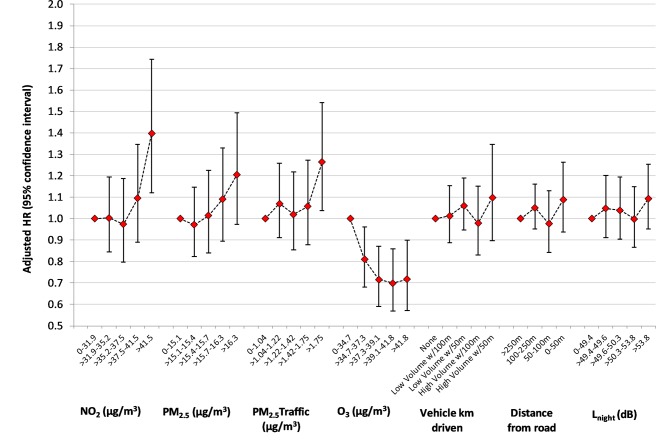
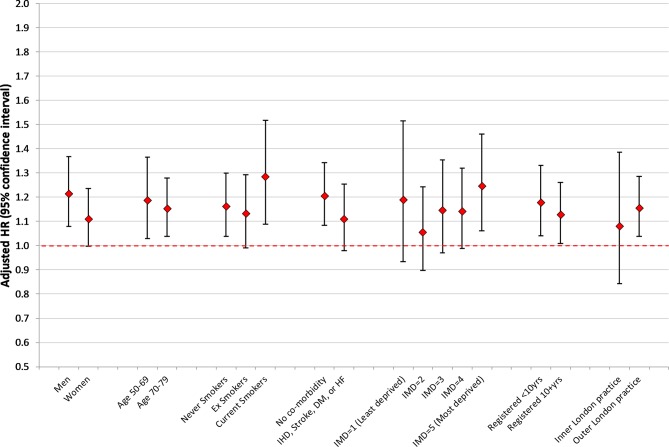
Objective: To investigate whether the incidence of dementia is related to residential levels of air and noise pollution in London. Design: Retrospective cohort study using primary care data. Setting: 75 Greater London practices. Participants: 130 978 adults aged 50–79 years registered with their general practices on 1 January 2005, with no recorded history of dementia or care home residence. Primary and secondary outcome measures: A first recorded diagnosis of dementia and, where specified, subgroups of Alzheimer’s disease and vascular dementia during 2005–2013. The average annual concentrations during 2004 of nitrogen dioxide (NO 2), particulate matter with a median aerodynamic diameter ≤2.5 µm (PM 2.5) and ozone (O 3) were estimated at 20×20 m resolution from dispersion models. Traffic intensity, distance from major road and night-time noise levels (L night) were estimated at the postcode level. All exposure measures were linked anonymously to clinical data via residential postcode. HRs from Cox models were adjusted for age, sex, ethnicity, smoking and body mass index, with further adjustments explored for area deprivation and comorbidity. Results: 2181 subjects (1.7%) received an incident diagnosis of dementia (39% mentioning Alzheimer’s disease, 29% vascular dementia). There was a positive exposure response relationship between dementia and all measures of air pollution except O 3, which was not readily explained by further adjustment. Adults living in areas with the highest fifth of NO 2 concentration (>41.5 µg/m 3) versus the lowest fifth (<31.9 µg/m 3) were at a higher risk of dementia (HR=1.40, 95% CI 1.12 to 1.74). Increases in dementia risk were also observed with PM 2.5, PM 2.5 specifically from primary traffic sources only and L night, but only NO 2 and PM 2.5 remained statistically significant in multipollutant models. Associations were more consistent for Alzheimer’s disease than vascular dementia. Conclusions: We have found evidence of a positive association between residential levels of air pollution across London and being diagnosed with dementia, which is unexplained by known confounding factors.
Overview
The claims and statistics of this paper haven’t been checked yet.
Free: it reads the open-access text and checks the first 5 claims that cite a source we can check. Create a free account to check every claim.
Integrity signals
Registry
Cites
Statistics
Figures
Verification
Claims the paper makes
The claims and statistics of this paper haven’t been checked yet.
Free: it reads the open-access text and checks the first 5 claims that cite a source we can check. Create a free account to check every claim.
Claims other papers make about this one
Each is checked against this paper’s own text: does it say what the citing paper says it does?
The source backs part of the claim, not all of it — or backs it for a different population, condition or comparison.
In the citing paper
“High nitrogen dioxide (NO2) concentration (>41·5 μg/m3; adjusted HR 1·2, 95% CI 1·0–1·3), fine ambient particulate matter (PM)2·5 from traffic exhaust (1·1, 1·0–1·2)127, 128, 129 and PM2·5 from residential wood burning (HR=1·6, 95% CI 1·0–2·4 for a 1 μg/m3 increase) are associated with increased dementia incidence.”
From Dementia prevention, intervention, and care: 2020 report of the Lancet Commission (2020) · cites this paper as [129]
Experimental — accuracy not yet measuredThe source backs part of the claim, not all of it — or backs it for a different population, condition or comparison.
In the citing paper
“although evidence for additive effects of different pollutants exists.”
From Dementia prevention, intervention, and care: 2020 report of the Lancet Commission (2020) · cites this paper as [129]
Experimental — accuracy not yet measuredThe cited source says what the claim attributes to it.
In the citing paper
“To date, studies with data on noise and air pollution have not found noise to be a substantial source of confounding (Andersson et al. 2018; Carey et al. 2018; Tzivian et al. 2016).”
From Exposure to Air Pollution in Relation to Risk of Dementia and Related Outcomes: An Updated Systematic Review of the Epidemiological Literature (2021) · cites this paper as Carey et al. 2018
Self-check
Percentages, sums and reported differences re-computed from the paper’s own numbers.
The self-check needs the paper’s full text.
Citations
Cites
Cohen, A. J., Brauer, M., Burnett, R., Anderson, H. R., Frostad, J., Estep, K., Balakrishnan, K., Brunekreef, B., Dandona, L., Dandona, R., et al. (2017) · The Lancet · doi:10.1016/s0140-6736(17)30505-6 · Cited by 6,583 · cited 1×
“6 While air pollution is a well-established risk factor for cardiovascular and respiratory disease, 7 its role in relation to dementia is less well considered and understood.”
Self-citationThe global prevalence of dementia: a systematic review and metaanalysis.
Prince, M., Bryce, R., Albanese, E., Wimo, A., Ribeiro, W., & Ferri, C. P. (2013) · Alzheimer's & Dementia · doi:10.1016/j.jalz.2012.11.007 · Cited by 4,941 · cited 1×
“Therefore, primary prevention of all dementia is a major global public health concern for the coming decades.(3) For Alzheimer’s disease for example, while it has been estimated that small delays in its onset and progression could significantly reduce its estimated future burden,(4) research has primarily focused on l…”
BackgroundForecasting the global burden of Alzheimer's disease
Brookmeyer, R., Johnson, E., Ziegler‐Graham, K., & Arrighi, H. M. (2007) · Alzheimer's & Dementia · doi:10.1016/j.jalz.2007.04.381 · Cited by 3,370 · cited 1×
“There would be significant public health gains even if the impact was only to delay the progression of dementia.(4) With the future global burden of dementia likely to be substantial,(3) further epidemiological work is urgently needed to confirm and understand better recent findings linking air pollution to dementia.”
BackgroundData Resource Profile: Clinical Practice Research Datalink (CPRD)
Herrett, E., Gallagher, A. M., Bhaskaran, K., Forbes, H., Mathur, R., van Staa, T., & Smeeth, L. (2015) · International Journal of Epidemiology · doi:10.1093/ije/dyv098 · Cited by 2,667 · cited 2×
“It has been shown to be broadly representative of the UK population, with about 7% of all people in the UK actively registered on it in 2011.(14) Approximately three-quarters of contributing CPRD practices in England have consented to their data being linked to external sources.”
BackgroundMethodPotential for primary prevention of Alzheimer's disease: an analysis of population-based data
Norton, S., Matthews, F. E., Barnes, D. E., Yaffe, K., & Brayne, C. (2014) · The Lancet Neurology · doi:10.1016/s1474-4422(14)70136-x · Cited by 2,466 · cited 1×
“For Alzheimer’s disease for example, while it has been estimated that small delays in its onset and progression could significantly reduce its estimated future burden,(4) research has primarily focused on lifestyle factors, where a large systematic review estimated that about a third of Alzheimer’s disease may be attr…”
BackgroundCalderón-Garcidueñas, L., Solt, A. C., Henríquez-Roldán, C., Torres-Jardón, R., Nuse, B., Herritt, L., Villarreal-Calderón, R., Osnaya, N., Stone, I., García, R., et al. (2008) · Toxicologic Pathology · doi:10.1177/0192623307313011 · Cited by 937
Expert position paper on air pollution and cardiovascular disease
Newby, D. E., Mannucci, P. M., Tell, G. S., Baccarelli, A. A., Brook, R. D., Donaldson, K., Forastiere, F., Franchini, M., Franco, O. H., Graham, I., et al. (2015) · European Heart Journal · doi:10.1093/eurheartj/ehu458 · Cited by 869 · cited 1×
“Context The established body of epidemiological evidence linking long-term concentrations of air pollution to adverse health effects has mainly focused on cardiovascular disease.(36) The Global Burden of Disease studies, which have described the worldwide impact of air pollution, considered a wide range of outcomes (I…”
BackgroundChen, H., Kwong, J. C., Copes, R., Tu, K., Villeneuve, P. J., van Donkelaar, A., Hystad, P., Martin, R. V., Murray, B. J., Jessiman, B., et al. (2017) · The Lancet · doi:10.1016/s0140-6736(16)32399-6 · Cited by 776 · cited 3×
“Research linking air pollution exposure to neurocognitive function has gradually increased from observational findings in 2002 from dogs in Mexico City,(37) to larger studies which assessed cognitive decline,(38) 39 and large population cohorts that specifically investigated the association in relation to diagnoses of…”
BackgroundSunyer, J., Esnaola, M., Alvarez-Pedrerol, M., Forns, J., Rivas, I., López-Vicente, M., Suades-González, E., Foraster, M., Garcia-Esteban, R., Basagaña, X., et al. (2015) · PLOS Medicine · doi:10.1371/journal.pmed.1001792 · Cited by 590 · cited 1×
“8 30 46 Traffic-related air pollution has been linked to poorer cognitive development in young children, 47 and continued significant exposure may produce neuroinflammation and altered brain innate immune responses in early adulthood.”
BackgroundThe outdoor air pollution and brain health workshop
Block, M. L., Elder, A., Auten, R. L., Bilbo, S. D., Chen, H., Chen, J.-C., Cory-Slechta, D. A., Costa, D., Diaz-Sanchez, D., Dorman, D. C., et al. (2012) · NeuroToxicology · doi:10.1016/j.neuro.2012.08.014 · Cited by 539 · cited 1×
“8 30 46 Traffic-related air pollution has been linked to poorer cognitive development in young children, 47 and continued significant exposure may produce neuroinflammation and altered brain innate immune responses in early adulthood.”
Background
Cited by
Items 301–317 of 317
Wu, A. H., Wu, J., Tseng, C., Darst, B. F., Park, S., Stram, D. O., Larson, T. V., Fruin, S. A., Setiawan, V. W., Yu, X., et al. (2026) · Environment International · doi:10.1016/j.envint.2026.110169
“…Canada, (Chen et al., Nov 2017; Smargiassi et al., 2020; Yuchi et al., 2020; Ilango et al., 2020) United Kingdom, (Wood, 2024; Zhang et al., 2022; Carey et al., 2018) Europe, (Mortamais et al., Mar 2021; Grande et al., 2020; Andersson et al., 2023; de Crom et al., 2023) and Australia, (Bagheri…”
Chan, N. (n.d.) · Summit (Simon Fraser University)
Ye, H., Li, K., Dong, Z., Amujilite, Zhao, M., Xu, J., Zhang, S., & Xu, Q. (2026) · Environmental Advances · doi:10.1016/j.envadv.2026.100704
Kimura, K., Driscoll, I. F., Cook, N., Shahzad, S., Betthauser, T. J., Johnson, S. C., Asthana, S., Gallagher, C. L., Hermann, B. P., Sager, M. A., et al. (2026) · Neurotoxicity Research · doi:10.1007/s12640-026-00786-2
“Although the literature is largely nascent we do know that reductions in AP are associated with proportional reductions in AD and dementia incidence (Carey et al. 2018, Chen et al. 2017; Letellier et al., 2021, Peters et al. 2019, Wang et al. 2022).”
Topological modelling of urban air pollution and cognition
Engleitner, H., Suárez‐Pinilla, M., Rossor, M. N., & Nachev, P. (2026) · npj Digital Public Health · doi:10.1038/s44482-025-00009-z
Kokubun, K., Nemoto, K., Ikaga, T., & Yamakawa, Y. (2026) · Brain Health · doi:10.1002/brh2.70006
Rocheeld, J., Gluck, B., Frishman, W. H., & Aronow, W. S. (2026) · Cardiology in Review · doi:10.1097/crd.0000000000001287
Han, J., Li, Y., Lee, S., Lynch, K. M., Bennett, E. E., Ying, Q., Park, E. S., Smith, R. L., Stewart, J. D., Whitsel, E. A., et al. (2026) · NeuroToxicology · doi:10.1016/j.neuro.2026.103470
“For example, a study by Carey et al. included ischemic heart disease, stroke, heart failure, and diabetes as the comorbidity factors (Carey et al., 2018).”
Air Pollution and Alzheimer’s Disease: A Systematic Review and Meta-Analysis
Baiamonte, L., Tarantino, D., Lodico, M., Bellante, G., Migliazzo, C., Allegra, P., Maniscalco, L., Piccoli, T., Vanacore, N., Matranga, D., et al. (2026) · Journal of Clinical Medicine · doi:10.3390/jcm15114163
“…suggesting potential publication bias (see Figure S3 in Supplementary Materials); however, Egger’s test result was not significative ( p = 0.071). https://doi.org/10.3390/jcm15114163 Forest plot for the meta-analysis on the association between NO 2 and AD risk [2,11,22,23,25,26,29,32,34,36,37,41].”
InfluentialDai, X., Zhu, Y., Wang, Z., He, W., Wang, Z., Zhang, Y., Sang, N., He, Y., & Wu, G. (2026) · Air Quality Atmosphere & Health · doi:10.1007/s11869-026-02045-x
“…via multiple pathways: triggering lung immune responses and free radical damage (Glencross et al. 2020), inducing chronic low-grade inflammation (Pieters et al. 2016), damaging mitochondrial function (Breton et al. 2019), and enabling particulate matter to enter the brain (Carey et al. 2018).”
Кошербаева, Л. К., Сейдуанова, Л. Б., & М., T. А. (2025) · Journal of Health Development
The role of behaviour in vulnerability to air pollution—a framework and evidence review
Avila-Uribe, A., Chatterjee, A., McCoy, D., & Shreedhar, G. (2026) · Frontiers in Environmental Health · doi:10.3389/fenvh.2026.1690373
Firouzabadi, D. D., Dadvand, P., Aliabadi, S. F., Ashkalooei, S. S., Jacquemin, B., & Sakhvidi, M. J. Z. (2026) · Environmental Pollution · doi:10.1016/j.envpol.2026.129138
Santos, R. O., de Oliveira, L. M., Alvarenga, A. C., Gadelha, C. L. V., Dias, D. B., Silva, H. C. D. S., François, J. H. M., Guimarães, L. D. S., & Ketzer, M. C. (2026) · Revista Tópicos. · doi:10.70773/revistatopicos/793319707
Flanagan, E., Mattisson, K., Walles, J., Abera, A., Eriksson, A., Balidemaj, F., Oudin, A., Isaxon, C., & Malmqvist, E. (2021) · doi:10.3389/frsc.2021.728384.s001
Meng, L., Zhang, Y., Zhang, S., Jiang, F., Sha, L., Lan, Y., & Huang, L. (2022) · doi:10.3389/fpubh.2022.832881.s001
McLachlan, J., Cox, S. R., Pearce, J., & Hernández, M. D. C. V. (2023) · doi:10.3389/fenvh.2023.1205443.s003
Metadata
- Authors
- Carey, I. M., Anderson, H. R., Atkinson, R. W., Beevers, S. D., Cook, D. G., Strachan, D. P., Dajnak, D., Gulliver, J., & Kelly, F. J.
- Affiliations
- University of London (GB)
- King's College London (GB)
- MRC Centre for Environment and Health (GB)
- Corresponding author
- Carey, Iain M
- ORCID
- Venue
- BMJ Open
- Publisher
- BMJ
- Published
- 2018-09
- Volume
- 8
- Issue
- 9
- Pages
- e022404
- ISSN
- 2044-6055 (ISSN-L)
- PMC
- PMC6144407
- OpenAlex
- W2891597364
- Cited by
- 302
- References
- 49
- Citations by year
- 2026: 19 · 2025: 50 · 2024: 43 · 2023: 39 · 2022: 50 · 2021: 39 · 2020: 45 · 2019: 13 · 2018: 3
- FWCI
- 12.35
- Type
- journal article
- Language
- en
- Open access
- gold
- doi.org
- Licence
- cc-by-nc
- Locations
- BMJ Open (publishedVersion, cc-by-nc)
- Europe PMC (PubMed Central) (publishedVersion, other-oa)
- PubMed Central (publishedVersion, cc-by-nc)
- PubMed (publishedVersion)
- St George's Online Research Archive (St George's University of London) (acceptedVersion)
- DOAJ (DOAJ: Directory of Open Access Journals) (submittedVersion)
- Figshare (submittedVersion, cc-by-nc)
- Research Portal (King's College London) (submittedVersion, other-oa)
- Leicester Research Archive (University of Leicester) (submittedVersion, cc-by-nc)
- HighWire Press Open Archive (submittedVersion)
- Spiral (Imperial College London) (submittedVersion, other-oa)
- Funders
- Wellcome Trust
- National Institute for Health Research Health Protection Research Unit
- National Institute for Health and Care Research (NE/I008039/1, NE/I007806/1, NE/I00789X/1)
- Imperial College London
- King's College London
- Public Health England
- Medical Research Council (MR/L01341X/1)
- Economic and Social Research Council
- Natural Environment Research Council (NE/I008039/1, NE/I00789X/1, NE/I007857/1)
- Health Technology Assessment Programme
- Topics
- Physical Sciences › Environmental Science › Health, Toxicology and Mutagenesis › Air Quality and Health Impacts
- Physical Sciences › Physics and Astronomy › Acoustics and Ultrasonics › Noise Effects and Management
- Health Sciences › Medicine › Psychiatry and Mental health › Dementia and Cognitive Impairment Research
- Keywords
- dementia, air pollution, noise pollution, nitrogen dioxide, PM2.5, ozone, night-time noise, Alzheimer's disease, vascular dementia, traffic-related pollution, residential exposure, area deprivation, London
- MeSH terms
- Aged, Air Pollution, Alzheimer Disease, Vehicle Emissions, Environmental Exposure, Female, Humans, London, Male, Middle Aged, Nitrogen Dioxide, Noise, Primary Health Care, Residence Characteristics, Risk Factors, Dementia, Vascular, Particulate Matter
About these checks
Registry, retraction, Cites and statistics results are computed, not judged, with one exception: a printed reference that no index lists is read once by a model before it counts as a citation error. Claims are extracted by a model and kept only when their quote appears verbatim in the text; each cited source is then checked, with a model’s help, for whether it says what the claim relies on. Those verdicts can be wrong — read the claim’s quote and the cited source before relying on one.
Statistics and arithmetic are recomputed, not judged.
Confidence bands are shown only for fields calibrated on our annotated test set. None is calibrated yet, so no band is shown.
What counts as a claim ›How we measure confidence ›How we check this ›
Are you an author, or do you see a problem with this page? Request a review
Data sources
Bibliographic data: Semantic Scholar, OpenAlex, Crossref.
Contains information from the Semantic Scholar Academic Graph Datasets, made available under the ODC Attribution License (ODC-BY 1.0).
Semantic Scholar’s data is described in: Kinney, R., et al. (2023). The Semantic Scholar Open Data Platform. arXiv:2301.10140.
