

What factors are associated with resilient outcomes in children exposed to social adversity? A systematic review
Open accessThe DOI matches its Crossref record; 76 of the 82 references it cites were found in a registry or an index; 12 of the 79 sources its claims cite were checked for support.
Abstract
Objectives: Children exposed to social adversity—hardship as a result of social circumstances such as poverty or intergenerational trauma—are at increased risk of poor outcomes across the life course. Understanding what promotes resilient outcomes is essential for the development of evidence informed intervention strategies. We conducted a systematic review to identify how child resilience is measured and what factors are associated with resilient outcomes. Design: Systematic search conducted in CINAHL, MEDLINE and PsychInfo from January 2004 to October 2018 using the keywords ‘resilien* and child* in the title or abstract. Eligible studies: (1) described children aged 5–12 years; (2) identified exposure to social adversity; (3) identified resilience; and (4) investigated factors associated with resilience. Outcome measures: (1) approaches to identifying resilience and (2) factors associated with resilient outcomes. Results: From 1979 studies retrieved, 30 studies met the inclusion criteria. Most studies were moderate to high quality, with low cultural competency. Social adversity exposures included poverty, parent loss, maltreatment and war. Only two studies used a measure of child resilience; neither was psychometrically validated. Remaining studies classified children as resilient if they showed positive outcomes (eg, mental health or academic achievement) despite adversity. A range of child, family, school and community factors were associated with resilient outcomes, with individual factors most commonly investigated. The best available evidence was for cognitive skills, emotion regulation, relationships with caregivers and academic engagement. Conclusions: While there is huge variation in the type and severity of adversity that children experience, there is some evidence that specific individual, relational and school factors are associated with resilient outcomes across a range of contexts. Such factors provide an important starting point for effective public health interventions to promote resilience and to prevent or ameliorate the immediate and long-term impacts of social adversity on children.
Overview
CoChat Summary
TL;DR
This systematic review of 30 studies found that resilience in children aged 5–12 exposed to social adversity is mostly identified by positive outcomes despite adversity rather than by validated resilience measures. The best available evidence supports cognitive skills, emotion regulation, relationships with caregivers and academic engagement as factors associated with resilient outcomes.
Key findings
- From 1979 retrieved studies, 30 met inclusion criteria; 20 (67%) were conducted in North America, 12 were prospective longitudinal cohort studies, 18 were cross-sectional and 2 used qualitative methods. Poverty was the most common adversity (n=14, 47%), followed by maltreatment (n=7, 23%), violence (n=4, 13%), caregiving interruption (n=8) and war (n=1).
- Only 2 studies (7%) used a resilience measure, and neither measure was psychometrically validated; one reported scale reliability of 0.6, and the other provided no psychometric information. The remaining 28 studies classified children as resilient if they showed positive outcomes in one or more domains despite adversity.
- Individual factors were most commonly investigated (n=24, 80%). The best available evidence was for cognitive skills, emotion regulation, relationships with caregivers and academic engagement; family/social support, school environment and community cohesion/spirituality were also associated with resilient outcomes in fewer studies.
- No two papers employed the same method to identify children as resilient, and most studies used positive outcomes in a single domain, such as mental health or academic achievement.
Methods
- Systematic search of CINAHL, MEDLINE and PsychInfo from January 2004 to October 2018 using keywords “resilien* and child*” in the title or abstract. Eligible studies described children aged 5–12 years, identified exposure to social adversity, identified resilience and investigated factors associated with resilience.
- Three reviewers screened titles/abstracts, full texts were examined against inclusion criteria, and disagreements were resolved with a fourth reviewer. Data were extracted with a structured form; quality was appraised using the Health Evidence Bulletin Wales critical appraisal tool and a cultural competency appraisal tool.
- Due to significant heterogeneity in measurement approaches, categorisation of resilience and factors investigated, the synthesis was descriptive rather than meta-analytic.
Limitations
- Stated by the authors: the synthesis was limited to a descriptive review because of heterogeneity; studies were limited to those published in English; the databases chosen may have missed relevant papers; many included studies scored poorly on culturally safe and participatory methods; and none reported data separately for Indigenous or refugee children.
- Evident from the text: only two studies used a resilience measure and neither was validated; no two papers used the same method to identify resilience; most studies relied on single-domain outcomes, which may not generalise across domains or settings; and school and community factors were investigated in relatively few studies.
Model-written summary. Check it against the paper before relying on it.
Integrity signals
Registry
Cites
Statistics
Figures
Verification
Claims the paper makes
8 Valid · 1 Not valid · 50 Not checked · 85 Own results and interpretations
The cited sources support only part of this claim — read each source’s verdict below.
In the paper
“Furthermore, childhood experiences of adversity are associated with lifelong negative impacts on health and well-being.”
§ What factors are associated with resilient outcomes in children exposed to social adversity? A systematic review > Background > Why is it important to understand resilience in children?
What the sources say
- Partly supportedcites [16] 16. Young JC, Widom CS. Long-term effects of child abuse and neglect on emotion processing in adulthood. Child Abuse Negl 2014;38:1369–81. 10.1016/j.chiabu.2014.03.008 sourceExperimental — accuracy not yet measured
The Results section reports that childhood abuse and neglect were associated with increased adult psychiatric symptoms and lower IQ, supporting long-term negative effects on well-being. The paper studies abuse and neglect rather than childhood adversity generally, and its evidence does not establish lifelong impacts on health broadly. (LLM, conf=0.85)
- Not checked yetcites [17] 17. Afifi TO, Boman J, Fleisher W, et al. The relationship between child abuse, parental divorce, and lifetime mental disorders and suicidality in a nationally representative adult sample. Child Abuse Negl 2009;33:139–47. 10.1016/j.chiabu.2008.12.009 source
- Partly supportedcites [18] 18. Webb RT, Antonsen S, Carr MJ, et al. Self-harm and violent criminality among young people who experienced trauma-related hospital admission during childhood: a Danish national cohort study. Lancet Public Health 2017;2:e314–22. 10.1016/S2468-2667(17)30094-4 sourceExperimental — accuracy not yet measured
The Discussion reports increased risks of self-harm and violent criminality after trauma-related hospital admission in childhood. The Methods state that participants were followed only between ages 15 and 35. The paper therefore supports later adverse outcomes for this specific exposure, but not lifelong impacts from childhood adversity generally across health and well-being. (LLM, conf=0.87)
- Supportedcites [19] 19. Herrenkohl TI, Hong S, Klika JB, et al. Developmental impacts of child abuse and neglect related to adult mental health, substance use, and physical health. J Fam Violence 2013;28:191–9. 10.1007/s10896-012-9474-9 source
The Discussion reports longstanding adverse effects of childhood maltreatment on adult mental health, substance-use risk, and general health. The Abstract likewise describes long-term developmental consequences and reports adverse outcomes in participants followed into their mid-30s. (LLM, conf=0.90)
- Supportedcites [20] 20. Hughes K, Bellis MA, Hardcastle KA, et al. The effect of multiple adverse childhood experiences on health: a systematic review and meta-analysis. Lancet Public Health 2017;2:e356–66. 10.1016/S2468-2667(17)30118-4 source
The Discussion (page not provided) says the review identifies effects of childhood adversity on health across the life course, including associations with all 23 health outcomes examined. The Introduction (page not provided) also describes poorer adult physical and mental health and impaired social and emotional functioning among people with adverse childhood experiences. (LLM, conf=0.94)
plainstates an association- Asserted: passes — The authors put it forward as true.
- Checkable: passes — It can be checked against evidence.
- Load-bearing: passes — The paper’s conclusions depend on it.
- Based: passes — The paper gives a reason why it holds.
- Partly supported
Every source the paper cites for this claim was checked and supports it.
In the paper
“In a large study of child emotional and behavioural resilience in the context of persistent poverty, verbal cognitive ability was found to be significantly associated with low levels of child internalising problems.58”
§ What factors are associated with resilient outcomes in children exposed to social adversity? A systematic review > Results > What factors are associated with resilient outcomes?
What the sources say
- Supportedcites [58] 58. Flouri E, Midouhas E, Joshi H. Family poverty and trajectories of children’s emotional and behavioural problems: the moderating roles of self-regulation and verbal cognitive ability. J Abnorm Child Psychol 2014;42:1043–56. 10.1007/s10802-013-9848-3 source
The Results (p. 15) report a significant interaction between poverty and verbal cognitive ability: children in poverty with higher ability had fewer internalising problems than those with lower ability. The Discussion (p. 17) describes the large longitudinal study and links verbal cognitive ability to resilience among children living consistently in poverty. (LLM, conf=0.94)
plainstates an association- Asserted: passes — The authors put it forward as true.
- Checkable: passes — It can be checked against evidence.
- Load-bearing: unclear — It is unclear whether the paper’s conclusions depend on it.
- Based: passes — The paper gives a reason why it holds.
- Supported
The sources with a verdict support this claim; the rest weren’t checked yet, have no full text we could read, or their verdicts aren’t rated yet.
In the paper
“In the 18 cross-sectional studies, three studies identified resilience using a composite of positive child outcomes across more than one domain, for example, mental health and social competence.54–56”
§ What factors are associated with resilient outcomes in children exposed to social adversity? A systematic review > Results > Measuring resilience in middle childhood
What the sources say
- Supportedcites [54] 54. Cicchetti D, Rogosch FA. Personality, adrenal steroid hormones, and resilience in maltreated children: a multilevel perspective. Dev Psychopathol 2007;19:787–809. 10.1017/S0954579407000399 source
The Method section describes a composite index of resilient functioning built from seven indicators across social competence, depressive symptoms, behavior problems, and school risk. This confirms that the cited study identified resilience using child outcomes from more than one domain; the counts of 18 studies and three studies describe the citing review, not this individual source. (LLM, conf=0.92)
- Not checked yetcites [55] 55. Flores E, Cicchetti D, Rogosch FA. Predictors of resilience in maltreated and nonmaltreated latino children. Dev Psychol 2005;41:338–51. 10.1037/0012-1649.41.2.338 source
- Not checked yetcites [56] 56. Graham-Bermann SA, Gruber G, Howell KH, et al. Factors discriminating among profiles of resilience and psychopathology in children exposed to intimate partner violence (IPV). Child Abuse Negl 2009;33:648–60. 10.1016/j.chiabu.2009.01.002 source
plain- Asserted: passes — The authors put it forward as true.
- Checkable: passes — It can be checked against evidence.
- Load-bearing: unclear — It is unclear whether the paper’s conclusions depend on it.
- Based: passes — The paper gives a reason why it holds.
- Supported
A result the paper reports from its own data — it cites no other source for it, so there is none to check. The quote shows it is in the paper.
In the paper
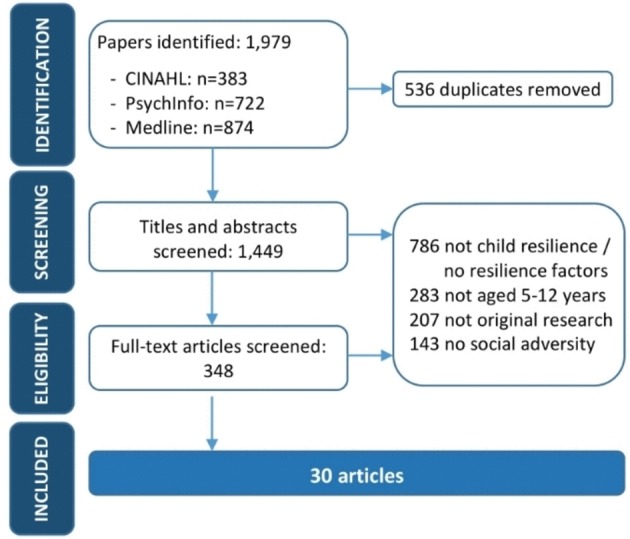
“From 1979 studies retrieved, 30 studies met the inclusion criteria.”
- Also stated in: § Results · plain
“The initial search identified 1979 papers, which was reduced to 348 after initial screening of titles and abstracts (see figure 1). A further 318 studies were excluded after obtaining the full papers and examining study methods in greater detail. Papers were excluded due to: not investigating child resilience and/or factors associated with resilience (n=786); participants outside the age range or”
§ What factors are associated with resilient outcomes in children exposed to social adversity? A systematic review > Abstract > Results
plain- Asserted: passes — The authors put it forward as true.
- Checkable: passes — It can be checked against evidence.
- Load-bearing: unclear — It is unclear whether the paper’s conclusions depend on it.
- Based: passes — The paper gives a reason why it holds.
- Also stated in: § Results · plain
A result the paper reports from its own data — it cites no other source for it, so there is none to check. The quote shows it is in the paper.
In the paper
“Critical appraisal of the included studies using the Health Evidence Bulletin Wales critical appraisal tool determined that the majority of the studies were of high quality (see online supplementary table 1a).”
§ What factors are associated with resilient outcomes in children exposed to social adversity? A systematic review > Results
plain- Asserted: passes — The authors put it forward as true.
- Checkable: passes — It can be checked against evidence.
- Load-bearing: unclear — It is unclear whether the paper’s conclusions depend on it.
- Based: passes — The paper gives a reason why it holds.
78 more claims
Create a free account to see all 144 claims and to verify the 67 references still open.
- It may state two separate claims as one. 35
- Probably not a substantial claim. 38
Claims other papers make about this one
Each is checked against this paper’s own text: does it say what the citing paper says it does?
In the citing paper
“Individual and social-environmental factors such as good emotional regulation, strong social support, and good familial relationships have been shown to promote resilience.74”
From The role of epigenetics in psychological resilience (2021) · cites this paper as [74]
Self-check
Percentages, sums and reported differences re-computed from the paper’s own numbers.
Each contradiction between two passages listed here was confirmed by an independent check.
Rated major: it would touch a result — a value a result rests on, reported and recomputed p-values on opposite sides of the significance level, two passages that conflict with no sign which is right, or a cited work retracted before this paper was published.
In the paper
§ What factors are associated with resilient outcomes in children exposed to social adversity? A systematic review > Results > What factors are associated with resilient outcomes?
“friendship quality, but not the number of friends, was associated with psychological well-being and resilient outcomes.47”
§ What factors are associated with resilient outcomes in children exposed to social adversity? A systematic review > Results
“| Bagci (2014)47 | UK | 247 | NR | 11 (0.3) | 56.3 | Child. | Ethnic minority (discrimination). | Resilience Scale (Bartko and Eccles). | Friendship quality. Friendship quantity. | Friendship quality. Friendship quantity. |”
Rated minor: it would not touch a result — a value no result rests on, a p-value that stays on the same side of the significance level, or a conflict that is clerical, resolved elsewhere in the paper, or outside its own findings.
In the paper
§ What factors are associated with resilient outcomes in children exposed to social adversity? A systematic review > Results
“| Borman (2014)60 | USA | 925 |”
§ What factors are associated with resilient outcomes in children exposed to social adversity? A systematic review > Results > What factors are associated with resilient outcomes?
“Borman60, 2004.”
Rated minor: it would not touch a result — a value no result rests on, a p-value that stays on the same side of the significance level, or a conflict that is clerical, resolved elsewhere in the paper, or outside its own findings.
In the paper
§ What factors are associated with resilient outcomes in children exposed to social adversity? A systematic review > Results
“| Yoon (2018)64 | USA | 449 |”
§ What factors are associated with resilient outcomes in children exposed to social adversity? A systematic review > Results > What factors are associated with resilient outcomes?
“Yoon64, 2017.”
Rated minor: it would not touch a result — a value no result rests on, a p-value that stays on the same side of the significance level, or a conflict that is clerical, resolved elsewhere in the paper, or outside its own findings.
In the paper
§ What factors are associated with resilient outcomes in children exposed to social adversity? A systematic review > Results
“| Ramos-Olazagasti (2010)72 | USA/Puerto Rico | 1271 |”
§ What factors are associated with resilient outcomes in children exposed to social adversity? A systematic review > Results > What factors are associated with resilient outcomes?
“Ramos-Olazagasti72, 2013.”
Rated minor: it would not touch a result — a value no result rests on, a p-value that stays on the same side of the significance level, or a conflict that is clerical, resolved elsewhere in the paper, or outside its own findings.
In the paper
§ What factors are associated with resilient outcomes in children exposed to social adversity? A systematic review > Results
“| Ebersöhn (2015)68 | South Africa | 19 |”
§ What factors are associated with resilient outcomes in children exposed to social adversity? A systematic review > Results > What factors are associated with resilient outcomes?
“Ebersohn68, 2010.”
Citations
Cites
The Construct of Resilience: A Critical Evaluation and Guidelines for Future Work
Luthar, S. S., Cicchetti, D., & Becker, B. (2000) · Child Development · doi:10.1111/1467-8624.00164 · Cited by 9,381 · cited 3×
“26 73–75 Positive outcomes in a single domain may mask negative outcomes in other areas, and conversely, while adversity and trauma will impact the mental health of all exposed children to some degree, they may exhibit resilience in other domains such as academic or behavioural.”
Hughes, K., Bellis, M. A., Hardcastle, K. A., Sethi, D., Butchart, A., Mikton, C., Jones, L., & Dunne, M. P. (2017) · The Lancet Public Health · doi:10.1016/s2468-2667(17)30118-4 · Cited by 5,255 · cited 1×
“4 11–15 20 There is also clear evidence of a clustering of social adversity, including strengths and limitations of this study Open access trauma, in families and communities.”
Social determinants of health inequalities
Marmot, M. (2005) · The Lancet · doi:10.1016/s0140-6736(05)71146-6 · Cited by 5,086
Garcia-Moreno, C., Jansen, H. A., Ellsberg, M., Heise, L., & Watts, C. H. (2006) · The Lancet · doi:10.1016/s0140-6736(06)69523-8 · Cited by 3,176 · cited 5×
“The seventh study was an examination of cross-ethnic friendships in South Asian British children in the context of perceived ethnic discrimination.”
BackgroundInfluentialBramer, W. M., Rethlefsen, M. L., Kleijnen, J., & Franco, O. H. (2017) · Systematic Reviews · doi:10.1186/s13643-017-0644-y · Cited by 2,114 · cited 1×
“In hindsight, some relevant papers may have been missed due to the databases chosen—a recent paper by Bramer et al 76 suggests that a combination of Embase, MEDLINE, Web of Science Core Collection and Google Scholar performs best for systematic reviews.”
A methodological review of resilience measurement scales
Windle, G., Bennett, K. M., & Noyes, J. (2011) · Health and Quality of Life Outcomes · doi:10.1186/1477-7525-9-8 · Cited by 2,079 · cited 1×
“26 35 41 73 74 Most of the included studies identified child resilience by measuring positive outcomes in a single domain, such as mental health.”
Child witnesses to domestic violence: A meta-analytic review
Kitzmann, K. M., Gaylord, N. K., Holt, A. R., & Kenny, E. D. (2003) · Journal of Consulting and Clinical Psychology · doi:10.1037/0022-006x.71.2.339 · Cited by 1,524
Herrman, H., Stewart, D. E., Diaz-Granados, N., Berger, E. L., Jackson, B., & Yuen, T. (2011) · The Canadian Journal of Psychiatry · doi:10.1177/070674371105600504 · Cited by 1,338
Self-citationMaternal antenatal anxiety and children's behavioural/emotional problems at 4 years
O'Connor, T. G., Heron, J., Golding, J., Beveridge, M., & Glover, V. (2002) · British Journal of Psychiatry · doi:10.1192/bjp.180.6.502 · Cited by 1,070
Masten, A. S. (2011) · Development and Psychopathology · doi:10.1017/s0954579411000198 · Cited by 993 · cited 1×
“Resilience has been defined as positive developmental outcomes in the face of adversity or stress, 24 being relatively resistant to psychosocial risk experiences 25 and the development of competence despite chronic stress.”
Research works printed but not linked: 1
- 81. Cahill H, Beadle S, Farrelly R, et al. Building resilience in children and young people: a literature review for the department of education and early childhood development youth research centre, melbourne graduate school of education. Melbourne: University of Melbourne, 2017.
Cited by
Items 201–300 of 310
Lin, J., Scott, J. G., Eapen, V., Kallapiran, K., O’Shea, P., Haslam, D. M., Edirippulige, S., & Davidson, P. M. (2026) · Stress and Health · doi:10.1002/smi.70202 · Cited by 1
“…instability, limited access to health and developmental services, systemic discrimination, and unequal educational opportunities may contribute to both increased exposure to adversity and delayed identification or management of NDDs (Gartland et al. 2019; Chen et al. 2007; Mehari and Zeleke 2026).”
The Impact of Formal One-to-One Mentoring Upon Vulnerable Young People: A Systematic Review
Cuming, T., Hoffman, L. M., Biles, B. J., & Verdon, S. E. (2026) · Youth & Society · doi:10.1177/0044118x261469877 · Cited by 1
Qianqian, G. A. O., Chen, M. F., Sun, J., Li, Y., Wang, W., Xiang, S., Xie, M., & Danhua, L. I. N. (2026) · Acta Psychologica Sinica · doi:10.3724/sp.j.1041.2026.1720 · Cited by 2
Developing kind emotions in caring environments
Speidel, R., Orlitsky, T., Schulz, M., & Malti, T. (2026) · Philosophical Transactions of the Royal Society B Biological Sciences · doi:10.1098/rstb.2025.0141 · Cited by 1
“When kindness becomes a central feature of an adolescent’s identity, kindness-related mental schemas, including kind emotions, may be more readily activated when appraising social situations [192 ,193 ].”
The quiet struggle: How vulnerable youth succeed with the right support
Gardezi, S., Brown, M., Cassidy, A., McNamara, G., O’Hara, J., & McNamara, M. W. (2026) · Review of Education · doi:10.1002/rev3.70243 · Cited by 1
Bradley, R. H., & Bryce, C. I. (2021) · Journal of Developmental & Behavioral Pediatrics · doi:10.1097/dbp.0000000000000957 · Cited by 1
“Researchers, policymakers, and philanthropic organizations continue to express interest in better understanding environmental factors that may assist in reducing the negative impact of racism and poverty on the well-being of minority children.(4,12,30) A key focus of their efforts is identifying ways to build resilien…”
BackgroundUnkrig, E. R. (2021) · Springer eBooks · doi:10.1007/978-3-658-34591-4_4 · Cited by 1
Kuhar, M., & Kocjan, G. Z. (2022) · Teorija in praksa · doi:10.51936/tip.59.1.95-114 · Cited by 4
Carr-Jones, N., & Ellis, G. (2024) · Educational Psychology in Practice · doi:10.1080/02667363.2024.2386294 · Cited by 1
Mental Health and Well-Being in Children
Nunes, C. (2022) · Children · doi:10.3390/children9081212 · Cited by 1
Lobo, J. (2022) · Research Square · doi:10.21203/rs.3.rs-2231054/v2 · Cited by 1
Suarez, G. (2025) · Deep Blue (University of Michigan) · doi:10.7302/25488 · Cited by 1
A psychobiological resilience factor for mental health across the lifespanPreprint
Jia, T., Yang, Z., Xiang, S., Zhai, R., Chen, Z., Hu, Y., Banaschewski, T., Bokde, A. L. W., Desrivières, S., Flor, H., et al. (2025) · Research Square · doi:10.21203/rs.3.rs-7861905/v1 · Cited by 1
Normand, C. L. (2024) · Papyrus : Institutional Repository (Université de Montréal) · doi:10.71781/5788 · Cited by 2
State of Public Health of Refuge Children Due to the Syrian War: A Narrative Review
Teymouri, F., & Moghaddam, A. D. (2020) · Military Caring Sciences · doi:10.29252/mcs.7.1.78
Promoting Partnership Themes Among Elementary School Stakeholders
McGaw, M. A. D. (2022) · Advances in early childhood and K-12 education · doi:10.4018/978-1-7998-8405-7.ch025
Pracana, C., & Wang, M. (2021) · doi:10.36315/2021padvii02
Heesterman, C. (2021) · Open Access Victoria University of Wellington | Te Herenga Waka (Figshare) · doi:10.26686/wgtn.15121869.v1 · Cited by 1
Putri, F. R., Andarini, S., Purwaningtyas, N. H., Ariani, A., Koentartiwi, D., Olivianto, E., Kurniawan, I. B., Rawaruntuk, K. S., Valencia, J., Maharani, P., et al. (2022) · majalah kesehatan · doi:10.21776/ub.majalahkesehatan.2022.009.01.5
Campion, J. (2022) · Oxford University Press eBooks · doi:10.1093/med/9780198861478.003.0051
Kuiper, C. H. Z., & Eijkelkamp, A. (2022) · Bohn Stafleu van Loghum eBooks · doi:10.1007/978-90-368-2829-1_10
Alderson, H., Lingam, R., Brown, R., & McGovern, R. (2023) · Adoption & Fostering · doi:10.1177/03085759231154269 · Cited by 2
“Consideration can also be given to the proximal environment inclusive of peers, family and support networks and distal measures of community and societal factors (Gartland et al., 2019).”
BackgroundOrigins of Individual Differences in Social Behavior and the Social Brain
Cho, I., & Sul, S. (2023) · Cambridge University Press eBooks · doi:10.1017/9781108974325.016
An Individual’s Cognitive Aging with Others: Key Findings, Issues, and Implications
Chey, J. (2023) · Cambridge University Press eBooks · doi:10.1017/9781108974325.013
Wynn, B. (2023) · Open Access Victoria University of Wellington | Te Herenga Waka (Figshare) · doi:10.26686/wgtn.24224017
Factors Associated With Sexual Initiation Amongst Adolescents 10–15 Years in JamaicaPreprint
Gordon-Strachan, G. M., Fox, H. K., Harrison, A., Grant, A. S., & McFarlane, S. (2024) · Preprints.org · doi:10.20944/preprints202406.1833.v1
Boussaïd, M., guedria, A., Manaa, R., Soiniya, R., & Aissaoui, A. (2024) · Neuropsychiatrie de l Enfance et de l Adolescence · doi:10.1016/j.neurenf.2024.07.002 · Cited by 1
Orbe, K. D., & Sloand, J. M. (2024) · iDEA - Drexel University Institutional Repository · doi:10.17918/00010505
Ajayi, O. B., Aloka, P. J. O., Zindoga, L., & Mnyamana, N. (2024) · Journal of Educational Studies · doi:10.59915/jes.2024.si2.13
Life Skills Training on Self Esteem and Mental Well Being among Orphan Children: Systemic Review
Varun Babu, E., & Abirami, M. (2024) · South Eastern European Journal of Public Health · doi:10.70135/seejph.vi.2026
Brain health Begins Before Birth (B4): A “learning” pregnancy and birth cohort studyPreprint
Pride, R. L., Villarreal, J., Restrepo, D., Grunberg, V. A., Bazan, M., Subedi, D., Fitzgerald, A., Shauh, K., Wollman, E., Perdomo, S., et al. (2025) · medRxiv · doi:10.1101/2025.03.12.25323835 · Cited by 1
“3,50,51 52–54 Identification and further clarification of risk factors remain top priorities in the field of preventive psychiatry, inspiring new birth cohort studies such as the HEALthy Brain and Child Development Study (HBCD) and new analyses of existing birth cohort data such as the 1987 Finnish…”
Assessing, Formulating, and Responding to Mental Health-Related Risks
Sweetmore, A., & O'Connor, S. (2025) · Springer eBooks · doi:10.1007/978-3-031-84532-1_11
The Influence of Parental Resilience on the Quality of Life of Children in Early Adulthood
Urs, G. B., & Thoti, K. K. (2025) · SAR Journal - Science and Research · doi:10.18421/10.18421/sar82-10
Socioeconomic mediators of the effect of resilience on cardiometabolic biomarkers in the UK BiobankPreprint
Pflanz, C. P., Gallacher, J., & Bauermeister, S. (2025) · Research Square · doi:10.21203/rs.3.rs-6990489/v1
Nuteistųjų trauminės patirtys: traumai jautrios praktikos svarba bausmių vykdymo sistemoje
Bagdonaite, S., & Klimukienė, V. (2025) · Psichologija · doi:10.15388/psichol.2025.73.4
Elias, H., Pagorek-Eshel, S., & Alnabilsy, R. (2025) · Children and Youth Services Review · doi:10.1016/j.childyouth.2025.108453
Impacto de la Guerra del Chaco en la niñez paraguaya
Chaparro, E. S. (2025) · Revista Paraguaya de Pedagogía · doi:10.33996/rpp.v2i4.15
Musical Engagement is Adaptive Following Early Life UnpredictabilityPreprint
Lopez, K. L., Kathios, N., Loui, P., & Gabard-Durnam, L. J. (2025) · PsyArXiv (OSF Preprints) · doi:10.31234/osf.io/ydbc7_v1
Risks and Resilience Amongst Rural Honduran Children
Viola, L. V. (2025) · Journal of Child and Family Studies · doi:10.1007/s10826-025-03162-4
“…existing research has examined resilience among urban Honduran youth (Reisman & Payan, 2015) and other children in comparable contexts exposed to social adversity (Gartland et al., 2018), no empirical studies have systematically investigated rural Honduran children ’ s processes of resilience.”
Schulz, M., Fogarty, A., Giallo, R., Dudfield, F., & Wood, C. (2025) · Journal of Family Violence · doi:10.1007/s10896-025-00985-z
Self-citationPsychosocial Correlates of Resilience in Adolescents in Adversity Contexts
Alzugaray, C., Villagrán, L., Reyes, C., & Torres, R. M. (2025) · Springer eBooks · doi:10.1007/978-3-032-00025-5_13
Tseliou, F., Dennison, C. A., Eaton, C. B., Armitage, J. M., Rice, F. J., & Collishaw, S. (2025) · JCPP Advances · doi:10.1002/jcv2.70072
“…is also important for understanding better - than - expected outcomes in high - risk children, especially children's school experiences and the quality of relationships with friends and peers (Cic-chetti & Rogosch, 2009; Collishaw et al., 2016; Gartland et al., 2019; Sapouna & Wolke, 2013).”
Experiencias protectoras del impacto de la adversidad de 0 a 5 años: revisión de alcance
Vega-Arce, M., & Núñez-Ulloa, G. (2025) · Boletín Médico del Hospital Infantil de México · doi:10.24875/bmhim.24000185
Childhood abuse and adult cyberbullying victimization in Canada: The role of community belonging
Earle, E., & Speed, D. (2025) · PLoS ONE · doi:10.1371/journal.pone.0337552
Edwards, P., Sneesby, R., Fairbrother, G., Husain, N., Cass-Verco, J., Forbes, E., & Norwood, C. (2025) · Journal of Paediatrics and Child Health · doi:10.1111/jpc.70265
Cahill, S., Hager, R., & Chandola, T. (2022) · Figshare · doi:10.6084/m9.figshare.19290142
Gill, R. (2024) · cIRcle (University of British Columbia) · doi:10.14288/1.0440992 · Cited by 1
Tennant, E., Miller, E., Costantino, K., De Souza, D., Coupland, H., Fotheringham, P., & Eastwood, J. (2020) · Figshare · doi:10.6084/m9.figshare.13173785
Tennant, E., Miller, E., Costantino, K., De Souza, D., Coupland, H., Fotheringham, P., & Eastwood, J. (2020) · Figshare · doi:10.6084/m9.figshare.13173779
Tennant, E., Miller, E., Costantino, K., De Souza, D., Coupland, H., Fotheringham, P., & Eastwood, J. (2020) · Figshare · doi:10.6084/m9.figshare.13173788
Maier, A. (2023) · Dokumentenrepositorium der RUB (Ruhr University Bochum) · doi:10.13154/294-9602
Tennant, E., Miller, E., Costantino, K., De Souza, D., Coupland, H., Fotheringham, P., & Eastwood, J. (2020) · Figshare · doi:10.6084/m9.figshare.13173782
Áhættu- og verndandi þættir í lífi barna: Þrautseigja og áhættumat
Arnarsdóttir, I. (2023) · Skemman
Rava, J. A. (2023) · eScholarship (California Digital Library)
Ásgeirsdóttir, A. R., & Magnúsdóttir, A. T. (2024) · Skemman
Noivo, B. N. G. (2023) · Lusophone University Repository
de, A. C. R. (2023) · LA Referencia (Red Federada de Repositorios Institucionales de Publicaciones Científicas)
Hallgrímsdóttir, K. H. (2020) · Skemman
Schramm, C. (2025) · Kölner Universitäts PublikationsServer (Universität zu Köln) · Cited by 1
King, L. (2023) · eScholarship@McGill (McGill) · doi:10.82308/2238
Noorhazlina Fairuz, F. (2024) · UUM Electronic Theses and Dissertation [eTheses] (Northern University of Malaysia)
Rodríguez, J. V. (2024) · Universidad de Córdoba Insitutional Repository (Universidad de Córdoba) · Cited by 1
Matías García, J. A. (2022) · idUS (Universidad de Sevilla) · Cited by 6
Froment, C. (2023) · Depositum (Université du Québec en Abitibi-Témiscamingue)
Garðarsdóttir, K. M., & Björnsdóttir, K. K. (2024) · Skemman
Resilience among adolescents in alternative care
Nešić, M. (2025) · Faculty of Special Education and Rehabilitation (University of Belgrade)
Eason, V. H. (2025) · ScholarWorks (Walden University)
Protective experiences against the impact of childhood adversity between 0-5 years: a scoping review
Vega-Arce, M., & Núñez-Ulloa, G. (2026) · Boletín Médico Del Hospital Infantil de México (English Edition) · doi:10.24875/bmhime.m25000103
da Costa, F. B., & Oliveira, K. D. S. (2025) · Psico-USF · doi:10.1590/1413-8271202530e292285
Parsons, A. A., Dang, S., Jacobs, S., Wagner, D., Tate, B., Williams, A. A., Wong, J., Collins-Lopez, J., & Causey, J. (2026) · PEC Innovation · doi:10.1016/j.pecinn.2026.100459
Lee, E. (2026) · International Journal of Environmental Research and Public Health · doi:10.3390/ijerph23030277
“Supports that strengthen family communication and collaborative coping may not fully address a child’s self-regulation or engagement, while child-focused supports may be insufficient if ongoing family stressors undermine sustained wellbeing [29–31].”
Supporting Parents and Caregivers
Garner, A. S., & Saul, R. A. (2025) · American Academy of PediatricsItasca, IL eBooks · doi:10.1542/9781610028196-ch8
Gump, B. B., Pilkay, S. R., Wang, X., Vasilenko, S. A., Atallah-Yunes, N. H., Woolf‐King, S. E., Maisto, S., Chen, E., & Ewart, C. K. (2026) · Health Psychology · doi:10.1037/hea0001598 · Cited by 1
Cadete, N. (2022) · ResearchSpace (University of KwaZulu-Natal)
Varhaiskasvatuksen sosionomin merkitys lapsen resilienssin tukemisessa
Ailio, M., & Hyvarinen, S. (2026) · Theseus (Ammattikorkeakoulujen)
Chishima, I., Koga, C., & Tabuchi, T. (2026) · Journal of Child & Adolescent Trauma · doi:10.1007/s40653-026-00883-6
“…embedded within ecological systems—including individual, family, and community domains—it is essential to distinguish between family-based PCEs (FPCEs) and community-based PCEs (CPCEs) to clarify the distinct contributions of FPCEs and CPCEs to mental health (Blazevic, 2016; Gartland et al., 2019).”
Pedrosa-Vazquez, C., Margañón, R. A., Lidón‐Moyano, C., Morales, P., Cañas, L., Garriga-Salvó, C., Farfan-Dominguez, B., Rey-Vitó, S., & Llistosella, M. (2026) · BMJ Open · doi:10.1136/bmjopen-2026-118438
“62 63 Importantly, the scalable and adaptable nature of the intervention offers the potential for implementation in diverse educational and cultural contexts.”
Zhao, Y., Liu, J., Cheng, W., & Sun, X. (2026) · Stress and Health · doi:10.1002/smi.70183
Effects of Small Traumas on Mental Health and Intervention Approaches
Çam, M. O., & Sarıkaya, B. (2026) · Psikiyatride Guncel Yaklasimlar - Current Approaches in Psychiatry · doi:10.18863/pgy.1859521
Shilpa, G. E., & Nanda, S. (2026) · International Journal of Drug Delivery Technology · doi:10.25258/ijddt.16.50s.149
“Young people with supportive relationships and adaptive coping/s stable environments were more likely to have resilient outcomes (Gartland et al., 2019).”
Kauffman, M. (2026) · Digital Commons (Liberty University)
Hurtavtsova, M. V., Poznysh, V. A., Zhovnir, V. A., Tashenova, G., САДЫКОВА, А. Ж., & Vdovenko, V. Y. (2026) · The Journal of V N Karazin Kharkiv National University series Medicine · doi:10.26565/2313-6693-2026-59-04
Hunt, G. R., Bastian, C., Cantley, L., Marwitz, U., & Higgins, D. J. (2026) · Australian Journal of Social Issues · doi:10.1002/ajs4.70123
Metcalf, S. A. (2026) · Apollo (University of Cambridge) · doi:10.17863/cam.132335
Mustikawati, T., Sunardi, S., & Santosa, E. B. (2026) · Jurnal Humanitas Katalisator Perubahan dan Inovator Pendidikan · doi:10.29408/jhm.v12i3.35449
“Yet, schools play a strategic role as the primary environment for enhancing mental health knowledge and awareness among children and adolescents (Gartland et al., 2019).”
Silva, L., Maia, Â., & Pinto, R. J. (2026) · Youth · doi:10.3390/youth6030104
“…research demonstrating that protective factors, such as supportive relationships, trusted adults, positive childhood experiences, and child, family, school, and community resources, may buffer or modify the effects of adversity (Bellis et al., 2017; Bethell et al., 2019; Gartland et al., 2019).”
Understanding Childhood Adversity and Resilience: Perspectives of Autistic Adults
Heselton, G. A. (2021) · AUSpace (Athabasca University) · Cited by 1
Soutien parental, résilience et fonctionnement psychologique et scolaire chez les adolescents
Levesque, N. (2023) · ScriptoriUM
Ibrohim, A. A., Arzaqi, R. N., Juliyanti, A., & Romadhoni, Y. (2026) · Qualitative Research in Early Childhood Education · doi:10.66291/qr-ece.v1i4.98 · Cited by 3
Resilience in traumatised youth: qualitative study on therapists’ perspectives and practices
Visser, I., Knipschild, R., van der Mheen, M., van Dam, L., Wildschut, M., Lindauer, R., & Hein, I. M. (2026) · European Journal of Psychotraumatology · doi:10.1080/20008066.2026.2712032
“Over the past decade, several reviews have identified numerous predictors that contribute to resilience (e.g. Afifi & MacMillan, 2011; Gartland et al., 2019; Traub & Boynton-Jarrett, 2017).”
McKenzie, A. I., Smith, A. C. T., Rattray, B., & Crisp, D. A. (2026) · Journal of Community Psychology · doi:10.1002/jcop.70147
Bullying and the Developing Brain: Understanding Trauma and Building Resilience
Hill, S. (2026) · Routledge eBooks · doi:10.4324/9781003771777
Greene, C. A., Gray, S. A. O., Mulligan, D. J., Briggs‐Gowan, M. J., & Tennen, H. A. (2026) · Child & Youth Care Forum · doi:10.1007/s10566-026-09978-5
Childhood Experiences of Violence – Meanings, Explanations and Coping Strate gies
Pihavaara, T. (2026) · UEF eRepo (University of Eastern Finland)
Yates, J., Uwizeye, G., Wathen, C. N., & Mantler, T. (2026) · Child Abuse & Neglect · doi:10.1016/j.chiabu.2026.108351
Metadata
- Authors
- Gartland, D., Riggs, E., Muyeen, S., Giallo, R., Afifi, T. O., MacMillan, H., Herrman, H., Bulford, E., & Brown, S. J.
- Affiliations
- The University of Melbourne (AU)
- Murdoch Children's Research Institute (AU)
- University of Manitoba (CA)
- McMaster University (CA)
- Orygen (AU)
- Corresponding author
- Gartland, Deirdre
- ORCID
- Venue
- BMJ Open
- Publisher
- BMJ
- Published
- 2019-04
- Volume
- 9
- Issue
- 4
- Pages
- e024870
- ISSN
- 2044-6055 (ISSN-L)
- PMC
- PMC6500354
- OpenAlex
- W2936330004
- Cited by
- 248
- References
- 82
- Citations by year
- 2026: 22 · 2025: 48 · 2024: 33 · 2023: 34 · 2022: 46 · 2021: 40 · 2020: 25
- FWCI
- 4.39
- Type
- journal article
- Language
- en
- Open access
- gold
- doi.org
- Licence
- cc-by-nc
- Locations
- BMJ Open (publishedVersion, cc-by-nc)
- Europe PMC (PubMed Central) (publishedVersion, cc-by-nc)
- PubMed Central (publishedVersion, cc-by-nc)
- PubMed (publishedVersion)
- Minerva Access (University of Melbourne) (submittedVersion, other-oa)
- Own your potential (DEAKIN) (submittedVersion)
- Figshare (submittedVersion, cc-by-nc)
- HighWire Press Open Archive (submittedVersion)
- Funders
- Myer Family Foundation philanthropic funding
- National Health and Medical Research Council
- Canadian Institutes of Health Research
- Chedoke Health Chair in Psychiatry
- Victorian Government’s Operational Infrastructure program
- Topics
- Social Sciences › Psychology › Clinical Psychology › Resilience and Mental Health
- Social Sciences › Psychology › Clinical Psychology › Child Abuse and Trauma
- Social Sciences › Sociology and Political Science › Child Welfare and Adoption
- Keywords
- child resilience, social adversity, poverty, child abuse, war exposure, resilience measurement, emotion regulation, caregiver relationships, academic engagement, cognitive skills, mental health outcomes, academic performance
- MeSH terms
- Adult Survivors of Child Adverse Events, Health Services Research, Humans, Mental Health, Risk Factors, Social Environment, Resilience, Psychological, Social Determinants of Health
About these checks
Registry, retraction, Cites and statistics results are computed, not judged, with one exception: a printed reference that no index lists is read once by a model before it counts as a citation error. Claims are extracted by a model and kept only when their quote appears verbatim in the text; each cited source is then checked, with a model’s help, for whether it says what the claim relies on. Those verdicts can be wrong — read the claim’s quote and the cited source before relying on one.
The claim verdicts this report counts are experimental: their accuracy is not yet measured.
A language model drew the claims from the paper on 2026-10-04, under version 3 of the claim definition (model deepseek-v4.1-flash, prompt extract-v3).
A second model labelled each claim on 2026-10-04 (model jev-1.13-20260917, definition revision gold-guideline-v0.2).
Cited sources are checked with a language model’s help (gpt-6-sol).
Statistics and arithmetic are recomputed, not judged.
Confidence bands are shown only for fields calibrated on our annotated test set. None is calibrated yet, so no band is shown.
What counts as a claim ›How we measure confidence ›How we check this ›
Are you an author, or do you see a problem with this page? Request a review
Data sources
Bibliographic data: Semantic Scholar, OpenAlex, Crossref.
Contains information from the Semantic Scholar Academic Graph Datasets, made available under the ODC Attribution License (ODC-BY 1.0).
Semantic Scholar’s data is described in: Kinney, R., et al. (2023). The Semantic Scholar Open Data Platform. arXiv:2301.10140.
