

What factors are associated with resilient outcomes in children exposed to social adversity? A systematic review
Open accessThe DOI matches its Crossref record; 76 of the 82 references it cites were found in a registry or an index; 12 of the 79 sources its claims cite were checked for support.
Abstract
Objectives: Children exposed to social adversity—hardship as a result of social circumstances such as poverty or intergenerational trauma—are at increased risk of poor outcomes across the life course. Understanding what promotes resilient outcomes is essential for the development of evidence informed intervention strategies. We conducted a systematic review to identify how child resilience is measured and what factors are associated with resilient outcomes. Design: Systematic search conducted in CINAHL, MEDLINE and PsychInfo from January 2004 to October 2018 using the keywords ‘resilien* and child* in the title or abstract. Eligible studies: (1) described children aged 5–12 years; (2) identified exposure to social adversity; (3) identified resilience; and (4) investigated factors associated with resilience. Outcome measures: (1) approaches to identifying resilience and (2) factors associated with resilient outcomes. Results: From 1979 studies retrieved, 30 studies met the inclusion criteria. Most studies were moderate to high quality, with low cultural competency. Social adversity exposures included poverty, parent loss, maltreatment and war. Only two studies used a measure of child resilience; neither was psychometrically validated. Remaining studies classified children as resilient if they showed positive outcomes (eg, mental health or academic achievement) despite adversity. A range of child, family, school and community factors were associated with resilient outcomes, with individual factors most commonly investigated. The best available evidence was for cognitive skills, emotion regulation, relationships with caregivers and academic engagement. Conclusions: While there is huge variation in the type and severity of adversity that children experience, there is some evidence that specific individual, relational and school factors are associated with resilient outcomes across a range of contexts. Such factors provide an important starting point for effective public health interventions to promote resilience and to prevent or ameliorate the immediate and long-term impacts of social adversity on children.
Overview
CoChat Summary
TL;DR
This systematic review of 30 studies found that resilience in children aged 5–12 exposed to social adversity is mostly identified by positive outcomes despite adversity rather than by validated resilience measures. The best available evidence supports cognitive skills, emotion regulation, relationships with caregivers and academic engagement as factors associated with resilient outcomes.
Key findings
- From 1979 retrieved studies, 30 met inclusion criteria; 20 (67%) were conducted in North America, 12 were prospective longitudinal cohort studies, 18 were cross-sectional and 2 used qualitative methods. Poverty was the most common adversity (n=14, 47%), followed by maltreatment (n=7, 23%), violence (n=4, 13%), caregiving interruption (n=8) and war (n=1).
- Only 2 studies (7%) used a resilience measure, and neither measure was psychometrically validated; one reported scale reliability of 0.6, and the other provided no psychometric information. The remaining 28 studies classified children as resilient if they showed positive outcomes in one or more domains despite adversity.
- Individual factors were most commonly investigated (n=24, 80%). The best available evidence was for cognitive skills, emotion regulation, relationships with caregivers and academic engagement; family/social support, school environment and community cohesion/spirituality were also associated with resilient outcomes in fewer studies.
- No two papers employed the same method to identify children as resilient, and most studies used positive outcomes in a single domain, such as mental health or academic achievement.
Methods
- Systematic search of CINAHL, MEDLINE and PsychInfo from January 2004 to October 2018 using keywords “resilien* and child*” in the title or abstract. Eligible studies described children aged 5–12 years, identified exposure to social adversity, identified resilience and investigated factors associated with resilience.
- Three reviewers screened titles/abstracts, full texts were examined against inclusion criteria, and disagreements were resolved with a fourth reviewer. Data were extracted with a structured form; quality was appraised using the Health Evidence Bulletin Wales critical appraisal tool and a cultural competency appraisal tool.
- Due to significant heterogeneity in measurement approaches, categorisation of resilience and factors investigated, the synthesis was descriptive rather than meta-analytic.
Limitations
- Stated by the authors: the synthesis was limited to a descriptive review because of heterogeneity; studies were limited to those published in English; the databases chosen may have missed relevant papers; many included studies scored poorly on culturally safe and participatory methods; and none reported data separately for Indigenous or refugee children.
- Evident from the text: only two studies used a resilience measure and neither was validated; no two papers used the same method to identify resilience; most studies relied on single-domain outcomes, which may not generalise across domains or settings; and school and community factors were investigated in relatively few studies.
Model-written summary. Check it against the paper before relying on it.
Integrity signals
Registry
Cites
Statistics
Figures
Verification
Claims the paper makes
8 Valid · 1 Not valid · 50 Not checked · 85 Own results and interpretations
The cited sources support only part of this claim — read each source’s verdict below.
In the paper
“Furthermore, childhood experiences of adversity are associated with lifelong negative impacts on health and well-being.”
§ What factors are associated with resilient outcomes in children exposed to social adversity? A systematic review > Background > Why is it important to understand resilience in children?
What the sources say
- Partly supportedcites [16] 16. Young JC, Widom CS. Long-term effects of child abuse and neglect on emotion processing in adulthood. Child Abuse Negl 2014;38:1369–81. 10.1016/j.chiabu.2014.03.008 sourceExperimental — accuracy not yet measured
The Results section reports that childhood abuse and neglect were associated with increased adult psychiatric symptoms and lower IQ, supporting long-term negative effects on well-being. The paper studies abuse and neglect rather than childhood adversity generally, and its evidence does not establish lifelong impacts on health broadly. (LLM, conf=0.85)
- Not checked yetcites [17] 17. Afifi TO, Boman J, Fleisher W, et al. The relationship between child abuse, parental divorce, and lifetime mental disorders and suicidality in a nationally representative adult sample. Child Abuse Negl 2009;33:139–47. 10.1016/j.chiabu.2008.12.009 source
- Partly supportedcites [18] 18. Webb RT, Antonsen S, Carr MJ, et al. Self-harm and violent criminality among young people who experienced trauma-related hospital admission during childhood: a Danish national cohort study. Lancet Public Health 2017;2:e314–22. 10.1016/S2468-2667(17)30094-4 sourceExperimental — accuracy not yet measured
The Discussion reports increased risks of self-harm and violent criminality after trauma-related hospital admission in childhood. The Methods state that participants were followed only between ages 15 and 35. The paper therefore supports later adverse outcomes for this specific exposure, but not lifelong impacts from childhood adversity generally across health and well-being. (LLM, conf=0.87)
- Supportedcites [19] 19. Herrenkohl TI, Hong S, Klika JB, et al. Developmental impacts of child abuse and neglect related to adult mental health, substance use, and physical health. J Fam Violence 2013;28:191–9. 10.1007/s10896-012-9474-9 source
The Discussion reports longstanding adverse effects of childhood maltreatment on adult mental health, substance-use risk, and general health. The Abstract likewise describes long-term developmental consequences and reports adverse outcomes in participants followed into their mid-30s. (LLM, conf=0.90)
- Supportedcites [20] 20. Hughes K, Bellis MA, Hardcastle KA, et al. The effect of multiple adverse childhood experiences on health: a systematic review and meta-analysis. Lancet Public Health 2017;2:e356–66. 10.1016/S2468-2667(17)30118-4 source
The Discussion (page not provided) says the review identifies effects of childhood adversity on health across the life course, including associations with all 23 health outcomes examined. The Introduction (page not provided) also describes poorer adult physical and mental health and impaired social and emotional functioning among people with adverse childhood experiences. (LLM, conf=0.94)
plainstates an association- Asserted: passes — The authors put it forward as true.
- Checkable: passes — It can be checked against evidence.
- Load-bearing: passes — The paper’s conclusions depend on it.
- Based: passes — The paper gives a reason why it holds.
- Partly supported
Every source the paper cites for this claim was checked and supports it.
In the paper
“In a large study of child emotional and behavioural resilience in the context of persistent poverty, verbal cognitive ability was found to be significantly associated with low levels of child internalising problems.58”
§ What factors are associated with resilient outcomes in children exposed to social adversity? A systematic review > Results > What factors are associated with resilient outcomes?
What the sources say
- Supportedcites [58] 58. Flouri E, Midouhas E, Joshi H. Family poverty and trajectories of children’s emotional and behavioural problems: the moderating roles of self-regulation and verbal cognitive ability. J Abnorm Child Psychol 2014;42:1043–56. 10.1007/s10802-013-9848-3 source
The Results (p. 15) report a significant interaction between poverty and verbal cognitive ability: children in poverty with higher ability had fewer internalising problems than those with lower ability. The Discussion (p. 17) describes the large longitudinal study and links verbal cognitive ability to resilience among children living consistently in poverty. (LLM, conf=0.94)
plainstates an association- Asserted: passes — The authors put it forward as true.
- Checkable: passes — It can be checked against evidence.
- Load-bearing: unclear — It is unclear whether the paper’s conclusions depend on it.
- Based: passes — The paper gives a reason why it holds.
- Supported
The sources with a verdict support this claim; the rest weren’t checked yet, have no full text we could read, or their verdicts aren’t rated yet.
In the paper
“In the 18 cross-sectional studies, three studies identified resilience using a composite of positive child outcomes across more than one domain, for example, mental health and social competence.54–56”
§ What factors are associated with resilient outcomes in children exposed to social adversity? A systematic review > Results > Measuring resilience in middle childhood
What the sources say
- Supportedcites [54] 54. Cicchetti D, Rogosch FA. Personality, adrenal steroid hormones, and resilience in maltreated children: a multilevel perspective. Dev Psychopathol 2007;19:787–809. 10.1017/S0954579407000399 source
The Method section describes a composite index of resilient functioning built from seven indicators across social competence, depressive symptoms, behavior problems, and school risk. This confirms that the cited study identified resilience using child outcomes from more than one domain; the counts of 18 studies and three studies describe the citing review, not this individual source. (LLM, conf=0.92)
- Not checked yetcites [55] 55. Flores E, Cicchetti D, Rogosch FA. Predictors of resilience in maltreated and nonmaltreated latino children. Dev Psychol 2005;41:338–51. 10.1037/0012-1649.41.2.338 source
- Not checked yetcites [56] 56. Graham-Bermann SA, Gruber G, Howell KH, et al. Factors discriminating among profiles of resilience and psychopathology in children exposed to intimate partner violence (IPV). Child Abuse Negl 2009;33:648–60. 10.1016/j.chiabu.2009.01.002 source
plain- Asserted: passes — The authors put it forward as true.
- Checkable: passes — It can be checked against evidence.
- Load-bearing: unclear — It is unclear whether the paper’s conclusions depend on it.
- Based: passes — The paper gives a reason why it holds.
- Supported
A result the paper reports from its own data — it cites no other source for it, so there is none to check. The quote shows it is in the paper.
In the paper
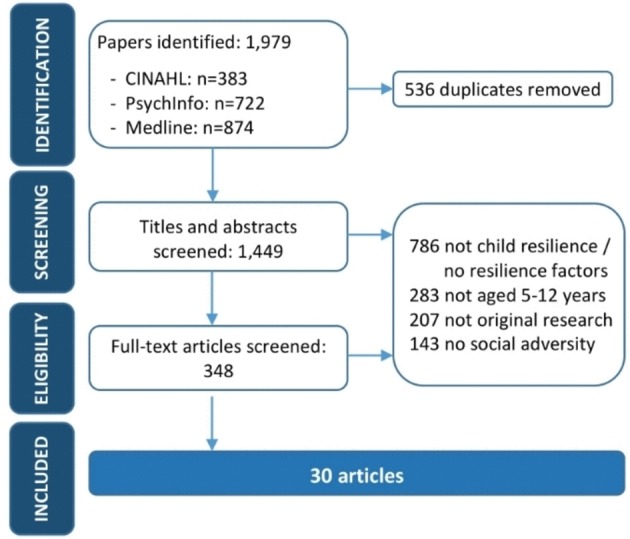
“From 1979 studies retrieved, 30 studies met the inclusion criteria.”
- Also stated in: § Results · plain
“The initial search identified 1979 papers, which was reduced to 348 after initial screening of titles and abstracts (see figure 1). A further 318 studies were excluded after obtaining the full papers and examining study methods in greater detail. Papers were excluded due to: not investigating child resilience and/or factors associated with resilience (n=786); participants outside the age range or”
§ What factors are associated with resilient outcomes in children exposed to social adversity? A systematic review > Abstract > Results
plain- Asserted: passes — The authors put it forward as true.
- Checkable: passes — It can be checked against evidence.
- Load-bearing: unclear — It is unclear whether the paper’s conclusions depend on it.
- Based: passes — The paper gives a reason why it holds.
- Also stated in: § Results · plain
A result the paper reports from its own data — it cites no other source for it, so there is none to check. The quote shows it is in the paper.
In the paper
“Critical appraisal of the included studies using the Health Evidence Bulletin Wales critical appraisal tool determined that the majority of the studies were of high quality (see online supplementary table 1a).”
§ What factors are associated with resilient outcomes in children exposed to social adversity? A systematic review > Results
plain- Asserted: passes — The authors put it forward as true.
- Checkable: passes — It can be checked against evidence.
- Load-bearing: unclear — It is unclear whether the paper’s conclusions depend on it.
- Based: passes — The paper gives a reason why it holds.
78 more claims
Create a free account to see all 144 claims and to verify the 67 references still open.
- It may state two separate claims as one. 35
- Probably not a substantial claim. 38
Claims other papers make about this one
Each is checked against this paper’s own text: does it say what the citing paper says it does?
In the citing paper
“Individual and social-environmental factors such as good emotional regulation, strong social support, and good familial relationships have been shown to promote resilience.74”
From The role of epigenetics in psychological resilience (2021) · cites this paper as [74]
Self-check
Percentages, sums and reported differences re-computed from the paper’s own numbers.
Each contradiction between two passages listed here was confirmed by an independent check.
Rated major: it would touch a result — a value a result rests on, reported and recomputed p-values on opposite sides of the significance level, two passages that conflict with no sign which is right, or a cited work retracted before this paper was published.
In the paper
§ What factors are associated with resilient outcomes in children exposed to social adversity? A systematic review > Results > What factors are associated with resilient outcomes?
“friendship quality, but not the number of friends, was associated with psychological well-being and resilient outcomes.47”
§ What factors are associated with resilient outcomes in children exposed to social adversity? A systematic review > Results
“| Bagci (2014)47 | UK | 247 | NR | 11 (0.3) | 56.3 | Child. | Ethnic minority (discrimination). | Resilience Scale (Bartko and Eccles). | Friendship quality. Friendship quantity. | Friendship quality. Friendship quantity. |”
Rated minor: it would not touch a result — a value no result rests on, a p-value that stays on the same side of the significance level, or a conflict that is clerical, resolved elsewhere in the paper, or outside its own findings.
In the paper
§ What factors are associated with resilient outcomes in children exposed to social adversity? A systematic review > Results
“| Borman (2014)60 | USA | 925 |”
§ What factors are associated with resilient outcomes in children exposed to social adversity? A systematic review > Results > What factors are associated with resilient outcomes?
“Borman60, 2004.”
Rated minor: it would not touch a result — a value no result rests on, a p-value that stays on the same side of the significance level, or a conflict that is clerical, resolved elsewhere in the paper, or outside its own findings.
In the paper
§ What factors are associated with resilient outcomes in children exposed to social adversity? A systematic review > Results
“| Yoon (2018)64 | USA | 449 |”
§ What factors are associated with resilient outcomes in children exposed to social adversity? A systematic review > Results > What factors are associated with resilient outcomes?
“Yoon64, 2017.”
Rated minor: it would not touch a result — a value no result rests on, a p-value that stays on the same side of the significance level, or a conflict that is clerical, resolved elsewhere in the paper, or outside its own findings.
In the paper
§ What factors are associated with resilient outcomes in children exposed to social adversity? A systematic review > Results
“| Ramos-Olazagasti (2010)72 | USA/Puerto Rico | 1271 |”
§ What factors are associated with resilient outcomes in children exposed to social adversity? A systematic review > Results > What factors are associated with resilient outcomes?
“Ramos-Olazagasti72, 2013.”
Rated minor: it would not touch a result — a value no result rests on, a p-value that stays on the same side of the significance level, or a conflict that is clerical, resolved elsewhere in the paper, or outside its own findings.
In the paper
§ What factors are associated with resilient outcomes in children exposed to social adversity? A systematic review > Results
“| Ebersöhn (2015)68 | South Africa | 19 |”
§ What factors are associated with resilient outcomes in children exposed to social adversity? A systematic review > Results > What factors are associated with resilient outcomes?
“Ebersohn68, 2010.”
Citations
Cites
The Construct of Resilience: A Critical Evaluation and Guidelines for Future Work
Luthar, S. S., Cicchetti, D., & Becker, B. (2000) · Child Development · doi:10.1111/1467-8624.00164 · Cited by 9,381 · cited 3×
“26 73–75 Positive outcomes in a single domain may mask negative outcomes in other areas, and conversely, while adversity and trauma will impact the mental health of all exposed children to some degree, they may exhibit resilience in other domains such as academic or behavioural.”
Hughes, K., Bellis, M. A., Hardcastle, K. A., Sethi, D., Butchart, A., Mikton, C., Jones, L., & Dunne, M. P. (2017) · The Lancet Public Health · doi:10.1016/s2468-2667(17)30118-4 · Cited by 5,255 · cited 1×
“4 11–15 20 There is also clear evidence of a clustering of social adversity, including strengths and limitations of this study Open access trauma, in families and communities.”
Social determinants of health inequalities
Marmot, M. (2005) · The Lancet · doi:10.1016/s0140-6736(05)71146-6 · Cited by 5,086
Garcia-Moreno, C., Jansen, H. A., Ellsberg, M., Heise, L., & Watts, C. H. (2006) · The Lancet · doi:10.1016/s0140-6736(06)69523-8 · Cited by 3,176 · cited 5×
“The seventh study was an examination of cross-ethnic friendships in South Asian British children in the context of perceived ethnic discrimination.”
BackgroundInfluentialBramer, W. M., Rethlefsen, M. L., Kleijnen, J., & Franco, O. H. (2017) · Systematic Reviews · doi:10.1186/s13643-017-0644-y · Cited by 2,114 · cited 1×
“In hindsight, some relevant papers may have been missed due to the databases chosen—a recent paper by Bramer et al 76 suggests that a combination of Embase, MEDLINE, Web of Science Core Collection and Google Scholar performs best for systematic reviews.”
A methodological review of resilience measurement scales
Windle, G., Bennett, K. M., & Noyes, J. (2011) · Health and Quality of Life Outcomes · doi:10.1186/1477-7525-9-8 · Cited by 2,079 · cited 1×
“26 35 41 73 74 Most of the included studies identified child resilience by measuring positive outcomes in a single domain, such as mental health.”
Child witnesses to domestic violence: A meta-analytic review
Kitzmann, K. M., Gaylord, N. K., Holt, A. R., & Kenny, E. D. (2003) · Journal of Consulting and Clinical Psychology · doi:10.1037/0022-006x.71.2.339 · Cited by 1,524
Herrman, H., Stewart, D. E., Diaz-Granados, N., Berger, E. L., Jackson, B., & Yuen, T. (2011) · The Canadian Journal of Psychiatry · doi:10.1177/070674371105600504 · Cited by 1,338
Self-citationMaternal antenatal anxiety and children's behavioural/emotional problems at 4 years
O'Connor, T. G., Heron, J., Golding, J., Beveridge, M., & Glover, V. (2002) · British Journal of Psychiatry · doi:10.1192/bjp.180.6.502 · Cited by 1,070
Masten, A. S. (2011) · Development and Psychopathology · doi:10.1017/s0954579411000198 · Cited by 993 · cited 1×
“Resilience has been defined as positive developmental outcomes in the face of adversity or stress, 24 being relatively resistant to psychosocial risk experiences 25 and the development of competence despite chronic stress.”
Research works printed but not linked: 1
- 81. Cahill H, Beadle S, Farrelly R, et al. Building resilience in children and young people: a literature review for the department of education and early childhood development youth research centre, melbourne graduate school of education. Melbourne: University of Melbourne, 2017.
Cited by
Resilience in Development and Psychopathology: Multisystem Perspectives
Masten, A. S., Lucke, C. M., Nelson, K. M., & Stallworthy, I. C. (2021) · Annual Review of Clinical Psychology · doi:10.1146/annurev-clinpsy-081219-120307 · Cited by 794
Multisystem Resilience for Children and Youth in Disaster: Reflections in the Context of COVID-19
Masten, A. S., & Motti-Stefanidi, F. (2020) · Adversity and Resilience Science · doi:10.1007/s42844-020-00010-w · Cited by 556
“Narrative and the rare systematic reviews in the resilience literature on children and youth have consistently implicated a recurring set of factors associated with more positive adaptation in the context of diverse kinds of adversity exposure, including disaster (Gartland et al., 2017; Masten, 2014b; Wright et al., 2…”
BackgroundBerk, M., Köhler‐Forsberg, O., Turner, M., Penninx, B. W. J. H., Wrobel, A., Firth, J., Loughman, A., Reavley, N. J., McGrath, J. J., Momen, N. C., et al. (2023) · World Psychiatry · doi:10.1002/wps.21110 · Cited by 336
Early life adversity shapes neural circuit function during sensitive postnatal developmental periods
Malave, L., van Dijk, M. T., & Anacker, C. (2022) · Translational Psychiatry · doi:10.1038/s41398-022-02092-9 · Cited by 177
“Additional resilience-promoting factors may include cellular and molecular regulators of the 5-HT system or the HPA axis, such as 5-HT receptors and GRs, nutritional interventions, high social support, physical activity, or cognitive flexibility and emotion regulation training [182].”
BackgroundThe complex neurobiology of resilient functioning after childhood maltreatment
Ioannidis, K., Askelund, A. D., Kievit, R. A., & van Harmelen, A.-L. (2020) · BMC Medicine · doi:10.1186/s12916-020-1490-7 · Cited by 162
“A recent systematic review of the literature suggests key roles for emotion regulation, cognitive skills, empathy and positive outlooks in resilient outcomes in children [136].”
BackgroundBaglivio, M. T., & Wolff, K. T. (2020) · Youth Violence and Juvenile Justice · doi:10.1177/1541204020972487 · Cited by 140
“…may transcend multiple ecological levels, including individual (e.g., self-regulation, coping skills), family (e.g. supportive, caring/warmth), and community (e.g., connection, engagement, supportive relationships) (Racine et al., 2020; see also Afifi & Macmillian, 2011; Gartland et al., 2019).”
BackgroundThe Protective Effect of Emotion Regulation on Child and Adolescent Wellbeing
Daniel, S. K., Abdel-Baki, R., & Hall, G. B. (2020) · Journal of Child and Family Studies · doi:10.1007/s10826-020-01731-3 · Cited by 143
“A recent meta-analysis implicated ER as a significant factor associated with psychological resilience among children ages 5–12 who have been exposed to adversity (Gartland et al. 2019).”
BackgroundRacine, N. M., Eirich, R., Dimitropoulos, G., Hartwick, C., & Madigan, S. L. (2020) · Child Abuse & Neglect · doi:10.1016/j.chiabu.2020.104375 · Cited by 130
The role of epigenetics in psychological resilience
Smeeth, D., Beck, S., Karam, E. G., & Pluess, M. (2021) · The Lancet Psychiatry · doi:10.1016/s2215-0366(20)30515-0 · Cited by 108
Resilience of sub-Saharan children and adolescents: A scoping review
Theron, L. C. (2020) · Transcultural Psychiatry · doi:10.1177/1363461520938916 · Cited by 97
“There are multiple syntheses of this extensive body of work (e.g., Fogarty, Wood, Giallo, Kaufman, & Hansen, 2019; Gartland et al., 2019; Masten, 2014a; Werner, 2013).”
Financial Shocks and Financial Well-Being: What Builds Resiliency in Lower-Income Households?
Bufe, S., Roll, S., Kondratjeva, O., Skees, S., & Grinstein‐Weiss, M. (2021) · Social Indicators Research · doi:10.1007/s11205-021-02828-y · Cited by 101
“Existing research from the field of psychology points to a number of individual, social, and community factors that can improve an individual’s capacity to cope with adversity and promote resilience (Davis et al., 2005; Gartland et al., 2019; Ungar and Theron, 2020).”
BackgroundThe Multidimensional Taxonomy of Individual Resilience
Miller‐Graff, L. E. (2020) · Trauma Violence & Abuse · doi:10.1177/1524838020967329 · Cited by 83
“…systematic reviews in resilience science have largely focused on narrowing the scope of reviewed research by subpopulation, integrating research into summative analyses of protective factors across social ecological systems (e.g., Chua et al., 2019; Gartland et al., 2019; Marley & Mauki, 2019).”
BackgroundKuhar, M., & Kocjan, G. Z. (2021) · European Journal of Psychotraumatology · doi:10.1080/20008198.2021.1924953 · Cited by 76
“…in childhood, several authors consider various factors that exist at multiple, interdependent levels of the child’s ecology (the individual child level, the family level, and the broader community level) to be PCEs (Cicchetti & Toth, 2016; Gartland et al., 2019; Masten & Cicchetti, 2016).”
BackgroundLevis, S. C., Baram, T. Z., & Mahler, S. V. (2021) · European Journal of Neuroscience · doi:10.1111/ejn.15223 · Cited by 72
White, A. L., Liburd, L. C., & Coronado, F. (2021) · Preventing Chronic Disease · doi:10.5888/pcd18.210084 · Cited by 66
“Furthermore, the Centers for Disease Control and Prevention (CDC) is providing $10 billion to states to support COVID-19 screening and testing for K-12 teachers, staff, and students (38).”
InfluentialIndigenous Youth and Resilience in Canada and the USA: a Scoping Review
Heid, O., Khalid, M., Smith, H. J., Kim, K. K., Smith, S., Wekerle, C., Bomberry, T., Hill, L. D., General, D. A., Green, T., et al. (2022) · Adversity and Resilience Science · doi:10.1007/s42844-022-00060-2 · Cited by 63
The validity of the residuals approach to measuring resilience to adverse childhood experiences
Cahill, S., Hager, R., & Chandola, T. (2022) · Child and Adolescent Psychiatry and Mental Health · doi:10.1186/s13034-022-00449-y · Cited by 64
“Family resilience factors In terms of family resilience factors, previous studies have had broad support for high quality caregiver relationships and stable family environments [1, 34, 40].”
BackgroundLlistosella, M., Castellví, P., Limonero, J. T., Ortiz, C., Baeza‐Velasco, C., & Rosado, T. G. (2022) · Health & Social Care in the Community · doi:10.1111/hsc.13899 · Cited by 58
Matjasko, J. L., Herbst, J. H., & Estefan, L. F. (2022) · American Journal of Preventive Medicine · doi:10.1016/j.amepre.2021.10.024 · Cited by 54
Emergence and evolution of developmental resilience science over half a century
Masten, A. S. (2024) · Development and Psychopathology · doi:10.1017/s0954579424000154 · Cited by 58
Schmidt, K. L., Merrill, S. M., Gill, R., Miller, G. E., Gadermann, A., & Kobor, M. S. (2021) · Developmental Review · doi:10.1016/j.dr.2021.100983 · Cited by 80
Dray, J. (2021) · International Journal of Environmental Research and Public Health · doi:10.3390/ijerph18147315 · Cited by 53
Resilience Processes in Development: Multisystem Integration Emerging from Four Waves of Research
Masten, A. S., Narayan, A. J., & Wright, M. O. (2023) · Springer eBooks · doi:10.1007/978-3-031-14728-9_2 · Cited by 59
Educational resilience among youth in foster care
Kothari, B. H., Godlewski, B. J., Lipscomb, S. T., & Jaramillo, J. (2021) · Psychology in the Schools · doi:10.1002/pits.22478 · Cited by 50
Warren, J. M., Halpin, S. A., Hanstock, T. L., Hood, C., & Hunt, S. (2022) · Child Abuse & Neglect · doi:10.1016/j.chiabu.2022.105942 · Cited by 47
Okwori, G. (2022) · Journal of Developmental & Behavioral Pediatrics · doi:10.1097/dbp.0000000000001076 · Cited by 46
“Future studies on resilient factors are necessary to understand and address these adverse events.(8,9) Although the initial ACE studies were important for operationalizing the measure and examining associations with adverse health outcomes, 2 important limitations have been noted.”
BackgroundAffected Mexico human papillomavirus vaccine: a proposal for collective health care
Pacheco, M. L., & Sánchez, O. L. (2023) · SAP Community and Interculturality in Dialogue · doi:10.56294/cid202399 · Cited by 41
Sousa, M., Machado, A. B., Pinheiro, M. L., Pereira, B., Caridade, S., Almeida, T. C., Cruz, A. R., & Cunha, O. S. (2025) · Trauma Violence & Abuse · doi:10.1177/15248380251320978 · Cited by 46
“PCEs, even in the presence of ACEs, have been shown to buffer the long-term effects of adversity and support normative functioning across domains (Gartland et al., 2019; Toth & Cicchetti, 2013).”
Almeida, T. C., Fernandes, R. M., & Cunha, O. S. (2022) · Child Abuse & Neglect · doi:10.1016/j.chiabu.2022.105969 · Cited by 39
Carriedo, N., Rodríguez‐Villagra, O. A., Moguilner, S., Morales, J.-P., Huepe-Artigas, D., Soto, V., Franco-O’Byrne, D., Ibáñez, A. M., Bekinschtein, T. A., & Huepe, D. (2024) · Frontiers in Psychology · doi:10.3389/fpsyg.2024.1321242 · Cited by 38
What Can We Do to Promote Mental Health Among Individuals With Developmental Coordination Disorder?
Tamplain, P. M., & Miller, H. L. (2020) · Current Developmental Disorders Reports · doi:10.1007/s40474-020-00209-7 · Cited by 37
Kwon, K., Jeon, S., Castle, S. L., & Ford, T. G. (2021) · Early Childhood Education Journal · doi:10.1007/s10643-021-01253-7 · Cited by 38
Srivastava, A., Brown, R., Newport, D. J., Rousseau, J. F., Wagner, K. D., Guzick, A. G., Devargas, C., Claassen, C. A., Ugalde, I. T., Garrett, A. S., et al. (2024) · Psychiatry Research · doi:10.1016/j.psychres.2024.115772 · Cited by 36
Defining and Measuring Resilience in Children with a Chronic Disease: a Scoping Review
van der Laan, S. E. I., van der Sprenkel, E. E. B., Lenters, V. C., Finkenauer, C., van der Ent, C. K., & Nijhof, S. L. (2023) · Adversity and Resilience Science · doi:10.1007/s42844-023-00092-2 · Cited by 34
“Most of the internal and external resilience factors, measured in the current scoping review, have also been reported in other (systematic) reviews focusing on resilience factors associated with different adversities, such as childhood maltreatment, war, and poverty (Afifi & MacMillan, 2011; Fritz et al., 2018; Gartla…”
BackgroundRodriguez, K. E., McDonald, S. E., & Brown, S. M. (2021) · Behavioral Sciences · doi:10.3390/bs11120178 · Cited by 34
“In addition, social support in the form of nurturing, positive relationships with parents, family members, and peers can promote adaptive outcomes among individuals experiencing adversity [13] and has been found to moderate the relationship between ACEs and later health outcomes [14].”
BackgroundSelf-citationLin, K., Mak, L., Cai, J., Jiang, S., Fayyaz, N., Broadley, S., & Sun, J. (2025) · Pediatric Research · doi:10.1038/s41390-025-03894-5 · Cited by 37
Suglia, S. F., Appleton, A. A., Bleil, M. E., Campo, R. A., Dube, S. R., Fagundes, C. P., Heard-Garris, N. J., Johnson, S. B., Slopen, N., Stoney, C. M., et al. (2021) · Preventive Medicine · doi:10.1016/j.ypmed.2021.106736 · Cited by 31
Nagi, Y., Sender, H., Orcutt, M., Fouad, F. M., Burgess, R. A., & Devakumar, D. (2021) · Journal of Migration and Health · doi:10.1016/j.jmh.2021.100046 · Cited by 33
Predictors of child resilience in a community-based cohort facing flood as natural disaster
Arshad, M., Mughal, M. K., Giallo, R., & Kingston, D. E. (2020) · BMC Psychiatry · doi:10.1186/s12888-020-02944-y · Cited by 31
Self-citationAdverse Childhood Experiences: Developments in Trauma and Resilience Aware Services
Spratt, T., & Kennedy, M. (2020) · The British Journal of Social Work · doi:10.1093/bjsw/bcaa080 · Cited by 35
McSherry, D., & McAnee, G. (2022) · Child Abuse & Neglect · doi:10.1016/j.chiabu.2022.105623 · Cited by 32
Lobo, J. (2023) · Journal of Learning for Development · doi:10.56059/jl4d.v10i2.826 · Cited by 29
What's the matter with ACEs? Recommendations for considering early adversity in educational contexts
Compton, A. B., Panlilio, C. C., & Humphreys, K. L. (2023) · Child Abuse & Neglect · doi:10.1016/j.chiabu.2023.106073 · Cited by 28
“However, the survey does not ask about the availability of such buffers that promote resilience to adversity, such as secure attachment relationships and supportive adults (e.g., teachers, religious group members, neighbors, and extended family; Gartland et al., 2019; Masten, 2001).”
BackgroundInfluentialPolice Violence Exposure and Traumatic Stress Among Youth: A Systematic Review
Oppenheim, S., Webb, L., Testa, A. M., Fix, R. L., Clary, L. K., Mendelson, T., & Jackson, D. B. (2024) · Trauma Violence & Abuse · doi:10.1177/15248380241255735 · Cited by 26
“…of other protective factors known to moderate traumatic stress outcomes (e.g., resilience, cognitive skills, family and peer relationships, and school connectedness) is needed to help researchers identify strategies to prevent adverse outcomes among impacted youth (see Gartland et al., 2019).”
Tennant, E., Miller, E., Costantino, K., de Souza, D., Coupland, H., Fotheringham, P., & Eastwood, J. G. (2020) · BMC Health Services Research · doi:10.1186/s12913-020-05818-x · Cited by 27
The effect of the “exposome” on developmental brain health and cognitive outcomes
Robinson, H., Dave, N., Barzilay, R., Wagner, A., Kells, N., & Keller, A. S. (2025) · Neuropsychopharmacology · doi:10.1038/s41386-025-02180-6 · Cited by 28
King, L., Jolicoeur‐Martineau, A., Laplante, D. P., Székely, E., Levitan, R. D., & Wazana, A. D. (2021) · Current Opinion in Psychiatry · doi:10.1097/yco.0000000000000663 · Cited by 29
Lobo, J. (2024) · Interpersona An International Journal on Personal Relationships · doi:10.5964/ijpr.10549 · Cited by 25
McCurdy, B. H., Bradley, T., Matlow, R. B., Rettger, J. P., Espil, F. M., Weems, C. F., & Carrión, V. G. (2024) · PLoS ONE · doi:10.1371/journal.pone.0301028 · Cited by 25
Fogarty, A., Brown, S., Gartland, D., Mensah, F. K., Seymour, M., Savopoulos, P., FitzPatrick, K. M., Papadopoullos, S., & Giallo, R. (2022) · International Journal of Behavioral Development · doi:10.1177/01650254221084100 · Cited by 24
“Research prior to the pandemic has demonstrated the importance of these resources in positive mental health outcomes for adolescents (Gartland et al., 2019); however, evidenced-based interventions targeting these are lacking.”
BackgroundInfluentialSelf-citationThe developmental consequences of early exposure to climate change-related risks
Cuartas, J. A., McCoy, D. C., Torres, I., Burghardt, L. C., Shonkoff, J. P., & Yoshikawa, H. (2024) · Child Development Perspectives · doi:10.1111/cdep.12503 · Cited by 23
Nash, C. (2022) · Challenges · doi:10.3390/challe13020028 · Cited by 24
Rosenberg, A. R., Steiner, J. M., Lau, N., Fladeboe, K., Toprak, D., Gmuca, S., O’Donnell, M. B., Smith, K., Brown, C. E., & Yi‐Frazier, J. P. (2021) · Journal of Pain and Symptom Management · doi:10.1016/j.jpainsymman.2021.02.036 · Cited by 21
Llistosella, M., Torné, C., García-Ortiz, M., López-Hita, G., Ortiz, R., Herández-Montero, L., Guallart, E., Solbas, E. U., & Miranda-Mendizábal, A. (2023) · Frontiers in Psychology · doi:10.3389/fpsyg.2022.1066874 · Cited by 21
Yoon, S., Pei, F., Benavides, J. L., Ploss, A., Logan, J. A. R., & Hamby, S. L. (2022) · International Journal of Environmental Research and Public Health · doi:10.3390/ijerph19105987 · Cited by 22
“For example, school engagement is a protective factor for maltreated children [32].”
BackgroundFehrenbach, T., Sax, R. M., Hosoda-Urban, T., Simon-Roper, L., Novacek, J., Aaby, D., & Hodgdon, H. (2021) · Journal of Child and Family Studies · doi:10.1007/s10826-021-02096-x · Cited by 20
Atay, S., Sarvan, S., Akcan, A., Güler, E., & Birsen, S. A. Y. (2022) · Current Psychology · doi:10.1007/s12144-022-03649-z · Cited by 18
“During this period, positive psychological changes and self-renewal can also serve as a catalyst or opportunity for spiritual and personal development when individuals are confronted with high-stress life events, such as facing death and/or dealing with a life-threatening illness (Calhoun & Tedeschi, 2006a; Gartland e…”
BackgroundŠvecová, J., Fürstová, J., Kaščáková, N., Hašto, J., & Tavel, P. (2023) · BMC Psychology · doi:10.1186/s40359-023-01270-8 · Cited by 19
The role of social capital in resilience among adolescents with adverse family environments
Rava, J. A., Hotez, E., & Halfon, N. (2023) · Current problems in pediatric and adolescent health care · doi:10.1016/j.cppeds.2023.101436 · Cited by 21
Childhood adversity, resilience, and autism: a critical review of the literature
Heselton, G. A. (2021) · Disability & Society · doi:10.1080/09687599.2021.1983416 · Cited by 21
Personality dimensions could explain resilience in patients with eating disorders
Tsigkaropoulou, E., Ferentinos, P. P., Karavia, A., Gournellis, R., Gonidakis, F., Liappas, I., Douzenis, A., & Michopoulos, I. (2020) · Eating and Weight Disorders - Studies on Anorexia Bulimia and Obesity · doi:10.1007/s40519-020-01012-4 · Cited by 17
Adverse Childhood Experiences and Social Work: Relationship-based Practice Responses
Frederick, J., Spratt, T., & Devaney, J. (2020) · The British Journal of Social Work · doi:10.1093/bjsw/bcaa155 · Cited by 17
Patterns of resilient functioning in early life: Identifying distinct groups and associated factors
Cahill, S., Hager, R., & Shryane, N. M. (2023) · Development and Psychopathology · doi:10.1017/s0954579423001165 · Cited by 18
“Family Resilience Factors: Previous studies have identified high-quality caregiver relationships and stable family environments as resilience factors (Afifi & MacMillan, 2011; Gartland et al., 2019; Haskett et al., 2006).”
BackgroundMitani, H., Kondo, N., Amemiya, A., & Tabuchi, T. (2024) · BMJ Open · doi:10.1136/bmjopen-2023-082134 · Cited by 20
Uddin, J., Ahmmad, Z., Uddin, H., & Tatch, A. (2021) · Sociological Spectrum · doi:10.1080/02732173.2021.1875089 · Cited by 18
COVID-19, children and anxiety in 2020
Parsons, J. (2020) · Australian Journal of General Practice · doi:10.31128/ajgp-covid-27 · Cited by 16
Pérez, R. C., Cubero, M., Matías-García, J. A., & Díaz, M. J. B. (2023) · European Journal of Psychology of Education · doi:10.1007/s10212-023-00704-6 · Cited by 20
“It is essential to highlight that resilience must be understood as an interactive and dynamic process that involves individuals, families, schools and communities (Gartland et al., 2019; Toland & Carrigan, 2011).”
Heselton, G. A., Rempel, G. R., & Nicholas, D. B. (2022) · International Journal of Qualitative Studies on Health and Well-Being · doi:10.1080/17482631.2022.2051237 · Cited by 15
Grant, M., Meissel, K., & Exeter, D. J. (2023) · Educational Psychology Review · doi:10.1007/s10648-023-09734-4 · Cited by 17
Sun, H., Qian, Q., Qin, Y., Guo, L., & Hengudomsub, P. (2023) · Archives of Psychiatric Nursing · doi:10.1016/j.apnu.2023.06.006 · Cited by 14
The impact of early adversity on later life health, lifestyle, and cognition
Künzi, M., Gheorghe, D. A., Gallacher, J., & Bauermeister, S. (2024) · BMC Public Health · doi:10.1186/s12889-024-20768-3 · Cited by 18
Chongwo, E. J., Aoko, B., Kaniala, M., Esala, M., Magoma, P., Njoroge, E., Nyamanya, S., Marangu, J., Khamis, A., Ng’asike, J. T., et al. (2025) · PLoS ONE · doi:10.1371/journal.pone.0316679 · Cited by 19
Psychological Well-being as a Predictor of Resilience Among University Students
., A., & Malik, A. A. (2021) · Pakistan Journal of Psychological Research · doi:10.33824/pjpr.2021.36.4.31 · Cited by 19
Firestone, A. R., & Cruz, R. A. (2022) · Journal of Teacher Education · doi:10.1177/00224871221121278 · Cited by 14
“Left unaddressed, mental health conditions that emerge during the early school years tend to persist and cascade across domains, impacting educational attainment, classroom engagement, and social functioning (Gartland et al., 2019).”
BackgroundHu, N., Gelaw, Y. A., Katz, I., Fernández, E., Falster, K., Hanly, M., Newton, B., Stephensen, J., Hotton, P. R., Zwi, K. J., et al. (2023) · Child Abuse & Neglect · doi:10.1016/j.chiabu.2023.106196 · Cited by 15
The role of Afrocultural ethos in African American youth's emotion skill development
Lozada, F. T. (2024) · Child Development Perspectives · doi:10.1111/cdep.12509 · Cited by 13
Resiliency in Persons Experiencing Homelessness: A Concept Analysis Using the Evolutionary Framework
Ketel, C. R., & Abdoli, S. (2024) · Journal of Advanced Nursing · doi:10.1111/jan.16440 · Cited by 14
“This dual approach—scientific inquiry and philosophical reflection— provides a comprehensive and nuanced understanding of resilience, highlighting its tangible and intangible aspects (Gartland et al. 2019; Heathcote, Wullschleger, and Sun 2019).”
Shariq, D. A., Romeo, R. R., & Gard, A. M. (2025) · Developmental Science · doi:10.1111/desc.70105 · Cited by 13
“…associations with cognitive development in meta-analyses and systematic reviews (e.g., Lopuszanska and Samardakiewicz 2020; Rakesh et al. 2025; Rodrigues et al. 2021) and/or conceptualizations as broad risk or protective factors (e.g., Gartland et al. 2019; Masten 2001; Walker et al. 2011).”
Preventing Irritability and Temper Outbursts in Youth by Building Resilience
Singh, M. K., Hu, R., & Miklowitz, D. J. (2021) · Child and Adolescent Psychiatric Clinics of North America · doi:10.1016/j.chc.2021.04.009 · Cited by 15
Externalizing and internalizing symptoms and coping strategies in young victims of abuse
Manso, J. M. M., Sánchez, M. E. G.-B., Barona, E. J. G., Merino, M. J. G., Guerrero‐Molina, M., & Barbosa‐Torres, C. (2021) · Current Psychology · doi:10.1007/s12144-021-01996-x · Cited by 18
Maruyama, J. M., Valente, J. Y., Tovo‐Rodrigues, L., Santos, I. S., Barros, A. J. D., Munhoz, T. N., Barros, F. C., Murray, J., & Matijasevich, A. (2022) · European Child & Adolescent Psychiatry · doi:10.1007/s00787-022-02022-6 · Cited by 13
“Positive psychological assets, which include high self-esteem and adaptive levels of emotion regulation, are linked to resilience processes that contribute to thriving in the presence of adversities such as maternal depression [42].”
BackgroundRisk and Resilience of Somali Children in the Context of Climate Change, Famine, and Conflict
Oberg, C. N., Hodges, H. R., & Masten, A. S. (2021) · Journal of Applied Research on Children Informing Policy for Children at Risk · doi:10.58464/2155-5834.1453 · Cited by 24
Matías-García, J. A., Cubero, M., Santamaría, A., & Díaz, M. J. B. (2024) · European Journal of Psychology of Education · doi:10.1007/s10212-024-00839-0 · Cited by 17
“It is essential to emphasize that resilience should be understood as an interactive and dynamic process that involves individuals, families, schools, and communities (Gartland et al., 2019; Toland & Carrigan, 2011).”
Gene-by-Environment Interaction Effects of Social Adversity on Externalizing Behavior in ABCD Youth
Dash, G. F., Karalunas, S. L., Kenyon, E. A., Carter, E. K., Mooney, M. A., Nigg, J. T., & Ewing, S. W. F. (2023) · Behavior Genetics · doi:10.1007/s10519-023-10136-z · Cited by 12
“Social adversity includes factors such as neighborhood disadvantage (e.g., poverty; lack of access to health and educational resources) and life stressors (e.g., parental incarceration, injury, and/or death; witnessing or experiencing violence) (Gartland et al. 2019).”
BackgroundMyers-Coffman, K. (2024) · The Arts in Psychotherapy · doi:10.1016/j.aip.2024.102166 · Cited by 13
von Wendorff, C., Bürgin, D., Meier, M., Boonmann, C., d’Huart, D., Habersaat, S., Schmid, M., Fegert, J. M., & Clemens, V. (2025) · Child Abuse & Neglect · doi:10.1016/j.chiabu.2025.107317 · Cited by 13
Cameranesi, M., Shooshtari, S., & Piotrowski, C. C. (2022) · Child Abuse & Neglect · doi:10.1016/j.chiabu.2021.105453 · Cited by 13
Ryding, R., Scales, M. J., Brittingham, R., & Holz, D. (2022) · Disability and health journal · doi:10.1016/j.dhjo.2022.101287 · Cited by 12
Gartland, D., Riggs, E., Giallo, R., Glover, K., Stowe, M., Mongta, S., Weetra, D., & Brown, S. (2022) · BMJ Open · doi:10.1136/bmjopen-2022-061129 · Cited by 13
Self-citationZambrano, V., Gemignani, M., Alises, G. F.-P., & Anwandter, L. E. (2024) · Revista de Estudios Sociales · doi:10.7440/res88.2024.04 · Cited by 16
Resilience under protracted conflict and siege: a new paradigm shift
Abuelaish, I., & Yousufzai, S. J. (2023) · Medicine Conflict & Survival · doi:10.1080/13623699.2023.2258325 · Cited by 13
“…the relationship between gender-specific differences, psychosocial, and contextual factors associated with resilience has not been well studied among adults in a protracted conflict zone, and in relation to the distinct idea of resilience within the Palestinian context (Gartland et al. 2019).”
BackgroundKonrad, K., & Puetz, V. B. (2024) · Translational Psychiatry · doi:10.1038/s41398-024-03092-7 · Cited by 13
“The importance of social factors for RF has emerged across many studies [55, 56], con fi rming the signi fi cance of social support for the psychosocial development of young adults, who have experienced childhood maltreatment (e.g., [57]).”
BackgroundExploring child participation in protecting them from maltreatment: Lithuanian insights
Kirka, V., & Tamutienė, I. (2023) · Children and Youth Services Review · doi:10.1016/j.childyouth.2023.107080 · Cited by 11
Tripa, L., Sava, F. A., Paloș, R., Măgurean, S., & Macsinga, I. (2021) · Cognitie, Creier, Comportament · doi:10.24193/cbb.2021.25.03 · Cited by 11
Adiponectin as a therapeutic target for diabetic foot ulcer
Abdalla, M. M. I., Mohanraj, J., & Somanath, S. D. (2023) · World Journal of Diabetes · doi:10.4239/wjd.v14.i6.758 · Cited by 13
Risk and protective factors for mental health and wellbeing in childhood and adolescence
ESRI, Nolan, A., Smyth, E., & ESRI (2021) · doi:10.26504/rs120 · Cited by 17
Mula-Márquez, Y., Nava-Arquillo, B., & Matías-García, J. A. (2026) · Current Psychology · doi:10.1007/s12144-026-09928-3 · Cited by 12
“Resilience can be defined as the pro - cess of successfully coping with or recovering from adverse situations (Gartland et al., 2019 ; Toland & Carrigan, 2011).”
Lugo-Candelas, C. I., Chang, L., Dworkin, J. D., Aw, N., Fields, A., Reed, H., Spann, M. N., Gilchrist, M., Hinds, W. A., Marsh, R., et al. (2023) · Journal of Developmental Origins of Health and Disease · doi:10.1017/s2040174423000247 · Cited by 10
“68 Identifying the mechanisms underlying resilience will be crucial when developing early intervention and policy.”
BackgroundIsumi, A., Doi, S. K., Ochi, M., Kato, T., & Fujiwara, T. (2022) · Social Psychiatry and Psychiatric Epidemiology · doi:10.1007/s00127-022-02322-x · Cited by 9
“, individual, family, school, and community), as posited by the ecological model [9, 10].”
BackgroundLogie, C. H., Lys, C. L., Sokolovic, N., Malama, K., Mackay, K. I., McNamee, C., Lad, A., & Kanbari, A. (2023) · International Journal of Behavioral Medicine · doi:10.1007/s12529-023-10195-w · Cited by 9
“Although resilience facilitated safer sex efficacy in our study, it was diminished by food insecurity, a toxic stressor [52] that limits resilience and coping resources [44].”
Metadata
- Authors
- Gartland, D., Riggs, E., Muyeen, S., Giallo, R., Afifi, T. O., MacMillan, H., Herrman, H., Bulford, E., & Brown, S. J.
- Affiliations
- The University of Melbourne (AU)
- Murdoch Children's Research Institute (AU)
- University of Manitoba (CA)
- McMaster University (CA)
- Orygen (AU)
- Corresponding author
- Gartland, Deirdre
- ORCID
- Venue
- BMJ Open
- Publisher
- BMJ
- Published
- 2019-04
- Volume
- 9
- Issue
- 4
- Pages
- e024870
- ISSN
- 2044-6055 (ISSN-L)
- PMC
- PMC6500354
- OpenAlex
- W2936330004
- Cited by
- 248
- References
- 82
- Citations by year
- 2026: 22 · 2025: 48 · 2024: 33 · 2023: 34 · 2022: 46 · 2021: 40 · 2020: 25
- FWCI
- 4.39
- Type
- journal article
- Language
- en
- Open access
- gold
- doi.org
- Licence
- cc-by-nc
- Locations
- BMJ Open (publishedVersion, cc-by-nc)
- Europe PMC (PubMed Central) (publishedVersion, cc-by-nc)
- PubMed Central (publishedVersion, cc-by-nc)
- PubMed (publishedVersion)
- Minerva Access (University of Melbourne) (submittedVersion, other-oa)
- Own your potential (DEAKIN) (submittedVersion)
- Figshare (submittedVersion, cc-by-nc)
- HighWire Press Open Archive (submittedVersion)
- Funders
- Myer Family Foundation philanthropic funding
- National Health and Medical Research Council
- Canadian Institutes of Health Research
- Chedoke Health Chair in Psychiatry
- Victorian Government’s Operational Infrastructure program
- Topics
- Social Sciences › Psychology › Clinical Psychology › Resilience and Mental Health
- Social Sciences › Psychology › Clinical Psychology › Child Abuse and Trauma
- Social Sciences › Sociology and Political Science › Child Welfare and Adoption
- Keywords
- child resilience, social adversity, poverty, child abuse, war exposure, resilience measurement, emotion regulation, caregiver relationships, academic engagement, cognitive skills, mental health outcomes, academic performance
- MeSH terms
- Adult Survivors of Child Adverse Events, Health Services Research, Humans, Mental Health, Risk Factors, Social Environment, Resilience, Psychological, Social Determinants of Health
About these checks
Registry, retraction, Cites and statistics results are computed, not judged, with one exception: a printed reference that no index lists is read once by a model before it counts as a citation error. Claims are extracted by a model and kept only when their quote appears verbatim in the text; each cited source is then checked, with a model’s help, for whether it says what the claim relies on. Those verdicts can be wrong — read the claim’s quote and the cited source before relying on one.
The claim verdicts this report counts are experimental: their accuracy is not yet measured.
A language model drew the claims from the paper on 2026-10-04, under version 3 of the claim definition (model deepseek-v4.1-flash, prompt extract-v3).
A second model labelled each claim on 2026-10-04 (model jev-1.13-20260917, definition revision gold-guideline-v0.2).
Cited sources are checked with a language model’s help (gpt-6-sol).
Statistics and arithmetic are recomputed, not judged.
Confidence bands are shown only for fields calibrated on our annotated test set. None is calibrated yet, so no band is shown.
What counts as a claim ›How we measure confidence ›How we check this ›
Are you an author, or do you see a problem with this page? Request a review
Data sources
Bibliographic data: Semantic Scholar, OpenAlex, Crossref.
Contains information from the Semantic Scholar Academic Graph Datasets, made available under the ODC Attribution License (ODC-BY 1.0).
Semantic Scholar’s data is described in: Kinney, R., et al. (2023). The Semantic Scholar Open Data Platform. arXiv:2301.10140.
