

Preoperative predictors of poor acute postoperative pain control: a systematic review and meta-analysis
Open accessThe DOI matches its Crossref record; 71 of the 81 references it cites were found in a registry or an index; 7 of the 34 sources its claims cite were checked for support.
Abstract
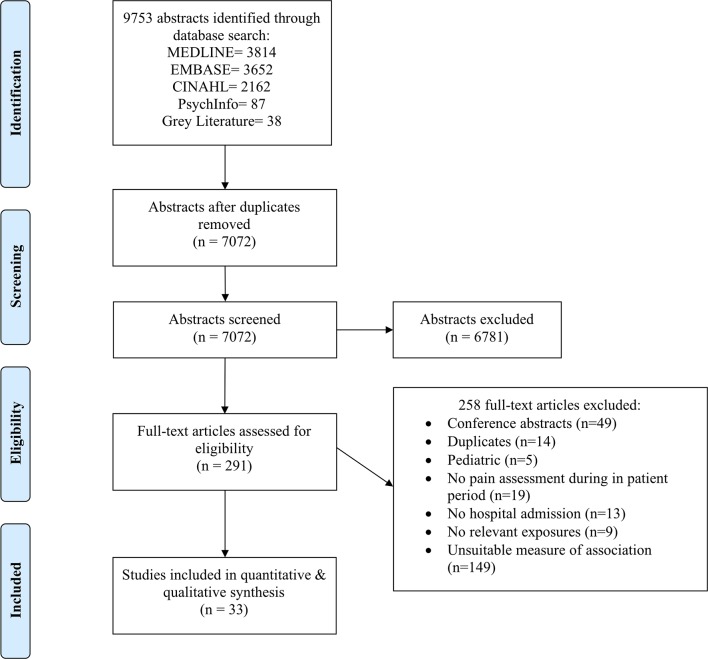
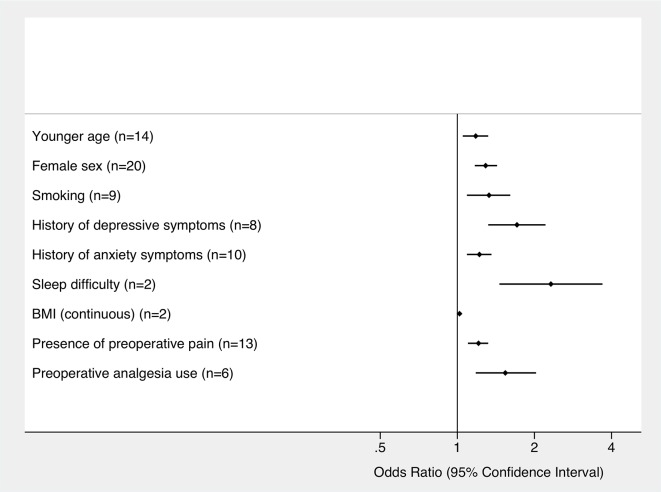
Objectives: Inadequate postoperative pain control is common and is associated with poor clinical outcomes. This study aimed to identify preoperative predictors of poor postoperative pain control in adults undergoing inpatient surgery. Design: Systematic review and meta-analysis Data sources: MEDLINE, Embase, CINAHL and PsycINFO were searched through October 2017. Eligibility criteria: Studies in any language were included if they evaluated postoperative pain using a validated instrument in adults (≥18 years) and reported a measure of association between poor postoperative pain control (defined by study authors) and at least one preoperative predictor during the hospital stay. Data extraction and synthesis: Two reviewers screened articles, extracted data and assessed study quality. Measures of association for each preoperative predictor were pooled using random effects models. Results: Thirty-three studies representing 53 362 patients were included in this review. Significant preoperative predictors of poor postoperative pain control included younger age (OR 1.18 [95% CI 1.05 to 1.32], number of studies, n=14), female sex (OR 1.29 [95% CI 1.17 to 1.43], n=20), smoking (OR 1.33 [95% CI 1.09 to 1.61], n=9), history of depressive symptoms (OR 1.71 [95% CI 1.32 to 2.22], n=8), history of anxiety symptoms (OR 1.22 [95% CI 1.09 to 1.36], n=10), sleep difficulties (OR 2.32 [95% CI 1.46 to 3.69], n=2), higher body mass index (OR 1.02 [95% CI 1.01 to 1.03], n=2), presence of preoperative pain (OR 1.21 [95% CI 1.10 to 1.32], n=13) and use of preoperative analgesia (OR 1.54 [95% CI 1.18 to 2.03], n=6). Pain catastrophising, American Society of Anesthesiologists status, chronic pain, marital status, socioeconomic status, education, surgical history, preoperative pressure pain tolerance and orthopaedic surgery (vs abdominal surgery) were not associated with increased odds of poor pain control. Study quality was generally high, although appropriate blinding of predictor during outcome ascertainment was often limited. Conclusions: Nine predictors of poor postoperative pain control were identified. These should be recognised as potentially important factors when developing discipline-specific clinical care pathways to improve pain outcomes and to guide future surgical pain research. PROSPERO registration number: CRD42017080682.
Overview
CoChat Summary
TL;DR
This systematic review and meta-analysis of 33 studies and 53,362 adults undergoing inpatient surgery identified nine preoperative predictors of poor acute postoperative pain control. The strongest associations were sleep difficulties and depressive symptoms, while several commonly suspected factors were not significantly associated.
Key findings
- Nine significant preoperative predictors of poor postoperative pain control were identified: younger age (OR 1.18, 95% CI 1.05–1.32, n=14), female sex (OR 1.29, 95% CI 1.17–1.43, n=20), smoking (OR 1.33, 95% CI 1.09–1.61, n=9), depressive symptoms (OR 1.71, 95% CI 1.32–2.22, n=8), anxiety symptoms (OR 1.22, 95% CI 1.09–1.36, n=10), sleep difficulties (OR 2.32, 95% CI 1.46–3.69, n=2), higher BMI as continuous (OR 1.02, 95% CI 1.01–1.03, n=2), preoperative pain (OR 1.21, 95% CI 1.10–1.32, n=13), and preoperative analgesia use (OR 1.54, 95% CI 1.18–2.03, n=6).
- Significant heterogeneity was detected for five predictors: female sex, younger age, preoperative pain, anxiety symptoms, and smoking, with I² values from 50.4% to 82.4%.
- Fourteen predictors were not significantly associated with poor pain control, including pain catastrophising, ASA status, chronic pain, marital status, socioeconomic status, education, surgical history, preoperative pressure pain tolerance, and orthopaedic versus abdominal surgery.
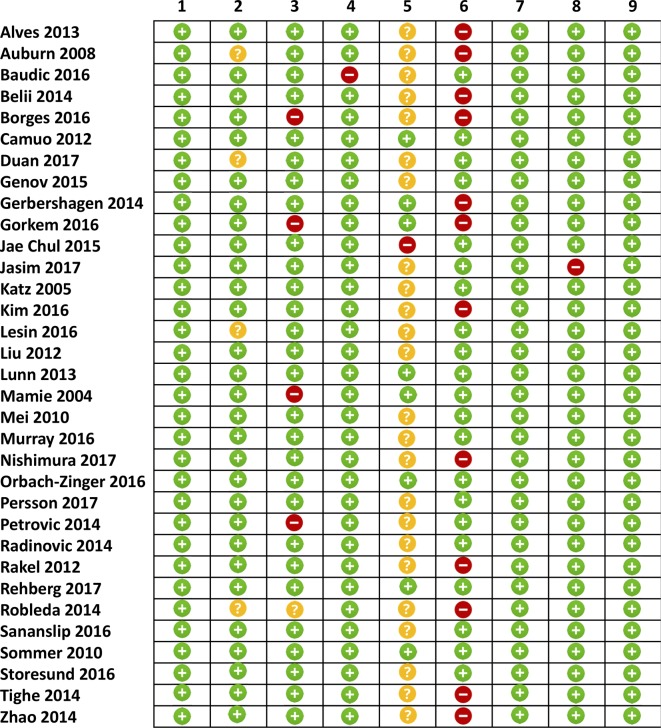
- Study quality was generally high, but blinding of predictors during outcome ascertainment was often limited.
Methods
- Systematic review and meta-analysis of observational studies in adults (≥18 years) undergoing inpatient surgery, with postoperative pain assessed by a validated instrument and poor pain control defined by study authors.
- Searched MEDLINE, Embase, CINAHL, and PsycINFO through October 2017; 33 studies representing 53,362 patients were included.
- Pooled ORs with 95% CIs were calculated using DerSimonian and Laird random effects models; heterogeneity was assessed with Cochran’s Q and I², with stratified analysis and meta-regression for prespecified factors.
Limitations
- The paper states that included studies were observational, so residual confounding cannot be excluded; heterogeneity in definitions of poor pain control, surgical procedure/specialty, timing and instrument of pain assessment, and thresholds for continuous predictors made interpretation challenging.
- The paper states that some predictors were evaluated by few studies and may be underpowered, and that significant statistical heterogeneity could not be explained by stratified analysis or meta-regression.
- Evident from the text: 25 of 33 studies (76%) had no blinding or no reporting of blinding of predictors during outcome ascertainment, and 12 studies (36%) did not adjust for at least three potential confounders.
Model-written summary. Check it against the paper before relying on it.
Integrity signals
Registry
Cites
Statistics
Figures
Verification
Claims the paper makes
5 Valid · 1 Not valid · 17 Not checked · 82 Own results and interpretations
None of the sources cited for this claim have been checked yet.
In the paper
“Since its publication was nearly a decade ago, many additional studies have been published with improved methodological rigour;21–24 thus, providing a new opportunity to provide an updated summary of the literature and to generate pooled estimates of risk.”
§ Preoperative predictors of poor acute postoperative pain control: a systematic review and meta-analysis > Introduction
What the sources say
- Not checked yetcites [21] Gorkem U, Togrul C, Sahiner Y, et al Preoperative anxiety may increase postcesarean delivery pain and analgesic consumption. Minerva Anestesiol 2016; 82: 974– 80. 27028449
- Not checked yetcites [22] Katz J, Poleshuck EL, Andrus CH, et al Risk factors for acute pain and its persistence following breast cancer surgery. Pain 2005; 119(1-3): 16– 25. 10.1016/j.pain.2005.09.008 16298063 source
- Could not verifycites [23] Liu SS, Buvanendran A, Rathmell JP, et al Predictors for moderate to severe acute postoperative pain after total hip and knee replacement. Int Orthop 2012; 36: 2261– 7. 10.1007/s00264-012-1623-5 22842653 PMC3479283 sourceExperimental — accuracy not yet measured
Our copy of Liu et al. (2012) is a single multi-centre, cross-sectional observational study (Methods, p. n/a: 'This study was a multi-centre, cross-sectional, observational study involving Hospital for Special Surgery...'); it reports its own logistic-regression odds ratios (Abstract) but nowhere states that a previous review appeared nearly a decade ago, that subsequently published studies show improved methodological rigour, or that an updated pooled summary of risk is therefore warranted. The Introduction cites earlier work on pain control and the need to identify predictors, and its reference list credits prior syntheses ([9] Ip et al. 2009 qualitative systematic review; [11] Liu and Wu 2007 systematic review), but the Discussion's forward-looking statements concern 'future longitudinal studies' and 'efficacy of interventions', not an updated review with pooled estimates (Discussion, limitations paragraph). Searches run: 'previous systematic review of predictors of postoperative pain limitations methodological' and 'additional studies needed pooled estimates of risk factors acute postoperative pain'; no passage in our copy addresses the claim, and no passage contradicts it either. (LLM, conf=0.62)
- Not checked yetcites [24] Nishimura D, Kosugi S, Onishi Y, et al Psychological and endocrine factors and pain after mastectomy. Eur J Pain 2017; 21: 1144– 53. 10.1002/ejp.1014 28169489 source
plain- Asserted: passes — The authors put it forward as true.
- Checkable: passes — It can be checked against evidence.
- Load-bearing: passes — The paper’s conclusions depend on it.
- Based: passes — The paper gives a reason why it holds.
The cited sources support only part of this claim — read each source’s verdict below.
In the paper
“However, quantitative analysis was not possible due to variability in the reporting of measures of associations and study design heterogeneity of the included studies.”
§ Preoperative predictors of poor acute postoperative pain control: a systematic review and meta-analysis > Introduction
What the sources say
- Partly supportedcites [20] Ip HY, Abrishami A, Peng PW, et al Predictors of postoperative pain and analgesic consumption: a qualitative systematic review. Anesthesiology 2009; 111: 657– 77. 10.1097/ALN.0b013e3181aae87a 19672167 sourceExperimental — accuracy not yet measured
Our copy supports the reporting-variability half of the claim: in Data Extraction, Data Analysis, and Conclusion Synthesis the authors state that meta-analysis of regression coefficients was carried out only for gender and anxiety 'because they are adequately reported among the studies in a consistent way,' and that for age and type of surgery 'nor was a meta-analysis performed because these factors were defined or treated differently among the studies.' But two parts are not supported: (a) the blanket statement that quantitative analysis 'was not possible' overstates the source, which did perform random-effects meta-analyses (MIX 1.0, I²) for two factors; (b) the Discussion gives a different reason for the inability to pool data — 'it is impractical to obtain the raw data from every study that spans over a few decades' — and no passage attributes the limitation to 'study design heterogeneity' of the included studies, so that qualifier is not stated in our copy. (LLM, conf=0.75)
plain- Asserted: passes — The authors put it forward as true.
- Checkable: passes — It can be checked against evidence.
- Load-bearing: passes — The paper’s conclusions depend on it.
- Based: passes — The paper gives a reason why it holds.
- Partly supported
The cited sources support only part of this claim — read each source’s verdict below.
In the paper
“The use of preoperative analgesia, especially opioid therapy, has been linked to poor postoperative pain control in numerous studies.23 68”
§ Preoperative predictors of poor acute postoperative pain control: a systematic review and meta-analysis > Discussion
What the sources say
- Partly supportedcites [23] Liu SS, Buvanendran A, Rathmell JP, et al Predictors for moderate to severe acute postoperative pain after total hip and knee replacement. Int Orthop 2012; 36: 2261– 7. 10.1007/s00264-012-1623-5 22842653 PMC3479283 sourceExperimental — accuracy not yet measured
Our copy supports the association itself: the Discussion ('We identified... preoperative use of opioids, anti-depressants and anti-convulsants... as risk factors for acute moderate to severe pain') and the Abstract/Table 3 report home opioid use predicting moderate-to-severe pain at rest (OR 1.63, 95% CI 1.32-2.01), with anticonvulsants and antidepressants predicting pain with activity; the Discussion also invokes opioid-induced hyperalgesia [22] as a speculative mechanism. What it does not support is the 'numerous studies' framing — this is a single multi-centre cross-sectional analysis of 897 THR/TKR patients, and the paper explicitly notes its analysis 'was observational and can only determine associations'; it reviews prior literature ([8,9,19,20]) for gender, age, BMI and preoperative pain, not for preoperative analgesic/opioid use. Additionally, opioid use was a predictor only for pain at rest, not for pain with activity (Table 2, p=0.34), so the claim's generality exceeds this source. (LLM, conf=0.78)
- Not checked yetcites [68] Kampe S, Wendland M, Welter S, et al Independent Predictors for Higher Postoperative Pain Intensity During Recovery After Open Thoracic Surgery: A Retrospective Analysis in 621 Patients. Pain Med 2018; 19: pnx238– pnx38. 10.1093/pm/pnx238 29635531 source
plainstates an association- Asserted: passes — The authors put it forward as true.
- Checkable: passes — It can be checked against evidence.
- Load-bearing: passes — The paper’s conclusions depend on it.
- Based: passes — The paper gives a reason why it holds.
- Partly supported
The cited sources support only part of this claim — read each source’s verdict below.
In the paper
“In addition to the predictors previously described, we identified six additional preoperative predictors of poor postoperative pain control.20”
§ Preoperative predictors of poor acute postoperative pain control: a systematic review and meta-analysis > Discussion
What the sources say
- Partly supportedcites [20] Ip HY, Abrishami A, Peng PW, et al Predictors of postoperative pain and analgesic consumption: a qualitative systematic review. Anesthesiology 2009; 111: 657– 77. 10.1097/ALN.0b013e3181aae87a 19672167 sourceExperimental — accuracy not yet measured
Our copy of Ip et al. (2009) is indeed a systematic review identifying preoperative predictors of postoperative pain outcomes (Abstract; Inclusion Criteria: 'The potential risk factor or predictive factor had to be identified preoperatively'), so the general thrust of the claim is in it. However, no passage enumerates 'six additional preoperative predictors of poor postoperative pain control': the paper groups its findings into four major categories (demographics, psychological, preoperative pain, surgery-related; Table 2/Table 3 discussion) and concludes that 'preexisting pain, anxiety, age, and type of surgery are the four most significant predictors for postoperative pain' with type of surgery, age and psychological distress for analgesic consumption (Discussion, Conclusion; Abstract). The specific count of six additional predictors, and the framing 'in addition to the predictors previously described', are not stated in this source; the review also addresses pain intensity/analgesic consumption rather than 'poor pain control' as such. (LLM, conf=0.70)
plainstates an association- Asserted: passes — The authors put it forward as true.
- Checkable: passes — It can be checked against evidence.
- Load-bearing: passes — The paper’s conclusions depend on it.
- Based: passes — The paper gives a reason why it holds.
- Partly supported
The cited sources support only part of this claim — read each source’s verdict below.
In the paper
“This may be due to greater preoperative severity of pain, opioid-induced hyperalgesia and central or peripheral sensitisation to pre-existing nociception.23 69”
§ Preoperative predictors of poor acute postoperative pain control: a systematic review and meta-analysis > Discussion
What the sources say
- Supportedcites [23] Liu SS, Buvanendran A, Rathmell JP, et al Predictors for moderate to severe acute postoperative pain after total hip and knee replacement. Int Orthop 2012; 36: 2261– 7. 10.1007/s00264-012-1623-5 22842653 PMC3479283 source
The Discussion (page not provided) identifies preoperative opioid and anticonvulsant use among risk factors for postoperative pain. It explicitly proposes greater underlying pain severity, central or peripheral sensitisation, and opioid-induced hyperalgesia as possible explanations, while calling these mechanisms speculative. (LLM, conf=0.92)
- Partly supportedcites [69] Angst MS, Clark JD Opioid-induced hyperalgesia: a qualitative systematic review. Anesthesiology 2006; 104: 570– 87. 16508405 sourceExperimental — accuracy not yet measured
The Recent Evidence section (page unavailable) reports increased postoperative pain after higher intraoperative opioid doses and says opioid-induced hyperalgesia is a possible explanation, while cautioning that acute tolerance could also explain it. The paper discusses peripheral and spinal sensitization as mechanisms of opioid-induced hyperalgesia, but the passages do not link poor postoperative pain control after preoperative analgesia to greater preoperative pain severity or to sensitization from pre-existing nociception. (LLM, conf=0.85)
hedgedstates a possible cause- Asserted: passes — The authors put it forward as true.
- Checkable: passes — It can be checked against evidence.
- Load-bearing: unclear — It is unclear whether the paper’s conclusions depend on it.
- Based: passes — The paper gives a reason why it holds.
- Supported
51 more claims
Create a free account to see all 105 claims and to verify the 27 references still open.
- Probably not a substantial claim. 34
- It may state two separate claims as one. 25
Claims other papers make about this one
Each is checked against this paper’s own text: does it say what the citing paper says it does?
The source backs part of the claim, not all of it — or backs it for a different population, condition or comparison.
In the citing paper
“Systematic reviews and meta-analyses have summarized the available evidence and concluded that emotional and cognitive factors are significantly associated with both acute postsurgical pain 25,49,69 and CPSP.19,26,58”
From Can perioperative psychological interventions decrease the risk of postsurgical pain and disability? A systematic review and meta-analysis of randomized controlled trials (2022) · cites this paper as [69]
Experimental — accuracy not yet measured
Self-check
Percentages, sums and reported differences re-computed from the paper’s own numbers.
Each contradiction between two passages listed here was confirmed by an independent check.
Rated minor: it would not touch a result — a value no result rests on, a p-value that stays on the same side of the significance level, or a conflict that is clerical, resolved elsewhere in the paper, or outside its own findings.
In the paper
§ Preoperative predictors of poor acute postoperative pain control: a systematic review and meta-analysis > Abstract > Results
“history of depressive symptoms (OR 1.71 [95% CI 1.32 to 2.22], n=8)”
§ Preoperative predictors of poor acute postoperative pain control: a systematic review and meta-analysis > Results > Preoperative predictors of poor postoperative pain control
“| History of depressive symptoms | 8 | 3042 | 1.71 (1.32 to 2.21) | 0.018 |”
Citations
Cites
Measuring inconsistency in meta-analyses
Higgins, J. P. T., Thompson, S. G., Deeks, J. J., & Altman, D. G. (2003) · BMJ · doi:10.1136/bmj.327.7414.557 · Cited by 63,139 · cited 1×
“Between-study heterogeneity was examined and quantified using the Cochran's Q test and I(2) statistic.(38) Stratified analysis and meta-regression were performed to explore for potential sources of heterogeneity based on an a priori list of factors related to study quality and clinical prognosis.”
MethodLiberati, A., Altman, D. G., Tetzlaff, J., Mulrow, C., Gøtzsche, P. C., Ioannidis, J. P. A., Clarke, M., Devereaux, P. J., Kleijnen, J., & Moher, D. (2009) · PLoS Medicine · doi:10.1371/journal.pmed.1000100 · Cited by 28,164
Dermyshi, E., Wang, Y., Yan, C., Hong, W., Qiu, G., Gong, X., & Zhang, T. (2017) · Neonatology · doi:10.1159/000454668 · Cited by 24,451
Meta-analysis of Observational Studies in Epidemiology<SUBTITLE>A Proposal for Reporting</SUBTITLE>
Stroup, D. F. (2000) · JAMA · doi:10.1001/jama.283.15.2008 · Cited by 20,623
Shamseer, L., Moher, D., Clarke, M., Ghersi, D., Liberati, A., Petticrew, M., Shekelle, P., Stewart, L. A., & the PRISMA-P Group (2015) · BMJ · doi:10.1136/bmj.g7647 · Cited by 13,120
Liberati, A., Altman, D. G., Tetzlaff, J., Mulrow, C., Gøtzsche, P. C., Ioannidis, J. P. A., Clarke, M., Devereaux, P. J., Kleijnen, J., & Moher, D. (2009) · Journal of Clinical Epidemiology · doi:10.1016/j.jclinepi.2009.06.006 · Cited by 10,578
PRESS Peer Review of Electronic Search Strategies: 2015 Guideline Statement
McGowan, J., Sampson, M., Salzwedel, D. M., Cogo, E., Foerster, V., & Lefebvre, C. (2016) · Journal of Clinical Epidemiology · doi:10.1016/j.jclinepi.2016.01.021 · Cited by 5,700
Zhang, J., & Yu, K. F. (1998) · JAMA · doi:10.1001/jama.280.19.1690 · Cited by 4,138 · cited 1×
“RRs were converted to OR using the formula, OR=RR/(1/[1/ (1−Po)]+Po), where Po is the incidence of the outcome of interest in the non-exposed group.(37) When raw data were presented, ORs were manually calculated.”
MethodAn estimation of the global volume of surgery: a modelling strategy based on available data
Weiser, T. G., Regenbogen, S. E., Thompson, K. D., Haynes, A. B., Lipsitz, S. R., Berry, W. R., & Gawande, A. A. (2008) · The Lancet · doi:10.1016/s0140-6736(08)60878-8 · Cited by 2,511
Systematic Reviews in Health Care : Meta-Analysis in Context
Egger, M., Smith, G. D., & Altman, D. G. (2000) · Cited by 2,401
Research works printed but not linked: 2
- 10.1097/00000658-200308000-00003 · DOI
- Radinovic K, Milan Z, Markovic-Denic L, et al Predictors of severe pain in the immediate postoperative period in elderly patients following hip fracture surgery. Injury 2014; 45: 1246– 50. 10.1016/j.injury.2014.05.024 24929779 · DOI · Paper page
Cited by
Items 201–300 of 410
Yang, D., Wang, X., Li, X., et al. (2025) · BMJ Open · doi:10.1136/bmjopen-2025-101636 · Cited by 3
Association between postoperative pain management and long-term patient outcomes
Kim, Y.-D. (2025) · Journal of Korean Medical Association · doi:10.5124/jkma.2025.68.1.6 · Cited by 4
Recovery After Thyroid and Parathyroid Surgery: How Do Our Patients Really Feel?
Lee, W. G., Gosnell, J. E., Shen, W. T., Duh, Q., Suh, I., & Chen, Y. (2022) · Journal of Surgical Research · doi:10.1016/j.jss.2022.11.028 · Cited by 3
Research progress of rebound pain after nerve block in arthroscopic rotator cuff repair
Yang, X., Yang, Y., Qin, S., & Chen, Y. (2025) · Frontiers in Medicine · doi:10.3389/fmed.2025.1659133 · Cited by 4
Luo, B.-J., Zhang, H.-Q., Zhong, J.-D., et al. (2021) · Journal of Gastrointestinal Oncology · doi:10.21037/jgo-21-605 · Cited by 3
Ramírez, C. E., Roca, G., Castellví, P., Martínez‐Rodríguez, D., Raynard, M., Draper, B. V., Masgoret, P., Rodriguez-Cosmen, C., Giménez, L. S., García, M. M., et al. (2025) · Journal of Clinical Medicine · doi:10.3390/jcm14134638 · Cited by 7
Hijriana, I., & Yusnita, Y. (2023) · JOURNAL OF HEALTHCARE TECHNOLOGY AND MEDICINE · doi:10.33143/jhtm.v9i1.2797 · Cited by 3
Pain Predictors in Patients in the Postanesthesia Care Unit
Periañez, C. A. H., Castillo-Díaz, M. A., Barbosa, M. H., & Mattia, A. L. D. (2024) · Journal of PeriAnesthesia Nursing · doi:10.1016/j.jopan.2023.11.010 · Cited by 3
Low Resilience Is Predictive of Skilled Nursing Facility Discharge After Total Hip Arthroplasty
Gunda, B., Strecker, S. E., Magaldi, R. J., Allen, D. A., & Witmer, D. K. (2025) · The Journal of Arthroplasty · doi:10.1016/j.arth.2025.06.007 · Cited by 3
MİNİKSAR, Ö. H., YÜKSEK, A., GÖÇMEN, A. Y., et al. (2023) · Turkish Journal of Medical Sciences · doi:10.55730/1300-0144.5570 · Cited by 3
Buprenorphine: An anesthesia-centric review
Hickey, T. R., & Acampora, G. A. (2024) · Journal of Opioid Management · doi:10.5055/jom.0901 · Cited by 3
Liu, X., Zhao, Y., Zhang, L.-Y., Li, B., Wang, S., Zhu, H., Zhi, H., Zhang, J., & Zhang, W. (2023) · PubMed Central · Cited by 3
Miniksar, Ö. H., Onat, T., Göçmen, A. Y., & Honca, M. (2022) · Irish Journal of Medical Science (1971 -) · doi:10.1007/s11845-022-03146-z · Cited by 5
Singh, S., Bolckmans, R., Ratnatunga, K., Gorissen, K., Jones, O., Lindsey, I., & Cunningham, C. (2023) · Colorectal Disease · doi:10.1111/codi.16321 · Cited by 3
“including young age, female sex, history of symptoms of depression or anxiety, smoking, high body mass index, the presence of preoperative pain and use of preoperative analgesia [44].”
BackgroundEffects of Mindfulness on Postoperative Pain, Anxiety, and Opioid Use: An Integrative Review
Miller, M. A., Ye, L., van Pelt, M., & Pavone, K. J. (2025) · Pain Management Nursing · doi:10.1016/j.pmn.2025.04.004 · Cited by 3
Nezafati, S., Dehghani, A. A., Khiavi, R. K., et al. (2023) · Oral and Maxillofacial Surgery · doi:10.1007/s10006-023-01169-z · Cited by 3
Makhlouf, S. M., Algabaily, A. K., Hawil, M. R., & Albkouri, F. O. (2025) · Indian Journal of Pain · doi:10.4103/ijpn.ijpn_86_24 · Cited by 4
Ameliyat öncesi anksiyete düzeyinin ameliyat sonrası uyku kalitesi ve konfor düzeyi üzerine etkisi
Karaveli Çakır, S., Demiryürek, S. O., & Çelik Demiryürek, S. (2024) · Health Care Academician Journal · doi:10.52880/sagakaderg.1301375 · Cited by 2
Postoperative pain at Landspitali: A prospective study
Tomasson, A. M., Jakobsdóttir, H., Gudnason, H. M., Kárason, S., & Sigurdsson, M. I. (2024) · Acta Anaesthesiologica Scandinavica · doi:10.1111/aas.14408 · Cited by 7
Szilagyi, I.-S., Ullrich, T., Klivinyi, C., Lang-Illievich, K., Brenna, C. T. A., Messerer, B., & Bornemann‐Cimenti, H. (2025) · Pain and Therapy · doi:10.1007/s40122-025-00804-9 · Cited by 2
Tighe, C. A., Bachrach, R. L., Perera, S., & Weiner, D. K. (2023) · SLEEP Advances · doi:10.1093/sleepadvances/zpad005 · Cited by 3
Jaeger, R., Mosku, N., Paganini, D., Schelling, G., van Oudenaarde, K., Falkowski, A. L., Guggenberger, R., Studer, G., Bode‐Lesniewska, B., Heesen, P., et al. (2024) · Cancers · doi:10.3390/cancers16233901 · Cited by 2
Prolonged opioid use after surgery in children, adolescents, and young adults: a systematic review
Sun, N., Chowdhury, A. R., Wu, A.-B., Englesakis, M. F., Rosenbloom, B. N., Steinberg, B. E., Stinson, J., & Aoyama, K. (2025) · Canadian Journal of Anesthesia/Journal canadien d anesthésie · doi:10.1007/s12630-025-02921-7 · Cited by 3
Shen, T., Yuan, J., Wang, D., et al. (2025) · European journal of medical research · doi:10.1186/s40001-025-02485-8 · Cited by 2
Postoperative Pain Following Coblation of Sinonasal Hereditary Hemorrhagic Telangiectasias
Kraimer, K., Scott, B., Farrell, N., et al. (2024) · Annals of Otology, Rhinology & Laryngology · doi:10.1177/00034894231182212 · Cited by 2
Papadomanolakis‐Pakis, N., Haroutounian, S., Sørensen, J. K., Runge, C., Brix, L. D., Christiansen, C. F., & Nikolajsen, L. (2025) · PAIN Reports · doi:10.1097/pr9.0000000000001329 · Cited by 6
Usta, E., Bozdemir, H., & AKBAL, S. (2026) · Journal of PeriAnesthesia Nursing · doi:10.1016/j.jopan.2025.09.003 · Cited by 3
Bakshi, S. G., Kadam, S., & Shylasree, T. S. (2023) · Indian Journal of Anaesthesia · doi:10.4103/ija.ija_503_22 · Cited by 2
Highland, K. B., Kent, M. L., McNiffe, N. J., Patzkowski, J. C., Patzkowski, M. S., Kane, A., & Giordano, N. A. (2023) · Orthopaedic Journal of Sports Medicine · doi:10.1177/23259671231184834 · Cited by 2
Wang, C. Y., Shah, R., Frost, J. K., Tang, M., Kim, E., Shamamian, P. E., Oleru, O. O., Seyidova, N., Henderson, P. W., & Taub, P. J. (2024) · Journal of Plastic Reconstructive & Aesthetic Surgery · doi:10.1016/j.bjps.2024.08.074 · Cited by 2
Mustard, C., Snell, K. I. E., Lee, K. M., Pike, C., Bhogal, S., Horne, A. W., Dodds, J. P., Allotey, J., Rivas, C. A., & Ball, E. (2025) · BMJ Open · doi:10.1136/bmjopen-2025-099374 · Cited by 3
Telegan, V. O., Tsagkaris, C., Singh, S. K., & Tarasenko, K. V. (2023) · European Journal of Investigation in Health Psychology and Education · doi:10.3390/ejihpe13020034 · Cited by 2
Tsai, H.-J., Chang, W., Yen, F.-Y., Lin, S.-P., Lin, T.-P., & Chang, K.-Y. (2022) · Journal of Personalized Medicine · doi:10.3390/jpm12030360 · Cited by 2
Little, C., Grewe, K., Gudzenko, V., et al. (2023) · Transplantation Proceedings · doi:10.1016/j.transproceed.2023.01.002 · Cited by 2
Li, J., Li, S., Yu, L., Wei, J., Li, S., & Tan, H. (2022) · Journal of Pain Research · doi:10.2147/jpr.s372845 · Cited by 2
Popov, M. O., Davidova, N. S., Собетова, Г. В., Berdnikova, A. A., & Voronova, L. N. (2023) · Ural Medical Journal · doi:10.52420/2071-5943-2023-22-1-23-31 · Cited by 3
Hafez, D. M., Zaki, A., El-Latif, M. A., & Sayed, I. E. (2025) · International Journal of Lean Six Sigma · doi:10.1108/ijlss-05-2024-0106 · Cited by 2
Risk Factors for Postoperative Pain in Pterygium Surgery Patients
Yang, G., Li, Q., Tian, M., et al. (2025) · Journal of Pain Research · doi:10.2147/jpr.s514070 · Cited by 2
Bergestuen, L., Hagen, M., & Kısa, S. (2025) · Journal of Pain Research · doi:10.2147/jpr.s483665 · Cited by 4
Periañez, C. A. H., Castillo-Díaz, M. A., & García, M. A. M. (2025) · Perioperative Care and Operating Room Management · doi:10.1016/j.pcorm.2025.100490 · Cited by 5
Volberg, C., Gschnell, M., Eubel, V., Föhr, J., Schubert, A., & Pfützner, W. (2024) · JDDG Journal der Deutschen Dermatologischen Gesellschaft · doi:10.1111/ddg.15435 · Cited by 2
Miniksar, Ö. H., & Katar, M. K. (2022) · Journal of Health Sciences and Medicine · doi:10.32322/jhsm.996147 · Cited by 2
Pain management after shoulder arthroplasty: a systematic review of randomized controlled trials
Cohn, M. R., Kunze, K. N., Wright-Chisem, J. I., et al. (2021) · Seminars in Arthroplasty JSES · doi:10.1053/j.sart.2021.04.002 · Cited by 2
Stellate Ganglion Blockade for Acute Pain Management After Transoral Robotic Surgery
Wong, E. C., Castellanos, C. X., Grogan, T., et al. (2026) · The Laryngoscope · doi:10.1002/lary.70151 · Cited by 2
Wie erkennt man Risikopatienten für starke Schmerzen nach Augeneingriffen?
Erlenwein, J., Lauff, S., Plohmann, J., Dreiling, J., Meißner, W., & Feltgen, N. (2023) · Die Ophthalmologie · doi:10.1007/s00347-023-01890-w · Cited by 2
At the Intersection of Pain and Sleep: a Roadmap for Preclinical Pain Research
Diester, C. M., & Joo, W. (2025) · Frontiers in Pain Research · doi:10.3389/fpain.2025.1609524 · Cited by 3
de Souza, R. P., Lopes, L. B., Carmo, A. C. N., Machado, P. M., Andrade, J. M. D. L., & Funez, M. I. (2024) · BMJ Open · doi:10.1136/bmjopen-2023-078743 · Cited by 2
Özkan, E., & Bayrak, N. G. (2025) · Perioperative Care and Operating Room Management · doi:10.1016/j.pcorm.2025.100465 · Cited by 2
Is There an Optimal Timing for Smoking Cessation?
Lumb, A. B., & Panesar, P. H. (2022) · Elsevier eBooks · doi:10.1016/b978-0-323-77846-6.00018-5 · Cited by 1
Transverse abdominis plane block as a method of anesthesia after caesarean section
Рязанова, О. В., Shadenkov, V. I., Kapustin, R. V., & Kogan, I. Y. (2023) · Messenger of Anesthesiology and Resuscitation · doi:10.24884/2078-5658-2023-20-3-52-58 · Cited by 1
Interpersonal differences in postoperative pain scores after bariatric surgery: a systematic review
Roebersen, M., Berghmans, J. M., Lapré, R., van Sprundel, F., & Saldien, V. (2024) · Acta Anaesthesiologica Belgica · doi:10.56126/75.3.53 · Cited by 1
Eficacia del bloqueo regional interescalénico en cirugía de hombro
García Santana, C. L., & Procel Macías, N. A. (2023) · Actas Médicas (Ecuador) · doi:10.61284/84 · Cited by 1
Abate, S. M., Mergia, G., Basu, B., Gezahegn, M., & Ayinie, A. (2024) · Annals of Medicine and Surgery · doi:10.1097/ms9.0000000000002291 · Cited by 3
Isik, O. G., Cassim, T. Z., Ahmed, M. T., Kreuzer, M., Daramola, A. M., & García, P. S. (2024) · Frontiers in Psychiatry · doi:10.3389/fpsyt.2024.1362749 · Cited by 1
Wang, Q., Ding, G., & Li, Y. (2026) · Journal of Multidisciplinary Healthcare · doi:10.2147/jmdh.s564668 · Cited by 1
Psychological Well-Being in Postoperative Pain: A Correlational Study
Orğan, E. M., & Topçu, S. Y. (2023) · Sağlık Akademisi Kastamonu · doi:10.25279/sak.992299 · Cited by 1
Vu, P. H., Tran, D., Dao, T. T., Dong, O. T., Nguyen, T., & Nguyen, T. (2021) · Hospital Topics · doi:10.1080/00185868.2021.2014767 · Cited by 1
Allgemeine Aspekte in präoperativen – intraoperativen – postoperativen Abschnitten
Kapfhammer, H. (2023) · Springer eBooks · doi:10.1007/978-3-662-68309-5_2 · Cited by 1
Abu, P., Tornu, E., & Aziato, L. (2024) · International Journal of Africa Nursing Sciences · doi:10.1016/j.ijans.2024.100741 · Cited by 4
Kościuczuk, U., Kossakowska, A., Talalaj, M., Grabowska, K., & Pryzmont, M. (2025) · Journal of Clinical Medicine · doi:10.3390/jcm14072163 · Cited by 1
King, M. R., Souza, E. D., & Anderson, T. A. (2023) · Canadian Journal of Anesthesia/Journal canadien d anesthésie · doi:10.1007/s12630-023-02612-1 · Cited by 1
(2022) · The Annals of Clinical and Analytical Medicine · doi:10.4328/acam.21306 · Cited by 1
Sarakatsianou, C., Perivoliotis, K., Papaspyrou, D., Chatzinikolaou, C., Papadopoulou, A., Georgopoulou, S., Lytras, D., Baloyiannis, I., & Tzovaras, G. (2026) · Journal of PeriAnesthesia Nursing · doi:10.1016/j.jopan.2025.10.006 · Cited by 1
Zeleke, T. K., Getachew, M., Tegegne, B. A., Teshome, A. H., Yismaw, M. B., Bazezew, Z. A., Kemal, L. K., & Abebe, R. B. (2025) · BMJ Open · doi:10.1136/bmjopen-2024-092524 · Cited by 1
Diemer, F., Zebisch, J., Zinser, W., Steens, W., Zimmerer, A., & Schoch, W. (2025) · International Journal of Sports Physical Therapy · doi:10.26603/001c.146239 · Cited by 1
Gezer, D., & Şişman, H. (2026) · Irish Journal of Medical Science (1971 -) · doi:10.1007/s11845-026-04412-0 · Cited by 3
Nakamura, T., Ogata, F., Hoshijima, H., Nagasaka, H., Doi, K., & Mieda, T. (2024) · Journal of Oral and Maxillofacial Surgery · doi:10.1016/j.joms.2024.11.012 · Cited by 2
Non-opioid based analgesia in otolaryngology
Kim, Y., Sanchez, A., & Nguyen, K. (2022) · Treatments, Mechanisms, and Adverse Reactions of Anesthetics and Analgesics · doi:10.1016/b978-0-12-820237-1.00005-3 · Cited by 1
Bugada, D., Allegri, M., & Ingelmo, P. M. (2026) · Current Opinion in Anaesthesiology · doi:10.1097/aco.0000000000001675 · Cited by 2
Shu, B., Yan, A., Liang, Y., He, J., Chen, J., Chen, X., Huang, H., & Duan, G. (2025) · Annals of Medicine · doi:10.1080/07853890.2025.2528453 · Cited by 1
Güven, B., Sevinç, C. K., Özkaya, B. Ö., et al. (2024) · Perioperative Care and Operating Room Management · doi:10.1016/j.pcorm.2024.100387 · Cited by 1
Hodgson, H., Golmohamad, R., Gulati, A., Pandit, H. G., Palan, J., Giannoudis, P. V., & Howard, A. (2022) · Annals of The Royal College of Surgeons of England · doi:10.1308/rcsann.2021.0189 · Cited by 5
Postsurgical Recovery and Long-Term Outcomes: What Should We Be Measuring?
Hogg, R. M. G., & O’Donnell, C. M. (2024) · Current anesthesiology reports · doi:10.1007/s40140-023-00601-0 · Cited by 1
Masuda, T., Kojima, H., Mizuno, T., Notsu, A., Matsushima, K., Takei, K., Hori, S., Morizono, S., Maeda, K., Nagata, T., et al. (2026) · Journal of Anesthesia · doi:10.1007/s00540-026-03727-7 · Cited by 1
Li, Y., Hong, H., Ma, J.-H., & Wang, D. (2026) · Anesthesiology · doi:10.1097/aln.0000000000006083 · Cited by 1
Knapen, R. R. M. M., Homberg, M. C., Balthasar, A. J. R., Jans, K., van Kuijk, S. M. J., Boer, S. W. D., Bouman, E. A. C., & van der Leij, C. (2024) · CardioVascular and Interventional Radiology · doi:10.1007/s00270-024-03851-5 · Cited by 1
Wenzel, P., Gründahl, M., Fischer, M., Hein, G., Fuchtmann, F., Schnabel, K., Rosenberger, D. C., Pogatzki-Zahn, E. M., Rittner, H. L., & Teichmüller, K. (2025) · European Journal of Pain · doi:10.1002/ejp.70094 · Cited by 5
Usamah, U., Department of Anesthesiology and Intensive Therapy, F. O. M., Sumartono, C., et al. (2023) · Journal of Medicine and Life · doi:10.25122/jml-2023-0196 · Cited by 1
Lenga, P., Scherer, M., Dao Trong, P., et al. (2025) · Acta Neurochirurgica · doi:10.1007/s00701-025-06708-z · Cited by 1
Xu, W., & Collaborative, T. (2023) · medRxiv · doi:10.1101/2023.10.01.23296409 · Cited by 1
Should Placebo Treatment Be Used in the Clinical Setting for Pain Management? A Commentary
Aslam, M. (2023) · Africa Journal of Nursing and Midwifery · doi:10.25159/2520-5293/13343 · Cited by 1
Zhang, H., Yang, Y., Jiang, L., et al. (2023) · Research Square · doi:10.21203/rs.3.rs-2689225/v1 · Cited by 1
A DEEP NEURAL NETWORK TWO-PART MODEL AND FEATURE IMPORTANCE TEST FOR SEMI-CONTINUOUS DATA
Zou, B., Mi, X., Wan, S.-Y., Wu, D., Xenakis, J., Hu, J.-H., & Zou, F. (2023) · bioRxiv · doi:10.1101/2023.06.07.544106 · Cited by 2
Ruiz, L., Ibán, M. Á. R., Heredia, J. D., & López‐Millán, J. M. (2024) · Journal of Shoulder and Elbow Surgery · doi:10.1016/j.jse.2023.11.011 · Cited by 1
Grit and Chronic Pain: Associations with Distress, Catastrophizing, Interference, and Control
Heise, M., Ruzek, J. I., Haug, N. A., & Cordova, M. J. (2025) · Journal of Clinical Psychology in Medical Settings · doi:10.1007/s10880-025-10073-5 · Cited by 3
Homberg, M. C., Knapen, R. R. M. M., Jans, K., van Kuijk, S. M. J., Boer, D. D. K., Joosten, E. A. J., Bühre, W., Boer, S. W. D., van der Leij, C., & Bouman, E. A. C. (2024) · doi:10.31487/j.acr.2024.01.02
Zhang, T., Yue, Z., Yu, L., et al. (2022) · doi:10.21203/rs.3.rs-2301769/v1 · Cited by 1
Sulen, N., Šimurina, T., Požgain, I., Župčić, M., Sorić, T., Kasap, E. B., & Mraović, B. (2023) · Acta Clinica Croatica · doi:10.20471/acc.2023.62.04.14 · Cited by 7
Erlenwein, J., & Petzke, F. W. (2021) · AINS - Anästhesiologie · Intensivmedizin · Notfallmedizin · Schmerztherapie · doi:10.1055/a-1531-0443 · Cited by 1
Multimodal Analgesia for Perioperative Pain Management
Yerebakan, F. C., Kurt, F., Çınbay, K., et al. (2024) · Journal of Ankara University Faculty of Medicine · doi:10.4274/atfm.galenos.2024.54871 · Cited by 1
Filippiadis, D. (2024) · CardioVascular and Interventional Radiology · doi:10.1007/s00270-024-03880-0 · Cited by 1
Pain Management for Ambulatory Surgery: Current Controversies and Concerns
Siu, E. C. K., Stewart, J. W., & Joshi, G. P. (2024) · Current anesthesiology reports · doi:10.1007/s40140-024-00617-0 · Cited by 1
Stretton, B., Booth, A. E. C., Kovoor, J., et al. (2025) · Pain Practice · doi:10.1111/papr.70068 · Cited by 1
Stasiowski, M. J., Marczak, K., Lyssek-Boroń, A., & Zmarzły, N. (2025) · Pharmaceuticals · doi:10.3390/ph18121826 · Cited by 1
Evaluating the impact of metabolic surgery on patients with prior opioid use
Dennis, A. A., Deng, C., Yang, P., Bonham, A. J., Carlin, A. M., & Varban, O. A. (2023) · Surgery for Obesity and Related Diseases · doi:10.1016/j.soard.2023.01.030 · Cited by 1
Winter, G., Urman, R. D., Luedi, M. M., & Stieger, A. (2026) · Current Pain and Headache Reports · doi:10.1007/s11916-026-01537-w
A deep neural network two-part model and feature importance test for semicontinuous data
Zou, B., Mi, X., Wan, S., Wu, D., Xenakis, J. G., Hu, J., & Zou, F. (2025) · The Annals of Applied Statistics · doi:10.1214/25-aoas2013 · Cited by 2
Sports Medicine Patients Accurately Predict Their Pain Tolerance
Gordon, O. L., Lowenstein, N. A., Mazzocca, J. L., et al. (2026) · Journal of the American Academy of Orthopaedic Surgeons · doi:10.5435/jaaos-d-25-00975
Nurkkala, J., Lampela, H., Sammalkorpi, H. E., Liisanantti, J. H., Kontinen, V., & Schramko, A. A. (2025) · Acta Anaesthesiologica Scandinavica · doi:10.1111/aas.70163
Alhassanin, D. H., Elbadry, A. A., Mohamed, N. K., & Ezz, H. A. A. (2023) · International Journal of Medical Anesthesiology · doi:10.33545/26643766.2023.v6.i4a.434
Metadata
- Authors
- Yang, M. M. H., Hartley, R. L., Leung, A. A., Ronksley, P. E., Jetté, N., Casha, S., & Riva-Cambrin, J.
- Affiliations
- University of Calgary (CA)
- Icahn School of Medicine at Mount Sinai (US)
- Corresponding author
- Yang, Michael M H
- ORCID
- Venue
- BMJ Open
- Publisher
- BMJ
- Published
- 2019-04
- Volume
- 9
- Issue
- 4
- Pages
- e025091
- ISSN
- 2044-6055 (ISSN-L)
- PMC
- PMC6500309
- OpenAlex
- W2927083218
- Cited by
- 414
- References
- 81
- Citations by year
- 2026: 39 · 2025: 81 · 2024: 75 · 2023: 76 · 2022: 60 · 2021: 51 · 2020: 26 · 2019: 6
- FWCI
- 7.37
- Type
- journal article
- Language
- en
- Open access
- gold
- doi.org
- Licence
- cc-by-nc
- Locations
- BMJ Open (publishedVersion, cc-by-nc)
- Europe PMC (PubMed Central) (publishedVersion, cc-by-nc)
- PubMed Central (publishedVersion, cc-by-nc)
- PubMed (publishedVersion)
- HighWire Press Open Archive (submittedVersion)
- Funders
- Canadian Institutes of Health Research
- Topics
- Health Sciences › Medicine › Anesthesiology and Pain Medicine › Anesthesia and Pain Management
- Health Sciences › Medicine › Anesthesiology and Pain Medicine › Pain Management and Opioid Use
- Health Sciences › Medicine › Pediatrics, Perinatology and Child Health › Pediatric Pain Management Techniques
- Keywords
- postoperative pain, preoperative predictors, inadequate pain control, inpatient surgery, age, sex differences, smoking, depressive symptoms, anxiety symptoms, sleep disorders, body mass index, preoperative pain, preoperative analgesia, pain catastrophizing, American Society of Anesthesiologists classification, chronic pain, socioeconomic status, marital status, orthopedic surgery, abdominal surgery, postoperative analgesia
- MeSH terms
- Adult, Analgesia, Anesthesia, Conduction, Humans, Pain, Postoperative, Postoperative Pain, Preoperative Care, Elective Surgical Procedures, Risk Assessment
About these checks
Registry, retraction, Cites and statistics results are computed, not judged, with one exception: a printed reference that no index lists is read once by a model before it counts as a citation error. Claims are extracted by a model and kept only when their quote appears verbatim in the text; each cited source is then checked, with a model’s help, for whether it says what the claim relies on. Those verdicts can be wrong — read the claim’s quote and the cited source before relying on one.
The claim verdicts this report counts are experimental: their accuracy is not yet measured.
A language model drew the claims from the paper on 2026-10-05, under version 3 of the claim definition (model deepseek-v4.1-flash, prompt extract-v3).
A second model labelled each claim on 2026-10-05 (model jev-1.13-20260917, definition revision gold-guideline-v0.2).
Cited sources are checked with a language model’s help (qwen3.8-omni-flash and gpt-6-sol).
Statistics and arithmetic are recomputed, not judged.
Confidence bands are shown only for fields calibrated on our annotated test set. None is calibrated yet, so no band is shown.
What counts as a claim ›How we measure confidence ›How we check this ›
Are you an author, or do you see a problem with this page? Request a review
Data sources
Bibliographic data: Semantic Scholar, OpenAlex, Crossref.
Contains information from the Semantic Scholar Academic Graph Datasets, made available under the ODC Attribution License (ODC-BY 1.0).
Semantic Scholar’s data is described in: Kinney, R., et al. (2023). The Semantic Scholar Open Data Platform. arXiv:2301.10140.
