

The DOI matches its Crossref record; 28 of the 30 references it cites were found in a registry or an index.
How accurate are digital symptom assessment apps for suggesting conditions and urgency advice? A clinical vignettes comparison to GPs
Open accessPublished version of a preprint
Abstract
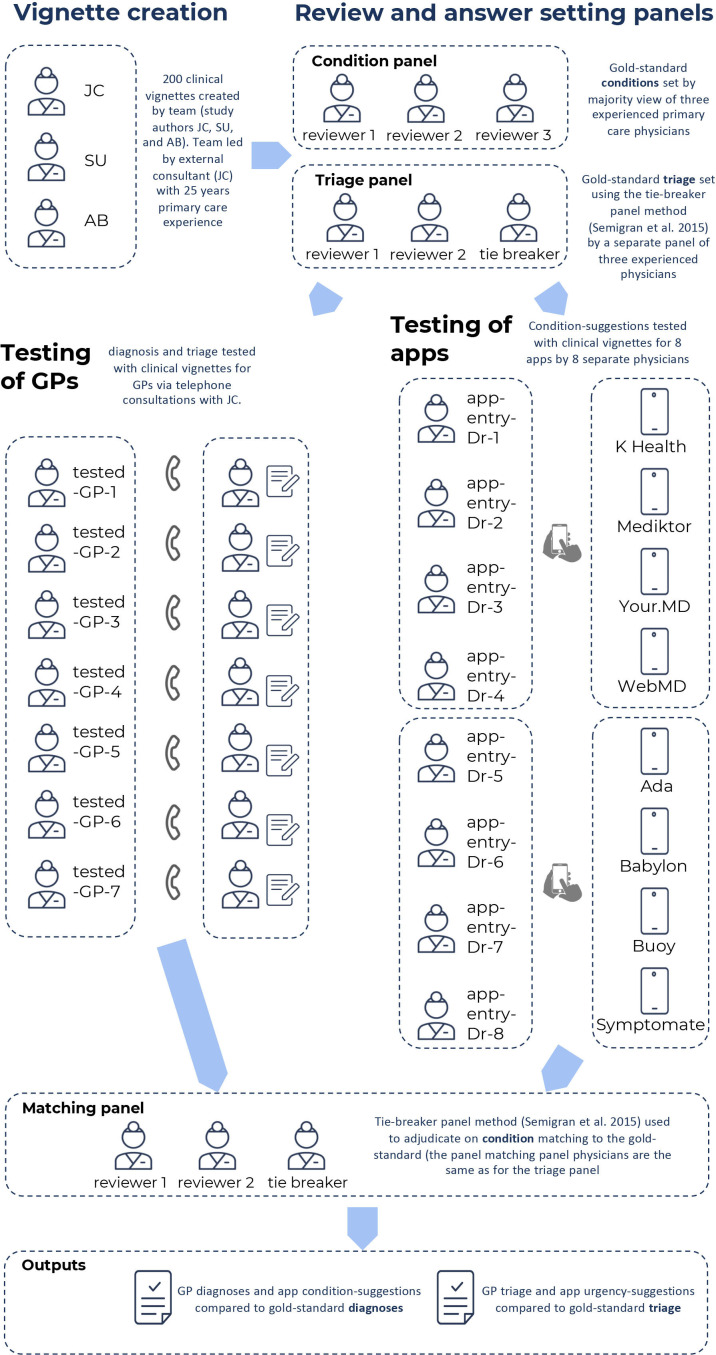
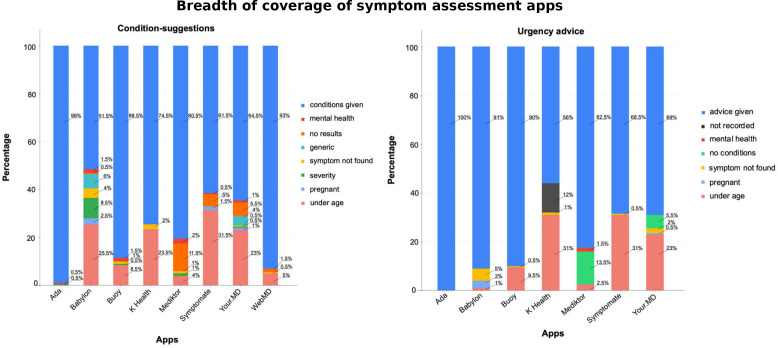
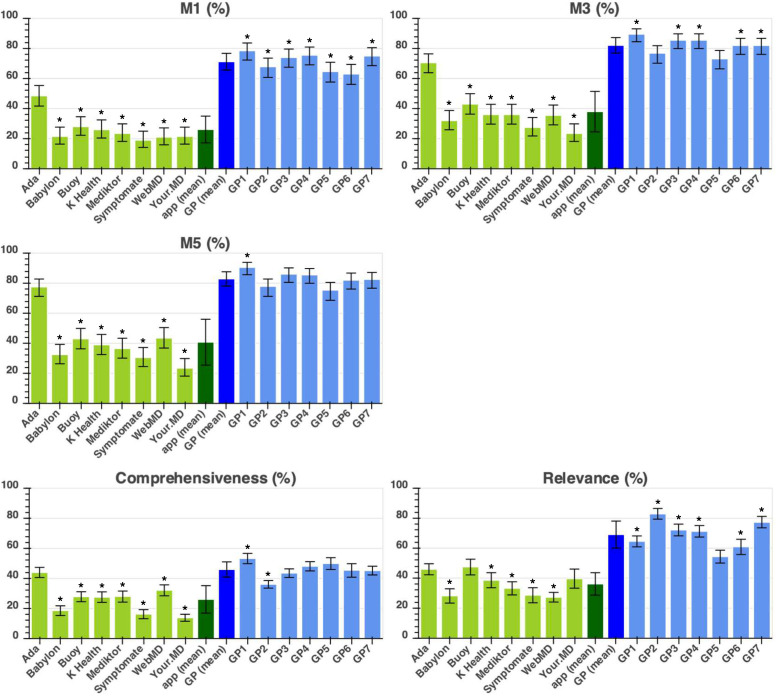
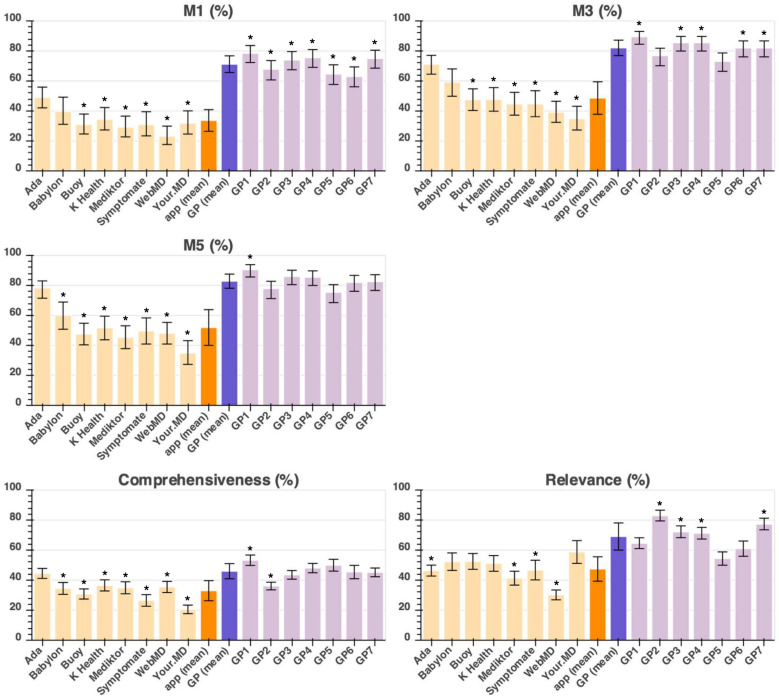
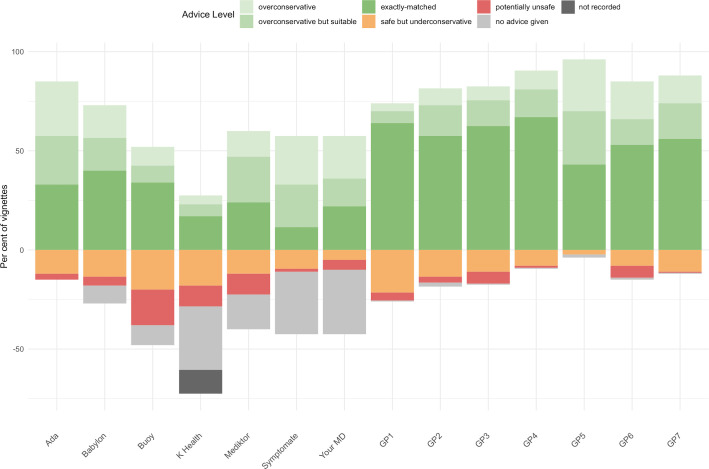
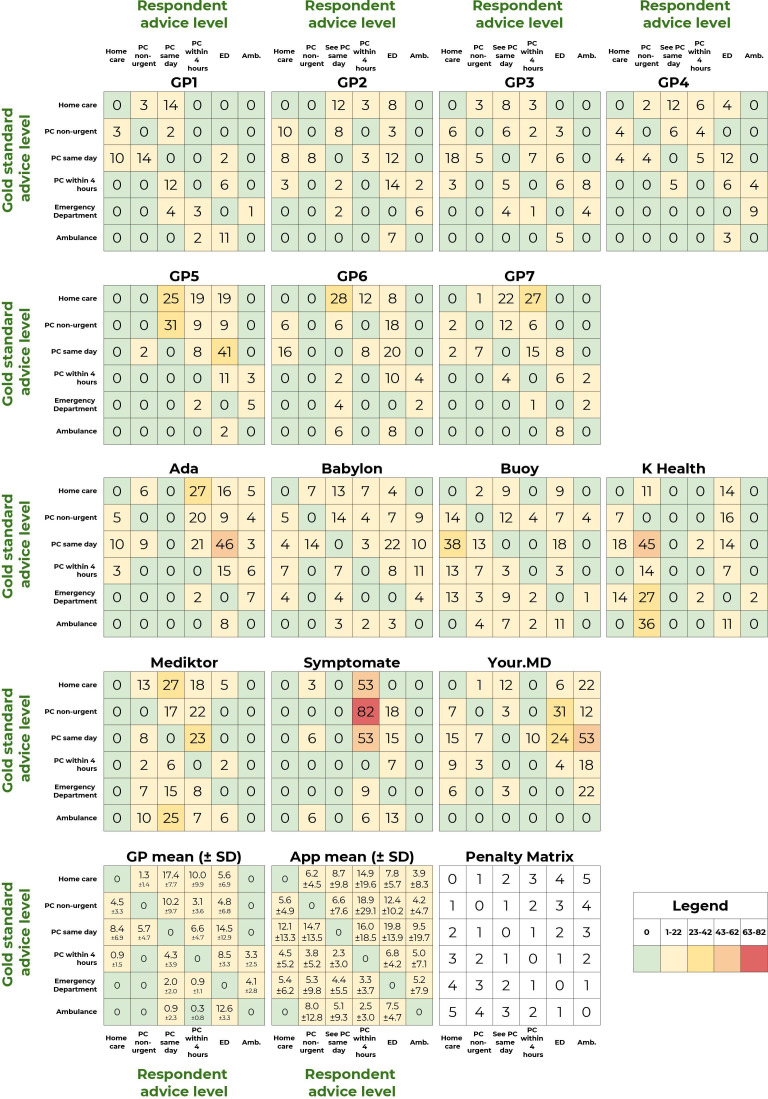
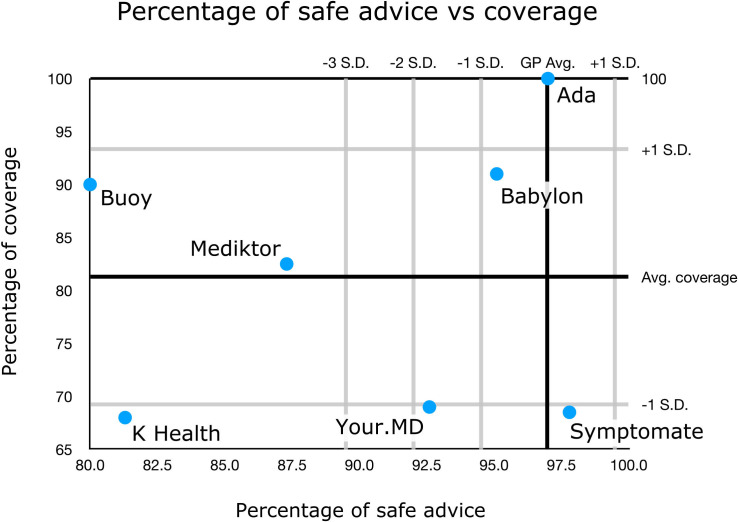
Objectives: To compare breadth of condition coverage, accuracy of suggested conditions and appropriateness of urgency advice of eight popular symptom assessment apps. Design: Vignettes study. Setting: 200 primary care vignettes. Intervention/comparator: For eight apps and seven general practitioners (GPs): breadth of coverage and condition-suggestion and urgency advice accuracy measured against the vignettes’ gold-standard. Primary outcome measures: (1) Proportion of conditions ‘covered’ by an app, that is, not excluded because the user was too young/old or pregnant, or not modelled; (2) proportion of vignettes with the correct primary diagnosis among the top 3 conditions suggested; (3) proportion of ‘safe’ urgency advice (ie, at gold standard level, more conservative, or no more than one level less conservative). Results: Condition-suggestion coverage was highly variable, with some apps not offering a suggestion for many users: in alphabetical order, Ada: 99.0%; Babylon: 51.5%; Buoy: 88.5%; K Health: 74.5%; Mediktor: 80.5%; Symptomate: 61.5%; Your.MD: 64.5%; WebMD: 93.0%. Top-3 suggestion accuracy was GPs (average): 82.1%±5.2%; Ada: 70.5%; Babylon: 32.0%; Buoy: 43.0%; K Health: 36.0%; Mediktor: 36.0%; Symptomate: 27.5%; WebMD: 35.5%; Your.MD: 23.5%. Some apps excluded certain user demographics or conditions and their performance was generally greater with the exclusion of corresponding vignettes. For safe urgency advice, tested GPs had an average of 97.0%±2.5%. For the vignettes with advice provided, only three apps had safety performance within 1 SD of the GPs—Ada: 97.0%; Babylon: 95.1%; Symptomate: 97.8%. One app had a safety performance within 2 SDs of GPs—Your.MD: 92.6%. Three apps had a safety performance outside 2 SDs of GPs—Buoy: 80.0% (p<0.001); K Health: 81.3% (p<0.001); Mediktor: 87.3% (p=1.3×10 -3 ). Conclusions: The utility of digital symptom assessment apps relies on coverage, accuracy and safety. While no digital tool outperformed GPs, some came close, and the nature of iterative improvements to software offers scalable improvements to care.
Overview
The claims and statistics of this paper haven’t been checked yet.
Run the check — free, no account needed. It reads the open-access text and checks the sources it cites.
Integrity signals
Registry
Cites
Statistics
Figures
Verification
Claims the paper makes
The claims and statistics of this paper haven’t been checked yet.
Run the check — free, no account needed. It reads the open-access text and checks the sources it cites.
Claims other papers make about this one
Each is checked against this paper’s own text: does it say what the citing paper says it does?
The source backs part of the claim, not all of it — or backs it for a different population, condition or comparison.
In the citing paper
“Furthermore, the accuracy observed in our study is close to the performance rate of ADA (48.5%) across a broad spectrum of medical conditions in the study by Gilbert et al [34] but lower than in another recent comparative study (72%) [35].”
From Diagnostic Performance of an App-Based Symptom Checker in Mental Disorders: Comparative Study in Psychotherapy Outpatients (2022) · cites this paper as [35]
Experimental — accuracy not yet measuredThe source backs part of the claim, not all of it — or backs it for a different population, condition or comparison.
In the citing paper
“In two-thirds (34/49, 67%) of cases, 1 in 5 condition suggestions aligned with any of the interview-based diagnoses, which is somewhat below the range of performance rates of ADA in previous studies using case vignettes (77%-84%) [34,35] or patients seeking emergency care (91.3%) [58].”
From Diagnostic Performance of an App-Based Symptom Checker in Mental Disorders: Comparative Study in Psychotherapy Outpatients (2022) · cites this paper as [35]
Experimental — accuracy not yet measuredThe source backs part of the claim, not all of it — or backs it for a different population, condition or comparison.
In the citing paper
“On this matter, evidence indicates that the use of algorithms over other methods, the inclusion of demographic information [57], or more rigorous questioning [35] could explain the differences between symptom checkers’ diagnostic performances.”
From Diagnostic Performance of an App-Based Symptom Checker in Mental Disorders: Comparative Study in Psychotherapy Outpatients (2022) · cites this paper as [35]
Experimental — accuracy not yet measuredThe cited source says what the claim attributes to it.
In the citing paper
“As previous studies have shown considerable differences between symptom checkers’ diagnostic accuracy [33,35], future studies could compare various symptom checkers for the formal diagnosis of mental disorders.”
From Diagnostic Performance of an App-Based Symptom Checker in Mental Disorders: Comparative Study in Psychotherapy Outpatients (2022) · cites this paper as [35]
Self-check
Percentages, sums and reported differences re-computed from the paper’s own numbers.
The self-check needs the paper’s full text.
Citations
Cites
Controlling the False Discovery Rate: A Practical and Powerful Approach to Multiple Testing
Benjamini, Y., & Hochberg, Y. (1995) · Journal of the Royal Statistical Society Series B: Statistical Methodology · doi:10.1111/j.2517-6161.1995.tb02031.x · Cited by 109,482
Probable Inference, the Law of Succession, and Statistical Inference
Wilson, E. B. (1927) · Journal of the American Statistical Association · doi:10.1080/01621459.1927.10502953 · Cited by 4,476
Controlling the false discovery rate in behavior genetics research
Benjamini, Y., Drai, D., Elmer, G., Kafkafi, N., & Golani, I. (2001) · Behavioural Brain Research · doi:10.1016/s0166-4328(01)00297-2 · Cited by 4,146
COVID-19: what is next for public health?
Heymann, D. L., & Shindo, N. (2020) · The Lancet · doi:10.1016/s0140-6736(20)30374-3 · Cited by 1,146
Video consultations for covid-19
Greenhalgh, T., Wherton, J., Shaw, S., & Morrison, C. (2020) · BMJ · doi:10.1136/bmj.m998 · Cited by 866 · cited 3×
“Other situations, such as the inability to search for certain symptoms, providing no condition-suggestions/urgency advice for certain input symptoms, or, excluding comorbidities, mental health or pregnancy are more problematic and can raise concerns about the safety and benefits of the app for…”
InfluentialEvans, S. C., Roberts, M. C., Keeley, J. W., Blossom, J. B., Amaro, C. M., Garcia, A. M., Stough, C. O., Canter, K. S., Robles, R., & Reed, G. M. (2015) · International Journal of Clinical and Health Psychology · doi:10.1016/j.ijchp.2014.12.001 · Cited by 757
Evaluation of symptom checkers for self diagnosis and triage: audit study
Semigran, H. L., Linder, J. A., Gidengil, C., & Mehrotra, A. (2015) · BMJ · doi:10.1136/bmj.h3480 · Cited by 489
Clinical Vignette-Based Surveys: A Tool for Assessing Physician Practice Variation
Veloski, J., Tai, S., Evans, A., & Nash, D. (2005) · American Journal of Medical Quality · doi:10.1177/1062860605274520 · Cited by 396
Performance of Four Computer-Based Diagnostic Systems
Berner, E. S., Webster, G. D., Shugerman, A. A., Jackson, J. R., Algina, J. J., Baker, A. L., Ball, E. V., Cobbs, C. G., Dennis, V. W., Frenkel, E. P., et al. (1994) · New England Journal of Medicine · doi:10.1056/nejm199406233302506 · Cited by 320
Fisher’s exact approach for post hoc analysis of a chi-squared test
Shan, G., & Gerstenberger, S. (2017) · PLoS ONE · doi:10.1371/journal.pone.0188709 · Cited by 234 · cited 1×
“MD and for this reason a subanalysis of the 150 vignettes for which full verification was possible for these apps is provided in online supplemental table 6 and 7.”
Research works printed but not linked: 1
- 10.2307/2276774 · DOI · Paper page
Cited by
Sorted by citations
Items 101–181 of 181
Innovations in primary health care
Платошкин, Э. Н., Platoshkina, Y. M., Шут, С. А., Ramanov, H. N., Kavalchuk, A. N., Тишков, С. П., Bartnouski, P. I., & Seifidinova, S. H. (2021) · Health and Ecology Issues · doi:10.51523/2708-6011.2021-18-4-2 · Cited by 2
“compared the accuracy of suggested conditions and appropriateness of advice given by eight different health apps vs that done by primary care physicians [28].”
Gilbert, S., Wicks, P. J., & Novorol, C. (2021) · The Medical Journal of Australia · doi:10.5694/mja2.50917 · Cited by 2
Self-citationKoch, R., Wetzel, A., Preiser, C., Müller, R., Klemmt, M., Ranisch, R., Ehni, H.-J., Wiesing, U., Rieger, M. A., Henking, T., et al. (2021) · Research Square · doi:10.21203/rs.3.rs-383127/v1
Moral Decision-Making via AI – deep ethics? About shifting or losing responsibility
Henking, T. (2024) · transcript Verlag eBooks · doi:10.1515/9783839469057-004 · Cited by 1
Künstliche Intelligenz in der Kinderpneumologie – Chancen und unbeantwortete Fragen
Dramburg, S. (2025) · Klinische Pädiatrie · doi:10.1055/a-2511-8548 · Cited by 1
InfoKids+: A Validation Study of a Pediatric Acuity Risk Stratification Algorithm
Starvaggi, C. A., Affentranger, S., Lengeler, N., Siebert, J. N., Galetto-Lacour, A., Tan, R., Jaboyedoff, M., Kuehni, C. E., Hartley, M., & Keitel, K. (2025) · Mayo Clinic Proceedings Digital Health · doi:10.1016/j.mcpdig.2025.100220 · Cited by 1
Evaluating the use of red flags by online symptom checkers
Sutaria, S., Devakumar, D., Mallinson, P. A. C., Kinra, S., Malak, T., & Meczner, A. (2025) · BMC Health Services Research · doi:10.1186/s12913-025-13353-w · Cited by 1
“We evaluated four popular, commercially available Online Symptom Checkers (OSCs) in the UK —Ada, Babylon, Symptomate, and Healthily based on their high performance in previous evaluations [14].”
Xu, Y., Prentice, C., Rueda, S. T., Meczner, A., Multmeier, J., Wickham, A. P., Kelly, L., Klepchukova, A., Stsefanovich, H., & Zhaunova, L. (2026) · npj Digital Medicine · doi:10.1038/s41746-025-02332-4 · Cited by 3
“Previous studies on digital SCs have largely focused on accuracy and triage safety 6 – 8, 12, 37 , with Our sensitivity analyses suggest that digital SC accuracy, especially speci fi city, was a key driver of cost-effectiveness.”
Self-citationYin, C., Sun, X., Dai, A., Ye, X., Lu, Y., Wang, W., Chen, Y., Jiang, H., Yu, J., Chong, S., et al. (2026) · APL Bioengineering · doi:10.1063/5.0299327 · Cited by 1
Han, Q., & Zhao, C. (2026) · Digital Health · doi:10.1177/20552076261456584 · Cited by 1
AI applications in veterinary digital health: a systematic survey
Polapragada, S. K. S. S. (2026) · Frontiers in Veterinary Science · doi:10.3389/fvets.2026.1853395 · Cited by 2
“However, general diagnostic accuracy for primary diagnoses remains notably low, ranging between 19% and 37.9% across multiple studies (56, 57).”
InfluentialRecognizing genital lymphoedema after penile cancer
Noble‐Jones, R., & Thomas, M. (2021) · International Journal of Urological Nursing · doi:10.1111/ijun.12272 · Cited by 1
How Does Triage by an Electronic Symptom Checker Match with Triage by a Nurse?
Koskela, T., Liu, V., & Kaila, M. (2022) · Studies in health technology and informatics · doi:10.3233/shti220528 · Cited by 1
Das Potenzial KI-basierter Lösungen mit Lotsenfunktion
Idris, A., Frank, T., & Strube, S. (2023) · Springer eBooks · doi:10.1007/978-3-658-35991-1_16 · Cited by 1
Implementation of Artificial Intelligence in Primary Care
Yang, H. (2023) · Korean Journal of Family Practice · doi:10.21215/kjfp.2023.13.2.73 · Cited by 1
Schooley, B. L., Ahmed, A., Maxwell, J., & Feldman, S. S. (2023) · Journal of Medical Internet Research · doi:10.2196/46026 · Cited by 1
“Yet, another study found that general practitioners performed better with condition-suggestion accuracy than symptom assessment apps but also found that all three metrics (coverage, condition accuracy, and urgency advice) significantly varied across symptom assessment apps [28].”
North, F., Buss, R. J., Nelson, E. M., Thompson, M. C., Pecina, J. L., & Crum, B. A. (2024) · Health Services Research and Managerial Epidemiology · doi:10.1177/23333928241271933 · Cited by 1
Evaluating ChatGPT’s Accuracy and Readability in Responding to Common Ophthalmology Questions
Esfahani, P. R., Ward, J., Yong, A., Nguyen, T. B., Reddy, A. J., Sobhani, S., Chen, D., Akanda, M., & Sheikh, S. (2025) · Cureus · doi:10.7759/cureus.87920 · Cited by 1
“The scale tool from Gilbert et al. [13] was used to score the urgency of responses recommending medical care.”
Wesinger, A., Riedl, E., Kittler, H., & Tschandl, P. (2022) · Dermatology Practical & Conceptual · doi:10.5826/dpc.1203a117 · Cited by 1
“2022;12(3):e2022117 5 for primary care and in the setting of store-and-forward tele-dermatology [18,25].”
BackgroundKnitza, J., & Hueber, A. J. (2022) · Arthritis Research & Therapy · doi:10.1186/s13075-022-02806-w · Cited by 1
Painter, A., Hayhoe, B. W. J., Sasco, E. R., & El-Osta, A. A. R. (2022) · doi:10.2196/preprints.42481 · Cited by 1
Painter, A., & Hayhoe, B. W. J. (2024) · doi:10.2196/preprints.63423 · Cited by 1
Madda, P., & Kondru, J. (2025) · medRxiv · doi:10.1101/2025.08.21.25333628 · Cited by 1
Knevel, R., Knitza, J., Hensvold, A. H., Cîrciumaru, A., Bruce, T., Evans, S., Maarseveen, T. D., Maurits, M. P., de Voorde, L. J. J. B.-V., Simón, D., et al. (2021) · Research Square · doi:10.21203/rs.3.rs-386435/v1
Ćirković, A. (2021) · Journal of Medical Internet Research · doi:10.2196/29336
Painter, A., Hayhoe, B. W. J., & El-Osta, A. A. R. (2022) · doi:10.2196/preprints.37408
Fraser, H., Cohan, G., Koehler, C., Anderson, J. S., Lawrence, A., Patena, J. V., Bacher, I., & Ranney, M. L. (2022) · doi:10.2196/preprints.38364
Self-citationVuillaume, L. A., Turpinier, J., Cipolat, L., Depil-Duval, A., Dumontier, T., Peschanski, N., Kieffer, Y., Barbat, B., Riquier, T., Dinot, V., et al. (2022) · Research Square · doi:10.21203/rs.3.rs-1580704/v1
Exploring the role of health apps in supporting young people with depression: a mixed methods study
Martinengo, L. (2021) · DR-NTU (Nanyang Technological University) · doi:10.32657/10356/157124
Assessing Data Gathering Quality of Chatbot Based Symptom Checkers - a Clinical Vignettes StudyPreprint
Ben‐Shabat, N., Sharvit, G., Meimis, B., Joya, D. B., Sloma, A., Kiderman, D., Shabat, A., Tsur, A. M., Watad, ., & Amital, H. (2022) · SSRN Electronic Journal · doi:10.2139/ssrn.4128799
Martinengo, L., Jabir, A. I., Goh, W. W. T., Lo, N. Y. W., Ho, M. R., Kowatsch, T., Atun, R. A., Michie, S., & Car, L. T. (2022) · doi:10.2196/preprints.39243
Mehrali, T., Cotte, F., Wicks, P. J., & Gilbert, S. (2022) · International Journal of Medical Informatics · doi:10.1016/j.ijmedinf.2022.104961
Self-citationAppropriateness of video call consultations in a Dutch primary care settingPreprint
Lindh, D., & Luiten, E. (2022) · medRxiv · doi:10.1101/2022.12.15.22283509
“This is important because it means that modern symptom checkers, some of which have similar accuracy in triaging as GPs (such as the Ada symptom checker; Gilbert et al., 2020), can be used to predict whether a consultation is appropriate for a video call or whether it is better done in person.”
BackgroundLiu, V., Koskela, T., & Kaila, M. (2023) · doi:10.2196/preprints.49401
Freyer, O., Bergey, F., Cotte, F., Gilbert, S., & Mehl, A. (2023) · doi:10.2196/preprints.52486
Self-citationFoda, A., Gilbert, S., & Mehrali, T. (2023) · Rheumatology International · doi:10.1007/s00296-023-05404-4
Self-citationYap, A. Q. Y., Wong, K., Lai, N. M., Lim, Z. S., Thein, W. M., Hassan, K. N., Pala, N., Elliza, S. A., & Bahari, R. (2023) · doi:10.2196/preprints.53287
Lussier, Y. A. (2023) · Elsevier eBooks · doi:10.1016/b978-0-12-824010-6.00082-4 · Cited by 3
Raman, S., Bacher, I., & Fraser, H. (2023) · Research Square · doi:10.21203/rs.3.rs-3571463/v1
Self-citationPankow, A., Meißner-Bendzko, N., Kaufeld, J. K., Fouquette, L., Cotte, F., Gilbert, S., Türk, E., Das, A. M., Terkamp, C., Burmester, G.-R., et al. (2023) · doi:10.2196/preprints.55001
Self-citationLiu, V., Koskela, T., & Kaila, M. (2023) · doi:10.2196/preprints.54818
Künstliche Intelligenz und ethische Verantwortung
Reder, M., & Koska, C. (2024) · Edition Moderne, Postmoderne · doi:10.1515/9783839469057 · Cited by 2
Künstliche Intelligenz in der Neuromedizin
Erbguth, F. (2024) · Springer eBooks · doi:10.1007/978-3-662-69739-9_5
Sellin, J., Pantel, J. T., Börsch, N., Conrad, R., & Mücke, M. (2025) · Zeitschrift für Pneumologie · doi:10.1007/s10405-025-00606-y
Can We Trust AI Symptom Checkers?Preprint
Adekemi, F. (2025) · SSRN Electronic Journal · doi:10.2139/ssrn.5352171
Rethinking self-diagnosis: Bridging doctor and patient perspectives
Dursun, M., Şen, G., & Günay, A. (2025) · Nordic design research conference · doi:10.21606/nordes.2025.36
Shaping the Future of Pharmacy Business and Pharmaceutical Sciences Using Artificial Intelligence
Aslam, A., Mustafa, A. G., Boota, N. M., & Aziz, S. (2025) · Lecture notes in networks and systems · doi:10.1007/978-3-031-96631-6_20
Krüger, D., Legg, D., Jouhoff, D., Eienbröker, L., Köhne, N., Neumann, K., Möckel, M. M., & Slagman, A. C. (2025) · Trials · doi:10.1186/s13063-025-09101-4
“…and either gold standard vignettes or physician review of cases concur at 62% − 63% [29, 30]; reviews and vignette studies found that the triage accuracy of SAAs ranged from 33 to 98%, with the majority of studies relying on vignettes rather than prospective data collection [18, 20, 30].”
Case Studies in AI-Enhanced Diagnostics
Hirosawa, T. (2025) · Springer eBooks · doi:10.1007/978-981-95-4338-0_9
Gellert, G. A., McMahon, B., Price, T. J., Liu, Z., Kabat-Karabon, A., Marecka, M., Burger, M., Ma, L., & Luckraj, N. (2025) · Mayo Clinic Proceedings Digital Health · doi:10.1016/j.mcpdig.2025.100331
“11,15,16 In the remaining 2.2% of cases, the result was a maximum of 1 level less conservative than expected, which is therefore not significantly different from expectations.”
InfluentialKnitza, J., Tascilar, K., Gruber, E., Kaletta, H., Hagen, M., Liphardt, A.-M., Schenker, H., Krusche, M., Wacker, J., Kleyer, A., et al. (2021) · Figshare · doi:10.6084/m9.figshare.16575791
Mahlknecht, A., Engl, A., Piccoliori, G., & Wiedermann, C. J. (2023) · Figshare · doi:10.6084/m9.figshare.24079682
Müller, R., Klemmt, M., Koch, R., Ehni, H.-J., Henking, T., Langmann, E., Wiesing, U., & Ranisch, R. (2024) · Figshare · doi:10.6084/m9.figshare.26681908
Knitza, J., Tascilar, K., Gruber, E., Kaletta, H., Hagen, M., Liphardt, A.-M., Schenker, H., Krusche, M., Wacker, J., Kleyer, A., et al. (2021) · Figshare · doi:10.6084/m9.figshare.16575794
Barr, K. R., Hawker, P. J., Winata, T., Wang, S., Smead, M., Ignatius, H., Kohlhoff, J. R., Schmied, V. A., Jalaludin, B., Lawson, K. D., et al. (2024) · Figshare · doi:10.6084/m9.figshare.26942886
Mahlknecht, A., Engl, A., Piccoliori, G., & Wiedermann, C. J. (2023) · Figshare · doi:10.6084/m9.figshare.24079691
Gilbert, A., Diep, A. N., Boufraioua, M., Pétré, B., Donneau, A.-F., & Ghuysen, A. (2022) · Figshare · doi:10.6084/m9.figshare.21200636
Mahlknecht, A., Engl, A., Piccoliori, G., & Wiedermann, C. J. (2023) · Figshare · doi:10.6084/m9.figshare.24079688
Mahlknecht, A., Engl, A., Piccoliori, G., & Wiedermann, C. J. (2023) · Figshare · doi:10.6084/m9.figshare.24079679
Knitza, J., Tascilar, K., Gruber, E., Kaletta, H., Hagen, M., Liphardt, A.-M., Schenker, H., Krusche, M., Wacker, J., Kleyer, A., et al. (2021) · Figshare · doi:10.6084/m9.figshare.16575803
Knitza, J., Tascilar, K., Gruber, E., Kaletta, H., Hagen, M., Liphardt, A.-M., Schenker, H., Krusche, M., Wacker, J., Kleyer, A., et al. (2021) · Figshare · doi:10.6084/m9.figshare.16575797
Barr, K. R., Hawker, P. J., Winata, T., Wang, S., Smead, M., Ignatius, H., Kohlhoff, J. R., Schmied, V. A., Jalaludin, B. B., Lawson, K. D., et al. (2024) · Figshare · doi:10.6084/m9.figshare.26942889
Mahlknecht, A., Engl, A., Piccoliori, G., & Wiedermann, C. J. (2023) · Figshare · doi:10.6084/m9.figshare.24079685
Knitza, J., Tascilar, K., Gruber, E., Kaletta, H., Hagen, M., Liphardt, A.-M., Schenker, H., Krusche, M., Wacker, J., Kleyer, A., et al. (2021) · Figshare · doi:10.6084/m9.figshare.16575800
Gilbert, A., Diep, A. N., Boufraioua, M., Pétré, B., Donneau, A.-F., & Ghuysen, A. (2022) · Figshare · doi:10.6084/m9.figshare.21200633
AI - Powered Medical Chatbot for Symptom Check
U, P. M., R, P. H., P, P. K., N, P. D., & N, T. A. H. (2026) · E3S Web of Conferences · doi:10.1051/e3sconf/202669203010
IMPLEMENTATION OF AUTOMATED PATIENT QUESTIONNAIRES: EXPERT OPINION OF PRIMARY HEALTHCARE PHYSICIANS
Petrukh, A., & Gutor, T. (2025) · Acta Medica Leopoliensia · doi:10.25040/aml2025.3-4.153
The last human touch: why AI doesn’t belong in life’s defining moments
Milford, S. R. (2026) · BMC Medical Ethics · doi:10.1186/s12910-026-01461-z
AI-driven mental health decision support linked to clinician resilience and preparedness
Mircea, M.-T., McFadyen, J., Harper, R. J., Rollwage, M., & Hauser, T. U. (2026) · Frontiers in Digital Health · doi:10.3389/fdgth.2026.1755085 · Cited by 3
“Studies comparing virtual symptom assessment systems with clinicians have shown that some tools can approach human-level performance in diagnostic accuracy and urgency guidance, supporting their feasibility for use in healthcare entry pathways [e.g., (13, 14)].”
Doligalska, A., Ziółkowska, K., & Wróbel, M. (2026) · Otolaryngologia Polska · doi:10.5604/01.3001.0055.7287
Apshinashvili, I., & Pkhakadze, G. (2026) · Georgian Medical Journal · doi:10.66636/gmj.v1.i2.a113
“%) and identified the absence of public evidence citation as a recurring methodological concern [9–11].”
The AI Revolution in Healthcare: Opportunities and Risks
Wood, D. W. (2026) · Springer eBooks · doi:10.1007/978-3-032-11814-1_23
Chen, C., Cotton, A., Gresser, L., & Yap, T. (2026) · Healthcare · doi:10.3390/healthcare14111433
“AI-supported triage systems have been implemented across several acute care pathways, including accident and emergency [4–6], cardiovascular medicine [7–9], ophthalmology [10], obstetrics [11], and patient-led self-triage platforms [12,13].”
Diagnose Me: A Web-Based Symptom-Driven Medical Diagnosis Support System
Abdallah, A. E., Alkayid, M., Saleh, A., Douglas, A., Salah, S., & Abdallah, E. E. (2026) · Procedia Computer Science · doi:10.1016/j.procs.2026.04.090
Chen, Y., Gholami, A. Z., & Hu, J. (2026) · Lecture notes of the Institute for Computer Sciences, Social Informatics and Telecommunications Engineering · doi:10.1007/978-3-032-27582-0_1
AI-Based Diagnostic Platform Capabilities With Lyme Disease as a Use Case: Integrative Exploration
Maxwell, S. P., McNeely, C. L., Zeraatpisheh, A., Brooks, C., Maxwell, C., & Thomas, K. C. (2026) · Online Journal of Public Health Informatics · doi:10.2196/87529
“For example, one widely used platform called Isabel uses more everyday or layperson “common” language [7], whereas others, such as the well-known WebMD, use more medically focused language [6,7,26-29].”
Application of artificial intelligence chatbots for primary diagnosis at home
Hirosawa, T. (2026) · Elsevier eBooks · doi:10.1016/b978-0-443-43934-6.00006-7
D’Oria, M., Dorigo, W., Alexiou, V. G., Lepidi, S., Pacciani, C., Lareyre, F., Pulli, R., Speziali, S., Campolmi, M., & Giacomelli, E. (2026) · European Journal of Vascular and Endovascular Surgery · doi:10.1016/j.ejvs.2026.07.060
Exploratory Study of the Determinants of Medical AI Adoption
Chae, J.-B., & Kim, K.-J. (2026) · The Korean Journal of Health Service Management · doi:10.12811/kshsm.2026.20.2.031
Zhao, Z., & Arnesano, C. (2026) · IEEE International Conference on Pattern Recognition and Machine Learning (PRML) · doi:10.1109/prml71097.2026.11686893
“Semigran et al. [2] audited 23 symptom checkers, setting the tone for the evaluation of such tools; Gilbert et al. [3] compared apps with general practitioners, and Ceney et al. [4] conducted a cross-platform accuracy comparison.”
Usability and Acceptability of a Symptom Checker App by Patients Seeking Urgent Care
Fraser, H., Bacher, I., Khatri, I. S., Raman, S., Nagle, D., Crossland, D., Madsen, T., & Hilliard, R. (2026) · Applied Clinical Informatics · doi:10.1055/a-2962-9261
“10 , 11 While such studies can offer useful insights into the comparative performance of different diagnostic algorithms, many have fewer than 50 cases and are not necessarily representative of real patient presentations.”
Self-citation
Metadata
- Authors
- Gilbert, S., Mehl, A., Baluch, A., Cawley, C., Challiner, J., Fraser, H., Millen, E., Montazeri, M., Multmeier, J., Pick, F., Richter, C., Türk, E., Upadhyay, S., Virani, V., Vona, N., Wicks, P., & Novorol, C.
- Affiliations
- Brown University (US)
- Corresponding author
- Gilbert, Stephen
- ORCID
- Venue
- BMJ Open
- Publisher
- BMJ
- Published
- 2020-12
- Volume
- 10
- Issue
- 12
- Pages
- e040269
- ISSN
- 2044-6055 (ISSN-L)
- PMC
- PMC7745523
- OpenAlex
- W3112185662
- Cited by
- 183
- References
- 30
- Citations by year
- 2026: 20 · 2025: 25 · 2024: 31 · 2023: 37 · 2022: 40 · 2021: 27 · 2020: 3
- FWCI
- 27.92
- Type
- journal article
- Language
- en
- Open access
- gold
- doi.org
- Licence
- Locations
- BMJ Open (publishedVersion, cc-by-nc)
- medRxiv (acceptedVersion, cc-by-nc-nd)
- PubMed Central (publishedVersion, cc-by-nc)
- PubMed (publishedVersion)
- DOAJ (DOAJ: Directory of Open Access Journals) (submittedVersion, cc-by-sa)
- HighWire Press Open Archive (submittedVersion)
- Topics
- Health Sciences › Health Professions › General Health Professions › Mobile Health and mHealth Applications
- Health Sciences › Medicine › Health Informatics › Artificial Intelligence in Healthcare and Education
- Health Sciences › Health Professions › Health Information Management › Artificial Intelligence in Healthcare
- Keywords
- symptom checkers, clinical vignettes, general practitioners, Ada, Babylon, buoys, WebMD, primary care, diagnostic accuracy, patient safety, user demographics, mobile health apps, telemedicine, primary diagnosis
- MeSH terms
- Humans, Primary Health Care, General Practitioners, Symptom Assessment, Mobile Applications
About these checks
Registry, retraction, Cites and statistics results are computed, not judged, with one exception: a printed reference that no index lists is read once by a model before it counts as a citation error. Claims are extracted by a model and kept only when their quote appears verbatim in the text; each cited source is then checked, with a model’s help, for whether it says what the claim relies on. Those verdicts can be wrong — read the claim’s quote and the cited source before relying on one.
Statistics and arithmetic are recomputed, not judged.
Confidence bands are shown only for fields calibrated on our annotated test set. None is calibrated yet, so no band is shown.
What counts as a claim ›How we measure confidence ›How we check this ›
Are you an author, or do you see a problem with this page? Request a review
