

The DOI matches its Crossref record; 10 of the 10 references it cites were found in a registry or an index.
Social and structural determinants of injecting-related bacterial and fungal infections among people who inject drugs: protocol for a mixed studies systematic review
Abstract
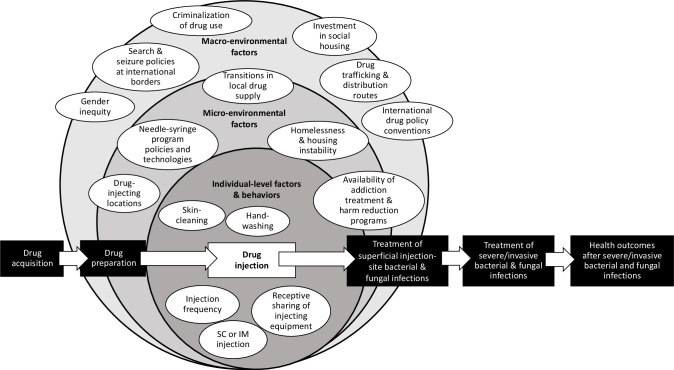
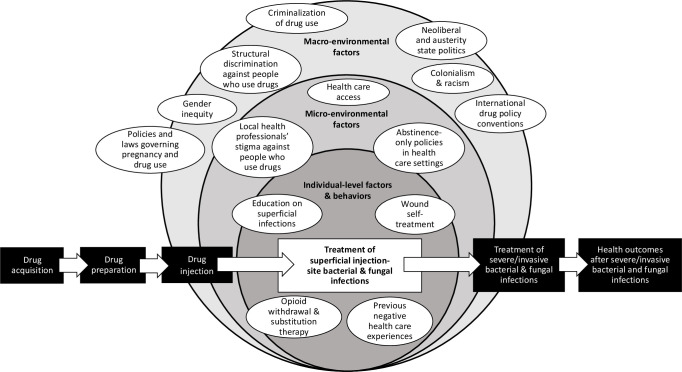
Introduction: Injecting-related bacterial and fungal infections are a common complication among people who inject drugs (PWID), associated with significant morbidity and mortality. Invasive infections, including infective endocarditis, appear to be increasing in incidence. To date, preventive efforts have focused on modifying individual-level risk behaviours (eg, hand-washing and skin-cleaning) without much success in reducing the population-level impact of these infections. Learning from successes in HIV prevention, there may be great value in looking beyond individual-level risk behaviours to the social determinants of health. Specifically, the risk environment conceptual framework identifies how social, physical, economic and political environmental factors facilitate and constrain individual behaviour, and therefore influence health outcomes. Understanding the social and structural determinants of injecting-related bacterial and fungal infections could help to identify new targets for prevention efforts in the face of increasing incidence of severe disease. Methods and analysis: This is a protocol for a systematic review. We will review studies of PWID and investigate associations between risk factors (both individual-level and social/structural-level) and the incidence of hospitalisation or death due to injecting-related bacterial infections (skin and soft-tissue infections, bacteraemia, infective endocarditis, osteomyelitis, septic arthritis, epidural abscess and others). We will include quantitative, qualitative and mixed methods studies. Using directed content analysis, we will code risk factors for these infection-related outcomes according to their contributions to the risk environment in type (social, physical, economic or political) and level (microenvironmental or macroenvironmental). We will also code and present risk factors at each stage in the process of drug acquisition, preparation, injection, superficial infection care, severe infection care or hospitalisation, and outcomes after infection or hospital discharge. Ethics and dissemination: As an analysis of the published literature, no ethics approval is required. The findings will inform a research agenda to develop and implement social/structural interventions aimed at reducing the burden of disease. PROSPERO registration number: CRD42021231411.
Overview
The claims and statistics of this paper haven’t been checked yet.
Run the check — free, no account needed. It reads the open-access text and checks the sources it cites.
Integrity signals
Registry
Cites
Statistics
Figures
Verification
Claims the paper makes
The claims and statistics of this paper haven’t been checked yet.
Run the check — free, no account needed. It reads the open-access text and checks the sources it cites.
Claims other papers make about this one
Each is checked against this paper’s own text: does it say what the citing paper says it does?
In the citing paper
“Suboptimal access to OAT may reflect system-level issues that separate addiction care from specialized, acute medical care for infections [1,22,29,30].”
In the citing paper
“Injection drug use–associated bacterial and fungal infections (e.g., skin and soft-tissue infections, endocarditis, osteomyelitis, septic arthritis, and epidural abscess) are associated with significant morbidity and mortality among people who inject drugs (PWID) and are costly for healthcare systems [1–6].”
In the citing paper
“Prevention efforts to date have focused on individual-level behavior change interventions to promote more sterile drug preparation and safer drug injecting techniques. Unfortunately, these have shown mixed results [18–20] and have had limited impact on a population level [1].”
In the citing paper
“This may be in part because of social and structural factors (e.g., criminalization, discrimination, lack of access to housing, harm reduction services, and supervised injection sites) that constrain the ability of PWID to inject more safely [1,21] and that push PWID away from healthcare [22].”
In the citing paper
“We had only limited information on other social determinants, aside from prior incarceration (reflecting experiences of criminalization and possible unsafe injecting technique while incarcerated) and Aboriginal or Torres Strait Islander status (reflecting experiences of cultural strengths as well as settler colonialism and structural racism) [1].”
In the citing paper
“Second, as this is a study of administrative healthcare data, we have no information on additional factors that may influence risk for these infections, including individual injecting practices, housing status, and access to needle exchange or supervised injection sites [1].”
Self-check
Percentages, sums and reported differences re-computed from the paper’s own numbers.
The self-check needs the paper’s full text.
Citations
Cites
PRISMA-P Group, Moher, D., Shamseer, L., Clarke, M., Ghersi, D., Liberati, A., Petticrew, M., Shekelle, P., & Stewart, L. A. (2015) · Systematic Reviews · doi:10.1186/2046-4053-4-1 · Cited by 26,223
The Mixed Methods Appraisal Tool (MMAT) version 2018 for information professionals and researchers
Hong, Q. N., Fàbregues, S., Bartlett, G., Boardman, F., Cargo, M., Dagenais, P., Gagnon, M.-P., Griffiths, F., Nicolau, B., O’Cathain, A., et al. (2018) · Education for Information · doi:10.3233/efi-180221 · Cited by 4,737
Greenhalgh, T., & Peacock, R. (2005) · BMJ · doi:10.1136/bmj.38636.593461.68 · Cited by 2,045
Pluye, P., & Hong, Q. N. (2014) · Annual Review of Public Health · doi:10.1146/annurev-publhealth-032013-182440 · Cited by 1,363
Risk environments and drug harms: a social science for harm reduction approach
Rhodes, T. (2009) · International Journal of Drug Policy · doi:10.1016/j.drugpo.2008.10.003 · Cited by 948
Using Mixed Methods Research Synthesis for Literature Reviews
Heyvaert, M., Hannes, K., & Onghena, P. (2017) · doi:10.4135/9781506333243 · Cited by 164
Wright, T., Hope, V., Ciccarone, D., Lewer, D., Scott, J., & Harris, M. (2020) · PLOS ONE · doi:10.1371/journal.pone.0235350 · Cited by 59
Self-citationAl-Rawahi, G. N., Schreader, A. G., Porter, S. D., Roscoe, D. L., Gustafson, R., & Bryce, E. A. (2008) · Journal of Clinical Microbiology · doi:10.1128/jcm.01596-07 · Cited by 57
Harris, M., Scott, J., Wright, T., Brathwaite, R., Ciccarone, D., & Hope, V. (2019) · Harm Reduction Journal · doi:10.1186/s12954-019-0330-6 · Cited by 41
Self-citationKudrina, I., Puzhko, S., Filion, K. B., Gore, G., Paraskevopoulos, E., Windle, S., Martel, M. O., & Eisenberg, M. J. (2021) · Systematic Reviews · doi:10.1186/s13643-021-01852-w · Cited by 4
Research works printed but not linked: 84
- 10.1016/j.drugalcdep.2016.11.029 · DOI · Paper page
- Robertson, 2021, Injecting drug use, the skin and vasculature, Addiction, 116, 1914, 10.1111/add.15283 · DOI · Paper page
- Trayner, 2018, A pragmatic harm reduction approach to manage a large outbreak of wound botulism in people who inject drugs, Scotland 2015, Harm Reduct J, 15, 10.1186/s12954-018-0243-9 · DOI
- Wurcel, 2019, Drug-Associated infective endocarditis trends: what"s all the buzz about?, Ann Intern Med, 170, 10.7326/M18-3026 · DOI
- Oh, 2018, Increased mortality and reoperation rates after treatment for septic arthritis of the knee in people who inject drugs: nationwide inpatient sample, 2000-2013, Clin Orthop Relat Res, 476, 1557, 10.1097/01.blo.0000534682.68856.d8 · DOI
- Serota, 2020, Infectious complications of addiction: a call for a new subspecialty within infectious diseases, Clin Infect Dis, 70, 968, 10.1093/cid/ciz804 · DOI
- 10.1111/add.14892 · DOI · Paper page
- Lewer, 2020, Incidence and treatment costs of severe bacterial infections among people who inject heroin: a cohort study in South London, England, Drug Alcohol Depend, 212, 10.1016/j.drugalcdep.2020.108057 · DOI · Paper page
- 10.1503/cmaj.180694 · DOI
- Coverdale, 2019, Rates of infective endocarditis in substance use disorder and associated costs in Ontario, Can J Addict, 10, 36, 10.1097/CXA.0000000000000053 · DOI
- Mosseler, 2020, Epidemiology, microbiology, and clinical outcomes among patients with intravenous drug use-associated infective endocarditis in new Brunswick, CJC Open, 2, 379, 10.1016/j.cjco.2020.05.002 · DOI · Paper page
- Lewer D , Harris M , Hope V . Opiate Injection–Associated skin, soft tissue, and vascular infections, England, UK, 1997–2016. Emerg Infect Dis 2019:1400–3. · DOI · Paper page
- Bates, 2019, Increasing incidence of IV-drug use associated endocarditis in southern West Virginia and potential economic impact, Clin Cardiol, 42, 432, 10.1002/clc.23162 · DOI
- 10.1016/j.jacc.2018.02.011 · DOI
- 10.15585/mmwr.mm6622a1 · DOI
- 10.7326/M18-2124 · DOI
- 10.1093/ofid/ofw157 · DOI
- Barocas, 2020, Long-Term infective endocarditis mortality associated with injection opioid use in the United States: a modeling study, Clin Infect Dis
- Wright, 2018, The current epidemiology of injecting drug Use-Associated infective endocarditis in Victoria, Australia in the midst of increasing crystal methamphetamine use, Heart Lung Circ, 27, 484, 10.1016/j.hlc.2017.03.166 · DOI · Paper page
- Asgeirsson, 2016, Low mortality but increasing incidence of Staphylococcus aureus endocarditis in people who inject drugs: experience from a Swedish referral hospital, Medicine, 95, 10.1097/MD.0000000000005617 · DOI
- 10.1056/NEJMra042823 · DOI · Paper page
- Dwyer, 2009, Prevalences and correlates of non-viral injecting-related injuries and diseases in a convenience sample of Australian injecting drug users, Drug Alcohol Depend, 100, 9, 10.1016/j.drugalcdep.2008.08.016 · DOI · Paper page
- Hope, 2014, Factors associated with recent symptoms of an injection site infection or injury among people who inject drugs in three English cities, Int J Drug Policy, 25, 303, 10.1016/j.drugpo.2013.11.012 · DOI
- Phillips, 2010, Risk practices associated with bacterial infections among injection drug users in Denver, Colorado, Am J Drug Alcohol Abuse, 36, 92, 10.3109/00952991003592311 · DOI
- Roux, 2021, Implementation and evaluation of an educational intervention for safer injection in people who inject drugs in Europe: a multi-country mixed-methods study, Int J Drug Policy, 87, 10.1016/j.drugpo.2020.102992 · DOI · Paper page
- 10.1111/add.15236 · DOI · Paper page
- 10.1097/ACM.0000000000001294 · DOI
- 10.2105/AJPH.2017.304187 · DOI · Paper page
- Okechukwu C , Davison K , Emmons K . Changing Health Behaviors in a Social Context. In: Berkman LF , Kawachi I , Glymour MM , eds. Social epidemiology. Oxford University Press, 2014: 365–95. · DOI
- 10.1016/j.socscimed.2005.08.044 · DOI · Paper page
- 10.1016/S0140-6736(17)31959-1 · DOI
- 10.1016/S0140-6736(10)60743-X · DOI
- 10.1016/S0955-3959(02)00007-5 · DOI · Paper page
- 10.1016/j.socscimed.2004.12.024 · DOI · Paper page
- Collins, 2019, The intersectional risk environment of people who use drugs, Soc Sci Med, 234, 10.1016/j.socscimed.2019.112384 · DOI
- 10.1136/bmj.331.7510.220 · DOI
- 10.1186/1477-7517-10-7 · DOI
- McLean, 2016, "There"s nothing here": Deindustrialization as risk environment for overdose, Int J Drug Policy, 29, 19, 10.1016/j.drugpo.2016.01.009 · DOI
- McNeil, 2014, "Safer environment interventions": a qualitative synthesis of the experiences and perceptions of people who inject drugs, Soc Sci Med, 106, 151, 10.1016/j.socscimed.2014.01.051 · DOI
- 10.1186/s12954-020-00369-0 · DOI
- 10.1016/j.socscimed.2020.113183 · DOI · Paper page
- 10.1007/s11904-018-0390-3 · DOI
- 10.1007/s11524-005-9007-4 · DOI
- Shamseer, 2015, Preferred reporting items for systematic review and meta-analysis protocols (PRISMA-P) 2015: elaboration and explanation, BMJ, 349, 10.1136/bmj.g7647 · DOI · Paper page
- Moola, 2015, Conducting systematic reviews of association (etiology): The Joanna Briggs Institute’s approach, JBI Evid Implement, 13, 163
- Pluye, 2016, Opening-up the definition of systematic literature review: the plurality of worldviews, methodologies and methods for reviews and syntheses, J Clin Epidemiol, 73, 2, 10.1016/j.jclinepi.2015.08.033 · DOI
- Tricco, 2016, Knowledge synthesis methods for integrating qualitative and quantitative data: a scoping review reveals poor operationalization of the methodological steps, J Clin Epidemiol, 73, 29, 10.1016/j.jclinepi.2015.12.011 · DOI
- 10.1258/1355819052801804 · DOI · Paper page
- 10.1111/jan.12000 · DOI
- Rhodes T , Wagner K , Strathdee SA . Structural Violence and Structural Vulnerability Within the Risk Environment: Theoretical and Methodological Perspectives for a Social Epidemiology of HIV Risk Among Injection Drug Users and Sex Workers. In: O’Campo P , Dunn JR , eds. Rethinking social epidemiology: towards a science of change. Dordrecht: Springer Netherlands, 2012: 205–30. · DOI · Paper page
- 10.1016/j.drugpo.2019.10.004 · DOI
- 10.1016/j.drugalcdep.2013.03.009 · DOI
- 10.1093/aje/kwq441 · DOI
- Bundle, 2017, Ongoing outbreak of invasive and non-invasive disease due to group A Streptococcus (gas) type emm66 among homeless and people who inject drugs in England and Wales, January to December 2016, Euro Surveill, 22, 10.2807/1560-7917.ES.2017.22.3.30446 · DOI
- Parikh, 2020, Methicillin-Resistant Staphylococcus aureus Bloodstream Infections and Injection Drug Use, Tennessee, USA, 2015–2017, Emerg Infect Dis, 26, 446, 10.3201/eid2603.191408 · DOI
- 10.1016/j.drugpo.2009.08.003 · DOI
- 10.1097/QAD.0b013e32835221cc · DOI
- Gicquelais, 2020, Prevalence and correlates of providing and receiving assistance with the transition to injection drug use, Epidemiol Rev, 42, 4, 10.1093/epirev/mxaa008 · DOI
- 10.1136/bmjopen-2019-035188 · DOI
- Shah, 2020, Risk factors of infective endocarditis in persons who inject drugs, Harm Reduct J, 17, 10.1186/s12954-020-00378-z · DOI
- Silverman, 2020, Hydromorphone and the risk of infective endocarditis among people who inject drugs: a population-based, retrospective cohort study, Lancet Infect Dis, 20, 487, 10.1016/S1473-3099(19)30705-4 · DOI
- 10.1016/j.drugalcdep.2016.04.009 · DOI
- Yeung, 2017, Assessing the impact of a temporary class drug order on ethylphenidate-related infections among people who inject drugs in Lothian, Scotland: an interrupted time-series analysis, Addiction, 112, 1799, 10.1111/add.13898 · DOI
- Trayner, 2020, Increased risk of HIV and other drug-related harms associated with injecting in public places: national bio-behavioural survey of people who inject drugs, Int J Drug Policy, 77, 10.1016/j.drugpo.2020.102663 · DOI
- 10.1177/1558689818770058 · DOI · Paper page
- 10.1177/1049732305276687 · DOI · Paper page
- Deeks JJ , Higgins JP , Altman DG . Analysing data and undertaking meta-analyses. In: Cochrane Handbook for Systematic Reviews of Interventions. John Wiley & Sons, Ltd, 2019: 241–84. · DOI · Paper page
- 10.1371/journal.pmed.1002680 · DOI
- Bonn, 2020, Addressing the Syndemic of HIV, hepatitis C, overdose, and COVID-19 among people who use drugs: the potential roles for decriminalization and safe supply, J Stud Alcohol Drugs, 81, 556, 10.15288/jsad.2020.81.556 · DOI · Paper page
- 10.1503/cmaj.190430 · DOI
- Bonn M , Touesnard N , Cheng B . Barriers and facilitators to accessing and providing a safe supply of drugs during COVID-19 and beyond: a scoping review. Submitted.
- Brothers, 2020, Implementation and evaluation of a novel, unofficial, trainee-organized Hospital addiction medicine consultation service, Subst Abus, 1-8
- Brothers TD , Webster D . Multidisciplinary infective endocarditis care teams should address substance use disorders and harm reduction services. Open Heart 2018;4 https://openheart.bmj.com/content/4/2/e000699.responses#multidisciplinary-infective-endocarditis-care-teams-should-address-substance-use-disorders-and-harm-reduction-services
- 10.1503/cmaj.202124 · DOI · Paper page
- Friedman, 2020, The Opioid/Overdose crisis as a Dialectics of pain, despair, and one-sided struggle, Front Public Health, 8, 540423, 10.3389/fpubh.2020.540423 · DOI
- McCall, 2019, Sowing a seed of safety: providing culturally safe care in acute care settings for people who use drugs, JMHAN, 3, e1, 10.22374/jmhan.v3i1.33 · DOI
- Lennox, 2021, Hospital policy as a harm reduction intervention for people who use drugs, Int J Drug Policy, 97, 10.1016/j.drugpo.2021.103324 · DOI
- Turner, 2020, Numerous outbreaks amongst homeless and injection drug-using populations raise concerns of an evolving syndemic in London, Canada, Epidemiol Infect, 148, 10.1017/S0950268820001260 · DOI
- Buchanan, 2019, Making the cut: perspectives on the surgical management of infective endocarditis among people who use intravenous drugs, Can J Cardiol, 35, 1416
- 10.1111/j.1360-0443.2011.03749.x · DOI
- Friedman, 1998, Networks and HIV risk: an introduction to social network analysis for harm reductionists, Int J Drug Policy, 9, 461, 10.1016/S0955-3959(98)00062-0 · DOI
- 10.1086/383471 · DOI
- 10.3201/eid1808.111343 · DOI
- Pantell, 2020, A call for social informatics, J Am Med Inform Assoc, 27, 1798, 10.1093/jamia/ocaa175 · DOI
Cited by
Sorted by citations
Brothers, T. D., Lewer, D., Jones, N., Colledge-Frisby, S., Farrell, M., Hickman, M., Webster, D., Hayward, A., & Degenhardt, L. (2022) · PLOS Medicine · doi:10.1371/journal.pmed.1004049 · Cited by 25
Self-citation
Metadata
- Authors
- Brothers, T. D., Lewer, D., Bonn, M., Webster, D., & Harris, M.
- Affiliations
- UCL Collaborative Centre for Inclusion Health, Institue of Epidemiology and Health Care, University College London, London, UK
- Canadian Association of People Who Use Drugs, Dartmouth, Nova Scotia, Canada
- Department of Medicine, Dalhousie University, Halifax, Nova Scotia, Canada
- Department of Public Health, Environments and Society, London School of Hygiene & Tropical Medicine, London, UK
- Venue
- BMJ Open
- Publisher
- BMJ
- Published
- 2021-08
- Volume
- 11
- Issue
- 8
- Pages
- e049924
- ISSN
- 2044-6055
- PMC
- PMC8354281
- Cited by
- 16
- References
- 10
- Language
- en
- Funders
- Dalhousie University Faculty of Medicine (Killam Scholarship, Clinician Investigator Program)
- National Institute for Health Research (CDF-2016-09-014, DRF-2018-11-ST2-016)
- Dalhousie University Internal Medicine Research Foundation (Internal Fellowship)
- Canadian Institutes of Health Research (FRN# 171259)
- National Institute on Drug Abuse (R25DA033211)
About these checks
Registry, retraction, Cites and statistics results are computed, not judged, with one exception: a printed reference that no index lists is read once by a model before it counts as a citation error. Claims are extracted by a model and kept only when their quote appears verbatim in the text; each cited source is then checked, with a model’s help, for whether it says what the claim relies on. Those verdicts can be wrong — read the claim’s quote and the cited source before relying on one.
Statistics and arithmetic are recomputed, not judged.
Confidence bands are shown only for fields calibrated on our annotated test set. None is calibrated yet, so no band is shown.
What counts as a claim ›How we measure confidence ›How we check this ›
Are you an author, or do you see a problem with this page? Request a review
