

The frequency of diagnostic errors in outpatient care: estimations from three large observational studies involving US adult populations
Open accessThe DOI matches its Crossref record; 28 of the 28 references it cites were found in a registry or an index.
Abstract
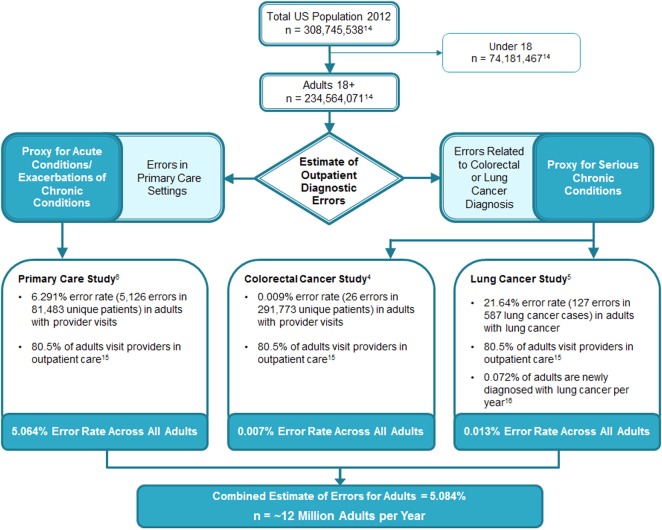
Background: The frequency of outpatient diagnostic errors is challenging to determine due to varying error definitions and the need to review data across multiple providers and care settings over time. We estimated the frequency of diagnostic errors in the US adult population by synthesising data from three previous studies of clinic-based populations that used conceptually similar definitions of diagnostic error. Methods: Data sources included two previous studies that used electronic triggers, or algorithms, to detect unusual patterns of return visits after an initial primary care visit or lack of follow-up of abnormal clinical findings related to colorectal cancer, both suggestive of diagnostic errors. A third study examined consecutive cases of lung cancer. In all three studies, diagnostic errors were confirmed through chart review and defined as missed opportunities to make a timely or correct diagnosis based on available evidence. We extrapolated the frequency of diagnostic error obtained from our studies to the US adult population, using the primary care study to estimate rates of diagnostic error for acute conditions (and exacerbations of existing conditions) and the two cancer studies to conservatively estimate rates of missed diagnosis of colorectal and lung cancer (as proxies for other serious chronic conditions). Results: Combining estimates from the three studies yielded a rate of outpatient diagnostic errors of 5.08%, or approximately 12 million US adults every year. Based upon previous work, we estimate that about half of these errors could potentially be harmful. Conclusions: Our population-based estimate suggests that diagnostic errors affect at least 1 in 20 US adults. This foundational evidence should encourage policymakers, healthcare organisations and researchers to start measuring and reducing diagnostic errors.
Overview
The claims and statistics of this paper haven’t been checked yet.
Free: it reads the open-access text and checks the first 5 claims that cite a source we can check. Create a free account to check every claim.
Integrity signals
Registry
Cites
Statistics
Figures
Verification
Claims the paper makes
The claims and statistics of this paper haven’t been checked yet.
Free: it reads the open-access text and checks the first 5 claims that cite a source we can check. Create a free account to check every claim.
Claims other papers make about this one
Each is checked against this paper’s own text: does it say what the citing paper says it does?
The source backs part of the claim, not all of it — or backs it for a different population, condition or comparison.
In the citing paper
“Approximately 5% of patients in U.S. outpatient settings suffer from diagnostic errors [8]”
From Toward Safer Diagnoses: A SEIPS-Based Narrative Review of Diagnostic Errors (2026) · cites this paper as [8]
Experimental — accuracy not yet measuredIn the citing paper
“The opportunity costs of not using our best available tools for disease detection and treatment are substantial-12 million people a year receive misdiagnoses in the United States, with about six million facing potential harm as a result. 17”
From Clinical applications of machine learning algorithms: beyond the black box (2019) · cites this paper as [17]
In the citing paper
“The opportunity costs of not using our best available tools for disease detection and treatment are substantial-12 million people a year receive misdiagnoses in the United States, with about six million facing potential harm as a result. 17”
From Clinical applications of machine learning algorithms: beyond the black box (2019) · cites this paper as [17]
Self-check
Percentages, sums and reported differences re-computed from the paper’s own numbers.
The self-check needs the paper’s full text.
Citations
Cites
Summary health statistics for U.S. adults: national health interview survey, 2012.
Blackwell, D. L., Lucas, J. W., & Clarke, T. C. (2014) · PubMed · Cited by 1,884
Incidence and Types of Adverse Events and Negligent Care in Utah and Colorado
Thomas, E. J., Studdert, D. M., Burstin, H. R., Orav, E. J., Zeena, T., Williams, E. J., Howard, K. M., Weiler, P. C., & Brennan, T. A. (2000) · Medical Care · doi:10.1097/00005650-200003000-00003 · Cited by 1,673
Self-citationClinical Reasoning in the Health Professions
Higgs, J., & Jones, M. A. (2000) · Cited by 920
Summary health statistics for U.S. adults: National Health Interview Survey, 2010.
Schiller, J. S., Lucas, J. W., Ward, B. W., & Peregoy, J. A. (2012) · PubMed · Cited by 760
Missed and delayed diagnoses in the ambulatory setting: a study of closed malpractice claims
Gandhi, T. K., Kachalia, A., Thomas, E. J., Puopolo, A. L., Yoon, C., Brennan, T. A., & Studdert, D. M. (2006) · Annals of Internal Medicine · doi:10.7326/0003-4819-145-7-200610030-00006 · Cited by 662 · cited 1×
“11 20 23 – 25 On the other hand, population-based studies have relied on medical record reviews, which are generally a gold standard for determining diagnostic error.”
BackgroundSelf-citationDiagnostic Error in Medicine: Analysis of 583 Physician-Reported Errors
Schiff, G. D. (2009) · Archives of Internal Medicine · doi:10.1001/archinternmed.2009.333 · Cited by 638 · cited 1×
“5 7 – 12 In many of these studies, lung cancer and CRC are the most common cancers for which diagnosis is delayed.”
BackgroundThe incidence of diagnostic error in medicine
Graber, M. L. (2013) · BMJ Quality & Safety · doi:10.1136/bmjqs-2012-001615 · Cited by 626
Types and Origins of Diagnostic Errors in Primary Care Settings
Singh, H., Giardina, T. D., Meyer, A. N. D., Forjuoh, S. N., Reis, M. D., & Thomas, E. J. (2013) · JAMA Internal Medicine · doi:10.1001/jamainternmed.2013.2777 · Cited by 559 · cited 2×
“Based on our previous work, 17 we estimated that about one-half of errors would have the potential to lead to severe harm.”
BackgroundSelf-citationMeasuring errors and adverse events in health care
Thomas, E. J., & Petersen, L. A. (2003) · Journal of General Internal Medicine · doi:10.1046/j.1525-1497.2003.20147.x · Cited by 455 · cited 1×
“11 20 23 – 25 On the other hand, population-based studies have relied on medical record reviews, which are generally a gold standard for determining diagnostic error.”
BackgroundSelf-citationThe Vanishing Nonforensic Autopsy
Shojania, K. G., & Burton, E. C. (2008) · New England Journal of Medicine · doi:10.1056/nejmp0707996 · Cited by 294
Jones, R., Latinovic, R., Charlton, J., & Gulliford, M. C. (2007) · BMJ · doi:10.1136/bmj.39171.637106.ae · Cited by 251
Phillips, R. L. (2004) · Quality and Safety in Health Care · doi:10.1136/qshc.2003.008029 · Cited by 233
Singh, H., Thomas, E. J., Mani, S., Sittig, D., Arora, H., Espadas, D., Khan, M. M., & Petersen, L. A. (2009) · Archives of Internal Medicine · doi:10.1001/archinternmed.2009.263 · Cited by 212
Self-citationDiagnostic Difficulty and Error in Primary Care—A Systematic Review
Kostopoulou, O., Delaney, B. C., & Munro, C. W. (2008) · Family Practice · doi:10.1093/fampra/cmn071 · Cited by 200 · cited 1×
“27 For example, a recent study from the UK suggests that opportunities to diagnose chronic obstructive pulmonary disease at an earlier stage are being missed in the majority of cases.”
BackgroundJones, R. C. M., Price, D., Ryan, D., Sims, E. J., von Ziegenweidt, J., Mascarenhas, L., Burden, A., Halpin, D. M. G., Winter, R., Hill, S., et al. (2014) · The Lancet Respiratory Medicine · doi:10.1016/s2213-2600(14)70008-6 · Cited by 198
Clinical reasoning in medicine.
Elstein, A. S. (1995) · Medical Entomology and Zoology · Cited by 143
Errors of Diagnosis in Pediatric Practice: A Multisite Survey
Singh, H., Thomas, E. J., Wilson, L., Kelly, P. A., Pietz, K., Elkeeb, D., & Singhal, G. (2010) · Pediatrics · doi:10.1542/peds.2009-3218 · Cited by 135
Self-citationSingh, H., Hirani, K., Kadiyala, H., Rudomiotov, O., Davis, T., Khan, M. M., & Wahls, T. L. (2010) · Journal of Clinical Oncology · doi:10.1200/jco.2009.25.6636 · Cited by 132 · cited 1×
“As a proxy for such errors in out-patient care, we obtained frequency estimates for missed and delayed diagnosis of CRC and lung cancer, represented in the two cancer studies, 4 5 respectively.”
MethodSelf-citationElectronic Health Record-Based Surveillance of Diagnostic Errors in Primary Care
Singh, H., Giardina, T. D., Forjuoh, S. N., Reis, M. D., Kosmach, S., Khan, M. M., & Thomas, E. J. (2012) · BMJ Quality & Safety · doi:10.1136/bmjqs-2011-000304 · Cited by 131 · cited 1×
“The triggers in the primary care study 6 were based on the occurrence of unexpected return visits and were therefore selective for misdiagnosis of acute conditions and exacerbations of chronic conditions.”
BackgroundSelf-citationElectronic health record-based triggers to detect potential delays in cancer diagnosis
Murphy, D. R., Laxmisan, A., Reis, B. A., Thomas, E. J., Esquivel, A., Forjuoh, S. N., Parikh, R., Khan, M. M., & Singh, H. (2014) · BMJ Quality & Safety · doi:10.1136/bmjqs-2013-001874 · Cited by 124 · cited 1×
“As a proxy for such errors in out-patient care, we obtained frequency estimates for missed and delayed diagnosis of CRC and lung cancer, represented in the two cancer studies, 4 5 respectively.”
MethodSelf-citationMissed Opportunities to Initiate Endoscopic Evaluation for Colorectal Cancer Diagnosis
Singh, H., Daci, K., Petersen, L. A., Collins, C., Petersen, N. J., Shethia, A., & El-Serag, H. B. (2009) · The American Journal of Gastroenterology · doi:10.1038/ajg.2009.324 · Cited by 117
Self-citationIdentifying Diagnostic Errors in Primary Care Using an Electronic Screening Algorithm
Singh, H. (2007) · Archives of Internal Medicine · doi:10.1001/archinte.167.3.302 · Cited by 107
Self-citationElectronic Health Record: Implementation Across the Michigan Academic Consortium
BOSTROM, A. C., SCHAFER, P., DONTJE, K., POHL, J. M., NAGELKERK, J., & CAVANAGH, S. J. (2006) · CIN: Computers, Informatics, Nursing · doi:10.1097/00024665-200601000-00011 · Cited by 102
Primary Care Closed Claims Experience of Massachusetts Malpractice Insurers
Schiff, G. D., Puopolo, A. L., Huben-Kearney, A., Yu, W., Keohane, C., McDonough, P., Ellis, B. R., Bates, D. W., & Biondolillo, M. (2013) · JAMA Internal Medicine · doi:10.1001/jamainternmed.2013.11070 · Cited by 84 · cited 1×
“5 7 – 12 In many of these studies, lung cancer and CRC are the most common cancers for which diagnosis is delayed.”
BackgroundUsing a Multifaceted Approach to Improve the Follow-Up of Positive Fecal Occult Blood Test Results
Singh, H., Kadiyala, H., Bhagwath, G., Shethia, A., El-Serag, H., Walder, A., Velez, M. E., & Petersen, L. A. (2009) · The American Journal of Gastroenterology · doi:10.1038/ajg.2009.55 · Cited by 63
Self-citationMedical Diagnoses Commonly Associated With Pediatric Malpractice Lawsuits in the United States
McAbee, G. N., Donn, S. M., Mendelson, R. A., McDonnell, W. M., Gonzalez, J. L., & Ake, J. K. (2008) · PEDIATRICS · doi:10.1542/peds.2008-1594 · Cited by 59
Diagnostic errors in ambulatory care: dimensions and preventive strategies
Singh, H., & Weingart, S. N. (2009) · Advances in Health Sciences Education · doi:10.1007/s10459-009-9177-z · Cited by 40
Self-citationProcess of Care Failures in Breast Cancer Diagnosis
Weingart, S. N., Saadeh, M. G., Simchowitz, B., Gandhi, T. K., Nekhlyudov, L., Studdert, D. M., Puopolo, A. L., & Shulman, L. N. (2009) · Journal of General Internal Medicine · doi:10.1007/s11606-009-0982-0 · Cited by 29
Cited by
High-performance medicine: the convergence of human and artificial intelligence
Topol, E. J. (2019) · Nature Medicine · doi:10.1038/s41591-018-0300-7 · Cited by 10,450
An overview of clinical decision support systems: Benefits, risks, and strategies for success
Sutton, R. T., Pincock, D., Baumgart, D. C., Sadowski, D. C., Fedorak, R. N., & Kroeker, K. I. (2020) · npj Digital Medicine · doi:10.1038/s41746-020-0221-y · Cited by 3,019
“52 We are now seeing diagnostic systems being developed with non-knowledge-based techniques like machine learning, which may pave the way for more accurate diagnosis.”
Background(2017) · OECD Health Working Papers · doi:10.1787/5a9858cd-en · Cited by 616
“It is estimated that about 5% of adult patients in the United States experience diagnostic errors in outpatient settings (Singh et al, 2014).”
BackgroundImproving the accuracy of medical diagnosis with causal machine learning
Richens, J. G., Lee, C. M., & Johri, S. (2020) · Nature Communications · doi:10.1038/s41467-020-17419-7 · Cited by 598
Clinical applications of machine learning algorithms: beyond the black box
Watson, D. S., Krutzinna, J., Bruce, I. N., Griffiths, C. E., McInnes, I. B., Barnes, M. R., & Floridi, L. (2019) · BMJ · doi:10.1136/bmj.l886 · Cited by 450
Metadata
- Authors
- Singh, H., Meyer, A. N. D., & Thomas, E. J.
- Affiliations
- Michael E. DeBakey VA Medical Center (US)
- Memorial Hermann (US)
- Corresponding author
- Singh, Hardeep
- Venue
- BMJ Quality & Safety
- Publisher
- BMJ
- Published
- 2014-04-17
- Volume
- 23
- Issue
- 9
- Pages
- 727-731
- ISSN
- 1475-3898 (ISSN-L)
- 2044-5415
- 2044-5423
- PMC
- PMC4145460
- OpenAlex
- W2154651644
- Cited by
- 677
- References
- 28
- Citations by year
- 2026: 61 · 2025: 67 · 2024: 70 · 2023: 77 · 2022: 75 · 2021: 89 · 2020: 68 · 2019: 41 · 2018: 34 · 2017: 32 · 2016: 26 · 2015: 26 · 2014: 8
- FWCI
- 31.48
- Type
- journal article
- Language
- en
- Open access
- hybrid
- doi.org
- Licence
- cc-by-nc
- Locations
- BMJ Quality & Safety (publishedVersion, cc-by-nc)
- PubMed Central (publishedVersion, cc-by-nc)
- PubMed (publishedVersion)
- HighWire Press Open Archive (submittedVersion)
- Funders
- National Institutes of Health (UL1TR000371, CIN13-413)
- Agency for Healthcare Research and Quality (R18HS017244, R18HS017820)
- Center for Innovations in Quality, Effectiveness and Safety (CIN 13–413, 13–413)
- National Cancer Institute (K23CA125585)
- National Center for Advancing Translational Sciences
- Topics
- Health Sciences › Medicine › Family Practice › Clinical Reasoning and Diagnostic Skills
- Health Sciences › Medicine › Public Health, Environmental and Occupational Health › Patient Safety and Medication Errors
- Health Sciences › Medicine › Family Practice › Primary Care and Health Outcomes
- Keywords
- diagnostic errors, outpatient care, missed diagnosis, primary care, return visits, colorectal cancer, lung cancer
- MeSH terms
- Adult, Ambulatory Care, Diagnostic Errors, Humans, Lung Neoplasms, United States, Colorectal Neoplasms
About these checks
Registry, retraction, Cites and statistics results are computed, not judged, with one exception: a printed reference that no index lists is read once by a model before it counts as a citation error. Claims are extracted by a model and kept only when their quote appears verbatim in the text; each cited source is then checked, with a model’s help, for whether it says what the claim relies on. Those verdicts can be wrong — read the claim’s quote and the cited source before relying on one.
Statistics and arithmetic are recomputed, not judged.
Confidence bands are shown only for fields calibrated on our annotated test set. None is calibrated yet, so no band is shown.
What counts as a claim ›How we measure confidence ›How we check this ›
Are you an author, or do you see a problem with this page? Request a review
Data sources
Bibliographic data: Semantic Scholar, OpenAlex, Crossref.
Contains information from the Semantic Scholar Academic Graph Datasets, made available under the ODC Attribution License (ODC-BY 1.0).
Semantic Scholar’s data is described in: Kinney, R., et al. (2023). The Semantic Scholar Open Data Platform. arXiv:2301.10140.
