

National improvements in resident physician-reported patient safety after limiting first-year resident physicians’ extended duration work shifts: a pooled analysis of prospective cohort studies
Open accessThe DOI matches its Crossref record; 43 of the 43 references it cites were found in a registry or an index; 17 of the 41 sources its claims cite were checked for support.
Abstract
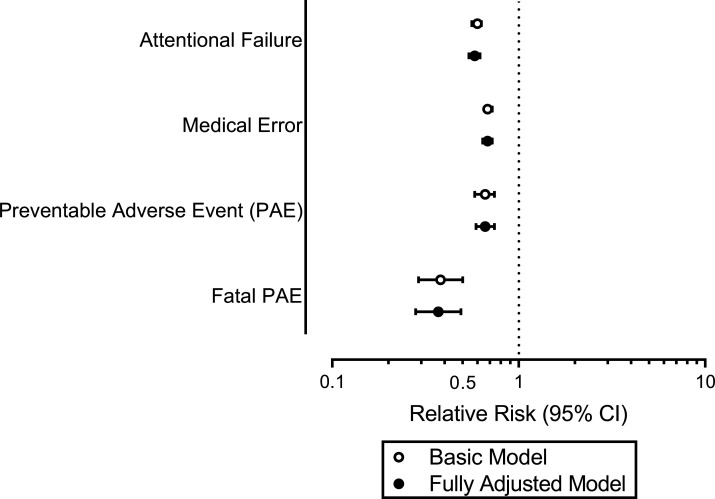
Background: The Accreditation Council for Graduate Medical Education (ACGME) enacted a policy in 2011 that restricted first-year resident physicians in the USA to work no more than 16 consecutive hours. This was rescinded in 2017. Methods: We conducted a nationwide prospective cohort study of resident physicians for 5 academic years (2002–2007) before and for 3 academic years (2014–2017) after implementation of the 16 hours 2011 ACGME work-hour limit. Our analyses compare trends in resident physician-reported medical errors between the two cohorts to evaluate the impact of this policy change. Results: 14 796 residents provided data describing 78 101 months of direct patient care. After adjustment for potential confounders, the work-hour policy was associated with a 32% reduced risk of resident physician-reported significant medical errors (rate ratio (RR) 0.68; 95% CI 0.64 to 0.72), a 34% reduced risk of reported preventable adverse events (RR 0.66; 95% CI 0.59 to 0.74) and a 63% reduced risk of reported medical errors resulting in patient death (RR 0.37; 95% CI 0.28 to 0.49). Conclusions: These findings have broad relevance for those who work in and receive care from academic hospitals in the USA. The decision to lift this work hour policy in 2017 may expose patients to preventable harm.
Overview
CoChat Summary
TL;DR
In a pooled analysis of nationwide prospective cohort studies, the 2011 ACGME policy limiting first-year resident physicians to 16 consecutive work hours was associated with reduced resident-reported significant medical errors, preventable adverse events, and fatal errors. The authors conclude that lifting the policy in 2017 may expose patients to preventable harm.
Key findings
- Among 14,796 residents reporting 78,101 months of direct patient care, the work-hour policy was associated with a 32% reduced risk of resident-reported significant medical errors (RR 0.68; 95% CI 0.64 to 0.72), a 34% reduced risk of preventable adverse events (RR 0.66; 95% CI 0.59 to 0.74), and a 63% reduced risk of medical errors resulting in patient death (RR 0.37; 95% CI 0.28 to 0.49).
- Patient-care-related attentional failures were reduced by more than 40% (IRR 0.58; 95% CI 0.54 to 0.62). Weekly work hours decreased from 71 hours (SD 18) to 62 hours (SD 17), and extended duration shifts per month decreased from 4.0 (SD 3.4) to 0.2 (SD 1.2), while hours engaged in patient care remained similar (50 vs 49 hours).
- Independent of cohort, working >80 hours per week and working extended duration shifts were each associated with increased risk of resident-reported adverse outcomes; for example, compared with ≤60 weekly hours, >80 hours was associated with medical errors (RR 3.58; 95% CI 3.36 to 3.82), preventable adverse events (RR 3.89; 95% CI 3.27 to 4.63), and fatal preventable adverse events (RR 2.39; 95% CI 1.59 to 3.59).
Methods
- Nationwide prospective cohort studies of resident physicians were conducted for 5 academic years before the policy (2002–2007) and 3 academic years after implementation (2014–2017); data were not available for transition years (2008–2013).
- Monthly reports collected demographics, work hours, extended duration shifts, hours in patient care, self-reported significant medical errors, preventable adverse events, fatal errors, and attentional failures. After exclusions, 14,796 individual residents reporting on 78,101 months with direct patient care were included.
- Analyses used generalized linear mixed models and incidence rate ratios, with fully adjusted models controlling for age, gender, specialty programme, university-based versus community hospital, an imputation indicator, and hours of patient care that month. Secondary pooled analyses examined weekly work hours and extended duration shifts independent of cohort.
Limitations
- The authors state that the study was observational, so findings cannot be directly attributed to the 2011 ACGME work-hour restrictions, and residual confounding or other bias may affect the estimated associations.
- The authors state that medical errors were self-reported and could be subject to social desirability bias, recall bias, or erroneous self-observation; they note this likely makes estimates conservative and biases results toward the null.
- The authors state that participants included 9% of all first-year US medical residents from 2002 to 2007 and 18% from 2014 to 2017, and that participants may differ from non-respondents in ways not captured; they also note that some reductions may be attributable to secular trends, though they argue most studies did not find temporal reductions in harm that could explain the results.
Model-written summary. Check it against the paper before relying on it.
Integrity signals
Registry
Cites
Statistics
Figures
Verification
Claims the paper makes
14 Valid · 1 Not valid · 10 Not checked · 53 Own results and interpretations
The cited sources support only part of this claim — read each source’s verdict below.
In the paper
“A limitation of several studies that informed this latest policy change is that the primary end points lacked sensitivity (eg, hospital-wide mortality) or were only tangentially related to the care provided by first-year resident physicians”
§ National improvements in resident physician-reported patient safety after limiting first-year resident physicians’ extended duration work shifts: a pooled analysis of prospective cohort studies > Introduction
What the sources say
- Not checked yetcites [18] Patel MS, Volpp KG, Small DS, et al. Association of the 2011 ACGME resident duty hour reforms with mortality and readmissions among hospitalized Medicare patients. JAMA 2014; 312: 2364– 73. 10.1001/jama.2014.15273 25490327 PMC5546100 source
Checked before — its earlier verdict is held back until a new check runs.
- Partly supportedcites [19] Bilimoria KY, Chung JW, Hedges LV, et al. National cluster-randomized trial of duty-hour flexibility in surgical training. N Engl J Med 2016; 374: 713– 27. 10.1056/NEJMoa1515724 26836220 sourceExperimental — accuracy not yet measured
The Discussion (page unavailable) acknowledges that the trial’s patient outcomes may be less sensitive to duty-hour policies than outcomes it did not collect, such as medication errors. The Measures section (page unavailable) identifies postoperative death or serious complications as this trial’s primary patient outcome. The paper does not establish that several studies informing the policy change had insensitive endpoints, or characterize that outcome as only tangentially related to care by first-year residents. (LLM, conf=0.83)
- Not checked — no full text of the sourcecites [20] Silber JH, Bellini LM, Shea JA, et al. Patient safety outcomes under flexible and standard resident duty-hour rules. N Engl J Med 2019; 380: 905– 14. 10.1056/NEJMoa1810642 30855740 PMC6476299 source
plain- Asserted: passes — The authors put it forward as true.
- Checkable: passes — It can be checked against evidence.
- Load-bearing: passes — The paper’s conclusions depend on it.
- Based: passes — The paper gives a reason why it holds.
- Not checked yet
Every source the paper cites for this claim was checked and supports it.
In the paper
“While the demographic characteristics of participants in this sample are similar to the demographic characteristics of resident physicians nationally (online supplemental table 3),21”
§ National improvements in resident physician-reported patient safety after limiting first-year resident physicians’ extended duration work shifts: a pooled analysis of prospective cohort studies > Discussion
What the sources say
- Supportedcites [21] Weaver MD, Landrigan CP, Sullivan JP, et al. The association between resident physician Work-Hour regulations and physician safety and health. Am J Med 2020; 133: e343– 54. 10.1016/j.amjmed.2019.12.053 32061733 PMC7469904 source
The Discussion explicitly states that participants’ demographic characteristics were similar to those of resident physicians nationally (Appendix Table 4). Appendix Table 4 compares the study sample with national first-year resident data. (LLM, conf=0.95)
plain- Asserted: passes — The authors put it forward as true.
- Checkable: passes — It can be checked against evidence.
- Load-bearing: passes — The paper’s conclusions depend on it.
- Based: passes — The paper gives a reason why it holds.
- Supported
Every source the paper cites for this claim was checked and supports it.
In the paper
“Subsequent evaluations found that shifts of 24 or more hours were associated with increased odds of fatigue-related medical errors and preventable adverse events (PAEs),3 percutaneous injuries4 and motor vehicle crashes.5”
§ National improvements in resident physician-reported patient safety after limiting first-year resident physicians’ extended duration work shifts: a pooled analysis of prospective cohort studies > Introduction
What the sources say
- Supportedcites [5] Barger LK, Cade BE, Ayas NT, et al. Extended work shifts and the risk of motor vehicle crashes among interns. N Engl J Med 2005; 352: 125– 34. 10.1056/NEJMoa041401 15647575 source
The Abstract defines extended shifts as at least 24 hours and reports higher odds of a motor vehicle crash after an extended shift than after a nonextended shift (odds ratio 2.3). The “motor vehicle crashes” section reports the same association for interns commuting from work. (LLM, conf=0.95)
plainstates an association- Asserted: passes — The authors put it forward as true.
- Checkable: passes — It can be checked against evidence.
- Load-bearing: passes — The paper’s conclusions depend on it.
- Based: passes — The paper gives a reason why it holds.
- Supported
Every source the paper cites for this claim was checked and supports it.
In the paper
“Subsequent evaluations found that shifts of 24 or more hours were associated with increased odds of fatigue-related medical errors and preventable adverse events (PAEs)”
§ National improvements in resident physician-reported patient safety after limiting first-year resident physicians’ extended duration work shifts: a pooled analysis of prospective cohort studies > Introduction
What the sources say
- Supportedcites [3] Barger LK, Ayas NT, Cade BE, et al. Impact of extended-duration shifts on medical errors, adverse events, and attentional failures. PLoS Med 2006; 3: e487. 10.1371/journal.pmed.0030487 17194188 PMC1705824 source
The Discussion defines extended-duration shifts as 24 hours or longer. The Significant Medical Errors and Preventable Adverse Events section reports higher odds of fatigue-related significant medical errors and preventable adverse events in months with extended-duration shifts than in months without them. The study concerns interns and their reported outcomes. (LLM, conf=0.94)
plainstates an association- Asserted: passes — The authors put it forward as true.
- Checkable: passes — It can be checked against evidence.
- Load-bearing: passes — The paper’s conclusions depend on it.
- Based: passes — The paper gives a reason why it holds.
- Supported
The cited sources support only part of this claim — read each source’s verdict below.
In the paper
“In addition to these two trials, prior retrospective studies using administrative data similarly concluded that the 16 hours 2011 ACGME work-hour limit did not appreciably impact hospital-level mortality or process of care measures,16 18 28”
§ National improvements in resident physician-reported patient safety after limiting first-year resident physicians’ extended duration work shifts: a pooled analysis of prospective cohort studies > Discussion
What the sources say
- Not checked — no full text of the sourcecites [16] Rajaram R, Chung JW, Jones AT, et al. Association of the 2011 ACGME resident duty hour reform with general surgery patient outcomes and with resident examination performance. JAMA 2014; 312: 2374– 84. 10.1001/jama.2014.15277 25490328 source
- Not checked yetcites [18] Patel MS, Volpp KG, Small DS, et al. Association of the 2011 ACGME resident duty hour reforms with mortality and readmissions among hospitalized Medicare patients. JAMA 2014; 312: 2364– 73. 10.1001/jama.2014.15273 25490327 PMC5546100 source
Checked before — its earlier verdict is held back until a new check runs.
- Partly supportedcites [28] Scally CP, Ryan AM, Thumma JR, et al. Early impact of the 2011 ACGME duty hour regulations on surgical outcomes. Surgery 2015; 158: 1453– 61. 10.1016/j.surg.2015.05.002 26054323 PMC4637214 sourceExperimental — accuracy not yet measured
The Methods and Discussion (page not provided) describe a retrospective analysis of Medicare administrative data and report no change in measured surgical patient outcomes after the 2011 regulations, including 30-day mortality. The paper identifies the 16-hour limit as applying to first-year residents, but its listed outcomes do not include process-of-care measures; it also evaluates the regulations as a whole rather than isolating that limit. (LLM, conf=0.87)
plain- Asserted: passes — The authors put it forward as true.
- Checkable: passes — It can be checked against evidence.
- Load-bearing: passes — The paper’s conclusions depend on it.
- Based: passes — The paper gives a reason why it holds.
36 more claims · 1 with their cited sources checked
Create a free account to see all 78 claims and to verify the 3 references still open.
- It may state two separate claims as one. 22
- Probably not a substantial claim. 20
Self-check
Percentages, sums and reported differences re-computed from the paper’s own numbers.
Each contradiction between two passages listed here was confirmed by an independent check.
Rated minor: it would not touch a result — a value no result rests on, a p-value that stays on the same side of the significance level, or a conflict that is clerical, resolved elsewhere in the paper, or outside its own findings.
In the paper
§ National improvements in resident physician-reported patient safety after limiting first-year resident physicians’ extended duration work shifts: a pooled analysis of prospective cohort studies > Methods > Statistical analysis
“We used generalised linear mixed models with a binomial distribution and log-link function to estimate the risk of each outcome.”
§ National improvements in resident physician-reported patient safety after limiting first-year resident physicians’ extended duration work shifts: a pooled analysis of prospective cohort studies > Results > Incidence and adjusted risk of resident physician-reported adverse safety outcomes following the 16 hours 2011 ACGME work-hour limit
“All models are generalised linear mixed models with a binomial distribution and logit link function.”
Citations
Cites
Medical error—the third leading cause of death in the US
Makary, M. A., & Daniel, M. (2016) · BMJ · doi:10.1136/bmj.i2139 · Cited by 3,264
Effect of Reducing Interns' Work Hours on Serious Medical Errors in Intensive Care Units
Landrigan, C. P., Rothschild, J. M., Cronin, J. W., Kaushal, R., Burdick, E., Katz, J. T., Lilly, C. M., Stone, P. H., Lockley, S. W., Bates, D. W., et al. (2004) · New England Journal of Medicine · doi:10.1056/nejmoa041406 · Cited by 1,760 · cited 1×
“Following implementation of the 2011 ACGME work-hour restrictions, we found that first-year resident physicians reported making fewer significant medical errors, errors resulting in patient harm and errors”
Self-citationWest, C. P., Huschka, M. M., Novotny, P. J., Sloan, J. A., Kolars, J. C., Habermann, T. M., & Shanafelt, T. D. (2006) · JAMA · doi:10.1001/jama.296.9.1071 · Cited by 1,454
Temporal Trends in Rates of Patient Harm Resulting from Medical Care
Landrigan, C. P., Parry, G. J., Bones, C. B., Hackbarth, A. D., Goldmann, D. A., & Sharek, P. J. (2010) · New England Journal of Medicine · doi:10.1056/nejmsa1004404 · Cited by 1,144 · cited 1×
“Following implementation of the 2011 ACGME work-hour restrictions, we found that first-year resident physicians reported making fewer significant medical errors, errors resulting in patient harm and errors”
Self-citationClassen, D. C., Resar, R., Griffin, F., Federico, F., Frankel, T., Kimmel, N., Whittington, J. C., Frankel, A., Seger, A., & James, B. C. (2011) · Health Affairs · doi:10.1377/hlthaff.2011.0190 · Cited by 1,027 · cited 1×
“6 38 By using self-report, our estimates for medical errors are likely to be conservative, which would bias our results towards the null.”
ResultExtended Work Shifts and the Risk of Motor Vehicle Crashes among Interns
Barger, L. K., Cade, B. E., Ayas, N. T., Cronin, J. W., Rosner, B., Speizer, F. E., & Czeisler, C. A. (2005) · New England Journal of Medicine · doi:10.1056/nejmoa041401 · Cited by 928
Self-citationEffect of Reducing Interns' Weekly Work Hours on Sleep and Attentional Failures
Lockley, S. W., Cronin, J. W., Evans, E. E., Cade, B. E., Lee, C. J., Landrigan, C. P., Rothschild, J. M., Katz, J. T., Lilly, C. M., Stone, P. H., et al. (2004) · New England Journal of Medicine · doi:10.1056/nejmoa041404 · Cited by 913
Self-citationThe New Recommendations on Duty Hours from the ACGME Task Force
Nasca, T. J., Day, S. H., & Amis, E. S. (2010) · New England Journal of Medicine · doi:10.1056/nejmsb1005800 · Cited by 556
Impact of Extended-Duration Shifts on Medical Errors, Adverse Events, and Attentional Failures
Barger, L. K., Ayas, N. T., Cade, B. E., Cronin, J. W., Rosner, B., Speizer, F. E., & Czeisler, C. A. (2006) · PLoS Medicine · doi:10.1371/journal.pmed.0030487 · Cited by 533
Self-citationNew Requirements for Resident Duty Hours
Philibert, I. (2002) · JAMA · doi:10.1001/jama.288.9.1112 · Cited by 531
National Cluster-Randomized Trial of Duty-Hour Flexibility in Surgical Training
Bilimoria, K. Y., Chung, J. W., Hedges, L. V., Dahlke, A. R., Love, R., Cohen, M. E., Hoyt, D. B., Yang, A. D., Tarpley, J. L., Mellinger, J. D., et al. (2016) · New England Journal of Medicine · doi:10.1056/nejmoa1515724 · Cited by 460 · cited 2×
“17 The mortality rate following general surgery was not inferior at teaching hospitals allowed to exceed the 16 hours 2011 ACGME work-hour limit compared with hospitals assigned to follow those limits.”
Extended Work Duration and the Risk of Self-reported Percutaneous Injuries in Interns
Ayas, N. T., Barger, L. K., Cade, B. E., Hashimoto, D. M., Rosner, B., Cronin, J. W., Speizer, F. E., & Czeisler, C. A. (2006) · JAMA · doi:10.1001/jama.296.9.1055 · Cited by 411
Self-citationChallenges in the design and interpretation of Noninferiority trials
Mauri, L., & D’Agostino, R. B. (2017) · New England Journal of Medicine · doi:10.1056/nejmra1510063 · Cited by 395 · cited 1×
“Whether this prespecified threshold is consistent with an acceptably small degree of harm 26 is questionable, and clinically significant decrements in patient safety may have gone unrecognised as a result.”
BackgroundSleep Loss and Performance in Residents and Nonphysicians: A Meta-Analytic Examination
Philibert, I. (2005) · Sleep · doi:10.1093/sleep/28.11.1392 · Cited by 361
Rajski, M., Zanetti-Dällenbach, R., Vogel, B., Herrmann, R., Rochlitz, C., & Buess, M. (2010) · BMC Medicine · doi:10.1186/1741-7015-8-1 · Cited by 355
Physician Reporting Compared with Medical-Record Review to Identify Adverse Medical Events
O'Neil, A. C., Petersen, L. A., Cook, E. F., Bates, D. W., Lee, T. H., & Brennan, T. A. (1993) · Annals of Internal Medicine · doi:10.7326/0003-4819-119-5-199309010-00004 · Cited by 315 · cited 1×
“36 37 Alternative detection methods, such as trigger tools and direct observation have been shown to detect higher rates of medical errors compared with self-report.”
The Debate over Residents' Work Hours
Steinbrook, R. (2002) · New England Journal of Medicine · doi:10.1056/nejmhpr022383 · Cited by 187
Rajaram, R., Chung, J. W., Jones, A. T., Cohen, M. E., Dahlke, A. R., Ko, C. Y., Tarpley, J. L., Lewis, F. R., Hoyt, D. B., & Bilimoria, K. Y. (2014) · JAMA · doi:10.1001/jama.2014.15277 · Cited by 139 · cited 2×
“…similarly concluded that the 16 hours 2011 ACGME work-hour limit did not appreciably impact hospital-level mortality or process of care measures, 16 18 28 but like FIRST and iCOMPARE , these studies relied on process and outcome measures that were relatively insensitive and lacked a direct…”
Resident duty hours around the globe: where are we now?
Temple, J. (2014) · BMC Medical Education · doi:10.1186/1472-6920-14-s1-s8 · Cited by 134 · cited 1×
“32 We found that even after controlling for the increased hours in patient care that could be expected to result from increased total work hours, increasing total work hours was associated with increased risk of reported significant medical errors, PAEs and errors resulting in patient death.”
BackgroundRevisiting Duty-Hour Limits — IOM Recommendations for Patient Safety and Resident Education
Iglehart, J. K. (2008) · New England Journal of Medicine · doi:10.1056/nejmp0808736 · Cited by 115
Patel, M. S., Volpp, K. G., Small, D. S., Hill, A. S., Even-Shoshan, O., Rosenbaum, L., Ross, R. N., Bellini, L., Zhu, J., & Silber, J. H. (2014) · JAMA · doi:10.1001/jama.2014.15273 · Cited by 113 · cited 1×
“16–18 In light of these studies and opposition to the work-hour limit from within the medical community, the ACGME lifted the 16-hour limit as of 1 July 2017, again allowing first-year resident physicians to be scheduled for 24 hours of continuous work, plus up to 4 hours for care transitions (28…”
BackgroundEffects of reducing or eliminating resident work shifts over 16 hours: a systematic review
Levine, A. C., Adusumilli, J., & Landrigan, C. P. (2010) · Sleep · doi:10.1093/sleep/33.8.1043 · Cited by 108
Self-citationAdverse Events in Hospitalized Pediatric Patients
Stockwell, D. C., Landrigan, C. P., Toomey, S. L., Loren, S. S., Jang, J., Quinn, J. A., Ashrafzadeh, S., Wang, M. J., Wu, M., Sharek, P. J., et al. (2018) · Pediatrics · doi:10.1542/peds.2017-3360 · Cited by 107
Self-citationA physician-based voluntary reporting system for adverse events and medical errors
Weingart, S. N., Callanan, L. D., Ship, A. N., & Aronson, M. D. (2001) · Journal of General Internal Medicine · doi:10.1046/j.1525-1497.2001.10231.x · Cited by 96 · cited 1×
“Prior work has shown that self-reported errors are corroborated in the medical record >80% of the time 35 and produce similar or lower estimates of medical error compared with retrospective chart review.”
ResultPatient Safety Outcomes under Flexible and Standard Resident Duty-Hour Rules
Silber, J. H., Bellini, L. M., Shea, J. A., Desai, S. V., Dinges, D. F., Basner, M., Even-Shoshan, O., Hill, A. S., Hochman, L. L., Katz, J. T., et al. (2019) · New England Journal of Medicine · doi:10.1056/nejmoa1810642 · Cited by 87 · cited 1×
“25 Another recent effort, the iCOMPARE (Individualized Comparative Effectiveness of Models Optimizing Patient Safety and Resident Education) trial, 20 compared programmes randomised to flexible work hours (where extended duration shifts were permitted) with programmes that maintained the 2011 ACGME…”
BackgroundThe association between resident physician Work-Hour regulations and physician safety and health
Weaver, M. D., Landrigan, C. P., Sullivan, J. P., O'Brien, C. S., Qadri, S., Viyaran, N., Wang, W., Vetter, C., Czeisler, C. A., & Barger, L. K. (2020) · The American Journal of Medicine · doi:10.1016/j.amjmed.2019.12.053 · Cited by 79 · cited 3×
“Therefore, given the associated improvements in physician safety that we have previously reported, 21 and the improvement in resident physician-reported patient safety that we report here, taken together, these studies indicate that the 2011 ACGME policy limiting first-year resident physician work…”
BackgroundResultInfluentialSelf-citationResident duty hours in Canada: past, present and future
Pattani, R., Wu, P. E., & Dhalla, I. A. (2014) · Canadian Medical Association Journal · doi:10.1503/cmaj.131053 · Cited by 72
Britt, L. D., Sachdeva, A. K., Healy, G. B., Whalen, T. V., & Blair, P. G. (2009) · Surgery · doi:10.1016/j.surg.2009.07.002 · Cited by 71
US public opinion regarding proposed limits on resident physician work hours
Blum, A. B., Raiszadeh, F., Shea, S., Mermin, D., Lurie, P., Landrigan, C. P., & Czeisler, C. A. (2010) · BMC Medicine · doi:10.1186/1741-7015-8-33 · Cited by 65 · cited 1×
“Following implementation of the 2011 ACGME work-hour restrictions, we found that first-year resident physicians reported making fewer significant medical errors, errors resulting in patient harm and errors”
Self-citationMarang-van de Mheen, P. J. (2005) · Quality and Safety in Health Care · doi:10.1136/qshc.2004.013250 · Cited by 46
Impact of Residents on Surgical Outcomes in High-Complexity Procedures
Ferraris, V. A., Harris, J. W., Martin, J. T., Saha, S. P., & Endean, E. D. (2016) · Journal of the American College of Surgeons · doi:10.1016/j.jamcollsurg.2015.12.056 · Cited by 46
Measuring patient safety: the Medicare patient safety monitoring system (past, present, and future)
Classen, D. C., Munier, W., Verzier, N., Eldridge, N., Hunt, D., Metersky, M., Richards, C., Wang, Y., Brady, P. J., Helwig, A., et al. (2021) · Journal of Patient Safety · doi:10.1097/pts.0000000000000322 · Cited by 38
Early impact of the 2011 ACGME duty hour regulations on surgical outcomes
Scally, C. P., Ryan, A. M., Thumma, J. R., Gauger, P. G., & Dimick, J. B. (2015) · Surgery · doi:10.1016/j.surg.2015.05.002 · Cited by 36 · cited 1×
“…concluded that the 16 hours 2011 ACGME work-hour limit did not appreciably impact hospital-level mortality or process of care measures, 16 18 28 but like FIRST and iCOMPARE , these studies relied on process and outcome measures that were relatively insensitive and lacked a direct connection…”
Goitein, L., & Ludmerer, K. M. (2013) · JAMA Internal Medicine · doi:10.1001/jamainternmed.2013.740 · Cited by 34 · cited 1×
“14 In addition, the work-hour limitations were not accompanied by an increased number of residency slots, leading to work compression and a shift in some responsibilities to other clinical providers, 15 as well as concerns about resident physician understaffing.”
BackgroundThe European Working Time Directive: An Uncontrolled Experiment in Medical Care and Education
Axelrod, L., Shah, D. J., & Jena, A. B. (2013) · JAMA · doi:10.1001/jama.2012.148065 · Cited by 33
The Effect of the 16-hour Intern Workday Restriction on Surgical Residents' In-hospital Activities
Dennis, B. M., Long, E. L., Zamperini, K. M., & Nakayama, D. K. (2013) · Journal of Surgical Education · doi:10.1016/j.jsurg.2013.02.001 · Cited by 29 · cited 1×
“…mortality and major complications, the study’s primary end point), as first-year surgical residents spend only a small fraction of their time in the operating room (estimates suggest 1 hour per day), 23 and their roles there are constrained by design (with involvement in 1% of complex cases).”
Limiting PGY 1 Residents to 16 Hours of Duty: Review and Report of a Workshop
Tan, P., Hogle, N. J., & Widmann, W. D. (2011) · Journal of surgical education · doi:10.1016/j.jsurg.2011.10.013 · Cited by 25
Medical adverse events in the US 2018 mortality data
Oura, P. (2021) · Preventive Medicine Reports · doi:10.1016/j.pmedr.2021.101574 · Cited by 15
Should Sleep-Deprived Surgeons Be Prohibited From Operating Without Patients' Consent?
Czeisler, C. A., Pellegrini, C. A., & Sade, R. M. (2013) · The Annals of Thoracic Surgery · doi:10.1016/j.athoracsur.2012.11.052 · Cited by 14
Self-citationTedesco, D., Moghavem, N., Weng, Y., Fantini, M. P., & Hernandez-Boussard, T. (2021) · Journal of Patient Safety · doi:10.1097/pts.0000000000000615 · Cited by 12
Patient safety under flexible and standard duty-hour rules
(2019) · New England Journal of Medicine · doi:10.1056/nejmc1905064 · Cited by 8 · cited 1×
“27 In any case, neither of these studies suggested limiting work hours Original research is harmful to patient safety.”
BackgroundSandefur, B. J., Shewmaker, D. M., Lohse, C. M., Rose, S. H., & Colletti, J. E. (2017) · BMC Medical Education · doi:10.1186/s12909-017-1033-x · Cited by 7
Horn, A. R., Weijer, C., Hey, S. P., Brehaut, J., Fergusson, D. A., Goldstein, C. E., Grimshaw, J., & Taljaard, M. (2018) · Journal of Medical Ethics · doi:10.1136/medethics-2017-104282 · Cited by 4 · cited 1×
“25 Another recent effort, the iCOMPARE (Individualized Comparative Effectiveness of Models Optimizing Patient Safety and Resident Education) trial, 20 compared programmes randomised to flexible work hours (where extended duration shifts were permitted) with programmes that maintained the 2011 ACGME…”
Background
Research works printed but not linked: 3
- Johns MM, Wolman DM, Ulmer C. Resident duty hours: enhancing sleep, supervision, and safety: national academies press, 2009. 25009922
- Bilimoria KY, Chung JW, Hedges LV, et al. National cluster-randomized trial of duty-hour flexibility in surgical training. N Engl J Med 2016; 374: 713– 27. 10.1056/NEJMoa1515724 26836220 · DOI · Paper page
- Miettinen OS. Theoretical epidemiology: principles of occurrence research in medicine: Wiley New York, 1985.
Cited by
Barger, L. K., Weaver, M. D., Sullivan, J. P., Qadri, S., Landrigan, C. P., & Czeisler, C. A. (2023) · BMJ Medicine · doi:10.1136/bmjmed-2022-000320 · Cited by 60
Self-citationFatigue and fallibility: the perils of prolonged shifts for neonatologists
McAdams, R. M. (2023) · Journal of Perinatology · doi:10.1038/s41372-023-01718-0 · Cited by 14
“…physician-reported signi fi cant medical errors (rate ratio (RR) 0.68; 95% CI 0.64 to 0.72), a 34% reduced risk of reported preventable adverse events (RR 0.66; 95% CI 0.59 to 0.74) and a 63% reduced risk of reported medical errors resulting in patient death (RR 0.37; 95% CI 0.28 to 0.49) [8].”
BackgroundInfluentialResident Physician Intentions Regarding Unionization
Barger, L. K., Weaver, M. D., Landrigan, C. P., Sullivan, J. P., Robbins, R., Winn, A. S., & Czeisler, C. A. (2025) · JAMA Network Open · doi:10.1001/jamanetworkopen.2025.3106 · Cited by 11
Self-citationImpact of medical education on patient safety: finding the signal through the noise
Hwang, J., & Kelz, R. R. (2022) · BMJ Quality & Safety · doi:10.1136/bmjqs-2022-015054 · Cited by 9
Public opinion of resident physician work hours in 2022
Weaver, M. D., Barger, L. K., Sullivan, J. P., Quan, S. F., Robbins, R., Landrigan, C. P., & Czeisler, C. A. (2023) · Sleep Health · doi:10.1016/j.sleh.2023.08.016 · Cited by 8
Self-citation
Metadata
- Authors
- Weaver, M. D., Landrigan, C. P., Sullivan, J. P., O'Brien, C. S., Qadri, S., Viyaran, N., Czeisler, C. A., & Barger, L. K.
- Affiliations
- Brigham and Women's Hospital (US)
- Brigham and Women's Hospital, Division of Sleep and Circadian Disorders, Departments of Medicine and Neurology, Boston, Massachusetts, USA
- Corresponding author
- Weaver, Matthew D
- ORCID
- Venue
- BMJ Quality & Safety
- Publisher
- BMJ
- Published
- 2022-05-10
- Volume
- 32
- Issue
- 2
- Pages
- 81-89
- ISSN
- 1475-3898 (ISSN-L)
- 2044-5415
- 2044-5423
- PMC
- PMC9887355
- OpenAlex
- W4280520265
- Cited by
- 35
- References
- 43
- Citations by year
- 2026: 8 · 2025: 10 · 2024: 6 · 2023: 8 · 2022: 3
- FWCI
- 7.45
- Type
- journal article
- Language
- en
- Open access
- hybrid
- doi.org
- Licence
- Locations
- BMJ Quality & Safety (publishedVersion, cc-by-nc)
- PubMed Central (publishedVersion, cc-by-nc)
- PubMed (publishedVersion)
- Funders
- National Institute for Occupational Safety and Health (R01OH010300, R01OH011773, R01OH07567)
- National Heart, Lung, and Blood Institute (F32HL134249, R56HL151637, T32HL007901, U01HL111478)
- Topics
- Health Sciences › Nursing › Leadership and Management › Hospital Admissions and Outcomes
- Health Sciences › Medicine › Public Health, Environmental and Occupational Health › Patient Safety and Medication Errors
- Health Sciences › Health Professions › General Health Professions › Healthcare professionals’ stress and burnout
- Keywords
- first-year residents, medical errors, patient safety, preventable adverse events, patient death, policy change, academic medical centers
- MeSH terms
- Accreditation, Education, Medical, Graduate, Humans, Internship and Residency, Personnel Staffing and Scheduling, Physicians, Prospective Studies, Work Schedule Tolerance, Workload, Patient Safety
About these checks
Registry, retraction, Cites and statistics results are computed, not judged, with one exception: a printed reference that no index lists is read once by a model before it counts as a citation error. Claims are extracted by a model and kept only when their quote appears verbatim in the text; each cited source is then checked, with a model’s help, for whether it says what the claim relies on. Those verdicts can be wrong — read the claim’s quote and the cited source before relying on one.
The claim verdicts this report counts are experimental: their accuracy is not yet measured.
A language model drew the claims from the paper on 2026-10-10, under version 3 of the claim definition (model deepseek-v4.1-flash, prompt extract-v3).
A second model labelled each claim on 2026-10-10 (model jev-1.13-20260917, definition revision gold-guideline-v0.2).
Cited sources are checked with a language model’s help (gpt-6-sol).
Statistics and arithmetic are recomputed, not judged.
Confidence bands are shown only for fields calibrated on our annotated test set. None is calibrated yet, so no band is shown.
What counts as a claim ›How we measure confidence ›How we check this ›
Are you an author, or do you see a problem with this page? Request a review
Data sources
Bibliographic data: Semantic Scholar, OpenAlex, Crossref.
Contains information from the Semantic Scholar Academic Graph Datasets, made available under the ODC Attribution License (ODC-BY 1.0).
Semantic Scholar’s data is described in: Kinney, R., et al. (2023). The Semantic Scholar Open Data Platform. arXiv:2301.10140.
