

Physical activity and exercise in youth mental health promotion: a scoping review
Open accessThe DOI matches its Crossref record; 82 of the 84 references it cites were found in a registry or an index; 14 of the 93 sources its claims cite were checked for support.
Abstract
Background/Aim: This scoping review examined the breadth and outcomes of controlled trials testing the effect of physical activity and exercise interventions across all mental health outcomes for mental health promotion and indicated prevention studies in young people. Methods: The literature search was conducted using ‘Evidence Finder’. Results: Thirty publications were included. Available evidence suggested that interventions of varying intensity may lead to a reduction in depression symptoms and that moderate-to-vigorous-intensity and light-intensity interventions may reduce anxiety symptoms. Effects of physical activity/exercise interventions on additional mental health outcomes were also shown; however, the number of studies was small, indicating a limited evidence base. Robust research regarding the effects of physical activity/exercise on mental health promotion and as an indicated prevention strategy in young people is lacking. Conclusion: The available evidence suggests that physical activity/exercise is a promising mental health promotion and early intervention strategy and warrants further investigation.
Overview
CoChat Summary
TL;DR
This scoping review found that physical activity/exercise is a promising mental health promotion and early intervention strategy for young people, with the strongest signals for reducing depression and anxiety symptoms. However, the evidence base is limited, heterogeneous, and lacks robust long-term prevention data.
Key findings
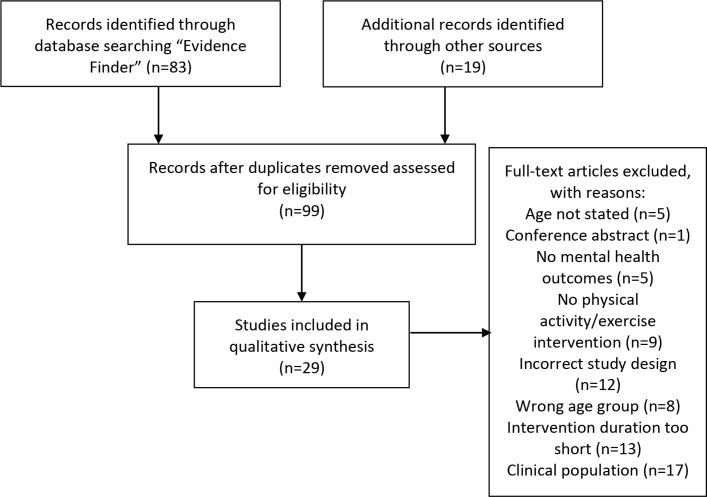
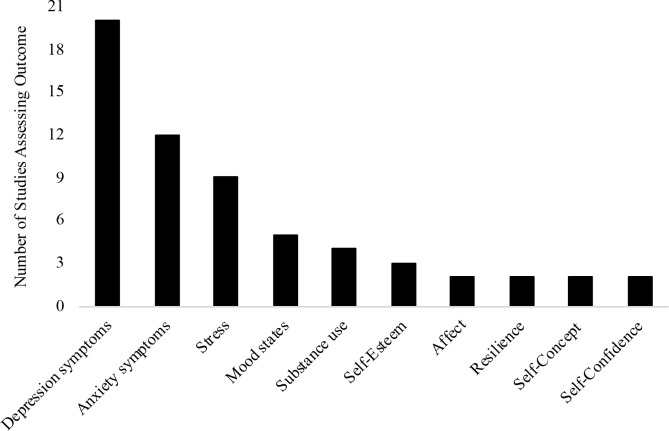
- The review included 29 studies (the abstract says 30 publications); 20 assessed depression symptoms, 12 anxiety symptoms, 9 stress, and 5 mood states.
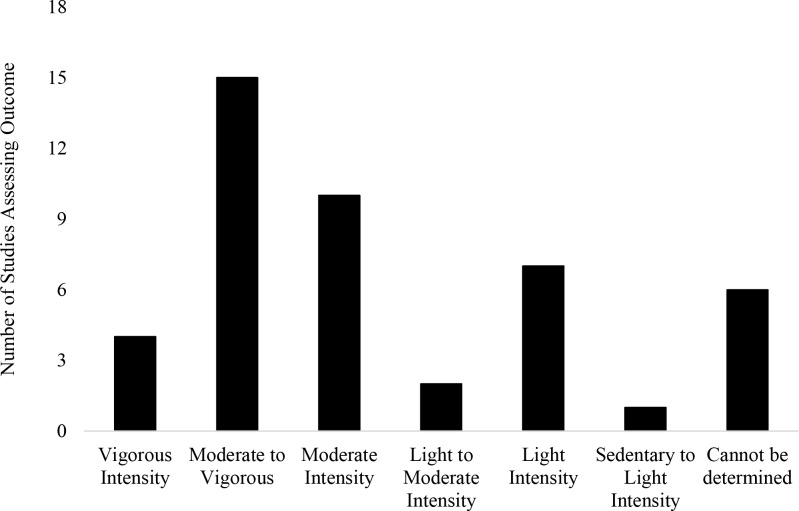
- Moderate-to-vigorous-intensity interventions showed beneficial effects for depression in 83% (5/6) of studies and for anxiety in 66% (4/6); light-intensity interventions showed beneficial effects for anxiety in 75% (3/4).
- Of 8 studies recruiting participants with elevated mental disorder symptoms at baseline, 5 demonstrated reductions in depression symptoms or high substance use; of 22 studies not recruiting on elevated symptoms, 17 showed improvements in at least one mental health outcome.
- Only 12 studies provided sufficient information to confidently assess intervention intensity, and the authors conclude that robust research on PA/exercise for mental health promotion and indicated prevention in young people is lacking.
Methods
- Scoping review conducted per PRISMA-ScR and Arksey and O’Malley’s five-stage framework; no review protocol was published.
- Searches used ‘Evidence Finder’ in July 2018 (updated April 2019), plus reference-list screening; eligibility required mean age 12–25.9 years, publication 1980–2017, a PA/exercise intervention with a comparison condition, duration >3 weeks, controlled trial design, English, and at least one quantitative mental health symptom outcome.
- Data were charted descriptively and synthesized using a descriptive-analytical method focused on mental health outcome; intervention intensity was classified by objective/subjective measures where possible, and no critical appraisal of individual sources was conducted.
Limitations
- The paper states that only five studies included follow-up assessments, none assessed whether PA/exercise prevented onset of future threshold mental disorder, only nine studies used an active comparison group, and only 12 studies provided sufficient information to confidently assess intervention intensity.
- The paper also states that no quality appraisal of individual trials was undertaken, and future work should search a wider range of databases and grey literature.
- Evident from the text: the abstract reports 30 publications while the results report 29 included studies; the review is limited to studies indexed in ‘Evidence Finder’ and does not contact authors for missing intervention details.
Model-written summary. Check it against the paper before relying on it.
Integrity signals
Registry
Cites
Statistics
Figures
Verification
Claims the paper makes
6 Valid · 2 Not valid · 54 Not checked · 61 Own results and interpretations
Some cited sources support this claim and some don’t — read each source’s verdict below.
In the paper
“Moderate-to-vigorous-intensity interventions showed improvements in depression symptoms,40 47 52–55 anxiety symptoms,40 47 52 55 59 60 self-esteem40 52 and mood states.52 62”
§ Physical activity and exercise in youth mental health promotion: a scoping review > Results > Intensity of interventions
What the sources say
- Disputedcites [40] Bonhauser M, Fernandez G, Püschel K, et al Improving physical fitness and emotional well-being in adolescents of low socioeconomic status in Chile: results of a school-based controlled trial. Health Promot Int 2005; 20: 113– 22. 10.1093/heapro/dah603 15788528 sourceExperimental — accuracy not yet measured
The Outcome measures section reports no statistically significant difference in depressive symptom scores between the intervention and control groups. The paper reports improvements in anxiety and self-esteem, but not in depressive symptoms. (LLM, conf=0.90)
Checked by a reasoning model — may be wrong.
- Not checked yetcites [47] Khorvash M, Askari A, Rafiemanzelat F, et al An investigation on the effect of strength and endurance training on depression, anxiety, and C-reactive protein's inflammatory biomarker changes. J Res Med Sci 2012; 17: 1072– 6. 23833584 PMC3702091
- Not checked yetcites [52] Hilyer JC et al Physical fitness training and counseling as treatment for youthful offenders. J Couns Psychol 1982; 29: 292– 303. 10.1037/0022-0167.29.3.292 source
- Supportedcites [53] O'Dougherty M, Hearst MO, Syed M, et al Life events, perceived stress and depressive symptoms in a physical activity intervention with young adult women. Ment Health Phys Act 2012; 5: 148– 54. 10.1016/j.mhpa.2012.05.001 23189088 PMC3505451 source
The Methods describe an aerobic exercise intervention progressing from 65–70% to 80–85% of maximum heart rate. The Results report that, after adjustment for baseline symptoms and other covariates, controls had significantly higher depressive-symptom scores than intervention participants at follow-up. This supports the cited paper as an example of improvement associated with a moderate-to-vigorous-intensity intervention. (LLM, conf=0.90)
- Supportedcites [54] Robledo-Colonia AF, Sandoval-Restrepo N, Mosquera-Valderrama YF, et al Aerobic exercise training during pregnancy reduces depressive symptoms in nulliparous women: a randomised trial. J Physiother 2012; 58: 9– 15. 10.1016/S1836-9553(12)70067-X 22341377 source
The Intervention section describes aerobic exercise prescribed at moderate-to-vigorous intensity. The Effect of intervention section reports that, after three months, depressive symptoms improved significantly more in the exercise group than in the control group. The finding applies to the pregnant women studied. (LLM, conf=0.93)
- Not checked yetcites [55] Wipfli B, Landers D, Nagoshi C, et al An examination of serotonin and psychological variables in the relationship between exercise and mental health. Scand J Med Sci Sports 2011; 21: 474– 81. 10.1111/j.1600-0838.2009.01049.x 20030777 source
plainstates a cause- Asserted: passes — The authors put it forward as true.
- Checkable: passes — It can be checked against evidence.
- Load-bearing: passes — The paper’s conclusions depend on it.
- Based: passes — The paper gives a reason why it holds.
- Disputed
The cited sources support only part of this claim — read each source’s verdict below.
In the paper
“Moderate-to-vigorous-intensity interventions showed improvements in depression symptoms,40 47 52–55 anxiety symptoms,40 47 52 55 59 60 self-esteem40 52 and mood states.52 62”
§ Physical activity and exercise in youth mental health promotion: a scoping review > Results > Intensity of interventions
What the sources say
- Partly supportedcites [40] Bonhauser M, Fernandez G, Püschel K, et al Improving physical fitness and emotional well-being in adolescents of low socioeconomic status in Chile: results of a school-based controlled trial. Health Promot Int 2005; 20: 113– 22. 10.1093/heapro/dah603 15788528 sourceExperimental — accuracy not yet measured
The Outcome measures section reports a significantly greater improvement in anxiety scores in the intervention group than in controls. The Intervention condition section describes fast walking, running, jumping and sports, but also low-intensity activities; it does not establish that the intervention as a whole was moderate-to-vigorous intensity. (LLM, conf=0.82)
- Not checked yetcites [47] Khorvash M, Askari A, Rafiemanzelat F, et al An investigation on the effect of strength and endurance training on depression, anxiety, and C-reactive protein's inflammatory biomarker changes. J Res Med Sci 2012; 17: 1072– 6. 23833584 PMC3702091
- Not checked yetcites [52] Hilyer JC et al Physical fitness training and counseling as treatment for youthful offenders. J Couns Psychol 1982; 29: 292– 303. 10.1037/0022-0167.29.3.292 source
plainstates a cause- Asserted: passes — The authors put it forward as true.
- Checkable: passes — It can be checked against evidence.
- Load-bearing: unclear — It is unclear whether the paper’s conclusions depend on it.
- Based: passes — The paper gives a reason why it holds.
- Partly supported
The cited sources support only part of this claim — read each source’s verdict below.
In the paper
“There was less support for moderate-intensity interventions in reducing depression symptoms, with only two positive studies from seven39 42 and only one positive study for anxiety59 and stress59 from the four that measured these outcomes.”
§ Physical activity and exercise in youth mental health promotion: a scoping review > Results > Intensity of interventions
What the sources say
- Partly supportedcites [39] Nabkasorn C, Miyai N, Sootmongkol A, et al Effects of physical exercise on depression, neuroendocrine stress hormones and physiological fitness in adolescent females with depressive symptoms. Eur J Public Health 2006; 16: 179– 84. 10.1093/eurpub/cki159 16126743 sourceExperimental — accuracy not yet measured
The Results report a significant reduction in depressive symptoms after jogging, so this paper supports counting it as a positive study. The Intervention section describes the exercise as mild intensity, not moderate intensity; as a single trial, it also does not establish the citing paper’s two-of-seven tally. (LLM, conf=0.86)
- Partly supportedcites [42] Melnyk BM, Jacobson D, Kelly S, et al Promoting healthy lifestyles in high school adolescents: a randomized controlled trial. Am J Prev Med 2013; 45: 407– 15. 24050416 PMC4285557 sourceExperimental — accuracy not yet measured
The Results (Immediate Post-intervention Outcomes and 6-Month Post-Intervention Outcomes) report no significant difference in depression symptoms between the COPE and Healthy Teens groups, consistent with limited evidence of benefit in this trial. This paper does not provide the claimed tally of two positive studies out of seven or classify interventions by moderate intensity. (LLM, conf=0.83)
plain- Asserted: passes — The authors put it forward as true.
- Checkable: passes — It can be checked against evidence.
- Load-bearing: passes — The paper’s conclusions depend on it.
- Based: passes — The paper gives a reason why it holds.
- Partly supported
Every source the paper cites for this claim was checked and supports it.
In the paper
“Only five studies included follow-up assessments39 42 46 50 56 and none assessed whether PA/exercise prevented the onset of future episodes of threshold mental disorder, rendering longer-term preventive effects unknown.”
§ Physical activity and exercise in youth mental health promotion: a scoping review > Discussion > Strengths and limitations
What the sources say
- Supportedcites [39] Nabkasorn C, Miyai N, Sootmongkol A, et al Effects of physical exercise on depression, neuroendocrine stress hormones and physiological fitness in adolescent females with depressive symptoms. Eur J Public Health 2006; 16: 179– 84. 10.1093/eurpub/cki159 16126743 source
The Results report that participants who exercised first had their depressive symptoms assessed again during the subsequent daily-activity phase, so this paper supports its identification as a study with a follow-up assessment. The total of five studies is the citing paper’s count, not a count this individual trial could establish. (LLM, conf=0.88)
- Supportedcites [42] Melnyk BM, Jacobson D, Kelly S, et al Promoting healthy lifestyles in high school adolescents: a randomized controlled trial. Am J Prev Med 2013; 45: 407– 15. 24050416 PMC4285557 source
The Results (6-Month Post-Intervention Outcomes) explicitly report a six-month follow-up assessment. As a citation to one of the five studies said to have follow-up assessments, this paper supports the attributed point; it does not itself establish the total of five across the citing paper's included studies. (LLM, conf=0.92)
- Supportedcites [46] Cecchini-Estrada J-A, Méndez-Giménez A, Cecchini C, et al Exercise and Epstein's target for treatment of depressive symptoms: a randomized study. Int J Clin Health Psychol 2015; 15: 191– 9. 10.1016/j.ijchp.2015.05.001 30487836 PMC6225030 source
This citation identifies the paper as one of the studies with a follow-up assessment; it is not offered as evidence for the review's count of five. The Results (Analysis of clinical efficacy) report depressive-symptom assessments at eight weeks and six months later, and the Discussion describes the six-month follow-up. (LLM, conf=0.91)
plain- Asserted: passes — The authors put it forward as true.
- Checkable: passes — It can be checked against evidence.
- Load-bearing: passes — The paper’s conclusions depend on it.
- Based: passes — The paper gives a reason why it holds.
- Supported
The sources with a verdict support this claim; the rest weren’t checked yet, have no full text we could read, or their verdicts aren’t rated yet.
In the paper
“In adults, mental health benefits are associated with lower levels of PA than required for physical health benefits,80–82 and it is possible that this relationship also holds for younger people; however, this would require additional rigorous empirical support.”
§ Physical activity and exercise in youth mental health promotion: a scoping review > Conclusions
What the sources say
- Supportedcites [80] Craike MJ, Mosely K, Browne JL, et al Associations between physical activity and depressive symptoms by weight status among adults with type 2 diabetes: results from diabetes MILES–Australia. J Phys Act Health 2017; 14: 195– 202. 10.1123/jpah.2016-0196 27918698 source
The Discussion explicitly states that population-based research has found mental-health benefits at lower PA levels than those required for physical health. It also reports that, in this study’s adults with type 2 diabetes, PA below the recommended level for physical-health benefit was associated with fewer depressive symptoms. (LLM, conf=0.92)
- Not checked yetcites [81] Vallance JK, Winkler EAH, Gardiner PA, et al Associations of objectively-assessed physical activity and sedentary time with depression: NHANES (2005–2006). Prev Med 2011; 53: 284– 8. 10.1016/j.ypmed.2011.07.013 21820466 source
- Not checked yetcites [82] Brunes A, Augestad LB, Gudmundsdottir SL Personality, physical activity, and symptoms of anxiety and depression: the HUNT study. Soc Psychiatry Psychiatr Epidemiol 2013; 48: 745– 56. 10.1007/s00127-012-0594-6 23052425 source
plainstates an association- Asserted: passes — The authors put it forward as true.
- Checkable: passes — It can be checked against evidence.
- Load-bearing: passes — The paper’s conclusions depend on it.
- Based: passes — The paper gives a reason why it holds.
- Supported
83 more claims
Create a free account to see all 123 claims and to verify the 79 references still open.
- Probably not a substantial claim. 23
- It may state two separate claims as one. 18
- The quote only partly states this claim. 2
Claims other papers make about this one
Each is checked against this paper’s own text: does it say what the citing paper says it does?
The cited source says what the claim attributes to it.
In the citing paper
“Two systematic reviews and one scoping review have approached this topic and improved our understanding of the effect of exercise on anxiety in mostly healthy, non-clinical young people and children (Carter 2021;Larun 2006;Pascoe 2020).”
From Exercise for the treatment of anxiety in children and adolescents (2022) · cites this paper as Pascoe 2020
In the citing paper
“although another possible explanation is that regular exercise may be associated with some improvement in mental well-being. [16,17].”
From Wearable devices for anxiety & depression: A scoping review (2023) · cites this paper as [17]
Self-check
Percentages, sums and reported differences re-computed from the paper’s own numbers.
Each contradiction between two passages listed here was confirmed by an independent check.
Rated minor: it would not touch a result — a value no result rests on, a p-value that stays on the same side of the significance level, or a conflict that is clerical, resolved elsewhere in the paper, or outside its own findings.
In the paper
§ Physical activity and exercise in youth mental health promotion: a scoping review > Discussion > Summary of evidence
“five demonstrated the effect of PA/exercise interventions in reducing symptoms of depression38 39 46 47 and high substance use,49”
§ Physical activity and exercise in youth mental health promotion: a scoping review > Results > Synthesis of results
“Two studies did not provide sufficient information to assess intervention intensity, and neither showed reductions in depression symptoms.36 46”
Rated minor: it would not touch a result — a value no result rests on, a p-value that stays on the same side of the significance level, or a conflict that is clerical, resolved elsewhere in the paper, or outside its own findings.
In the paper
§ Physical activity and exercise in youth mental health promotion: a scoping review > Results > Intensity of interventions
“Of the studies that examined vigorous-intensity interventions, a considerable proportion found positive outcomes on depression symptoms,35 50 51 stress43 and mood states,61 but not for anxiety.50”
§ Physical activity and exercise in youth mental health promotion: a scoping review > Results > Synthesis of results
“In the third study, a vigorous-intensity intervention did not improve depression symptoms in unemployed young men, compared with a wait-list group.51”
Rated minor: it would not touch a result — a value no result rests on, a p-value that stays on the same side of the significance level, or a conflict that is clerical, resolved elsewhere in the paper, or outside its own findings.
In the paper
§ Physical activity and exercise in youth mental health promotion: a scoping review > Results > Intensity of interventions
“Moderate-to-vigorous-intensity interventions showed improvements in depression symptoms,40 47 52–55 anxiety symptoms,40 47 52 55 59 60 self-esteem40 52 and mood states.52 62”
§ Physical activity and exercise in youth mental health promotion: a scoping review > Results > Synthesis of results
“The sixth study compared two moderate-to-vigorous-intensity interventions and found no effect of either on depression symptoms.40”
Rated minor: it would not touch a result — a value no result rests on, a p-value that stays on the same side of the significance level, or a conflict that is clerical, resolved elsewhere in the paper, or outside its own findings.
In the paper
§ Physical activity and exercise in youth mental health promotion: a scoping review > Results > Synthesis of results
“| Moderate-intensity intervention | 28% (n=2 out of 7)39 42 | 25% (n=1 out of 4)59 | 33% (n=1 out of 3)59 | 0% (n=0 out of 2) |”
§ Physical activity and exercise in youth mental health promotion: a scoping review > Results > Synthesis of results
“One study of a moderate-intensity intervention found that it decreased stress in adolescents, compared with no intervention,61 and a further three did not specify intervention intensity but were likely moderate.43 57 59 In one of these, both the moderate-intensity intervention and the psychological treatment condition decreased stress in university students, compared with no intervention, as stated above.59”
Rated minor: it would not touch a result — a value no result rests on, a p-value that stays on the same side of the significance level, or a conflict that is clerical, resolved elsewhere in the paper, or outside its own findings.
In the paper
“Eight studies included young people with elevated mental disorder symptoms at baseline, including anxiety sensitivity,45 anxiety or depression symptoms,37–39 46 47 or high substance use,48 49 and the remaining 22 involved young people without mental health symptoms.”
§ Physical activity and exercise in youth mental health promotion: a scoping review > Results > Characteristics of sources of evidence
Reported 29 · recomputed 30
2 more findings
Create a free account to see every finding of this check.
Citations
Cites
Ryan, R. M., & Deci, E. L. (2000) · American Psychologist · doi:10.1037//0003-066x.55.1.68 · Cited by 54,599
PRISMA Extension for Scoping Reviews (PRISMA-ScR): Checklist and Explanation
Tricco, A. C., Lillie, E., Zarin, W., O'Brien, K. K., Colquhoun, H., Levac, D., Moher, D., Peters, M. D. J., Horsley, T., Weeks, L., et al. (2018) · Annals of Internal Medicine · doi:10.7326/m18-0850 · Cited by 43,565
Scoping studies: towards a methodological framework
Arksey, H., & O'Malley, L. (2005) · International Journal of Social Research Methodology · doi:10.1080/1364557032000119616 · Cited by 36,742
The structure of psychological well-being revisited.
Ryff, C. D., & Keyes, C. L. M. (1995) · Journal of Personality and Social Psychology · doi:10.1037//0022-3514.69.4.719 · Cited by 10,285
The Physical Activity Guidelines for Americans
Piercy, K. L., Troiano, R. P., Ballard, R. M., Carlson, S. A., Fulton, J. E., Galuska, D. A., George, S. M., & Olson, R. D. (2018) · JAMA · doi:10.1001/jama.2018.14854 · Cited by 9,755
Garber, C. E., Blissmer, B., Deschenes, M. R., Franklin, B. A., Lamonte, M. J., Lee, I.-M., Nieman, D. C., & Swain, D. P. (2011) · Medicine & Science in Sports & Exercise · doi:10.1249/mss.0b013e318213fefb · Cited by 9,319
(1985) · Europe PMC (PubMed Central) · Cited by 9,143
Compendium of physical activities: an update of activity codes and MET intensities
AINSWORTH, B. E., HASKELL, W. L., WHITT, M. C., IRWIN, M. L., SWARTZ, A. M., STRATH, S. J., O???BRIEN, W. L., BASSETT, D. R., SCHMITZ, K. H., EMPLAINCOURT, P. O., et al. (2000) · Medicine & Science in Sports & Exercise · doi:10.1097/00005768-200009001-00009 · Cited by 8,497
Moral Identity and Developmental Theory
Lapsley, D. (2015) · Human Development · doi:10.1159/000435926 · Cited by 3,819
Age of onset of mental disorders: a review of recent literature
Kessler, R. C., Amminger, G. P., Aguilar-Gaxiola, S., Alonso, J., Lee, S., & ??st??n, T. B. (2007) · Current Opinion in Psychiatry · doi:10.1097/yco.0b013e32816ebc8c · Cited by 3,457
Pollock, M. L., Gaesser, G. A., Butcher, J. D., Despr??s, J.-P., Dishman, R. K., Franklin, B. A., & Garber, C. E. (1998) · Medicine & Science in Sports & Exercise · doi:10.1097/00005768-199806000-00032 · Cited by 3,051
Thompson, P. D., Arena, R., Riebe, D., & Pescatello, L. S. (2013) · Current Sports Medicine Reports · doi:10.1249/jsr.0b013e31829a68cf · Cited by 1,823
Young People’s Help-Seeking for Mental Health Problems
Rickwood, D., Deane, F. P., Wilson, C. J., & Ciarrochi, J. (2005) · Australian e-Journal for the Advancement of Mental Health · doi:10.5172/jamh.4.3.218 · Cited by 1,619
Physical Activity for Cognitive and Mental Health in Youth: A Systematic Review of Mechanisms
Lubans, D., Richards, J., Hillman, C., Faulkner, G., Beauchamp, M., Nilsson, M., Kelly, P., Smith, J., Raine, L., & Biddle, S. (2016) · Pediatrics · doi:10.1542/peds.2016-1642 · Cited by 1,548
Rodriguez-Ayllon, M., Cadenas-Sánchez, C., Estévez-López, F., Muñoz, N. E., Mora-Gonzalez, J., Migueles, J. H., Molina-García, P., Henriksson, H., Mena-Molina, A., Martínez-Vizcaíno, V., et al. (2019) · Sports Medicine · doi:10.1007/s40279-019-01099-5 · Cited by 1,360
Ekkekakis, P., Parfitt, G., & Petruzzello, S. J. (2011) · Sports Medicine · doi:10.2165/11590680-000000000-00000 · Cited by 1,215
When and how do young people seek professional help for mental health problems?
Rickwood, D. J., Deane, F. P., & Wilson, C. J. (2007) · Medical Journal of Australia · doi:10.5694/j.1326-5377.2007.tb01334.x · Cited by 1,195
McGorry, P. D., Hickie, I. B., Yung, A. R., Pantelis, C., & Jackson, H. J. (2006) · Australian & New Zealand Journal of Psychiatry · doi:10.1080/j.1440-1614.2006.01860.x · Cited by 919
Position statement on physical activity and exercise intensity terminology.
Norton, K., Norton, L., & Sadgrove, D. (2010) · Journal of Science and Medicine in Sport · doi:10.1016/j.jsams.2009.09.008 · Cited by 804
(1996) · American Journal of Psychiatry · doi:10.1176/ajp.153.11.1411 · Cited by 538
Judd, L. L., Akiskal, H. S., & Paulus, M. P. (1997) · Journal of Affective Disorders · doi:10.1016/s0165-0327(97)00055-4 · Cited by 444
Community interventions and effective prevention.
Wandersman, A., & Florin, P. (2003) · American Psychologist · doi:10.1037/0003-066x.58.6-7.441 · Cited by 444
Norris, R., Carroll, D., & Cochrane, R. (1992) · Journal of Psychosomatic Research · doi:10.1016/0022-3999(92)90114-h · Cited by 409
Nabkasorn, C., Miyai, N., Sootmongkol, A., Junprasert, S., Yamamoto, H., Arita, M., & Miyashita, K. (2006) · European Journal of Public Health · doi:10.1093/eurpub/cki159 · Cited by 353
Bailey, A. P., Hetrick, S. E., Rosenbaum, S., Purcell, R., & Parker, A. G. (2018) · Psychological Medicine · doi:10.1017/s0033291717002653 · Cited by 338
Self-citationEnnett, S. T., Ringwalt, C. L., Thorne, J., Rohrbach, L. A., Vincus, A., Simons-Rudolph, A., & Jones, S. (2003) · Prevention Science · doi:10.1023/a:1021777109369 · Cited by 276
Khalsa, S. B. S., Hickey-Schultz, L., Cohen, D., Steiner, N., & Cope, S. (2012) · The Journal of Behavioral Health Services & Research · doi:10.1007/s11414-011-9249-8 · Cited by 271
Exercise and clinical depression: examining two psychological mechanisms
Craft, L. L. (2005) · Psychology of Sport and Exercise · doi:10.1016/j.psychsport.2003.11.003 · Cited by 253
Walking on sunshine: Scoping review of the evidence for walking and mental health
Kelly, P., Williamson, C., Niven, A. G., Hunter, R., Mutrie, N., & Richards, J. (2018) · British Journal of Sports Medicine · doi:10.1136/bjsports-2017-098827 · Cited by 253
Wipfli, B., Landers, D., Nagoshi, C., & Ringenbach, S. (2011) · Scandinavian Journal of Medicine & Science in Sports · doi:10.1111/j.1600-0838.2009.01049.x · Cited by 242
Berger, B. G., & Owen, D. R. (1988) · Research Quarterly for Exercise and Sport · doi:10.1080/02701367.1988.10605493 · Cited by 240
Vallance, J. K., Winkler, E. A. H., Gardiner, P. A., Healy, G. N., Lynch, B. M., & Owen, N. (2011) · Preventive Medicine · doi:10.1016/j.ypmed.2011.07.013 · Cited by 238
Noggle, J. J., Steiner, N. J., Minami, T., & Khalsa, S. B. S. (2012) · Journal of Developmental & Behavioral Pediatrics · doi:10.1097/dbp.0b013e31824afdc4 · Cited by 224
The Effect of Exercise on Depressive Symptoms in Adolescents: A Systematic Review and Meta-Analysis
Carter, T., Morres, I. D., Meade, O., & Callaghan, P. (2016) · Journal of the American Academy of Child & Adolescent Psychiatry · doi:10.1016/j.jaac.2016.04.016 · Cited by 213
Self-citationBonhauser, M., Fernandez, G., Püschel, K., Yañez, F., Montero, J., Thompson, B., & Coronado, G. (2005) · Health Promotion International · doi:10.1093/heapro/dah603 · Cited by 205
An Examination of Stress in College Students Over the Course of a Semester
Baghurst, T., & Kelley, B. C. (2014) · Health Promotion Practice · doi:10.1177/1524839913510316 · Cited by 190
Early Identification and Intervention in Depressive Disorders: Towards a Clinical Staging Model
Hetrick, S. E., Parker, A. G., Hickie, I. B., Purcell, R., Yung, A. R., & McGorry, P. D. (2008) · Psychotherapy and Psychosomatics · doi:10.1159/000140085 · Cited by 186
Self-citationPromoting Healthy Lifestyles in High School Adolescents
Melnyk, B. M., Jacobson, D., Kelly, S., Belyea, M., Shaibi, G., Small, L., O’Haver, J., & Marsiglia, F. F. (2013) · American Journal of Preventive Medicine · doi:10.1016/j.amepre.2013.05.013 · Cited by 183
Effect of a mindfulness program on stress, anxiety and depression in university students
Gallego, J., Aguilar-Parra, J. M., Cangas, A. J., Langer, Á. I., & Mañas, I. (2014) · The Spanish Journal of Psychology · doi:10.1017/sjp.2014.102 · Cited by 181
Cheng, E. R., Hawkins, S. S., Rifas-Shiman, S. L., Gillman, M. W., & Taveras, E. M. (2016) · BMC Public Health · doi:10.1186/s12889-016-3110-1 · Cited by 181
Daley, A. J., Copeland, R. J., Wright, N. P., Roalfe, A., & Wales, J. K. H. (2006) · Pediatrics · doi:10.1542/peds.2006-1285 · Cited by 170
Melnyk, B. M., Jacobson, D., Kelly, S., O'Haver, J., Small, L., & Mays, M. Z. (2009) · Journal of School Health · doi:10.1111/j.1746-1561.2009.00451.x · Cited by 166
The exercise–affect–adherence pathway: an evolutionary perspective
Lee, H. H., Emerson, J. A., & Williams, D. M. (2016) · Frontiers in Psychology · doi:10.3389/fpsyg.2016.01285 · Cited by 160
Jorm, A. F., & Wright, A. (2007) · Australian & New Zealand Journal of Psychiatry · doi:10.1080/00048670701449179 · Cited by 159
Robledo-Colonia, A. F., Sandoval-Restrepo, N., Mosquera-Valderrama, Y. F., Escobar-Hurtado, C., & Ramírez-Vélez, R. (2012) · Journal of Physiotherapy · doi:10.1016/s1836-9553(12)70067-x · Cited by 156
Roth, D. L., & Holmes, D. S. (1987) · Psychosomatic Medicine · doi:10.1097/00006842-198707000-00004 · Cited by 156
Targeted primary care‐based mental health services for young Australians
Scott, E. M., Hermens, D. F., Glozier, N., Naismith, S. L., Guastella, A. J., & Hickie, I. B. (2012) · Medical Journal of Australia · doi:10.5694/mja11.10481 · Cited by 155
Changes in sport and physical activity participation for adolescent females: a longitudinal study
Eime, R., Harvey, J. T., Sawyer, N. A., Craike, M. J., Symons, C. M., & Payne, W. R. (2016) · BMC Public Health · doi:10.1186/s12889-016-3203-x · Cited by 138
Self-citationPhysical activity levels and determinants of change in young adults: a longitudinal panel study
Zimmermann-Sloutskis, D., Wanner, M., Zimmermann, E., & Martin, B. W. (2010) · International Journal of Behavioral Nutrition and Physical Activity · doi:10.1186/1479-5868-7-2 · Cited by 133
Population levels of sport participation: implications for sport policy
Eime, R. M., Harvey, J. T., Charity, M. J., & Payne, W. R. (2016) · BMC Public Health · doi:10.1186/s12889-016-3463-5 · Cited by 124
Hetrick, S. E., Parker, A. G., Callahan, P., & Purcell, R. (2010) · Journal of Evaluation in Clinical Practice · doi:10.1111/j.1365-2753.2008.01112.x · Cited by 121
Self-citationLederman, O., Suetani, S., Stanton, R., Chapman, J., Korman, N., Rosenbaum, S., Ward, P. B., & Siskind, D. (2017) · Australasian Psychiatry · doi:10.1177/1039856217711054 · Cited by 101
Parker, A. G., Hetrick, S. E., Jorm, A. F., Mackinnon, A. J., McGorry, P. D., Yung, A. R., Scanlan, F., Stephens, J., Baird, S., Moller, B., et al. (2016) · Journal of Affective Disorders · doi:10.1016/j.jad.2016.02.043 · Cited by 94
Self-citationCarter, T., Guo, B., Turner, D., Morres, I., Khalil, E., Brighton, E., Armstrong, M., & Callaghan, P. (2015) · BMC Psychiatry · doi:10.1186/s12888-015-0638-z · Cited by 93
Self-citationIs there more to yoga than exercise?
(2011) · PubMed · Cited by 92
Effect of exercise intensity on depressive symptoms in women
Chu, I.-H., Buckworth, J., Kirby, T. E., & Emery, C. F. (2009) · Mental Health and Physical Activity · doi:10.1016/j.mhpa.2009.01.001 · Cited by 87
Current issues in anxiety and depression: comorbid, mixed, and subthreshold disorders
Rivas-Vazquez, R. A., Saffa-Biller, D., Ruiz, I., Blais, M. A., & Rivas-Vazquez, A. (2004) · Professional Psychology: Research and Practice · doi:10.1037/0735-7028.35.1.74 · Cited by 84
Prevention of depression in childhood and adolescence
Mendelson, T., & Tandon, S. D. (2016) · Child and Adolescent Psychiatric Clinics of North America · doi:10.1016/j.chc.2015.11.005 · Cited by 77
Physical fitness training and counseling as treatment for youthful offenders.
Hilyer, J. C., Wilson, D. G., Dillon, C., Caro, L., Jenkins, C., Spencer, W. A., Meadows, M. E., & Booker, W. (1982) · Journal of Counseling Psychology · doi:10.1037/0022-0167.29.3.292 · Cited by 72
Personality, physical activity, and symptoms of anxiety and depression: the HUNT study
Brunes, A., Augestad, L. B., & Gudmundsdottir, S. L. (2013) · Social Psychiatry and Psychiatric Epidemiology · doi:10.1007/s00127-012-0594-6 · Cited by 72
Psychoeducational Interventions for Stress Management and Well‐Being
Romano, J. L. (1992) · Journal of Counseling & Development · doi:10.1002/j.1556-6676.1992.tb02200.x · Cited by 65
Comparison of jogging, the relaxation response, and group interaction for stress reduction
Berger, B. G., & Friedman, E. (1988) · Journal of Sport and Exercise Psychology · doi:10.1123/jsep.10.4.431 · Cited by 62
Taspinar, B., Aslan, U. B., Agbuga, B., & Taspinar, F. (2014) · Complementary Therapies in Medicine · doi:10.1016/j.ctim.2014.03.007 · Cited by 59
Wyn, J. (2004) · Family matters · Cited by 54
Hematfar, A., Shahsavari, A., & Mousavi, S. R. (2012) · Cited by 49
Exercise interventions for mental disorders in young people: a scoping review
Pascoe, M. C., Bailey, A. P., Craike, M. J., Carter, T., Patten, R. K., Stepto, N. K., & Parker, A. G. (2020) · BMJ Open Sport & Exercise Medicine · doi:10.1136/bmjsem-2019-000678 · Cited by 47
Self-citationExercise as an intervention for sedentary hazardous drinking college students: A pilot study
Weinstock, J., Capizzi, J. A., Weber, S. M., Pescatello, L. S., & Petry, N. M. (2014) · Mental health and physical activity · doi:10.1016/j.mhpa.2014.02.002 · Cited by 46
Physical and Psychological Effects of Aerobic Exercise in Delinquent Adolescent Males
MacMahon, J. R. (1988) · Archives of Pediatrics & Adolescent Medicine · doi:10.1001/archpedi.1988.02150120115053 · Cited by 43
Psychosocial Correlates of Exercise in Women With Self-Reported Depressive Symptoms
Craft, L. L., Perna, F. M., Freund, K. M., & Culpepper, L. (2008) · Journal of Physical Activity and Health · doi:10.1123/jpah.5.3.469 · Cited by 39
Sedentary college student drinkers can start exercising and reduce drinking after intervention.
Weinstock, J., Petry, N. M., Pescatello, L. S., & Henderson, C. E. (2016) · Psychology of Addictive Behaviors · doi:10.1037/adb0000207 · Cited by 38
O'Dougherty, M., Hearst, M. O., Syed, M., Kurzer, M. S., & Schmitz, K. H. (2012) · Mental Health and Physical Activity · doi:10.1016/j.mhpa.2012.05.001 · Cited by 36
The beneficial effect of Tai Chi on self‐concept in adolescents
Bao, X., & Jin, K. (2015) · International Journal of Psychology · doi:10.1002/ijop.12066 · Cited by 36
Feasibility of using soccer and job training to prevent drug abuse and HIV
Rotheram-Borus, M. J., Tomlinson, M., Durkin, A., Baird, K., DeCelles, J., & Swendeman, D. (2016) · AIDS and Behavior · doi:10.1007/s10461-015-1262-0 · Cited by 35
Becoming adult in the 2000s: new transitions and new careers
Wyn, J. (2004) · Family matters · Cited by 30
Haase, R., Piatkowski, J., & Ziemssen, T. (2011) · PubMed · Cited by 27
Sabourin, B. C., Watt, M. C., Krigolson, O. E., & Stewart, S. H. (2016) · Journal of Cognitive Psychotherapy · doi:10.1891/0889-8391.30.2.131 · Cited by 26
Khorvash, M., Askari, A., Rafiemanzelat, F., Botshekan, M., & Khorvash, F. (2012) · PubMed Central · Cited by 22
Open‐access evidence database of controlled trials and systematic reviews in youth mental health
Silva, S. D., Bailey, A. P., Parker, A. G., Montague, A. E., & Hetrick, S. E. (2017) · Early Intervention in Psychiatry · doi:10.1111/eip.12423 · Cited by 22
Self-citationExercise and Epstein's target for treatment of depressive symptoms: a randomized study
Cecchini-Estrada, J.-A., Méndez-Giménez, A., Cecchini, C., Moulton, M., & Rodríguez, C. (2015) · International Journal of Clinical and Health Psychology · doi:10.1016/j.ijchp.2015.05.001 · Cited by 19
The Utilization of Exercise to Decrease Depressive Symptoms in Young Adult Women
Balkin, R. S., Tietjen-Smith, T., Caldwell, C., & Shen, Y.-P. (2007) · Adultspan Journal · doi:10.1002/j.2161-0029.2007.tb00027.x · Cited by 18
Craike, M. J., Mosely, K., Browne, J. L., Pouwer, F., & Speight, J. (2017) · Journal of Physical Activity and Health · doi:10.1123/jpah.2016-0196 · Cited by 12
Self-citation(2004)
Research works printed but not linked: 3
- Bull FtEWG Physical activity guidelines in the U.K. review and recommendations. Loughborough University, 2010.
- Aras D, Ewert AW The effects of eight weeks sport rock climbing training on anxiety. Acta Medica Mediterranea 2016; 32: 223– 30.
- Berger BG, Friedman E Comparison of jogging, the relaxation response, and group interaction for stress reduction. J Sport Exerc Psychol 1988; 10: 431– 47. 10.1123/jsep.10.4.431 · DOI · Paper page
Cited by
Mental health in elite athletes: International Olympic Committee consensus statement (2019)
Reardon, C. L., Hainline, B., Aron, C. M., Baron, D., Baum, A. L., Bindra, A., Budgett, R., Campriani, N., Castaldelli-Maia, J. M., Currie, A., et al. (2019) · British Journal of Sports Medicine · doi:10.1136/bjsports-2019-100715 · Cited by 1,277
Savage, M. J., James, R., Magistro, D., Donaldson, J., Healy, L. C., Nevill, M., & Hennis, P. J. (2020) · Mental Health and Physical Activity · doi:10.1016/j.mhpa.2020.100357 · Cited by 366
Belcher, B. R., Zink, J., Azad, A., Campbell, C. E., Chakravartti, S. P., & Herting, M. M. (2021) · Biological Psychiatry: Cognitive Neuroscience and Neuroimaging · doi:10.1016/j.bpsc.2020.08.005 · Cited by 281
“Several recent reviews and meta-analyses of study samples ranging from 10 to 779 participants concluded that PA and exercise can improve internalizing and externalizing symptoms in youth (23–26), with depression and anxiety the two most-studied outcomes (27).”
BackgroundStudies of Physical Activity and COVID-19 During the Pandemic: A Scoping Review
Caputo, E. L., & Reichert, F. F. (2020) · Journal of Physical Activity and Health · doi:10.1123/jpah.2020-0406 · Cited by 302
Carter, T., Pascoe, M., Bastounis, A., Morres, I. D., Callaghan, P., & Parker, A. G. (2021) · Journal of Affective Disorders · doi:10.1016/j.jad.2021.02.026 · Cited by 190
Self-citation
Metadata
- Authors
- Pascoe, M., Bailey, A. P., Craike, M., Carter, T., Patten, R., Stepto, N., & Parker, A.
- Affiliations
- Peter MacCallum Cancer Centre (AU)
- The University of Melbourne (AU)
- Victoria University (AU)
- University of Nottingham (GB)
- Corresponding author
- Pascoe, Michaela
- ORCID
- Venue
- BMJ Open Sport & Exercise Medicine
- Publisher
- BMJ
- Published
- 2020-01
- Volume
- 6
- Issue
- 1
- Pages
- e000677
- ISSN
- 2055-7647 (ISSN-L)
- PMC
- PMC7010991
- OpenAlex
- W3001994494
- Cited by
- 332
- References
- 84
- Citations by year
- 2026: 46 · 2025: 53 · 2024: 61 · 2023: 67 · 2022: 43 · 2021: 44 · 2020: 17
- FWCI
- 5.48
- Type
- journal article
- Language
- en
- Open access
- gold
- doi.org
- Licence
- Locations
- BMJ Open Sport & Exercise Medicine (publishedVersion, cc-by-nc)
- PubMed Central (publishedVersion, cc-by-nc)
- PubMed (publishedVersion)
- Victoria University Research Repository (Victoria University) (submittedVersion, cc-by-nc)
- Minerva Access (University of Melbourne) (submittedVersion, cc-by)
- DOAJ (DOAJ: Directory of Open Access Journals) (submittedVersion, cc-by-sa)
- Topics
- Health Sciences › Medicine › Public Health, Environmental and Occupational Health › Physical Activity and Health
- Social Sciences › Psychology › Clinical Psychology › Child and Adolescent Psychosocial and Emotional Development
- Social Sciences › Life-span and Life-course Studies › Recreational Sport and Physical Activity
- Keywords
- physical activity, exercise intervention, youth mental health, mental health promotion, depressive symptoms, anxiety symptoms, prevention, early intervention, adolescents
About these checks
Registry, retraction, Cites and statistics results are computed, not judged, with one exception: a printed reference that no index lists is read once by a model before it counts as a citation error. Claims are extracted by a model and kept only when their quote appears verbatim in the text; each cited source is then checked, with a model’s help, for whether it says what the claim relies on. Those verdicts can be wrong — read the claim’s quote and the cited source before relying on one.
The claim verdicts this report counts are experimental: their accuracy is not yet measured.
A language model drew the claims from the paper on 2026-10-05, under version 3 of the claim definition (model deepseek-v4.1-flash, prompt extract-v3).
A second model labelled each claim on 2026-10-05 (model jev-1.13-20260917, definition revision gold-guideline-v0.2).
Cited sources are checked with a language model’s help (gpt-6-sol).
Statistics and arithmetic are recomputed, not judged.
Confidence bands are shown only for fields calibrated on our annotated test set. None is calibrated yet, so no band is shown.
What counts as a claim ›How we measure confidence ›How we check this ›
Are you an author, or do you see a problem with this page? Request a review
Data sources
Bibliographic data: Semantic Scholar, OpenAlex, Crossref.
Contains information from the Semantic Scholar Academic Graph Datasets, made available under the ODC Attribution License (ODC-BY 1.0).
Semantic Scholar’s data is described in: Kinney, R., et al. (2023). The Semantic Scholar Open Data Platform. arXiv:2301.10140.
