

WHO mental health gap action programme (mhGAP) intervention guide: updated systematic review on evidence and impact
Open accessThe DOI matches its Crossref record; 39 of the 39 references it cites were found in a registry or an index.
Abstract
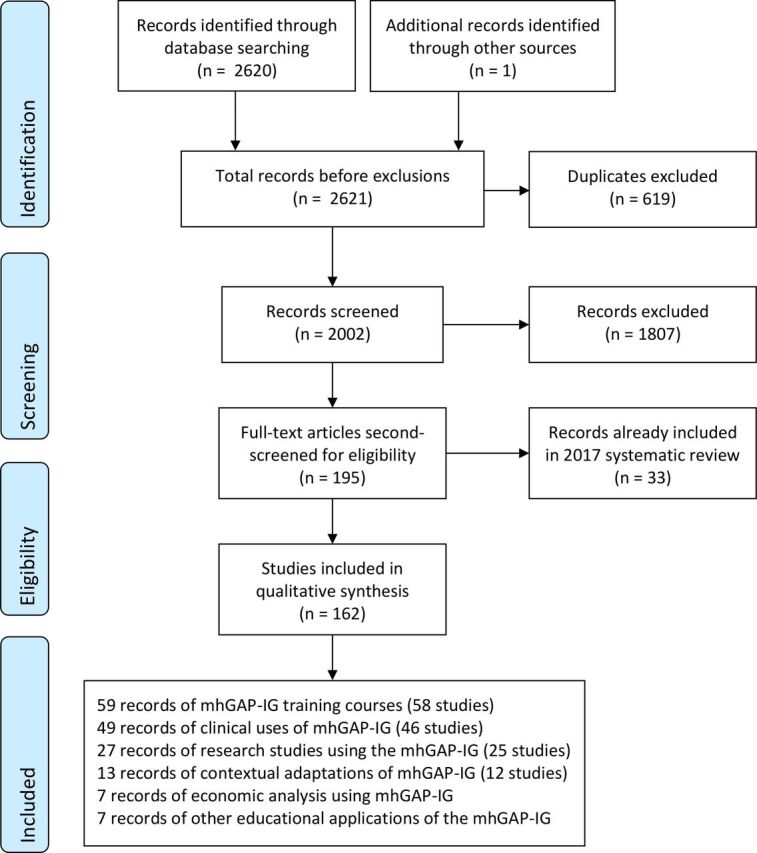
QUESTION: There is a large worldwide gap between the service need and provision for mental, neurological and substance use disorders. WHO's Mental Health Gap Action Programme (mhGAP) intervention guide (IG), provides evidence-based guidance and tools for assessment and integrated management of priority disorders. Our 2017 systematic review identified 33 peer-reviewed studies describing mhGAP-IG implementation in low-income and middle-income countries. STUDY SELECTION AND ANALYSIS: We searched MEDLINE, Embase, PsycINFO, Web of Knowledge, Scopus, CINAHL, LILACS, ScieELO, Cochrane, PubMed databases, 3ie, Google Scholar and citations of our review, on 24 November 2020. We sought evidence, experience and evaluations of the mhGAP-IG, app or mhGAP Humanitarian IG, from any country, in any language. We extracted data from included papers, but heterogeneity prevented meta-analysis. FINDINGS: Of 2621 results, 162 new papers reported applications of the mhGAP-IG. They described mhGAP training courses (59 references), clinical applications (n=49), research uses (n=27), contextual adaptations (n=13), economic studies (n=7) and other educational applications (n=7). Most were conducted in the African region (40%) and South-East Asia (25%). Studies demonstrated improved knowledge, attitudes and confidence post-training and improved symptoms and engagement with care, post-implementation. Research studies compared mhGAP-IG-enhanced usual care with task-shared psychological interventions and adaptation studies optimised mhGAP-IG implementation for different contexts. Economic studies calculated human resource requirements of scaling up mhGAP-IG implementation and other educational studies explored its potential for repurposing. CONCLUSIONS: The diverse, expanding global mhGAP-IG literature demonstrates substantial impact on training, patient care, research and practice. Priorities for future research should be less-studied regions, severe mental illness and contextual adaptation of brief psychological interventions.
Overview
The claims and statistics of this paper haven’t been checked yet.
Free: it reads the open-access text and checks the first 5 claims that cite a source we can check. Create a free account to check every claim.
Integrity signals
Registry
Cites
Statistics
Figures
Verification
Claims the paper makes
The claims and statistics of this paper haven’t been checked yet.
Free: it reads the open-access text and checks the first 5 claims that cite a source we can check. Create a free account to check every claim.
Claims other papers make about this one
Each is checked against this paper’s own text: does it say what the citing paper says it does?
The source backs part of the claim, not all of it — or backs it for a different population, condition or comparison.
In the citing paper
“Adopted in over 90 countries and adapted to local contexts, the mhGAP-IG aligns with WHO’s global mental health action framework (Keynejad et al., 2021).”
From Scaling mental health care in Nigeria: Impact of WHO mhGAP training under the MeHPriC program on knowledge, attitudes, and practices of primary health care workers in Lagos State – A pre-post mixed-methods study (2025) · cites this paper as Keynejad et al., 2021
Experimental — accuracy not yet measuredThe source backs part of the claim, not all of it — or backs it for a different population, condition or comparison.
In the citing paper
“In a review of 162 studies, Keynejad et al. concluded that more research is needed to look at mhGAP implementation especially focused on contextual adaptations [39].”
From Integrating mental health into primary care: evaluation of the Health Action for Psychiatric Problems In Nigeria including Epilepsy and SubstanceS (HAPPINESS) pilot project (2022) · cites this paper as [39]
Experimental — accuracy not yet measuredThe source backs part of the claim, not all of it — or backs it for a different population, condition or comparison.
In the citing paper
“It has been found to be effective for the delivery of evidence-based mental health services within primary healthcare in LMICs [10].”
From Perception of providers on use of the WHO mental health Gap Action Programme-Intervention Guide (mhGAP-IG) electronic version and smartphone-based clinical guidance in Nigerian primary care settings (2022) · cites this paper as [10]
Experimental — accuracy not yet measuredThe source backs part of the claim, not all of it — or backs it for a different population, condition or comparison.
In the citing paper
“Several randomised controlled trials (RCT), reviewed by Singla and colleagues [9], have demonstrated the effectiveness of psychosocial interventions delivered by non-specialist healthcare workers for mental health conditions in LMICs [10].”
From Perception of providers on use of the WHO mental health Gap Action Programme-Intervention Guide (mhGAP-IG) electronic version and smartphone-based clinical guidance in Nigerian primary care settings (2022) · cites this paper as [10]
Experimental — accuracy not yet measuredThe cited source says what the claim attributes to it.
In the citing paper
“There is also evidence to show that stigma improves among trainees pre-and post-mhGAP training [39].”
2 more claims about this paper
Create a free account to see every claim other papers make about this one.
Self-check
Percentages, sums and reported differences re-computed from the paper’s own numbers.
The self-check needs the paper’s full text.
Citations
Cites
Cochrane Handbook for Systematic Reviews of Interventions: Cochrane Book Series
(2008) · doi:10.1002/9780470712184 · Cited by 25,048
Assessing Risk of Bias in Included Studies
Higgins, J. P., & Altman, D. G. (2008) · Cochrane Handbook for Systematic Reviews of Interventions · doi:10.1002/9780470712184.ch8 · Cited by 3,396
The world health report 2001 - Mental health: new understanding, new hope
Sayers, J. G. (2001) · Europe PMC (PubMed Central) · doi:10.1590/s0042-96862001001100014 · Cited by 3,123
Keynejad, R. C., Dua, T., Barbui, C., & Thornicroft, G. (2018) · Evidence Based Mental Health · doi:10.1136/eb-2017-102750 · Cited by 341
Self-citationKohrt, B. A., Turner, E. L., Rai, S., Bhardwaj, A., Sikkema, K. J., Adelekun, A., Dhakal, M., Luitel, N. P., Lund, C., Patel, V., et al. (2020) · Social Science & Medicine · doi:10.1016/j.socscimed.2020.112852 · Cited by 177
Charlson, F. J., Diminic, S., Lund, C., Degenhardt, L., & Whiteford, H. A. (2014) · PLoS ONE · doi:10.1371/journal.pone.0110208 · Cited by 155
Rai, S., Gurung, D., Kaiser, B. N., Sikkema, K. J., Dhakal, M., Bhardwaj, A., Tergesen, C., & Kohrt, B. A. (2018) · Families, Systems, & Health · doi:10.1037/fsh0000338 · Cited by 128
Maulik, P. K., Kallakuri, S., Devarapalli, S., Vadlamani, V. K., Jha, V., & Patel, A. (2017) · Journal of Global Health · doi:10.7189/jogh.07.010408 · Cited by 125
Faregh, N., Lencucha, R., Ventevogel, P., Dubale, B. W., & Kirmayer, L. J. (2019) · International Journal of Mental Health Systems · doi:10.1186/s13033-019-0312-9 · Cited by 120
Lund, C., Alem, A., Schneider, M., Hanlon, C., Ahrens, J., Bandawe, C., Bass, J., Bhana, A., Burns, J., Chibanda, D., et al. (2015) · Epidemiology and Psychiatric Sciences · doi:10.1017/s2045796015000281 · Cited by 113
Self-citation
Research works printed but not linked: 1
- Miguel Esponda G. What enables and hinders implementation? A mixed-methods case study of a mental health programme implemented in primary care clinics in rural Mexico: London School of Hygiene & Tropical Medicine, 2020. · DOI
Cited by
Items 101–200 of 239
Research on the impact of digital anxiety management tools on athletes' well-being
Kuang, G., Liu, Z., & Zhi, Z. (2025) · Acta Psychologica · doi:10.1016/j.actpsy.2025.105368 · Cited by 3
Akhtar, S., Rabbani, F., Nafis, J., Siddiqui, A., & Merali, Z. (2026) · BJPsych Open · doi:10.1192/bjo.2026.11051 · Cited by 3
Dambi, J. M., Mavindidze, E., Nyamayaro, P. C., Beji‐Chauke, R., Tunduwani, T. D., Shava, B. K., Mavhu, W. M., Abas, M., Chibanda, D., & Nhunzvi, C. (2024) · BMJ Open · doi:10.1136/bmjopen-2023-077695 · Cited by 3
Mudiyanselage, K. W. W., Jörg, F., Mendis, M. S. D., Fuhr, D. C., & Busse, H. (2024) · Cambridge Prisms Global Mental Health · doi:10.1017/gmh.2024.75 · Cited by 2
“These individuals can be either workers from the medical field (i.e., general medical doctors) or lay workers outside the medical field (van Ginneken et al., 2013; Barnett et al., 2019; Keynejad et al., 2021).”
BackgroundPetrushenko, V. V., & Чорна, В. В. (2024) · Reports of Vinnytsia National Medical University · doi:10.31393/reports-vnmedical-2024-28(4)-25 · Cited by 3
Psychological rehabilitation: cognitive behavioral therapy
Солохина, Т. А., & Михайловна, Л. Е. (2025) · Реабилитология. · doi:10.17749/2949-5873/rehabil.2024.27 · Cited by 3
Patel, A., Jayawickreme, N., Visquerra, V., Dixon, K. E., & Patel, V. (2025) · Behaviour Research and Therapy · doi:10.1016/j.brat.2025.104757 · Cited by 3
Adeleke, O. T., Adekunle, W. A., Oduniyi, O. A., Akinbode, A. O., Oluwasanya, A. N., Aibangbee, O., Orji, E. J., Olabode, A. T., & Ariba, A. J. (2025) · Discover Mental Health · doi:10.1007/s44192-025-00221-6 · Cited by 3
“While mhGAP-IG implementation has been evaluated in numerous contexts, a comprehensive review of 162 studies by Keynejad and colleagues highlighted the need for further research on its implementation [8].”
Kaur, H., Duncan, K. B., Dhakal, S., Sharma, N. P., Niraula, S., Pandey, R., Kumari, V., Lau, J. Y. F., & Singh, T. (2021) · BJPsych International · doi:10.1192/bji.2021.50 · Cited by 3
Addressing the complex needs of people with severe mental health disorders in low-resource settings
Gureje, O., & Ayinde, O. (2022) · The Lancet Global Health · doi:10.1016/s2214-109x(22)00092-4 · Cited by 3
Katayama, M., Sugiura, K., Fujishiro, S., Konishi, J. S., Inada, K., Shirakawa, N., & Matsumoto, T. (2023) · Psychiatry and Clinical Neurosciences Reports · doi:10.1002/pcn5.125 · Cited by 4
Tannor, A. Y., Touhami, D., Duttine, A., Rauch, A., Kleinitz, P., Marks, E., Cieza, A., & Sabariego, C. (2026) · BMC Family Practice · doi:10.1186/s12875-026-03479-z · Cited by 2
“A systematic review, however, identified several challenges in implementing mhGAP, including a shortage of specialist staff for supervision, negative cultural attitudes toward mental health, and competing demands on primary care workers’ time [48].”
Jones, E., Quinn, L., Tanner, J.-R., Janković, J., Berrisford, G. S., MacArthur, C., & Taylor, B. (2025) · The Lancet Regional Health - Europe · doi:10.1016/j.lanepe.2025.101312 · Cited by 4
“42 Further research could explore prevalence of particular subgroups of mental illness, such as post-traumatic stress disorder and illness trajectories for women who have new onset in the second year.”
Current state of mental health and substance use in Toledo, Belize: A mixed methods study
Kirsch, J., Fabbri, M., Kerr, K., & Gomez, L. (2025) · Cambridge Prisms Global Mental Health · doi:10.1017/gmh.2025.10007 · Cited by 2
“Belize relies on a small number of psychiatric nurse practitioners, mirroring challenges in other under-resourced settings where community-based services remain underdeveloped (Keynejad et al., 2021).”
Wu, D., Sitthiworachart, J., & Ratanaolarn, T. (2025) · Journal of Curriculum and Teaching · doi:10.5430/jct.v14n2p219 · Cited by 2
Wu, S. S., Shi, Y., Xu, J., Ma, Y., & Wang, X. (2025) · Archives of Public Health · doi:10.1186/s13690-025-01643-y · Cited by 2
“For low-and middle-income countries, task sharing, a model in which community health workers are trained and supervised by mental health specialists to deliver psychosocial interventions in primary and community care, can help tackle the resource gap for mental health professionals [19, 20].”
Šebela, A., Hořáková, A., Němcová, H., Kuklová, M., Nosková, E., Švancer, P., Byatt, N., Janovska, A., & Hrdlickova, K. (2025) · Psychosocial Intervention · doi:10.5093/pi2025a12 · Cited by 5
Innovative HIV care strategies and health system resilience in conflict-affected settings
Terkimbi, S. D., Aja, P. M., Kibirige, J., Nicholas, B., Eze, E. D., Moyosore, A. A., Mitaki, N. B., Owembabazi, E., Shahid, S., & Mujinya, R. (2026) · Conflict and Health · doi:10.1186/s13031-026-00757-6 · Cited by 3
“By embedding these services within ART distribution points, mobile clinics, and community out-reach, HIV programs can reach individuals who would otherwise remain outside the mental health system [47].”
de Queiroz, M. R., Valente, M., Hubloue, I., & Corte, F. D. (2026) · Frontiers in Health Services · doi:10.3389/frhs.2026.1726804 · Cited by 2
“This observation aligns with broader evidence suggesting that mhGAP training can enhance primary care practitioners’ capacity to recognize and manage common mental disorders and contribute to narrowing the mental health treatment gap (18, 45).”
A Qualitative Study on Mental Health Services in Primary Care in Türkiye
Güden, E., Borlu, A., Akpınar, Y. Y., Çorum Provincial Health Directorate, Ç., Eker, Ö. O., Özsoy, S., & Baykan, Z. (2024) · ALPHA PSYCHIATRY · doi:10.5152/alphapsychiatry.2024.241605 · Cited by 3
Zheng, M., Zhang, Y., Chen, F., Chen, A., Kong, D., Xie, K., Li, J., Hall, B. J., Renzaho, A. M. N., Gao, J., et al. (2025) · SSM - Mental Health · doi:10.1016/j.ssmmh.2025.100389 · Cited by 3
A Community-Driven Mental Health Solution: Lay Mental Health Ambassadors
Doornbos, M. M., & Zandee, G. L. (2025) · Journal of the American Psychiatric Nurses Association · doi:10.1177/10783903251341546 · Cited by 2
“…have included the need to address the worldwide gap between service need and provision for mental, neurological, and substance use disorders and to reduce specific mental health disparities (Barnett, Gonzalez, et al., 2018; Barnett et al., 2021; Heetderks-Fong & Bobb, 2024; Keynejad et al., 2021).”
Alibudbud, R. C. (2023) · Health Services Insights · doi:10.1177/11786329231167122 · Cited by 2
Romero, V. F., Tovar, Á. E., Montoya, A. L., Flores-Coronado, M. A., Ferrer-Reyes, S. I., Chainé, S. M., & Serrano, M. M. (2023) · Acta de Investigación Psicológica · doi:10.22201/fpsi.20074719e.2023.2.486 · Cited by 2
“To achieve this goal, efforts have been made to include evidence-based procedures from training staff in the best practices for mental health care (Keynejad et al., 2021).”
BackgroundEshriqui, I., de Almeida, L. Y., de Mendonça, J. M. T., Anazawa, L. S., Belotti, L., Fortes, S., de Sousa, A. A. F., de Souza, E. L., Teodoro, C. D. S., Bonfim, D., et al. (2025) · BMC Family Practice · doi:10.1186/s12875-025-02735-y · Cited by 9
“The evidence gathered in a recent systematic review [3] describes promising results from programs focusing mainly on countries in Africa and Southeast Asia, signaling a gap in studies that evaluate and investigate proposals in other regions.”
Zespoły mobilne a zapobieganie hospitalizacji w środowiskowym modelu opieki psychiatrycznej
Bartosiewicz-Niziołek, M., Błasiak, Ł., Olszewski, B. H., Ostrowska, M., & Wojciechowska, A. (2021) · Studia Psychologica Theoria et praxis · doi:10.21697/sp.2021.21.2.02 · Cited by 2
Panichkriangkrai, W., Detkong, T., Kruahong, N., Thamarangsi, T., & Tangcharoensathien, V. (2022) · Cambridge Prisms Global Mental Health · doi:10.1017/gmh.2022.15 · Cited by 2
“…lack of financial resources, scarcity and limited competency among mental health workforce and care workers to provide quality mental health services, as well as the social stigmatization of patients and families experiencing mental health conditions (Eaton et al., 2011; Keynejad et al., 2021).”
BackgroundAdewuya, A. O., Ola, B. A., Coker, O., Oladipo, O. E., Olibamoyo, O., & Atilola, O. (2025) · Implementation Science Communications · doi:10.1186/s43058-025-00798-7 · Cited by 1
“Robust evidence confirms that integrating mental health services into primary care can improve clinical outcomes and has demonstrated favourable cost-effectiveness [13].”
Musisi, S., Muron, J., & Nakku, J. E. M. (2020) · Springer eBooks · doi:10.1007/978-3-319-70134-9_131-1 · Cited by 1
Mental Health: The Need for Effective Policies
Jato, D. M., Hassan, H. K., & Asombang, M. W. (2025) · Springer eBooks · doi:10.1007/978-3-031-65179-3_19 · Cited by 2
Acceptability and perceived impact of a mental health and disability programme in Ghana
Sakyi, L., Adwan-Kamara, L., Ae-Ngibise, K. A., & Lund, C. (2025) · African Journal of Disability · doi:10.4102/ajod.v14i0.1659 · Cited by 1
“…mental health conditions to health centres, and general health workers were equipped to provide mental health services appropriately, including identification and referral of cases, using the WHO Mental Health Gap Action Programme (mhGAP) Intervention Guide (Keynejad, Spagnolo & Thornicroft 2021).”
Early Childhood Trauma in Humanitarian Crisis Settings: Factors and Effects (A Review)
Isarinade, D. T., Ajayi, F. O., Adebajo, G. O., Akintayo, A. D., Elliot-Wokoro, S. D., & Alabi, G. J. (2025) · Discover Mental Health · doi:10.1007/s44192-025-00206-5 · Cited by 2
Ventevogel, P. (2026) · Springer eBooks · doi:10.1007/978-981-95-5871-1_2 · Cited by 1
Measuring mental disorder burden for action
Nordentoft, M., & Krantz, M. F. (2026) · The Lancet · doi:10.1016/s0140-6736(26)00818-4 · Cited by 1
Le, D. T., & Nguyen, M. T. H. (2026) · Journal of Engineering Design and Technology · doi:10.1108/jedt-01-2026-0037 · Cited by 1
Adewuya, A. O., Abdulmalik, J. O., Abímbọ́lá, Ṣ., Oladipo, O. E., Dahiru, A., Shettima, F., Fasawe, A. A., Fahim, C., Marten, R., Yangchen, S., et al. (2026) · Health Research Policy and Systems · doi:10.1186/s12961-026-01463-8 · Cited by 1
“Geographical inaccessibility, low demand for services, delayed provision of care, and low adherence to clinical protocols limit the ability to close the gaps in coverage, quality and affordability of interventions and undermine the potential to achieve success [12].”
Habbash, F., Khamis, Z., Alasfoor, Z., Mahdi, A., Alsharkhat, M., Hasan, N., Qari, A. H., Chlif, S., Almarabheh, A. J., & Salah, A. B. (2024) · Frontiers in Medicine · doi:10.3389/fmed.2024.1403469 · Cited by 1
Wei, Z., Sha, M., Bu, Z., Liu, Y., Gao, Y., Dong, F., Jiang, S., & Huang, D. (2025) · Frontiers in Psychology · doi:10.3389/fpsyg.2025.1590573 · Cited by 1
Barriers, perception, and attitudes of adult Saudis regarding mental health services: a survey
Khan, R., Tammar, R., Geneve, M., Al-Qahtani, M., & Ahmad, K. (2025) · Middle East Current Psychiatry · doi:10.1186/s43045-025-00587-x · Cited by 1
“The WHO also acknowledged the presence of such a gap in different countries and undertook training under the Mental Health Gap Action Programme (mhGAP) to introduce culturally specific intervention guides in various regions [17].”
Tannor, A. Y., Touhami, D., Kabulwa, M. N., Lau, M., Kalandarov, S., Fones, G., & Sabariego, C. (2026) · Journal of Primary Care & Community Health · doi:10.1177/21501319261470017 · Cited by 1
Vasylkovskyi, O., & Bilokon, M. (2026) · Theory and Practice of Public Administration · doi:10.26565/1727-6667-2026-1-13 · Cited by 1
Suriyani, S., Razak, A., Ibnu, I. F., Zainuri, A., & Suprapto, S. (2026) · Acta Innovations · doi:10.62441/actainnovations.v63i.1967 · Cited by 1
Wu, Y., & Yin, S. (2021) · Advances in Social Science, Education and Humanities Research/Advances in social science, education and humanities research · doi:10.2991/assehr.k.211020.317 · Cited by 1
Kusumawaty, I., Yunike, Y., & Upoyo, A. S. (2023) · Health & Social Care in the Community · doi:10.1155/2023/5954810 · Cited by 1
Service users’ experience of psychological interventions on an enhanced rehabilitation pathway
Fenton, K., Griffiths, C., Kidd, K., Kadir, S., Lord, A., & Lanyi, J. (2024) · Mental Health Practice · doi:10.7748/mhp.2024.e1697 · Cited by 1
Belus, J. M., Johnson, N. E., Yoon, G. H., Tschumi, N., Lerotholi, M., Falgas‐Bagué, I., Lee, T. T., Letsoela, P., Magidson, J. F., Amstutz, A., et al. (2024) · Trials · doi:10.1186/s13063-024-08411-3 · Cited by 1
A novel methodology to develop low‐intensity psychological treatments
Davey, E., Bennett, S. D., Bryant‐Waugh, R., Micali, N., & Shafran, R. (2024) · Mental Health Science · doi:10.1002/mhs2.91 · Cited by 1
Framing the future: Ensuring vulnerable island communities are engaged
Cutler, N. A., Rumsey, M., Chang, O., Motofaga, S., & Millard, J. (2024) · Australasian Psychiatry · doi:10.1177/10398562241292977 · Cited by 1
Implementation drivers scale: a new implementation measure to reduce mental health gaps
Agudelo‐Hernández, F., Guapacha-Montoya, M., & Reyes, A. C. D. (2025) · Primary Health Care Research & Development · doi:10.1017/s146342362510025x · Cited by 1
“This is essential, since it has been determined that, although a hundred countries have been using the programme, it has been carried out mainly in training, and not in the monitoring or management stage (Agudelo-Hernández et al., 2023; Keynejad et al., 2021).”
InfluentialBourey, C., Murray, S. M., Tol, W. A., Bass, J., Ba, A., Mahenge, B., Munthali, S., & Falb, K. (2025) · The Lancet Global Health · doi:10.1016/s2214-109x(25)00191-3 · Cited by 2
“46,47”
Aljalei, M. H., & Alsubari, A. M. A. (2025) · Springer eBooks · doi:10.1007/978-981-95-0461-9_15 · Cited by 1
Principles: Mental Health Resources and Services
Sharan, P., & Krishnan, V. (2024) · Elsevier eBooks · doi:10.1016/b978-0-323-99967-0.00187-3 · Cited by 3
Mental Health Awareness and Treatment: Bridging the Gap in Pakistan and Globally
Shuja, A. (2025) · Developmental medico-life-sciences · doi:10.69750/dmls.02.01.091 · Cited by 1
Role of ayurvedic herbs in the management of major depressive disorders (MDD)
Rajini, P. S., & Muralidhara, M. (2023) · Elsevier eBooks · doi:10.1016/b978-0-443-19084-1.00027-2 · Cited by 2
Kassaw, C., & Alemayehu, S. (2023) · Psychology Research and Behavior Management · doi:10.2147/prbm.s419426
“screening of mental illness and giving emphasis to special populations (children, elderly, and women), and limiting access to suicide methods.(8) It is a significant public health issue that can have a long-lasting impact on families, and communities.”
BackgroundPSYCHOSOCIAL SUPPORT CHALLENGES IN MATARAM WEST NUSA TENGGARA
Bisri, M. H. (2023) · SANGKéP Jurnal Kajian Sosial Keagamaan · doi:10.20414/sangkep.v6i1.7575
Iheanacho, T. (2023) · Cambridge Prisms Global Mental Health · doi:10.1017/gmh.2024.4.pr4
Iheanacho, T., Chu, C., Aguocha, C. M., et al. (2023) · Cambridge Prisms Global Mental Health · doi:10.1017/gmh.2024.4.pr2
Iheanacho, T., Chu, C., Aguocha, C. M., et al. (2023) · Cambridge Prisms Global Mental Health · doi:10.1017/gmh.2024.4.pr5
Iheanacho, T., Chu, C., Aguocha, C. M., et al. (2023) · Cambridge Prisms Global Mental Health · doi:10.1017/gmh.2024.4.pr9
Iheanacho, T. (2023) · Cambridge Prisms Global Mental Health · doi:10.1017/gmh.2024.4.pr1
Iheanacho, T., Chu, C., Aguocha, C. M., et al. (2023) · Cambridge Prisms Global Mental Health · doi:10.1017/gmh.2024.4.pr3
Iheanacho, T., Chu, C., Aguocha, C. M., et al. (2023) · Cambridge Prisms Global Mental Health · doi:10.1017/gmh.2024.4.pr11
Iheanacho, T. (2023) · Cambridge Prisms Global Mental Health · doi:10.1017/gmh.2024.4.pr7
Iheanacho, T., Chu, C., Aguocha, C. M., et al. (2023) · Cambridge Prisms Global Mental Health · doi:10.1017/gmh.2024.4.pr6
Iheanacho, T., Chu, C., Aguocha, C. M., et al. (2023) · Cambridge Prisms Global Mental Health · doi:10.1017/gmh.2024.4.pr8
Koni, K., Tarugu, J., Chaudhuri, S., Srinivasan, M., & Krishna, A. M. (2024) · National Journal of Community Medicine · doi:10.55489/njcm.150420243586
Mushi, D., Hanlon, C., Moshiro, C. S., Francis, J. M., Feyasa, M. B., & Teferra, S. (2024) · BMC Health Services Research · doi:10.1186/s12913-024-10687-9
“A broad range of evidence has accrued to support this model of mhGAP integration in diverse settings [18].”
BackgroundCooper, Z., O’Shields, J., Ali, M. K., Chwastiak, L., & Johnson, L. C. M. (2024) · SSRN Electronic Journal · doi:10.2139/ssrn.4875991
Volunteering in Global Mental Health: A Practical Guide for Clinicians
Devaraj, T. (2024) · Family Medicine · doi:10.22454/fammed.2024.715685
World Mental Health Day 2022: Key Drivers of Risk to Mental Health Services and Innovative Solutions
Sawchuk, K., Jilka, S., & Shen, N. (2024) · Frontiers research topics · doi:10.3389/978-2-8325-5241-4
Mudiyanselage, K. W. W. (2024) · Cambridge Prisms Global Mental Health · doi:10.1017/gmh.2024.75.pr4
Nakidde, G., Mugisha, J. F., & Kumakech, E. (2024) · Cureus · doi:10.7759/cureus.76670
“…integration of mental health care in PHC, including limited funding, insufficient specialists to supervise non-specialist workers, inadequate health system structures to support the rollout of task-shared interventions, low community awareness of mental health, and high levels of stigma [7,11,12].”
Uniendo voces por la paz: Estudios iniciales por una cultura de paz, género y bienestar
(2024) · Ediciones Comunicación Científica eBooks · doi:10.52501/cc.241 · Cited by 2
Saleem, S., Baig, A., Qureshi, O., Sajun, S., Bird, V. J., Priebe, S., & Pasha, A. (2025) · BJPsych International · doi:10.1192/bji.2025.4
South Asia (South Asian Association for Regional Cooperation [SAARC] countries)
Varghese, M., Issac, T. G., & Ninan, S. (2025) · Oxford University Press eBooks · doi:10.1093/med/9780198874799.003.0008
Consejo breve por profesionales en salud mental: Buen trato y paz en migración
Chainé, S. M., Rangel, G., Chávez, I. A. L., & Romero, V. F. (2024) · Ediciones Comunicación Científica eBooks · doi:10.52501/cc.241.06
Investigation of lithium treatment during pregnancy on miR124 gene expression of offspring rats
Askari, Z., Hasanein, P., Haidari, A., Saleh, S. M., & Askarian, S. (2025) · Human Gene · doi:10.1016/j.humgen.2025.201429
Берлач, А. І., Zdanevych, N., Мельник, А. А., Soldatkin, S., & Lavryk, O. (2025) · Journal of Insurance Medicine · doi:10.17849/insm-52-2-1-13.2
Rosa, R. D. D., Balleza, S. L. N., Olivar, J. J. R., Aguila, N. A., Castro, C. S. D., & Aliswag, E. G. (2025) · International Journal of Psychiatry Research · doi:10.33545/26648962.2025.v7.i2a.97 · Cited by 1
Osumah, O. A., & Edeme-Okonigene, D. (2024) · Jurnal Penelitian dan Pengembangan Sains dan Humaniora · doi:10.23887/jppsh.v9i1.89603
Lau, C. Y. H. (2025) · Preprints.org · doi:10.20944/preprints202507.1329.v1
Gribble, R., & Bricknell, M. C. M. (2025) · Wiley eBooks · doi:10.1002/9781394326129.ch13
Barreto, D. M. R., Agudelo, J. D. C., & Zuluaga, E. R. (2025) · Pensando Psicología · doi:10.16925/2382-3984.2025.02.04
Luitel, N. P., Kohrt, B. A., Lamichhane, B., Bhardwaj, A., Gautam, K., & Jordans, M. J. D. (2025) · Trials · doi:10.1186/s13063-025-09014-2 · Cited by 1
“Research has shown that depression and other mental health conditions can be effectively treated in primary and community health care systems through a task-sharing approach [7, 34, 37].”
Mental Health Burdens of the Israel-Hamas-Gaza War
Malik, M. A., Belkin, G. S., Chandra, R., Gerbarg, P. L., Cooper, R., Kanawati, Y., Cho, A., Fleming, J., & Bailey, R. K. (2025) · Journal of Biomedical Research & Environmental Sciences · doi:10.37871/jbres2141
An Introduction To Mental Health Equity
Barnett, W., Dunlap, N. J., & Dawes, D. E. (2025) · Springer Publishing Company eBooks · doi:10.1891/9780826180599.0001
Ufniarski, T., Ufniarska, M., Piech, A., Pasierb, K., Poplicha, K., Grodzińska, M., Siuzdak, B., Moszkowicz, J., Sobkiewicz, P., Kardasz, P., et al. (2025) · International Journal of Innovative Technologies in Social Science · doi:10.31435/ijitss.3(47).2025.3809
“While systemic reviews indicate a significant impact of mhGAP on training, patient care, and research, universal availability of much-needed care remains a distant goal (Keynejad et al., 2021).”
Pereira‐Morales, A. J., Rojas, L. H., Suarez, J., & López, G. M. (2025) · Journal of Technology in Behavioral Science · doi:10.1007/s41347-025-00561-8
Bokhari, S. A., Khater, M. S., & Qassem, T. (2025) · Middle East Current Psychiatry · doi:10.1186/s43045-025-00595-x
“Lebanon’s experience shows that primary care–anchored mental health pathways can be implemented with standardized training and supervision using mhGAP [64, 72].”
InfluentialZhao, R., Li, Z., Nicholas, S., Maitland, E., & Wang, W. (2025) · Journal of Health Organization and Management · doi:10.1108/jhom-05-2025-0273
Качай, В., & Чернобровкіна, В. (2025) · Psychological Prospects Journal · doi:10.29038/2227-1376-2025-46-kac
Additional file 2 of Exploring Heterogeneity in perinatal depression: a comprehensive review
Waqas, A., Nadeem, M., & Rahman, A. (2024) · Figshare · doi:10.6084/m9.figshare.26614750
Boran, P., Dönmez, M., Barış, E., Us, M. C., Altaş, Z. M., Nisar, A., Atif, N., Sikander, S., Hıdıroğlu, S., Save, D., et al. (2023) · Figshare · doi:10.6084/m9.figshare.22607983
Additional file 1 of Exploring Heterogeneity in perinatal depression: a comprehensive review
Waqas, A., Nadeem, M., & Rahman, A. (2024) · Figshare · doi:10.6084/m9.figshare.26614747
Encina, E. P., Rodante, D., Agrest, M., Tapia‐Muñoz, T., Vidal-Zamora, I., Ardila-Gómez, S. E., Alvarado, R., Leiderman, E. A., & Reavley, N. J. (2023) · Figshare · doi:10.6084/m9.figshare.24792342
Encina, E. P., Rodante, D., Agrest, M., Tapia‐Muñoz, T., Vidal-Zamora, I., Ardila-Gómez, S. E., Alvarado, R., Leiderman, E. A., & Reavley, N. J. (2024) · Figshare · doi:10.6084/m9.figshare.24792424
Belus, J. M., Johnson, N. E., Yoon, G. H., Tschumi, N., Lerotholi, M., Falgas‐Bagué, I., Lee, T. T., Letsoela, P., Magidson, J. F., Amstutz, A., et al. (2024) · Figshare · doi:10.6084/m9.figshare.26945019
Metadata
- Authors
- Keynejad, R., Spagnolo, J., & Thornicroft, G.
- Affiliations
- King's College London (GB)
- Université de Sherbrooke (CA)
- Corresponding author
- Keynejad, Roxanne
- Venue
- Evidence Based Mental Health
- Publisher
- BMJ
- Published
- 2021-04-26
- Volume
- 24
- Issue
- 3
- Pages
- 124-130
- ISSN
- 1362-0347 (ISSN-L)
- 1468-960X
- PMC
- PMC8311089
- OpenAlex
- W3159716563
- Cited by
- 219
- References
- 39
- Citations by year
- 2026: 37 · 2025: 53 · 2024: 48 · 2023: 42 · 2022: 27 · 2021: 11
- FWCI
- 5.11
- Type
- journal article
- Language
- en
- Open access
- hybrid
- doi.org
- Locations
- Evidence-Based Mental Health (publishedVersion, cc-by)
- PubMed Central (publishedVersion, cc-by)
- PubMed (publishedVersion)
- Funders
- King's College London (King's IoPPN Clinician Investigator Scholarship)
- National Institute of Mental Health (R01MH100470)
- World Health Organization
- Medical Research Council (MR/R023697/1, MR/S001255/1)
- Health Services and Delivery Research Programme (Applied Research Collaboration, GHRU 16/136/54)
- Topics
- Health Sciences › Medicine › Psychiatry and Mental health › Mental Health Treatment and Access
- Health Sciences › Health Professions › General Health Professions › Health Policy Implementation Science
- Health Sciences › Medicine › Public Health, Environmental and Occupational Health › Global Health and Surgery
- Keywords
- Mental Health Gap Action Programme, task shifting, mental health treatment gap, low- and middle-income countries, mental, neurological and substance use disorders, contextual adaptation, economic evaluation, severe mental illness, brief psychological intervention, scaling up mental health services
About these checks
Registry, retraction, Cites and statistics results are computed, not judged, with one exception: a printed reference that no index lists is read once by a model before it counts as a citation error. Claims are extracted by a model and kept only when their quote appears verbatim in the text; each cited source is then checked, with a model’s help, for whether it says what the claim relies on. Those verdicts can be wrong — read the claim’s quote and the cited source before relying on one.
Statistics and arithmetic are recomputed, not judged.
Confidence bands are shown only for fields calibrated on our annotated test set. None is calibrated yet, so no band is shown.
What counts as a claim ›How we measure confidence ›How we check this ›
Are you an author, or do you see a problem with this page? Request a review
Data sources
Bibliographic data: Semantic Scholar, OpenAlex, Crossref.
Contains information from the Semantic Scholar Academic Graph Datasets, made available under the ODC Attribution License (ODC-BY 1.0).
Semantic Scholar’s data is described in: Kinney, R., et al. (2023). The Semantic Scholar Open Data Platform. arXiv:2301.10140.
