

WHO mental health gap action programme (mhGAP) intervention guide: updated systematic review on evidence and impact
Open accessThe DOI matches its Crossref record; 39 of the 39 references it cites were found in a registry or an index.
Abstract
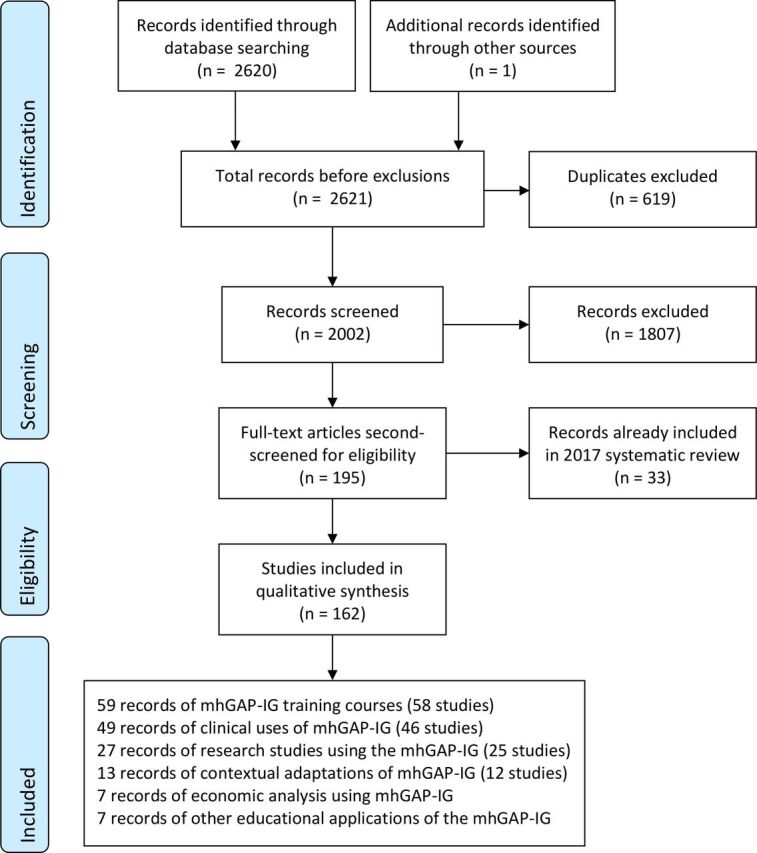
QUESTION: There is a large worldwide gap between the service need and provision for mental, neurological and substance use disorders. WHO's Mental Health Gap Action Programme (mhGAP) intervention guide (IG), provides evidence-based guidance and tools for assessment and integrated management of priority disorders. Our 2017 systematic review identified 33 peer-reviewed studies describing mhGAP-IG implementation in low-income and middle-income countries. STUDY SELECTION AND ANALYSIS: We searched MEDLINE, Embase, PsycINFO, Web of Knowledge, Scopus, CINAHL, LILACS, ScieELO, Cochrane, PubMed databases, 3ie, Google Scholar and citations of our review, on 24 November 2020. We sought evidence, experience and evaluations of the mhGAP-IG, app or mhGAP Humanitarian IG, from any country, in any language. We extracted data from included papers, but heterogeneity prevented meta-analysis. FINDINGS: Of 2621 results, 162 new papers reported applications of the mhGAP-IG. They described mhGAP training courses (59 references), clinical applications (n=49), research uses (n=27), contextual adaptations (n=13), economic studies (n=7) and other educational applications (n=7). Most were conducted in the African region (40%) and South-East Asia (25%). Studies demonstrated improved knowledge, attitudes and confidence post-training and improved symptoms and engagement with care, post-implementation. Research studies compared mhGAP-IG-enhanced usual care with task-shared psychological interventions and adaptation studies optimised mhGAP-IG implementation for different contexts. Economic studies calculated human resource requirements of scaling up mhGAP-IG implementation and other educational studies explored its potential for repurposing. CONCLUSIONS: The diverse, expanding global mhGAP-IG literature demonstrates substantial impact on training, patient care, research and practice. Priorities for future research should be less-studied regions, severe mental illness and contextual adaptation of brief psychological interventions.
Overview
The claims and statistics of this paper haven’t been checked yet.
Free: it reads the open-access text and checks the first 5 claims that cite a source we can check. Create a free account to check every claim.
Integrity signals
Registry
Cites
Statistics
Figures
Verification
Claims the paper makes
The claims and statistics of this paper haven’t been checked yet.
Free: it reads the open-access text and checks the first 5 claims that cite a source we can check. Create a free account to check every claim.
Claims other papers make about this one
Each is checked against this paper’s own text: does it say what the citing paper says it does?
The source backs part of the claim, not all of it — or backs it for a different population, condition or comparison.
In the citing paper
“Adopted in over 90 countries and adapted to local contexts, the mhGAP-IG aligns with WHO’s global mental health action framework (Keynejad et al., 2021).”
From Scaling mental health care in Nigeria: Impact of WHO mhGAP training under the MeHPriC program on knowledge, attitudes, and practices of primary health care workers in Lagos State – A pre-post mixed-methods study (2025) · cites this paper as Keynejad et al., 2021
Experimental — accuracy not yet measuredThe source backs part of the claim, not all of it — or backs it for a different population, condition or comparison.
In the citing paper
“In a review of 162 studies, Keynejad et al. concluded that more research is needed to look at mhGAP implementation especially focused on contextual adaptations [39].”
From Integrating mental health into primary care: evaluation of the Health Action for Psychiatric Problems In Nigeria including Epilepsy and SubstanceS (HAPPINESS) pilot project (2022) · cites this paper as [39]
Experimental — accuracy not yet measuredThe source backs part of the claim, not all of it — or backs it for a different population, condition or comparison.
In the citing paper
“It has been found to be effective for the delivery of evidence-based mental health services within primary healthcare in LMICs [10].”
From Perception of providers on use of the WHO mental health Gap Action Programme-Intervention Guide (mhGAP-IG) electronic version and smartphone-based clinical guidance in Nigerian primary care settings (2022) · cites this paper as [10]
Experimental — accuracy not yet measuredThe source backs part of the claim, not all of it — or backs it for a different population, condition or comparison.
In the citing paper
“Several randomised controlled trials (RCT), reviewed by Singla and colleagues [9], have demonstrated the effectiveness of psychosocial interventions delivered by non-specialist healthcare workers for mental health conditions in LMICs [10].”
From Perception of providers on use of the WHO mental health Gap Action Programme-Intervention Guide (mhGAP-IG) electronic version and smartphone-based clinical guidance in Nigerian primary care settings (2022) · cites this paper as [10]
Experimental — accuracy not yet measuredThe cited source says what the claim attributes to it.
In the citing paper
“There is also evidence to show that stigma improves among trainees pre-and post-mhGAP training [39].”
2 more claims about this paper
Create a free account to see every claim other papers make about this one.
Self-check
Percentages, sums and reported differences re-computed from the paper’s own numbers.
The self-check needs the paper’s full text.
Citations
Cites
Cochrane Handbook for Systematic Reviews of Interventions: Cochrane Book Series
(2008) · doi:10.1002/9780470712184 · Cited by 25,048
Assessing Risk of Bias in Included Studies
Higgins, J. P., & Altman, D. G. (2008) · Cochrane Handbook for Systematic Reviews of Interventions · doi:10.1002/9780470712184.ch8 · Cited by 3,396
The world health report 2001 - Mental health: new understanding, new hope
Sayers, J. G. (2001) · Europe PMC (PubMed Central) · doi:10.1590/s0042-96862001001100014 · Cited by 3,123
Keynejad, R. C., Dua, T., Barbui, C., & Thornicroft, G. (2018) · Evidence Based Mental Health · doi:10.1136/eb-2017-102750 · Cited by 341
Self-citationKohrt, B. A., Turner, E. L., Rai, S., Bhardwaj, A., Sikkema, K. J., Adelekun, A., Dhakal, M., Luitel, N. P., Lund, C., Patel, V., et al. (2020) · Social Science & Medicine · doi:10.1016/j.socscimed.2020.112852 · Cited by 177
Charlson, F. J., Diminic, S., Lund, C., Degenhardt, L., & Whiteford, H. A. (2014) · PLoS ONE · doi:10.1371/journal.pone.0110208 · Cited by 155
Rai, S., Gurung, D., Kaiser, B. N., Sikkema, K. J., Dhakal, M., Bhardwaj, A., Tergesen, C., & Kohrt, B. A. (2018) · Families, Systems, & Health · doi:10.1037/fsh0000338 · Cited by 128
Maulik, P. K., Kallakuri, S., Devarapalli, S., Vadlamani, V. K., Jha, V., & Patel, A. (2017) · Journal of Global Health · doi:10.7189/jogh.07.010408 · Cited by 125
Faregh, N., Lencucha, R., Ventevogel, P., Dubale, B. W., & Kirmayer, L. J. (2019) · International Journal of Mental Health Systems · doi:10.1186/s13033-019-0312-9 · Cited by 120
Lund, C., Alem, A., Schneider, M., Hanlon, C., Ahrens, J., Bandawe, C., Bass, J., Bhana, A., Burns, J., Chibanda, D., et al. (2015) · Epidemiology and Psychiatric Sciences · doi:10.1017/s2045796015000281 · Cited by 113
Self-citation
Research works printed but not linked: 1
- Miguel Esponda G. What enables and hinders implementation? A mixed-methods case study of a mental health programme implemented in primary care clinics in rural Mexico: London School of Hygiene & Tropical Medicine, 2020. · DOI
Cited by
The Lancet Commission on ending stigma and discrimination in mental health
Thornicroft, G., Sunkel, C., Alikhon Aliev, A., Baker, S., Brohan, E., el Chammay, R., Davies, K., Demissie, M., Duncan, J., Fekadu, W., et al. (2022) · The Lancet · doi:10.1016/s0140-6736(22)01470-2 · Cited by 748
“150 Cost-effectiveness is a research gap 150,164,167 and more meta-analyses are needed.”
BackgroundMethodSelf-citationJohnson, S., Dalton‐Locke, C., Baker, J. A., Hanlon, C., Salisbury, T. T., Fossey, M. J., Newbigging, K., Carr, S., Hensel, J. M., Carrà, G., et al. (2022) · World Psychiatry · doi:10.1002/wps.20962 · Cited by 199
“However, it does not provide clear guidance on key components of rights-based care (including supported decision-making, informed consent for treatment, and non-coercive practices) and evaluation for people with crisis presentations has been limited 192 .”
The Lancet Psychiatry Commission: transforming mental health implementation research
McGinty, E. E., Alegria, M. M., Beidas, R. S., Braithwaite, J., Kola, L., LESLIE, D. L., Moise, N., Mueller, B., Pincus, H. A., Shidhaye, R. R., et al. (2024) · The Lancet Psychiatry · doi:10.1016/s2215-0366(24)00040-3 · Cited by 148
Kohrt, B. A., Jordans, M. J. D., Turner, E. L., Rai, S., Gurung, D., Dhakal, M., Bhardwaj, A., Lamichhane, J., Singla, D. R., Lund, C., et al. (2021) · JAMA Network Open · doi:10.1001/jamanetworkopen.2021.31475 · Cited by 87
Atewologun, F., Adigun, O. A., Okesanya, O. J., Hassan, H. K., Olabode, O. N., Micheal, A. S., Ahmed, M. M., Ukoaka, B. M., Idris, N. B., Oso, T. A., et al. (2025) · Discover Mental Health · doi:10.1007/s44192-025-00177-7 · Cited by 89
“The mhGAP-Intervention Guide (mhGAP-IG) has been implemented in several regions to train primary healthcare providers to identify and manage mental health disorders [72].”
Sequeira, M., Singh, S., Fernandes, L., Gaikwad, L., Gupta, D., Chibanda, D., & Nadkarni, A. (2022) · Tropical Medicine & International Health · doi:10.1111/tmi.13802 · Cited by 91
Exploring Heterogeneity in perinatal depression: a comprehensive review
Waqas, A., Nadeem, M., & Rahman, A. (2023) · BMC Psychiatry · doi:10.1186/s12888-023-05121-z · Cited by 76
“This is an important finding because most mental health systems recommend utilizing cost-efficient stepped-care approaches [100, 101].”
BackgroundFuture Directions in Lay Health Worker Involvement in Children’s Mental Health Services in the U.S.
Barnett, M. L., Sanchez, B. E. L., Rosas, Y. G., & Broder‐Fingert, S. (2021) · Journal of Clinical Child & Adolescent Psychology · doi:10.1080/15374416.2021.1969655 · Cited by 73
“…Clinical Child & Adolescent Psychology Gap Action Programme identified the role LHWs could have to increase evidence-based practices (EBPs) in lowand middle-income countries (LMICs), where there are extreme shortages in professional mental health providers (Dua et al., 2011; Keynejad et al., 2021).”
BackgroundManolova, G., Waqas, A., Chowdhary, N., Salisbury, T. T. T., & Dua, T. (2023) · British medical journal · doi:10.1136/bmj-2022-073343 · Cited by 49
Aldridge, L. R., Kemp, C. G., Bass, J., Danforth, K., Kane, J. C., Hamdani, S. U., Marsch, L. A., Uribe-Restrepo, J. M., Nguyen, A. J., Bolton, P. A., et al. (2022) · Implementation Science Communications · doi:10.1186/s43058-022-00301-6 · Cited by 51
“There are now dozens of randomized controlled trials (RCTs) supporting the effectiveness of psychotherapy delivered by nonspecialist health workers for depression, anxiety, posttraumatic stress, substance use, and violence [2–4], with over 20 RCTs focused on the implementation of the World Health Organization’s Mental…”
BackgroundHanlon, C., Medhin, G., Dewey, M. E., Prince, M. J., Assefa, E., Shibre, T., Ejigu, D. A., Negussie, H., Timothewos, S., Schneider, M., et al. (2021) · The Lancet Psychiatry · doi:10.1016/s2215-0366(21)00384-9 · Cited by 53
Self-citationKeynejad, R. C., Spagnolo, J., & Thornicroft, G. (2022) · Evidence-Based Mental Health · doi:10.1136/ebmental-2021-300401 · Cited by 54
Self-citationBrohan, E., Chowdhary, N., Dua, T., Barbui, C., Thornicroft, G., Kestel, D., Ali, A., Assanangkornchai, S., Brodaty, H., Carli, V., et al. (2023) · The Lancet Psychiatry · doi:10.1016/s2215-0366(23)00370-x · Cited by 44
Self-citationPrevalence and its correlates of anxiety disorders from India’s National Mental Health Survey 2016
Manjunatha, N., Jayasankar, P., Suhas, S., Rao, G. N., Gopalkrishna, G., Varghese, M., Benegal, V., & NMHS National Collaborators Group (2022) · Indian Journal of Psychiatry · doi:10.4103/indianjpsychiatry.indianjpsychiatry_964_21 · Cited by 39
“[29] Given the pressing need to take appropriate remedial measures, WHO’s mental health gap action program [30] is a step forward.”
Koly, K. N., Baskin, C., Khanam, M. I., Rao, M., Rasheed, S., Law, G. R., Sarker, F., & Gnani, S. (2021) · Frontiers in Psychiatry · doi:10.3389/fpsyt.2021.741328 · Cited by 49
Garriga, R., Buda, T. S., Guerreiro, J., Iglesias, J. O., Aguerri, I. E., & Matić, A. (2023) · Cell Reports Medicine · doi:10.1016/j.xcrm.2023.101260 · Cited by 53
Yim, S. H., Lorenz, H., & Salkovskis, P. M. (2023) · Trauma Violence & Abuse · doi:10.1177/15248380231156198 · Cited by 39
“…and variable quality of the studies, future studies could use standardized checklists such as TIDieR checklist (Hoffmann et al., 2014) and adhere to World Health Organization Mental Health Gap Action Programme guidelines (Keynejad et al., 2021) when designing and evaluating interventions.”
MethodAccessibility and availability of smartphone apps for schizophrenia
Kwon, S., Firth, J., Joshi, D., & Torous, J. B. (2022) · Schizophrenia · doi:10.1038/s41537-022-00313-0 · Cited by 37
Chu, C., Roxas, N., Aguocha, C. M., Nwefoh, E., Wang, K., Dike, C., & Iheanacho, T. (2022) · BMC Health Services Research · doi:10.1186/s12913-022-07703-1 · Cited by 30
“concluded that more research is needed to look at mhGAP implementation especially focused on contextual adaptations [39].”
BackgroundValencia, J. S., Lapadula, M. C., Westfall, J. M., Gaona, G., de Lusignan, S., Kristiansson, R. S., Ling, Z. J., Goh, L. H., Soto-Becerra, P., Cuba-Fuentes, M. S., et al. (2024) · EClinicalMedicine · doi:10.1016/j.eclinm.2024.102533 · Cited by 33
“Rates have been calculated relative to the total number of visits. intervention guide, 31 ongoing challenges persist, including issues like fragmentation in healthcare delivery, stigma, and insuf fi cient medical education on mental health conditions.”
BackgroundBirtel, M. D., & Mitchell, B. L. (2022) · Psychology and Psychotherapy Theory Research and Practice · doi:10.1111/papt.12428 · Cited by 41
“Furthermore, access to mental health services is becoming increasingly difficult due to worldwide cuts (Keynejad et al., 2021).”
BackgroundOjagbemi, A., Daley, S., Kola, L., Taylor Salisbury, T., Feeney, Y., Makhmud, A., Lempp, H., Thornicroft, G., & Gureje, O. (2022) · BMC Primary Care · doi:10.1186/s12875-022-01869-7 · Cited by 28
“Several randomised controlled trials (RCT), reviewed by Singla and colleagues [9], have demonstrated the effectiveness of psychosocial interventions delivered by non-specialist healthcare workers for mental health conditions in LMICs [10].”
BackgroundMethodSelf-citationHenderson, C., Kotera, Y., Lloyd‐Evans, B., Jordan, G., Gorner, M., Salla, A., Kalha, J., Coventry, P. A., Bojke, L., Hinde, S., et al. (2026) · World Psychiatry · doi:10.1002/wps.70031 · Cited by 39
Wasserman, D. (2024) · World Psychiatry · doi:10.1002/wps.21185 · Cited by 31
Zimmermann, R., Steppan, M., Zimmermann, J., Oeltjen, L., Birkhölzer, M., Schmeck, K., & Goth, K. (2022) · PLoS ONE · doi:10.1371/journal.pone.0269327 · Cited by 30
Huang, S., Wang, Y., Li, G., Hall, B. J., & Nyman, T. J. (2024) · JMIR Mental Health · doi:10.2196/56650 · Cited by 36
Cooper, Z., O’Shields, J., Ali, M. K., Chwastiak, L., & Johnson, L. C. M. (2024) · Diabetes Care · doi:10.2337/dc24-1334 · Cited by 52
Kohrt, B. A., Turner, E. L., Gurung, D., Wang, X., Neupane, M., Luitel, N. P., Kartha, M. R., Poudyal, A., Singh, R., Rai, S., et al. (2022) · Implementation Science · doi:10.1186/s13012-022-01202-x · Cited by 24
“Despite poor identification of mental illness, studies of primary care services in LMICs, including in Nepal, demonstrate that the correct treatments are provided if a patient is accurately diagnosed, and this leads to improved patient outcomes [10, 12, 13].”
BackgroundSelf-citationKhan, B., Hameed, W., & Avan, B. I. (2023) · PLoS ONE · doi:10.1371/journal.pone.0285209 · Cited by 27
Grimes, K. E. L., Ebasone, P. V., Dzudié, A., Nash, D., Wainberg, M. L., Pence, B. W., Barrington, C., Pefura, E. W. Y., Yotebieng, M., Anastos, K., et al. (2024) · BMC Health Services Research · doi:10.1186/s12913-024-10775-w · Cited by 24
“Systematic reviews of evidence on mhGAP implementation have demonstrated that learners have improved knowledge, attitudes, and confidence after participating in mhGAP training [54, 55].”
BackgroundReprioritising global mental health: psychoses in sub-Saharan Africa
Omigbodun, O. O., Ryan, G. K., Fasoranti, B., Chibanda, D., Esliker, R., Sefasi, A., Kakuma, R., Shakespeare, T., & Eaton, J. (2023) · International Journal of Mental Health Systems · doi:10.1186/s13033-023-00574-x · Cited by 26
Lin, H., Fang, J. S., Zhang, J., Zhang, X., Piao, W., & Liu, Y. (2024) · Sensors · doi:10.3390/s24216815 · Cited by 28
Hamdani, S. U., Huma, Z., Nizami, A. T., Baneen, U.-U., Suleman, N., Javed, H., Malik, A., Wang, D., Mazhar, S., Khan, S. A., et al. (2022) · Child and Adolescent Psychiatry and Mental Health · doi:10.1186/s13034-022-00480-z · Cited by 23
Boran, P., Dönmez, M., Barış, H. E., Us, M. C., Altaş, Z. M., Nisar, A., Atif, N., Sikander, S., Hıdıroğlu, S., Save, D., et al. (2023) · BMC Psychiatry · doi:10.1186/s12888-022-04499-6 · Cited by 30
“Abbreviations THP Thinking Healthy Programme THP-BGV Thinking Healthy Programme –”
MethodResultInfluentialHunt, X., Abdurahman, H., Omobowale, O. C., Afolayan, A., Munetsi, E., Dzapasi, L., Mokaya, N., Koroma, A., Barrie, I., Ogunmola, O. A., et al. (2022) · Cambridge Prisms Global Mental Health · doi:10.1017/gmh.2022.25 · Cited by 19
“%) of recent peer-reviewed studies documenting the application of the World Health Organization’s (WHO) mental health Gap Action Program intervention guide (mhGAP-IG) come from Africa – more than any other world region (Keynejad et al., 2021).”
BackgroundMarchionatti, L. E., Schäfer, J., Karagiorga, V. E., Balikou, P., Mitropoulou, A., Serdari, A., Moschos, G., Athanasopoulou, L., Basta, M., Simioni, A., et al. (2024) · Frontiers in Health Services · doi:10.3389/frhs.2024.1470053 · Cited by 20
Stewart, L., McConnell, B. B., Darboe, B., Glover, V. A. S., Huma, H. B., Sanfilippo, K. R. M., Cross, I. R. M., Ceesay, H., Ramchandani, P. G., & Cornelius, V. R. (2022) · Health Promotion International · doi:10.1093/heapro/daab210 · Cited by 22
“The use of social singing to improve mood, promote social bonds and convey information aligns well with recommendations from the WHO’s Mental Health gap action programme for LMIC contexts (Keynejad et al. , 2021) and formed the basis for the intervention.”
Trends in the utilization of psychotropic medications in China from 2018 to 2021
Zhang, X., Hu, X., Zhao, Y., Lu, C. Y., Nie, X., & Shi, L. (2022) · Frontiers in Pharmacology · doi:10.3389/fphar.2022.967826 · Cited by 22
“The WHO has developed many initiatives and interventions to promote the comprehensive health of people worldwide (Chokshi et al., 2016; Keynejad et al., 2021), such as the development of the WHO Comprehensive Mental Health Action Plan 2013–2030 (WHO, 2013) and the inclusion of mental health in the Sustainable Developm…”
BackgroundAsefa, A., Hanlon, C., Marchal, B., Homer, C., Gebremedhin, S., Tunçalp, Ö., Sarkar, N. D. P., Délamou, A., McNab, S., & Beňová, L. (2024) · BMJ Global Health · doi:10.1136/bmjgh-2024-015820 · Cited by 16
“Resources include the WHO mental health Gap Action Programme, now implemented in >100 countries 23 and the Practical Approach to Care Kit, which integrates woman-centred psychosocial approaches into every primary care-based maternal care consultation along the continuum of care using a…”
den Bergh, B. R. H. V., Antonelli, M. C., & Stein, D. J. (2024) · Current Opinion in Psychiatry · doi:10.1097/yco.0000000000000932 · Cited by 18
Luitel, N. P., Neupane, V., Lamichhane, B., Koirala, G. P., Gautam, K., Karki, E., Adhikari, S., Votruba, N., Jordans, M. J., Kohrt, B. A., et al. (2023) · SSM - Mental Health · doi:10.1016/j.ssmmh.2023.100278 · Cited by 13
Self-citationTsigebrhan, R., Fekadu, A., Medhin, G., Newton, C. R., Prince, M. J., & Hanlon, C. (2021) · BMC Family Practice · doi:10.1186/s12875-021-01551-4 · Cited by 13
“Since its launch in 2008, there have been many efforts to adapt, implement and evaluate mhGAP, although there has been limited evaluation of the application of mhGAP-IG to people with co-morbid epilepsy and mental health disorders [16].”
BackgroundSajjad, A., Shah, S., Abbas, G., Aslam, A., Randhawa, F. A., Khurram, H., & Assiri, A. A. (2024) · PeerJ · doi:10.7717/peerj.17711 · Cited by 21
“To tackle the shortage of mental health professionals, the Mental Health Gap Action Programme (mhGAP), developed by the WHO has been employed by various South Asian countries to train non-specialist healthcare providers ( Keynejad, Spagnolo & Thornicroft, 2021 ).”
MethodCosta, N., Olson, R. E., Mescouto, K. A., Setchell, J., Plage, S., Dune, T. M., Creese, J., Suleman, S., Prasad-Ildes, R., & Ng, Z. Y. (2025) · Culture Medicine and Psychiatry · doi:10.1007/s11013-024-09893-1 · Cited by 15
Dong, F., Bu, Z., Jiang, S., Liu, Y., Li, J., Li, J., Li, J., & Liu, Y. (2025) · Scientific Reports · doi:10.1038/s41598-025-97848-w · Cited by 14
de Queiroz, M. R., Rubini, E., Valente, M., Hubloue, I., & Corte, F. D. (2025) · Cadernos de Saúde Pública · doi:10.1590/0102-311xen199224 · Cited by 12
“A systematic review by Keynejad et al. 17 also reported a growing number of studies on the use and evaluation of mhGAP-IG in recent years, mostly conducted in LMICs.”
Universal mental health training for frontline professionals: evaluation of pilot trial in Ukraine
Горбунова, В., Klymchuk, V., Портницька, Н. Ф., Savychenko, О., Тичина, І. М., & Steffgen, G. (2024) · Open Research Europe · doi:10.12688/openreseurope.16941.2 · Cited by 13
Ganzevoort, C. O. W., Wolters, L. H., Hornstra, R., Grieve, C. M., Højgaard, D. R. M. A., Skarphedinsson, G. A., Weidle, B., Waite, P., Bertie, L.-A., Tomlinson, M., et al. (2024) · Journal of Anxiety Disorders · doi:10.1016/j.janxdis.2024.102940 · Cited by 11
Phiri, K., Songo, J., Whitehead, H. S., Chikuse, E., Moucheraud, C., Dovel, K. L., Phiri, S., Hoffman, R. M., & van Oosterhout, J. J. (2023) · PLOS Global Public Health · doi:10.1371/journal.pgph.0001887 · Cited by 11
“If interventions for depression and burnout are to have meaningful impact, a large diagnostic and treatment gap for mental disorders, caused by scarce human resources, competing public health priorities, and low investment in mental health services, must be addressed [52].”
BackgroundConhecimento de profissionais da atenção primária em saúde mental: diagnóstico pelo mhGAP
de Mendonça, J. M. T., Eshriqui, I., de Almeida, L. Y., Filho, V. V. G., Schunk, L., de Sousa, A. A. F., Santos, L. K. D. O., & Fortes, S. (2023) · Revista de Saúde Pública · doi:10.11606/s1518-8787.2023057005272 · Cited by 14
“…use of MhGAP-IG point out the need for broader training, one which is not limited only to the technical knowledge of health professionals, but also encourages changes in work processes and investments at other levels of management, including, fundamentally, the federal and regional levels 26,27 .”
BackgroundThe WHO World Mental Health Report 2022: a new standard of care is emerging
Barbui, C. (2023) · Molecular Psychiatry · doi:10.1038/s41380-022-01788-0 · Cited by 10
“Notably, the WHO has already developed a set of task-sharing training packages and implementation tools, with positive feedback from a number of implementation projects and initiatives conducted in low-income settings [9].”
BackgroundKohrt, B. A., Gurung, D., Singh, R., Rai, S., Neupane, M., Turner, E. L., Platt, A. C., Sun, S., Gautam, K., Luitel, N. P., et al. (2025) · Epidemiology and Psychiatric Sciences · doi:10.1017/s2045796025000010 · Cited by 16
“…the five-day curriculum for WHO’s mental health Gap Action Programme-Intervention Guide (mhGAP-IG), have been implemented in over 90 countries to facilitate the integration of mental health services into primary care (Brohan et al. , 2024; Keynejad et al. , 2021; World Health Organization, 2016).”
Tong, Y., Yin, Y., Conner, K. R., Zhao, L., Wang, Y., Wang, X., & Conwell, Y. (2023) · Journal of Affective Disorders · doi:10.1016/j.jad.2023.02.095 · Cited by 13
Leresche, E., Hossain, M., de Rubeis, M. L., Hermans, V., Burtscher, D., Rossi, R., Lonsdale, C., & Singh, N. (2023) · Conflict and Health · doi:10.1186/s13031-023-00534-9 · Cited by 12
“Most authors (n = 14) anticipated a benefit based on external findings from systematic reviews [66, 67], WHO guidance [68– 73], randomized trials [74, 75], cross-sectional surveys or cohort studies [76–78], or a literature review [79].”
BackgroundBhidayasiri, R., Phumphid, S., Sringean, J., Anan, C., Laosombut, T., Meesri, J., Wekhinhiran, S., Leabthong, N., Phokaewvarangkul, O., Surangsrirat, D., et al. (2026) · BMC Public Health · doi:10.1186/s12889-026-27654-0 · Cited by 12
“The benefits of digital health tools have also been demonstrated in mental health and cognitive or neurocognitive population screening [38–40], with the World Health Organization (WHO)’s Mental Health Gap Action Programme (e-mhGAP) aiming to leverage such tools to scale services for mental,…”
Elnasseh, A., Mehta, V. S., Manolova, G., Pedersen, G. A., Golden, S., Eloul, L., Gebrekristos, F., Collins, P. Y., Mutavi, T. N., Mbwayo, A., et al. (2024) · BJPsych Open · doi:10.1192/bjo.2024.37 · Cited by 12
“15 Therefore, one of the objectives during the development of EQUIP was to evaluate the feasibility and acceptability of using competency-based approaches in existing curricula for non-specia-lists working with a range of manualised interventions in different settings around the world.”
BackgroundDawson-Squibb, J.-J., Davids, E. L., Chase, R. M., Puffer, E. S., Rasmussen, J. D., Franz, L., & de Vries, P. J. (2022) · International Journal of Environmental Research and Public Health · doi:10.3390/ijerph19084450 · Cited by 11
“Globally, there are challenges and on-going efforts to improve access to evidence-based and evidence-informed psychological and psychosocial treatments [1,2].”
BackgroundAl-Uzri, M., Al-Taiar, H., Abdulghani, E. A., Abbas, Y. A., & Suleman, M. (2024) · BJPsych International · doi:10.1192/bji.2023.36 · Cited by 10
Nisar, A., Yin, J., Zhang, J., Qi, W., Yu, J., Li, J., Li, X., & Rahman, A. (2025) · Frontiers in Global Women s Health · doi:10.3389/fgwh.2024.1475430 · Cited by 13
King, S. L., Lebert, J., Karpisek, L., Phillips, A. C., Neal, T. J., & Kosyluk, K. A. (2022) · JMIR Formative Research · doi:10.2196/35699 · Cited by 9
Ventevogel, P., & Whitney, C. (2022) · Essential clinical social work series · doi:10.1007/978-3-031-12600-0_13 · Cited by 13
Deahl, M., & Andreassen, M. (2023) · International Journal of Social Psychiatry · doi:10.1177/00207640231193286 · Cited by 8
“Mental Health Gap (or MHGap) is designed to equip non-mental-health professionals to assess, diagnose and treat a broad range of mental disorders likely to be encountered in community settings (Keynejad et al., 2021).”
BackgroundMew, E. J., Blas, V., Winschel, J., Hunt, L., Soliai-Lemusu, S., Johansson, A. M., Lowe, S. R., Faiai, M., Naseri, J., Toelupe, R. L. M., et al. (2023) · International Journal of Mental Health Nursing · doi:10.1111/inm.13223 · Cited by 9
Petersen, I., Kemp, C. G., Rao, D., Wagenaar, B. H., Bachmann, M. O., Sherr, K., Kathree, T., Luvuno, Z., van Rensburg, A. J., Gigaba, S. G., et al. (2023) · PLOS Global Public Health · doi:10.1371/journal.pgph.0002604 · Cited by 9
“The Mental Health Gap Action Programme (mhGAP), initiated in 2008, offers training, evidence-based guidelines, and tools for assessment and integrated management of mental health conditions by non-specialist PHC practitioners using a task-sharing approach [7].”
BackgroundHana, R. A., Ramia, J. A., Burchert, S., Carswell, K., Cuijpers, P. J., Heim, E., Knaevelsrud, C., Noun, P., Sijbrandij, M., van Ommeren, M., et al. (2024) · JMIR Mental Health · doi:10.2196/55544 · Cited by 13
Raghuram, H., Rajguru, A. J., Pathiyil, M. M., Brahmbhatt, A., Bhan, A., Spagnolo, J., & Naslund, J. A. (2025) · International Journal of Mental Health Systems · doi:10.1186/s13033-025-00671-z · Cited by 11
“This review was updated in 2021 and found 162 new articles of which only 13 described modifications [11].”
Self-citationEncina, E. P., Rodante, D., Agrest, M., Tapia‐Muñoz, T., Vidal-Zamora, I., Ardila-Gómez, S. E., Alvarado, R., Leiderman, E. A., & Reavley, N. J. (2023) · BMC Psychiatry · doi:10.1186/s12888-023-05417-0 · Cited by 10
“Similar ideas have garnered renewed interest in recent years [74], converging with international strategies such as the Mental Health Global Action Programme (mhGAP) [75] for training non-specialist health personnel, which has recently expanded its scope to include lay community members [76].”
BackgroundAdewuya, A., Ola, B., Coker, O., Atilola, O., Olibamoyo, O., Oladipo, O., & Ajomale, T. (2025) · Cambridge Prisms: Global Mental Health · doi:10.1017/gmh.2025.10040 · Cited by 7
“Adopted in over 90 countries and adapted to local contexts, the mhGAP-IG aligns with WHO ’ s global mental health action framework (Keynejad et al., 2021).”
Zhao, C. Y. (2025) · Humanities and Social Sciences Communications · doi:10.1057/s41599-025-04387-w · Cited by 11
“With the increasing public awareness of mental well-being, individuals are becoming more attuned to the origins of these disorders and how they manifest in their lives (Keynejad et al. 2021).”
McDaid, D., & Park, A. (2023) · Cambridge Prisms Global Mental Health · doi:10.1017/gmh.2023.1 · Cited by 11
“Another approach, for example, transforms World Health Organization Disability Assessment Schedule scale (WHO-DAS 2.0) scores into utility values (Lokkerbol et al., 2021).”
MethodInfluentialAgudelo‐Hernández, F., & Giraldo-Álvarez, A. B. (2025) · Public health reviews · doi:10.3389/phrs.2025.1607759 · Cited by 8
“Keynejad et al. [30] conducted a systematic review to identify the evidence generated from its implementation.”
InfluentialAgudelo‐Hernández, F., Giraldo-Álvarez, A. B., & Andrade, R. M. R. (2024) · Psychological Reports · doi:10.1177/00332941241248595 · Cited by 7
“The implementation of the mhGAP strategy has encountered barriers, particularly in the follow-up step, as it has been primarily focused on training across 100 countries, rather than effectively putting the strategy into practice (Keynejad et al., 2021; PAHO, 2021).”
BackgroundMethodDevelopment of mental health human resources for mental well-being
Das, A., Sarkhel, S., Brahma, A., & Akula, V. (2024) · Indian Journal of Psychiatry · doi:10.4103/indianjpsychiatry.indianjpsychiatry_639_23 · Cited by 7
“[11] Recommendations as per the WHO mhGAP intervention guide RECOMMENDATIONS FOR IMPLEMENTATION is described in Table 5 i.”
Addressing the challenges of integrating care for perinatal depression in primary care in Nigeria
Oladeji, B. D., Ayinde, O. O., Bello, T., Kola, L., Faregh, N., Abdulmalik, J. O., Zelkowitz, P., Seedat, S., & Gureje, O. (2024) · Social Psychiatry and Psychiatric Epidemiology · doi:10.1007/s00127-024-02611-7 · Cited by 7
“Whilst the mhGAP-IG is currently being used in more than 100 countries in different regions of the world to scale up mental health care [20] there is at present limited research evidence for its utility for scaling-up care for perinatal depression.”
Cost-effectiveness of task-shifting in resource-constrained settings
Chatterton, M. L., & Belay, Y. B. (2024) · The Lancet Global Health · doi:10.1016/s2214-109x(24)00038-x · Cited by 6
Humayun, A., & Najmussaqib, A. (2025) · BJPsych International · doi:10.1192/bji.2025.10059 · Cited by 9
Quality care for people with severe mental disorders in low-resource settings
Gureje, O., & Oladeji, B. D. (2021) · The Lancet Psychiatry · doi:10.1016/s2215-0366(21)00438-7 · Cited by 7
Sharifi, V., Shahrivar, Z., Zarafshan, H., Ashezary, S. B., Arabgol, F., Khademi, M., Jafarinia, M., Hajebi, A., Abolhassani, F., Emami, S., et al. (2022) · JAMA Psychiatry · doi:10.1001/jamapsychiatry.2022.3989 · Cited by 7
“of children per GP, 11 [1-20]) 173 Children screened using the SDQ and had positive scores (median [range] No.”
BackgroundMethodPatel, V. L., Halpern, M., Nagaraj, V. H., Chang, O., Iyengar, S., & May, W. N. (2021) · BMJ Health & Care Informatics · doi:10.1136/bmjhci-2021-100342 · Cited by 7
Adewuya, A. O., Ola, B. A., Abímbọ́lá, Ṣ., & Abdulmalik, J. O. (2025) · Journal of Global Health · doi:10.7189/jogh.15.04305 · Cited by 6
Hailemichael, Y., Mariam, D. H., Tirfessa, K., Docrat, S., Alem, A., Medhin, G., Fekadu, A., Lund, C., Chisholm, D., & Hanlon, C. (2025) · International Journal of Mental Health Systems · doi:10.1186/s13033-025-00668-8 · Cited by 5
“In a review including 33 studies, WHO mhGAP had been implemented in varying global contexts and the mhGAP intervention guide had been used for training, clinical practice and to estimate total and incremental costs of scaled-up mental health service provision using economic models [22].”
An App-Based WHO Mental Health Guide for Depression Detection: A Cluster Randomized Clinical Trial
Kohrt, B. A., Ojagbemi, A., Luitel, N. P., Bakolis, I., Bello, T., McCrone, P., Salisbury, T. T., Jordans, M. J. D., Votruba, N., Carswell, K., et al. (2025) · JAMA Network Open · doi:10.1001/jamanetworkopen.2025.12064 · Cited by 8
Self-citationMiddle-income country perspectives on global mental health
Adams, A. S., Sibeko, G., & Stein, D. J. (2023) · Current Opinion in Psychiatry · doi:10.1097/yco.0000000000000877 · Cited by 8
Kuule, Y., Dobson, A., Mutahunga, B., Stewart, A. G., & Wilkinson, E. (2023) · Frontiers in Health Services · doi:10.3389/frhs.2023.1133770 · Cited by 6
“Training non-specialist staff in mhGAP adds to the workforce able to diagnose and treat or refer people with mental health conditions (36).”
BackgroundJain, N., Gupta, A., Sharma, D., Kukreja, S., & Priya, K. R. (2025) · Qualitative Health Research · doi:10.1177/10497323241311493 · Cited by 5
“An average person with SMI spends 12% of their per capita income on direct treatment costs (Sarkar et al., 2017), predominantly as out-of-pocket expenditure for most households (Keynejad et al., 2021).”
Humayun, A., Muneeb, N. U. A., Najmussaqib, A., Haq, I. U., & Asif, M. (2025) · medRxiv · doi:10.1101/2025.05.21.25327990 · Cited by 6
“Such integration is critical for policy reformation, improving quality care, and guiding strategic scale-up and sustainability (Faregh et al., 2019; R. Keynejad et al., 2021; R. C. Keynejad et al., 2018).”
Fifty Years of Maternal and Child Health Nursing: Milestones Achieved and Future Horizons
Abuhammad, S. (2025) · Journal of Advanced Nursing · doi:10.1111/jan.17029 · Cited by 4
Scale-up of Global Child and Youth Mental Health Services: A Scoping Review
Walker, S. C., Wissow, L. S., Gubner, N. R., Ngo, S., Szatmári, P., & Servili, C. (2024) · Administration and Policy in Mental Health and Mental Health Services Research · doi:10.1007/s10488-024-01400-3 · Cited by 4
“…reviews and studies of adult mental health scale-up efforts identify common barriers, including cultural differences in the view of mental health disorder, health worker motivation, staff turnover, lack of finances, and lack (or presence) of institutional and policy support (Keynejad et al., 2021).”
BackgroundVerma, M., Sidana, S., Kumar, P., Singh, O., Esht, V., Balasubramanian, K., Kapoor, N., Kakkar, R., & Kalra, S. (2025) · Diabetology & Metabolic Syndrome · doi:10.1186/s13098-025-01603-0 · Cited by 9
“The World Health Organ-isation’s (WHO) Mental Health Gap Action Programme guidelines for mental health interventions delivered by primary care doctors and nurses to address this gap need to be supported with evidence for feasibility and effectiveness [44].”
Eid, M., Kheir, V. A., Bizri, M., Larnaout, A., & Hayek, S. E. (2025) · Frontiers in Psychiatry · doi:10.3389/fpsyt.2025.1692267 · Cited by 7
Tamming, T., Otake, Y., Aburahma, S., Tan, M., Shishtawi, A. A., El-Daour, Y., Hamad, K. I., & Seita, A. (2023) · BMJ Open · doi:10.1136/bmjopen-2022-066552 · Cited by 8
“15 At the same time, they also highlight the need for qualitative studies on service provider perspectives as the current evidence base does not discuss contextual strengths and challenges for services.”
BackgroundGoodman, M. L., Lee, M., Springer, A. E., Schick, V., Vaughan, E. M., Markham, C. M., Gitari, S., & Mukiri, F. (2023) · Journal of Sleep Research · doi:10.1111/jsr.14119 · Cited by 5
Andrade, R. M. R., & Agudelo‐Hernández, F. (2024) · Revista Panamericana de Salud Pública · doi:10.26633/rpsp.2024.10 · Cited by 4
Dimensi Teoretikal Psikoterapi Komplementari dalam Tafsir al-Qurṭubī
Zaman, R. K., Nasir, K., & Adnan, I. (2023) · Maʿālim al-Qurʾān wa al-Sunnah · doi:10.33102/jmqs.v19i1.398 · Cited by 5
Iheanacho, T., Chu, C., Aguocha, C. M., Nwefoh, E., & Dike, C. (2024) · Cambridge Prisms Global Mental Health · doi:10.1017/gmh.2024.4 · Cited by 3
“…Health Gap Action Programme-Intervention Guide (mhGAP-IG), which supports this approach to scale-up treatment and services for MNS disorders in LMICs (Keynejad et al., 2021), has been contextualized and piloted in Nigeria and utilized in programme implementation in thesestates (WHO, 2010;…”
MethodInfluentialAe-Ngibise, K. A., Sakyi, L., Adwan-Kamara, L., Cooper, T. D., Weobong, B., & Lund, C. (2024) · Community Mental Health Journal · doi:10.1007/s10597-024-01357-5 · Cited by 11
“Doing so can improve access to health-care and reduce stigma, leading to improved outcomes and a more comprehensive approach to mental healthcare (Keynejad et al., 2018 , 2021 ; Kohrt et al., 2020 ; Pathare et al., 2018).”
Wang, H., Wang, H., Guan, S., & Li, J. (2025) · Patient Preference and Adherence · doi:10.2147/ppa.s564293 · Cited by 3
“22,26 Farrokhi et al 20 found that non-clinical services, such as the outpatient environment, sanitation, and timely responses from staff, serve as critical explanations for the “tangibles” and “responsiveness” dimensions in the SERVQUAL model.”
Cogan, N. A., Kirk, A. F., Couper, I. D., DeKock, H., Hodgson, W., Rasmussen, S. A., & Whittaker, S. (2026) · JMIR Research Protocols · doi:10.2196/83521 · Cited by 3
Muriuki, M. M., Mwangi, P. K., Osoro, E. K., & Miima, M. (2024) · Depression and Anxiety · doi:10.1155/2024/4756962 · Cited by 3
“Questions that had been used in other studies and the WHO Mental Health Gap Action Programme were used to select items for the knowledge and practice sections [7].”
Alibudbud, R. C. (2024) · Journal of Lesbian Studies · doi:10.1080/10894160.2024.2415236 · Cited by 4
“As a start, the region can adopt and implement training programs for primary health workers using the WHO’s Mental Health Gap Action Programme (mhGAP) intervention guide (IG), which has already shown promising results across the globe (Keynejad et al., 2021).”
Metadata
- Authors
- Keynejad, R., Spagnolo, J., & Thornicroft, G.
- Affiliations
- King's College London (GB)
- Université de Sherbrooke (CA)
- Corresponding author
- Keynejad, Roxanne
- Venue
- Evidence Based Mental Health
- Publisher
- BMJ
- Published
- 2021-04-26
- Volume
- 24
- Issue
- 3
- Pages
- 124-130
- ISSN
- 1362-0347 (ISSN-L)
- 1468-960X
- PMC
- PMC8311089
- OpenAlex
- W3159716563
- Cited by
- 219
- References
- 39
- Citations by year
- 2026: 37 · 2025: 53 · 2024: 48 · 2023: 42 · 2022: 27 · 2021: 11
- FWCI
- 5.11
- Type
- journal article
- Language
- en
- Open access
- hybrid
- doi.org
- Locations
- Evidence-Based Mental Health (publishedVersion, cc-by)
- PubMed Central (publishedVersion, cc-by)
- PubMed (publishedVersion)
- Funders
- King's College London (King's IoPPN Clinician Investigator Scholarship)
- National Institute of Mental Health (R01MH100470)
- World Health Organization
- Medical Research Council (MR/R023697/1, MR/S001255/1)
- Health Services and Delivery Research Programme (Applied Research Collaboration, GHRU 16/136/54)
- Topics
- Health Sciences › Medicine › Psychiatry and Mental health › Mental Health Treatment and Access
- Health Sciences › Health Professions › General Health Professions › Health Policy Implementation Science
- Health Sciences › Medicine › Public Health, Environmental and Occupational Health › Global Health and Surgery
- Keywords
- Mental Health Gap Action Programme, task shifting, mental health treatment gap, low- and middle-income countries, mental, neurological and substance use disorders, contextual adaptation, economic evaluation, severe mental illness, brief psychological intervention, scaling up mental health services
About these checks
Registry, retraction, Cites and statistics results are computed, not judged, with one exception: a printed reference that no index lists is read once by a model before it counts as a citation error. Claims are extracted by a model and kept only when their quote appears verbatim in the text; each cited source is then checked, with a model’s help, for whether it says what the claim relies on. Those verdicts can be wrong — read the claim’s quote and the cited source before relying on one.
Statistics and arithmetic are recomputed, not judged.
Confidence bands are shown only for fields calibrated on our annotated test set. None is calibrated yet, so no band is shown.
What counts as a claim ›How we measure confidence ›How we check this ›
Are you an author, or do you see a problem with this page? Request a review
Data sources
Bibliographic data: Semantic Scholar, OpenAlex, Crossref.
Contains information from the Semantic Scholar Academic Graph Datasets, made available under the ODC Attribution License (ODC-BY 1.0).
Semantic Scholar’s data is described in: Kinney, R., et al. (2023). The Semantic Scholar Open Data Platform. arXiv:2301.10140.
