

WHO mental health gap action programme (mhGAP) intervention guide: updated systematic review on evidence and impact
Open accessThe DOI matches its Crossref record; 39 of the 39 references it cites were found in a registry or an index.
Abstract
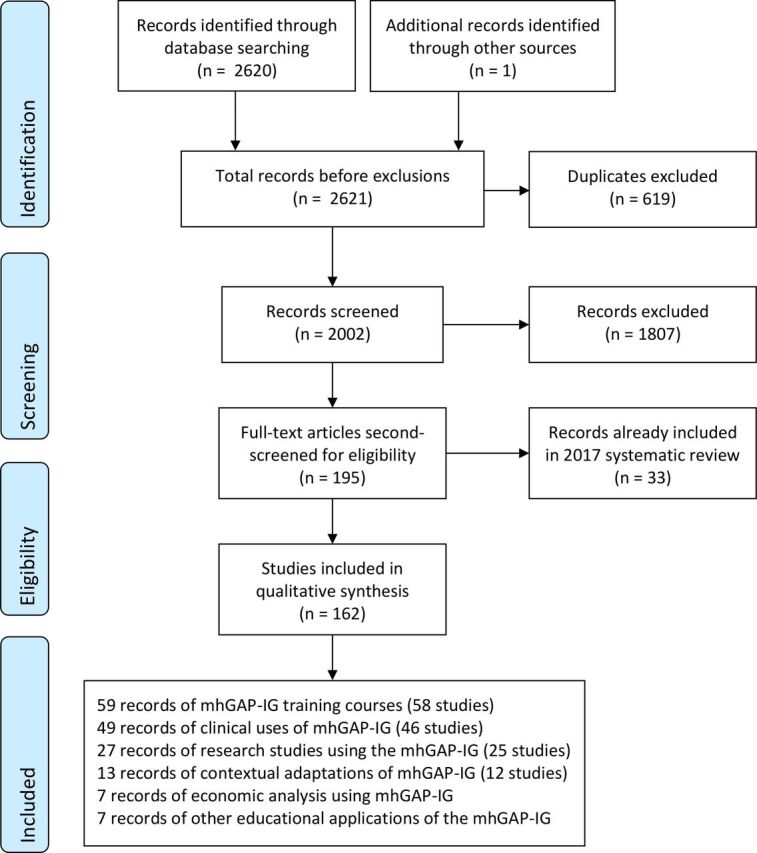
QUESTION: There is a large worldwide gap between the service need and provision for mental, neurological and substance use disorders. WHO's Mental Health Gap Action Programme (mhGAP) intervention guide (IG), provides evidence-based guidance and tools for assessment and integrated management of priority disorders. Our 2017 systematic review identified 33 peer-reviewed studies describing mhGAP-IG implementation in low-income and middle-income countries. STUDY SELECTION AND ANALYSIS: We searched MEDLINE, Embase, PsycINFO, Web of Knowledge, Scopus, CINAHL, LILACS, ScieELO, Cochrane, PubMed databases, 3ie, Google Scholar and citations of our review, on 24 November 2020. We sought evidence, experience and evaluations of the mhGAP-IG, app or mhGAP Humanitarian IG, from any country, in any language. We extracted data from included papers, but heterogeneity prevented meta-analysis. FINDINGS: Of 2621 results, 162 new papers reported applications of the mhGAP-IG. They described mhGAP training courses (59 references), clinical applications (n=49), research uses (n=27), contextual adaptations (n=13), economic studies (n=7) and other educational applications (n=7). Most were conducted in the African region (40%) and South-East Asia (25%). Studies demonstrated improved knowledge, attitudes and confidence post-training and improved symptoms and engagement with care, post-implementation. Research studies compared mhGAP-IG-enhanced usual care with task-shared psychological interventions and adaptation studies optimised mhGAP-IG implementation for different contexts. Economic studies calculated human resource requirements of scaling up mhGAP-IG implementation and other educational studies explored its potential for repurposing. CONCLUSIONS: The diverse, expanding global mhGAP-IG literature demonstrates substantial impact on training, patient care, research and practice. Priorities for future research should be less-studied regions, severe mental illness and contextual adaptation of brief psychological interventions.
Overview
The claims and statistics of this paper haven’t been checked yet.
Free: it reads the open-access text and checks the first 5 claims that cite a source we can check. Create a free account to check every claim.
Integrity signals
Registry
Cites
Statistics
Figures
Verification
Claims the paper makes
The claims and statistics of this paper haven’t been checked yet.
Free: it reads the open-access text and checks the first 5 claims that cite a source we can check. Create a free account to check every claim.
Claims other papers make about this one
Each is checked against this paper’s own text: does it say what the citing paper says it does?
The source backs part of the claim, not all of it — or backs it for a different population, condition or comparison.
In the citing paper
“Adopted in over 90 countries and adapted to local contexts, the mhGAP-IG aligns with WHO’s global mental health action framework (Keynejad et al., 2021).”
From Scaling mental health care in Nigeria: Impact of WHO mhGAP training under the MeHPriC program on knowledge, attitudes, and practices of primary health care workers in Lagos State – A pre-post mixed-methods study (2025) · cites this paper as Keynejad et al., 2021
Experimental — accuracy not yet measuredThe source backs part of the claim, not all of it — or backs it for a different population, condition or comparison.
In the citing paper
“In a review of 162 studies, Keynejad et al. concluded that more research is needed to look at mhGAP implementation especially focused on contextual adaptations [39].”
From Integrating mental health into primary care: evaluation of the Health Action for Psychiatric Problems In Nigeria including Epilepsy and SubstanceS (HAPPINESS) pilot project (2022) · cites this paper as [39]
Experimental — accuracy not yet measuredThe source backs part of the claim, not all of it — or backs it for a different population, condition or comparison.
In the citing paper
“It has been found to be effective for the delivery of evidence-based mental health services within primary healthcare in LMICs [10].”
From Perception of providers on use of the WHO mental health Gap Action Programme-Intervention Guide (mhGAP-IG) electronic version and smartphone-based clinical guidance in Nigerian primary care settings (2022) · cites this paper as [10]
Experimental — accuracy not yet measuredThe source backs part of the claim, not all of it — or backs it for a different population, condition or comparison.
In the citing paper
“Several randomised controlled trials (RCT), reviewed by Singla and colleagues [9], have demonstrated the effectiveness of psychosocial interventions delivered by non-specialist healthcare workers for mental health conditions in LMICs [10].”
From Perception of providers on use of the WHO mental health Gap Action Programme-Intervention Guide (mhGAP-IG) electronic version and smartphone-based clinical guidance in Nigerian primary care settings (2022) · cites this paper as [10]
Experimental — accuracy not yet measuredThe cited source says what the claim attributes to it.
In the citing paper
“There is also evidence to show that stigma improves among trainees pre-and post-mhGAP training [39].”
2 more claims about this paper
Create a free account to see every claim other papers make about this one.
Self-check
Percentages, sums and reported differences re-computed from the paper’s own numbers.
The self-check needs the paper’s full text.
Citations
Cites
Cochrane Handbook for Systematic Reviews of Interventions: Cochrane Book Series
(2008) · doi:10.1002/9780470712184 · Cited by 25,048
Assessing Risk of Bias in Included Studies
Higgins, J. P., & Altman, D. G. (2008) · Cochrane Handbook for Systematic Reviews of Interventions · doi:10.1002/9780470712184.ch8 · Cited by 3,396
The world health report 2001 - Mental health: new understanding, new hope
Sayers, J. G. (2001) · Europe PMC (PubMed Central) · doi:10.1590/s0042-96862001001100014 · Cited by 3,123
Keynejad, R. C., Dua, T., Barbui, C., & Thornicroft, G. (2018) · Evidence Based Mental Health · doi:10.1136/eb-2017-102750 · Cited by 341
Self-citationKohrt, B. A., Turner, E. L., Rai, S., Bhardwaj, A., Sikkema, K. J., Adelekun, A., Dhakal, M., Luitel, N. P., Lund, C., Patel, V., et al. (2020) · Social Science & Medicine · doi:10.1016/j.socscimed.2020.112852 · Cited by 177
Charlson, F. J., Diminic, S., Lund, C., Degenhardt, L., & Whiteford, H. A. (2014) · PLoS ONE · doi:10.1371/journal.pone.0110208 · Cited by 155
Rai, S., Gurung, D., Kaiser, B. N., Sikkema, K. J., Dhakal, M., Bhardwaj, A., Tergesen, C., & Kohrt, B. A. (2018) · Families, Systems, & Health · doi:10.1037/fsh0000338 · Cited by 128
Maulik, P. K., Kallakuri, S., Devarapalli, S., Vadlamani, V. K., Jha, V., & Patel, A. (2017) · Journal of Global Health · doi:10.7189/jogh.07.010408 · Cited by 125
Faregh, N., Lencucha, R., Ventevogel, P., Dubale, B. W., & Kirmayer, L. J. (2019) · International Journal of Mental Health Systems · doi:10.1186/s13033-019-0312-9 · Cited by 120
Lund, C., Alem, A., Schneider, M., Hanlon, C., Ahrens, J., Bandawe, C., Bass, J., Bhana, A., Burns, J., Chibanda, D., et al. (2015) · Epidemiology and Psychiatric Sciences · doi:10.1017/s2045796015000281 · Cited by 113
Self-citationEcheverri, C., Le Roy, J., Worku, B., & Ventevogel, P. (2018) · Global Mental Health · doi:10.1017/gmh.2018.19 · Cited by 101
Li, J., Fan, Y., Zhong, H.-Q., Duan, X.-L., Chen, W., Evans-Lacko, S., & Thornicroft, G. (2019) · International Journal of Mental Health Systems · doi:10.1186/s13033-018-0259-2 · Cited by 98
Self-citationDiez-Canseco, F., Toyama, M., Ipince, A., Perez-Leon, S., Cavero, V., Araya, R., & Miranda, J. J. (2018) · Journal of Medical Internet Research · doi:10.2196/jmir.9208 · Cited by 85
Kohrt, B. A., Mutamba, B. B., Luitel, N. P., Gwaikolo, W., Onyango Mangen, P., Nakku, J., Rose, K., Cooper, J., Jordans, M. J. D., & Baingana, F. (2018) · International Review of Psychiatry · doi:10.1080/09540261.2019.1566116 · Cited by 83
Davies, T., & Lund, C. (2017) · Global Mental Health · doi:10.1017/gmh.2017.3 · Cited by 71
Musyimi, C. W., Mutiso, V. N., Ndetei, D. M., Unanue, I., Desai, D., Patel, S. G., Musau, A. M., Henderson, D. C., Nandoya, E. S., & Bunders, J. (2017) · International Journal of Mental Health Systems · doi:10.1186/s13033-017-0152-4 · Cited by 69
Praharso, N. F., Pols, H., & Tiliopoulos, N. (2020) · Asian Journal of Psychiatry · doi:10.1016/j.ajp.2020.102168 · Cited by 69
Li, J., Huang, Y.-G., Ran, M.-S., Fan, Y., Chen, W., Evans-Lacko, S., & Thornicroft, G. (2018) · Asian Journal of Psychiatry · doi:10.1016/j.ajp.2018.04.017 · Cited by 63
Self-citationIheanacho, T., Marienfeld, C. B., Stefanovics, E. A., & Rosenheck, R. A. (2014) · Academic Psychiatry · doi:10.1007/s40596-014-0073-3 · Cited by 60
Kerbage, H., Marranconi, F., Chamoun, Y., Brunet, A., Richa, S., & Zaman, S. (2020) · Qualitative Health Research · doi:10.1177/1049732319895241 · Cited by 58
Chaulagain, A., Pacione, L., Abdulmalik, J., Hughes, P., Oksana, K., Chumak, S., Mendoza, J., Avetisyan, K., Ghazaryan, G., Gasparyan, K., et al. (2020) · International Journal of Mental Health Systems · doi:10.1186/s13033-020-00379-2 · Cited by 46
Li, J., Li, J., Thornicroft, G., Yang, H., Chen, W., & Huang, Y. (2015) · BMC Psychiatry · doi:10.1186/s12888-015-0660-1 · Cited by 45
Self-citationHailemariam, M., Fekadu, A., Medhin, G., Prince, M., & Hanlon, C. (2019) · International Journal of Mental Health Systems · doi:10.1186/s13033-019-0332-5 · Cited by 44
Hailemichael, Y., Hailemariam, D., Tirfessa, K., Docrat, S., Alem, A., Medhin, G., Lund, C., Chisholm, D., Fekadu, A., & Hanlon, C. (2019) · International Journal of Mental Health Systems · doi:10.1186/s13033-019-0294-7 · Cited by 43
Docherty, M., Shaw, K., Goulding, L., Parke, H., Eassom, E., Ali, F., & Thornicroft, G. (2017) · International Journal of Mental Health Systems · doi:10.1186/s13033-016-0115-1 · Cited by 41
Self-citationProcess evaluation of a district mental healthcare plan in Nepal: a mixed-methods case study
Luitel, N. P., Breuer, E., Adhikari, A., Kohrt, B. A., Lund, C., Komproe, I. H., & Jordans, M. J. D. (2020) · BJPsych Open · doi:10.1192/bjo.2020.60 · Cited by 41
Engaging culture and context in mhGAP implementation: fostering reflexive deliberation in practice
Gómez-Carrillo, A., Lencucha, R., Faregh, N., Veissière, S. P. L., & Kirmayer, L. J. (2020) · BMJ Global Health · doi:10.1136/bmjgh-2020-002689 · Cited by 36
Esponda, G. M., Bohm-Levine, N., Rodríguez-Cuevas, F. G., Cohen, A., & Kakuma, R. (2020) · International Journal of Mental Health Systems · doi:10.1186/s13033-020-00346-x · Cited by 35
Mutiso, V. N., Pike, K., Musyimi, C. W., Rebello, T. J., Tele, A., Gitonga, I., Thornicroft, G., & Ndetei, D. M. (2019) · Epidemiology and Psychiatric Sciences · doi:10.1017/s2045796018000264 · Cited by 30
Self-citationBreuer, E., Subba, P., Luitel, N. P., Jordans, M. J. D., Silva, M. J. D., Marchal, B., & Lund, C. (2018) · BMJ Global Health · doi:10.1136/bmjgh-2018-001023 · Cited by 30
Charlson, F., Diminic, S., & Whiteford, H. (2015) · Asia & the Pacific Policy Studies · doi:10.1002/app5.93 · Cited by 29
Catalao, R., Eshetu, T., Tsigebrhan, R., Medhin, G., Fekadu, A., & Hanlon, C. (2018) · BMC Health Services Research · doi:10.1186/s12913-018-3190-y · Cited by 25
Bitta, M. A., Kariuki, S. M., Omar, A., Nasoro, L., Njeri, M., Kiambu, C., Ongeri, L., & Newton, C. R. J. C. (2020) · Cambridge Prisms Global Mental Health · doi:10.1017/gmh.2020.6 · Cited by 20
Spagnolo, J., Champagne, F., Leduc, N., Melki, W., Piat, M., Laporta, M., Bram, N., Guesmi, I., & Charfi, F. (2018) · BMC Public Health · doi:10.1186/s12889-018-6261-4 · Cited by 19
Self-citationChisholm, D., Garman, E. C., Breuer, E., Fekadu, A., Hanlon, C., Jordans, M. J. D., Kathree, T., Kigozi, F. N., Luitel, N. P., Medhin, G., et al. (2020) · Health Policy and Planning · doi:10.1093/heapol/czz182 · Cited by 10
Hughes, P. G., & Thomson, S. (2019) · Progress in Neurology and Psychiatry · doi:10.1002/pnp.546 · Cited by 8
Charlson, F., Lee, Y. Y., Diminic, S., & Whiteford, H. (2016) · Cambridge Prisms Global Mental Health · doi:10.1017/gmh.2016.4 · Cited by 7
Doherty, S., Dass, G., Edward, A., Manolova, G., & Solomon, M. (2020) · Conflict and Health · doi:10.1186/s13031-020-00259-z · Cited by 7
Spagnolo, J., Champagne, F., Leduc, N., Melki, W., Bram, N., Guesmi, I., Rivard, M., Bannour, S., Bouabid, L., Ganzoui, S. B. H. H., et al. (2019) · Journal of Global Health Reports · doi:10.29392/joghr.3.e2019022 · Cited by 3
Self-citation
Research works printed but not linked: 1
- Miguel Esponda G. What enables and hinders implementation? A mixed-methods case study of a mental health programme implemented in primary care clinics in rural Mexico: London School of Hygiene & Tropical Medicine, 2020. · DOI
Cited by
The Lancet Commission on ending stigma and discrimination in mental health
Thornicroft, G., Sunkel, C., Alikhon Aliev, A., Baker, S., Brohan, E., el Chammay, R., Davies, K., Demissie, M., Duncan, J., Fekadu, W., et al. (2022) · The Lancet · doi:10.1016/s0140-6736(22)01470-2 · Cited by 748
“150 Cost-effectiveness is a research gap 150,164,167 and more meta-analyses are needed.”
BackgroundMethodSelf-citationJohnson, S., Dalton‐Locke, C., Baker, J. A., Hanlon, C., Salisbury, T. T., Fossey, M. J., Newbigging, K., Carr, S., Hensel, J. M., Carrà, G., et al. (2022) · World Psychiatry · doi:10.1002/wps.20962 · Cited by 199
“However, it does not provide clear guidance on key components of rights-based care (including supported decision-making, informed consent for treatment, and non-coercive practices) and evaluation for people with crisis presentations has been limited 192 .”
The Lancet Psychiatry Commission: transforming mental health implementation research
McGinty, E. E., Alegria, M. M., Beidas, R. S., Braithwaite, J., Kola, L., LESLIE, D. L., Moise, N., Mueller, B., Pincus, H. A., Shidhaye, R. R., et al. (2024) · The Lancet Psychiatry · doi:10.1016/s2215-0366(24)00040-3 · Cited by 148
Kohrt, B. A., Jordans, M. J. D., Turner, E. L., Rai, S., Gurung, D., Dhakal, M., Bhardwaj, A., Lamichhane, J., Singla, D. R., Lund, C., et al. (2021) · JAMA Network Open · doi:10.1001/jamanetworkopen.2021.31475 · Cited by 87
Atewologun, F., Adigun, O. A., Okesanya, O. J., Hassan, H. K., Olabode, O. N., Micheal, A. S., Ahmed, M. M., Ukoaka, B. M., Idris, N. B., Oso, T. A., et al. (2025) · Discover Mental Health · doi:10.1007/s44192-025-00177-7 · Cited by 89
“The mhGAP-Intervention Guide (mhGAP-IG) has been implemented in several regions to train primary healthcare providers to identify and manage mental health disorders [72].”
Metadata
- Authors
- Keynejad, R., Spagnolo, J., & Thornicroft, G.
- Affiliations
- King's College London (GB)
- Université de Sherbrooke (CA)
- Corresponding author
- Keynejad, Roxanne
- Venue
- Evidence Based Mental Health
- Publisher
- BMJ
- Published
- 2021-04-26
- Volume
- 24
- Issue
- 3
- Pages
- 124-130
- ISSN
- 1362-0347 (ISSN-L)
- 1468-960X
- PMC
- PMC8311089
- OpenAlex
- W3159716563
- Cited by
- 219
- References
- 39
- Citations by year
- 2026: 37 · 2025: 53 · 2024: 48 · 2023: 42 · 2022: 27 · 2021: 11
- FWCI
- 5.11
- Type
- journal article
- Language
- en
- Open access
- hybrid
- doi.org
- Locations
- Evidence-Based Mental Health (publishedVersion, cc-by)
- PubMed Central (publishedVersion, cc-by)
- PubMed (publishedVersion)
- Funders
- King's College London (King's IoPPN Clinician Investigator Scholarship)
- National Institute of Mental Health (R01MH100470)
- World Health Organization
- Medical Research Council (MR/R023697/1, MR/S001255/1)
- Health Services and Delivery Research Programme (Applied Research Collaboration, GHRU 16/136/54)
- Topics
- Health Sciences › Medicine › Psychiatry and Mental health › Mental Health Treatment and Access
- Health Sciences › Health Professions › General Health Professions › Health Policy Implementation Science
- Health Sciences › Medicine › Public Health, Environmental and Occupational Health › Global Health and Surgery
- Keywords
- Mental Health Gap Action Programme, task shifting, mental health treatment gap, low- and middle-income countries, mental, neurological and substance use disorders, contextual adaptation, economic evaluation, severe mental illness, brief psychological intervention, scaling up mental health services
About these checks
Registry, retraction, Cites and statistics results are computed, not judged, with one exception: a printed reference that no index lists is read once by a model before it counts as a citation error. Claims are extracted by a model and kept only when their quote appears verbatim in the text; each cited source is then checked, with a model’s help, for whether it says what the claim relies on. Those verdicts can be wrong — read the claim’s quote and the cited source before relying on one.
Statistics and arithmetic are recomputed, not judged.
Confidence bands are shown only for fields calibrated on our annotated test set. None is calibrated yet, so no band is shown.
What counts as a claim ›How we measure confidence ›How we check this ›
Are you an author, or do you see a problem with this page? Request a review
Data sources
Bibliographic data: Semantic Scholar, OpenAlex, Crossref.
Contains information from the Semantic Scholar Academic Graph Datasets, made available under the ODC Attribution License (ODC-BY 1.0).
Semantic Scholar’s data is described in: Kinney, R., et al. (2023). The Semantic Scholar Open Data Platform. arXiv:2301.10140.
