

The DOI matches its Crossref record; 30 of the 30 references it cites were found in a registry or an index.
Semistructured interviewing in primary care research: a balance of relationship and rigour
Open accessAbstract
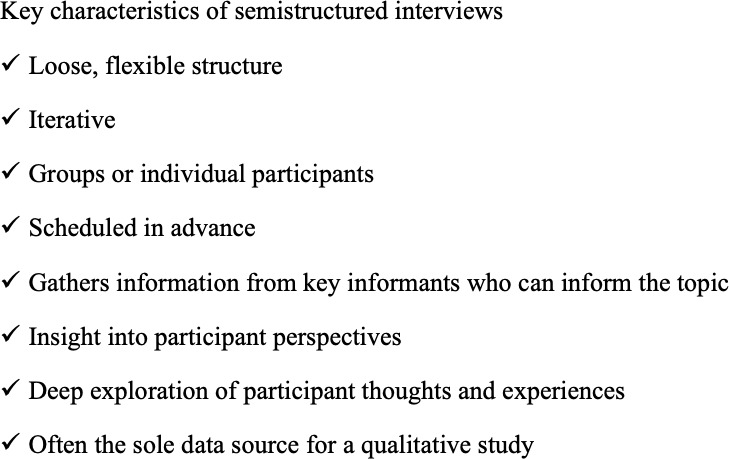
Semistructured in-depth interviews are commonly used in qualitative research and are the most frequent qualitative data source in health services research. This method typically consists of a dialogue between researcher and participant, guided by a flexible interview protocol and supplemented by follow-up questions, probes and comments. The method allows the researcher to collect open-ended data, to explore participant thoughts, feelings and beliefs about a particular topic and to delve deeply into personal and sometimes sensitive issues. The purpose of this article was to identify and describe the essential skills to designing and conducting semistructured interviews in family medicine and primary care research settings. We reviewed the literature on semistructured interviewing to identify key skills and components for using this method in family medicine and primary care research settings. Overall, semistructured interviewing requires both a relational focus and practice in the skills of facilitation. Skills include: (1) determining the purpose and scope of the study; (2) identifying participants; (3) considering ethical issues; (4) planning logistical aspects; (5) developing the interview guide; (6) establishing trust and rapport; (7) conducting the interview; (8) memoing and reflection; (9) analysing the data; (10) demonstrating the trustworthiness of the research; and (11) presenting findings in a paper or report. Semistructured interviews provide an effective and feasible research method for family physicians to conduct in primary care research settings. Researchers using semistructured interviews for data collection should take on a relational focus and consider the skills of interviewing to ensure quality. Semistructured interviewing can be a powerful tool for family physicians, primary care providers and other health services researchers to use to understand the thoughts, beliefs and experiences of individuals. Despite the utility, semistructured interviews can be intimidating and challenging for researchers not familiar with qualitative approaches. In order to elucidate this method, we provide practical guidance for researchers, including novice researchers and those with few resources, to use semistructured interviewing as a data collection strategy. We provide recommendations for the essential steps to follow in order to best implement semistructured interviews in family medicine and primary care research settings.
Overview
The claims and statistics of this paper haven’t been checked yet.
Run the check — free, no account needed. It reads the open-access text and checks the sources it cites.
Integrity signals
Registry
Cites
Statistics
Figures
Verification
Claims the paper makes
The claims and statistics of this paper haven’t been checked yet.
Run the check — free, no account needed. It reads the open-access text and checks the sources it cites.
Claims other papers make about this one
Each is checked against this paper’s own text: does it say what the citing paper says it does?
The cited source says what the claim attributes to it.
In the citing paper
“Individual semi-structured interviews enabled consistent exploration of common topics while allowing follow-up questions when participants introduced unexpected examples or distinctions (DeJonckheere & Vaughn, 2019).”
From Between Co-Intelligence and Cognitive Offloading: Educators’ Perspectives from Dutch Academic Medical Settings on Generative AI, Critical Thinking, and Adult Professional Learning (2026) · cites this paper as DeJonckheere & Vaughn, 2019
Self-check
Percentages, sums and reported differences re-computed from the paper’s own numbers.
The self-check needs the paper’s full text.
Citations
Cites
Qualitative Data Analysis: An Expanded Sourcebook
(1994) · Journal of Environmental Psychology · doi:10.1016/s0272-4944(05)80231-2 · Cited by 48,420
Lincoln, Y. S., Guba, E. G., & Pilotta, J. J. (1985) · International Journal of Intercultural Relations · doi:10.1016/0147-1767(85)90062-8 · Cited by 45,787
How Many Interviews Are Enough?: An Experiment with Data Saturation and Variability
Guest, G., Bunce, A., & Johnson, L. (2006) · Field Methods · doi:10.1177/1525822x05279903 · Cited by 20,808
(2008) · Springer eBooks · doi:10.1007/978-0-387-77282-0_6 · Cited by 17,411
(2017) · Cited by 16,036
Sample Size in Qualitative Interview Studies: Guided by Information Power
Malterud, K., Siersma, V. D., & Guassora, A. D. (2016) · Qualitative Health Research · doi:10.1177/1049732315617444 · Cited by 12,703
Strategies for ensuring trustworthiness in qualitative research projects
Shenton, A. K. (2004) · Education for Information · doi:10.3233/efi-2004-22201 · Cited by 9,748
(2017) · Sage eBooks · doi:10.4135/9781483381411.n168 · Cited by 8,268
The qualitative research interview
DiCicco‐Bloom, B., & Crabtree, B. F. (2006) · Medical Education · doi:10.1111/j.1365-2929.2006.02418.x · Cited by 4,995
Kallio, H., Pietilä, A., Johnson, M., & Kangasniemi, M. (2016) · Journal of Advanced Nursing · doi:10.1111/jan.13031 · Cited by 4,295
Research works printed but not linked: 3
- Kvale S . Interviews. Thousand Oaks: SAGE Publications, 1996.
- Spradley JP . The ethnographic interview. 1979. Waveland Press, 2016.
- Bernard HR . Social research methods: quantitative and qualitative approaches. SAGE, 2000.
Cited by
Sorted by citations
Items 701–800 of 1,002
Sumara, R. (2024) · eCo-Buss · doi:10.32877/eb.v7i1.1530 · Cited by 3
Zagler, J., Yu, N. G., & Cleland, A. (2024) · Disability and Rehabilitation · doi:10.1080/09638288.2024.2388874 · Cited by 3
Whitehorne-Smith, P., Lalwani, K., Martin, R., Mitchell, G., Milbourn, B. T., Abel, W., & Burns, S. K. (2024) · PLoS ONE · doi:10.1371/journal.pone.0309678 · Cited by 5
Living documents: A longitudinal data collection method for health services research
daSilva, M., Hang, S. T., & Sibbald, S. L. (2024) · SSM - Qualitative Research in Health · doi:10.1016/j.ssmqr.2024.100513 · Cited by 4
Hansa, J., & Hansen, H. (2025) · International Journal of Speech-Language Pathology · doi:10.1080/17549507.2025.2473075 · Cited by 6
Humphrey, S., Pike, K. E., Long, B., Ma, H., Bourke, R., Wright, B. J., & Wong, D. K. (2025) · Neuropsychological Rehabilitation · doi:10.1080/09602011.2025.2492753 · Cited by 3
Shankar, R., Chew, E., Bundele, A., & Mukhopadhyay, A. (2025) · Frontiers in Aging Neuroscience · doi:10.3389/fnagi.2025.1581891 · Cited by 4
MacLean, S. E., Edgar, N. E., Ahluwalia, C., Testa, V., & Hatcher, S. (2025) · Health Services Insights · doi:10.1177/11786329251333019 · Cited by 3
Moton, L. N. (2025) · International journal of law, crime and justice · doi:10.1016/j.ijlcj.2025.100763 · Cited by 3
Sidelemine, M., & Campion, E. D. (2025) · International Migration · doi:10.1111/imig.70064 · Cited by 3
Martín-Sanz, M. B., Martín‐Segarra, O., Palacios‐Ceña, D., Crujera, A. G., Gómez-Sanchez, S. M., & Velasco, M. (2025) · Annals of Medicine · doi:10.1080/07853890.2025.2543520 · Cited by 3
Trust and Distrust in Dental Professionals: Patient Perceptions and Experiences
He, K., Sale, J. E. M., Singhal, S., & Dempster, L. J. (2025) · Journal of Dental Education · doi:10.1002/jdd.70017 · Cited by 4
Teye, A. T., & Adjetey, R. A. (2025) · Child & Youth Services · doi:10.1080/0145935x.2025.2561690 · Cited by 3
Nicoara, D., Cristescu, C., Pop, I. C., Ilieș, R. A., Nicoara, N., von Stauffenberg, A. O., Matei, S., Muntean, M. V., & Achimaș-Cădariu, P. (2025) · Journal of Clinical Medicine · doi:10.3390/jcm14197073 · Cited by 3
Fraisse, V., Montambault, C., Wanderley, M. M., & Guastavino, C. (2025) · Music & Science · doi:10.1177/20592043251384052 · Cited by 3
Algosaibi, E. A., AlAnazi, M., Algabgab, M. F., Alhazmi, R. A., Alobaid, A. M., Althunayyan, S. M., Abahussain, M. A., Al-Wathinani, A. M., Goniewicz, K., Gómez-Salgado, J. C., et al. (2025) · Scientific Reports · doi:10.1038/s41598-025-24624-1 · Cited by 3
Bobitt, J., Franceschini, D., Hernandez‐Vallant, A., Afridi, M., Ross, R. D., Daubert, E. M., Cohen, M. H., & French, A. L. (2025) · The Gerontologist · doi:10.1093/geront/gnaf250 · Cited by 3
Wyke, E., Baxter, E. R., Chew-Graham, C. A., Woodward, A., Walters, K. R., Davies, N., Taylor, S. J., Ross, J., Protheroe, J., Mitchell, C. A., et al. (2025) · British Journal of General Practice · doi:10.3399/bjgp.2025.0361 · Cited by 3
Women' and midwives' experiences of perinatal mental health care: A qualitative study
Navarro‐Maldonado, R., Moreno‐Poyato, A. R., & Rioboó, N. A. (2025) · International Journal of Nursing Studies Advances · doi:10.1016/j.ijnsa.2025.100467 · Cited by 3
Lu, Y.-C. (2025) · Journal of Character Education · doi:10.1108/jced-08-2025-0006 · Cited by 3
NADWAH, O., Romli, M. H., Singh, S. K. D. J., Salim, M. S., Dada, S., & Nazan, A. I. N. M. (2026) · Aphasiology · doi:10.1080/02687038.2025.2610413 · Cited by 3
Parturients' Perspectives on Labor Pain and Epidural Analgesia: An Explorative Qualitative Study
Højstrup, L., Bohart, S., Thellesen, L., & Wildgaard, K. (2026) · Acta Anaesthesiologica Scandinavica · doi:10.1111/aas.70195 · Cited by 3
All the Feels, None of the Labels: Young Adults’ Experiences of Situationships
Anderson, S. M., & Phillips, M. J. (2026) · Societies · doi:10.3390/soc16020042 · Cited by 3
Underground mine rescue robotic systems: insights into human-robot information exchange
Bakzadeh, R., Alhaj-Bedar, R., Wilson, S., Androulakis, V., Khaniani, H., Shao, S., Hassanalian, M., & Roghanchi, P. (2026) · Frontiers in Robotics and AI · doi:10.3389/frobt.2026.1698570 · Cited by 3
Wijntuin, R., Vanna, M., Miliya, T., Thong, P., Chanpheakdey, P., Bran, S., Mishra, A., Dahal, A., van Driessen, F., Liverani, M., et al. (2026) · Wellcome Open Research · doi:10.12688/wellcomeopenres.25343.1 · Cited by 3
Simoni, J., Mengual, E., Aschenbrenner-Noriega, I., Monforte-Martínez, C., Pérez-Merino, M., Sawczyn, G., Zurita, R., & Pereira, J. L. (2025) · MedEdPublish · doi:10.12688/mep.21319.1 · Cited by 6
Opoku, S., Nordstrom, O. A., Siegel, D. S., & Waldman, D. A. (2026) · Research Policy · doi:10.1016/j.respol.2026.105447 · Cited by 3
Muthuri, R. N. D. K., Senkubuge, F., & Hongoro, C. (2021) · Healthcare · doi:10.3390/healthcare9030350 · Cited by 3
Methods for capturing patient experience and satisfaction in healthcare services
Walker, K. L. (2021) · Nursing Standard · doi:10.7748/ns.2021.e11664 · Cited by 3
Burton, E., O’Driscoll, M., & Fleming, A. (2022) · International Journal of Clinical Pharmacy · doi:10.1007/s11096-022-01381-z · Cited by 3
The Child’s Right to Participation: High School Learners’ Understanding and Experiences
Munongi, L. (2022) · Child Care in Practice · doi:10.1080/13575279.2022.2037515 · Cited by 3
Laginha, B. I., Rapport, F., Smith, A. L., Wilkinson, D., Cust, A. E., & Braithwaite, J. (2022) · BMJ Open · doi:10.1136/bmjopen-2021-059829 · Cited by 4
Napiah, M. K. M., Abrizah, A., & Kiran, K. (2022) · Malaysian Journal of Library & Information Science · doi:10.22452/mjlis.vol27no2.5 · Cited by 3
Horton, A., Loban, K., Nugus, P., Fortin, M., Gunaratnam, L., Knoll, G. A., Mucsi, I., Chaudhury, P. K., Landsberg, D. N., Pâquet, M. R., et al. (2023) · JMIR Research Protocols · doi:10.2196/44172 · Cited by 3
Hanley, N., MacPhail, C. L., Simpson, H. B., & Stevenson, S. (2023) · International Journal for Crime Justice and Social Democracy · doi:10.5204/ijcjsd.2437 · Cited by 3
Moon, S., Hogden, A., Eljiz, K., & Siddiqui, N. (2023) · Healthcare · doi:10.3390/healthcare11152175 · Cited by 5
Kha, R., Wen, Q., Bender, N., Jones, C., Gopinath, B., Macniven, R., & Tang, D. (2023) · Journal of Health Psychology · doi:10.1177/13591053231204722 · Cited by 3
Whiting, L. S., Petty, J., Roberts, S., Littlechild, B., & Mills, K. (2023) · Health & Social Work · doi:10.1093/hsw/hlad037 · Cited by 3
The life cycle of a cultural heritage tourism destination: The case of Boğazkale
KALELİ, C., & ÖZLÜ, T. (2024) · lnternational Journal of Geography and Geography Education · doi:10.32003/igge.1375082 · Cited by 3
Exploring EFL Students’ Speaking Challenges in Their Speaking for Social Purposes
Elisathusilawani, E. (2023) · Journal of English and Education · doi:10.20885/jee.v9i1.28010 · Cited by 3
Shtainmetz, N., Tesler, R., Sharon, C., & Korn, L. (2024) · SAGE Open Medicine · doi:10.1177/20503121241237447 · Cited by 3
Poscia, A., Paolorossi, G., Collamati, A., Costantino, C., Fiacchini, D., Angelini, C., Bernabei, R., Cimini, D., Icardi, G., Siddu, A., et al. (2024) · Human Vaccines & Immunotherapeutics · doi:10.1080/21645515.2024.2330152 · Cited by 3
McNally, K., Weinstein, A. A., Lindley, L., Wallin, R. L., & Roess, A. (2024) · The Journal of School Nursing · doi:10.1177/10598405241241229 · Cited by 3
Amare, S., Adamek, M. E., & Minaye, A. (2024) · Cogent Social Sciences · doi:10.1080/23311886.2024.2342597 · Cited by 3
Maoela, M. A., Chapungu, L., & Nhamo, G. (2024) · The Extractive Industries and Society · doi:10.1016/j.exis.2024.101462 · Cited by 3
Quirke‐McFarlane, S., & Ogden, J. (2024) · British Journal of Health Psychology · doi:10.1111/bjhp.12733 · Cited by 4
Engel, R. M., Baxter, D. A., Muddle, L., Vaughan, B., & Grace, S. (2024) · Complementary Therapies in Clinical Practice · doi:10.1016/j.ctcp.2024.101918 · Cited by 3
The dementia–nature–inclusivity nexus and the needs of people living with dementia
Stapley, S., Page, S. J., Wheat, H. C., Owen, S., Ledingham, K., Price, S., Connell, J., Quinn, C., Opdebeeck, C., Victor, C. R., et al. (2024) · Ageing and Society · doi:10.1017/s0144686x24000199 · Cited by 3
Demír, F. E. (2024) · Aula de encuentro: Revista de investigación y comunicación de experiencias educativas · doi:10.17561/ae.v26n2.9024 · Cited by 3
Kreutz, J., Potemkin, M., Shah, H., Lam, D., Patel, P. K., & Doyle–Baker, P. K. (2025) · Performance Enhancement & Health · doi:10.1016/j.peh.2025.100319 · Cited by 3
Mahot, K., Pété, É., Lienhart, N., & Doron, J. (2025) · The Sport Psychologist · doi:10.1123/tsp.2024-0017 · Cited by 3
Charway, D., Asare, F., & Grønkjær, A. B. (2025) · Social Inclusion · doi:10.17645/si.8866 · Cited by 3
St-Amant, A., Peixoto, C., Bair-Patel, D., Heideman, M., Menkhorst, K., & Fitzsimon, J. P. (2025) · BMC Family Practice · doi:10.1186/s12875-025-02719-y · Cited by 3
Alanezi, F. Z., Morrison, C. F., Wagner, R., Kelcey, B. M., & Miller, E. (2025) · Nurse Education in Practice · doi:10.1016/j.nepr.2025.104292 · Cited by 3
The lifecycle of a social media beauty trend: a case study of the Instagram body
Uti, T., & Marcella-Hood, M. (2025) · Cogent Arts and Humanities · doi:10.1080/23311983.2025.2472544 · Cited by 3
Cultural diversity in early hearing detection and intervention: service provider perspectives
Wong, H., Sheehan, J., Sung, V., Best, S., & Leigh, G. (2025) · The Journal of Deaf Studies and Deaf Education · doi:10.1093/jdsade/enaf002 · Cited by 3
Kruger, E., de Freitas, H., Ferrecchia, I. A., Gaydon, M., & Lloyd, A. R. (2025) · Journal of health economics and outcomes research · doi:10.36469/jheor.2025.131811 · Cited by 3
Onus, E. L., Chinyio, E., Daniel, E. I., & Gerges, M. (2025) · Sustainability · doi:10.3390/su17083426 · Cited by 4
Risager, S. K., Pedersen, T. A., Viberg, B., Odgaard, A., Lindberg‐Larsen, M., & Abrahamsen, C. S. (2025) · International Journal of Orthopaedic and Trauma Nursing · doi:10.1016/j.ijotn.2025.101194 · Cited by 3
Factors influencing parents’ food-purchasing decisions in the Pacific: a qualitative study in Tonga
Fusi, S. K. F., Crocetti, A., Cameron, A. J., Ferguson, M., Backholer, K., & Browne, J. (2025) · BMC Public Health · doi:10.1186/s12889-025-23210-4 · Cited by 3
Tsoi, C. M., Smith, T. B., Cutrer‐Párraga, E. A., Clayton, D. A., Marshall, J. M., & Mastny, J. (2025) · Healthcare · doi:10.3390/healthcare13233070 · Cited by 4
Templeton, L. J., Galvani, S., & Peacock, M. (2021) · International Journal of Mental Health and Addiction · doi:10.1007/s11469-020-00445-3 · Cited by 4
Sekyi, N. A. S. A., Bervell, B., & Arkorful, V. (2021) · Advances in Social Sciences Research Journal · doi:10.14738/assrj.81.9544 · Cited by 3
Mahony, L., & Fenton, A. (2021) · Journal of Divorce & Remarriage · doi:10.1080/10502556.2021.1993008 · Cited by 3
Norcott, A. E., Chan, C., NYQUIST, L. V., Bynum, J., Min, L. C., Fetters, M. D., & DeJonckheere, M. J. (2021) · BMJ Open · doi:10.1136/bmjopen-2020-048299 · Cited by 3
Self-citationTorabi, S., & Maleki, R. (2022) · Anatolian Journal of Education · doi:10.29333/aje.2022.7110a · Cited by 3
Woenardi, T. N., Supratno, H., & Mudjito (2022) · Studies in Learning and Teaching · doi:10.46627/silet.v3i1.106 · Cited by 3
Matriculation students’ usages and its driving factors in mobile learning for Chemistry
Lok, W. F., & Hamzah, M. (2022) · International Journal of Evaluation and Research in Education (IJERE) · doi:10.11591/ijere.v11i2.22468 · Cited by 3
Dartnall, S., Goodman‐Delahunty, J., & Gullifer, J. (2022) · Psychiatry Psychology and Law · doi:10.1080/13218719.2022.2085208 · Cited by 5
Managing multimorbidity: a qualitative study of the Australian general practitioner experience
Damarell, R., Morgan, D. D., Tieman, J., & Senior, T. (2022) · Family Practice · doi:10.1093/fampra/cmac096 · Cited by 3
Behavioral Preventative Strategies Undertaken by Dental Clinics in Fiji during COVID-19 Pandemic
Kajal, K., & Mohammadnezhad, M. (2022) · Journal of International Society of Preventive and Community Dentistry · doi:10.4103/jispcd.jispcd_73_22 · Cited by 3
Paramedic use and understanding of their professional code of conduct
Collings-Hughes, D., Townsend, R., & Williams, B. A. (2022) · Nursing Ethics · doi:10.1177/09697330221130607 · Cited by 3
Walsh, L., Hyett, N., Hewson, D., Howley, J., Juniper, N., Li, C., MacLeod-Smith, B. J., Rodier, S., & Hill, S. (2022) · International Journal of Qualitative Methods · doi:10.1177/16094069221132173 · Cited by 3
Rahim, N. M. S. A., & Kamaruddin, M. S. (2023) · Malaysian Journal of Sustainable Environment · doi:10.24191/myse.v10i1.21250 · Cited by 3
Ozainne, F., Rauss, L., & Stuby, L. (2023) · International Journal of Environmental Research and Public Health · doi:10.3390/ijerph20043736 · Cited by 4
Teaching vulval anatomy in the twenty‐first century: The Australian experience
Hayes, J. A., & Temple-Smith, M. J. (2023) · Anatomical Sciences Education · doi:10.1002/ase.2264 · Cited by 3
Identity conflicts of student affairs officers in a medical university
Hayashi, M., Breugelmans, R., & Nishiya, K. (2023) · Medical Education Online · doi:10.1080/10872981.2023.2182216 · Cited by 3
Exclusive breastfeeding after breast cancer. Case study
Martins, M. A. P., & Sim-Sim, M. (2023) · Investigación y Educación en Enfermería · doi:10.17533/udea.iee.v41n1e05 · Cited by 3
Skidmore, S., Prior, Y., Nester, C., Bird, S., & Vasilica, C. M. (2023) · Journal of Foot and Ankle Research · doi:10.1186/s13047-023-00621-3 · Cited by 3
Sarango, A. M. C., & Díaz, J. (2022) · Revista del Cuerpo Médico Hospital Nacional Almanzor Aguinaga Asenjo · doi:10.35434/rcmhnaaa.2022.154.1632 · Cited by 3
La confection d’un guide d’entretien pas à pas dans l’enquête qualitative
Rondeau, K., Paillé, P., & Bédard, E. (2023) · Recherches qualitatives · doi:10.7202/1100242ar · Cited by 3
Technology Pedagogical Content Knowledge-based learning model in Citizenship Education courses
Dahnial, I., Hasibuan, S. H., Nasution, D. K., & Daniela, I. R. (2023) · Jurnal Civics Media Kajian Kewarganegaraan · doi:10.21831/jc.v20i1.51796 · Cited by 3
Wun, T., Leung, L., Martin, R. A., Mandrusiak, A., & Forbes, R. (2023) · Physiotherapy Theory and Practice · doi:10.1080/09593985.2023.2231539 · Cited by 8
Yespolova, G., Kholdarova, I., Bekzod, B., Bazarbekova, R., & Astambayeva, Z. (2023) · Journal of Education and e-Learning Research · doi:10.20448/jeelr.v10i3.4795 · Cited by 3
Mpofu, M., Magagula, H., Manwa, L., & Manwa, L. (2023) · International Journal of Social Learning (IJSL) · doi:10.47134/ijsl.v3i3.219 · Cited by 3
Bettin, B., Sarabia, A., Gonzalez, M. C., Gatti, I., Magnan, C., Murav, N., Heuvel, R. V., McBride, D., & Abraham, S. (2023) · ACM Conference on International Computing Education Research (ICER) · doi:10.1145/3568813.3600144 · Cited by 3
Mahlatji, M. L., Seshoka, W., & Mabasa, L. T. (2023) · International Journal of Educational Reform · doi:10.1177/10567879231202483 · Cited by 3
Future Learning in the Metaverse—An Exploration of Virtual Architectural Design Studios
Yu, R., & Gu, N. (2023) · KAIST research series · doi:10.1007/978-981-99-2314-4_1 · Cited by 3
McWalter, P., Alkhenizan, A. H., & Ahmad, M. (2023) · MedEdPublish · doi:10.12688/mep.19364.2 · Cited by 3
Current approaches of health technologies introduction in Ukrainian hospitals
Filiniuk, O., Бабенко, М. М., Kosyachenko, K., & Sucu, R. (2023) · ScienceRise Pharmaceutical Science · doi:10.15587/2519-4852.2023.289683 · Cited by 3
The impact of the Health Silk Road on Global South countries: insights from Brazilian health agents
Santiago, A., & Rodrigues, C. (2023) · Frontiers in Political Science · doi:10.3389/fpos.2023.1250017 · Cited by 4
Shafiq, S., Haith‐Cooper, M., Hawkins, R., & Parveen, S. (2023) · Health Psychology and Behavioral Medicine · doi:10.1080/21642850.2023.2286958 · Cited by 3
Māori end-of-life care in the intensive care unit: A qualitative exploration of nursing perspectives
Taylor, E., Moeke‐Maxwell, T., & Anderson, N. E. (2023) · Australian Critical Care · doi:10.1016/j.aucc.2023.09.011 · Cited by 3
Jeffery, S., Monkhouse, J., Bertini, L., Walker, S., & Sharp, R. (2023) · BMJ Open Quality · doi:10.1136/bmjoq-2023-002515 · Cited by 3
Barrot, J. S., Agdeppa, J. Y., & Manzano, B. A. (2024) · Online Learning · doi:10.24059/olj.v28i1.3921 · Cited by 3
Berlian, H., Hertasning, B., Nugroho, H., Subarja, D., & Samudra, A. A. (2024) · Journal of Law and Sustainable Development · doi:10.55908/sdgs.v12i3.3279 · Cited by 3
Schartner, A., & Wang, Y. (2024) · Journal of Comparative & International Higher Education · doi:10.32674/jcihe.v16i1.5309 · Cited by 3
Invisible: An exploratory study of the impact of COVID-19 restrictions on people who use heroin
Stadniciuc, D.-I., Hout, M. C. V., Kewley, S., & Mathlin, G. (2024) · Heroin addiction and related clinical problems · doi:10.62401/2531-4122-2024-17 · Cited by 3
Application of Within-Methods Triangulation to Analyze Hospital System Health
Brittain, A. C., & Carrington, J. M. (2024) · Advances in Nursing Science · doi:10.1097/ans.0000000000000525 · Cited by 3
Whitehorne-Smith, P., Lalwani, K., Mitchell, G., Martin, R., Milbourn, B. T., Abel, W., & Burns, S. K. (2024) · Discover Health Systems · doi:10.1007/s44250-024-00093-7 · Cited by 4
Metadata
- Authors
- DeJonckheere, M., & Vaughn, L. M.
- Affiliations
- University of Michigan (US)
- Cincinnati Children's Hospital Medical Center (US)
- Corresponding author
- DeJonckheere, Melissa
- Venue
- Family Medicine and Community Health
- Publisher
- BMJ
- Published
- 2019-03
- Volume
- 7
- Issue
- 2
- Pages
- e000057
- ISSN
- 2009-8774 (ISSN-L)
- 2305-6983
- PMC
- PMC6910737
- OpenAlex
- W2942286908
- Cited by
- 1,898
- References
- 30
- Citations by year
- 2026: 304 · 2025: 356 · 2024: 378 · 2023: 341 · 2022: 267 · 2021: 171 · 2020: 62 · 2019: 14
- FWCI
- 258.58
- Type
- journal article
- Language
- en
- Open access
- diamond
- doi.org
- Licence
- cc-by-nc
- Locations
- Family Medicine and Community Health (publishedVersion, cc-by-nc)
- PubMed Central (publishedVersion, cc-by-nc)
- PubMed (publishedVersion)
- Topics
- Social Sciences › Sociology and Political Science › Focus Groups and Qualitative Methods
- Social Sciences › Sociology and Political Science › Qualitative Research Methods and Ethics
- Social Sciences › Education › Qualitative Research Methods and Applications
- Keywords
- in-depth interviews, primary care research, family medicine research, interview skills, rapport building, trustworthiness, interview guide development, qualitative data collection, researcher-participant relationship, research ethics
About these checks
Registry, retraction, Cites and statistics results are computed, not judged, with one exception: a printed reference that no index lists is read once by a model before it counts as a citation error. Claims are extracted by a model and kept only when their quote appears verbatim in the text; each cited source is then checked, with a model’s help, for whether it says what the claim relies on. Those verdicts can be wrong — read the claim’s quote and the cited source before relying on one.
Statistics and arithmetic are recomputed, not judged.
Confidence bands are shown only for fields calibrated on our annotated test set. None is calibrated yet, so no band is shown.
What counts as a claim ›How we measure confidence ›How we check this ›
Are you an author, or do you see a problem with this page? Request a review
